Original article (short paper)
Monitoring the training intensity and recovery
with a psychometrics approach: a gender
comparison with young athletes
Ramon Cruz Rafael Azevedo Romulo Bertuzzi
Universidade de São Paulo, USP, São Paulo, SP, Brazil
Danilo L. Alves
Universidade Federal do Paraná, UFPR, Curitiba, PR, Brazil
Fernando R. De-Oliveira
Universidade Federal de Lavras, UFLA, Lavras, MG, Brazil
Jorge R.P. Lima
Universidade Federal de Juiz de Fora, UFJF, Juiz de Fora, MG, Brazil
Abstract - Aim — The purpose of present study was verify if the RPE-training session difers between females and males during the track and ield training and if biological maturity (BM) has interference on this response. Methods:
Seventy-ive athletes (13-15 years old) have participated of study, with 38 male 37 female. FSeventy-ive training sessions of track and ield were prescribe and monitoring by RPE-training session (intensity) and Total Quality Recovery (TQR) (recovery). Results: There was no statistical diference between males and females on 75-meters run, long jump and shot put. Otherwise, for training of 250 and 1000-meters females related higher RPE-values than males 3.68 ± 0.79, 3.26 ± 0.56, p < 0.01 and 4.14 ± 0.94, 3.72 ± 0.89, p < 0.05; respectively. Even when controlling the efect of biological maturity the same results were observed to 250-meters F1,73 = 2.060; p = 0.002 and 1000-meters F1,73 = 0.997; p = 0.036. There was no diference for TQR between genders. Conclusion: The comparison the RPE-training session of females and males indicated there were
diference to 250 and 1000-m training sessions, females have more RPE-training sessions than males. Additionally, there were no diferences between genders for recovery parameters, even controlling BM.
Keywords: biologicalmaturity, RPE, TQR, training, adolescent.
Introduction
Coaches are constantly challenged to precisely prescribe the training intensity, specially with young athletes and sports which include several diferent disciplines, like track and ield (run
-ning, jump and throw). A possible tool to control the training intensity is rating of perceived exertion method (RPE-method) 1, 2, 3. However, a special attention must be taken since previous
studies have demonstrated that male and female athletes perceived
diferent intensity to the same training session 4,5. For example, Kellmann, Altenburg, Lormes, Steinacker.4 demonstrated that female athletes perceived the efort in a greater magnitude than male athlete with similar training sessions. Otherwise, a study conducted by Lupo, Capranica, Cortis, Guidotti, Bianco, Tessitore6 with young Taekwondo athletes did not show statistical diference between the genders to RPE-training. Thus, this topic is not well established and it is interest to note these studies, except Lupo, Capranica, Cortis, Guidotti, Bianco, Tessitore6 do not considered
youth population.
In this sense, it is expected that the biological maturity (BM) to be considered because of all physical and psychologic
changes that occurred on these period 7,8,9. Furthermore, it is
widely established that females reach the mature state before the males with the same age, thus it is indispensable to consider the BM for comparisons between genders with the range of age (13 – 15 years old). Additionally, it is necessary an experimental design with high ecological validity, a large number of athletes
to make the analysis and training session well controlled. Besides
that, in regardless young track and ield training is necessary to considerer all disciplines that compose the modality (running, jump and throw).
In summary, previous studies have demonstrated diferent results about training intensity (based on RPE-method) between genders to the same training session. Additionally, has been
demonstrated that the stress of training is more pronounced in female athletes 4,5. Considering the knowledge available about
Cruz R. & Alves D. L. & Azevedo R. & Bertuzzi R. & De-Oliveira F. R. & Lima J. P.
males during the track and ield training and if BM has interfer -ence on this response.
Methods
Participants
Seventy-ive young athletes, of the same category (under-16, 13 – 15 years old), of both genders (38 males and 37 females) participated in the present study. They belonged of the same category (under-16), aged between 13 – 15 years old. All athletes
have at least six months of training and were participating on
oicial track and ield competitions. All participants and their respective responders received verbal explanation about of this research and written informed consent before participation in
the study. The local ethical committee of Federal University of
Juiz de I approved all procedures (protocol number: 945.274).
Experimental design
The experimental sessions were performed during seven
con-secutive days. In the irst day, the subjects did anthropometric
measures and anamnesis. The disciplines that were considered
on training sessions were running (75, 250 and 1000-m running), jump (long jump) and throw (shot put). During the experimen
-tal period, they were instructed to keep their same pattern of
feed. Previously to the training sessions it was used the Total
Quality Recovery (TQR) to evaluate the global recovery10 and 30 minutes after each training session, the athletes was asked the rate of perceived exertion (CR-10) 2,3. The igure 1 shows
an overview of the experimental design.
Methodology
Anthropometry Measurements and Biological Maturity
Anthropometry measurements were performed according to the
procedures described by Isak11. Participants were weighed to
the nearest 0.1 kg using an electronic scale (Filizola, model ID 1500, São Paulo, Brazil). Height was measured to the nearest 0.1 cm using a portable stadiometer (Welmy, model W200/5, Santa Bárbara d´Oeste, Brazil). Skinfold thickness was measured to the nearest 0.1 mm at four body sites (i.e. subscapularis, supra iliac, triceps and leg) using an adipometer (Sanny, Model Classic Scientiic, São Bernardo do Campo – Brazil). The median of
three values of skinfolds it was used.
The method of The Predicted Mature Stature (PMS) was used to estimate the BM. This method was propose by Khamis and
Roche12,13 and is a non-invasive method, based on decimal age,
athletes anthropometry measurements (weight and stature) and their parents measurements. The percentage of PMS (PPMS) is obtained by the following equation:
PPMS = 100*(Current Height/PMS) (Eq. 1)
Training Sessions
To improve the control of training session’s intensity, ive days of training to all athletes were prescribed according to under-16 category. Previously of experimental procedures, all coaches
were consulted and ensured that their athletes were familiarized with structure and all activities proposed. It is import to highlight that all training sessions have the same structure and duration. A
typical training session was composed by 120 minutes, divided by warm-up (10 min) and stretching (5 min), main part (90 min) and active recovery (jogging and lightly stretching – 15 min) and all athletes completed the ive training sessions. The activities of main part were based on his respective discipline. Thereby, the table 1 shows the characteristics of main part.
Monitoring the Intensity of Training Session
To estimate the intensity of training session the RPE-method
was used, based on Category Ratio Scale CR-10. After 30 minutes from training session ending, the athletes were asked
“How was your workout?” 2,3. To estimate the recovery between
Table 1. Training Sessions Description.
Duration 75 m Long Jump 250 m Shot Put 1000 m
15 Warm-Up
90
Technical of High Speed
Running Short Sprints
Running.
Drills for jumps, Series of
jumps.
Technical of Speed
Run-ning, Long Sprints
Running.
Drills for shot put, Exercises to Shot Put
Technique, Throw Resistance
training.
Technical of long distance running,
Continuous run-ning, Fartlek.
15 Active Recovery
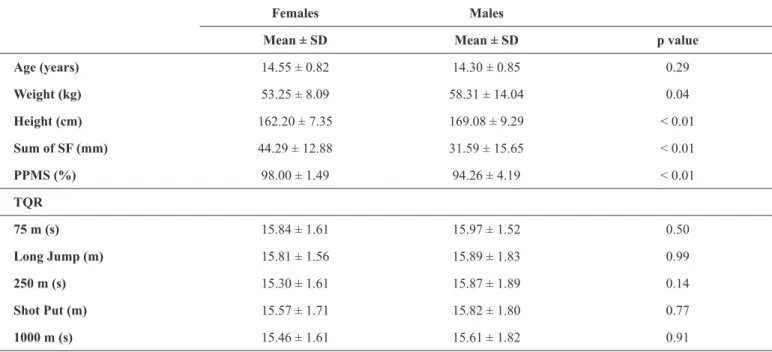
Table 2. Descriptive and Total Quality Recovery values of participants.
Females Males
Mean ± SD Mean ± SD p value
Age (years) 14.55 ± 0.82 14.30 ± 0.85 0.29
Weight (kg) 53.25 ± 8.09 58.31 ± 14.04 0.04
Height (cm) 162.20 ± 7.35 169.08 ± 9.29 < 0.01
Sum of SF (mm) 44.29 ± 12.88 31.59 ± 15.65 < 0.01
PPMS (%) 98.00 ± 1.49 94.26 ± 4.19 < 0.01
TQR
75 m (s) 15.84 ± 1.61 15.97 ± 1.52 0.50
Long Jump (m) 15.81 ± 1.56 15.89 ± 1.83 0.99
250 m (s) 15.30 ± 1.61 15.87 ± 1.89 0.14
Shot Put (m) 15.57 ± 1.71 15.82 ± 1.80 0.77
1000 m (s) 15.46 ± 1.61 15.61 ± 1.82 0.91
Statistical Analysis
The results of the descriptive statistics were reported as mean
and standard deviations (± SD). Parametric assumptions were assessed by the Shapiro-Wilk test and the Levene test. To compare the RPE-training session between males and females it was used Mann-Whitney test. The analysis of covariance was used to test the RPE-training session between genders, but controlling the biological maturity (covariate). The efect size of variables with signiicance diference the efect size was estimate. Statistical signiicance was set at p < 0.05.
Results
The table 2 presents descriptive characteristics of all athletes and TQR values. As expected females were more advanced biological maturity (PPMS) (p < 0.01). Other variables associate with BM
also had signiicance diference (weight, height and sum of SF). Regarding the recovery, during the all training session females and males reported “Good Recovery”, which refers of 15 score.
The igure 2 shows the mean of training intensity of each training session females males for both genders. The RPE-training
values for resistance of speed and endurance training sessions
had statistical diference (p = 0.006 and p = 0.044, respectively),
where females values were higher than males. Even when
Cruz R. & Alves D. L. & Azevedo R. & Bertuzzi R. & De-Oliveira F. R. & Lima J. P.
Discussion
Control the training intensity is essential to enhance performance.
In the present study, the comparison of RPE-training session between females and males indicated no diference on training 75-m, long jump and shot put. Otherwise, there were statistical diference for 250 and 1000-m training sessions, where females had higher RPE-training sessions values than males. Moreover, this diference persisted even when biological maturity efect was controlled. Additionally, there was no diference for recovery parameter by TQR. To the best of our knowledge, this is the irst study to consider speciic training sessions of track and ield and
compare the RPE-training sessions of male and female athletes.
Furthermore, it were considered the biological maturity on the analysis, controlling and prescribed the same training session for a large number of athletes (duration and exercise).
There are several studies demonstrating how the rating
of perceived exertion can be used to control the intensity of
exercise and training session 1,2,3,6,15. However, distinct results
have been reported when the comparison between the genders
are taken into account5,6. For example, di Fronso, Nakamura,
Bortoli, Robazza, Bertollo5 have indicated that female athletes have diferent perceived diferent of psychophysical stressors. On other hand, Lupo, Capranica, Cortis, Guidotti, Bianco,
Tessitore6 have not indicated diference on RPE training session
between genders during taekwondo training sessions. Our results demonstrated that training sessions of speed, jump and throw were not diferent between females and males, even controlling the BM. In accordance with our results of skin fold, we can to speculate that diference in RPE-training sessions of 250-m and 1000-m running was pronounced because the female athletes has more total body mass, which are not necessary muscle involved in mechanical work, this condition could cause more physical stress and therefore, higher values of RPE-training session.
The main diference for RPE-training sessions were the 250-meters and 1000 meters training sessions, which females
had higher values than males, as demonstrated by Kellmann, Altenburg, Lormes, Steinacker4. Additionally, have been specu
-lated that physiological signal is more pronounced in running exercises and then caused greater values of RPE-training ses-sion16. di Fronso, Nakamura, Bortoli, Robazza, Bertollo5 have
demonstrated that even with similar training session, female athletes perceive diferent the training stimulus and stress res -ponses. Considering the higher values for female athletes, the
recovery could be afected and the RPE-training session values. During the week of training, the parameters of recovery did not difer between male and female athletes, thus we believe that the intensity of training sessions and time between each session
allowed all athletes to have a good recovery. Furthermore, we speculated that only during high intense consecutive training
ses-sions could do diferent in recovery measure by TQR. Kellmann, Altenburg, Lormes, Steinacker4 demonstrated that female athletes indicated low recovery values in diferent parameters (sleep, feeding, age, and emotional factors/behavior/cognitive/social).
Despite the advances brought by our results, some limitations and suggestions for future studies could be considered, such as,
more training sessions of each disciple as well as greater and
lower intensities. As demonstrated by Impellizzeri, Rampinini, Marcora15 and Viru17, the intensity variability could cause pro
-nounced stress and it is important to understand how females and males feel the training stimulus. The practical analysis of
magnitude-based inference shown moderate and small efect size to 250-m and 1000-m training sessions, respectively. Even though, we suggest that RPE-training session could be used during track and ield training, specially during the training
sessions of resistance of speed and endurance.
Conclusions
In summary, the comparison the RPE-training session of females and males indicated there were no diference to training of 75-m,
recovery parameters, even controlling BM. Thus, RPE-training session and TQR can be used to controlling training intensity and recovery, respectively. However, more attention it is necessary to 250-m and 1000-m.
References
1. Borresen J, Lambert MI. The quantiication of training load, the training response and the efect on performance. Sport Med. 2009;39(9):779-95.
2. Foster C, Daines E, Hector L, Snyder AC, Welsh R. Athletic perfor -mance in relation to training load. Wis Med J. 1996;95(6):370-4. 3. Foster C, Heimann KM, Esten PL, Brice G, Porcari JP. Diferences
in perceptions of training by coaches and athletes. South African J Sport Med. 2001;8(2):3-7.
4. Kellmann M, Altenburg D, Lormes W, Steinacker JM. Assessing stress and recovery during preparation for the world champion-ships in rowing. Sport Psychol. 2001;15(2):151-67.
5. di Fronso S, Nakamura FY, Bortoli L, Robazza C, Bertollo M. Stress and recovery balance in amateur basketball players: Diferences by gender and preparation phase. Int J Sports Physiol Perform. 2013;8(6):618-22.
6. Lupo C, Capranica L, Cortis C, Guidotti F, Bianco A, Tessitore A. Session-RPE for quantifying load of diferent youth taekwondo training sessions. J Sports Med Phys Fitness. 2016; 57(3):189-94. 7. Figueiredo AJ, Coelho e Silva MJ, Malina RM. Predictors of
functional capacity and skill in youth soccer players. Scand J Med Sci Sports. 2011;21(3):446-54.
8. Malina RM, Bouchard C, Bar-Or O. Growth, Maturation, and Physical Activity. Champaign, Ill.: Human Kinetics Books; 2004. 9. Silva DRP, Fernandes RA, Ohara D, et al. Correlates of sports
practice, occupational and leisure‐time physical activity in Brazilian adolescents. Am J Hum Biol. 2016;28(1):112-7. 10. Kenttä G, Hassmén P. Overtraining and recovery. Sport Med.
1998;26(1):1-16.
11. MacDougall JD, Wenger HA, Green HJ. Physiological Testing of the High-Performance Athlete. Champaign, Ill.: Human Kinetics Books; 1991.
12. Khamis HJ, Roche AF. Growth outcome of“ normal” short chil -dren who are retarded in skeletal maturation. J Pediatr Endocrinol Metab. 1995;8(2):85-96.
13. Khamis HJ, Roche AF. Predicting adult stature without using skel -etal age: the Khamis-Roche method. Pediatrics. 1994;94(4):504-7. 14. Suzuki S, Sato T, Maeda A, Takahashi Y. Program design based
on a mathematical model using rating of perceived exertion for an elite japanese sprinter: acase study. J Strength Cond Res. 2006;20(1):36-42.
15. Impellizzeri FM, Rampinini E, Marcora SM. Physiological assess -ment of aerobic training in soccer. J Sports Sci. 2005;23(6):583-92. 16. Green JM, Crews TR, Bosak a M, Peveler WW. Overall and
diferentiated ratings of perceived exertion at the respiratory compensation threshold: efects of gender and mode. Eur J Appl Physiol. 2003;89(5):445-50.
Acknowledgments
The authors thank CAPES for scholarship and all teams and athletes of track and
ield for their participation.
Corresponding author
Ramon Cruz.
Address: Departamento de Esporte . Escola de Educação Física e Esporte da Uni
-versidade de São Paulo. Av. Prof. Melo de Morais, 65, Cidade Universitária, São Paulo, SP, CEP: 05371-140, Brazil.
Email: [email protected]
Manuscript received on May 3, 2017 Manuscript accepted on July 21, 2017