Ethanol-Induced Gastric Injury: Microscopic Analysis
of the Protective Effect of Frutalin
Ana Paula Vasconcellos Abdon•Renata Prado Vasconcelos •Carolina Arau´jo Castro• Marjorie Moreira Guedes•Adriana da Rocha Tome´• Andre´ Luiz Herzog Cardoso• Thiago de Melo Santiago•Luciana Magalha˜es Rebeˆlo• Renato de Azevedo Moreira• Ana Cristina de Oliveira Monteiro-Moreira•Adriana Rolim Campos
Accepted: 31 January 2014 / Published online: 16 February 2014 ÓSpringer Science+Business Media New York 2014
Abstract Obtained from breadfruit seeds (Artocarpus incisa), frutalin (FTL) has a range of important pharmaco-logical properties. FTL activates and modulates lympho-cytes and neutrophils and possesses gastroprotective effects. The purpose of this study was to evaluate the ability of FTL to protect the gastric mucosa of mice submitted to ethanol-induced gastric injury. The gastroprotective effect of fruta-lina was evaluated using a murine model of ethanol-induced gastric injury. Damage of the gastric mucosa was assessed morphologically by light, scanning electron and atomic force microscopy. Lymphocyte infiltration, necrosis, disruption of the mucosal structures and epithelial desquamation were observed in the control group. In the group pretreated with frutalina at 0.5 mg/kg, gastroprotection, reduced tissue damage and preserved submucosal and mucosal structures
were observed. In conclusion, FTL displayed gastroprotec-tive activity against ethanol-induced gastric injury, pre-venting the formation of gastric ulcer and reducing epithelial desquamation, glandular damage, mucosal necrosis and infiltration. The observed effects appear to be due to mech-anisms previously described for frutalin.
Keywords Artocarpus incisaFrutalin GastroprotectiveEthanol-induced gastric injury Microscopic analysis
Introduction
The gastric mucosa consists of different cell populations undergoing constant renewal. Mucosal integrity is main-tained by a balance between aggressive factors (such as pepsin and acid secretion) and a number of defense mechanisms (such as bicarbonate and mucus secretion and prostaglandin production) (Abdel-Salam et al. 2001).
Gastric ulcer may be caused by an array of external aggressive factors, including infection with Helicobacter pylori,indiscriminate use of NSAIDs, smoking and alcohol consumption (Abdel-Salam et al.2001).
Currently, gastric ulcer is treated with several classes of drugs, including antiacids, anticholinergic agents, proton pump inhibitors and H2-receptor antagonists. However, the
large number of adverse effects associated with these drugs indicates a need for safer and more effective anti-gastric ulcer agents (Vera-Arzave et al. 2012). More recently, research on metabolites derived from plants used in tradi-tional medicine has led to the discovery and development of novel therapeutic drugs (Sa´nchez-Mendoza et al.2011).
Phytogenic agents have traditionally been used by herbalists and indigenous healers for the prevention and A. P. V. AbdonR. P. VasconcelosC. A. Castro
R. A. MoreiraA. C. O. Monteiro-Moreira
A. R. Campos (&)
RENORBIO, University of Fortaleza (UNIFOR), Av. Washington Soares 1321, Fortaleza, Ceara´ CEP 60811-905, Brazil
e-mail: [email protected]
M. M. Guedes
Department of Physiology and Pharmacology, Federal University of Ceara´ (UFC), Fortaleza, Ceara´ 60430-270, Brazil
M. M. GuedesT. M. SantiagoL. M. Rebeˆlo
Department of Physics, Federal University of Ceara´ (UFC), Fortaleza, Ceara´ 60455-900, Brazil
A. R. Tome´
Veterinarian School, State University of Ceara´ (UECE), Fortaleza, Ceara´ 60740-000, Brazil
A. L. H. Cardoso
Science and Technology Center, State University of Ceara´ (UECE), Fortaleza, Ceara´ 60740-000, Brazil
treatment of peptic ulcer. Despite advances in the pro-duction of effective drugs by conventional chemistry and pharmacology, the plant kingdom remains a treasury of unexplored compounds with potential healing properties. Some of these compounds may be useful in the treatment of gastric ulcer or as dietary adjuncts to existing therapies (Borrelli and Izzo2000).
The breadfruit (Artocarpus incisa L.) is a common species of flowering tree found in tropical regions around the world. The fruit may be consumed roasted, baked, fried or boiled, but is generally cooked by local populations (Jagtap and Bapat2010). Frutalin (FTL), ana-D -galactose-binding lectin purified from A. incisa seeds, shares many structural characteristics with other galactose-binding
Artocarpuslectins, such as jacalin (A. integrifolia), a well-known specific ligand of IgA1 and C1 inhibitors (Brando-Lima et al. 2005). Unlike most other lectins, FTL has a rather broad specificity and interacts with galactose and other sugars, such as mannose (Moreira et al. 1998). Physico-chemical and biological studies found higher lev-els of hemagglutinating activity for FTL than for jacalin. In addition, FTL is a potent human lymphocyte stimulator (Campana et al.2002).
In a previous study, FTL was found to be gastropro-tective against gastric mucosal injury induced by ethanol and indomethacin. The observed gastroprotection to some extent involves the activation of capsaicin-sensitive gastric afferents, stimulation of endogenous prostaglandins and nitric oxide (NO), and the opening of KATP
?
channels (Abdon et al.2012).
The purpose of this study was to evaluate the ability of FTL to protect the gastric mucosa of mice submitted to ethanol-induced gastric injury.
Materials and Methods
Animals
Male Swiss albino mice (20–25 g) were obtained from the experimental animal facility of the University of Fortaleza (UNIFOR). The animals were housed under environmen-tally controlled conditions (22°C, 12-h light/dark cycle), with free access to standard pellet diet (Purina, Sa˜o Paulo, Brazil) and water. The cages were fitted with raised mesh bottoms to prevent coprophagy. Prior to the experiment, the mice were fasted for 12 h. The experimental protocols were in accordance with the ethical guidelines of the Brazilian Council for the Control of Animal Experiments (CONCEA) and were approved by the Animal Research Ethics Committee of the State University of Ceara´, under entry #08476547-0.
Frutalin Purification
Highly purified lectin was obtained from breadfruit seeds as described elsewhere (Moreira et al. 1998). Briefly, the seeds were dried, ground and immersed in phosphate buffer solution [pH 7.4 phosphate-buffered saline (PBS)] at 1:10 w/v. The solution was stirred for 6 h at 4°C, then centri-fuged for 20 min (1,5009g/4°C). The supernatant was ultrafiltrated through a YM10 membrane to half its original volume. FTL (MW 44 kDa) was purified from this crude extract on a sepharose–D-galactose column eluted with 0.2 MD-galactose in PBS. After extensive dialysis against water, the eluted material was lyophilized and stored at
-20°C. Just before use, FTL was dissolved in sterile PBS, pH 6.8. The protein concentration was determined with Bradford’s method and purity was confirmed by the pre-sence of only two bands (15.5 and 12 kDa) following SDS-PAGE.
Pretreatment and Ethanol-Induced Gastric Injury
The mice were randomly assigned to 5 groups of 8 animals each for pretreatment with either saline solution, cimeti-dine or FTL 30 min prior to induction of gastric injury by oral administration of absolute ethanol (96 %, 0.2 mL/ animal) (Robert et al. 1979):
Group A: Pretreatment with saline solution (0.9 % NaCl, 10 mL/kg, p.o.)
Group B: Pretreatment with cimetidine (100 mg/kg, p.o.)
Group C: Pretreatment with FTL (0.25 mg/kg, i.p.) Group D: Pretreatment with FTL (0.5 mg/kg, i.p.) Group E: Pretreatment with FTL (1 mg/kg, i.p.) Thirty minutes after induction of gastric injury, the animals were euthanized and the stomachs were excised, opened along the greater curvature and rinsed with saline solution (0.9 % NaCl).
Light Microscopy
Scanning Electron Microscopy (SEM)
Tissue samples were washed gently with PBS and fixed in 3 % glutaraldehyde overnight at 4°C, then washed in 0.1 M cacodylate buffer (pH 7.3) and post-fixed with 1 % osmium tetroxide in cacodylate buffer. After another wash in buffer, the samples were immersed in 2 % tannic acid in cacodylate buffer, washed in water and fixed again in 1 % osmium tetroxide in water, followed by dehydration through increasing alcohol gradients (25–100 %). The dehydrated samples were then submitted to critical point drying, mounted on aluminum stubs, coated with a thin layer of gold using a Polaron-ES 100 sputter-coating apparatus and examined in a SEM (Johnson et al.1983).
Atomic Force Microscopy (AFM)
Samples for AFM analysis were prepared following the same procedure described above for light microscopy, except for a slight modification in section thickness (5lm). The samples were analyzed in a Nanoscope III AFM (Digital Instruments) operating in tapping mode, using TESP7 silicon nitride tips (Veeco NanProbe). The resolu-tion was set to 5129512 pixels. The images were
pro-cessed with the Nanoscope software (v. 5.12.r3) and further analyzed with the software Image-Pro Plus 4.5 (Media Cybernetic) (Deacon et al.2000).
Results
Light Microscopy
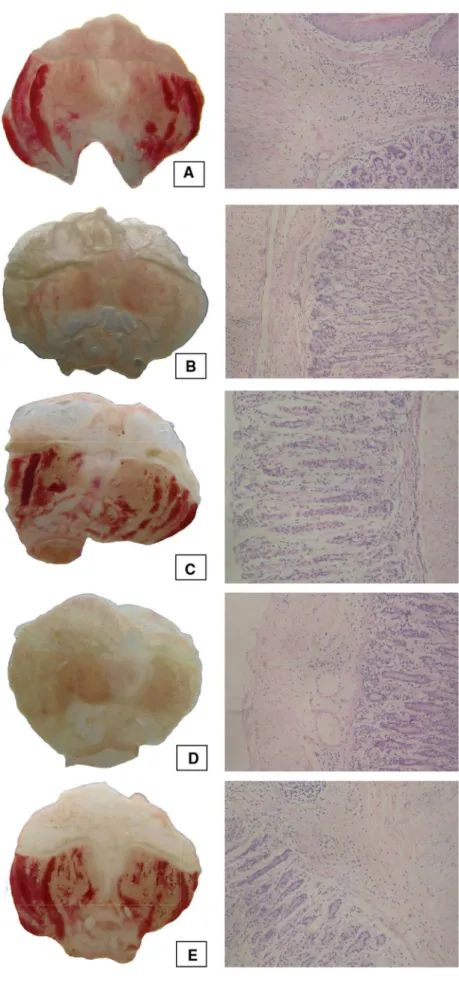
Figure1 shows light micrographs of the mucosa 30 min after administration of 0.2 mL absolute ethanol. The ani-mals in Group A (negative control) presented intense lymphocyte infiltration, epithelial desquamation and edema. In addition to these symptoms, the animals in Group C and E presented necrosis and disruption of the gastric mucosa.
However, the animals in Group B (positive controls) (Fig.1b) and Group D (Fig.1d) had preserved mucosa and reduced levels of lymphocyte infiltration and edema, indicating a significant gastroprotective effect.
Scanning Electron Microscopy (SEM)
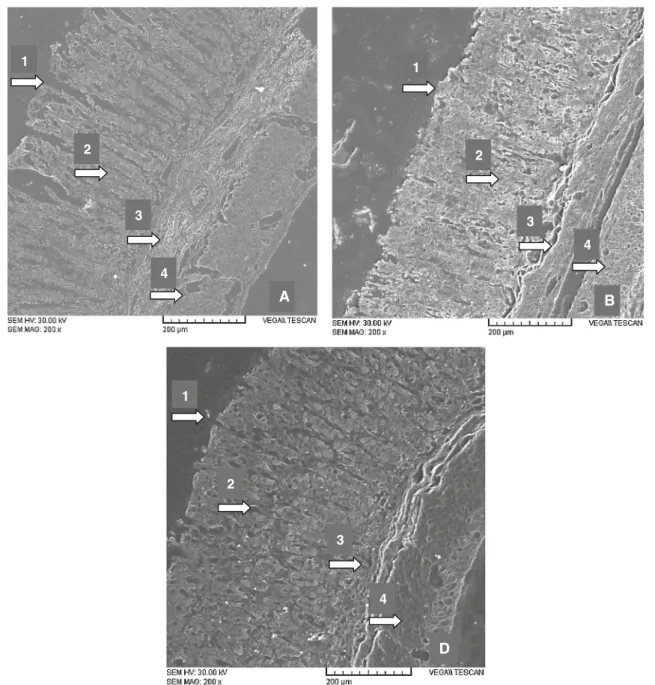
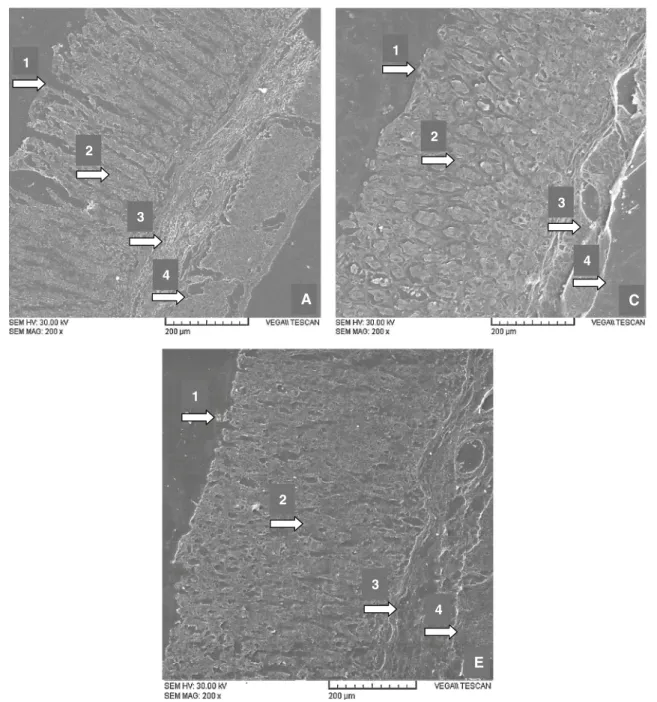
SEM confirmed the light microscopy findings while allowing a more detailed visualization of the glandular lesions. In Group A (Fig.2a), necrosis, submucosal edema, vasodilation (hypoechoic image) and disruption of collagen fibers were observed.
Pretreatment with cimetidine (Group B, Fig.2b) and FTL at 0.5 mg/kg (Group D, Fig.2d) reduced injury and preserved the mucosal and submucosal structures.
Pretreatment with FTL at 0.25 mg/kg (Group C, Fig.3c) and 1 mg/kg (Group E, Fig.3e) had no protective effect when compared to Group A (Fig. 3a). Disruption of the connective tissue and vascular proliferation were observed on SEM.
Atomic Force Microscopy (AFM)
The results of light and SEM were confirmed by AFM. In the AFM analysis, the animals in Group A presented dis-ruption of submucosal layers and collagen fibers, edema and loss of epithelium and villi (Fig. 4a).
The analysis also confirmed the integrity of epithelial and connective tissues in Group B (Fig.4b) and Group D (Fig.4d), suggesting a gastroprotective effect of pretreat-ment with, respectively, cimetidine and FTL at 0.5 mg/kg.
Discussion
Lectins are glycoproteins with numerous and important applications in biochemistry, cell biology and medicine (Rudiger and Gabius 2001). Frutalin, a lectin extracted from the seeds of A. incisa, appears to be no exception.
In this study, the gastroprotective effects of FTL were evaluated histologically using a model of ethanol-induced gastric injury. Only two of the five pretreatments (FTL at 0.5 mg/kg and cimetidine, a histamine receptor antagonist) had gastroprotective effects. The findings of the histolog-ical analysis support the results of previous studies in which FTL was found to be highly gastroprotective against injury induced by ethanol and indomethacin. The observed gastroprotection appears to involve the activation of cap-saicin-sensitive gastric afferents, stimulation of endoge-nous prostaglandins and NO, and the opening of KATP
?
channels (Abdon et al.2012).
In vivo ethanol-induced injury of the gastric mucosa may lead to surface epithelial exfoliation with loss of barrier, transport, and electrical functions, and hemorrhagic necrosis of the deeper mucosal layers, including progenitor and glandular cells (Tarnawski et al. 1985b; Tamawski et al. 1987). The endothelial cells are damaged within minutes of exposure, resulting in microvascular stasis. The latter is believed to be an important mechanism responsible for deep mucosal necrosis following challenge with ethanol (Szabo et al.1985; Tarnawski et al.1985a).
cellular exfoliation and inflammatory cell infiltration (Matsuhashi et al.2007).
Our histological findings confirmed the gastroprotective effect of FLT on the gastric mucosa of mice, suggesting cytoprotective action. In an earlier macroscopic analysis (Abdon et al. 2012), FTL afforded non-dose-related gas-troprotection against ethanol-induced injury.
Three-dimensional high-resolution images of the stom-ach made with SEM and AFM are very useful in the evaluation of surface tissue structures. These techniques
have over the past two decades become indispensable tools in a number of health-related areas. For example, phar-macological research on new drugs requires extensive knowledge of the mechanisms, toxicity and microstructural aspects involved in order to understand the interaction between drugs and target tissues, especially the mucosa (Deacon et al. 2000).
The microscopic capabilities of SEM and AFM allowed to observe the microstructure of the stomach surface exposed to ethanol and confirm the gastroprotective effect 1
2
3
4
A B
1
2
3
4
D 1
2
3
4
Fig. 2 Histological analysis by scanning electron microscopy (SEM) of gastric tissues in a model of ethanol-induced gastric injury. Magnification9200. Images showing specific stomach cells.1gastric pits,2 mucosal layer,3 submucosal layer,4 muscle layer (smooth
of pretreatment with FTL, as previously described by Ab-don et al. (2012).
In the present study, administration of FTL at 0.5 mg/kg significantly reduced gastric injury, preventing damage (lymphocyte infiltration, necrosis, desquamation and dis-ruption of the mucosal layers and collagen fibers) other-wise observed in control group. FTL produced a biphasic trend, with decreasing gastroprotection in higher dose. This may reflect that FTL have two different and opposed actions or partial agonist activity at their receptors (Kekesi et al.2004). A similar result was found by Figueiredo et al.
(2009). They demonstrated that the lectin Cbol, from (Canavalia bolivianaseeds) presented a bell-shaped curve in the second phase of formalin test.
The gastroprotective effect of FTL involves multiple factors acting on the gastric microcirculation and cyto-protection promoted through the activation of capsaicin (TRPV)-sensitive gastric afferents, the stimulation of endogenous prostaglandins and NO, and the opening of KATP
?
channels (Abdon et al.2012).
The stimulation of gastric capsaicin receptors (TRPV1) leads to the release of substance P, somatostatin and 1
2
3
4
A C
1
E 1
2
3
4 2
3
4
Fig. 3 Histological analysis by scanning electron microscopy (SEM) of gastric tissues in a model of ethanol-induced gastric injury. Magnification9200. Images showing specific stomach cells.1gastric
calcitonin gene-related peptide (CGRP) and to the inhibi-tion of gastrin producinhibi-tion. The TRPV1-expressing nerve fibres are activated when the protective mucus barrier is disrupted and acid comes into contact with the lamina propria. This activation releases CGRP and NO, thereby promoting mucosal hyperemia and facilitating the activa-tion of other defense mechanisms, such as bicarbonate secretion and inhibition of gastric acid secretion (Guedes et al.2008).
The mechanisms of gastric self-protection depend on adequate blood flow due to the intense metabolic activity and the oxygen needs of the gastric mucosa. Therefore, an increase in blood flow following disruption of the protec-tive barrier and retrodiffusion of H?
ions to the mucosal cells is of utmost importance (Maity et al. 2003). The control of gastrointestinal blood flow is largely attributed to the action of endogenous prostaglandins (Funatsu et al. 2007), but prostaglandins also help maintain the integrity of the gastric mucosa by inhibiting acid secretion, stimu-lating mucus and bicarbonate secretion, inhibiting
mastocyte activation, reducing leucocyte adherence to the vascular endothelium and inhibiting apoptosis (Batista et al.2004).
In addition, NO plays an important role in gastrointes-tinal defense because of its ability to increase mucosal blood flow, produce mucus and inhibit the adherence of neutrophils to endothelial cells (Coruzzi et al.2000).
Using SEM and AFM, desquamation of the collagen of the gastric epithelium induced by exposure to ethanol was observed in control group but not in pretreated with FTL (0.5 mg/kg). Collagen helps support the epithelial cells of the gastric mucosa during acute injury. Thus, an increase in mucosal collagen can enhance resistance against lesion progression (Arisawa et al.2006).
Apart from these mechanisms, recent studies based on different models of gastric injury have revealed reactivity to neutrophils, excessive recruitment and metabolic acti-vation (Fialkow et al.2007). Thus, FTL has been shown to promote neutrophil migration, induce chemotaxis and trigger oxidative burst. These effects are believed to favor Fig. 4 Histological analysis by atomic force microscopy (AFM) of gastric tissues in a model of ethanol-induced gastric injury. Magnification
FTL-promoted gastroprotective activity (Brando-Lima et al.2005).
A number of studies have evaluated the ability of anti-oxidants to protect the gastric mucosa in gastric ulcer models (Potrich et al.2010), but antioxidant activity is not likely to have played a role in the gastroprotection observed in the present study. In fact, in a previous study, FTL displayed no antioxidant activity, based on glutathione and malondialdehyde measurements (Abdon et al.2012).
Conclusion
In conclusion, FTL displayed gastroprotective activity against ethanol-induced gastric injury, preventing the for-mation of gastric ulcer and reducing epithelial desquama-tion, glandular damage, mucosal necrosis and infiltration. The observed effects appear to be due to mechanisms previously described for frutalin.
Acknowledgments The authors would like to thank CNPq, Funcap and Fundac¸a˜o Edson Queiroz for financial support.
Conflict of interest The authors report no conflicts of interest.
References
Abdel-Salam OME, Czimmer J, Debreceni A et al (2001) Gastric mucosal integrity: gastric mucosal blood flow and microcircu-lation. An overview. J Physiol Paris 95:105–127
Abdon APV, Coelho de Souza G, Coelho de Souza LN et al (2012) Gastroprotective potential of frutalin, a D-galactose binding lectin, against ethanol-induced gastric lesions. Fitoterapia 83:604–608
Arisawa T, Shibata T, Kamiya Y et al (2006) Effects of sucralfate, cimetidine and rabeprazole on mucosal hydroxyproline content in healing of ethanol–HCL-induced gastric lesions. Clin Exp Pharmacol Physiol 33:628–632
Batista LM, Almeida AB, Pietro ML et al (2004) Gastric antiulcer activity ofSyngonanthus arthrotrichusSilveira. Biol Pharm Bull 27:328–332
Borrelli F, Izzo AA (2000) The plant kingdom as a source of anti-ulcer remedies. Phytother Res 14:581–591
Brando-Lima AC, Saldanha-Gama RF, Henriques MGMO et al (2005) Frutalin, a galactose-binding lectin, induces chemotaxis and rearrangement of actin cytoskeleton in human neutrophils: involvement of tyrosine kinase and phosphoinositide 3-kinase. Toxicol Appl Pharmacol 208:145–154
Campana PT, Moraes DI, Monteiro-Moreira ACO et al (2002) Unfolding and refolding studies of frutalin, a tetrameric D -galactose binding lectin. Eur J Biochem 269:753–758
Coruzzi G, Adami M, Morini G et al (2000) Antisecretory and gastroprotective activities of compounds endowed with H2 antagonistic and nitric oxide (NO) donor properties. J Physiol Paris 94:5–10
Deacon MP, Mcgurk S, Roberts CJ et al (2000) Atomic force microscopy of gastric mucin and chitosan mucoadhesive systems. Biochemistry 384:557–563
Fialkow L, Wang Y, Downey GP (2007) Reactive oxygen and nitrogen species as signaling molecules regulating neutrophil function. Free Radic Biol Med 42:153–164
Figueiredo JG, Bitencourt FS, Beserra IG et al (2009) Antinociceptive activity and toxicology of the lectin fromCanavalia boliviana seeds in mice. Naunyn Schmiedebergs Arch Pharmacol 380:407–414
Funatsu T, Chono K, Hirata T et al (2007) Mucosal acid causes gastric mucosal microcirculatory disturbance in nonsteroidal anti-inflammatory drug-treated rats. Eur J Pharmacol 554:53–59 Guedes MM, da Carvalho AC, Lima AF et al (2008) Gastroprotective mechanisms of centipedic acid, a natural diterpene fromEgletes viscosaLESS. Biol Pharm Bull 31:1351–1355
Jagtap UB, Bapat VA (2010) Artocarpus: a review of its traditional uses, phytochemistry and pharmacology. J Ethnopharmacol 129:142–166
Johnson AP, Clark JB, Osborn MF (1983) Scanning electron microscopy of the interaction betweenHaemophilus influenzae and organ cultures of rat trachea. J Med Microbiol 16:477–482 Kekesi G, Joo G, Csullog E et al (2004) Dose-independent antinociceptive interaction of endogenous ligands at the spinal level. Brain Res 1029:93–102
Maity P, Biswas K, Roy S et al (2003) Smoking and the pathogenesis of gastroduodenal ulcer—recent mechanistic update. Mol Cell Biochem 253:329–338
Matsuhashi T, Otaka M, Odashima M et al (2007) Protective effect of a novel rice extract against ethanol-induced gastric mucosal injury in rat. Dig Dis Sci 52:434–441
Moreira RA, Castelo-Branco CC, Monteiro AC et al (1998) Isolation and partial characterization of a lectin fromArtocarpus incisaL. seeds. Phytochemistry 47:1183–1188
Potrich FB, Allemand A, Silva LM et al (2010) Antiulcerogenic activity of hydroalcoholic extract of Achillea millefolium L.: involvement of the antioxidant system. J Ethnopharmacol 130:85–92
Robert A, Nezamis JE, Lancaster C et al (1979) Cytoprotection by prostaglandins in rats: prevention of gastric necrosis produced by alcohol, HCl, NaOH, hypertonic NaCl and thermal injury. Gastroenterology 77:433–443
Rudiger H, Gabius HJ (2001) Plant lectins: occurrence, biochemistry, functions and applications. Glycoconj J 18:189–613
Sa´nchez-Mendoza ME, Reyes-Ramı´rez A, Cruz Antonio L et al (2011) Bioassay-guided isolation of an anti-ulcer compound, Tagitinin C, from Tithonia diversifolia: role of nitric oxide, prostaglandins and sulfhydryls. Molecules 16:665–674 Silva MS, Almeida ACA, Farias FM et al (2010) Abarema
cochliacarpos: gastroprotective and ulcer-healing activities. J Ethnopharmacol 132:134–142
Szabo S, Trier JS, Brown A et al (1985) Early vascular injury and increased vascular permeability in gastric mucosal injury caused by ethanol in the rat. Gastroenterology 88:228–236
Tamawski A, Hollander D, Stachura J et al (1987) Alcohol injury to the normal human gastric mucosa: endoscopic histologic and functional assessment. Clin Invest Med 10:259–263
Tarnawski A, Hollander D, Gergely H (1985a) Ethanol-induced gastric mucosal injury: sequential analysis of morphologic and functional changes. Gastroenterol Clin Biol 9:88–92
Tarnawski A, Hollander D, Stachura J et al (1985b) Prostaglandin protection of the gastric mucosa against alcohol injury, a dynamic time-related process. Role of the mucosal proliferative zone. Gastroenterology 89:366–374