236 EALR, V.10, nº 3, p.236-249, Set-Dez, 2019
Economic Analysis of Law Review
Effects Of Monetary Sanctions On Behavior: Evidence From Library Fines
Efeitos das Sanções Monetárias no Comportamento: Evidências das Multas da BibliotecaMatheus Albergaria1
Fundação Escola de Comércio Álvares Penteado (FECAP)
RESUMO
Discussões comparando multas e aprisionamento sugerem que, sob certas condições, as primeiras podem ser preferíveis em relação ao último tipo de sanção, principalmente em termos de eficiência econômica. O presente artigo contribui para este debate, ao avaliar as respostas comportamentais de indivíduos a sanções monetárias em um novo ambiente: uma biblioteca universitária. Especificamente, o artigo estuda o comportamento dos usuários de uma biblioteca durante um período de dez anos (2005-2015), cobrindo mais de 800.000 transações diárias. Neste caso, buscamos responder à seguinte pergunta: como a introdução de uma sanção monetária afeta o comportamento observado? Ao explorar a variação ocorrida na introdução de uma sanção monetária na biblioteca, constatamos que a multa reduziu os atrasos dos usuários, conforme previsto por modelos econômicos convencionais de cumprimento da lei. Entretanto, ao analisar os efeitos dinâmicos de tal introdução, constatamos que a multa perdeu eficácia ao longo do tempo, uma vez que seu valor nominal permaneceu o mesmo após sua instauração. Os resultados reportados neste artigo têm importantes implicações para o desenho de sistemas de sanções, ao mesmo tempo em que lançam luz sobre questões relacionadas, como incentivos, normas sociais e corrupção em ambientes reais.
ABSTRACT
Discussions comparing fines and imprisonment suggest that, under certain conditions, the former might be preferred over the latter, especially in terms of economic efficiency. The present paper contributes to this debate by studying the behavioral responses to monetary sanctions in a unique field setting: a university library. I study the behavior of library users during a ten-year period (2005-2015), covering more than 800,000 daily transactions. In doing so, I want to answer the following question: how does the introduction of a monetary sanction affect observed behavior in this specific setting? By exploiting variation in the introduction of a monetary sanction (fine) in the library, I find that such an introduction reduced users’ delays, as predicted by standard models of law enforcement. However, when analyzing the dynamic effects of such an introduction, I find that the fine lost efficacy over time, since its nominal value remained the same after its instauration. These results not only have important implications for the design of sanctioning systems, but they also shed light on related issues, such as incentives, social norms, and corruption in real-world settings.
Palavras-chave: execução; multas; direito e economia. Keywords: enforcement; fines; law and economics.
JEL: C33, C93, H41, K42 R: 12/12/19 A: 14/12/19 P: 31/12/19
EALR, V.10, nº 3, p.236-249, Set-Dez, 2019 237
Universidade Católica de Brasília – UCB Brasília-DF
1. Introduction
ne important discussion in the field of law and economics focus on the merits of alternative ways to deter illicit behavior. The classical economic model of crime predicts that, either monetary sanctions – such as fines – or imprisonment, can work as a deterrence factor for illicit activities (Becker, 1968; Stigler, 1974). While most contributions in the economics literature focused on the deterrent effects of imprisonment (Di Tella & Schargrodsky, 2004; Kline, 2012), the tradeoff among distinct types of punishment has received far less attention (Piehl & Williams, 2011). In fact, discussions comparing fines and imprisonment suggest that, under certain conditions, the former might be preferred over the latter, especially in terms of economic efficiency, since they correspond to mere transfers of money across society (Polinsky & Shavell, 2000).
The present paper presents novel evidence related to the effects of fines in a field setting. I study the behavior of users in a university library during a ten-year period (2005-2015), covering more than 800,000 daily transactions. In doing so, I want to answer the following question: how does the introduction of a monetary sanction affect behavior in this specific setting? I exploit variation in the introduction of a monetary sanction (fine) in the library in a specific year to uncover a causal effect of such a sanction over user behavior. Before 2006, the library studied in this paper had a sanctioning system based on nonmonetary sanctions (daily suspensions) for all of its users. After this period, the library started charging monetary sanctions (fines) for students with late items, while maintaining a nonmonetary sanction for professors and university employees. One particular advantage of this setting is that the change in the type of sanction was not the same for all library users. This unique feature of the data allows me to employ a difference-in-differences research design in order to evaluate the effects of the policy implemented by the library. In this case, the identification condition is that, in the absence of treatment, both groups – control and treatment – would display similar trends over time.
I uncover three main results. First, in aggregate terms, the instauration of a monetary sanction in the library reduced users’ delays, as predicted by standard law enforcement models. Second, there was considerable heterogeneity in the deterrent effects of such a sanction: when looking at specific categories of users as well as distinct areas of study, I find remarkably different magnitudes of the effects of fines. Third, since the nominal value of the fine remained the same (R$ 2.00) during a ten-year period (2006/2015), this specific type of sanction lost efficacy over time. I report estimates of the dynamic effects of fines, which suggest that the fine deterred illicit behavior in the short run, only. While these results corroborate some of the main predictions derived from standard economic models, I explore possible related mechanisms, which could explain the behavioral response of users over time.
The remainder of the paper proceeds as follows. Section 2 presents a brief discussion of the related literature, as well as this paper’s main contributions. Section 3 describes the data and research design employed in the empirical analysis below. Section 4 reports the main empirical results. Finally, section 5 concludes.
2. Related Literature
There is not a clear consensus among economists, legal scholars and psychologists in terms of the superiority of monetary sanctions over other forms of punishment. For instance, there exists
238 EALR, V.10, nº 3, p.236-249, Set-Dez, 2019 some evidence from laboratory experiments suggesting that different types of punishment can affect behavior through distinct channels (Fehr & Gächter, 2000; Masclet, Noussair, Tucker, & Villeval, 2003)2. In terms of field settings, the available evidence presents mixed results. In a famous
study, Gneezy and Rustichini (2000a) uncovered a result in which the institution of fines in daycare centers in Israel would actually increase the number of late-incoming parents, instead of decreasing it. According to the authors, this result is a consequence of contracts’ incompleteness. On the other hand, most previous contributions suggest that fines can deter illicit behavior, as predicted by standard models of law enforcement. When reporting the results of a study analyzing the impacts of personal experience with fines faced by video-rental store customers during a two-year period, Haselhuhn, Pope, Schweitzer, and Fishman (2012) conclude that monetary fees boost users’ compliance. Bar-Ilan and Sacerdote (2004) report the results of a series of field experiments in the United States and Israel where traffic violations decrease in response to higher fines and the probability of being caught, as predicted by Becker’s (1968) economic model of crime.
This paper dialogues with several literatures. First, the results presented here corresponds to an empirical analysis related to the public enforcement of law, a situation in which victims may not know who is injuring them. In such situations, the imposition of monetary fines may be a preferred option when compared to incapacitation (Polinsky & Shavell, 2000). In this sense, the present paper contributes to a growing literature discussing the desirability of fines as an efficient means to punish illicit behavior (Gneezy & Rustichini, 2000a; Piehl & Williams, 2011). Specifically, the results here presented complement previous empirical analyses focused on the impacts of fines, such as Agarwal et al. (2013), Bar-Ilan and Sacerdote (2004), Fisman and Miguel (2007), and Haselhuhn et al. (2012). However, contrarily to these papers, the present setting allows me to study the causal effects of the instauration of a monetary sanction. By exploiting variation in the imposition of fines over time for distinct groups of users, I am able to uncover a causal effect of fines over illicit behavior. Additionally, the focus on the dynamic effects of the fine represents an innovation when compared to previous studies, which focused on shorter periods of time (Bar-Ilan & Sacerdote, 2004; Donna & Espín-Sánchez, 2015).
Second, this paper’s results also relate to contexts in which agents might value nonmonetary factors, such as customs or social norms, making the instauration of monetary sanctions a less effective instrument to deter certain behaviors (Acemoglu & Jackson, 2017; Bénabou & Tirole, 2006, 2011; Ellingsen & Johannesson, 2007). In fact, there are situations where, due to contracts’ incompleteness, agents may interpret monetary sanctions as a price to pay for additional goods and services. In such situations, monetary sanctions may actually backfire (Gneezy, Meier, & Rey-Biel, 2011; Gneezy & Rustichini, 2000a). The present paper contributes to this research, by comparing the behavioral responses of agents subject to distinct types of sanctions in a field setting.
Finally, the paper’s findings relate to the literature in social dilemmas, such as common-pool resources’ management, for instance (Hardin, 1968; Ostrom, 1999). While most of the previous contributions in the literature emphasized examples related to environmental themes such as forests, fisheries, and wildlife in general (Fehr & Leibbrandt, 2011; Rustagi, Engel, & Kosfeld, 2010; Zylbersztajn, 2010), I present an example related to an information commons, a library (Hess & Ostrom, 2007). As far as I know, this is probably the first attempt to study the effects of monetary sanctions in a specific type of common-pool resource, an information commons. In this sense, the present paper contributes to understanding the impacts of distinct sanctions over behavior, with an emphasis on social dilemmas involving collective action.
2 Gneezy, Meier, and Rey-Biel (2011) and Kamenica (2012) discuss the importance of monetary and non-monetary
EALR, V.10, nº 3, p.236-249, Set-Dez, 2019 239
Universidade Católica de Brasília – UCB Brasília-DF
3. Data And Method
3.1. Institutional Background and Data
In this paper, I study the behavior of library users covering more than 800,000 transactions during a 10-year period (2005-2015). I have access to confidential daily data related to library users of a private university in São Paulo, Brazil, for the 2005-2015 period. The data contain detailed information on 17,498 individual users, covering more than 800,000 daily transactions. This corresponds to an unbalanced panel, since each library user may borrow different numbers of specific library items at distinct moments. For instance, one user might borrow two books on March 1st, and then borrow one more book on March 3rd, before returning previous items. The
data is available in electronic format through a system named Pergamum (https://www.pergamum.pucpr.br), which provides technology services for several libraries in Brazil.
The main advantage of studying the 2005-2015 period is that I am able to investigate the dynamic effects of the instauration of a monetary sanction over time. However, since the data begins in 2005, I do not have additional data to test for pre-treatment behavior. This is the reason why I focus on the 2005 year when evaluating pre-policy events. Since I am interested in the immediate effects of the monetary sanction, I focus the analysis on the 2005-2006 period. The data contain information on users’ socioeconomic characteristics – such as gender, date of birth, and address – as well as library’s confidential information, with each user’s identification number, university category (high school, undergraduate, master’s, MBA, former student, professor, and employee) and area of study (management, accounting, economics, international relations, advertising, and secretariat). For each user in the data, I am able to identify her department and category. The data also contain the dates when each user borrowed specific items from the library, as well as each item’s code, and title. Based on each title, I am able to build a measure of area of expertise for each book in the sample, such as management, accounting, economics, and law.
I also have access to the library’s official yearly reports. These reports contain rich institutional information related to the library’s internal workings over the 2005-2015 period (Choi, 2016). Based on this information, I am able to estimate the predicted devolution date for each user in the sample. In this specific case, the library’s electronic system imposes a rule of 15 days for professors and masters’ students, and seven days, for all other users. Each user can renew books after the predicted devolution date expires, conditional on a waiting list managed by library staff. Although I do not have access to information on such lists’ content, I can observe when users renew library items by comparing the dates of borrowings of the same item over time. There are also differences in terms of the number of items that each user can borrow from the library: while professors and masters’ students can borrow a maximum limit of seven items, students can borrow a maximum of five, while university employees can borrow three items, only. This information allows me to build additional performance measures for each user in the sample, such as the number of items that she borrows every time she goes to the library, as well as measures of delays over time (equal to the difference between the predicted and effective devolution dates for each item borrowed). I also build measures for early returns (in the case of users who return books before the predicted date), and books’ usage (equal to the number of times that users pick a specific book). Finally, I complement the data with official calendar information related to exams’ weeks occurred in the university over time.
240 EALR, V.10, nº 3, p.236-249, Set-Dez, 2019
4. RESULTS 4.1. Main Results
The main empirical challenge in the present setting is to find an appropriate counterfactual, that is, a control group that would present behaviors consistent with the behavior of the treatment group, given the absence of the institutional change in the library. I try to circumvent this difficulty by considering as the treatment group users who suffered any kind of sanction (nonmonetary or monetary) during the entire sample period. For instance, users who present delays over time suffered either a nonmonetary sanction (daily suspension) in the pre-policy period or a monetary sanction (fine), afterwards. On the other hand, the control group corresponds to users who did not suffer any sanction. Initially, I exclude professors and employees from the treatment and control groups, since these categories were not subject to monetary sanctions in either period. It is worth noting that the latter categories present specific characteristics that make difficult comparisons to groups containing students. I return to these groups below, when presenting placebo tests for the identification condition used in the paper. Table 1 presents summary statistics for selected variables for both groups in the pre-policy period (the 2005 year):
Table 1
Descriptive Statistics – Pre-Policy Period (2005)
VARIABLE Control Group Treatment Group Total Sample
Age 25.56 (7.11) 24.40 (5.82) 25.13 (6.68) Female 0.55 (0.50) 0.56 (0.50) 0.55 (0.50) First Year 0.29 (0.45) 0.31 (0.46) 0.29 (0.46) Predicted Duration 8.02 (2.67) 7.05 (0.62) 7.66 (2.20) Business Book 0.35 (0.48) 0.34 (0.47) 0.34 (0.48) Accounting Book 0.12 (0.33) 0.12 (0.33) 0.12 (0.33) Economics Book 0.16 (0.37) 0.17 (0.38) 0.16 (0.37) Observations 39,522 23,271 62,793
Source: author’s calculations, based on library data. Notes: (a) Standard errors reported in parentheses.
The table’s first and second columns display results for the control and treatment group, respectively. The third column contains results for the total sample (treatment + control) during the pre-policy period. A visual inspection of the results in the table suggests that both groups (treatment and control) present very similar characteristics in the period before the instauration of a monetary sanction in the library. The only exception is for each group’s predicted duration. At first, this result may reflect compositional differences between the groups, since distinct user categories face different limits in terms of predicted duration.
I present the results of difference-in-differences estimations of equation (1) in Table 2. In this case, the dependent variable corresponds to the proportion of delays above average in the period. I progressively add covariates to the specifications in the table in order to control for fixed-effects that might bias the resulting estimates, a common practice in studies of this kind.
EALR, V.10, nº 3, p.236-249, Set-Dez, 2019 241
Universidade Católica de Brasília – UCB Brasília-DF
Effects of Fines over Probability of Delays
(1) (2) (3) (4) (5)
VARIABLES Prob.(Late) Prob.(Late) Prob.(Late) Prob.(Late) Prob.(Late)
DiD Coefficient -0.01 -0.03 -0.03 -0.04** -0.04**
(0.023) (0.022) (0.022) (0.017) (0.017)
Academic Year Fixed Effects No Yes Yes Yes Yes
Book Fixed Effects No No Yes Yes Yes
User Fixed Effects No No No Yes Yes
Time Trends No No No No Yes
Mean Dep. Variable 0.233 0.233 0.233 0.233 0.233
Observations 128,156 128,156 128,156 128,156 128,156
Adj. R-squared 0.467 0.511 0.511 0.515 0.516
Source: author’s calculations, based on library data.
Notes: (a) The dependent variable in the specifications corresponds to the probability of higher than average delays in the library. (b) Standard errors clustered by course (reported in parentheses). (c) “Academic Year Fixed Effects” correspond to a set of dummies for 6 days of the week, 51 weeks of the year and the 2006-year. (d) “Book fixed effects” correspond to a set of dummies for books’ area of study (business, accounting, economics, and law). (d) “User fixed effects” correspond to a set of dummies for users’ group ages (14-17, 18-23, 24-30, 31-40, 41-50, 51-60, 60+), category (high school student, undergraduate, graduate, and former student), area of study (business, accounting, and economics), and time at school (0 to 4 years). (d) “Time Trends” correspond to variable time trends for the control and treatment groups. (g) Statistical significance: * p < 0.10, ** p < 0.05, *** p < 0.01.
The table’s first column corresponds to an econometric specification for equation (1) with no controls. In the table’s second column, I add dummies for each week in the year, in order to capture seasonal effects over borrowings. I also add dummies for days of the week, month, and year. In the third column, I add book and library dummies to capture differences in terms of items borrowed. In the fourth column, I add a rich set of user-related covariates in order to capture users’ fixed effects: their gender, age group, area of study, category, and time at school. Finally, in the fifth column, I add specific time trends for both the control and the treatment groups. I do this inclusion to allow distinct trends for each group over time, which corresponds to an alternative test of the parallel trends hypothesis in a difference-in-differences’ research setting (Besley & Burgess, 2004)3.
The first column in the table finds no statistically significant correlation between the introduction of a monetary sanction and the proportion of delays. This result may be a consequence of a lack of inclusion of other variables, which might bias the reported estimates. Even after adding dummies for seasonal effects (second column), as well as books’ and libraries’ fixed effects (third column), I do not find a statistically significant effect of fines over the probability of delays. However, once I include users’ fixed effects (fourth column), and specific time trends (fifth column), the estimated coefficients become statistically and economically significant at a 5% level of significance (-.04). This result suggests that, if the difference-in-differences identification hypothesis is valid, there is a negative causal effect of monetary sanctions over delays. Specifically,
3There is one important, but untestable hypothesis, in a difference-in-differences research design. In this specific
case, users’ non-observable characteristics should follow similar time trends, either in the control or treatment groups. Although I am not able to test this hypothesis in the present setting, I try to address such a possibility by including specific time trends in my estimations, following the suggestions contained in Besley and Burgess (2004). Given the additional possibility of severe serial correlation among users and library borrowings over time, as originally suggested by Bertrand, Duflo, and Mullainathan (2004), I cluster standard errors by the number of courses offered at the university (equal to 52).
242 EALR, V.10, nº 3, p.236-249, Set-Dez, 2019 the introduction of fines reduces the probability of higher than average delays by 17% (= -0.04/0.23).
4.2. Dynamic Effects
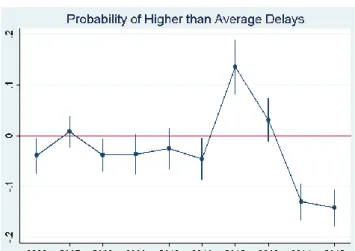
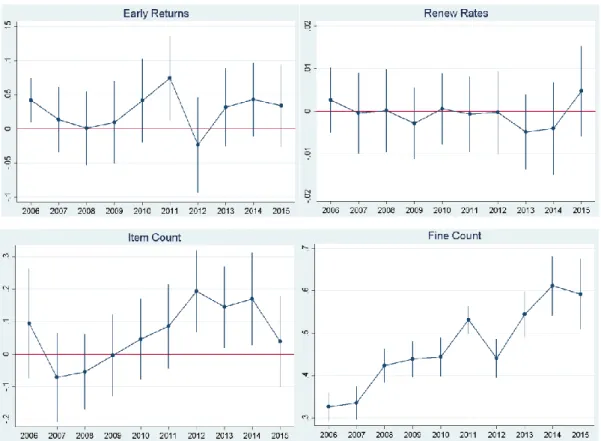
One unique feature of the data used in this paper relates to its longitudinal dimension. I am able to observe 830,813 transactions by 17,397 library users, covering more than 10 years (2005-2015). In this section, I explore the data’s longitudinal dimension in more detail. In doing so, I hope to gain a better understanding of the long-term impacts of the fine over behavior. I exploit the fact that the fine, once it began, remained with the same nominal value (R$ 2.00) for the entire period after the 2006 year. In this case, there are two related possibilities. First, if library users perceive the fine’s constancy over time, they will probably respond to it by raising delays, since the fine’s real value declines as time goes by (given a positive rate of inflation, in aggregate terms). Second, even with a fine with constant nominal value, there is the possibility that users’ delays reduce over time, due to the psychological effects of a sanction of this kind. Figure 1 displays the dynamic effects of the introduction of the fine over the probability of higher than average delays for the 2006-2015 period. Figure 2 contains the dynamic effects for users’ alternative measures of performance.
Figure 1. Dynamic Effects of a Fine over the Probability of Higher
than Average Delays, 2006-2015.
Source: author’s calculations, based on library data.
EALR, V.10, nº 3, p.236-249, Set-Dez, 2019 243
Universidade Católica de Brasília – UCB Brasília-DF
Figure 2. Dynamic Effects of a Fine over Distinct Library Performance Measures, 2006-2015.
Source: author’s calculations, based on library data.
When looking at the dynamic effects of the fine over other variables, I uncover two distinct sets of results. First, according to the patterns in the graph, the fine has an initial negative impact of – 4 percentage points (p.p.) over the probability of delays, in the year following its introduction (2006). However, after that period, there is not a statistically significant impact in the following five years (2007-2011). There is a positive impact in 2012, no impact in 2013, and negative impacts for the 2014-2015 period. While it seems unlikely that the fine impacts still occur five years past its instauration, this dynamic evidence suggests that the deterrent effects of the fine are short-lived, at best. This is probably a direct consequence of the fine’s constant nominal value.
Second, while the fine has a clear contractionary effect over borrowings’ effective durations and delays, it does not present a robust pattern in the case of early returns, renew rates, and the number of items each user borrows. Interestingly, when looking at the number of fines each user receives over time, I uncover a result in which the number of fines increases over time. That is, contrarily to standard arguments concerning the efficacy of fines as a deterrence factor for illicit behavior, fines increase over time.
5. Sensitivity Analysis
In the previous section, I reported a result in which the instauration of a monetary sanction reduced illicit behavior in a statistical and economic meaningful way. Although this is an intuitive and interesting result, it may present different types of bias for several reasons. In this section, I present results from distinct tests to validate the main results reported before. I divide the section in three parts: a first section containing placebo tests, a second section containing robustness checks, and a third section, in which I explore alternative mechanisms.
244 EALR, V.10, nº 3, p.236-249, Set-Dez, 2019
5.1. Placebo Tests
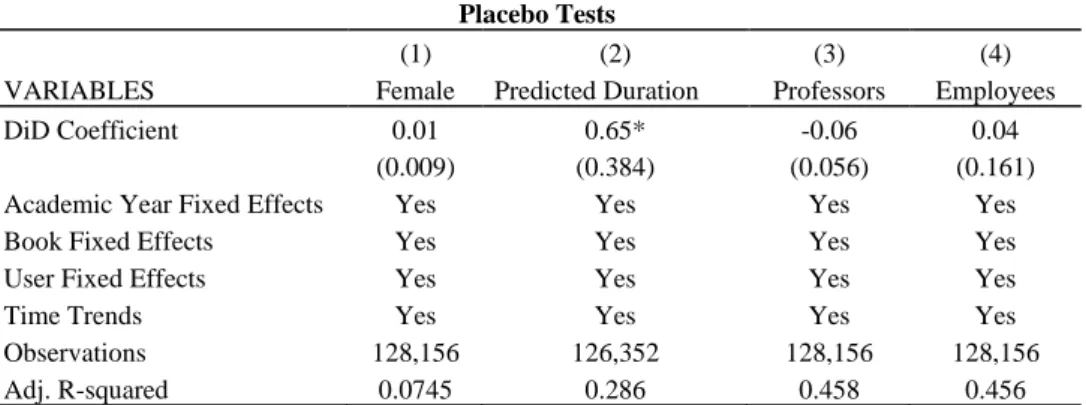
In the case of the present setting, fines make delays more expensive and this affects users’ behavior, on average, lowering delays. If this basic mechanism applies to the library I study, then it should not affect variables that would not correlate with monetary sanctions, at first. Given this reasoning, I present, in Table 3, estimates of difference-in-differences regressions, where the dependent variables correspond to variables that the fine should not affect. Specifically, I consider specifications in which the dependent variable is either users’ gender (first column) or borrowings’ predicted duration (second column). Additionally, I consider specifications where I substitute the treatment group with professors (third column) or university employees (fourth column), given that none of these categories were subject to monetary sanctions during the 2005-2015 period. Once again, I employ complete specifications, controlling for the same fixed-effects as before, as well as specific time trends.
Table 3
Placebo Tests
(1) (2) (3) (4)
VARIABLES Female Predicted Duration Professors Employees
DiD Coefficient 0.01 0.65* -0.06 0.04
(0.009) (0.384) (0.056) (0.161)
Academic Year Fixed Effects Yes Yes Yes Yes
Book Fixed Effects Yes Yes Yes Yes
User Fixed Effects Yes Yes Yes Yes
Time Trends Yes Yes Yes Yes
Observations 128,156 126,352 128,156 128,156
Adj. R-squared 0.0745 0.286 0.458 0.456
Source: author’s calculations, based on library data.
Notes: (a) The dependent variable in the specifications corresponds to users’ gender (first column), and borrowings’ predicted duration (second column). In the case of the table’s third and fourth columns, I substitute the treatment group either by professors (third column) or by university employees (fourth columns). (b) Standard errors clustered by course (reported in parentheses). (c) “Academic Year Fixed Effects” correspond to a set of dummies for 6 days of the week, 51 weeks for each year, and the 2006-year. (d) “Book fixed effects” correspond to a set of dummies for books’ area of study (business, accounting, economics, and law). (d) “User fixed effects” correspond to a set of dummies for users’ group ages (14-17, 18-23, 24-30, 31-40, 41-50, 51-60, 60+), category (high school student, undergraduate, graduate, and former student), area of study (business, accounting, and economics), and time at school (0 to 4 years). (d) “Time Trends” correspond to variable time trends for the control and treatment groups. (g) Statistical significance: * p < 0.10, ** p < 0.05, *** p < 0.01.
The results reported above confirm that monetary sanctions do not affect the dependent variables considered in the table. When looking at users’ specific characteristics, such as gender and age, I cannot reject the null hypothesis of no significance of the estimated difference-in-differences coefficient. Similarly, when employing either professors or employees as the treatment group, I cannot find a significant difference-in-differences effect. The only exception to such a pattern is borrowings’ predicted duration, which is marginally significant, in this case. Overall, the placebo tests reported in this section suggest that there is a meaningful effect of monetary sanctions over behavior in this context.
5.2. Robustness Checks
In Table 4, I present difference-in-differences estimates based on different samples. I do this in order to verify if the previous results are sensitive to alternative sample definitions.
EALR, V.10, nº 3, p.236-249, Set-Dez, 2019 245
Universidade Católica de Brasília – UCB Brasília-DF
Robustness: Alternative Samples
(1) (2) (3) (4)
VARIABLES Legal Counts No Vacations No Holydays No Exams
DiD Coefficient -0.04** -0.03** -0.04** -0.04**
(0.016) (0.015) (0.017) (0.018)
Academic Year Fixed Effects Yes Yes Yes Yes
Book Fixed Effects Yes Yes Yes Yes
User Fixed Effects Yes Yes Yes Yes
Time Trends Yes Yes Yes Yes
Observations 122,676 112,663 127,544 110,940
Adj. R-squared 0.517 0.526 0.516 0.512
Source: author’s calculations, based on library data.
Notes: (a) The dependent variable in the specifications corresponds to the probability of higher than average delays in the library. (b) Standard errors clustered by course (reported in parentheses). (c) In each column, I exclude a specific part of the sample: no vacations (first column), no book counts outside the library’s legal rules (second column), no holydays (third column), and no exams’ weeks (fourth column). (d) “Academic Year Fixed Effects” correspond to a set of dummies for 6 days of the week, 51 weeks for each year, and the 2006-year. (d) “Book fixed effects” correspond to a set of dummies for books’ area of study (business, accounting, economics, and law). (d) “User fixed effects” correspond to a set of dummies for users’ group ages (14-17, 18-23, 24-30, 31-40, 41-50, 51-60, 60+), category (high school student, undergraduate, graduate, and former student), area of study (business, accounting, and economics), and time at school (0 to 4 years). (d) “Time Trends” correspond to variable time trends for the control and treatment groups. (g) Statistical significance: * p < 0.10, ** p < 0.05, *** p < 0.01.
In the first column of the table, I exclude from the sample users whose items’ count surpass the library’s legal limits. Although the library has clear limits concerning each user category, it is possible that some users have special permission from librarians to take more items during specific times of the academic year. For instance, some professors may be able to take more than seven books in the beginning of the semester in order to organize courses4. In the second column, I
exclude vacation periods. I do this because one could speculate that the main results concerning the effects of fines over delays might present biases due to longer delays during periods when classes are over. Similarly, in the third and fourth columns, I exclude holidays and exam weeks from the sample, in order to avoid contamination of the results by specific times of the academic year. In the latter case, one possible concern would be that users could exhibit a different behavior during exam weeks. For instance, some users could hold books for longer time during exam weeks, given the library’s rivalry property. Note that the exclusion of these specific periods (vacations, holydays and exam weeks) correspond to indirect tests of the importance of users’ behavioral biases, such as inattention during holydays, or opportunistic behaviors during exam weeks. I return to these points below, when I discuss in detail possible mechanisms affecting the main results. In all cases of the above table, the previous results remain robust to minor modifications in the sample.
6. Conclusion
Different types of sanctions can affect behavior in varied (and unexpected) ways. In this paper, I try to answer the following question: how does the introduction of a monetary sanction affect behavior? Using a unique field setting and a longitudinal dataset covering more than 800,000
4 I confirm this empirical pattern by looking at the data. In certain occasions, a few users in the library took more
items than allowed over time. However, the vast majority of the sample (99.96%) conforms to the library’s legal rules concerning maximum limits per user.
246 EALR, V.10, nº 3, p.236-249, Set-Dez, 2019 daily transactions from a university library during a 10-year period (2005-2015), I analyze how the introduction of a monetary sanction (fine) affects users’ delays.
By exploiting the fact that the library instituted, in a given year, a fine for students only, I estimate the causal effects of the introduction of a monetary sanction over behavior. Three main results emerge. First, in aggregate terms, the introduction of the monetary sanction reduces delays by 34%, approximately. Second, there is considerable heterogeneity in terms of the effects over distinct groups of library users. Third, when considering the dynamic effects of this type of sanction, I uncover a result in which the sanction lost efficacy over time, since its nominal value remained the same for the entire period. The constancy of the fine’s nominal value not only affects its efficacy over time, but it also affects users in differentiated ways, since those who are wealthier tend to be less sensitive by this monetary sanction. These results are robust to several specification issues, such as variations in sample definitions and periods, as well as the use of distinct library performance measures.
Overall, the results reported in this paper suggest that monetary sanctions can influence behavior in the desired direction, as predicted by standard models of law enforcement. More than that, these results emphasize the dynamic effects of this kind of sanction, since the imposition of fines impacts behavior over time. The uniqueness of the library setting studied in this paper call attention for two important points related to the impacts of fines over time. First, the results reported in this paper suggest the importance of adjusting fines’ values to users’ wealth, as predicted by previous contributions in the area. According to some authors (Polinsky & Shavell, 2000), one important aspect related to the instauration of fines is adjusting its value to users’ wealth. By not adjusting fines in this manner, the library under study ended up punishing poorer users harder. Second, the dynamic effects’ results emphasize the symbolic effects of fines, since the fine’s nominal value remained constant for a 10-year period. Given that library users observe these values, as well as the enforcement done by the library, they can adapt their decisions to such an environment.
These results have important implications, both in practical and theoretical grounds. In terms of practice, the results provide valuable insight for important organizational issues, such as agency and teamwork issues, for example. In terms of theory, the results in this paper not only provide a better understanding of the impacts of fines over illicit behavior, but they also shed light on related issues, such as economic incentives, social norms, and corruption in real-world settings. In particular, an interesting route of future research would be to explore some of the results predicted by models emphasizing the interaction between social norms and laws.
EALR, V.10, nº 3, p.236-249, Set-Dez, 2019 247
Universidade Católica de Brasília – UCB Brasília-DF
7.
References
Acemoglu, D., & Jackson, M. O. (2017). Social norms and the enforcement of laws. Journal of the
European Economic Association, (forthcoming).
Agarwal, S., Driscoll, J. C., Gabaix, X., & Laibson, D. I. (2013). Learning in the credit card market. http://doi.org/10.2139/ssrn.1091623
Alesina, A., & Giuliano, P. (2015). Culture and institutions. Journal of Economic Literature, 53(4), 898–944. http://doi.org/10.1257/jel.53.4.898
Bar-Ilan, A., & Sacerdote, B. (2004). The response of criminals and noncriminals to fines. Journal
of Law and Economics, 47(1), 1–17. http://doi.org/10.1017/CBO9781107415324.004
Becker, G. S. (1968). Crime and punishment: an economic approach. Journal of Political Economy,
76(2), 169–217.
Bénabou, R., & Tirole, J. (2006). Incentives and prosocial behavior. American Economic Review,
96(5), 1652–1678. http://doi.org/10.1257/aer.96.5.1652
Bénabou, R., & Tirole, J. (2011). Laws and norms (NBER Working Paper Series No. 17579). Cambridge. Retrieved from http://www.nber.org/papers/w17579
Bertrand, M., Duflo, E., & Mullainathan, S. (2004). How much should we trust differences-in-differences estimates? Quarterly Journal of Economics, 119(February), 249–275.
Besley, T., & Burgess, R. (2004). Can labor regulation hinder economic performance? Evidence from India. Quarterly Journal of Economics, 119(1), 91–134.
Chetty, R., Saez, E., & Sándor, L. (2014). What policies increase prosocial behavior? An
experiment with referees at the Journal of Public Economics. Journal of Economic Perspectives,
28(3), 169–188. http://doi.org/10.1257/jep.28.3.169
Choi, V. M. P. (2016). Biblioteca “Paulo Ernesto Tolle” Yearly Reports (2005-2015). São Paulo. Di Tella, R., & Schargrodsky, E. (2004). Do police reduce crime? Estimates using the allocation
of police forces after a terrorist attack. American Economic Review, 94(1), 115–133. http://doi.org/10.1257/000282804322970733
Donna, J., & Espín-Sánchez, J. A. (2015). Let the punishment fit the criminal. The Ohio State University. Retrieved from
https://dl.dropboxusercontent.com/u/4794458/_WebPage/Papers/Punishment.pdf Ellingsen, T., & Johannesson, M. (2007). Paying respect. Journal of Economic Perspectives, 21(4), 135–
149. http://doi.org/10.1257/jep.21.4.135
Fehr, E., & Gächter, S. (2000). Cooperation and punishment in public goods experiments.
American Economic Review, 90(4), 980–994. http://doi.org/10.1126/science.151.3712.867-a
Fehr, E., & Leibbrandt, A. (2011). A field study on cooperativeness and impatience in the Tragedy of the Commons. Journal of Public Economics, 95(9), 1144–1155.
248 EALR, V.10, nº 3, p.236-249, Set-Dez, 2019 http://doi.org/http://dx.doi.org/10.1016/j.jpubeco.2011.05.013
Fisman, R., & Miguel, E. (2007). Corruption, norms, and legal enforcement: evidence from diplomatic parking tickets. Journal of Political Economy, 115(6), 1020–1048.
http://doi.org/10.1086/527495
Gneezy, U., Meier, S., & Rey-Biel, P. (2011). When and why incentives (don’t) work to modify behavior. Journal of Economic Perspectives, 25(4), 1–21. http://doi.org/10.1257/jep.25.4.191 Gneezy, U., & Rustichini, A. (2000a). A fine is a price. Journal of Legal Studies, 29(1), 1–17.
http://doi.org/10.1086/468061
Gneezy, U., & Rustichini, A. (2000b). Pay enough or don’t pay at all. Quarterly Journal of Economics,
115(3), 791–810.
Hardin, G. (1968). The tragedy of the commons. Science, 162(3859), 1243–1248.
Haselhuhn, M. P., Pope, D. G., Schweitzer, M. E., & Fishman, P. (2012). The impact of personal experience on behavior: evidence from video-rental fines. Management Science, 58(1), 52–61. http://doi.org/10.1287/mnsc.1110.1367
Henrich, J., Boyd, R., Bowles, S., Camerer, C., Fehr, E., Gintis, H., & McElreath, R. (2001). In search of Homo Economicus: behavioral experiments in 15 small-scale societies. American
Economic Review, 91(2), 73–84. http://doi.org/10.1257/aer.91.2.73
Hess, C., & Ostrom, E. (2007). Introduction: an overview of the knowledge commons. In C. Hess & E. Ostrom (Eds.), Understanding knowledge as a commons: from theory to practice (pp. 3– 26). Boston: MIT Press.
Kamenica, E. (2012). Behavioral economics and psychology of incentives. Annual Review of
Economics, 4(1), 13.1-13.26. http://doi.org/10.1146/annurev-economics-080511-110909
Kline, P. (2012). The impact of juvenile curfew laws on arrests of youth and adults. American Law
and Economics Review, 14(1), 44–67. http://doi.org/10.1093/aler/ahr011
Lacetera, N., Macis, M., & Slonim, R. (2013). Economic rewards to motivate blood donations.
Science, 340(6135), 927–928. http://doi.org/10.1126/science.1232280
Masclet, D., Noussair, C., Tucker, S., & Villeval, M. C. (2003). Monetary and nonmonetary punishment in the voluntary contributions mechanism. American Economic Review, 93(1), 366– 380. http://doi.org/10.1257/000282803321455359
Ostrom, E. (1999). Coping with tragedies of the commons. Annual Review of Political Science, 2(1), 493–535. http://doi.org/10.1146/annurev.polisci.2.1.493
Ostrom, E. (2000). Collective action and the evolution of social norms. Journal of Economic
Perspectives, 14(3), 137–158.
Piehl, A. M., & Williams, G. (2011). Institutional requirements for effective imposition of fines. In P. J. Cook, L. Ludwig, & J. McCrary (Eds.), Controlling crime: strategies and tradeoffs (pp. 95– 121). Chicago: University of Chicago. Retrieved from http://www.nber.org/books/cook10-1
EALR, V.10, nº 3, p.236-249, Set-Dez, 2019 249
Universidade Católica de Brasília – UCB Brasília-DF
Polinsky, A. M., & Shavell, S. (2000). The economic theory of public enforcement of law. Journal
of Economic Literature, 38(1), 45–76.
Posner, R. A. (1997). Social norms and the law: an economic approach. American Economic Review,
87(2), 365–369.
Rustagi, D., Engel, S., & Kosfeld, M. (2010). Conditional cooperation and costly monitoring explain success in forest commons management. Science, 330(November), 961–965. http://doi.org/10.1126/science.1193649
Stigler, G. J. (1974). The optimum enforcement of laws. In G. S. Becker & W. M. Landes (Eds.),
Essays in the economics of crime and punishment (Vol. I, pp. 55–67). New York: National Bureau
of Economic Research (NBER). http://doi.org/10.1086/259646
Zylbersztajn, D. (2010). Fragile social norms: (un)sustainable exploration of forest products.