i
Transparency in addressing decoupling: The role of
corporate transparency in the reformation process of
the Institute for the Works of Religion
Mendo Ataíde
Advisor: Professor Tommaso Ramus
Dissertation submitted in partial fulfilment of requirements for the
Degree of MSc in Business Administration, at Católica-Lisbon
ii Sic Transit Gloria Mundi
iii
Abstract
Transparency in business and especially in the financial industry has proven to be a crucial matter for its stability and success over time. This dissertation is a case study that focuses, through an ethical perspective, in the particular situation of the Holy See’s IOR – Istituto per le Opere di Religione - in its reformation procedures, which are commonly called altogether as a transparency process. It presents the problems IOR underwent and the recent process of change in the organization. It is analyzed the role that corporate transparency has in the solution of ethical problems of the institute, in particular in what regards the effective implementation of corporate values. In the end, it is argued that corporate transparency is an important factor for the implementation of values in the IOR, for through transparency there is the possibility of scrutiny of the company on the part of stakeholders, which harmonizes all reform measures in the same direction and convinces stakeholders of the institutional changes. However, it is also concluded that transparency is not the only factor to guarantee an ethical conduct, for there is the need of control mechanisms to monitor operations. These conclusions go in line with the existing theory on value implementation in organizations, which states that not only values-based programs but also compliance-based programs are effective in solving ethical problems. There is a revision on the existing literature regarding the role of values, Catholic Social Teachings, transparency and the phenomena of decoupling from institutional values in a business.
iv
Table of Contents
Abstract iii
Table of Contents iv
Table of Figures vi
Table of Tables vii
Motivation and Acknowledgements viii
Introduction 1
Proposition 1
Objective 1
Period of Analysis 2
Structure of Dissertation 2
Chapter 1 - Literature Review 3
1.1 Values and Business 3
1.2 Catholic Social Teachings and Business 4
1.3 Introducing Values in an Organization 8
1.4 Decoupling 12
1.5 Reintroducing Values in an Organization 17
Transparency in Re-implementing Values 18
Chapter 2 - Case Study 21
2.1 Introduction 21
2.2 The Institute for the Works of Religion 22
2.3 History and Important Facts on the IOR 25
2.4 Historical Problems of the IOR 27
2.5 Reforming for Transparency 30
Chapter 3 - Teaching Notes 39
3.1 Case Synopsis 39
v
3.1.2 Teaching and Learning Objectives 39
3.2 Presentation of Case Study 40
3.2.1 Summary of Class Discussion: 40
3.2.2 Preparation 41
3.2.3 Class Presentation 42
Conclusion 53
Appendixes 55
Section 1 – For a better Understanding the Case Study 55
Appendix 1 – Clients, Internal Risk-Level Assessment and Distribution of Clients in
Quantity 55
Appendix 2 – Key Milestones of IOR’s History 55
Appendix 3 – Permanent Principles of Catholic Values and Purpose of the Firm
According to the Social Doctrine of the Catholic Church 57 Appendix 4 – Main Irregular Occurrences Regarding the IOR 58
Appendix 5 – Governance Structure of the IOR 60
Appendix 6 – Drivers of Transparency Process and Corresponding Effects 60 Appendix 7 – General Outline of the Economic and Financial Structure of the Vatican
City State and of the Holy See 61
Appendix 8 - Classification of the IOR According to Portuguese Regulation
Standards 63
Appendix 9 - Financial Statements of the IOR 64
Section 2 – Methodological Approach for the Case Study 66
1. Research Design Protocol 66
2. Case Study writing 69
3. External Validity of Findings 70
References 71
References for Literature review 71
vi
Table of Figures
Figure 1 - Types of programs for implementing values 10
Figure 2 – Process of policy creation 12
Figure 3 - Scheme of effective policy implementation, means-ends and policy-practice
decoupling 16
Figure 4 - Effects of internal and external transparency 19
Figure 5 - Effects of transparency in internal and external environment of the company 20
Figure 6 - Client profile in number of clients 24
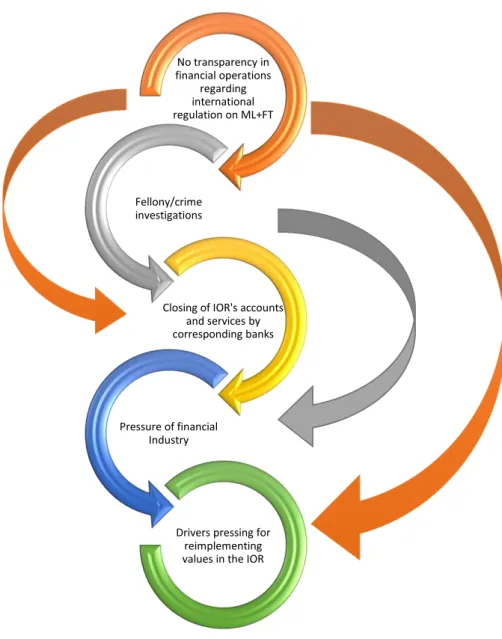
Figure 7 - Scheme of drivers of decoupling 45
Figure 8 - Main factors leading to the process of transparency 46
Figure 9 - Governance structure of the IOR 60
vii
Table of Tables
Table 1 - Brief Explanation of the four permanent principles of CST 43 Table 2 - Conflict between unethical situations and the permanent principles 43
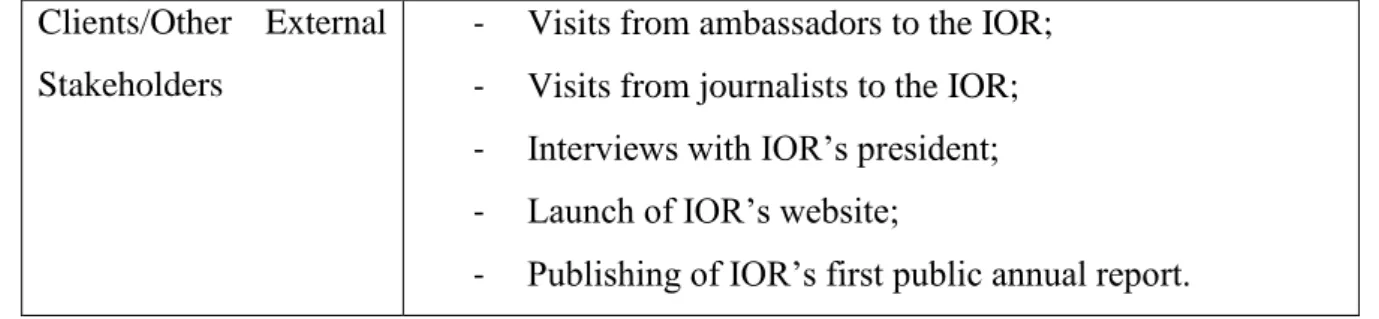
Table 3 - Transparency measures and its targets 48
Table 4 - Effects of disclosure to stakeholders in the Institute. 49 Table 5 - Risk level and distribution of clients of the IOR in number 55 Table 6 - Brief description of the permanent principles of CST 57
Table 7 - Purpose of business according to CST 57
Table 8 - Main irregular occurences regarding the IOR 58
Table 9 - Sources of funds for Holy See's and Vatican City State's budget 62
Table 10 - Income statement of the IOR, 2012 64
Table 11 - Balance sheet of the IOR, 2012 65
Table 12 - Summary of data collection and literature review 66
viii
Motivation and Acknowledgements
Many people write romances and novels on the subject of the Vatican. Many of those, too, claim they are writing something that is based in true facts, but end up scrambling truth with a romance, and the result of that is a biased view of Vatican affairs. Of these affairs, finance is always a hot topic, with its center in the “Vatican Bank”, the Institute for the Works of Religion. As a Catholic and a business student, my personal interest to understand better the Church’s administration drove me to study the situation. Having attended both courses of Business Ethics of the Master in Business Administration of Católica-Lisbon School of Business and Economics, a bigger interest in the area arouse, as well as the acknowledgement of having very little knowledge on the subject of ethics.
These two interests, in better understanding ethics and the Church, found an opportunity to be developed to some extent. As I concluded the curricular part of my Masters degree at Catolica-Lisbon School of Business and Economics, new developments occurred in the Institute for the Works of Religion, in what regarded the “Transparency Process” that is being implemented there since 2010. Therefore, envisioning the coming thesis to conclude the Masters, I presented the subject to Professor Tommaso Ramus, head of the Business Ethics department, who helped me in setting a clear objective for this dissertation, in order to avoid being trapped due to the risk involved of not gathering sufficient information for its development. The scope became, therefore, the study of the subjects of business values, decoupling from business values and the role of transparency in the re-implementation of business values in the Institute for the Works of Religion.
I thank Professor Tommaso Ramus for all the help throughout this dissertation, without whom I would not manage to keep focus on the essential questions. I thank all the people who conceded interviews for the purpose of this dissertation and who reviewed the facts exposed in the case study. Finally, I thank my family for the support given, without whom I could not accomplish this dissertation.
1
Introduction
The Institute for the Works of Religion (IOR), one of the financial institutions of the Vatican City State, is a Catholic institution, which is expected to follow strong ethical values, based in Catholic teachings. Nevertheless, through its history, it went through investigations of unethical matters, in some situations due to true misconduct.
Since 2010, due to a set of market pressures and to the will of the Pope, the Vatican City State started a reformation of its financial system, with a particular focus on the IOR. For the IOR, there was a specific program, commonly denominated a “transparency process”, which consisted in a series of measures regarding both internal and external stakeholders.
Proposition
This dissertation aims at understanding the causes and expected consequences of this transparency program, in particular the role that corporate transparency has in the effective establishment of business values in the IOR. This is set on the assumption that corporate transparency has an important role in the solution of the problem of institutional decoupling, since it is a guarantee of scrutiny of stakeholders. The rationale is that transparency drives pressure on business to be aligned with an ethical conduct. In the same manner, transparency would help by convincing stakeholders of the corporate changes.
At the light of the above mentioned proposition, this investigation aims to understand the role that transparency has in this program in order to guarantee the filling of ethical gaps in the running of the institution.
Objective
This case study’s objective is to test the given proposition, through a summative evaluation of the transparency program undertaken by the Institute for the Works of Religion (IOR) and the subsequent effect it is expected to have in addressing the problem of decoupling from institutional values. The established objectives for this case study are to understand the drivers, consequences and the rationale behind the measures taken by the management of the
2 institution. Specifically, the aim is to understand the relative strength that each set of stakeholders, to which different measures of the transparency program were destined, have concerning driving the institute to the avoidance of illegal behavior. This is, considering the relative strength of information disclosure to market stakeholders comparing to non-market stakeholders, it considers which type of information disclosure is more effective in filling existing or potential ethical gaps.
Period of Analysis
The period of analysis that concerns this Case Study considers the recent history of the institution since the launch of its first statutes in 1942 until the 15th of November of 2013, date of launch of new statutes for the regulation entity, FIA. There is a specific focus on the period from the 30th December of 2010 until the 15th of November of 2013, since it is the timespan under which the IOR started its transparency process until the end of data collection for this case study.
Structure of Dissertation
First, a literature review is presented on the studying matters – values, Catholic social teachings, introducing values in an organization, decoupling and re-implementing values in an organization, chapter where transparency is addressed. Following goes the case study on the transparency process of the IOR, and the respective teaching notes to guide class teaching, optimized for a ninety-minute class. In the end, a series of attachments to better understand the subjects involved in this case study and the methodological approach for development of this dissertation, to justify the validity of the research and findings.
3
Chapter 1 - Literature Review
1.1 Values and Business
There is a vast literature on the subject of values. Various authors have drawn a set wide of definitions for values. Nystrom (1990) defines values as “normative beliefs about proper standards of conduct and preferred or desired results” (Nystrom, 1990). Joyner and Payne’s definition (2002) states values as “the core set of beliefs and principles deemed to be desirable (by groups) of individuals”. (Joyner and Payne, 2002). Rokeach states a definition regarding not only values but of a value system, which is “an enduring organization of beliefs concerning preferable modes of conduct or end-states of existence along a continuum of relative importance” (Rokeach, 1979). At last, Schwartz and Bilsky (1987), wrapping up the definitions of value they found on their literature review, define values “as concepts or beliefs, about desirable end states or behaviors, that transcend specific situations, guide selection or evaluation of behavior and events, and are ordered by relative importance” (Schwartz and Bilsky, 1987). Based on each conception of value presented, in the present dissertation values are defined in short as beliefs that a specific mode of conduct or end-stake of existence is preferable to other alternatives. For fully understanding this concept, this short definition is to be complemented with Rokeach’s systemization of values, from which a hierarchy is established, this is, some values are more important than others. This supplement is crucial for understanding what are values, for it is through the hierarchy of values, on the interrelation of values, that the process of decision-making depends to choose from various alternatives (Fritzsche and Oz, 2007; Maurer, Bansal and Crossan 2011). For example, consider the case of an energy company building a dam on a river, which has necessarily consequences for the involving natural ecosystem. The decision to make regarding the construction of the dam depends on the relative value they give to preserving the established ecosystem and the economic development of the region, as in the case of Portugal’s Baixo-Sabor dam.
It can’t be disregarded that values are subjective, in the sense that they refer to a specific subject. This subject can be either individual or collective. For instance, values can be referent to a person – which are defined as personal values – or to a specific organization – organizational values – or to a culture – cultural values (Melé, 2009; Maurer et al., 2011).
Notwithstanding the fact that values refer to a subject, this does not make values a relativistic matter which is unable to be judged. Values have a goal to reach, which is the happiness of
4 men that, according to many notorious authors, is attained through human excellence. (Yarza, 2007) The goal of values is, therefore, human excellence, for which it makes it is possible to judge values per se an in relation to the subject’s value hierarchy, in the way that they are or not driving the subject towards human excellence. Values aligned for this purpose are ethical values, and are defined, according to Melé, as “values based on moral qualities that contribute to human excellence” (Melé, 2009). For example, justice, gratitude and integrity are samples of ethical values (Melé, 2009).
In the corporate world it is generally agreed the importance of ethical values in business. To pursue ethical values should be a goal per se, for through this is achieved the fulfilment of the human being, whose reality goes beyond economic relationships (Melé, 2009) More than a guarantee of individual good, ethical values are a guarantee of the common good. For this reason, organizations, too, have to regard ethical organizational values as an important factor for its development and its members. Otherwise, disregarding ethical values might lead to big catastrophes for many people, such as closure of companies and, in a broader perspective, even to economical crisis. The cases of companies like Enron and many of the failing financial institutions during the subprime crisis that started in 2008 such as Lehman Brothers are associated with ethical problems, such as cosmetic accounting. These problems might happen through misconduct of individuals, ethical lapses in the structure of organizations and in the development of theories which are not based in ethical values, leading to unethical outcomes (Melé and Argandoña and Sanchez-Runde, 2011; Costa and Ramus, 2012). The pursuit of ethical values avoids the emergence of illegal behaviors, such as fraud, deception and illegal activities. The cases during the economic crisis of 2008 such as Bernie Madoff, the massive use of Ponzi units and the pushing of credit to consumers incapable of paying reveal such issues. It is essential, therefore, that the values organizations and in particular businesses stand for be ethical (das Neves, 2008; Melé, 2009).
1.2 Catholic Social Teachings and Business
The understanding of values in business depends on the perspective taken. Values can refer to either a person or to an organization. In the business context, both individual and corporate values influence the outcomes of a company. Corporate values are not, nevertheless, an arithmetic sum of all individual values, for businesses and organizations as a whole have its own dynamic that surpasses those of the individual. Many times, more than a situation of an
5 individual misconduct, there is a corporate culture whose values are disregarded. Examples that illustrate this point are the cases of unethical behaviors of companies, such as Enron, Lehman Brothers and other financial institutions during the 2009 crisis, as well as other notorious cases, such as Nike’s incompliance to its own ethical standards in the 90’s, as with the use of child labor. These cases were a matter of organizational values and its violation, not a matter of individual values alone (Hatch, 1993). Under this situation, the focus for the purpose of this dissertation will be the corporate values of a company.
Corporate values vary from firm to firm, and can have a variety of expressions that orient business and its members. A particular expression of the orientation of business according to a specific ethical value structure is the case of the doctrine derived from the teachings of the Catholic Church, which serve as a guideline not only for personal, but also for organizational and cultural values. The role of the doctrine from these teachings, denominated Catholic Social Teachings, recently had a greater highlight on the part of some authors, in what matters rethinking the values of a business context (Costa and Ramus, 2012; das Neves and Vaccaro, 2013; Abela, 2001).
Catholic Social Teaching (CST) is a collection of documents elaborated by the Catholic Church, which apply Catholic beliefs to contemporary issues, in particular issues that regard economics and business (Abela, 2001; Costa and Ramus, 2012). The literature on the application of CST to business, although recent, had a great increase in the past decade (Costa and Ramus, 2012).
CST applies transversally to society as a whole and the teachings of the Church on social matters are various. Although the vastness of CST, its core teachings are gathered into four permanent principles: Common good, solidarity, subsidiarity and the dignity of the human being (Compendium, 160; Vaccaro and Sison, 2011). These are the central principles of the social doctrine of the Catholic Church. For this, they will be briefly described according to the Compendium of Catholic Social Doctrine and other related documents and authors that worked on them.
6
Common Good
The principle of common good includes three basic values – the dignity, unity and equality of all people. Given this, the concept of common good comes as an aggregator for these three determining factors. The compendium defines common good as “the sum of the total social conditions which allows people, as groups and as individuals, to reach their fulfilment more easily” (Compendium 164). It respects all aspects of society and it give responsibility to every person and governments in particular, to contribute to the common good of society (Compendium 165; Compendium 166).
Solidarity
The permanent principle of solidarity embraces the premise of equality of all men in terms of rights and dignity and “the common path of individuals and peoples towards an ever more committed unity” (Compendium 192). Solidarity comes in response to the fulfilment of this: it is a duty of each individual and of society to strive for fair conditions to everyone. Solidarity highlights the moral requirement of interdependence between the needy and the ones who have in abundance (Compendium, 193).
Subsidiarity
Subsidiarity consists in the matching of freedom and responsibility. Its focus is set on avoiding the exploitation of the weak by the powerful, and promoting on the other hand a relationship in a constructive way, allowing the participation of all involved in a given matter. The principle of subsidiarity implies the duty of social entities that are in higher orders of a hierarchy to help, by support, promotion and development, social entities or individuals of lower orders of the same hierarchy in economic, institutional or juridical matters. Simultaneously, those superior order entities have to refrain from anything that restricts the lower order cells, guaranteeing their personal freedom and responsibility, therefore their personal development (Compendium, 186).
7
Respect for human being
The respect for the human being is the value that recognizes the dignity of men as center of all creation and the equal dignity of men and women (Compendium 106; Compendium 107; Compendium 111; Compendium 112). It opposes reductive visions of men, many times applied in management theories, that absolute men as, for example, a “human resource” (Melé, 2009)
There are several reasons that Catholic Social Teaching gives us to arrive at the principle of respect for the human being. According to Catholic teachings men is created at God’s image, which grants dignity in itself and should make him recognize dignity in other men, for they follow the same condition (Compendium, 106; Compendium, 108). Moreover, men is the protagonist of all social life and has all creatures at his service, which he is to manage with responsibility (Compendium, 113). For these and other reasons, in a humanistic perspective it is, in fact, the principle that absorbs all others due to its conceptual broadness.
Impact of CST on Business
The four permanent principles of CST affect the conception of business when business is seen through them, and can contribute to the presence of ethics in the business, for the reasons that follow next.
According to Melé, to know if a business is ethical, we have to analyze the ethicality of its purpose and practices (Melé, 2009). The values of CST, by focusing on the common good, the respect for the human being, subsidiarity and solidarity give a different view to the spread purpose of business as a means for wealth creation. Business, according to Catholic Social Doctrine and specifically according to John Paul II’s encyclical Centesimus annus, has the purpose to fulfill three main vectors at the same time: to generate a profit, to serve society with goods and services and to be a community of people striving to satisfy basic needs (Abela, 2001).
On the view of CST profit generation is a guarantee of financial health, for “when a firm makes a profit, this means that productive factors have been properly employed” (Centesimus annus, 35; Compendium, 340). The second goal described, to serve society, emphasizes the
8 responsibility of a business in what is does; its responsibility to provide goods and services that are beneficial to society (Abela, 2001; Centesimus Annus, 36). This comes as a direct consequence of the values of common good and solidarity, for it makes the business accountable to make good in whatever it does, to the society as a whole.
At last, according to CST, business also exists in order to be a community of people striving for the satisfaction of basic needs. This third vector of the purpose of business is, once again, the application of the permanent principles of CST of common good, solidarity and subsidiarity. Dislike the goal of business of serving society, which consists in providing goods and services to society as a whole, it concerns the benefits of a specific group of people who are part of a business. This presupposes the respect and the help of the business’ hierarchy to all workers involved in the business in order to guarantee them dignity in their living conditions (Abela, 2001; Centesimus Annus, 36).
There is, therefore, a difference in the scope of business when seen through CST (Abela, 2001; Costa and Ramus, 2012). Through the application of the core values of subsidiarity, solidarity, common good and the respect for the human being the ethicality of a business, in what regards its purpose, is more likely to be guaranteed. The sole focus on profit, disregarding these values or regarding other non-ethical values, might lead to unethical situations (Abela, 2001) To be ethical, however, the business also has to be ethical on its practices, which implies the implementation of ethical values in its operations, not only on its theoretical principles (Melé, 2009).
1.3 Introducing Values in an Organization
The reality of an organization goes beyond the sum of the reality of the individual parts of its members. In what concerns values, the implementation of values in an organization is, in the same way, a situation of greater complexity.
The introduction of values in an organization is usually made through the implementation of an ethics program. An ethics program consists in a set of initiatives taken in order to promote ethics and values. Ethics programs can be very diverse in its forms, for they are to comply with the unique reality and specific values of a company. Previous literature has shown, however, that programs can be categorized according to its main focus (Trevino & Weaver &
9 Gibson & Toffler, 1999). The focus of an ethical program, according to Trevino et al. (1999), can follow four main approaches (Trevino et al., 1999):
i) Values-based ethical programs, which focus on defining organizational values and encouraging the ethical awareness of employees;
ii) Compliance-based, focused on preventing, detecting and punish unethical behavior;
iii) Protecting top management, on the eventual need to assume responsibility in the case that unethical behavior arises;
iv) To boost corporate image and please stakeholders.
In Trevino et al.’s research (1999) on which is the most effective approach to implement values on business, it is highlighted that the most effective way to implement values on a business is through a substantial values-based approach. A values-based approached is the most effective for motivating employees and arising ethical aspirations and awareness in the company. Through such a program, employees are more likely to report ethical violations, be more committed in their job and be better decision makers, in comparison to other types of programs (Trevino et al., 1999). However, a combination of a values-based ethical program with another type of program can prove to have complementary skills that are valuable to the company. Combining a values-based program with a complementary compliance-based approach, can be of great value, for “discipline for rule violators serves an important symbolic role in organizations—it reinforces standards, upholds the value of conformity to shared norms, and maintains the perception that the organization is a just place where wrongdoers are held accountable for their actions” (Trevino et al., 1999). For effective implementation of values in corporations, ethical programs should focus, therefore, in a values-based approach complemented with a compliance-based approach.
The form ethical programs materialize is through interventions in two different aspects (Harvey, 2000). One aspect focuses on promoting an ethical conduct of the employees, through teaching. The other aspect is to analyze the structural practices of the company or organization, such as rewards and punishments, corporate culture, and other environmental conditions that can influence the ethical conduct of individuals in a company (Harvey, 2000).
10
Figure 1 - Types of programs for implementing values
Both aspects are complementary to each other, for in order to guarantee values and an ethical behavior in an organization the structural conditions can help, through organizational designs that avoid exposure of employees to pressures that move to unethical practices (Trevino et al., 1999; Harvey, 2000).
Intervention in individuals
Ethical programs’ intervention on the individuals of an organization consists in, essentially, training and the establishment of codes of conduct (Harvey, 2000). Training consists in initiatives to raise the ethical awareness of individuals, such as workshops and simulations (Crane and Matten, 2007). A code of conduct or code of ethics is a document whose goal is to help people in an organization interiorize certain rules of conduct that are essential in the vision of the company’s top management, this is, the values stressed for the company (Melé, 2009). Its adoption, in what regards the implementation of values in business, can be very beneficial. According to Melé, a code of conduct is useful for many different reasons. First of all, through a code of conduct there is an exposition and articulation of corporate values, so the company’s view on different values is materialized for employees. Second, through a code of conduct the company is providing to its employees guidelines for decision making, so some ambiguity in analyzing situations might be prevented. Lastly, by stating what a company stands for in a code of conduct, it is limiting power abuses within the firm and it helps avoiding litigation between employees, for there is an objective document as a reference (Melé, 2009).
Structural
Intervention
- Rewards - Punishment - Organizational CultureIndividual
Intervention
- Training - Codes of Conduct11
Structural intervention
For effective implementation of values it is important to remove any barriers that can be in the way of ethical choices. Three main situations have to be analyzed in the company’s structure: rewards and punishment, performance and evaluation processes and decision-making rights and responsibilities (Harvey, 2000). Regarding rewards and punishments it is important, especially, that the company condemns unethical behavior, through punishment, so that it is not seen as impugn and be repeated in other occasions (Harvey, 2000, Trevino et al., 1999). Moreover, the system a company adopts in terms of performance evaluation has to be in such way that unethical behavior is not incentivized to meet expectations. It is important to have objectives very clear as well as the expectations top management has of the employees to avoid such situations. For example, this issue occurred with Sears Auto centers, where central management, in a time of financial distress, implemented a plan that established the need of reaching certain sales levels on each units, and the failure of this plan would result in penalties to the units, including job losses. The results from this policy was that unethical behaviors such as overcharging customers were incurred in order to meet quotas (Harvey, 2000). At last, there are circumstances that facilitate the incurrence of unethical behavior in matters of decision-making. This occurs when power is divided between a group of people, which diminishes the sense of responsibility, and when there is little sense of power over questions. An example of this last situation was the decision to launch the space shuttle Challenger (1986) in adverse meteorological conditions and the consequential explosion of its fuel tank. Even though engineers, the experts on the matter, strongly recommended postponing the launch due to the weather, NASA overran the safety recommendation, which resulted in disaster (Harvey, 2000).
Cultural aspects
Organizational culture has a crucial role in the effectiveness of the initiatives for an effective implementation of values in a business. By organizational culture it is intended the assumptions, beliefs, goals, knowledge and values shared by organizational (Hatch, 1993). Values are instigated in employees through the corporate culture established. For this to happen, organizational culture needs to have certain characteristics that promote effective value transmission. In order for this to happen, participation an communication with members
12 has to be present, for this way individuals make corporate values their own and management shows its commitment to the values. Moreover, it is very important that an organizational culture shows commitment of top management in the values desired to all levels of the hierarchy, for the example of leadership is one of the top influencing factors (Harvey, 2000; Stevens, 2008).
Corporate culture fills in the gaps of organizational structure in what concerns the implementation of values, therefore is crucial to consider it and the need of its enrichment with participation of members, example from leadership and efficient communication (Harvey, 2000)
1.4 Decoupling
Efforts are continuously made in the academia on the development of management models that help effectively implementing values in a business (Melé, 2003; Spitzeck, 2011) and there are various studies on the most effective way to implement corporate values (Trevino et al. 1999; Harvey, 2000; Stevens, 2008). However, the establishment of a formal system with mechanisms like ethical codes, training and whistleblowing lines is not enough to guarantee that the values a company aims in attaining are de facto put into practice (Trevino et al., 1999). There are cases, in fact, where the values a company officially stands for and formally states and defends through the described mechanisms, are disregarded in practice. This situation is conceptualized as decoupling (Bromley and Powel, 2012).
13 Decoupling is defined as the situation of a company formally having a policy or code of conduct which in practice is not regarded (Bromley and Powel, 2012). Decoupling can occur essentially due to two different types of causes, one related with issues on the implementation of the policy; another related with issues of the implementing process. When decoupling occurs due to issues in the process of implementation of the policy, creating a gap between the stated values of the company and the actual values of the company, it is called policy-practice decoupling. The other situation, when decoupling is caused due to a bad definition of the policy at first it is called means-ends decoupling (Bromley and Powel, 2012).
Policy-practice decoupling arises when there are pressures from different sets of stakeholders to avoid the practical consequences of a formalized policy. Means-ends decoupling occurs due to a bad connection between the policies defined and the outcomes that are desired, for the policy in itself might raise in the organization conflicting views on the same matter than cannot be compatible (Bromley and Powel, 2012). Policy-practice and means-ends decoupling are a result of different factors that lead to each situation. As there is a conceptual difference between policy-practice decoupling and means-ends decoupling, as there are different causes and antecedents that lead to each type of situation.
Policy-Practice Decoupling Antecedents and D rivers
According to Bromley and Powel (2012), an organization is more likely to incur in policy-practice decoupling situations in the case that the company or organization has network ties with entities that incur in decoupling situations or if there is any prior experience decoupling from established policies. Moreover, in the case the company has a weak capability of implementing changes and where there is no reinforcement of changes that are to be implemented it is more likely to fall into such a decoupling situation (Bromley and Powel, 2012). The occurrence of policy-practice decoupling, however, is caused not by the circumstances alone, but due to pressures that come in different forms from different stakeholders on the company (Bromley and Powel, 2012). Bromley and Powel (2012) describe these pressures in the form of five different drivers. The first driver regards the existence of interests of leaders on the concerning policy, such as personal gain or covering malpractices (Bromley and Powel, 2012; Tilcsik, 2010). Secondly, the existence of local power relations that are unfavorable, such as rivalries, relationship struggles, transfer of responsibilities to
14 other persons, excess familiarity or character clashes, among others, can stalk or impede the process of an effective implementation of a policy (Bromley and Powel, 2012). In third place, there might be the desire of agents to protect its internal core operations, which are considered to be of high value to the organization and whish not to have any interference from external factors (Bromley and Powel, 2012). Fourth, there can be a pressure from outside the company that the company assumes as its own priority, disregarding the established policies. For example, the case of an important client who threats to finish his relationship with the company if a new implementing policy goes through, to which the company’s response is evading the policy to keep the client. (Bromley and Powel, 2012). At last, inertia in implementing drives to a situation of policy-practice, in the case something needs to be worked on to guarantee it (Bromley and Powel, 2012).
Means-ends decoupling antecedents and respective consequences
Means-ends decoupling is a result of a weak formulation of a policy that does not establish tight relationships between the implementing policy and the desired outcome. Bromley and Powel (2012) consider essentially four main reasons why a company might incur in means-ends decoupling. The first cause presented is the case of, when establishing a policy, give excessive attention to the way a policy is to be implemented, respecting all rules and involved stakeholders, but consequently not giving the necessary importance to the outcome that is desired in the end. It is the case of, for example, of quality control processes where the main focus is to guarantee that all steps are followed properly and not in the final quality of a product in itself (Bromley and Powel, 2012). Consequently, resources are shifted from the principal activity to support these policies (Bromley and Powel, 2012). Means-ends decoupling can happen, too, when the environment of the company is fragmented, for example working in multiple industries, therefore having a great number of different stakeholders to report. Implementing a common policy, to all different realities it is present at, might be a difficulty due to the compartmentalization of the company, and policy remains a mere formal document or it is only partially implemented. For example, a production facility of heavy material, which requires physical strength, might not be able to fulfil an establishing general policy of the company imposing that half of the workforce in all departments be woman. When such situation occurs, it makes the organization in cause very complex in its internal activity,
15 requiring multiple logics of acting inside the company and, when the policy is not directly related to the activity of a specific department, it might deviate it from the core work it is to do. (Bromley and Powel, 2012). Rationalizing pretended outcomes that are difficult to measure can be another possible cause for means-ends decoupling. For example, it is not easy for the Church to measure the intended outcomes of its policies, which is the saving of souls – it might instrumentally consider the number of people present or other factors that are measurable. Companies tend to create mental shortcuts and, in the end, have false links between the intended outcome and the designed policy. An endemic reform, rethinking the goals and policies of a company, would eventually emerge as a way to give consistency with the purpose of the organizations (Bromley and Powel, 2012). At last, means-ends decoupling can also be caused when the company champions a specific ideal and lose sight of its core activities. Such is the case of companies that set CSR departments that act on its own, disregarding the essence of the core activities of the main company. Resources, in this case, are diverted to fields other than the company’s industry and, sometimes, to entities unrelated with the mother company (Bromley and Powel, 2012).
Effects of decoupling
Besides not implementing the policy in question, when a company falls into the situation of decoupling, additional consequences come to the performance of an organization, both in internal and external matters. These occur especially in what regards the long-term performance of an organization. These effects can be the following:
In external matters, there can be an effect in a company’s legitimacy in acting and its reputation. Westphal and Zajac (2001) studied the situation of companies who implemented stock repurchase plans and disregarded them in practice, and noticed that, with time, financial markets become policy-neutral in matters of policies of the given company, they are seen as merely symbolic documents (Westphal and Zajac, 2001). In regards of the reputation, decoupling might damage it for according to Stevens et al. (2005) it is directly connected to a company’s ethical conduct (Stevens & Steensma & Harrison & Cochran, 2005).
In internal matters, corporate governance might be affected with decoupling. Decoupling is more likely to occur when previous decoupling situations had already
16 taken place (Westphal and Zajac, 2001). This situation creates a governance problem of endemic misconduct and, possibly, mistrust on the dedication or effectiveness on the management team by internal and external stakeholders.
Means-ends decoupling, due to its conceptual nature, might have some additional specific consequences of its own. These consequences are directly linked to the causes means-ends decoupling, and consists in situations such as diversion of resources from core activities, creating complexity in operations and endemic reforms.
17
1.5 Reintroducing Values in an Organization
The path to solve a decoupling situation, however, might be complex, for it goes according to the nature of the issues present in the company, which can be of structural nature or regarding behaviors of members. Diagnosing each issue might be hard and can be erroneous, and the problem might still remain if the issues are not correctly addressed. Nevertheless, there are some key figures on the company found in the research of Trevino et al. (1999) that are strongly related to the effective implementation of values in organizations. The research identifies what are the most significant aspects on a business that lead to ethical outcomes, therefore what aspects most contribute for the guarantee of ethical values in a company (Trevino et al., 1999). The factors that were found as being the most relevant for ethical outcomes in businesses were the presence of an ethical leadership, a positive perception that members of a company have in terms of internal fairness in treatment, discussions of ethical matters with employees and general perception that ethical behavior is rewarded and unethical behavior punished (Trevino et al., 1999). In order to guarantee such conditions in a company, corporate transparency can have an important role, for it upholds pressure on the company to implement the announced policies, and therefore promote an ethical conduct.
Corporate transparency
Corporate transparency has multiple definitions according to different authors and application fields, such as accounting, finance or business in general. The broadest definition given of transparency is from Saint Thomas Aquinas, who defines transparency simply as “declaring the truth” (das Neves and Vaccaro, 2013). Tapscott and Ticol (2003), on the other hand, consider transparency as “accessibility of information to stakeholders of institutions, regarding matters that affect their interests” (Tapscott and Ticol, 2003). Vaccaro and Madsen give a definition of transparency as the “Widespread availability of information about such aspects as short and long term performance, financial position, investment opportunities, governance, value and risk” (Vaccaro and Madsen, 2009). Finally, Das Neves and Vaccaro (2013) wrap up the current business ethics literature and conclude that, in the field of business, the most agreed and used definition of transparency is “addressing stakeholders’ information requests” (das Neves and Vaccaro, 2013).
18 Considering the given definitions, for the purpose of conceptualizing corporate transparency, we obtain that corporate transparency is, in short, to provide information to stakeholders. This definition can apply on the corporate level in two ways: internally, which is refers to as internal corporate transparency, or externally, which is called external corporate transparency. Internal corporate transparency applies to providing information of various activities of the company, in diverse departments, to internal stakeholders. For example, monthly operational reports to the administration board and internal newsletters to all employees on the company’s activities are examples of internal transparency, to the leadership and to all company, respectively. External transparency, on the other hand, considers disclosure to external stakeholders, unveiling. the way the company operates to people outside of the company (das Neves and Vaccaro, 2013). The role of both internal and external transparency produces effects in the functioning of companies in matters of internal operations and the way stakeholders relate to the company. There is, however a difference in the strength of the effects of internal and external transparency. From transparency is expected, as it will be explained next, exigencies of stakeholders for compliance in the matters found most opportune to each stakeholder, and the weight these have is relative. According to Stevens et al. (2005), by norm the power of external stakeholders scrutiny on the operations of a company, especially the one that comes from market-based stakeholders, tends to be higher than the pressure made by internal stakeholders (Stevens et al., 2005). We can expect, therefore, a greater impact in the company from external transparency rather than from internal transparency.
Transparency in Re-implementing Values
In addressing the matter of decoupling and value implementation, corporate transparency is a powerful way to help the effective implementation of values within a business. Both internal and external transparency produce effects in a company that support the establishment of values.
Through internal transparency, internal agents within a company are informed about the company’s course of action, which is a way to hold the management of the company accountable for what is does (Vaccaro and Sison, 2011). With this, being under scrutiny management is more likely to have an ethical leadership approach. However, more than a potential control mechanism, which can also be, until a certain degree, an auto-regulation tool
19 for the company, it is also an ethical value per se to provide information to whoever has the right to it, in this case the internal stakeholders (Vaccaro and Sison, 2011).
Through external transparency, the same effects as internal transparency in regards to internal operations of the company occur, with the difference that external shareholders are involved in the process. From external transparency, corporate accountability, trust and regulation come from figures outside of the company, such as clients, governments and the public opinion. According to the existing theory, the more information given to stakeholders the higher trust is placed by these on the company (DiPiazza and Eccles, 2002; Vaccaro and Madsen, 2009; Williams, 2005).
Figure 4 - Effects of internal and external transparency
Acknowledging the described effects of transparency, the role it can have on the successful reimplementation of values in a country is to be recognized essentially for three main reasons. First, a company in a decoupling situation lost trust on the part of its stakeholders, for not fulfilling its own values. Since transparency engages stakeholders and builds trust, it can convince stakeholders of the changes the company is undergoing in order to correct its situation.
Second, since transparency has, to a certain point, a regulatory function done by stakeholders, it keeps pressure on the company to respect its policies and can help to accelerate them. Third, just the fact of being transparent is a sign of compromise and respect for stakeholders, recognizing their right to know.
Internal transparency effects
•Increased corporate accountability;
•Respect of internal stakeholders’ right to know about business activities;
•Self-regulation through internal stakeholder engagement;
•Increased ethicality of leadership and human resource management.
External transparency effects
•Increased corporate accountability;
•Respect of external stakeholders’ right to know about business activities;
•Regulation from scrutiny on company; •External Stakeholder engagement; •Trust from external stakeholders;
•Increased ethicality of leadership and human resource management.
20
Figure 5 - Effects of transparency in internal and external environment of the company
Transparency can be, therefore, a helpful tool in the process of reestablishing values in a company as a good complement to the core measures that need to be undertaken in order to solve a decoupling situation.
Effects within the company
•Increased corporate accountability;
•Respect of internal stakeholders’ right to know about business activities; •Self-regulation;
•Increased ethicality of leadership and human resource management.
Effects on the company's stakeholders
•Respect of external stakeholders’ right to know about business activities; •Stakeholder engagement;
21
Chapter 2 - Case Study
2.1 Introduction
Two man were sitting in a round table in an ample room, height three times the size of a man, walls covered with frescoes that contained maps with the various perspectives that humankind had, throughout time, of how were the seas and land of the world. Outside of the window, a magnificent view over Bernini’s masterpiece of the Piazza S. Pietro, covered of Saints that inspire the lives of many Catholic throughout times. In the midst of this atmosphere, the host, who was wearing a cassock, went straight to the point that motivated the coming of the visitor:
Archbishop - “Don Corleone, I need your help… I am not just a white little candle. My gift was to be able to persuade people to give to the Holy Church. Then, the Pope decides to put me in charge of the Vatican Bank. But I was never a true banker… Mea Colpa, I trusted my friends”.
Don Corleone - “Friendship and money… boiling water…”
Archbishop - “Indeed. But these - “friends” – used the good name of the Church to feed their greed! If money was lost, than I am to blame!”
This dialog extracted from Francis Ford Coppola’s movie, The Godfather III, a romance about the life of the Mafia and organized crime in the second half of the twentieth century, although it is a product of fiction, reveals a lot of what is the common idea people have concerning the financial activities of the Holy See – obscure, dirty and illegal. On the eyes of the public opinion, the Holy See’s “Vatican Bank” is nothing other than a vehicle for the greed of the Vatican Clergy. History shows that, in fact, some misbehaviors were effectively connected to this financial institution, but many myths have also been created around it, always generating suspicion of a systematic involvement in illicit situations. Myth and fact are scrambled, and the integrity of the institution is the one who suffers with this, especially in the financial industry where the main asset is trustworthiness.
In real life, the so-called “Vatican Bank” is, in fact, the Institute for the Works of Religion (In Italian Istituto per le Opere di Religione, from here on called IOR). The purpose of the IOR is essentially to help the fulfilment of the Church’s mission – which is the salvation of souls and giving glory to Godi - through supporting financial services for religious works all over the world. Not disregarding this end, throughout its history the IOR became known for lack
22 of transparency in its operations. There was effectively, in some cases, a set of occasions when the institute was under inspection due to suspicious situations. Such situations concerned investments in companies engaged in activities of money laundering and connected to the Mafia, as well as money laundering of singular people that used the IOR, which in some cases ended in accusations on the part of Italian authoritiesii. The response to this situation came throughout time, with a progressive walk towards a greater transparency. In the recent years, from around 2009 until today, the Holy Father gave a special attention to the Institute, by appointing the president Gotti Tedeschi, from the moment of his nomination, a special task of bringing light to the Institute’s activities, make them transparent and according to the standards of international finance. From that point on, it started what is frequently called a “Transparency Process”, which continues as of today.
2.2 The Institute for the Works of Religion
Inserted in a very peculiar ecclesial context, the IOR is a financial institution that serves the Church through the provision of financial services to the Holy See and to whoever is connected to activities of the Church. Being an institution of the Holy See, it operates under the values of Catholic Social Teachings, the doctrine the Church sets for an ethical conduct.
The IOR is inserted in the Vatican framework as an institute of pontifical law with its own juridical personality, which means that the institute’s leadership responds for what the institute does. It is directly dependent from the Pope, not being integrated in any congregation that is part of the Holy See. IOR’s mission, according to its last statutes, is the custody and administration of goods that are transferred to it. Historically, as a Diplomatic official of the Holy See states, its central function was the service of the Holy See.
“The main objective of the IOR is, before anything else, to manage the finances of the Holy See.”(Interview with external stakeholder, Diplomatic Official of the Holy See, 29th October 2013)
The IOR serves a client base, which according to the statutes, is limited to “entities or persons of the Holy See and of the Vatican City State”. In practical terms, the main function for which the IOR exists is to support the economic activities that the Holy See is supposed to fulfill, such as the reach of aid of local churches or communities in need, from all around the world, as well as for charitable purposes.iii As an expert of financial affairs of the Holy See states it:
23
… the IOR is important to guarantee the arrival of money to , for example, a hospital in Vietnam, where the government would not make it. Why the existence of the Istituto per le Opere di Religione? Precisely for this. (Interview to expert in Financial affairs of the Holy See).
The way the IOR fulfils this is through the use of the international financial system. The clients, whose scope is described in the last paragraph, open accounts next to the IOR, who guarantees that the money deposited is well managed and arrives where it needs to go. This way, the IOR has in its hands not only assets of the Holy See’s organisms but also goods of a greater number of church and charity-related entities. This way, the IOR concentrates on itself money from diverse entities and is able to create greater value from a greater volume of funds and invest them, just like any financial institutioniv.
The IOR manages the funds to it allocated through a set of banking activities, for as any financial institution, the IOR is to multiply the goods entrusted to it. The activities IOR performs to reach this goal are deposit-taking, payment services, asset management, custody services and even some pension accountsv. Given this, the IOR can be classified as a financial institution very similar to a bank, even though it has some peculiar characteristics.vi Nevertheless, certain circumstances regarding the services provided, its modus operandi and its ownership structure make the IOR substantially different from regular financial institutions, which puts the IOR in a very particular, unique situation. First, very little of its income is originated by granting loans, which traditionally is the core business of banks and its main source of income. In second place, the way that IOR operates to serve its clients is through corresponding banks, this is, it opens accounts in other institutions and manage its activities through these. It has no branches or offices, just the In terms of the shareholder structure, there is only one shareholder - the Holy See – which cannot be seen as a regular entity, for it is an entity which is closer to a public entity than to a private owner.
“IOR is not a company, the IOR is not a Bank, the IOR is not a concession, it is nothing of this. The IOR is an Institute of Pontifical law, which means that all the funds go to the Pope who decides how to use them. This is so because the Vatican City State is the only Patrimonial State in the world – well maybe in Saudi Arabia something like this happens – where all the goods belong to the Pope” (Interview to expert in Financial affairs of the Holy See following IOR’s transparency process).
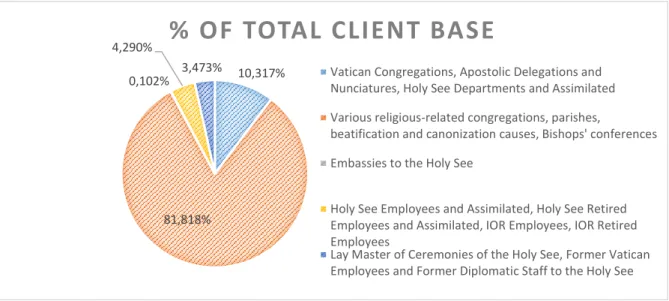
24 The client base of the institute is restrictive to individuals and entities that have some connection to the Holy See, as seen in the statutes of the Institute (See appendix for Client Base)vii. The main goal of the institute is to serve the Holy See and activities associated to it. Nevertheless, the broadening of the service to other categories of clients permits greater synergies for the fulfilment of its primary mission – more funds means more disposables and consequently higher profits on investments, which is beneficial to everyone, for the Institute received fees for its service to clients and could invest the money in a broader portfolio. The logic is the same as any financial institution.
Figure 6 - Client profile in number of clients
Source: Moneyval report, 4th July 2012
Values of the IOR
The IOR in itself does not state, either in its statutes or in any official document, the values under which it operates. However, being a Catholic institution dependent of the Holy See it is expected to follow the values the Church defends, in particular those that affect the institutional context it is inserted in, which are expressed through the Social Doctrine of the Catholic Church. Such values are aggregated into four main principles, which consist in i) the respect for the human being, ii) solidarity, iii) subsidiarity and iii) common good (See Appendix Permanent Principles of Catholic Social Doctrine)viii.
However, Catholic Social Doctrine Principles did not avoid the emergence of problems and accusations in the lifetime of the institution, regarding common problems of financial
10,317%
81,818% 0,102% 4,290%
3,473%
% OF TOTAL CLIENT BASE
Vatican Congregations, Apostolic Delegations and Nunciatures, Holy See Departments and Assimilated Various religious-related congregations, parishes,
beatification and canonization causes, Bishops' conferences Embassies to the Holy See
Holy See Employees and Assimilated, Holy See Retired Employees and Assimilated, IOR Employees, IOR Retired Employees
Lay Master of Ceremonies of the Holy See, Former Vatican Employees and Former Diplomatic Staff to the Holy See
25 institutions. This contrast with the values of a Catholic institution, which is to be light to the world in its operations. Business obscurity in its financial activities was a constant accusation of the media and the financial industry and this had repercussions on operations of the IOR in the market and in civil society (See appendix 4 - main irregular cases of the IOR). For this, throughout the last five years before the writing of this case study, IOR’s approach for the solution for these issues was, among other factors, to be transparent with its stakeholders – market stakeholders, clients and civil society – in order to impose a straight conduct that is verified through scrutiny of theseix.
2.3 History and Important Facts on the IOR
The foundation of the IOR, under this designation, took place in 1942 with Pope Pius XII. The operating currency for the Institute and all Holy See was the Lira and, in 1999, the Euro. In the beginning of the 90’s there was a revision of its statutes.
IOR is part of the independent financial system of the Vatican City State, and its history is deeply connected with the background of the finances of the Vatican City State since its foundation in 1929, with the Lateran Treaty. The Lateran treaty was the culmination of the conflict between Italy and the Holy See on Papal territory conquered by Italy. The treaty sat peace through the revocation of claims on the conquered territories on the part of the Holy See and its consequent financial compensation in 750 million liras and consolidated bearer bonds with a coupon of 5% with nominal value of one billion liras, as well as an uncontested territory, the Vatican City Statex. After the treaty an agreement was issued concerning the use of the lira by the new Vatican State, currency that the new state was allowed to issue under a set of conditionsxi.
The State that resulted from the process of these treaties, the Vatican City State, is autonomous by nature and financially independent. This made it, therefore, independent from Italian regulation. This way, the Vatican City State is able to exchange liras directly for other currency so the Pope was not subject to another authorityxii.
Under this paradigm that in the 19th of June of 1942 Pope Pius XII founds the Istituto per le
Opere di Religione, an institute with juridical personality of its own, therefore having responsibility for its own activities. Its first client and principal aim was to serve the Holy See with its financial servicesxiii.
26 Reform of the Statutes
Past the second world war, IOR’s activity developed and it engaged in a series of investments in Italian companies, especially in the 80’s, under the leadership of the American Archbishop Paul Marcinkus. Some of these investments, in the end, proved to be ruinous and ethically challenging, in some cases resulting in scandals in the public opinion. For example, the investment of the IOR in Banco Ambrosiano turned out to be a big failure, with associated cases of money laundering (see appendix main irregular cases of the IOR)xiv. Consequently to these cases, on the first of March of 1990, Pope John Paul II wrote a Chirograph1 on the IOR, with the intention of better “adapting it to the exigencies of the present times”, in which it establishes new statutes for the Institute, which included a new governance organization. In this new configuration, which is in practice as of today, two novelties are introduced: the existence of a board of layman, experts in banking and the figure of a Prelate, who was a Pope’s delegate and who is present in all deliberations of the Institutes’ organs and in its operational activities, in order to report to the highest council and representative of the Pope, the council of cardinals.xv.
The Euro
With Italy’s adoption of Europe’s unique currency in 1999 the Vatican City State decided that it was to follow Italy and make an agreement with the European union to join the Euro. This act created a peculiar situation, for the Vatican City State was not an integrated financial system in the Eurozone, it was not part of the European Union and it remained independent from its supervision, essentially just sharing the same currencyxvi. The IOR, therefore, was connected to the European network in a special way, for it was not supervised by any institution or body, unlike all other financial institutions in the Eurozone who were regulated by an independent entity.
With the Euro we arrive at the preceding time of the transparency process of the IOR, that was to start in 2008. On the 17th of December 2009, the Vatican City State would settle with the European Union the adoption of anti-money laundering measures, which was a formal sign of its compromise in the process of transparency of its financial institutions, through the sharing
27 of confidential information for guaranteeing the soundness of its operations. This would affect the IOR directly, for it was in this particular institution of the Vatican City State that this form of white-collar crime was more felt throughout its history.
2.4 Historical Problems of the IOR
Throughout its history, the IOR went through problems of people who sought to use the institute as a means for illicit gain. To understand the reasons why this happens it is necessary to understand the circumstances where the institute is inserted and its history.
There was a set of problems through which the IOR went through in its existence, some of which were very mediatized – cases that involved dubious investments with the Italian businessman Michele Sindona, who was a financial advisor for the Holy See and with the Italian banker Roberto Calvi, which resulted in cases such as the Banco Ambrosiano bankruptcy referred before. More recently, under the new statutes of the IOR, other cases emerged, which involved the then Prelate of the Institute, Monsignor Donato de Bonis, who, creating fictional foundations or using existing entities of such kind used its accounts to manage funds for political and personal matters of third persons. Due to this, later the institute prohibited IOR’s employees or associates to manage third party accounts.xvii Finally, the most recent case arouse in June of 2013, which is related to Monsignor Nunzio Scarano, an accountant of one of the Vatican’s financial institutions, who is arrested and being investigated for two different operations. The alleged operations are, first, of having withdrawn 560 thousand dollars in cash from his account in the IOR and bring it to Italy in order to pay for his house mortgage. The issue involved is the fact that the origin of the funds is not attested to be licit, and allegedly, the Monsignor used a scheme of dividing the money between some friends in smaller amounts to pass unnoticed. The second case involved the unsuccessful plot to introduce in Italy 20 million dollars coming through a governmental airplane in Switzerland, whose origin was also dubious, together with some of his friends. At the moment of the writing of this case study the investigation was not concluded yet.xviii
To look for the genesis of these cases, nevertheless, is never a clear cut situation to the public nor there is a clear cut solution. The testimony of a Vatican insider who follows economic issues of the Vatican City State and of the Holy See attributes the problem to a structural issue:
28
”IOR’s problems are in fact connected to its lack of transparency. The IOR is an institution that was impossible to control from outside of it, because it was constructed and made to function in an incontrollable, not understandable way, unable to hold account” (Interview to Vaticanist2 A)xix.
In fact, until December 2010, the structure of the IOR consisted in a board of supervision, in practice an administration board, who met according to the statutes once every three months and a supervising organ, the Cardinals commission.xx Very little information came out public regarding the institute, no independent entity followed the IOR’s activities to check the regularity of what it was doing and the unit who was in charge of prosecuting illicit situations, the Gendarmerie, was small and specialized in small crimes, such as theftxxi. All control on the operations of the IOR was therefore, made essentially by the IOR itself.This helped the arousal of a series of circumstances in IOR’s operations that contributed to the stories that emerged. According to multiple sources, until 1995 the IOR was accepting, similarly to what happened in Swiss banks, numbered accounts – situation when the holder of the account did not need to be identified by name to manage his money, but by an account number.
“What they (numbered accounts) usually do is attract money. Money of whom? Of those who don’t want that people know the money is theirs, but want to keep the money. For example, if I was a drug dealer and making a living out of it, (…) if I wanted to keep myself undercover maybe a way to do it would be to find a place who would accept my money and give me a document saying it was received (…) so it would be at my reach. ” (Interview with Lawyer following IOR affairs)xxii.
These accounts were finished in 1995, time when there was an analysis of all accounts and computerization of the account system.xxiii.
“(…) when they (IOR) say that there are no numbered accounts – it means that there aren’t anymore. They made their job. In 1995, they got an external company to revise their accounts, they got PriceWaterHouse to do it (…) on a KYC3 process” (Interview with expert on financial matters of the Holy See)xxiv.
However, for many experts the problem that led to illicit behaviors did not reside in guaranteeing that the ownership of the account is disclosed, but rather on the operations that were developed through the accounts.xxvA Vaticanistrecalls thatthe danger of the accounts
2 Vaticanist – Journalist especially accredited by the Holy See