42 Radiol Bras. 2011 Jan/Fev;44(1):42–46
Impact of enteral nutrition on acute toxicity and treatment
continuity in head and neck cancer patients submitted
to intensity-modulated radiotherapy
*
Impacto da nutrição enteral na toxicidade aguda e na continuidade do tratamento dos pacientes com tumores de cabeça e pescoço submetidos a radioterapia com intensidade modulada
Liêvin Matos Rebouças1, Elisabeth Callegaro2, Gabriel Oliveira Bernardes Gil3, Maria Letícia Gobo Silva4, Maria Aparecida Conte Maia5, João Victor Salvajoli6
Objective: The present study was aimed at analyzing the impact of enteral nutrition on the maintenance of body weight and on the necessity of replanning and/or interruption of treatment of head and neck cancer patients undergoing intensity-modulated radiotherapy (IMRT). Materials and Methods: Cases of patients submitted to IMRT in the period from January 2005 to October 2008 were retrospectively reviewed, and 83 of them were included in the study. Results: Median patients’ age was 58.6 years. Only five patients (6%) had their treatment interrupted for a period ranging from 4 to 18 days, and in 19 cases (23%) required replanning. Enteral nutrition was initiated before the radiotherapy in 16 patients (19%). Weight loss of ≥ 5% was observed in 58 patients (70%), with a higher prevalence in the group of patients who had not received pre-radiotherapy enteral nutrition. No significant difference was observed between the groups regarding the necessity of radiotherapy replanning (25% versus 21%; p = 0.741) and necessity and duration of treatment interruption. Conclusion: Enteral nutrition is of a great value in the body weight maintenance, but no benefit was observed with the performance of endoscopic percutaneous gastrostomy as compared with radiotherapy interruption/replanning. Keywords: Radiotherapy; IMRT; Enteral nutrition; Head and neck tumors; Toxicity.
Objetivo: Analisar o impacto da terapia nutricional enteral na manutenção do peso corpóreo e na necessidade de replanejamento e/ou interrupção da radioterapia em pacientes com câncer de cabeça e pescoço submetidos a radio-terapia de intensidade modulada (IMRT). Materiais e Métodos: Foram analisados, retrospectivamente, os pacientes submetidos a IMRT entre janeiro de 2005 e outubro de 2008, com a inclusão de 83 casos. Resultados: A idade mediana foi de 58,6 anos. Em apenas em cinco pacientes (6%) houve interrupção do tratamento, que variou de 4 a 18 dias, e em 19 casos (23%) houve necessidade de replanejamento. A terapia nutricional enteral foi instituída antes do início da radioterapia em 16 pacientes (19%). Perda de peso ≥ 5% ocorreu em 58 casos (70%), sendo mais pre-valente no grupo de pacientes em que a terapia nutricional enteral não foi instituída pré-radioterapia. Na comparação entre os grupos não houve diferença significativa na realização de replanejamento (25% versus 21%; p = 0,741) ou na ocorrência e duração da interrupção da radioterapia. Conclusão: A terapia nutricional enteral tem um claro ganho na manutenção do peso corporal, porém, não houve um benefício na realização da gastrostomia percutânea endos-cópica ou da sonda nasoenteral em relação à interrupção e ao replanejamento da radioterapia.
Unitermos: Radioterapia; IMRT; Nutrição enteral; Tumores de cabeça e pescoço; Toxicidade. Abstract
Resumo
* Study developed at Hospital A. C. Camargo, São Paulo, SP, Brazil.
1. MD, Radiation Oncologist, Instituto do Câncer do Ceará, Fortaleza, CE, Brazil.
2. Medical Student, Faculdade de Ciências Médicas da Santa Casa de São Paulo, Student of Scientific Initiation at Fundação Antônio Prudente, Hospital A. C. Camargo, São Paulo, SP, Brazil. 3. MD, Radiation Oncology Resident, Hospital A. C. Camargo, São Paulo, SP, Brazil.
4. Master, MD, Radiation Oncologist, Department of Radiation Oncology, Hospital A. C. Camargo, São Paulo, SP, Brazil.
5. Master, MD, Head of the Department of Radiation Oncol-ogy, Hospital A. C. Camargo, São Paulo, SP, Brazil.
6. PhD, MD, Radiation Oncologist, Instituto do Câncer do Estado de São Paulo (Icesp), São Paulo, SP, Brazil.
Mailing Address: Dr. Liêvin Matos Rebouças. Rua Doutor José Lourenço, 1154, ap. 202, Aldeota. Fortaleza, CE, Brazil, 60115-281. E-mail: [email protected]
Rebouças LM, Callegaro E, Gil GOB, Silva MLG, Maia MAC, Salvajoli JV. Impact of enteral nutrition on acute toxicity and treatment continuity in head and neck cancer patients submitted to intensity-modulated radiotherapy. Radiol Bras. 2011 Jan/Fev;44(1):42–46.
INTRODUCTION
Head and neck cancer is the sixth most prevalent tumor in the world and the use of tobacco and alcohol are accountable for 75% of neoplasias in this region(1,2). The
role of infection by human papilloma virus seems to be important, mainly in oropha-ryngeal carcinomas, particularly in young adult individuals(3). The treatment for head
and neck cancer consists of surgery,
fol-lowed or not by radiotherapy (RT) or radi-cal RT, concomitantly or not with chemo-therapy.
Intensity-modulated radiotherapy (IMRT) has been demonstrating to be ad-vantageous over traditional techniques such as conventional (2D) RT and confor-mational (3D) RT, as it provides a more homogeneous dose coverage of the target volume, while reducing the dose to adja-cent tissues(4,5).
The increase in dose is related to an improvement in the tumor management Received July 19, 2010. Accepted after revision November 25,
and to a better survival rate. In this sce-nario, IMRT also plays an important role in improving quality of life, as it is capable of preserving the function of some organs adjacent to the target volume, for example, the salivary glands(6).
Malnutrition is a frequent outcome in head and neck cancer patients, not only by the tumor itself, but also as a result of the treatment which can commonly cause side effects such as dysgeusia, dysphagia, xe-rostomia and mucositis(7,8).
In spite of the clear dosimetric gain which can be translated into late toxicity re-duction, patients undergoing IMRT may present important acute toxicity during or immediately after the treatment comple-tion, which may adversely impact on nutri-tional status maintenance and cause inter-ruptions of the treatment. The radiation treatment interruption due to toxicity is one of the effects that should be avoided, as it extends the total treatment time and, as a result, causes a decrease in local control(9).
Reports in the literature correlate treatment interruption for only one day with a de-crease of 1.4% in local control, and inter-ruption for one week, with a decrease in local control by 10% to 12%(10). Enteral
nutritional therapy during RT may mini-mize the impact of adverse side effects, such as weight loss and treatment interrup-tions. The most commonly used forms of enteral nutritional therapy are percutaneous endoscopic gastrostomy and nasoenteric feeding tube(11,12).
In the present study, the weight loss of patients submitted to IMRT was quantified and correlated with the need of radio-therapy replanning and/or interruption. Additionally, we evaluated the impact of the pre-radiation introduction of nutri-tional support techniques such as endo-scopic percutaneous gastrostomy or nasoenteric feeding tube on body weight and total treatment time in head and neck cancer patients.
MATERIALS AND METHODS
Population and inclusion criteria
Records of all the head and neck can-cer patients submitted to IMRT at Hospi-tal A.C. Camargo, São Paulo, Brazil, be-tween January of 2005 and October of
2008 were retrospectively evaluated. Pa-tients submitted to definite radical or adju-vant RT, in association or not with chemo-therapy, were included. As an inclusion criterion, it was established that, besides the primary lesion or tumor bed, IMRT would have as a target volume either uni-lateral or biuni-lateral cervical lymph nodes regions. Thus, we avoided the inclusion of cases in which minimal adverse side effects related to IMRT were expected because of the reduced target volume, which could, consequently, lead to an additional confu-sion factor for the interpretation of results. Among the 123 patients, 40 were ex-cluded due to: focal irradiation only (14), uncompleted radiation treatment for other causes than the associated toxicity (2), pre-vious history of RT in the tumor region (10) and absence of data about the body weight (14). Therefore, 83 patients were included in the study.
The study was submitted to the Com-mittee for Ethics in Research of the insti-tution, and approved under No. 1164/08.
Treatment description
Preceding the RT, all the patients were submitted to nutritional evaluation and were informed of the possible RT toxicity. They were offered the option of being sub-mitted to enteral nutritional therapy, either by nasoenteral tube or by endoscopic per-cutaneous gastrostomy. The simulation was performed with the patient in supine posi-tion and thermoplastic masks were utilized for immobilization. The patients were then submitted to computed tomography (CT scan) for the radiotherapy planning. The IMRT field arrangement consisted of seven coplanar beams, with no field match line, covering the entire treatment volume, in-cluding the supraclavicular fossae when they were part of the target volume.
During the course of RT, the patients had their weight measured on a daily basis, and were submitted to a weekly review with the radiation oncologist for assess-ment ofthe occurrence of morbidity related to the treatment, particularly dysphagia, odynophagia, xerostomia and mucositis. The toxicity was classified according to the acute morbidity criteria of the Radiation Therapy Oncology Group(13) and grouped
into grades ≤ 2, and grades > 2. In this same
classification system, weight loss is given grade 1 for loss of up to 5% of initial weight, grade 2, between 5% and 15%, and grade 3, the loss greater than 15%(13).
At least one CT scan was performed during the course of RT, around the 15th treatment fraction, when the changes in treatment volumes and necessity of replan-ning would be evaluated.
Statistical analysis
Descriptive analysis was utilized to summarize the patients’ characteristics, site of the primary tumor, performed treatment (surgery, neo- or adjuvant chemotherapy, and enteral nutritional therapy), and toxic-ity. The correlation between RT interrup-tion and the variables weight loss and pre-RT enteral nutritional therapy was evalu-ated by the Fisher’s exact test, while the continuous variables were compared by the Student’s t test, and its correlation was as-sessed by the Pearson’s correlation.
RESULTS
Patients’ characteristics
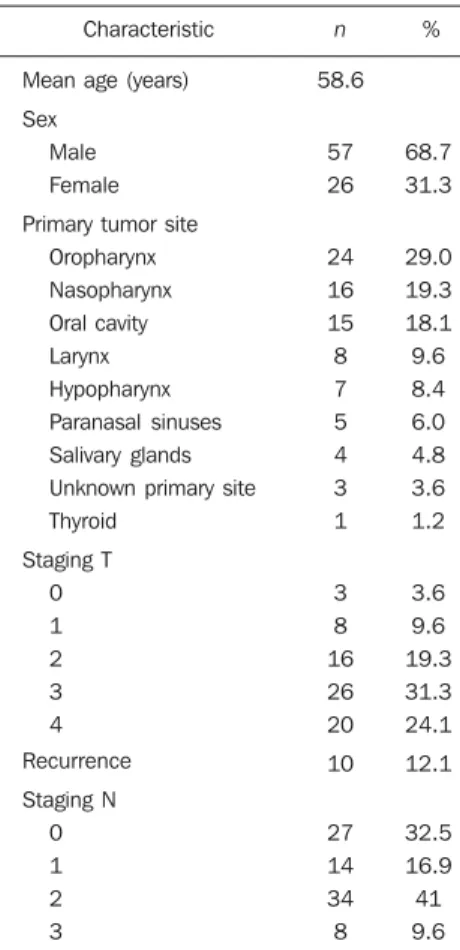
The median age was 58.6 years, with a predominance of male individuals (68.7%) and the oropharynx being the most frequent primary tumor site. Most patients presented locally advanced tumors, T3 or T4, and 67% presented positive lymph nodes (N1-N3) (Table 1).
Treatment characteristics
In 52 (63%) patients, IMRT was indi-cated as an adjuvant after surgical resec-tion, and in 31 (37%) the RT was definitive. Radiotherapy with concomitant chemo-therapy was performed in 45 (55%) pa-tients, and the other 38 (45%) patients re-ceived RT alone. All the patients in the study underwent irradiation of the cervical chain, bilaterally in 69 (83%) patients and unilaterally in 14 (17%) patients. The me-dian final radiation dose was 66 Gy, rang-ing between 50 and 72 Gy.
inter-ruption was longer than 9 days, achieving 18 days. Replanning due to changes in volume was required for 19 patients, 17 of them requiring replanning only once, and two twice.
In only 16 patients (19%) enteral nutri-tional therapy was performed before RT beginning, i.e., with a prophylactic intent. Among these patients, 14 (87.5%) under-went percutaneous gastrostomy and only 2 (12.5%) underwent nasoenteral intubation.
Toxicity
The presence of significant toxicity was frequently observed during treatment. The number of patients with mucositis, dysph-agia or odynophdysph-agia and xerostomia > grade 2 at any moment during the course of RT corresponded, respectively, to 54 (64%), 21 (25%) and 34 (41%).
Weight loss ≥ 5% of the pre-RT body weight was observed in 58 patients, of which 18 (26.4%) required treatment re-planning. Among the 25 patients who did not present weight loss > 5%, only one
went concomitant chemotherapy and RT, and 10% underwent pre-RT induction che-motherapy.
Combined RT/chemotherapy in patients with head and neck tumors is associated with a considerable incidence of grade 3 acute toxicity. A high degree of acute mu-cositis impairs a proper dietary intake. Thus, enteral nutritional therapy becomes an important tool for such patients. The analysis demonstrates that enteral nutri-tional therapy plays a relevant role in the maintenance of the body weight, as the patients who underwent pre-RT nutrition therapy experienced lesser weight loss as compared with those who didn’t.
In the study developed by Corry et al., a statistically significant difference was observed in relation to weight loss among the forms of enteral nutritional therapy. The patients who underwent nasoenteral intu-bation have averagely lost 3.7 kg, while those who were submitted to percutaneous endoscopic gastrostomy gained 0.8 kg(7).
This same study demonstrated that the nasoenteral tube tends to move out of po-sition more easily, requiring repopo-sitioning in 62% of cases, while, with percutaneous endoscopic gastrostomy, repositioning was required in only 19% of the patients. How-ever, infections were more prevalent in the Table 1 Patients’ characteristics. (0.25%) required replanning (p = 0.009;
Fisher’s exact test).
Enteral nutritional therapy
In spite of the expected positive rela-tionship between the use of enteral nutri-tional therapy and a less frequent occur-rence of weight loss ≥ 5% (Table 2), it was not possible to establish a significant cor-relation between utilization of enteral nu-tritional therapy and a lower replanning occurrence. Among the 16 patients who received enteral nutritional therapy, 9 (56.3%) did not require replanning, while among the 67 who did not receive prophy-lactic enteral nutritional therapy, 55 (82%) did not require replanning (p = 0.741; Fisher’s exact test).
The utilization of enteral nutritional therapy did not demonstrate any significant correlation with the occurrence of RT in-terruption, nor with its duration (Table 3).
DISCUSSION
Patients with advanced head and neck cancer require concomitant RT and chemo-therapy. Cisplatin and cetuximab are the drugs most frequently utilized as systemic therapy for head and neck tumors(14). In the
present study, 55% of the patients
under-Table 3 Enteral nutritional therapy versus RT interruption.
Days 0 4 9 18 Total
With enteral nutritional therapy
Without enteral nutritional therapy n 14 1 1 0 16 % 87.5 6.25 6.25 0 100 n 64 0 2 1 67 % 95.5 0 3.0 1.5 100
p = 0,226, two-ratio test. n, Number of patients. Characteristic
Mean age (years)
Sex Male Female
Primary tumor site Oropharynx Nasopharynx Oral cavity Larynx Hypopharynx Paranasal sinuses Salivary glands Unknown primary site Thyroid Staging T 0 1 2 3 4 Recurrence Staging N 0 1 2 3 n 58.6 57 26 24 16 15 8 7 5 4 3 1 3 8 16 26 20 10 27 14 34 8 % 68.7 31.3 29.0 19.3 18.1 9.6 8.4 6.0 4.8 3.6 1.2 3.6 9.6 19.3 31.3 24.1 12.1 32.5 16.9 41 9.6
n, Number of patients.
Table 2 Enteral nutritional therapy versus weight loss.
Weight loss
< 5% or no loss ≥ 5% and < 10%
≥ 10% Total
With enteral nutritional therapy
Without enteral nutritional therapy n 6 10 0 16 % 37.5 62.5 0 100 n 19 26 22 67 % 28.4 38.8 32.8 100
group that received percutaneous endo-scopic gastrostomy (66%) than in the group that received nasoenteral tube (30%). Other complications resulting from nasoenteral intubation were pharyngeal ulceration, re-fusal of reintubation, and discomfort caused by the tube, while with percutaneous endo-scopic gastrostomy the complications were tube obstruction and colonies grow in the ileum. In the study developed by Scolapio et al., percutaneous endoscopic gastros-tomy is recommended as the enteral nutri-tional therapy when it extends for more than four weeks, considering that, after that period, the presence of a nasoenteral tube is related to laryngeal irritation, gastroe-sophageal reflux, necrosis and sinusitis(15).
In the present study, the possible differ-ences between nasoenteral intubation and percutaneous endoscopic gastrostomy were not evaluated because of the small number of patients submitted to pre-RT enteral nutritional therapy (only 16 cases).
Only five (6%) patients required RT interruption, but in four of these cases the interruption was longer than nine days, a fact that tends to reduce the local control, as demonstrated in the study developed by Bese et al., where the interruption of the treatment for a single day caused a decrease of 1.4% in local management, while in one-week interruptions such decrease ranged between 10% and 12%(10).
It was not possible to establish a corre-lation between the need for RT replanning and enteral nutritional therapy. Replanning is required in cases where the patient pre-sents a significant weight loss, with body volume decrease, or in the presence of a tumor volume decrease, and in such cir-cumstances a new immobilization mask has to be made and subsequently a new treatment plan has to be established. In the present study, it was expected that patients who had not been submitted to enteral nu-tritional therapy and, therefore, presented a greater weight loss, would require a higher number of replannings. Such a cor-relation was not present, possibly because of the small size of the sample, and also for the fact that only the patients who received prophylactic (i.e. pre-RT) enteral nutri-tional therapy were considered, and not those who received on a reactive basis, during RT.
Besides mucositis, other symptoms aris-ing from the treatment may considerably affect the patients’ nutritional status. Xe-rostomia, dysphagia and dysgeusia/ageusia have an influence on the appetite loss and, consequently, on the weight loss(16).
Inten-sity-modulated radiotherapy may play a significant role in the minimization of at least two of such symptoms.
One of the great advantages of IMRT is the reduction of the rates of late xerostomia because of the reduction of the dose on the salivary glands, particularly the parotid glands. In the present study, 41% of the patients presented xerostomia > grade 2 during RT, a finding similar to the one ob-served by Chao et al.(17), who have also
demonstrated that, although most patients presented dry mouth as a symptom during RT, the salivary glands presented good re-covery of their function. In the present study, only patients submitted to IMRT technique were analyzed, therefore no comparison was made with the toxicity associated with conventional RT. The study developed by Kam et al.(18) shows that
pa-tients submitted to IMRT presented xeros-tomia grade 2 to 4, with a much lower tox-icity as compared with patients who under-went conventional RT (46.4% versus 85.7%, respectively; p = 0.002), a fact that demonstrates the relevance of IMRT in the reduction of late toxicity.
Dysphagia is a frequent symptom in patients with head and neck cancer. Changes in deglutition caused by the pres-ence of the tumor itself are expected(19).
Additionally, RT becomes a further factor for the occurrence and severity of dysph-agia. Einsbruch et al. have demonstrated that an important mechanism would be the injury of the pharyngeal constrictor muscles additionally to the glottic and su-praglottic segments of the larynx in patients undergoing radio-chemotherapy(20). In
an-other study, Gokhale et al. have shown a direct relationship between a higher radia-tion dose to the pharyngeal constrictor muscles and the need to extend the use of enteral nutritional therapy(21). Reports of up
to 20% of long-term dependence on enteral nutritional therapy are found in the litera-ture. Therefore, a reasonable strategy would be the planning of IMRT striving to achieve a lower radiation dose to structures
related to deglutition, thus reducing the incidence and severity of dysphagia, which may lead to a lower dependence on enteral nutritional therapy.
There are recent reports in the literature suggesting that a reactive approach with enteral nutritional therapy provides excel-lent results with respect to morbidity, de-pendence on enteral nutritional therapy and adherence to the treatment. Additionally, prophylactic percutaneous endoscopic gas-trostomy, in spite of the lesser weight loss, leads to a higher risk for late esophageal stenosis(22).
These factors bring into question the tendency of systematically performing pro-phylactic enteral nutritional therapy in pa-tients who will be submitted to IMRT for head and neck tumors. However, further studies with more careful analyses of qual-ity of life are necessary to identify those patients who might actually benefit from such an approach.
CONCLUSION
Body weight loss > 5% was related to a greater probability of RT replanning. In spite of the noticeable benefits of percuta-neous endoscopic gastrostomy or nasoen-teral intubation in the maintenance of body weight, no gain was observed with prophy-lactic enteral nutritional therapy in relation to RT interruption or replanning. Consid-ering the currently available medical evi-dences, we could not objectively recom-mend the moment during RT course to in-stitute enteral nutritional nor the most ap-propriate technique to be performed. The decision making shall be done on an indi-vidual basis at each institution, and adapted to the needs of each patient.
REFERENCES
1. Parkinuyt DM, Bray F, Ferlay J, et al. Global can-cer statistics, 2002. CA Cancan-cer J Clin. 2005;55: 74–108.
2. Vineis P, Alavanja M, Buffler P, et al. Tobacco and cancer: recent epidemiological evidence. J Natl Cancer Inst. 2004;96:99–106.
3. Psyrri A, Gouveris P, Vermorken JB. Human papillomavirus-related head and neck tumors: clinical and research implication. Curr Opin Oncol. 2009;21:201–5.
5. Salvajoli JV, Souhami L, Faria SL. Radioterapia em oncologia. Rio de Janeiro, RJ: Medsi; 1999. 6. Fang FM, Chien CY, Tsaai WL, et al. Quality of life and survival outcome for patients with na-sopharyngeal carcinoma receiving three-dimen-sional conformal radiotherapy vs. intensity-modulated radiotherapy – a longitudinal study. Int J Radiat Oncol Biol Phys. 2008;72:356–64. 7. Corry J, Poon W, McPhee N, et al. Prospective
study of percutaneous endoscopic gastrostomy tubes versus nasogastric tubes for enteral feeding in patients with head and neck cancer undergo-ing (chemo) radiation. Head Neck. 2009;31:867– 76.
8. Meuric J, Garabige V, Blanc-Vincent MP, et al. Bonnes pratiques pour la prise en charge diététi-que des patients atteints de cancer des voies aéro-digestives supérieures. Bull Cancer. 1999;86: 843–54.
9. Tyldesley S, Sheehan F, Munk P, et al. The use of radiologically placed gastrostomy tubes in head and neck cancer patients receiving radiotherapy. Int J Radiat Oncol Biol Phys. 1996;36:1205–9. 10. Bese NS, Hendry J, Jeremic B. Effects of
prolon-gation of overall treatment time due to unplanned interruptions during radiotherapy of different tu-mor sites and practical methods for compensa-tion. Int J Radiat Oncol Biol Phys. 2007;68:654– 61.
11. van Bokhorst-de van der Schueren MA. Nutri-tional support strategies for malnourished cancer patients. Eur J Oncol Nurs. 2005;9 Suppl 2:S74– 83.
12. Dias MCG, Nadalin W, Baxter YC, et al. Acom-panhamento nutricional de pacientes em radiote-rapia. Rev Hosp Clin Fac Med Univ São Paulo. 1996;51:53–9.
13. Cox JD, Stetz J, Pajak TF. Toxicity criteria of the Radiation Therapy Oncology Group (RTOG) and the European Organization for Research and Treatment of Cancer (EORTC). Int J Radiat Oncol Biol Phys. 1995;31:1341–6.
14. Koukourakis MI, Tsoutsou PG, Karpouzis A, et al. Radiochemotherapy with cetuximab, cisplatin, and amifostine for locally advanced head and neck cancer: a feasibility study. Int J Radiat Oncol Biol Phys. 2010;77:9–15.
15. Scolapio JS, Spangler PR, Romano MM, et al. Prophylactic placement of gastrostomy feeding tubes before radiotherapy in patients with head and neck cancer: is it worthwhile? J Clin Gastro-enterol. 2001;33:215–7.
16. Di Liberto C, Caroprese M, Pizzo G, et al. Oral complications in patients with head and neck cancer after radio-chemotherapy. Mucositis and xerostomia. Recenti Prog Med. 2007;98:302–14. 17. Chao KS, Majhail N, Huang CJ, et al. Intensity modulated radiation therapy reduces late salivary
toxicity without compromising tumor control in patients with oropharyngeal carcinoma: a com-parison with conventional techniques. Radiother Oncol. 2001;61:275–80.
18. Kam MK, Leung SF, Zee B, et al. Prospective ran-domized study of intensity-modulated radio-therapy on salivary gland function in early-stage nasopharyngeal carcinoma patients. J Clin Oncol. 2007;25:4873–9.
19. Nguyen NP, Smith HJ, Sallah S. Evaluation and management of swallowing dysfunction follow-ing chemoradiation for head and neck cancer. Curr Opin Otolaryngol Head Neck Surg. 2007;15: 130–3.
20. Eisbruch A, Schwartz M, Rasch C, et al. Dysph-agia and aspiration after chemoradiotherapy for head-and-neck cancer: which anatomic structures are affected and can they be spared by IMRT? Int J Radiat Oncol Biol Phys. 2004;60:1425–39. 21. Gokhale AS, McLaughlin BT, Flickinger JC, et