abstract
Characterization of aqueous silver nitrate solutions
for leakage tests
José Ferreira COSTA1, Walter Luiz SIQUEIRA2, Alessandro Dourado LOGUERCIO3, Alessandra REIS3, Elizabeth
de OLIVEIRA4, Cláudia Maria Coelho ALVES1, José Roberto de Oliveira BAUER1, Rosa Helena Miranda GRANDE5
1- DDS, PhD, Assistant Professor, Department of Operative Dentistry, Dental School, Federal University of Maranhão, São Luiz, MA, Brazil. 2- DDS, PhD, Assistant Professor, Schulich School of Medicine & Dentistry, University of Western Ontario, London, ON, Canada. 3- DDS, PhD, Adjunctive Professors, Department of Restorative Dentistry, State University of Ponta Grossa, Ponta Grossa, PR, Brazil. 4- Professor, Institute of Chemistry, University of São Paulo, São Paulo, SP, Brazil.
5- DDS, PhD, Associate Professor, Department of Dental Materials, Dental School, University of São Paulo, São Paulo, SP, Brazil.
Corresponding address: - Rosa Helena Miranda Grande - Avenida Prof. Lineu Prestes, 2227 - Cidade Universitária - 05508-900 - São Paulo - SP - Phone/ Fax: +55-11-3091-7840 - e-mail:[email protected]
Received: June 4, 2009 - Modiication: October 9, 2009 - Accepted: February 16, 2010
O
bjectives: To determine the pH over a period of 168 h and the ionic silver contentin various concentrations and post-preparation times of aqueous silver nitrate solutions. Also, the possible effects of these factors on microleakage test in adhesive/resin restorations in primary and permanent teeth were evaluated. Material and Methods: A digital pHmeter was used for measuring the pH of the solutions prepared with three types
of water (puriied, deionized or distilled) and three brands of silver nitrate salt (Merck, Synth or Cennabras) at 0, 1, 2, 24, 48, 72, 96 and 168 h after preparation, and storage
in transparent or dark bottles. Ionic silver was assayed according to the post-preparation
times (2, 24, 48, 72, 96, 168 h) and concentrations (1, 5, 25, 50%) of solutions by atomic
emission spectrometry. For each sample of each condition, three readings were obtained for calculating the mean value. Class V cavities were prepared with enamel margins on primary and permanent teeth and restored with the adhesive systems OptiBond FL or
OptiBond SOLO Plus SE and the composite resin Filtek Z-250. After nail polish coverage, the permanent teeth were immersed in 25% or 50% AgNO3 solution and the primary teeth
in 5% or 50% AgNO3 solutions for microleakage evaluation. ANOVA and the Tukey’s test
were used for data analyses (α=5%). Results: The mean pH of the solutions ranged from
neutral to alkaline (7.9±2.2 to 11.8±0.9). Mean ionic silver content differed depending on the concentration of the solution (4.75±0.5 to 293±15.3 ppm). In the microleakage test, signiicant difference was only observed for the adhesive system factor (p=0.000).
Conclusions: Under the tested experimental conditions and based on the obtained results,
it may be concluded that the aqueous AgNO3 solutions: have neutral/alkaline pH and service life of up to 168 h; the level of ionic silver is proportional to the concentration of
the solution; even at 5% concentration, the solutions were capable of indicating loss of
marginal seal in the composite restorations; the 3-step conventional adhesive system had better performance regarding microleakage in enamel on primary and permanent teeth.
Key words: Silver nitrate. Dental leakage. Adhesives.
INtrODUctION
The dye penetration technique is one of the most used methods for assessing marginal seal1,14
because it allows penetration of the substance to be
veriied in contrasting colors at the tooth-restoration
interface, without requiring a chemical reaction or the use of radioactive materials28,29. In spite of the
variety of dyes mentioned in the literature7, several
authors have used chemical tracers4,14,15,19,30, such as 50% silver nitrate (w/v) with special frequency
in microleakage assays, using different immersion times of specimens in the agent and different times to reveal the silver3,7,19. The amount and distribution
various micro-investigation techniques6,12,28,29,30.
Considering the penetration capacity of the silver nitrate solution, its use is considered a very severe test19 because the diameter of the silver ion is very small (0.059 nm) when compared to the mean size of a bacteria (0.5-1.0 µm)13.
Silver nitrate has been extensively used for analyzing the degradation at tooth/material interface, since Sano, et al.21 (1995) detected the presence
of silver nitrate in the hybrid layer, calling the phenomenon nanoleakage. Several authors15,16,26
adopted silver nitrate as a tracer for nanoleakage analysis because of its contrast quality observed in microleakage. By its use, it was possible to verify that there is discrepancy between the depth of the demineralized zone and monomer diffusion27, as a
result of the presence of water around the collagen
ibrils21.
In nanoleakage tests, the pH of silver nitrate
solutions, considered acid (4.3), would be
disadvantageous, since the samples remain immersed
for a long period (24 h)12,15. Therefore, some authors
developed buffered solutions25 and others indicated the use of a 5% silver methenamine solution (pH 8.1)9. However, in spite of their relevance, some of
the variables15,16,25 are not clear.
The aims of this study were to determine the pH over a period of 168 h and the ionic silver content in various concentrations and post-preparation times of aqueous silver nitrate solutions, as well as to verify the possible effects of these factors on microleakage test in class V composite restorations placed in primary and permanent molars.
MatErIaL aND MEtHODs
pH analysis
In the irst phase, the alterations in pH of 50% (w/v) aqueous silver nitrate solutions, stored for up
to 168 h, were observed. Water used as solvent for
the silver nitrate salt (AgNO3), was treated in three ways: 1) by distillation (Fisatom Equipamentos
Cientíicos, São Paulo, SP, Brazil), 2) by deionization (Permution; Krieger Cia Ltda, Curitiba, PR, Brazil), or 3) by puriication (Milli-Q; Millipore Corp, Billerica, MA, USA). Three brands of silver nitrate salt were selected: 1) Merck (Merck & Co Inc, Darmstadt, HE, Germany), 2) Synth (Labsynth, Diadema, SP, Brazil), or 3) Cennabras (Cennabras Ind & Com Ltda, Guarulhos, SP, Brazil). Two types of bottles were used (transparent or dark).
All bottles were coded with regard to the conditions of the experiment18 and 3 replicas per
condition were obtained to calculate the mean value. The solutions were prepared, pH readings were taken, and the bottles were stored in an acclimatized room
under conditions of ixed temperature (25°C) and relative humidity (60%).
The silver nitrate salt (2.5 g±0.01 g) was weighed
in an analytical balance Adventurer Series (OHAUS
Corp, Pine Brook, NJ, USA), 5.0 mL of water were
added and the was beaker placed on a magnetic
agitator MT2 (Amicon Div; WR Grace & Co, Beverly, MA, USA), with the speed (rpm) at level 4, for 3
min to homogenize the solution. A digital pHmeter
(Digimed – DM22; ServMed Analítica, Guarulhos, SP, Brazil), calibrated with standard solutions of pH 4.0 and 6.9, was used to take the pH readings. The pH readings were taken immediately, and after 1, 2, 24, 48, 72, 96 and 168 h.
Ionic silver analysis
The ionic silver was measured considering the
post-preparation age (2, 24, 48, 72, 96, 168 h) and concentration of solutions (1%, 5%, 25% and 50%), by means of the atomic emission spectrometry
(Spectroflame; Spectro Analytical Instruments,
Kleve, NW, Germany). All bottles were coded
according to the conditions of the experiment24 and
3 readings per condition were taken to calculate the mean value.
Microleakage test
To analyze the inluence of the adhesive system,
post-preparation time of the solution and concentration of solutions on the microleakage tests, Class V resin
restorations were made in permanent teeth (64 third molars) and primary teeth (20 molars). The teeth
were obtained by donation, after the research project
had been approved by the Research Ethics Committee of FOUSP (No. 151/2004).
The teeth were stored in 0.5% chloramine at 4°C for 7 days, cleaned and kept in distilled water until
the experimental stage. Then, they were cleaned with
pumice and ultrasonicated with distilled water for 5 min (Thornton Eletrônica Ltda, Vinhedo, SP, Brazil).
The roots were sealed with 2 layers of a fast drying nail polish (Maybelline; L’Oréal, New York, NY, USA),
embedded in plastic cylinders with acrylic resin, up to the height of the cervical portion. In each tooth, two class V cavities were prepared3, with standardized
dimensions of 4 mm (mesiodistal width), 2 mm (occlusogingival height) and 2 mm (depth) on the
buccal and lingual surfaces. Cylindrical diamonds burs
(FG 3100; KG Sorensen Ind. & Com. Ltda, Barueri, SP, Brazil) under constant water spray cooling
were used. The cavosurface angle of preparation was entirely located in enamel, without beveling21,
since one of the goals was to analyze the marginal seal2,5,10,14,22,24. The methodology for the primary teeth
was the same as described for the permanent teeth. The permanent teeth were divided into 8 groups
groups (n=5), considering two concentrations of solutions (5 and 50%) prepared 2 h before and two
adhesive systems.
The adhesive-restorative procedures were performed in an acclimatized room at a temperature
of 25°C and relative humidity of 60%, by a single
operator. After drying, the cavities were re-moistened20 with 2 µL of water applied with an
automatic pipette (Socorex ISBA S.A, Lausanne,
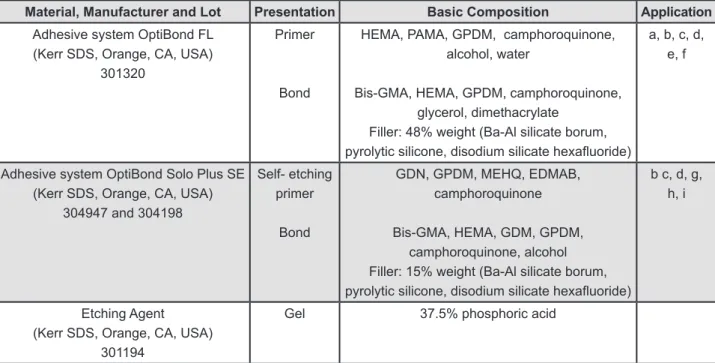
VD, Switzerland), and the adhesive systems were applied in accordance with the manufacturer’s speciications (Figure 1). The cavities were restored with Filtek Z-250 (3M ESPE, St. Paul, MN, USA) in
three horizontal increments, each one light-activated
for 40 s (Jet Lite 4000 Plus; J. Morita Corp, Suita, OSA, JPN).
The specimens were stored in distilled water at
37°C for 24 h1,4,15,23 in a humidiier incubator (Nova Ética Ind & Com Ltda, Vargem Grande Paulista, SP, Brazil). After this period, each restoration was inished with aluminum oxide disks (Sof-Lex; 3M ESPE) of different grain sizes (medium, ine, and extra-ine), under constant water cooling17.
The entire crown of each washed and dried specimen was covered with two layers of the nail polish, leaving exposed only a window of about 1 mm around each restoration.
After immersion in the silver nitrate solutions
for 2 h, the specimens were washed, immersed
in a photographic developer (Eastman; Kodak Co,
Rochester, NY, USA) for 8 h under luorescent light,
and then abundantly washed under running water4,19.
Afterwards, the specimens were sectioned parallel to the long axis in the mesiodistal direction, to obtain two halves with a restoration in each of them, which were then sectioned two times in the cervico-occlusal
direction, with diamond saws itted to a hard tissue cutting machine (Isomet 1000; Buehler Ltd, Lake Bluff, IL, USA).
Three sections with 4 surfaces of each restoration per tooth were obtained for visual analysis. To make
a linear quantiication of the tracer penetration at the bond interfaces, the images of the 4 surfaces
of each restoration were captured with a digital
camera (Hyper HAD; Sony Corp, Tokyo, TYO, JPN) coupled to a stereoscopic loupe (Citoval 2; Carls Zeiss Corp, Oberkochen, BW, Germany), using Vidcap 32 software. Digital images were generated at 20x magniication. Cavity depth was measured (mm) at
the gingival and occlusal walls as well as the depth of tracer penetration, by means of the IMAGELAB
2000 software, developed at LIDO (Computational Laboratory Dedicated to Dentistry at FOUSP). A percentage mean value was deined for each
restoration.
Data were analyzed by ANOVA and Tukey’s
test (α=5%)to determine the main effects and interactions between the factors of interest18.
Material, Manufacturer and Lot Presentation Basic Composition Application
Adhesive system OptiBond FL (Kerr SDS, Orange, CA, USA)
301320
Primer
Bond
HEMA, PAMA, GPDM, camphoroquinone, alcohol, water
Bis-GMA, HEMA, GPDM, camphoroquinone, glycerol, dimethacrylate
Filler: 48% weight (Ba-Al silicate borum,
pyrolytic silicone, disodium silicate hexaluoride)
a, b, c, d, e, f
Adhesive system OptiBond Solo Plus SE (Kerr SDS, Orange, CA, USA)
304947 and 304198
Self- etching primer
Bond
GDN, GPDM, MEHQ, EDMAB, camphoroquinone
Bis-GMA, HEMA, GDM, GPDM, camphoroquinone, alcohol Filler: 15% weight (Ba-Al silicate borum,
pyrolytic silicone, disodium silicate hexaluoride)
b c, d, g, h, i
Etching Agent
(Kerr SDS, Orange, CA, USA) 301194
Gel 37.5% phosphoric acid
Sequence of application: a) acid etching of cavity (15 s enamel + 15 s dentin); b) wash with water (30 s); c) vigorous drying
with air; d) wet cavity with water (2 μl); e) apply primer rubbing the surface (15 s) and apply light jet of air (5 s); f) uniform
application of bond FL in a single layer and light-activation 600mW/cm2 (30 s); g) apply self-etching primer SE rubbing the
surface lightly (15 s) and apply light jet of air (5 s); h) apply irst layer of bond SE rubbing lightly (15 s) and light jet of air (3
s); i) apply second layer of bond SE and light jet of air (3 s) and light-activation 600mW/cm2 (20 s)
rEsULts
In the pH analysis of 50% solution, there was a statistically signiicant difference (p<0.05) for the
factors salt brand, water purity, bottle type, but there was no difference for the factor post-preparation
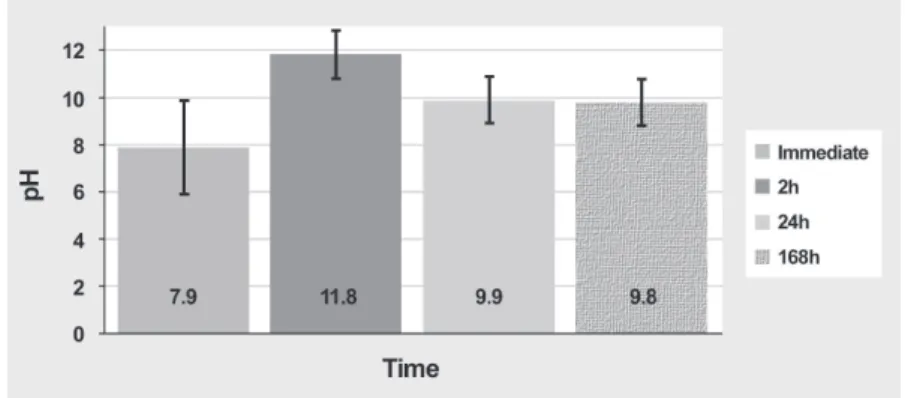
time (age) of solutions (p=0.99). The mean pH was always higher than 7 (7.9±2.2 to 11.8±0.9), under all of the 18 conditions (Figure 2).
In the analysis of ionic silver in the 5, 25 and 50% solutions, only silver amount was signiicantly different (p<0.01), that is, the higher the concentration of the
solution the higher the amount of silver. The age of
solution and interaction (TxC) showed no signiicant differences (p=0.30). The mean values are shown in
Figure 3, with variation of 4.75±0.5 to 293.5±15.3
ppm.
In the microleakage tests, the mean tracer penetration values were calculated according to the adhesive system, concentration and post-preparation
time of solutions (Table 1) for permanent teeth. For
primary teeth, the mean tracer penetration was calculated according to adhesive and concentration
of the solutions (Table 2). Only the factor Adhesive
allowed the detection of significant difference
(Tables 1 and 2, p=0.000). OptiBond FL showed the lowest mean values of penetration, irrespective of concentration or post-preparation time of solutions
(Tables 1 and 2).
Figure 2- Means and standard deviations of pH according to the post-preparation times of solutions
Figure 3- Distribution of the amount of ionic silver in the solutions according to the post-preparation times and concentrations
Concentration 25% 50%
Time 2 h 72 h 2 h 72 h
Adhesive FL SE FL SE FL SE FL SE
Mean ± standard deviation 1.6±0.4a 1.9±0.6b 1.2±0.8a 2.2±0.4b 1.6±0.4a 2.2±0.4b 1.6±0.3a 2.2±0.5b
Table 1- Mean values and standard deviations (mm) of tracer penetration in permanent teeth regarding adhesive systems according to concentration and post preparation time of solutions as well as statistical significance*
DIscUssION
The indings of this study showed that the pH of
aqueous silver nitrate solutions ranges from neutral to alkaline; this result will always be found whenever
the solvent of the solution is water, a inding that has
not been explained in previous studies7,28,29.
With the use of silver nitrate in nanoleakage
studies and immersion time of 24 h3,11,25, there has
been concern about the possible demineralizing effect of the solutions, said to be acid, and this aspect
would compromise the results. Nevertheless, the
authors who made reference to the acid pH of silver nitrate solutions9,15,16,25 presented no details of their
formulation, and some of them did not even mention the term “aqueous”. This leads us to suppose that they used nitric acid as the solvent, and consequently obtained solutions with a low pH. Therefore, the results of this study, as regards the acidity of the solutions, are in line with those presented in the literature.
Some authors9,16,25 mentioned the possible
problems arising from the use of silver nitrate
solutions at concentrations as high as 50%: the need
to seal the specimens in order to guarantee that there are no other pathways of silver nitrate penetration,
and immersion time of 24 h. Considering the results
obtained in this study, it seems that one can use solutions at lower concentrations; it only remains
to be veriied whether it is really necessary for
specimens, in nanoleakage studies, to stay immersed
in the solution for 24 h.
Our results corroborate those of Li, Burrow and Tyas15 (2003), proving that an aqueous silver nitrate solution at concentrations lower than 50% (25% or even 5%) is capable of providing a satisfactory and
reliable standard of leakage in microleakage tests. It was also noted that the age or post-preparation
time of the solutions did not cause signiicant changes
in pH, when the assessment was performed within a period of up to 168 h. Although there are no reports in the literature referring to this important feature, the observations made in this study allow researchers to work in a safe and organized way for a longer period of time, providing a certain leeway in performing the tests.
In the analysis of microleakage in Class V cavities prepared in permanent and primary teeth, the results showed that the variables post-preparation time and
5% Concentration 50% Concentration
Adhesive System FL SE FL SE
Mean ± SD 0.038±0.08a 0.348±0.40b 0.025±0.04a 0.428±0.42b
Table 2- Mean values (mm) ± standard deviations (SD) of tracer penetration in deciduous teeth regarding adhesive systems
according to concentration of solutions, as well as, statistical signiicance*
*Values with same letter are not signiicantly different (p>0.05). FL= Optibond FL; SE= Optibond SOLO Plus SE
concentration of the solutions did not interfere in the mean values obtained.
Nevertheless, for the factor Adhesive, ANOVA showed signiicant differences, and the OptiBond
FL showed better performance in comparison with the OptiBond Solo Plus SE, in both permanent and
deciduous teeth (Tables 1 and 2). The results of
this study are similar to those found by Ernst, et al.8 (2004) in the enamel cervical margin of Class II
restorations, using the OptiBond FL in comparison with the two-step and one-step self-etching adhesive systems.
In a similar manner, Swanson, et al.24 (2008) found signiicant differences in enamel margins when
a total-etch adhesive system was compared with the self-etch in primary and permanent teeth. On the other hand, Silveira de Araújo, et al.22 (2006) did not observe any signiicant difference in the
microleakage scores at the enamel margins when total-etch and self-etch adhesive systems were used.
Result conirmed by Borges, Matos and Dias5 (2007),
in class V restorations with margins in enamel, using total-etch and self-etch adhesives systems. However, Giachetti, et al.10 (2008), examining both adhesive
protocols, observed that the performance of the materials was dependent on the technique sensitivity and the operator skills.
cONcLUsIONs
Under the tested experimental conditions and based on the obtained results, it may be concluded that the aqueous silver nitrate solutions: have neutral/ alkaline pH and service life of up to 168 h; the level of ionic silver is proportional to the concentration of
the solution; even at 5% concentration, the solutions
were capable of indicating loss of marginal seal in the composite restorations; the 3-step conventional adhesive system had better performance regarding microleakage in enamel on primary and permanent teeth.
acKNOWLEDGMENts
This study was partially supported by FAPESP
(03/12192-0 and 03/10416-8), CNPq (307319/06-7) and PQI/CAPES (00090/03-4).
Walter Luiz Siqueira is a recipient of the CIHR New
rEFErENcEs
1- Alani AH, Toh CG. Detection of microleakage around dental restorations: a review. Oper Dent. 1997;22(4):173-85.
2- Almeida KG, Scheibe KG, Oliveira AE, Alves CM, Costa JF. Inluence of human and bovine substrate on the microleakage of two adhesive systems. J Appl Oral Sci. 2009;17(2):92-6.
3- Awliya WY, El-Sahn AM. Leakage pathway of Class V cavities restored with different lowable resin composite restorations. Oper Dent. 2008;33(1):31-6.
4- Bauer JR, Reis A, Loguercio AD, Barroso LP, Grande RH. Effects of aging methods on microleakage of an adhesive system used as a sealant on contaminated surfaces. J Appl Oral Sci. 2005;13(4):377-81.
5- Borges MA, Matos IC, Dias KR. Inluence of two self-etching primer systems on enamel adhesion. Braz Dent J. 2007;18(2):113-8. 6- Celiberti P, Lussi A. Use of a self-etching adhesive on previously etched intact enamel and its effect on sealant microleakage and tag formation. J Dent. 2005;33(2):163-71.
7- Douglas WH, Fields RP, Fundingsland J. A comparison between the microleakage of direct and indirect composite restorative systems. J Dent. 1989;17(4):184-8.
8- Ernst CP, Kotter T, Victor A, Canbek K, Brandenbusch M, Willershausen B. Marginal integrity of self- and total-etching adhesives in two different application protocols. J Adhes Dent. 2004;6(1):25-32.
9- Fernando de Goes M, Montes MA. Evaluation of silver methenamine method for nanoleakage. J Dent. 2004;32(5):391-8.
10- Giachetti L, Scaminaci Russo D, Bambi C, Nieri M, Bertini F. Inluence of operator skill on microleakege of total-etch and self-etch bonding systems. J Dent. 2008;36(1):49-53.
11- Gladys S, Van Meerbeek B, Lambrechts P, Vanherle G. Microleakage of adhesive restorative materials. Am J Dent. 2001;14(3):170-6.
12- Gwinnett JA, Tay FR, Pang KM, Wei SH. Comparison of three methods of critical evaluation of microleakage along restorative interfaces. J Prosthet Dent. 1995;74(6):575-85.
13- Hammesfahr PD, Huang CT, Shaffer SE. Microleakage and bond strength of resin restorations with various bonding agents. Dent Mater. 1987;3(4):194-9.
14- Heintze S, Forjanic M, Cavalleri A. Microleakage of Class II restorations with different tracers-comparison with SEM quantitative analysis. J Adhes Dent. 2008;10(4):259-67.
15- Li H, Burrow MF, Tyas MJ. The effect of concentration and pH of silver nitrate solution on nanoleakage. J Adhes Dent. 2003;5(1):19-25.
16- Li H, Burrow MF, Tyas MJ. The effect of thermocycling regimens on the nanoleakage of dentin bonding systems. Dent Mater. 2002;18(3):189-96.
17- Lopes GC, Franke M, Maia HP. Effect of inishing time and techniques on marginal seal ability of two composite restorative materials. J Prosthet Dent. 2002;88(1):32-6.
18- Neter JK, Nachtsheim CJ, Wasserman W. Applied linear statistical models. 4th ed. Chicago: Irwin; 1996.
19- Pintado MR, Douglas WH. The comparison of microleakage between two different dentin bonding resin systems. Quintessence Int. 1988;19(12):905-7.
20- Reis A, Loguercio AD, Carvalho RM, Grande RH. Durability of resin dentin interfaces: effects of surface moisture and adhesive solvent component. Dent Mater. 2004;20(7):669-76.
21- Sano H, Takatsu T, Ciucchi B, Horner JA, Matthews WG, Pashley DH. Nanoleakage: leakage within the hybrid layer. Oper Dent. 1995;20(1):18-25.
22- Silveira de Araújo C, Incerti da Silva T, Ogliari FA, Meireles SS, Piva E, Demarco FF. Microleakage of seven adhesive systems in enamel and dentin. J Contemp Dent Pract. 2006;7(5):26-33. 23- Soares CJ, Celiberto L, Dechichi P, Fonseca RB, Martins LR. Marginal integrity and microleakage of direct and indirect composite inlays: SEM and stereomicroscopic evaluation. Braz Oral Res. 2005;19(4):295-301.
24- Swanson TK, Feigal RJ, Tantbirojn D, Hodges JS. Effect of adhesive systems and bevel on enamel margin integrity in primary and permanent teeth. Pediatr Dent. 2008;30(2):134-40.
25- Tay FR, Pashley DH. Water treeing - a potential mechanism for degradation of dentin adhesives. Am J Dent. 2003;16(1):6-12. 26- Taylor MJ, Lynch E. Microleakage. J Dent. 1992;20(1):3-10. 27- Van Meerbeek B, De Munck J, Yoshida Y, Inoue S, Vargas M, Vijay P, et al. Buonocore memorial lecture. Adhesion to enamel and dentin: current status and future challenges. Oper Dent. 2003;28(3):215-35.
28- Wu W, Cobb EN. A silver staining technique for investigating wear of restorative dental composites. J Biomed Mater Res. 1981;15(3):343-8.
29- Wu W, Cobb EN, Dermann K, Rupp NW. Detecting margin leakage of dental composite restorations. J Biomed Mater Res. 1983;17(1):37-43.