270 Rev Bras Med Esporte – Vol. 17, No 4 – July/August, 2011
Comparison Between Direct and Indirect Methods
for the Determination of the Maximal Oxygen
Uptake in Female Runners
Cecília Segabinazi Peserico1
Paulo Victor Mezzaroba1
Geraldo Angelo Nogueira1
Solange Marta Franzói de Moraes1
Fabiana Andrade Machado1
State University of Maringá – Maringá, PR
Mailing address:
Fabiana Andrade Machado Departamento de Educação Física Universidade Estadual de Maringá Avenida Colombo, 5.790 – Bloco M06 – sala 06 – 87020-900 Maringá, PR
E-mails: [email protected], [email protected]
ABSTRACT
The aim of this study was to compare the values of O2max directly determined by an
ergospi-rometry system, with values indirectly predicted by the ErgoPC system during maximal exercise test underwent by female runners. Twenty trained female runners participated in the study (42.7 ± 6.4
years-old, height 1.64 ± 0.04m, body mass 58.3 ± 5.8kg, body mass index (BMI) 21.7 ± 1.9kg/m2 and
body fat percentage 22.3 ± 3.5. The subjects were evaluated for body composition and underwent a progressive exercise test on treadmill (Inbrasport, Porto Alegre, RS, Brazil) to measure the aerobic fitness ( O2max). The initial speed was 7km/h with increments of 1km/h every three minutes and
constant inclination of 1% was kept throughout the test. The participants were encouraged to remain in the test as long as possible until voluntary exhaustion. The gas analyzer VO2000 Inbras-port Spirometer, Porto Alegre, Brazil was used for the direct measurement of O2max, while for the
indirect measurement of O2max the ErgoPC program with the prediction formula from Foster (1996)
was used. Statistical analysis was performed by Student’s t test for the comparison of the values of O2max obtained in the direct and indirect test, and Pearson’s correlation was applied to correlate
these two variables. Direct measurement of O2max showed a value of 51.8 ± 6.8ml/kg/min and
indirect one of 42.8 ± 3.7ml/kg/min. The comparison between both results was significantly different. The correlation between the values of O2max was r = 0.67. Thus, the results show that the obtained
O2max by an indirect way underestimates the value of the direct measurement.
Keywords:aerobic fitness, ergoespirometry, ErgoPC.
INTRODUCTION
The maximal oxygen uptake ( O2max) is an important
pre-dicting parameter of aerobic performance which us used in the training control and prescription; it is a widely used index for the determination and classification of the cardiorespiratory functio-nal capacity, especially for athletes who perform efforts of long and medium duration and prioritarily depend on the oxidative metabolic way(1,2).
This measurement is the best representation of the quantita-tive as well as qualitaquantita-tive of the functional capacity of the cardio-respiratory system integrated with the muscular system during physical exercise and the ability to regulate the energetic demand from each intensity for the performance of activities, since there is a perfect congruency of the body in uptaking, transporting and using oxygen for the aerobic processes of energy production during physical exertion(3,4)
.
The O2max may be influenced, according to Fernandes et al.(5),
by factors such as: gender, age, presence of pathologies or use of some kinds of medication, the manner of exercising and body composition. According to Barros et al.(6), the O
2max decreases with
age progression, both in men and women, regardless of the training status or level of physical activity.
Concerning gender, due to the differences in body composi-tion, it is expected that the men present higher O2max values than
women since the former have more muscle mass and less body fat.
Moreover, since men have higher concentrations of hemoglobin, which enables the transport of more oxygen by the blood during exercise, the O2max index is higher in the male gender(7).
O2max measuring and determination can be done through two
methods: direct and indirect, both present advantages and disad-vantages which should be taken into consideration.
The direct measurement is considered gold standard for being the most reliable and it is performed through the ergospirometric test in which the individual is submitted to increasing effort loads and the oxygen expired (O2) and carbon dioxide (CO2) fractions
are measured during exercise and pulmonary ventilation, precisely assessing hence the cardiorespiratory and metabolic capacity(8,9).
Nonetheless, the ergospirometric test presents high cost, the equipment is sophisticated and needs skilled labor to operate it, longer time for evaluation of each individual as well as higher mo-tivation since the tests are usually performed in laboratory; these are the reasons why methods for O2max indirect determination
have been proposed(10,11).
Indirect determination is performed during submaximal or maximal exertion tests, in which some physiological variables are used and whose values are inserted in mathematical equations and many individuals can be concomitantly assessed, the cost is low and the test conditions may be closer to the modality’s specificities(7,8).
However, reliability is many times questioned, both by the used equations and the specific groups to which it was designed and by
EXERCISE AND SPORTS SCIENCES
271
Rev Bras Med Esporte – Vol. 17, No 4 – July/August, 2011
the significant differences found in the comparison of the direct and indirect measurements; many studies have shown that the indirect method tends to overestimate values(12-14).
Thus, the present study had as aim to compare the O2max
values directly determined by an ergospirometry system, with va-lues indirectly predicted by the ErgoPC system during maximal exertion test performed by female runners.
METHODS
Sample
Twenty female runners, mean age of 42.7 ± 6.4 years, running practitioners submitted to systematized training with weekly vo-lume of approximately 25km and competitive experience in rustic events of the modality participated in the study. Each subject after having received information on the work procedures and goals sig-ned a Free and Clarified Consent Form for participation in the study, which was approved by the Local Ethics in Research Committee.
Data collection
All athletes replied to an anamnesis form containing spe-cific and individual information on their health and training prior to the tests. Anthropometric measures concerning body mass, height, and skinfolds were taken for subsequent determination of the body fat percentage. Body weight was checked on a digital scale brand name Tanita and height was checked with a
stadi-ometer brand name Seca® with 0.1cm precision and skinfolds
were measured with adipometer brand name Harpender. Body density was calculated with equation by Jackson et al.(15) and for
determination of fat percentage the Siri formula was used(16). Body
mass index (BMI kg/m²) was calculated from the formula: body mass (kg)/height2 (m2).
A rest electrocardiogram (ECG) was performed before the beginning of the exertion test and during the test performance the heart rate (HR) was constantly checked. Blood pressure (BP) was checked before and at the end of the each stage of the test. All procedures were followed by a cardiologist.
Determination of the aerobic parameters
Incremental treadmill tests were performed (Inbrasport, Porto Alegre, RS, Brazil) in a acclimatized laboratory, during the morning shift with mean temperature kept at 24°C. Initial speed was 7km/h, with increments of 1km/h at every three minutes and constant incli-nation of 1% was kept during the entire test. The participants were strongly encouraged to stay in the test for as long as possible, until voluntary exhaustion. The tests were monitored with electromyo-graphic records at the end of each stage as well as at recovery.
A gas analyzer (Spirometer VO2000, Inbrasport, Porto Alegre, Brazil), in which the gas samples are collected and directly measured during the test was used for determination of the O2max.
Addi-tionally to the spirometry system, the ErgoPC program (Micromed, Brasília, Brazil) was used. Besides recording the cardiac behavior, it also indirectly predicts the
O2max through a formula proposed by Foster et al.(17), which
consider the intensity increase in each of the stages: O2max (ml/
kg/min) = [0.869] x [0.2 x Speed (m/min) + 0.9 x Speed x Elevation (%/100) + 3.5] + [–0.070].
STATISTICAL ANALYSIS
Data were analysed with descriptive statistics with mean ± standard deviation (SD), Student’s t test for mean comparisons and significance level was of p < 0.05. Pearson correlation test was used to correlate the variables related to O2max.
RESULTS
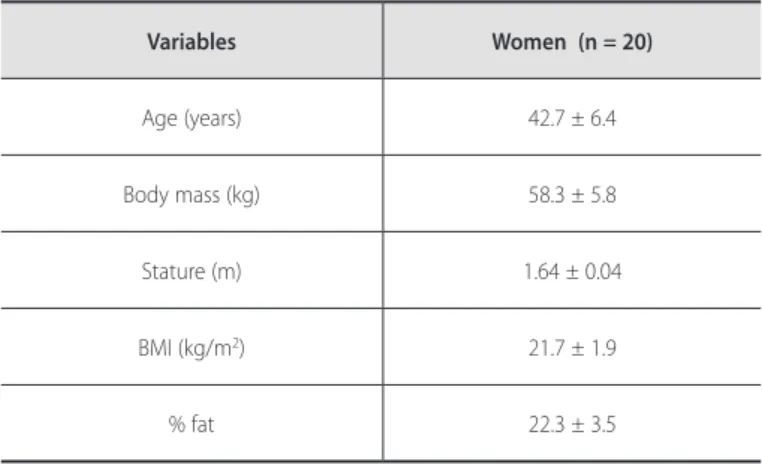
Table 1 presents mean ± SD values of the variables concerning the sample’s anthropometric characteristics (age, body mass, sta-ture, BMI, % fat).
Table 2 shows the mean values of O2max (ml/kg/min)
direc-tly obtained (ergospirometry) and indirecdirec-tly obtained. Statistically significant difference was observed between the O2max values
directly determined by the ergospirometry system as well as O2max predicted by the ErgoPC system. Despite of that, moderate
correlation was identified direct and indirect O2max (r = 0.67).
Table 3 represents the cardiorespiratory fitness classification of the women according to the American College of Sports Medici-ne(18). There was difference in the classification between the two
methods for all age groups.
Variables Women (n = 20)
Age (years) 42.7 ± 6.4
Body mass (kg) 58.3 ± 5.8
Stature (m) 1.64 ± 0.04
BMI (kg/m2) 21.7 ± 1.9
% fat 22.3 ± 3.5
Table 1. Descriptive characteristics of the sample (mean ± SD).
Variables Women (n = 20)
O2máx (indirect) 42.8 ± 3.7
O2máx (direct) 51.8 ± 6.8*
Table 2. Comparison of the O2max (ml/kg/min) determined by the direct and
in-direct methods.
* p < 0.05 in relation to the indirect method.
Method 30-39 years (n = 6)
40-49 years (n = 11)
50-59 years (n = 3)
O2máx (indirect) Good Excellent Excellent
O2máx (direct) Excellent Excellent Excellent
Table 3. Classification of the cardiorespiratory fitness according to the American College of Sports Medicine(18).
272 Rev Bras Med Esporte – Vol. 17, No 4 – July/August, 2011
ments (direct and indirect), it is important to highlight the useful-ness as well as influence that the O2max measurement represents
to training and its prescription. According to Laurentino and Pel-legrinoti(3), the O
2max is an index of great validity of application
and prescription in sports modalities which individualizes the exercise intensity for improvement of cardiorespiratory fitness of each subject(11).
According to the ACSM(27), a physical conditioning program
which aims to improve cardiorespiratory fitness should be applied with training loads suitable concerning intensity, duration, frequency and modality. Amongst the cited factors, intensity is the one which has the greatest influence on the reached results.
Thus, it is implied that athletes who present excellent fit-ness (table 3), if use parameters obtained through the indirect test (good fitness), may be within a lower target zone of aerobic training, inadequate to physical fitness improvement and their performance.
Therefore, it is important to highlight that the O2max
underes-timated by the indirect measurement, when used as parameter for a population of athletes, will be able to determine lower cardio-respiratory adaptations and, consequently, lower improvement as a consequence of training. Nevertheless, when populations with any coronary risk are considered, the intensity underestimation in comparison with protocols which are able to overestimate the
O2max variable guarantees higher safety of training application, not
representing hence higher risks.
CONCLUSION
Based on the data presented here, it was observed that the O2max, indirectly obtained, underestimates the value of direct
me-asurement, at least through the systems and protocols used in this investigation. Therefore, the conventional ergometric test presented substantial limitations for the real functional capacity of the studied individuals; however, since the indirect method is more practical, it is more present in the sports routine.
Thus, the use of indirect methods of cardiorespiratory evaluation should not be used as the only parameter in the training prescrip-tion, since it can represent aerobic fitness lower or higher than the reality and can be applied together with other physiological variables. Nonetheless, if the goal is to determine the O2max for
the physiological use for athletes or general training, it is suggested that ergometric tests which determine this variable by the direct method are performed.
All authors have declared there is not any potential conflict of interests concerning this article.
DISCUSSION
The aim of this study was to compare the O2max values
direc-tly determined by an ergospirometry system with values indirecdirec-tly predicted by the ErgoPC system during a maximal exertion test performed by female runners.
It is known that ergospirometry is the gold standard for eva-luation of cardiorespiratory fitness, especially for scientific studies or evaluations which require greater accuracy(8,11,19,20). In order to
indirectly measure the O2max, measurement instruments such as
cycle ergometers and treadmills, wooden benches as well as ap-plication of field tests (run or gait) have been used(21).
Higher practicality justifies the cost/benefit ratio of the applica-tion of indirect measurements, since they present higher associated error(22). The ACSM(23) reported an approximate error of 7% in the
O2 estimation with their equations as a starting point.
The main finding of this study was that the indirect O2max
measu-rement underestimated the direct measumeasu-rement, as shown in table 2. Conversely, further studies found opposite results, as the study by Santos(13) and Rondon et al.(9), who assessed in the conventional
ergometry the O2max estimated by regression, in which the indirect
measurement overestimated the direct measurement regardless of the protocol and ergometer used. Brum et al.(24), Filardo et al.(25)
and Costa et al.(14) assessed, respectively, the run and gait equations
by the ACSM(11,26,27) for estimation of the O
2 and also found results
which overestimated the direct measurement, pointing to the need to specify the study of the indirect methods by gender, age and physical status.
In a field test, Costa et al.(28) compared ergospirometry values
with the ones predicted by the 12-minute Cooper’s test(29) and
similarly to the present study, found underestimation of the indirect method compared to the direct method.
Therefore, it can be observed that extent to which the proto-col and formula used influence on the O2max prediction and are
able to increase or decrease the real values. According to Rondon et al.(9) and Santos(13), the final results obtained ( O
2max) with the
indirect measurement are influenced by the level of cardiorespira-tory fitness of the studied subjects. In their studies, these authors observed that the O2max estimated by the formula by the ACSM
was higher in individuals with low physical fitness than in the ones with moderate fitness.
Table 3 presents the classification of the level of cardiorespira-tory fitness when the O2max values are used for prediction of this
fitness(26); from this point, the individuals are classified regarding
fitness as: very low; low; average; good or excellent, according to the American College of Sports Medicine(18), taking the age group
into consideration.
The difference found in table 2 between the two
measure-REFERENCES
1. Barros, NTL, Tebexreni, AS, Tambeiro, VL. Aplicações práticas da ergoespirometria no atleta. Rev Soc Cardiol Estado de São Paulo. 2001;11:695-705.
2. Silva PRS, Romano A, Yazbek JP, Cordeiro JR, Battistella LR. Ergoespirometria computadorizada ou calorimetria indireta: um método não invasivo de crescente valorização na avaliação cardiorrespiratória ao exercício. Rev Bras Med Esporte. 1998;4:147-58.
3. Laurentino GC, Pellegrinoti IL. Alterações nos valores de consumo máximo de oxigênio ( O2máx) na aplicação de dois programas de exercícios com pesos em indivíduos do sexo masculino. Rev Bras Fisiol Exerc. 2003;2:97-106.
4. Denadai BS. Índices fisiológicos de avaliação aeróbia. Conceitos e aplicações. Ribeirão Preto: BSD, 1999.
cardior-273
Rev Bras Med Esporte – Vol. 17, No 4 – July/August, 2011
respiratória em pacientes hemiplégicos. Arq Sanny Pesq Saúde. 2008;1:90-7.
6. Barros NTL, Cesar MC, Tambeiro VL. Avaliação da aptidão física cardiorrespiratória. In: Ghorayeb N, Barros T, editores. O exercício: preparação fisiológica, avaliação médica, aspectos especiais e preventivos. São Paulo: Atheneu, 1999;15-24.
7. McArdle WD, Katch FL., Katch VL. Fisiologia do exercício: energia, nutrição e desempenho humano. Rio de Janeiro: Guanabara Koogan, 2008.
8. Diaz FJ, Montano JG, Melchor MT, Guerrero JH, Tovar, JA. Validation and reliability of the 1,000 meter aerobic test. Rev Invest Clin. 2000;52:44-51.
9. Rondon MUPB, Forjaz CLM, Nunes N, Amaral SL, Barretto ACP, Negrão ALCE. Comparação entre a prescrição de intensidade de treinamento físico baseado na avaliação ergométrica convencional e na ergoespirométrica. Arq Bras Cardiol. 1998;70:159-66.
10. Duarte MFS, Duarte CR. Validade do teste aeróbio de corrida de vai e vem de 20 metros. Rev Bras Ci e Mov. 2001;9:7-14.
11. American College of Sports Medicine. Guidelines for Exercise Testing and Prescription. 6th ed. Phila-delphia: Lippincott, Williams & Wilkins, 2000.
12. Basset DR Jr, Howley ET. Limiting factors for maximum oxygen uptake and determinants of endurance performance. Med Sci Sports Exerc. 2000;32:70-84.
13. Santos MAA. Análise da prescrição e da aplicabilidade do consumo de oxigênio de reserva durante o exercício aeróbio contínuo nas intensidades de 50% a 80% do consumo máximo de oxigênio. Tese de doutorado, Universidade Federal do Espírito Santo, UFES, 2007.
14. Costa FC, Garcia MPC, Almeida DD, Costa EC, Nunes N, Navarro F. Análise comparativa do consumo máximo de oxigênio e da prescrição de intensidade de treinamento aeróbio: ergoespirometria versus teste ergométrico convencional. Rev Bras de Presc e Fisiol do Exerc. 2007;7:40-70.
15. Jackson AS, Pollock ML, Ward A. Generalized equations for predicting body density of women. Med Sci Sports Exerc. 1980;12:175-82.
16. Siri WE. Tecniques for measuring body composition. Washington (DC): National Academy Press; 1961.
17. Foster C, Crowe AJ, Daines E, Dumit M, Green MA, Lettau S, Thompson NN, Weymier J. Predicting
functional capacity during treadmill testing independent of exercise protocol. Med Sci Sports Exerc. 1996:752-6.
18. American College of Sports Medicine. Guidelines for graded exercise testing and exercise prescription. Philadelphia: Lea & Febiger, 1980.
19. Silva AC, Torres FC. Ergoespirometria em atletas paraolímpicos brasileiros. Rev Bras Med Esporte. 2002;8:107-16.
20. Guimarães JI, Stein R, Vilas-Boas F. Normatização de técnicas e equipamentos para realização de exames em ergometria e ergoespirometria. Arq Bras Cardiol. 2003;80:457-64.
21. Buono MJ, Roby JJ, Micale FG, Sallis JF, Shephard E. Validity and reliability of predicting maximum oxygen uptake via field tests in children and adolescents. Pediatr Exerc Sci. 1991;3:250-5.
22. Swain DP. Energy cost calculations for exercise prescription: an update. Sports Med. 2000;30:17-22.
23. American College of Sports Medicine. ACSM´s Guidelines for Exercise Testing and Prescription. 7th ed. Baltimore: Lippincott Williams and Wilkins, 2005.
24. Brum PP, Sousa WAF, Santos MAA. Comparação entre as faixas de intensidade para exercício aeróbico propostas pelo ACSM com as obtidas na ergoespirometria. Rev Bras Ci e Mov. 2008;16:1-19.
25. Filardo RD, Silva RCR, Petroski EL. Validação das equações metabólicas para caminhada e corrida propostas pelo American College of Sports Medicine em homens entre 20 e 30 anos de idade. Rev Bras Med Esporte. 2008;14:523-27.
26. American College of Sports Medicine. Diretrizes do ACSM para os Testes de Esforço e sua Prescrição. 5a. ed. Rio de Janeiro: Guanabara Koogan, 2003.
27. American College of Sports Medicine. Diretrizes do ACSM para os testes de esforço e sua prescrição. 7ª ed. Rio de Janeiro: Guanabara Koogan; 2007.
28. Costa EC, Guerra LMM, Guerra FEF, Nunes N, Pontes FLP Jr. Validade da medida do consumo máximo de oxigênio e prescrição de intensidade de treinamento aeróbico preditos pelo teste de Cooper de 12 minutos em jovens sedentários. Rev Bras de Presc e Fisiol do Exerc. 2007;1:32-9.