284
Parameters, Considerations and Modulation of
Physical Exercise Programs for Oncologic
Patients – A Systematic Review
Wodyson Thiago Escriboni Soares1
1. Medicine College of São José do Rio Preto (FAMERP)
Mailing address:
Avenida Coronel Rafael Brandão, 335 – Barretos – 14783-276 – SP, Brasil E-mail: [email protected]
ABSTRACT
Introduction: This investigation searched for data that would describe the use of physical exercise, not as preventive method, but as a supporting therapeutic modality in the coping of the cancer (CA) and its treatment from diagnosis to recovery, since there is massive harm and side effects experienced by the patients that can be modified through the practice of physical exercises. Objective: To identify and select references which demonstrate necessary parameters for prescription of physical exercise programs to oncologic patients. Method: The systematic model of research was used in the Medline, Liliacs and Pubmed databases, using the terms: cancer, physical exercise, physical activity, exercise, being considered articles published between 1997 and 2008, in the Portuguese, English, Spanish and German languages. The articles that presented data which supported the use of physical exercise as a therapeutic method, as well as its modulation, indication, contraindication and interaction with other treatments were selected. Results: In the revised literature, subsidies that ground the use of physical exercise in its supporting role in the coping of CA and its treatment, as well as, benefits, indications, contraindications and precaution in the use of physical exercise were found. Conclusions: In spite of being a broad field where there is still a lot to be researched, if the contraindications and precautions are respected, physical exercise becomes safe, viable and effective for patients and survivors, giving them support to face the treatment and accelerate recovery.
Keywords: cancer, physical exercise, physical activity, exercise.
INTRODUCTION
The prevention effect that physical exercise primarily and se-condarily develops in the evolution of many types of cancer (CA) is already well-reported. Currently, there are many investigations which have examined physical exercise in the prevention of Ca; however, little is known about the use of physical exercise during the treatment.
Although physical exercise does not directly reduce the risk of CA remission or delay the growth of the tumor, it is the key--component for the control of triggering factors(1) such as obesity,
overweight, hormonal and immune alterations and physical inac-tivity, among others.
CA and its treatment cause deep alterations in the psychological and physical aspects of its patients. Although the treatments for CA are increasingly more efficient and modern, these alterations still compromise the quality of life and capacity of the patients in facing the treatment. These alterations vary according to the severity of the treatment, and sometimes place the individual in an extreme passive and hopeless condition.
Therefore, physical exercise constitutes an interesting therapeu-tic modality due to its improvement in physical capacities as well as the correlated ones which are crucial for supporting the diagnosis until recovery.
The literature available on the issue stresses the several bene-fits which physical exercise promotes in this population; however, broader information spread, clarification and knowledge from the
part of the population and health professionals on this important instrument in the treatment assistance.
METHOD
Systematic research was used on the Medline, Liliacs and Pub-Med databases, using the terms: cancer, physical exercise, physical activity, exercise, individually and combined in citations in the title or abstract. The articles considered were published between 1997 and 2008 in Portuguese, English, Spanish and German.
112 references were obtained in this research, and 22 were selected for having presented data which supported the use of physical exercise as a therapeutic method, as well as its modula-tion, recommendamodula-tion, contraindication and interaction with other treatments in oncologic patients.
RESULTS AND DISCUSSIONS
Effects of CA and its treatment
CA, and especially its treatment, result in severe collateral effects in the different body systems(2) causing physical, psychosocial and
economical damage (3) which drastically reduce quality of life and
functionality of the individuals(4).
The diagnosis of CA is a strong impact, reduces life expectancy and increases depression level in about 25% of the patients, being depression also related to the use of corticosteroids used in the treatment(2).
During the course of the treatment, the patients experience
REVIEWARTICLE
285
many collateral effects, which include: astenia, ataxia, anemia, an-xiety, nausea, vomiting, diarrhea, sarcopenia, osteopenia, mood swings, neutropenia, body composition and perceotion alteration, thrombopenia, decrease in flexibility, sleep disorders, self-esteem reduction, depression, cardiopulmonary and vascular function re-duction, pain and fatigue(5-7), and these effects can persist for
mon-ths or even years after the end of the treatment(5,8).
In the middle of the collateral effects, fatigue is undoubtedly the commonest(9-11) and most evident, affecting over 75% of the
patients immediately after the first cycle of chemotherapy(8). It is
defined as a subjective state of oppression and prolonged exhaus-tion which decreases physical and mental capacities to perform work and which is not alleviated with rest(8).
Until some years ago, fatigue was seen by patients and doctors as a natural consequence of the disease and their treatment and not as something possible to be controlled(8). Fatigue can present
central etiological factors, such as: decrease in the gonadotropin le-vel, increase of the number of circulating T lymphocytes, increase in the interleukin antagonist receptors, increase in the type II receptor of the soluble tumor necrosis factor, increase in the neopterin and peripherals level: negative energetic balance, disease and its treat-ments, systemic infections, hypothyroidism, malnutrition, metabolic disorders, sleep disorders, psychological factors(12). Additionally, the
following hypotheses can occur: anemia, ATP, vagal afferent and of the interaction of the hypothalamus – hypophysis/cytokines and 5HTaxis (serotonin deregulation)(8).
Besides its influence on the organic systems, fatigue negatively influences on the course of the treatment for affecting the patients(8)
capacity to comprehend and retain informationand for being a limi-ting factor for some therapies such as interferon and interleukin(9).
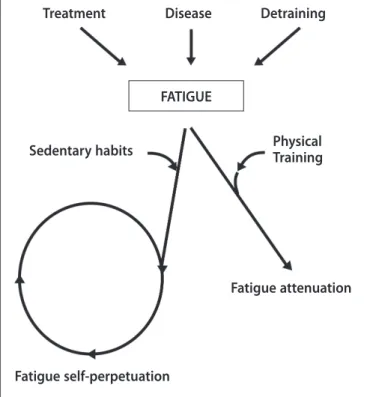
Due to the cardiorespiratory decontioning caused by CA and its treatment, increase of the metabolic rate, increase in the energetic cost, substantial increase of HR and lactate concentration in low intensity activities are observed(3), which cause the patients into
avoiding exertion, which produces additional conditioning losses and lead to a cycle of self-perpetuation of fatigue(9). This scenario
is very harmful, since this cardiorespiratory deconditioning resul-ting from inactivity is a key-predictor for higher mortality rate in oncologic patients(7). However, fatigue derived from causal factors
(treatment, disease, detraining, sedentary habits) can be attenuated with the use of physical exercises and break this self-perpetuation cycle (figure1).
Some drugs are used to fight fatigue, such as megestrol acetate, modafinil and erythropoietin, to name some; however, these drugs are not efficient against muscular and cardiorespiratory losses(3).
According to the National Comprehensive Cancer Network (NCCN), physical exercise is one of the non-pharmacological in-terventions most efficient in the fatigue treatment(13), preventing,
minimizing or decreasing it(7), besides promoting positive
adapta-tions to the CA stress as well as the effects of its treatment during and after the therapies(14).
When to use it
The implementation of a physical exercises program can be done in any of the three phases after the CA diagnosis(2); however,
in each phase their aims and consequent modulation are distinct.
Pre-treatment: comprehends the period between the disease diagnosis and the beginning of the treatment. The aims are focused on (a) improvement of the general functional status, (b) prevention and attenuation of the functional decline during treatment, (c) assis-tance to the individual to emotionally and psychologically face the disease while waits for the treatment(15). The individuals who already
practice some physical activity should priorize maintenance and the non-practitioners should progressively engage in a program.
• Maintenance of muscular mass and strength(2);
• Maintenance/optimization of the cardiorespiratory function(2);
• Maintenance of ADM(2);
• Optimization of immune function(2).
During treatment: the focus on this phase will be on patients who are experiencing treatment, regardless of its nature (surgical, chemo, radio, hormone, immune therapy and transplant). The aims are (a) to attenuate the collateral effects(5) and toxicity of the treatments,
(b) to maintain the physical functions and body composition, (c) to maintain/improve functional capacity and muscular strength(4), mood
status and quality of life, (d) to facilitate the treatment conclusion, and (e) to boost the efficiency of the treatments(15).
• Pain(2);
• Fatigue/anemia(2);
• Muscular weakness(2);
• ADM deficit(2);
• Balance and coordination(2);
• Lymphedema/edema/swollenness(2);
• Peripheral neuropathies(2);
• Osteopenia/osteoporosis(2);
• Myopathy induced by steroids(2).
Post-treatment: the approach this time will be focused on the survivors, that is to say, the individuals who have finished the
tre-Treatment Disease Detraining
Sedentary habits PhysicalTraining
Fatigue attenuation
Fatigue self-perpetuation FATIGUE
286
atment, being exercise essential in the recovery process as well as optimization of the general health status and quality of life (15).
• Improvement of body composition(2);
• Improvement of muscular endurance and strength(2);
• Improvement of cardiorespiratory fitness(2);
• Improvement of flexibility(2);
• Improvement of physical function(2).
The aim is to return to the pre-diagnosis physical levels(2), to
reduce the risk of remission and onset of other diseases, to deve-lop exercising habits and to extend survival rate with quality(15).
Women and men during treatment have successfully parti-cipated in physical exercise programs, although the main study focus had been women with breast CA(16). Exercise has been used
in patients with prostrate, colon, lung, stomach, endometrial, head and neck CA, lymphoma, myeloma, melanoma and bone marrow transplant. In the majority of the studies, the recruited patients are on stage I or II of the disease; however, the few investigations carried out with patients in advanced stages or with metastasis have reported success(3,13).
Exercise types
The methodological choice as well as exercises typification to be used for these individuals is complex due to the extreme heterogeneity of the disease as well as to the no-linear respon-se to exercirespon-se(2). Due to the exercise particularity and
complexi-ty, a multidimensional approach which included resistance and aerobic exercises, relaxation, body awareness, massage and fle-xibility would be broader, since it would provide a more holisti approach(6,17,18).
Although it is not known yet which approaches are more efficient over others(19), the massive majority of the
investiga-tions use aerobic exercises of moderate intensity as a therapeutic method(3-5,10,16,18,20).
All investigations performed, each one with different samples, projects, interventions, periods and evaluation methods, report statistically significant results or in the improvement of physical aspects or in the reduction of collateral effects(4,5,18).
Therefore, the method as well as the modulation to be used should be carefully chosen, based on the daily needs of the patient(2).
Benefits
Recent studies and reviews suggest that intervention with physical exercise for patients and survivors have shown favora-ble results in all four domains related to quality of life (physical, physiological, psychological, social and spiritual)(4,13,14,16,19,21). The
related benefits include: fatigue reduction, improvement in qua-lity of life, psychological wellness, body image, improvement in physical function (oxygenation capacity, cardiovascular and respi-ratory fitness, flexibility and general health status), anthropometric measurements (weight, fat mass and waist-hip index), biomarkers related to health (blood pressure, heart rate, hemoglobin concen-tration, hormones circulating levels and immunological
parame-ters(7,14,16,18,22). Besides these parameters, other very important ones
are decrease of hospitalization time(9,18,20) and reduction of amount
of analgesics used due to the increase of the painful threshold as well as release of endorphins(10).
It is important to highlight that, despite all benefits, very few patients exercise after the CA diagnosis and, out of the ones who exercise, great part does of in an inefficient and unsui-table manner(2).
Risks
Although moving is natural to humans, it is not risk-free(2),
both for healthy individuals and for the ones experiencing some pathology. Some clinical precautions are necessary due to the treatment, namely: immunosuppressive potential, probability of fractures, cardiotoxicity exacerbation caused by chemo and ra-diotherapy, pain, nausea, fatigue and incapacity of tolerance (5).
However, according to the American Cancer Society (2007), the physical exercises interference in the conclusion of the treatment or efficiency of chemotherapy is unknown, and there are not phy-siological reasons of great concern concerning the application of exercise during the treatment(1).
In a study with over 700 patients, during several treatments, there was no report of any main adverse effect(5).
Strong evidence suggests that physical exercise is safe and efficient during CA treatment, improving physical functions and many aspects related to quality of life(1,14).
Conditions for prescription
In order to suitably prescribe exercises, it is necessary that the program follows some basic principles which structure any kind of training, both for healthy and sick individuals.
This situation is not different for individuals diagnosed with CA; however, besides the traditional principles of training (biological individuality, adaptation, specificity, reversibility and overload), another very important principle should be incorporated(2). This
principle, termed principle of modification(2), is necessary doe to
the patient’s response to the chemotherapy agents and other therapeutic devices used which momentously alters his/her phy-siological condition(2,11).
Other parameters to be considered in the prescription are: type and stage of the disease, medical treatment used, treatment intensity and duration, past and current physical exercise history and comorbidity conditions(5).
Additionally, the physiologists involved in the exercises pres-cription for this group of individuals should deeply understand about the CA physiopathology under consideration and the types of treatment which have been applied(13).
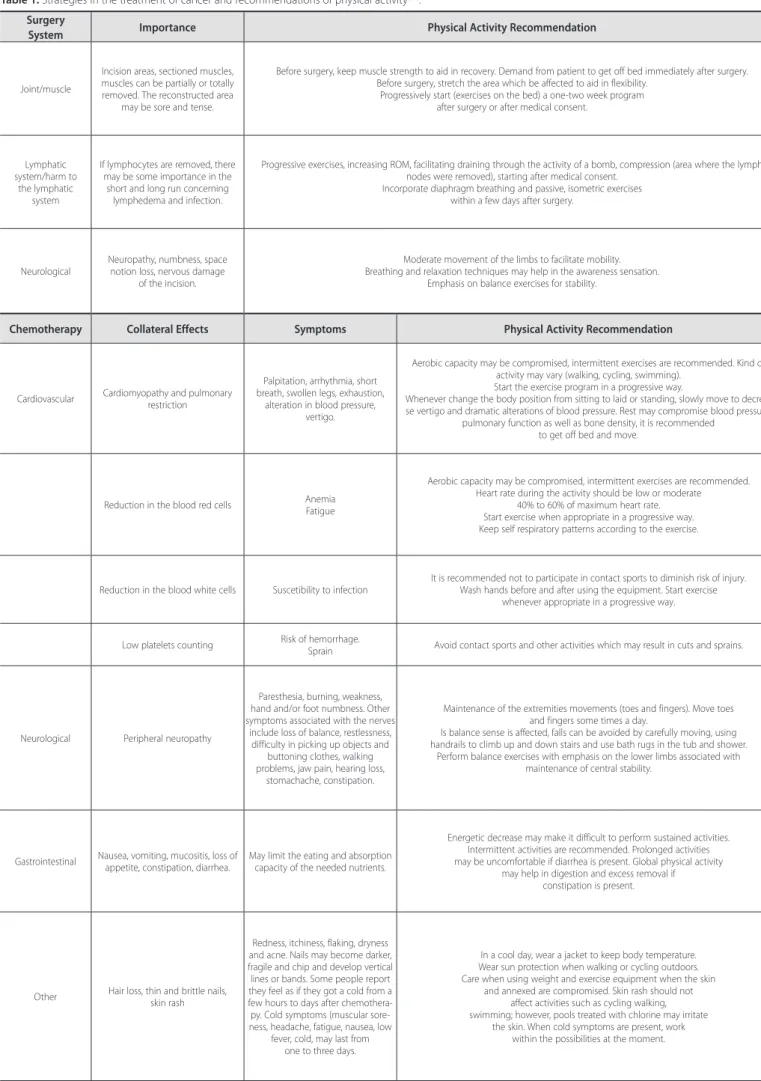
Besides approaching physiological aspects, it is crucial that the exercises are pleasant and interactive so that the development of new abilities and trust bonding can be developed with the patient(5) (table 1).
Contraindications and precautions (table 2)
Protocol
There is no direct evidence of the type, frequency, duration, intensity or ideal progression of exercises for this population(2,5,11).
287
Surgery
System Importance Physical Activity Recommendation
Joint/muscle
Incision areas, sectioned muscles, muscles can be partially or totally removed. The reconstructed area
may be sore and tense.
Before surgery, keep muscle strength to aid in recovery. Demand from patient to get off bed immediately after surgery. Before surgery, stretch the area which be affected to aid in flexibility.
Progressively start (exercises on the bed) a one-two week program after surgery or after medical consent.
Lymphatic system/harm to
the lymphatic system
If lymphocytes are removed, there may be some importance in the
short and long run concerning lymphedema and infection.
Progressive exercises, increasing ROM, facilitating draining through the activity of a bomb, compression (area where the lymph nodes were removed), starting after medical consent.
Incorporate diaphragm breathing and passive, isometric exercises within a few days after surgery.
Neurological
Neuropathy, numbness, space notion loss, nervous damage
of the incision.
Moderate movement of the limbs to facilitate mobility. Breathing and relaxation techniques may help in the awareness sensation.
Emphasis on balance exercises for stability.
Chemotherapy Collateral Effects Symptoms Physical Activity Recommendation
Cardiovascular Cardiomyopathy and pulmonary restriction
Palpitation, arrhythmia, short breath, swollen legs, exhaustion,
alteration in blood pressure, vertigo.
Aerobic capacity may be compromised, intermittent exercises are recommended. Kind of activity may vary (walking, cycling, swimming).
Start the exercise program in a progressive way.
Whenever change the body position from sitting to laid or standing, slowly move to decrea-se vertigo and dramatic alterations of blood pressure. Rest may compromidecrea-se blood pressure,
pulmonary function as well as bone density, it is recommended to get off bed and move.
Reduction in the blood red cells Anemia Fatigue
Aerobic capacity may be compromised, intermittent exercises are recommended. Heart rate during the activity should be low or moderate
40% to 60% of maximum heart rate. Start exercise when appropriate in a progressive way. Keep self respiratory patterns according to the exercise.
Reduction in the blood white cells Suscetibility to infection
It is recommended not to participate in contact sports to diminish risk of injury. Wash hands before and after using the equipment. Start exercise
whenever appropriate in a progressive way.
Low platelets counting Risk of hemorrhage.
Sprain Avoid contact sports and other activities which may result in cuts and sprains.
Neurological Peripheral neuropathy
Paresthesia, burning, weakness, hand and/or foot numbness. Other symptoms associated with the nerves
include loss of balance, restlessness, difficulty in picking up objects and
buttoning clothes, walking problems, jaw pain, hearing loss,
stomachache, constipation.
Maintenance of the extremities movements (toes and fingers). Move toes and fingers some times a day.
Is balance sense is affected, falls can be avoided by carefully moving, using handrails to climb up and down stairs and use bath rugs in the tub and shower.
Perform balance exercises with emphasis on the lower limbs associated with maintenance of central stability.
Gastrointestinal Nausea, vomiting, mucositis, loss of appetite, constipation, diarrhea.
May limit the eating and absorption capacity of the needed nutrients.
Energetic decrease may make it difficult to perform sustained activities. Intermittent activities are recommended. Prolonged activities may be uncomfortable if diarrhea is present. Global physical activity
may help in digestion and excess removal if constipation is present.
Other Hair loss, thin and brittle nails, skin rash
Redness, itchiness, flaking, dryness and acne. Nails may become darker, fragile and chip and develop vertical lines or bands. Some people report they feel as if they got a cold from a few hours to days after chemothera-py. Cold symptoms (muscular sore-ness, headache, fatigue, nausea, low
fever, cold, may last from one to three days.
In a cool day, wear a jacket to keep body temperature. Wear sun protection when walking or cycling outdoors. Care when using weight and exercise equipment when the skin
and annexed are compromised. Skin rash should not affect activities such as cycling walking, swimming; however, pools treated with chlorine may irritate
288
Chemotherapy
System Collateral effects Symptoms Physical Activity recommendation
Gynecological
Anticancer drugs may damage the ovaries and reduce its hormone production. As a result, some women
have their menstrual cycle irregular or completely interrupted during the
chemotherapy period.
Chemotherapy may cause menopause symptoms as heat
flushes and itchiness, vaginal burning or dryness.
Keep physical activity level to maintain muscle mass and cardiorespiratory conditioning. Perform activities with weight sustaining to promote bone health (any activity with feet
on the ground, such as walking, climbing up stairs, dancing). Emphasize chest, thorax and abdomen strengthening. Improve posture.
Relaxation techniques may help to face the heat flushes and other menopause symptoms.
Radiotherapy
System Collateral effects Symptoms Physical Activity Recommendation
Localized
Head and neck: hypothyroidism, esophageal mucositis. Thorax: cardiac toxicity. Pelvic area:complications in the bladder, vaginal and gastrointestinal
tissues, hematuria.
Some symptoms are mainly felt after some weeks from radiotherapy. In
some cases, the beginning of the collateral effects may not appear
after some years.
Aerobic capacity may be compromised; hence intermittent exercises arerecommended. Heart rate during the activity should be from low to moderate (40%-60%
from maximum).
Initiate whenever appropriate, progressively. Avoid impact activities due to the bladder. Maintain self breathing pattern suitable to the exercise.
Range of motion in the radiated area may get compromised. However, the area should be carefully mobilized to increase mobility.
Skin
Short-time alterations on the skin; long-time (six -10 months), skin
thickness.
Itchiness, dryness, redness, heating, discomfort.
Hydrate the dry area (according to medical orientation), and protect skin when manipula-ting exercise equipment.
The radiated area may become tense and with limited range of motion. Work progressively to maintain mobility.
Perform exercise in ventilated places to prevent overheating. Drink plenty of water. Wear loose clothes to decrease skin rash.
Lymphatic Scar formation of the lymphedema
or sking burns. Lymphedema
Improve lymphatic circulation with diaphragmatic breathing. Isometry, squeeze hands or pumping exercise. Use light weight to progressively strengthen the upper
extremity of the body.
Transplant
System Collateral Effects Physical Activity Recommendation
Stem cell/bone marrow transplant
Affects white cells, red cells and platelets
Start program three-four weeks after transplant, in bed, on a chair or standing. Perform walking or cycling on a cycloergometer in an intermittent way.
Modify movements if the biopsy area is sore.
Contraindications Precautions and alterations
Factors related to the treatment Day and 24h after-application of cytostatics. Before blood collections Severe tissue reactions of radiotherapy
Treatments which affect lungs and /or heart Ulcerations and mouth sores: avoid tests with buccal device
Pulmonary Severe dyspnea, cough, breathlessness
Thoracic pain increased by deep inspiration Mild to moderate dyspnea: avoid maximal tests
Musculoskeletal
Bone pain, head and neck of recent origin unusual muscle soreness severe cachexia (loss > 35% of pre-treatment weight) Extreme
fatigue Low functional status
Investigate pain or cramps Avoid high impact and contact exercises Myopaties induced by steroids
Limit exercise intensity
Siystemic Acute infections Fever < 38° general discomfort Avoid exercises until the patient is asymptomatic for 48h Avoid high intensity exercises
Gastrointestinal Severe nausea Vomiting or diarrhea in the last 24 to 36h
Dehydration inadequate food and fluids ingestion Follow-up with nutritionist
Cardiovascular 145mmHg systolic and 95mmHg diastolic Irregular pulse Swelling on the ankles
Risk for associated-cardiac disease Caution with excessive medication to control BP and HR
Lymphedema
Hematological Platelets < 50,000 white cells < 3,000 Hemoglobin < 9g/dL
Avoid risk of hemorrhage Avoid risk of bacterial infection (swimming pool)
Avoid high intensity exercises
Neurologic Significant decline in the cognitive status Vertigo/frivolous person Disorientation. Blurry vision. Ataxia
Cognitive alterations
289
Type
Exercises involving big muscle groups: cycling and walking are especially recommended for their safety and tolerability.
Alteration Will be based on the treatments (surgery, chemotherapy and radiotherapy).
Frequency Daily exercises for deconditioned patients.At least three to five weekly times.
Duration
At least 20 to 30 continuous minutes. For deconditioned patients or the ones experiencing collateral effects, perform interval training (sets of exercises
with rest intervals).
Intensity
Moderate, dependent on the fitness level of the patient and the treatment. 50% to 75% O2max/60% to 80% of HR
reserve/ PSE between 11 and 14
Progression
It should be firstly done by the frequency and duration and later by the intensity.
Slow and gradual for deconditioned patients or the ones experiencing collateral effects.
Table 3. Guidelines for exercise prescription(2,5,11,13,20).
ERRATA
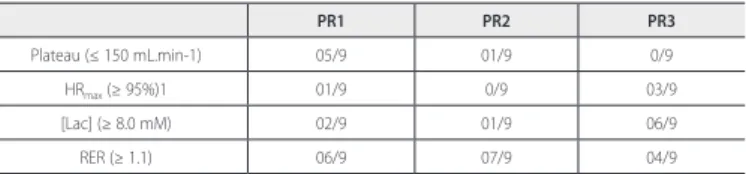
In the RBME Volume 17 # 1 – January/February in the article “Influence of the Ergometric Protocol in the Onset of Different Criteria of Maximum Exertion”, on page 20, in Table 1 where it can be read (L+min-1) the correct should be (L.min-1) and in table 2, in columns PR1, PR2 and PR3 where set is read it should be 9.
Table 1. Physiological and metabolic responses in the three investigated protocols.
PR1 PR2 PR3
Texhaustion (min) 11 ± 1 (9-14) 10 ± 3 (6-15) 24 ± 3** (17-30)
Pmax (Watts) 183 ± 57 (135-325) 153 ± 29 (125-225) 182 ± 43 (120-250)
VO2max
(L.min-1) 2.68 ± 1.0 (1.48-4.53) 2.58 ± 1.0 (1.47-4.81) 2.99 ± 1.3 (1.63-5.60)
HRmax (bpm) 168 ± 15 (141-195) 165 ± 12 (153-186) 180 ± 13 (159-200)
[Lac] 6.4 ± 1.6 (4.0-8.2) 5.3 ± 2.6 (1.8-9.3) 8.1 ± 2.3* (5.1-11.3)
Mean ± standard deviation (minimum and maximum values); Texhaustion, time of exhaustion; Pmax, maximum
power reached; VO2max, oxygen maximum uptake; HRmax, maximum heart rate; [Lac], blood lactate concentration
at the end of the test; *significant difference for p ≤ 0.05; ** significant difference for p ≤ 0.01.
Table 2. Onset frequency of the different criteria of maximum exertion in the evaluated protocols.
PR1 PR2 PR3
Plateau (≤ 150 mL.min-1) 05/9 01/9 0/9
HRmax (≥ 95%)1 01/9 0/9 03/9
[Lac] (≥ 8.0 mM) 02/9 01/9 06/9
RER (≥ 1.1) 06/9 07/9 04/9
1 HRmax = 220 – age; Number of occurrences/total of observations; the abbreviations follow format of table 1.
CONCLUSION
When the contraindications and precautions are respected, exercise becomes not only safe and viable(1), but also efficient for
patients and survivors(11), positively affecting physical and
psycho-social aspects, providing them with support to face treatment and its deleterious effects and, in post-treatment, accelerating recovery and extending their survival rate with quality.
ACKNOWLEDGEMENT
To professor Drª. Elza Maria Castilho for the trust, support and attention not only during this investigation.
All authors have declared there is not any potential conflict of interests concerning this article.
REFERENCES
1. Brown J, Byers T, Doyle C, Courneya K, Demark-Wahenfried W, Kushi L. Nutrition and physical activity during and after cancer treatment: an American Cancer Society guide for informed choices. CA Cancer J Clin 2003;53:268-91.
2. McNeely ML, Peddle C, Parliament M, Courneya KS. Cancer rehabilitation: recommendations for integrating exercise programming in the clinical practice setting. Current Cancer Therapy Reviews 2006;2:000-000.
3. Dimeo F, Schwartz S, Fietz T, Wanjura T, Boning D, Thiel E. Effects of endurance training on the physical performance of patients with hematological malignancies during chemotherapy. Support Care Cancer 2003;11:623-8.
4. Knols R, Aaronson NK, Duebelhart D, Fransen J, Aufdemkampe. Physical exercise in cancer patients during and after medical treatment: a systematic review of randomized and controlled trials. J Clin Oncol 2005;23:3830-42.
5. Courneya KS, Mackey JR, Jones LW. Coping with cancer, can exercise help? Phys Sportsmed 2000;28:49-73.
6. Adamsen L, Quist M, Midtgaard J, Andersen C, Moller T, Knutsen L, et al. The effect of a multidimensional exercise intervention on physical capacity, well-being and quality of life in cancer patients undergoing chemotherapy. Support Care Cancer 2006;14:116-27.
7. Ingram C, Visovsky C. Intervention to modify physiologic risk factors in cancer survivors. Semin Oncol Nurs 2007;23:275-84.
8. Morrow GR, Andrews PL, Hickok JT, et al: Fatigue associated with cancer and its treatment. Support Care Cancer 2002;10:389-98.
9. Dimeo FC, Stieglitz RD, Novelli-Fischer U, Fetscher S, Keul J. Effects of physical activity on the fatigue and psychologic status of cancer patients during chemotherapy. Cancer 1999;85:2273-7.
10. Dimeo F, Fetscher S, Lange W, Mertelsmann R, Keul J. Effects of aerobic exercise on the physical performance and incidence of treatment-related complications after high-dose chemotherapy. Blood 1997;90:3390-4.
11. Hoffman L. How to Keep Your Patients Moving. J Support Oncol 2006;4:153-8.
12. Rao AV, Cohen HJ. Fatigue in older cancer patients: etiology, assessment, and treatment. Semin Oncol 2008;35:633-42.
13. McCaughan SY, Arzola SM. Exercise intervention research for patients with cancer on treatment. Semin Oncol Nurs 2007;23:264-74.
14. Knobf MT, Musanti R, Dorward J. Exercise and quality of life outcomes in patients with cancer. Semin Oncol Nurs 2007;23:285-96.
15. Courneya KS, Friedenreich CM. Physical activity and cancer control. Semin Oncol Nurs 2007;23:242-52.
16. Pinto BM, Floyd A. Methodologic issues in exercise intevention research in oncology. Semin Oncol Nurs 2007;23:297-304.
17. Adamsen L, Midtgaard J, Rorth M, Borregaard N, Andersen C, Quist M, et al. Feasibility, physical ca-pacity, and health benefits of a multidimensional exercise program for cancer patients undergoing chemotherapy. Support Care Cancer 2003;11:707-16.
18. Peters C, Schulz T, Michna H. Exercise in cancer therapy. European Journal of
19. Sport Science 2002;2:1-13.
20. Battaglini CL, Bottaro M, Campbell JS, Novaes J, Simão R. Atividade física e níveis de fadiga em pacientes portadores de câncer. Rev Bras Med Esporte 2004;10:98-110.
21. Lucía A, Earnest C, Pérez M. Cancer-related fatigue: can exercise physiology assist oncologists? Lancet Oncol 2003;4:616-25.
22. Clark MM, Vickers KS, Hathaway JC, Smith M, Looker SA, Petersen LR, et al. Physical activity in patients with advanced-stage cancer actively receiving chemotherapy. J Support Oncol 2007;5:487-93.