students
Diego Oliveira Guedes 1, Douglas Leonardo Gomes Filho 2
Abstract
While plagiarism has existed since human beings irst learnt to write, it has become an issue of greater con
-cern since we became aware of the inancial and intellectual damage it can cause. Yet despite an increased awareness of the dangers of plagiarism in academic circles and in the media, the term itself has not yet been clearly deined. The present study addresses full, conceptual and parial plagiarism, with the aim of assessing the knowledge of students enrolled in the Denistry course of the Universidade Estadual do Sudoeste da Bahia regarding plagiarism, relevant legislaion, research sources and image copyright. Through the use of a quesionnaire and subsequent analysis of the responses of students using SPSS sotware, it was found that while students use reliable sources in their research, they are not fully aware of what plagiarism is and do not respect image copyright.
Keywords:Bioethics. Copyright. Scieniic misconduct. Plagiarism.
Resumo
Percepção de plágio acadêmico entre estudantes do curso de odontologia
O plágio se faz presente no mundo desde que os seres humanos desenvolveram a escrita. Porém, despertou maior interesse quando passou a trazer prejuízos inanceiros e intelectuais. Mesmo surgindo cada vez mais na mídia e sendo discuido na vida acadêmica, sua deinição precisa ainda não foi estabelecida. Neste estudo, foram abordados o plágio integral, o conceitual e o parcial. O objeivo foi avaliar o nível de conhecimento dos alunos matriculados no curso de odontologia da Universidade Estadual do Sudoeste da Bahia a respeito do tema plágio, da legislação perinente ao tema, das fontes de pesquisa uilizadas e de como são tratados os direitos de reprodução de imagem. Para essa avaliação, uilizou-se quesionário e posterior análise das res
-postas por meio do programa SPSS. Apesar de uilizarem fontes coniáveis para as pesquisas, os alunos não apresentaram conhecimento pleno sobre o plágio e mostraram não respeitar os direitos autorais das imagens. Palavras-chave: Bioéica. Direitos autorais. Má conduta cieníica. Plágio.
Resumen
Percepción de plagio académico entre estudiantes de un curso de odontología
El plagio se hace presente en el mundo desde que los seres humanos desarrollaron la escritura. No obstante, despertó un mayor interés cuando trajo perjuicios inancieros e intelectuales. Aún surgiendo cada vez más en los medios y siendo discuido en la vida académica, su deinición precisa no es clara. En este estudio fueron abordados el plagio integral, el conceptual y el parcial. El objeivo fue evaluar el nivel de conocimiento de los alumnos matriculados en el curso de Odontología de la Universidade Estadual do Sudoeste da Bahiasobre el tema plagio, la legislación perinente al tema, las fuentes de invesigación uilizadas y de cómo son tratados los derechos de las imágenes. Para esta evaluación, se uilizó un cuesionario y posterior análisis de las respuestas por medio del programa SPSS. A pesar de uilizar fuentes coniables para las invesigaciones, los alumnos no presentaron conocimiento pleno sobre el plagio y mostraron no respetar los derechos de las imágenes. Palabras-clave: Bioéica. Derechos de autor. Mala conducta cieníica. Plagio.
Aprovação CEP Uesb 274.117 de 16/05/2013
1. Graduado[email protected] – Universidade Estadual do Sudoeste da Bahia (Uesb), Jequié/BA, Brasil. 2. Doutorando dlgilho@
uol.com.br – Universidade Estadual do Sudoeste da Bahia (Uesb), Jequié/BA, Brasil e PPGBIOS – UFRJ/UERJ/UFF/Fiocruz, Rio de Janeiro/ RJ, Brasil.
Correspondência
Douglas Leonardo Gomes Filho – Rua Cândido Mendes, 129, aptº 908, Glória CEP 20241-220. Rio de Janeiro/RJ, Brasil.
Declaram não haver conlito de interesse.
Artig
Percepion of academic plagiarism among denistry students
Plagiarism exists since the development of wriing. Its concept, however, as we understand today, is recent. In ancient Rome, the pracice of pla
-giarism was condemned, not as thet of texts, but as crime involving slaves 1. With a more present-day
sense, the word “plagiarism” was used for the irst ime by the Lain poet Marial. To date its concept is not very precise, but it is always present in the
literature 1.
Students, teachers, researchers, authors, re
-visers, editors, all of these worry about plagiarism to some extent. Teachers of any area of knowledge as
-pire that young researchers naturalize to academic ethics, learn to be honest which implies not deceiv
-ing readers, not to lie forg-ing false authorship, in the
sense that plagiarism confounds the reader, as it
disturbs the conidence in science2.
Discussions on the losses caused by plagia
-rism only arose when the appropriaion of someone else’s authorship had efect on inancial issues. Large-scale publicaion of books, magazines and scieniic aricles and the trade of intellectual pro
-ducion evidenced the need to curb plagiarism 3.
Similar to plagiarism, bioethics did not start with a big bang4. Many events contributed to the
emergence of bioethics and its discussions, techno
-logical advances and social changes lead to moral pluralism, calling for the bioethical debate 5. Not sur
-prisingly, the creators of one of the most inluenial bioethical current, principlism, included, from the
6th North American ediion of the book “Principles
of biomedical ethics”, a chapter specially dedicated to common morality, understood as universal moral
-ity, which would include general rules as not to lie, not to steal other people’s property, to keep one’s promises, to respect the rights of others and not to kill or harm others 6.
Correlaions between plagiarism and bioethics can also be observed in the most recent versions of the codes of professional ethics of biomedical area. In Brazil, the Denistry Code of Ethics, for example, in Chapter XVI, Secion II, Aricle 49, items II and IV, states that it consitute an ethical infracion: II) to
present as one’s own, in whole or in part, educaion
-al materi-als or scieniic work of others, even if not published; (...) IV) to make use, without reference to
the author or without the author’s permission, of
data, informaion or opinions collected from pub
-lished or unpub-lished parts of the author’s work7.
According to Diniz and Guilhem, the “En
-cyclopedia of bioethics” deines bioethics as the
systemaic study of the moral dimensions—includ
-ing moral vision, decisions, conduct, and policies—of
the life sciences and health care, employing a variety of ethical methodologies in an interdisciplinary
set-ing 8.If “not lying” and “not deceiving” are moral principles, not to incur plagiarism, i.e. not to lead to
some form of decepion, also includes the deiniion of the scope of bioethics, especially when related to the producion in the ields of life sciences and health.
The internet has proved an important source of knowledge and a facilitator of research for stu
-dents and researchers. The amount of available informaion is immeasurable and the ease of get
-ing it, too. Barbastefano and Souza 9 alert about
the ease of plagiarizing, as well as of detecing cases of plagiarism. The cases reported in the media re
-searchers who lose their itles, achieved through illegal pracices are becoming increasingly frequent.
Even being a common phenomenon in ac
-ademic life, it is not easy to establish the precise deiniion of plagiarism 10. For the scope of the pres
-ent study, plagiarism is understood as the use, in whole or in part, of someone else’s work acing as if it were by one’s own authorship. There are three types of plagiarism: integral, which is full-text tran
-scripion without quoing the source; parial which comprises copying some sentences or paragraphs from several sources; and conceptual, in which there is the appropriaion of one or several con
-cepts, or of a theory, that one presents as produced by oneself 11.
This is the point it which there seems to be lack of knowledge on the mater. Integral plagiarism, the exact copy, is of easy ideniicaion and under
-standing by most people. However, not only this is considered plagiarism. The use of the idea without the correct ideniicaion of the author is also pla
-giarism, although debatable, and this percepion will be veriied in the study. Even unknowing the rules of paraphrase ends up classifying the work as plagiarism. And it is this lack of knowledge that has led a whole generaion of students to systemaically pracice plagiarism as a habit 3.
A study published in Australia showed that ac
-ademic integrity and, more speciically, the noion of the importance of curbing plagiarism has been neglected in professional training 12. This important
aspect of academic life should be both the student’s and the supervisor’s responsibility, who must share the integrity of its intellectual producion. The gen
-eral idea is that denistry students and teachers (or from any other health AREA) must be ethical, honest and responsible.
Artig
However, it so happens that plagiarism does not get to be considered an issue in the acade
-mia since the training aims at the clinical pracice, emphasizing only the technical aspects of the pro
-fession. This direcive is subject to interpretaions according to which academic insituions admit unethical behavior, especially when dealing with undervalued aspects of professional life, for exam
-ple, the writen producion a highly technical area. The acceptance of a possible plagiarism and the “blind eye” by teachers in relaion to this type of fraud can enhance these behaviors and contribute to their extension beyond graduaion, having a ne
-gaive impact on the percepion of the integrity of professions 12.
So, some quesions may be raised. Besides the ethical aspect, what would be the knowledge of denistry undergraduate students about copyrights? To what point are they aware of the violaions that they may be commiing? In the atempt to answer these quesions, the present study intended to eva
-luate the level of knowledge of all students enrolled in the undergraduate course of denistry of the Uni
-versidade Estadual do Sudoeste da Bahia – UESB (“State University of Southwest Bahia”) on academic plagiarism and the legislaion relaive to plagiarism, ideniicaion of the sources used in research and, moreover, analyze how the paricipants proceed on the use images in their academic works.
It is expected that the present study be a star
-ing point to minimize such a common problem in the academic environment these days. Based on the results presented, strategies may be designed to di
-fuse the informaion necessary both to students and teachers, in order to avoid new cases of plagiarism.
Methods
Type of study
This research was descripive and censual. Data were collected, analyzed and correlated wi
-thout any type of manipulaion.
Study site
Universidade Estadual do Sudoeste da Bahia (UESB), Jequié campus, which also includes the Den
-istry Module of the UESB.
Populaion studied
The populaion studied comprised 199 stu
-dents regularly enrolled in the course of Denistry of the UESB, in the period between the months of July and October 2013. It was possible to apply the quesionnaire to 186 out of the 199 students, represening 93.5% of the focal populaion. The remaining 13 students were either not found or re
-fused to answer the quesionnaire.
Instrument of data collecion
A quesionnaire was applied to produce a pro
-ile of the volunteers and to assess their knowledge on academic plagiarism. It included a set of ordered quesions (13 muliple-choice quesions and 3 dis
-cursive quesions), which ere answered in wriing, in the presence of the researcher. This quesionnaire is an adaptaion of the one used by Barbastefano and Souza 9 to evaluate cases of academic plagiarism
among Producion Engineering students in 2007. Before the applicaion of the quesionnaire, a pilot study was conducted with students of the third semester of the undergraduate Biology course of the same university, in order to check the performan
-ce of the quesionnaire to be applied. The results of the pilot study showed the need for changes in the quesionnaire to adapt it to the focal group. The quesion on plagiarism and legislaion was altered and two quesions were added, asking if the volun
-teer agreed with the legislaion and if the volun-teer knew what is a retracted aricle. Data collecion was performed by the irst author of this study with coo
-peraion of the supervising researcher.
Data analysis
Firstly, using Microsot Excel 2013®, a databa
-se was designed and illed with the quesionnaires obtained. Secondly, using SPSS for Windows 16.0 (2007), the descripive analysis of the frequencies of the answers was performed.
Ethical aspects
Considering ethical aspects, this project was submited to the Research Ethics Commitee o the UESB (“Comitê de Éica em Pesquisa da Universidade Estadual do Sudoeste da Bahia” - CEP UESB), throu
-gh the Plataforma Brasil, for analysis and approval
Artig
Percepion of academic plagiarism among denistry students
prior to data collecion. The researchers strictly followed the Norms and Guidelines for Research Involving Human Beings (“Normas e Diretrizes para Pesquisa Envolvendo Seres Humanos” ) - Resoluion CNS 466/2012, respecing the process of obtaining the free and informed consent from paricipants.
Results and discussion
As menioned, the populaion in focus com
-prised 199 students enrolled in all periods of the undergraduate Denistry course at UESB, in the period between July and October 2013, being that 93,5% answered the quesionnaire. From these 35.5% are males and 64.5% are females, with ages from 18 and 39 years, the average being 23 years.
Two quesions checked if the students had knowledge about the deiniion of plagiarism accor
-ding to Brazilian legislaion. All of them stated that it consitutes a crime and stated that they agreed with the current legislaion. The penalty for plagia
-rism is determined in aricle 184 of the Brazilian Penal Code, which determines between the penalty of three months to one year of detenion, or a ine, for violaion of copyrights 13. Moreover, plagiarism
qualiies under Law 9.610 / 98, which considers the unauthorized reproducion of a work protected by copyright as counterfeiing 14,15. Diniz and Munhoz 10, in turn, disagree that plagiarism must be conside
-red crime as such. They understand that plagiarism, when it does not involve copyrights would be an ethical infracion and should be confronted in the ield of bioethics.
The following quesion sill deals with legis
-laion, as it focus on situaions in which the parial reproducion of an intellectual work is permited. From the total paricipants, 56% answered correctly: “When the owner of the copyrights authorizes the
reproducion” and “When the author is duly
referen-ced”. Similar results were obtained by Barbastefano and Souza 9, Fachini and Domingues 3 and Silva and
Domingues 16, although these studies considered
as correct the opions: When the owner of the
co-pyrights authorizes the reproducion and When the
work is in public domain. However, in both cases, if the author is not correctly referenced, the work is in disagreement with authorship idenity and in
-tellectual honesty, and the two opions cannot be considered correct when isolated.
In order to analyze the three discursive ques
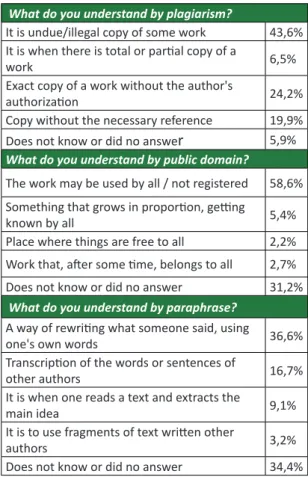
-ions referring to the concepts of plagiarism, public domain and paraphrase, categories were created
from the mos frequent answers. The results are sho
-wn in Table 1.
Table 1. Knowledge of denistry students of the concepts of plagiarism, public domain and
paraphrase. UESB, Jequié, BA, Brazil 2013 What do you understand by plagiarism?
It is undue/illegal copy of some work 43,6% It is when there is total or parial copy of a
work 6,5%
Exact copy of a work without the author's
authorizaion 24,2%
Copy without the necessary reference 19,9% Does not know or did no answer 5,9%
What do you understand by public domain?
The work may be used by all / not registered 58,6% Something that grows in proporion, geing
known by all 5,4%
Place where things are free to all 2,2% Work that, ater some ime, belongs to all 2,7% Does not know or did no answer 31,2%
What do you understand by paraphrase? A way of rewriing what someone said, using
one's own words 36,6%
Transcripion of the words or sentences of
other authors 16,7%
It is when one reads a text and extracts the
main idea 9,1%
It is to use fragments of text writen other
authors 3,2%
Does not know or did no answer 34,4%
When asked about the concept of plagiarism, many were able to show that they knew it is a crime or something wrong but few approached the three most common types of plagiarism menioned in the present study, as is shown in Table 1. Another ques
-ion presented three situa-ions illustraing each of the three types of plagiarism and people who did not choose one of them were counted as not kno
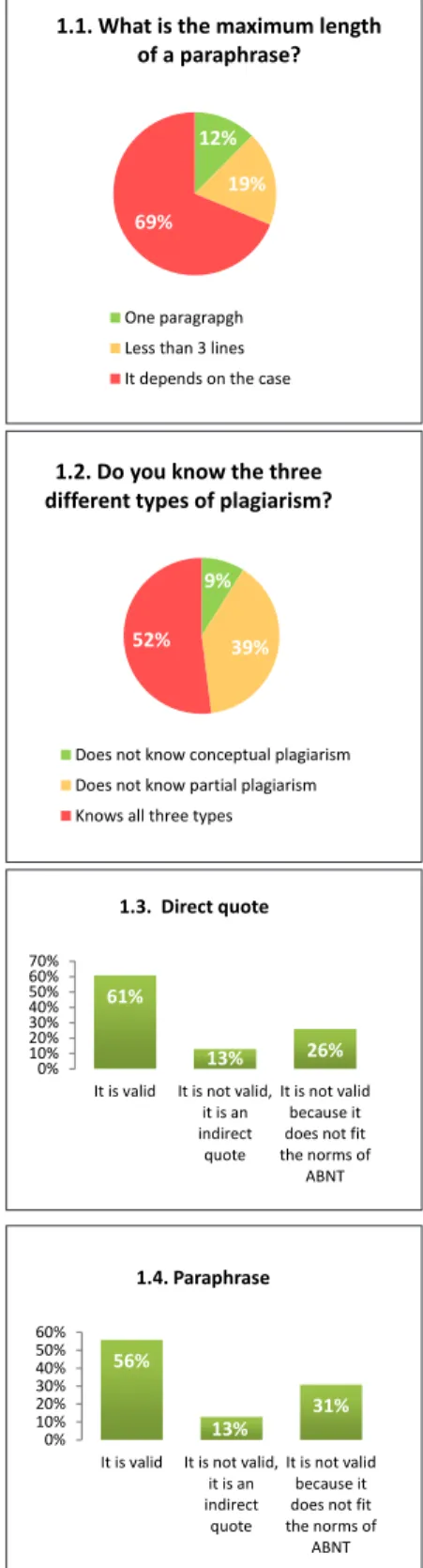
-wing the situaion described was plagiarism. The results can be seen in Figure 1.2.
Artig
A study performed in Peru to assess the fre
-quency of plagiarism in academic papers revealed literal plagiarism as the most frequent, in accor
-dance with the results found in the present study that showed this is the best known type of plagiarism by students. This indicates that, despite knowing the problem, they keep doing this kind of fraud 17. In
health courses – where such issues of responsibility and ethics in clinical conduct are so encouraged, as they do not involve only the development of knowl
-edge but other people’s lives –, acing ethically and transparently is fundamental 18.
The concept of public domain that was expect
-ed as an answer from the students is dein-ed as the economic rights of every scieniic, literary or arisic work for which the term of legal protecion is ex
-pired belong to no one. In Brazil, this term expires 70 years ater the author’s death. However, the moral rights of any work are eternal and, thus, when using any of these works, they must be properly ref
-erenced so as not to conigure plagiarism 3. As can
be seen in Table 1, most volunteers showed lack of knowledge of the concept of public domain and mis
-took it with public access to informaion and works. Only 2.7% answered correctly. A similar result was obtained in the study by Silva and Domingues 16.
Paraphrase, conceptually, refers to the repro
-ducion of the idea or thought of an author (source) transcribed in one’s own words. However, authors must be referenced (all paricipants or at least the three irst ones + et al., according to the ABNT, or
the six irst one as speciied by Vancouver); other
-wise, parial plagiarism or pasiche 3,9. From the total
of paricipants, 36.6% answered parially right. No
-body menioned the need to reference authors of the paraphrased text.
There is no rule of the length a paraphrase may have. Each case must be analyzed individually and what counts is the good sense of the author, 68.8% of the paricipants answered correctly to this quesion. In the study by Fachini and Domingues 3,
the number of correct answers was much inferior 38%. In the research by Barbastefano and Souza 9
the result was similar to ours, 71%.
For the two following quesions, a passage of the book “Oral and maxillofacial pathology”, by Neville et al. 19 was used and, in the sequence, one
example of direct quote and one of paraphrase were presented. The volunteers had to evaluate and judge if the examples were valid or not. The example of direct quote was incorrect because, al
-though it consisted in an exact copy of the fragment and cited authors, it did not it the ABNT norms (it
lacked quotaion marks and the number of pages of the original cited). As can be seen in Figure 1.3, only 26% of the paricipants answered correctly.
Figure 1. Knowledge of denistry students about the length of paraphrase, types of plagiarism and norms of direct quote and paraphrase. UESB, Jequié/BA Brazil, 2013
1.1. What is the maximum length of a paraphrase?
1.2. Do you know the three different types of plagiarism?
1.3. Direct quote.
12% 19% 69%
1.1. What is the maximum length of a paraphrase?
One paragrapgh
Less than 3 lines
It depends on the case
9%
39% 52%
1.2. Do you know the three different types of plagiarism?
1.2. Do you know the three different types of plagiarism?
1.3. Direct quote.
12% 19% 69%
1.1. What is the maximum length of a paraphrase?
9%
39% 52%
1.2. Do you know the three different types of plagiarism?
Does not know conceptual plagiarism
Does not know partial plagiarism
Knows all three types
1.4. Paraphrase
rms o 61%
13% 26%
0% 10% 20% 30% 40% 50% 60% 70%
It is valid It is not valid, it is an indirect
quote
It is not valid because it does not fit the norms of
ABNT
1.3. Direct quote
56%
13% 31%
1.4. Paraphrase
1.4. Paraphrase
61%
13% 26%
1.3. Direct quote
56%
13% 31%
0% 10% 20% 30% 40% 50% 60%
It is valid It is not valid, it is an indirect quote
It is not valid because it does not fit the norms of
ABNT
1.4. Paraphrase
Artig
Percepion of academic plagiarism among denistry students
As to the paraphrase example, it was also not valid because, there was no reference to the authors of the paraphrased text at the end of the fragment writen with diferent words. Figure 1.4 shows that only 31% judged the case of paraphrase correctly. This result shows litle knowledge of the norms for the use of quotes in their text producion.
The following quesion asked which sources the volunteers used the most to make their scieniic researches, and they could choose as many opions as they found necessary. The most frequent answers were: internet, through search sites (2,5%) and Uni
-versity library (1,5%). Other results were 0.5% for the Scieniic Library on Line (SciELO), 1% used the Capes Journal Portal (Portal de periódicos da Coor
-denação de Aperfeiçoamento de Pessoal de Nível Superior - Capes), 1% at the Virtual Library on Health (“Biblioteca Virtual em Saúde - BVS”) and 0.5% for
Google Scholar. These results were corroborated by Barbastefano and Souza 9 and Silva and Domingues 17.
The study by Fachini and Domingues 3, how
-ever, indicates that the University library is the most used source and the internet is the third most used. But such results may vary inf funcion of the quality of the University library and the availability of internet access to students.
Seeking to systemaize the answers of parici
-pants who marked more than one alternaive, about approximately 53% of the volunteers, the answers of those who only use reliable sources (congress proceedings; SciELO; journals assessed by Capes; BVS; Google scholar and the university library) were separated in a group. Another category was that of students who use both reliable and unreliable sources (considering so any search site on the internet and the Wikipedia), 32% of the paricipants were in this group. A much smaller group was the one of students who only use unreliable sources, represening only 2%.
It is a notorious fact that increasingly more cases of plagiarism are detected in the academic en
-vironment, soon reaching the media that publishes them. In this point, a quesion that remains unan
-swered may be raised: does the expansion in the use of the internet cause and increase in the numbers of cases of plagiarism or has it just caused an increase in their detecion? What can be concluded is that so far there is no consensus on this mater among authors. Diniz and Terra 2 infer that there are sill no
studies showing that the popularizaion of the inter
-net has actually increased the number of cases of plagiarism, but they may be detected more readi
-ly in the present days, even with the use of online tools and programs.
Biondi 20 also discusses this divergence among
several. Among these, Mr. Lopes dos Santos, coordi
-nator of Humaniies at the Fundação de Ampara a Pesquisa do Estado de São Paulo (Fapesp - State of São Paulo Research Foundaion), who states there is no data indicaing that the problem is increasing in gravity or not, despite recognizing that the con
-cern in relaion to the theme has grown. In the same report, Biondi quotes Erney de Camargo, full pro
-fessor at the Biomedical Sciences Insitute of USP (State University of São Paulo) and former president of CNPq (Naional Research Council), according to whom, 50 years ago one could hear say about pla
-giarism and thet of ideas and data at USP. However, right ater this, the professor say he does not know if it is the number of occurrences of plagiarism that is increasing or if it is our ability to discover them. Other authors menioned in the same news report will atribute this alleged increase in the number of cases of plagiarism to the requirement of high indi
-vidual producivity in academic publicaions. There is much divergence on the plagiarism versus pro
-ducivity relaionship among the authors cited in the present study.
Images are widely used resources in scienif
-ic producion and are also protected by copyright law. Thus, there is the need to encourage students to create their own images or, when it is necessary to use images by others, to correctly refer to them in order not to commit the crime of copyright vio
-laion. When asked about the way they use these images, 78% declared they do not respect image copyrights and that they use images found on the in
-ternet without discriminaion. This conduct should be avoided, even though it is diicult to prove au
-thorship of an image. To produce their own images or ask for authorizaion to use other people’s imag
-es would be the b-est opions to avoid problems. Finally, when asked if they had received ori
-entaion on academic plagiarism during their undergraduate course, 69.4% of the paricipants of the study declared they had been oriented by some teacher. This result contrasts in comparison with those of the studies by Fachini and Domingues 3, Bar
-bastefano and Souza 9, and Silva and Domingues 16, in
which 48.2%, 19%, and 28.7%, respecively, declared having received orientaion on plagiarism.
Although the present study did not focus the is
-sue of self-plagiarism, as the research was made with undergraduate students who are being inserted in the universe of academic research and will have to write their inal projects, it is worth menioning this new ca
-tegory of plagiarism. Self-plagiarism may be ideniied
Artig
in situaions in which authors copy and change the wording of their own published works, republishing the same ideas presented in the original studies in “new” allegedly original aricles. New editorial crite
-ria along with the pressure to publish studies mainly required by graduate programs seem to be creaing this ethical issues in scieniic communicaion 21,22.
Final consideraions
The results obtained in this research allow the conclusion that undergraduate denistry students do not have full knowledge of what plagiarism is. Even this being a recurrent issue in the media and discussed in academic life, most students did not know how to respond clearly to the quesions asked. It can be noted that the basic content of the law on the topic, that plagiarism is a crime and may result in penalies is understood by the majority o students. However, they could not idenify clearly the speciic cases of plagiarism, as conceptual or parial plagia
-rism, nor was it clear for them that the incorrect use of indirect citaions may be considered plagiarism.
Most of the volunteers declared they used reliable sources for their researches. However, par
-icipants showed no concern relaive to the use of third party images in academic papers or with the sources from which these images are obtained or even with the possibility that they may involve copy rights. A small porion declared that they take cor
-rect precauions, using free access images, asking for permission to use protected images, or produ
-cing their own images.
The discipline of Research Methodology is ofered from the second semester of this course. It is expected that, from then on, students will build a more solid concept of plagiarism and its importan
-ce in the academic medium. However, this was not shown in this study. Titles and even inancial gains may be obtained through this illegal pracice. It is clear, then, the need to combat plagiarism in un
-dergraduate courses or even before, in elementary school.
Due to the relevance of the theme, the need to enhance this research to the other courses of this and of other universiies is registered here, in a way to obtain a survey of how this subject is being approached in the undergraduate courses. Besides, the importance is stated of designing a booklet to disseminate informaion and combat plagiarism.
Referências
1. Christofe L. Intertextualidade e plágio: questões de linguagem e autoria [tese]. [Internet]. Campinas: Universidade de Campinas; 1996 [acesso 19 nov 2013]. Disponível: htp://libdigi. unicamp.br/document/?code=vtls000115064
2. Diniz D, Terra A. Plágio: palavras escondidas. Rio de JaneiroQBrasília: Fiocruz/Letras-Livres; 2014. p. 18.
3. Fachini GJ, Domingues MJCS. Percepção do plágio acadêmico entre alunos de programas de pós-graduação em administração e contabilidade. [Internet]. Trabalho apresentado no 11º
Semead; 28-29 ago 2008; São Paulo. 2008 [acesso 10 fev 2013]. Disponível: www.ead.fea.usp.br/ semead/11semead/resultado/trabalhosPDF/842.pdf
4. Jonsen AR. The birth of bioethics. New York: Oxford University Press; 1998.
5. Beauchamp TL, Childress JF. Principles of biomedical ethics. 7ª ed. New York: Oxford University Press; 2013.
6. Reich WT, editor. Encyclopedia of bioethics [CD-ROM]. Rev ed. New York: Macmillan Library Reference; 1995.
7. Conselho Federal de Odontologia. Código de éica odontológica. Rio de Janeiro: CFO; 2012. 8. Diniz D, Guilhem D. O que é bioéica? São Paulo: Brasiliense; 2006. p. 11-62.
9. Barbastefano RG, Souza CG. Plágio em trabalhos acadêmicos: uma pesquisa com alunos de graduação. Anais do 27º Encontro Nacional de Engenharia de Produção: 8-11 out 2007; Foz do
Iguaçu, Brasil. Foz do Iguaçu: Enegep; 2007. p. 1-8.
10. Diniz D, Munhoz AT. Cópia e pasiche: plágio na comunicação cieníica. Argumentum. 2011;3(1):11-28.
11. Silva OSF. Entre o plágio e a autoria: qual o papel da universidade. Rev Bras Educ. 2008;13(38):357-414.
12. Ford PJ, Hughes C. Academic integrity and plagiarism: percepions and experience of staf and students in a school of denistry. A situaional analysis of staf and student perspecives. Eur J Dent Educ. 2012;16(1):180-6.
13. Brasil. Decreto-Lei nº 2.848, de 7 de setembro de 1940. Código Penal. Diário Oicial da União. 31 dez 1940;Seção 1:2391.
Artig
Percepion of academic plagiarism among denistry students
14. Brasil. Lei nº 9.610, de 19 de fevereiro de 1998. Altera, atualiza e consolida a legislação sobre direitos autorais e dá outras providências. Brasília. Diário Oicial da União. 20 fev 1998;Seção 1:3 15. Krokoscz M. Abordagem do plágio nas três melhores universidades de cada um dos cinco
coninentes e do Brasil. Rev Bras Educ. 2011;16(48):745-68.
16. Silva AKL, Domingues MJCS. Plágio no meio acadêmico: de que forma alunos de pós-graduação compreendem o tema. Perspecivas Contemporâneas. 2008;3(2):117-35.
17. Saldaña GJJC, Quezada OCC, Peña OA, Mayta TP. Alta frecuencia de plagio en tesis de medicina de una universidad pública peruana. Rev Peru Med Exp Salud Pública. 2010;27(1):63-7.
18. Sauthier M, Almeida FAJ, Matheus MP, Fonseca PML. Fraude e plágio em pesquisa e na ciência: moivos e repercussões. Rev Enf Ref. 2011;3(3):47-55.
19. Neville BW, Damm DD, Allen CM, Bouquot JE. Patologia oral e maxilofacial. 3a ed. Rio de Janeiro: Elsevier; 2009.
20. Biondi A. Plágio na produção acadêmica, vespeiro intocado. Ou não? Revista Adusp. 2011;(50):57-65.
21. Porto D. Publicação em bioéica na América Laina: impasses e desaios. Bioeikos. 2013;7(4):442-7.
22. Gomes AB. Orientações da Capes sobre o plágio. [Internet]. 2011 [acesso 15 set 2014]. Disponível: htp://anabeatrizgomes.blogspot.com.br/2011/02/orientacoes-da-capes-sobre-o-plagio.html
Paricipaion of the authors
Diego Oliveira Guedes paricipated in the concepion of the research project, bibliographic research, data collecion, analysis and wriing the aricle. Douglas Leonardo Gomes Filho paricipated in the supervison, review of the project, data collecion, analysis, formaing, and review of the text.
Recebido: 17. 7.2014 Revisado: 3. 9.2014 Aprovado: 14.11.2014
Artig
Annex Quesionnaire
1. Gender: ( ) Male ( ) Female
2. Age: ( ) Years
3. Semester you are taking: ( ) Semester
4. According to your knowledge about Brazilian Law, plagiarism is:
( ) A crime. ( ) Not a crime. ( ) Does not know.
5. In case you answered “A crime” in the previous quesion, you:
( ) Agree with the law. ( ) Do not agree with the law.
6. Sill according to your knowledge on the law, in which situaion(s) is it permited to reproduce intellectual work?
( ) When the owner of the copyrights authorizes the reproducion.
( ) When the author is duly referenced. ( ) When the work is in public domain.
( ) When the reproducion is done by an undergrad
-uate student.
( ) When the reproducion is for nonproit purpos
-es.
( ) When the reproducion serves to beneit the au
-thor.
( ) When the reproducion has the objecive of im
-proving or commening the work.
7. What do you understand by plagiarism?
__________________________________________ __________________________________________ __________________________________________ __________________________________________
8. What do you understand by public domain?
__________________________________________ __________________________________________ __________________________________________ __________________________________________
9. What do you understand by paraphrase?
__________________________________________ __________________________________________ __________________________________________
10. Which of the following situaions do you consider plagiarism?
( ) Exact copy of a text or fragment of a text. ( ) Use of the idea contained in a text but writen with diferent words.
( ) Text built with fragments of several diferent texts.
11. In your understanding, what is the maximum length of a paraphrase in a text so that there is no violaion of copyright:
( ) One paragraph. ( ) Less than 3 lines.
( ) There is no maximum length, it depends on the case.
12. What follows is a passage of the book “Oral and maxillofacial pathology”, by Neville et al.:
“The denigerous cyst is deined as a cyst that originates by the separaion of the follicle from around the crown of an unerupted tooth. This is the most common type of developmental odontogenic cyst.”
Example of direct quote:
The denigerous cyst is deined as a cyst that originates by the separaion of the follicle from around the crown of an unerupted tooth. This is the most common type of developmental odontogenic cyst (Neville et al., 2009).
( ) It’s valid.
( ) It’s not valid, it is an indirect quote.
( ) It’s not valid because it is not in accordance with ABNT norms.
Example of paraphrase:
Denigerous cyst, that originates by the separaion of the follicle from around the
crown of an unerupted tooth is the most common type of developmental odontogenic cyst.
( ) It’s valid.
( ) It’s not valid, it is a direct quote.
( ) It’s not valid because it is not in accordance with ABNT norms.
13. What sources of research do you use regularly to do your academic studies:
( ) University library ( ) City library
Artig
Percepion of academic plagiarism among denistry students
( ) Personal library ( ) Google Scholar
( ) Health Virtual Library (Biblioteca Virtual em Saú
-de)
( ) Capes Journal Portal (Portal de Periódicos Capes) ( ) Wikipedia
( ) Internet, through search engines ( ) SciELO
( ) Congress proceedings
14. What sources of images do you use in your research?
( ) Any open site, because their images are open and I use them with no problem.
( ) Any site that allows the use.
( ) I try to reproduce the images with my own re
-sources.
( ) I ask for authorizaion from the authors to use images found on the internet.
15. During your literature research, in case you ind a retracted aricle, what is your conduct? ( ) Includes in the list of references, because it went through a review process.
( ) Disregard its use because it is fraud.
( ) Use it with conidence because it has doubles staisical treatment.
16. Have you got informaion from any college teacher about academic plagiarism?
( ) Yes ( ) No