Original article
Static postural balance in healthy individuals:
Comparisons between three age groups
Yanne Salviano Pereira Jéssica Mascena de Medeiros
Federal University of Paraíba at João Pessoa, Brazil
José Ângelo Barela Ana Maria Forti Barela
Cruzeiro do Sul University at São Paulo, Brazil
César Ferreira Amorim University of the City of São Paulo, Brazil
Catarina de Oliveira Sousa Federal University of São Carlos, Brazil
Palloma Rodrigues de Andrade José Jamacy de Almeida Ferreira Heleodório Honorato dos Santos
Federal University of Paraíba at João Pessoa, Brazil
Abstract—The aim of the study was to compare static postural balance of healthy individuals of three age groups in different conditions of support and vision. Seventy one individuals, divided into 3 groups, were analyzed: young group (YG: 22.2 ± 2.1 years), middle aged group (MAG: 50.7 ± 5.7 years) and older individuals group (EG: 66.8 ± 5.4 years). Their balance was tested on a force platform, under 3 support and 3 visual conditions. Measures included: total (TD), anterior-posterior (APD) and mediolateral displacement (MLD) of the center of pressure (CoP). ANOVA revealed
signi-icant differences for interactions between group X support conditions and group X visual conditions for the 3 variables
(p<0.01), with greater displacements for the MAG and EG groups during single-leg stance with partial and occluded vision (p<0.05). Static postural balance decreased over time in healthy individuals, and conditions of support and visual negatively affected balance with the increment of age.
Keywords: age groups, sensory feedback, posture
Resumo—“Equilíbrio postural estático em indivíduos saudáveis : Comparações entre três grupos etários.” O objetivo do estudo foi comparar o equilíbrio postural estático de indivíduos saudáveis de três faixas etárias em diferentes condições de apoio e de visão. Foram analisados 71 sujeitos, divididos em 3 grupos: jovens (GJ: 22,2±2,1 anos); meia idade (GMI: 50,7±5,7 anos) e idosos (GI: 66,8±5,4 anos). O equilíbrio foi testado numa plataforma de força, em 3 condições de apoio e 3 condições de visão, avaliando-se o deslocamento total (DT), ântero-posterior (DAP) e médio-lateral (DML) do centro
de pressão (CP). ANOVA mostrou interação grupo X condições de apoio e grupo X condições visuais, nas 3 variáveis
estudadas (p<0,01), com maiores deslocamentos no GMI e GI no apoio unipodal com visão parcial e ausente (p<0,05). O equilíbrio postural estático em indivíduos saudáveis diminuiu ao longo do tempo e que as condições de apoio e de visão podem afetá-lo negativamente com o avançar da idade.
Palavras-chave: grupos etários, retroalimentação sensorial, postura
Resumen—“Equilibrio postural estático en individuos sanos: Las comparaciones entre los tres grupos de edad.” El ob-jetivo del estudio fue comparar el equilibrio postural estático de individuos sanos de tres grupos de edad em diferentes condiciones de apoyo y visón. Fueran analizados 71 sujetos, divididos en 3 grupos: jóvenes (GJ: 22,2±2,1 años), de mediana edad (GME: 50,7±5,7 años) y ancianos (GA: 66,8±5,4 años). El equilibrio fue probado en una plataforma de fuerza, em 3 condiciones de apoyo y 3 condiciones de visión, evaluando el desplazamiento total (DT), anteroposterior
grupo X condiciones visuales, en las 3 variables (p<0,01), con grandes desplazamientos en GME y GA en apoyo unipodal con visión parcial y ausente (p<0,05). El equilibrio postural estático disminuyó en individuos sanos con el tiempo y que las condiciones de apoyo y de visión pueden afectarle negativamente con la edad.
Palabras clave: grupos de edad, retroalimentación sensorial, postura
Introduction
Brazil has a rapidly aging population, target to signiicant
changes Data from the Brazilian Institute of Geography and
Statistics (Instituto Brasileiro de Geograia e Estatística, IBGE)
in 2010 has indicated that the Brazilian population over 60 years of age was fastest growing group in the last decade, increasing approximately 8% of the total population (14.5 million people) to approximately 10.8% (20 million). According to statistical projections of the World Health Organization, in the period from 1950 to 2025, the group of older people in Brazil is expected to
increase approximately ifteen times, reaching, in 2025, about
32 million people aged 60 and older (Instituto Brasileiro de
Geograia e Estatística, 2000, 2010).
According to Kirkwood (2002), aging is a process that be-gins at conception and continues throughout the lifespan. Aging causes physiological changes with various effects. Many of the physiological changes attributed to aging occur in a progressive manner and compromise independence and functional status of older individuals, leading, for example, to decreased strength and
proprioception, (Alieri & Moraes, 2008), deicits of sensory sys
-tems (Nardone & Schieppati, 2010; Ricci, Gazzola, & Coimbra, 2009) and changes in gait and balance (Abreu & Caldas, 2008).
Among the most prominent physiological changes caused by aging is the decreased balance and its important functional
limi-tations (Nascimento, Patrizzi, & Oliveira, 2012). Freitas Junior and Barela (2006) observed that deicit of balance is one of the
main cause of high rate of falls among older individuals, mainly due to the decreased ability of sensory (visual, somatosensory and vestibular) and motor systems to keep the body oriented.
The maintenance of stability is a dynamic process that invol-ves adjustments between stabilization and destabilization forces. Here, the control strategies are dependent on interactions between the individual, the task at hand, and the environment. Such
strate-gies are triggered by accurate and speciic sensory input, and are inluenced by the integrity of motor process (Duarte & Zatsiorsky,
2002). Posture and balance involve, both, the ability to recover from instability, and the ability to anticipate and move in order
to avoid instability (Leonardi, Lopes, Bezerra, & Borges, 2009).
Several studies have examined the effects of
institutio-nalization (Aikawa, Braccialli, & Padula, 2006; Alves &
Scheicher, 2011), disease (Gazzola, Perracini, Ganança, & Ganança, 2006), and regular physical activity (Bruni,
Gra-nado, & Prado, 2008) on static balance in older individuals.
However, few studies have reported how aging affects sta-bility over time in this age group.
Some recent studies have shown the effects of strength and multisensory training under different conditions of support and
visual restrictions (Alieri et al., 2010; 2012), and the impact of
standing on one foot — regardless dominance of members — (Gil
et al., 2011; Maciel & Guerra, 2005) on the displacement of the
center of pressure. However, the literature is sparse in analyzing balance in response to sensory factors such as different types of support and types of visual restriction in different age groups.
Studying the effects of sensory stimuli associated with three age groups is important because it attempts to identify stimuli that are more related to balance changes as age advances. From this perspective, the aim of this study was to compare static postural balance of healthy individuals of the three age groups in different conditions of support and vision.
Methods
Study design and sample
This work consisted in a cross-sectional and descriptive stu-dy conducted at the Laboratory of Biological Signal Processing in the Core Studies of Human Movement at Federal University of Paraíba (CSHM/UFPB).
The study was approved by the Research Ethics Committee Lauro Wanderley University Hospital (CEP/HULW/UFPB), under the protocol number 009/2009. Individuals were informed about the study’s purpose, and signed a consent form, agreeing to participate in the study, according to the Brazilian National Health Council (NHC), Resolution 196/96.
The sample was selected by convenience, meeting the following inclusion criteria: age between 20 and 80 years old, and based on a physiotherapy evaluation form, no disorders
that would compromised static balance were identiied, such
as: chronic vestibular syndrome, labyrinthitis, vertigo and/or neurological, cognitive and/or orthopedic impairments.
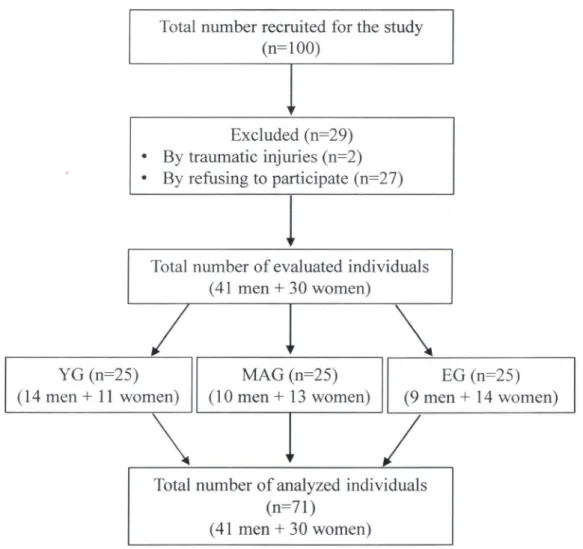
The study included 71 volunteers, male and female, divided into 3 groups (Figure 1) according to age: 1 - the youth group (YG = 25 individuals: 14 men and 11 women, 22.2±2.1), ages between 20 and 40 years; 2 - the middle-aged group (MAG = 23 individu-als: 10 men and 13 women; 50.7±5.7 years), ages between 41 and 60, and 3 - the group of older individuals (EG = 23 individuals: 9 men and 14 women, 66.7±5.4 years), ages over 60 years, who regularly participated in an exercise program that includes, for example, water gymnastics, lasting 1 hour twice a week.
The sample size was estimated by means of a pilot study that determined the necessary number of participants for each group (www.lee.dante.br). The criterion was to meet a difference of 1.3 cm of anterior-posterior postural displacement (APD). A total of 21
Equipment
Anthropometric data (weight and height) was collected using analog scale, 100g accuracy and coupled with a stadio-meter (Filizola, Brazil). Static postural balance was assessed in the anterior-posterior and mediolateral directions using a force platform (EMG System, Brazil), with a sampling fre-quency of 100 Hz.
Procedures
Initially, individuals’ anthropometric data (age, weight and height) were registered barefoot of each group. During data acquisition via stabilometric (postural oscillation), each individual was asked stand on a force platform (EMG Sys-tem, Brazil) wearing their normal shoes, in a comfortable and aligned position (i.e., with the body mass distributed as best as possible—based on the coordinate lines of the platform—, arms relaxed at their sides), keeping still and silent, gazing an image located one meter away at eye level). After a verbal command (attention, ready, go), individuals were instructed to remain as still as possible during 30 seconds for data collection.
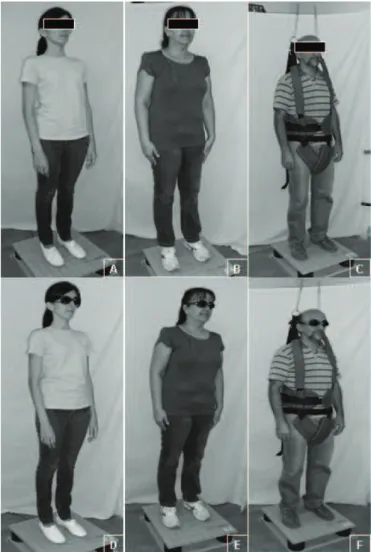
Data collection included: three support conditions (standing on two-feet, DLS); one-foot stance with the dominant leg, DL, and non-dominant leg, NDL, and three visual conditions: full vi-sion, FV (Figure 2A, B and C); partial vivi-sion, wearing swimming goggles with 50% visibility, PV; and occluded vision, wearing swimming goggles with 0% visibility, AV (Figure 2D, E and F). These conditions were randomly presented (Dalal, 2008).
One minute rest time was given between each condition, and if
an individual could not maintain position for 30 seconds on the irst
try, they were given a second trial and even third trial. Throughout the procedure, a quiet environment was req uired, and a researcher stood beside each individual for their safety. In full vision (FV) condition, some individuals kept their corrective glasses. To pre-vent possible falls during the assessments of one-foot standing and restricted vision, older individuals wore a parachute vest connected to the ceiling by two metal cables (Figure 2C and F).
The static postural balance records were analyzed using the 400 BIOMEC software (version 2009 - EMG System, Brazil). Fata was processed using MatLab (Component Runtime 7.6) to quantify the total (TD), anteroposterior (AP; axis Y) and
me-diolateral (ML; X axis) displacement of the center of pressure (CoP) (in centimeters), using a second order Butterworth ilter.
Statistical analysis
The statistical procedures (descriptive and inferential) were performed in Statistical Package for Social Sciences (SPSS – 15.0). Normal distribution of the data (Shapiro Wilk’s) and
homogeneity of variances (Levene’s) were conirmed. Then,
analysis of variance (ANOVA – three way) was computed for each variable (TD, APD and MLD) considering groups, support and visual conditions. When necessary, Tukey post hoc tests
were employed, considering a signiicance level of 5%.
Results
The anthropometric characteristics of the groups were: YG body mass = 64.90±13.93 kg, height = 1.68±0.10 m, and BMI = 22.89±1.18 kg/m2; MAG body mass = 69.75±10.88 kg, height
= 1.62±0.09 m, BMI = 26.58±2.31 kg/m2; EG body mass =
69.58±11.30 kg, height = 1.57±0.10 m, BMI = 28.23±2.85 kg/m2.
The ANOVA three way revealed differences between groups (TD: F=17.45; APD: F=33.21; MLD: F=34.70, p<0.01, respec-tively), support conditions (TD: F=137.82; APD: F=130.80; MLD: F=112.11, p<0.01, respectively), and visual conditions (TD: F=8.71; APD: F=56.08; MLD: F=39.54, p<0.01, respecti-vely). Interactions between groups and support conditions were detected for the variables TD (F=3.38, p<0.01), APD (F=4.38, p<0.01), and MLD (F=8.11, p<0.01) and for groups X visual conditions for the variables TD (F=4.72, p<0.01), APD (F=2.49, p<0.05), and MLD (F=2.97, p<0.05).
According to Table 1, during the one-foot standing task, Tukey post-hoc tests indicated that, regarding the interactions between group and support conditions, the MAG showed higher TD than YG (DL and NDL: p<0.01) and GE (DL and NDL:
Figure 2. Evaluation of CoP displacement in doble leg-stance (YG, MAG and EG) with full (A, B and C) and partial vision (D, E and F).
Variables
Factors
Age Groups X Support Conditions
Young Group (YG) Middle-Aged Group (MAG) Elderly Group (EG)
DLS DL NDL DLS DL NDL DLS DL NDL
TD (cm) 15.2±7.7 59.1±51.9a 59.4±48.6c 19.7±4.4 95.3±53.4a,b 86.0±47.0c,d 19.5±4.9 69.0±56.4b 71.1±39.5d
APD (cm) 0.7±0.6 2.0±1.7a,b 1.9±1.7c,d 1.0±0.4 3.4±2.3a 3.1±1.6c 1.0±0.5 3.1±1.8b 3.2±1.8d
MLD (cm) 0.4±0.3 1.3±1.1a,b 1.4±1.2d,e 0.5±0.3 2.6±2.1a,c 2.3±1.1d,f 0.4±0.2 3.2±3.2b,c 2.8±2.1e,f
Age Groups X Visual Conditions
Young Group (YG) Middle-Aged Group (MAG) Elderly Group (EG)
AV PV FV AV PV FV AV PV FV
TD (cm) 61.9±61.0 42.2±40.5b 29.6±22.7d,e 69.5±63.9a 76.7±54.9b,c 54.7±34.3d 50.4±59.2a 56.3±42.2c 52.3±34.7e
APD (cm) 2.09±2.0a,b 1.5±1.3c,d 1.9±0.9e 3.5±2.6a 2.4±1.5c 1.6±2.6 3.0±2.2b 2.5±1.7d 1.8±1.1e
MLD (cm) .4±1.4a,b 1.0±1.0c,d 0.7±0.6f 2.7±2.4a 1.6±1.0c,e 1.1±0.5 2.9±3.2b 2.3±2.5d,e 1.3±1.2f Table 1. Displacement of the center of pressure (CoP) in the interactions between factors: age groups X support conditions and age groups X
visual conditions.
Note: Values are expressed as mean ± standard deviation. Same letters represent differences between groups (YG, MAG and EG) for each variable (TD, APD and MLD) in each line.
p<0.01 and p<0.05, respectively). The MAG and EG showed higher APD than YG during the one-foot standing task, in both legs (DL and NDL: p<0.01). MAG and EG showed higher MLD than YG (p<0.01); and EG showed greater MLD than MAG during the one-foot standing task for both legs (DL and NDL: p<0.05, respectively).
Regarding the interaction between group and visual condi-tions, MAG showed higher TD than EG (p<0.05) during the visual occlusion condition; and higher TD that YG (p<0.01) and EG (p<0.05) during partial vision condition. During the full visual condition, MAG (p<0.01) and EG (p<0.01) exhibited higher TD than YG.
With respect to APD, MAG and EG showed higher values than YG during the visual occlusion and partial visual conditions (p<0.01); and EG showed higher values than YG during the full vision condition (p<0.05).
As for the MLD, MAG and EG presented higher averages than YG during visual occlusion (p<0.01) and partial visual conditions (p<0.05 and p<0.01, respectively). EG showed higher mean values compared to MAG during partial visual condition (p<0.05), and also EG had higher mean values compared to YG, during the full visual condition (p<0.05).
Discussion
The results of the present study showed that age has a strong
inluence on static postural balance when associated with ma -nipulations of support and visual conditions. In general, larger body oscillations—represented by the anterior-posterior (AP) and mediolateral (ML) directions—were found for the indivi-duals of middle age and the older indiviindivi-duals.
Barbieri, Gissot and Pérennou (2010) reported that the changes related to aging interfere with the ability of individuals internally align their bodies with the vertical direction, therefore, playing an important role in postural decline in healthy elderly. However, in the present study, during the one-foot stance, indi-viduals of the MAG group showed higher TD than indiindi-viduals of the EG group, and the individuals of the YG group. Possibly, for the individuals of the EG, these differences were the result of effects of practice in regular physical exercises (Lojudice, 2008), therefore, improving postural stability and reducing the risk for
falls (Nardone & Schieppati, 2010; Pimentel & Scheicher, 2009).
In contrast, analysis of the AP and ML directions showed that MAG and EG exhibit higher displacements during one-foot stance than individuals in the YG group, and EG showed greater displacement than MAG in the ML direction. These results corroborate results by Barbieri et al. (2010) and have great clinical relevance. Older individuals often are unable to move from the two-feet to one-foot stance during walking due
to dificulties in controlling the lateral movement of their bodies (Rogers & Mille, 2003).
Despite the differences in postural control between one-foot stance and two-feet stance, in this study no differences were observed between dominant and non-dominant legs, which corroborates with several other studies conducted with both young and older individuals (Alonso,Brech, Bourquin,
& Greve 2011; Alonso, Bronzatto Filho, Brech, & Moscoli,
2008; Tookuni et al., 2005).
When we investigated the role of vision, MAG and EG showed higher TD than YG during FV condition. However, MAG showed greater TD than EG during the AV condition, and greater TD than YG and EG during the PV condition. The
eficiency of the visual system is an essential factor for body balance (Freitas Júnior, 2003; Sihvonen, Sipilä, & Era 2004),
and consequently, low visual acuity (Macedo, Pereira, Gomes,
Silva, & Castro, 2008) or absence of vision, even if momentary, generates instability (Costa, Goroso, & Lopes, 2009), which
in this study was more evident for the MAG. This can also be related to differences between the levels of physical condition among the groups.
To Bugnariu and Fung (2007), who compared sensorimotor strategies during regulation of upright balance of the young and older healthy adults, aging affects the interaction of the soma-tosensory and visual systems affecting the ability of the central nervous system (CNS) to maintain upright stance equilibrium. Therefore, older adults tend to show greater AP and ML CoP displacements when compared to young adults.
Kitabayashi, Demura, Kawabata, Uchiyama and Demura (2011) also found through stabilometry, greater sway in the AP and ML direction of healthy older individuals (n = 342) compared to young ones (n = 380).
According to Freitas Júnior and Barela (2006), there is a consensus on the decrease of postural control in the elderly, indicating that they sway more than young adults, during both, eyes open and eyes closed conditions.
Our results corroborate others studies (Brooke-Wavell,
Per-rett, Howarth, & Haslam, 2002; Cruz, Oliveira & Melo, 2010)
that analyzed the CoP displacement in the AP and ML direc-tions, and that observed that the visual feedback is an important contribution to replace reduced somatosensory and vestibular sensory input in older individuals, especially during one-foot
stance tasks (Deyer & Ashton-Miller, 1999). In addition, for
Soares (2010), the importance of vision increases gradually with the advancing of age, becoming a key factor for the stability of older people. He noted that, for adults with ages 20 to 60 years, the stability decreases 30% when eyes are closed and reaches 50% for individuals over 60 years.
The fact that individuals in the EG were practicing regular
physical activity may somehow have inluenced the results of
TD. YG and MAG performed only activities of daily living (ADLs), and most studies with older people in the literature include institutionalized (Medeiros et al., 2012) or community residents (Freitas Júnior, 2003), but not engaged in regular physical activity. Furthermore, the use of the parachute vest safety system by the EG group could have an effect on results by adding information that helped stabilization of the body.
Conclusion
velocity feedback. Archives of Physical Medicine Rehabilitation,
80(9), 1072-1077. doi: 0003-9993/99/8009-506253.00/0.
Duarte, M. & Zatsiorsky, V. M. (2002). Effects of body lean and
visual information on the equilibrium maintenance during stance.
Experimental Brain Research, 146, 60-69. doi: 10.1007/s00221-002-1154-1.
Freitas Jr, P. B. (2003). Características comportamentais do controle
postural de jovens, adultos e idosos (Dissertação de Mestrado em Ciências da Motricidade, Universidade Estadual Paulista, Rio
Claro). Retrieved from http://www.rc.unesp.br/ib/eisica/lem/pdf/
dissertacao_paulo.pdf
Freitas Jr, P. B. & Barela, J. A. (2006). Alterações no funcionamento do
sistema de controle postural de idosas: Uso da informação visual.
Revista Portuguesa de Ciências do Desporto, 6(1), 94-105. doi: 1000000000393421.
Gazzola, J. M., Perracini, M. R., Ganança, M. M., & Ganança, F. F.
(2006). Fatores associados ao equilíbrio funcional em idosos com
disfunção vestibular crônica. Revista Brasileira de
Otorrinolarin-gologia, 72(5), 683-690. doi: 110976725705762.
Gil, A. W. O., Oliveira, M. R., Coelho, V. A., Carvalho, C. E.,
Tei-xeira, D. C., & Silva, R. A. (2011). Relationship between force
platform and two functional tests for measuring balance in the
elderly. Revista Brasileira de Fisioterapia,15(6), 429-435. doi:
1000000000238497.
Instituto Brasileiro de Geograia e Estatística [IBGE] (2000). Censo demográico: Brasil. Access: 22/02/2012. Retrieved from http://
www.ibge.gov.br/censo/
Instituto Brasileiro de Geograia e Estatística [IBGE] (2010). Censo demográico: Brasil. Access: 22/02/2012. Retrieved from http://
www.ibge.gov.br/censo/
Kirkwood, T. B. (2002). Evolution of ageing: Mechanisms of ageing
and development, The Biology of Ageing,123(7), 737-745. doi:
10.1016/S0047-6374(01)00419-5.
Kitabayashi, T., Demura, S-I., Kawabata, H., Uchiyama, M., & Demura,
T. (2011). Comparison of the body-sway characteristics of young adults compared to healthy elderly and elderly with equilibrium
disorder. Perceptual and Motor Skills, 113(2), 547-556. doi:
10.2466/10.15.26.PMS.113.5.547-556.
Laboratório de epidemiologia e estatística [Lee]: Tamanho da amostra para pesquisa em ciências da saúde. Acess: 08/10/2012; Available: http://www.lee.dante.br.
Leonardi, M. M. (2009). Impacto do desequilíbrio estático e dinâmico no risco de quedas em indivíduos com ataxia espinocerebelar.
Revista de Neurociências, 17(2), 178-182. Retrieved from http:// www.revistaneurociencias.com.br/edicoes/2009/RN%2017%20 02/16.pdf.
Lojudice, D. C.; Laprega, M. R., & Vidal, P. (2008). Equilíbrio e marcha de
idosos residentes em instituições asilares do município de Catanduva, SP. Revista Brasileira de Geriatria e Gerontologia, 11(2), 181-189. Retrieved from
http://revista.unati.uerj.br/scielo.php?script=sci_art-text&pid=S1809-98232008000200005&lng=pt&nrm=iso&tlng=pt. Macedo, B. G., Pereira, L. S. M., Gomes, P. F., Silva, J. P., &
Castro, A. N. V. (2008). Impacto das alterações visuais nas quedas, desempenho funcional, controle postural e no
equilí-brio dos idosos: Uma revisão de literatura. Revista Brasileira
de Geriatria e Gerontologia, 11(3), 419-432. Retrieved from
http://revista.unati.uerj.br/scielo.php?script=sci_arttext&pi
-d=S1809-98232008000300010&lng=pt&nrm=iso&tlng=pt. Maciel, A. C. C. & Guerra, R. O. (2005). Prevalência e fatores asso
-ciados ao déicit de equilíbrio em idosos. Revista Brasileira de Ciência e Movimento, 13(1), 37-44.
Retrieved from http://portalrevistas.ucb.br/index.php/RBCM/article/ view/610/622.
References
Abreu, S. S. E. & Caldas, C. P. (2008). Velocidade de marcha, equilíbrio
e idade: Um estudo correlacional entre idosas praticantes e idosas
não praticantes de um programa de exercícios terapêuticos. Revista
Brasileira de Fisioterapia, 12(4), 324-330. Retrieved from http://
www.scielo.br/pdf/rbis/v12n4/a12v12n4.pdf.
Aikawa, A. C., Braccialli, L. M. P., & Padula, R. S. (2006). Efeitos
das alterações posturais e de equilíbrio estático nas quedas de
idosos institucionalizados. Revista de Ciências Médicas, 15(3),
189-196. Retrieved from
http://www.puc-campinas.edu.br/perio-dicocientiico/
Alieri, F. M. & Moraes, M. C. L. (2008). Envelhecimento e o controle
postural. Saúde Coletiva, 4(19), 30-33. Retrieved from http://
redalyc.uaemex.mx/pdf/842/84201907.pdf.
Alieri, F. M., Riberto, M., Gatz, L. S., Ribeiro, C. P. C., Lopes, J. A. F., & Battistella, L. R. (2012). Comparison of multisensory and
strength training for postural control in the elderly. Clinical Inter-ventions in Aging, 7, 119-125. doi: 10.2147/CIA.S27747
Alieri, F. M., Riberto, M., Gatz, L. S., Ribeiro, C. P. C., Lopes, J. A. F., Santarém, J. M.. & Battistella, L. R. (2010). Funcional mobility
and balance in community-dwelling alderly submitted to multisen-sory versus strength exercises. Clinical Interventions in Aging, 5, 181-185. doi: 10.2147/CIA.S10223
Alonso, A. C.,Brech, G. C., Bourquin, A. M., & Greve, J. M. D. (2011).
The inluence of lower-limb dominance on postural balance. São Paulo Medical Journal, 129(6), 410-413. Retrieved from http:// www.scielo.br/pdf/spmj/v129n6/v129n6a07.pdf.
Alonso, A. C.,Bronzatto Filho, E., Brech, G. C., & Moscoli, F. (2008). Estudo comparativo do equilíbrio postural entre atletas de judô e indivíduos sedentários. Brazilian Journal of Biomechanics, 9 (17), 130-137. Retrieved from http://citrus.uspnet.usp.br/biomecan/ojs/ index.php/rbb/article/view/84
Alves, N. B. & Scheicher, M. E. (2011). Equilíbrio postural e risco
para queda em idosos da cidade de Garça, SP. Revista Brasileira
de Geriatria e Gerontologia,14(4), 763-768. Retrieved from http:// revista.unati.uerj.br/pdf/rbgg/v14n4/v14n4a15.pdf
Barbieri, G., Gissot, A. S., & Pérennou, D. (2010). Ageing of the
postural vertical. Age (Dordr), 32(1), 51–60. DOI: 10.1007/
s11357-009-9112-5.
Bruni, B. M.; Granado, F. B., & Prado, R. A. (2008). Avaliação do
equilíbrio postural em idosos praticantes de hidroterapia em grupo.
O Mundo da Saúde, 32(1), 56-63. Retrieved from http://www. saocamilo-sp.br/pdf/mundo_saude/58/56a63.pdf.
Brooke-Wavell, K., Perrett, L. K., Howarth, P. A., & Haslam, R. A. (2002). Inluence of the visual environment on the postural
stability in healthy older women. Gerontology, 48(5), 293-297.
doi:10.1159/000065252.
Bugnariu, N. & Fung, J. (2007). Aging and selective sensorimotor stra -tegies in the regulation of upright balance. Journal of NeuroEngine-ering and Rehabilitation, 4(19):1-7. doi:10.1186/1743-0003-4-19.
Costa, R. M. C. L.; Goroso, D. G., & Lopes, J. A. F. (2009). Estabili -dade postural de adultos jovens na privação momentânea da visão.
Revista Acta Fisiátrica, 16(1), 19-24. Retrevied from: http://www.
actaisiatrica.org.br/default.asp?ed=22.
Cruz, A.; Oliveira, E. M., & Melo, S. I. L. (2010). Análise biomecânica
do equilíbrio do idoso. Acta Ortopédica Brasileira, 18(2), 96-99. Retrieved from http://www.scielo.br/pdf/aob/v18n2/v18n2a07.pdf.
Dalal, G. E. (2012). Citind randomization.com. [última modiicação em 16/07/2008] Access: 15/03/2012. Retrieved from http://www.
radomization.com.
Deyer, T. W. & Ashton-Miller, J. A. (1999). Unipedal balance in healthy
Medeiros, P. A., Heinz, C., Filippin, L. I., Vendrusculo, A. P., Virtuoso,
J. F., Streit, I. A.. & Mazo, G. Z. (2012). Estudo correlacional
entre parâmetros de avaliação da marcha e equilíbrio em idosas institucionalizadas. Revista ConScientiae Saúde, 11(3), 470-476. doi: 10.5585/ConsSaude.v11n3.3436.
Nardone, A. & Schieppati, M. (2010). The role of instrumental assess
-ment of balance in clinical decision making. European Journal of
Physical and Rehabilitation Medicine, 46(2), 221–237.
Nascimento, L. C. G.; Patrizzi, L. J., & Oliveira, C. C. E. S. (2012).
Efeito de quatro semanas de treinamento proprioceptivo no equilí-brio postural de idosos. Fisioterapia e Movimento, 25(2), 325-331. doi: 10.1590/S0103-51502012000200010.
Pimentel, R. M. & Scheicher, M. E. (2009). Comparação do risco
de queda em idosos sedentários e ativos por meio da escala de equilíbrio de Berg. Fisioterapia e Pesquisa, 16(1), 6-10. Retrived from http://www.revistasusp.sibi.usp.br/pdf/fpusp/v16n1/02.pdf.
Ricci, N. A.; Gazzola, J. M., & Coimbra, I. B. (2009). Sistemas sen
-soriais no equilíbrio corporal de idosos. Arquivo Brasileiro de
Ciências da Saúde, 34(2), 94-100. Retrieved from http://www. nepas.org.br/abcs/v34n2/34abcs094.pdf.
Rogers, M. W. & Mille, M-L. (2003). Lateral stability and falls in ol -der people. Exercise and Sport Sciences Reviews, 31(4), 182-187. Retrieved from http://www.laps.univ-mrs.fr/IMG/pdf/Rogers_Mil-le_ESSR_2003.pdf.
Soares, A. V. (2010). A contribuição visual para o controle postural.
Revista de Neurociências, 18(3), 370-379. Retrieved from http:// www.revistaneurociencias.com.br/edicoes/2010/RN1803/415%20 revisao.pdf.
Sihvonen, S. E., Sipilä, S., & Era, P. A. (2004). Changes in Postural
Balance in Frail Elderly Women during a 4-Week Visual Feedback
Training: A Randomized Controlled Trial. Gerontology, 50(2),
87–95. doi: 10.1159/000075559.
Tookuni, K. S., Bollinger Neto, R., Pereira. C. A. M., Souza, D. R.,
Greve, J. M. A., & Ayala, A. A. (2005). Análise comparativa do
controle postural de indivíduos com e sem lesão do ligamento
cruzado anterior do joelho. Acta Ortopédica Brasileira, 13(3),
115-119. Retrieved from http://www.scielo.br/pdf/aob/v13n3/ en_25670.pdf.
Authors’ note
Yanne Salviano Pereira ([email protected]) and Jéssica Mascena de Medeiros ([email protected]) graduated in physiotherapy at the Federal University of Paraíba (UFPB), João Pessoa, Paraíba, Brazil.
José Ângelo Barela, PhD ([email protected]), and Ana Maria Forti Barela, PhD ([email protected]), are professors of the graduate program in Human Movement Sciences, Cruzeiro do Sul University (Unicsul), São Paulo, Brazil.
César Ferreira Amorim, PhD ([email protected]), is a profes-sor in the physiotherapy graduate program, University of the City of São Paulo (Unicid), São Paulo, Brazil.
Catarina de Oliveira Sousa ([email protected]) is a PhD student in physiotherapy at the Federal University of São Carlos (UFSCar), São Carlos, São Paulo, Brazil.
Palloma Rodrigues de Andrade, PhD ([email protected]), José Jamacy de Almeida Ferreira, PhD ([email protected]), and Heleodório Honorato dos Santos, PhD ([email protected]), are professors from the Physiotherapy Department at the Federal University of Paraíba (UFPB), João Pessoa, Paraíba, Brazil.
Corresponding author:
Heleodório Honorato dos Santos
Av. Mons. Odilon Coutinho, 191/402, Cabo Branco, João Pessoa, PB 58045-120
Phone: (55-83) 8750-7708 / 9613-7900 E-mail: [email protected]
Acknowledgments
We thank the participants and collaborators in this research, and CNPq
for inancial support (Edital Universal 2008). This study was presented
at the 2nd Brazilian Congress of Electromyography and Kinesiology (II
Cobec) at Piracicaba, State of São Paulo in 2012.