Original article
What are the risk factors for readmission in patients with an
ileostomy?
Luiz Felipe de Campos-Lobato
a,b,*, Patricia Cristina Alves-Ferreira
b,c,
Paulo Gonçalves de Oliveira
a,c, João Batista de Sousa
a,c, Jon D. Vogel
daDivision of Coloproctology, Escola de Medicina, Universidade de Brasília, Brasília, DF, Brazil
bInstituto Brasileiro de Coloproctologia, Brasília, DF, Brazil
cProgram in Medical Sciences, Escola de Medicina, Universidade de Brasília, Brasília, DF, Brazil
dDepartment of Colorectal Surgery, Digestive Diseases Institute, Cleveland Clinic, Cleveland, OH, US
* Corresponding author.
E-mail: [email protected] (L.F. Campos-Lobato)
2237-9363/$ - see front matter. © 2013 Elsevier Editora Ltda. All rights reserved. http://dx.doi.org/10.1016/j.jcol.2013.09.004
A r t i C L E i n F o
Article history: received 23 July 2013 Accepted 8 September 2013
Keywords: ileostomy readmission
A b S t r A C t
Purpose: the aim of this study was to identify the risk factors for readmission among pa-tients submitted to colorectal surgery.
Methods: a single-center colorectal quality-assessment database was queried for patients undergoing colorectal procedures with ileostomy during 2009. the sample was divided into readmitted vs. non-readmitted. readmission was deined as admission within the irst 30 days after the index procedure. Groups were compared by pre, intra and postoperative characteristics. A multivariate analysis was performed to identify the risk factors for read-mission.
Results: the query returned 496 patients, [267 (54%) males, median age 48 years (iQr: 34-60)]. Eighty-three (17%) were readmitted; 296 patients (60%), were operated due to inlamma-tory bowel disease, 89 (18%) for cancer, 16 (3%) for diverticular disease and 95 (19%) for other diagnosis. the three most common procedures were total proctocolectomy with ileal pouch-anal anastomosis (iPAA) in 103 patients (21%), total colectomy with end ileostomy in 117 (24%) and small bowel resections (including enterocutaneous istula takedown and J-pouch excision) in 149 (30%). the following variables were signiicantly more common in readmitted patients: current smoking (24% vs. 14%, p = 0.02), postoperative DVt/PE (10% vs. 4%, p = 0.04), wound infection (20% vs. 10% p = 0.01), sepsis (22% vs. 8% p < 0.001) and organ or space surgical site infection (orgSSi) (35% vs. 5%, p < 0.001). Postoperative orgSSi was the only independent factor associated with readmission in a multivariate analysis (p < 0.001). Conclusion: colorectal surgeons should be alert for orgSSi when facing an ileostomy patient readmitted after a colorectal procedure.
Palavras-chave: ileostomia readmissão
r e s u m o
Quais são os fatores de risco para readmissão em pacientes com ileostomia?
Objetivo: o objetivo deste estudo foi identiicar os fatores de risco para readmissão em pa-cientes submetidos à cirurgia colorretal.
Métodos: um banco de dados de avaliação da qualidade colorretal em um único centro foi consultado para pacientes submetidos à procedimentos colorretais com ileostomia em 2009. A amostra foi dividida em readmitidos versus não readmitidos. A readmissão foi dei-nida como a admissão dentro dos primeiros 30 dias após o procedimento índice. os grupos foram comparados em relação à características pré, intra e pós-operatórias. A análise mul-tivariada foi realizada para identiicar os fatores de risco para readmissão.
Resultados: a consulta identiicou 496 pacientes, [267 (54%) do sexo masculino, idade mé-dia de 48 anos (ViQ: 34 -60)]. oitenta e três (17%) foram readmitidos; 296 pacientes (60%) foram operados por doença inlamatória intestinal, 89 (18%) por câncer, 16 (3%) por doença diverticular e 95 (19%) devido a outro diagnóstico. os três procedimentos mais comuns foram proctocolectomia total com anastomose anal e bolsa ileal (iPAA) em 103 pacientes (21%), colectomia total com ileostomia inal em 117 (24%) e ressecções do intestino delgado (incluindo a remoção de fístula enterocutânea e excisão da bolsa em J) em 149 (30%). As seguintes variáveis foram signiicativamente mais comuns em pacientes readmitidos: ta-bagismo atual (24 % vs. 14%, p = 0,02), tVP/EP pós-operatório (10% vs. 4 %, p = 0,04), infecção da ferida cirúrgica (20 % vs. 10% p = 0,01), sepse (22% vs. 8%, p < 0,001) e infecção de órgão/ espaço do sítio cirúrgico (ioSC) (35 % vs. 5%, p < 0,001). A infecção do ioSC pós-operatório foi o único fator independente associado com a readmissão na análise multivariada (p < 0,001). Conclusão: os cirurgiões colorretais devem estar alertas para ioSC diante de um paciente com ileostomia readmitido após um procedimento colorretal.
© 2013 Elsevier Editora Ltda. todos os direitos reservados.
Introduction
Construction of an ileostomy is a common procedure in colorectal surgery. A diverting (defunctioning) loop ileostomy may be used in patients for whom the integrity of a bowel anastomosis is a critical concern. in this setting, the aim is to decrease the morbidity and perhaps the incidence of anas-tomotic leak.1 A diverting loop ileostomy may also be used
to help control and alleviate persistent perineal sepsis,2
ob-structive tumors,3 refractory pelvic loor disorders,4 and other
conditions in which deinitive surgery is either unneeded or unwise. the creation of an end ileostomy (Ei) is required in patients with dysfunctional or unsalvageable anal sphincters and in cases in which an anastomosis is unsafe, such as those with refractory Clostridium dificile colitis.5 While the creation
of an ileostomy is often of great beneit in these scenarios, it may also open the door to other types of morbidity including pouching dificulty, hernia, prolapse, dehydration, and acute renal failure.6
Although a previous study from our unit found no link be-tween the presence of an ostomy and the incidence of read-mission after colorectal surgery, we have recently observed an increased rate of readmissions in patients who under-went colorectal surgery that resulted in an ileostomy.7 With
the awareness that hospital readmissions are now under
in-creased scrutiny, we intend to identify and rank the factors associated with readmission in patients undergoing colorec-tal procedures with an ileostomy formation.8
Material and methods
values (creatinine, albumin, white blood cell count and hematocrit), surgical variables (surgical technique, dura-tion of surgery, estimate blood loss (EbL), anastomosis type), postoperative morbidity, readmission and mortality. During the evaluation period, a trained research nurse as-sessed each patient at the time of hospital discharge and at 45 days after the discharge date. the assessment was performed via review of the electronic medical records for both hospitalization and outpatient visits and also by di-rect communication with the patient to ensure that read-mission to other hospitals was noted. the research nurse in charge of data collection followed strict definitions for each of the study outcomes, which, in most cases, were the same as the ACS nSQiP definitions.9
the study population was divided into two groups ac-cording to the readmission status (readmitted vs. non-re-admitted). readmission was defined as admission to any hospital within 30 days after the date of the index surgery. Groups were compared with respect to the preoperative, intraoperative and postoperative variables. For the read-mitted group, the following additional data was recorded: reason for readmission, readmission diagnostic imaging results, treatments required during readmission, and re-admission length of stay (LoS).
Statistical analysis
Categorical variables were summarized as absolute num-bers and percentages. Continuous variables were ex-pressed as medians and interquartile ranges (iQr) and compared with the Wilcoxon rank sum test.
in order to better evaluate the factors associated with patient readmission, a univariate analysis was performed using as independent factors the perioperative variables that had a p-Value ≤ 0.10 in the comparison of study groups.
Variables that were associated with readmission in the univariate analysis were selected for a multivariate analysis.
Results
in the one-year study period, 1,583 patients were registered in the database of which 188 (12%) were readmitted; 496 pa-tients underwent major colorectal procedures that included an ileostomy creation and out of these, 83 (17%) required hos-pital readmission, including 75 (15%) who were readmitted to our hospital.
Preoperative variables
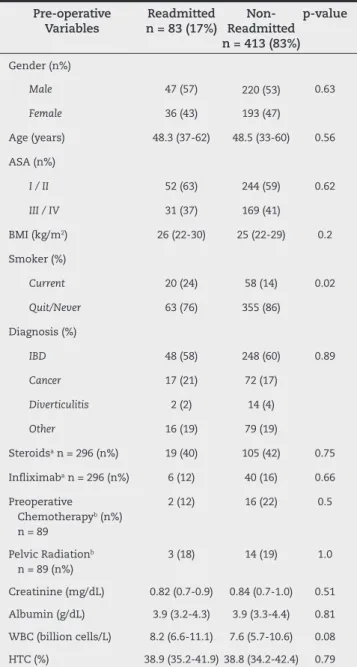
the preoperative patient characteristics and demograph-ics are described in table 1. the proportion of patients that were current smokers was significantly higher in the read-mitted group (24% vs. 14%, p = 0.02). All other preoperative variables were not significantly different between groups.
Intraoperative and postoperative variables
the three most common procedures performed were ma-jor operations involving small bowel resections (including enterocutaneous fistula takedown and J-pouch excision) in 149 patients (30%), total abdominal colectomy with end ileostomy in 117 (24%), and total proctocolectomy with il-eal pouch-anal anastomosis (iPAA) in 103 (21%) patients (table 2).
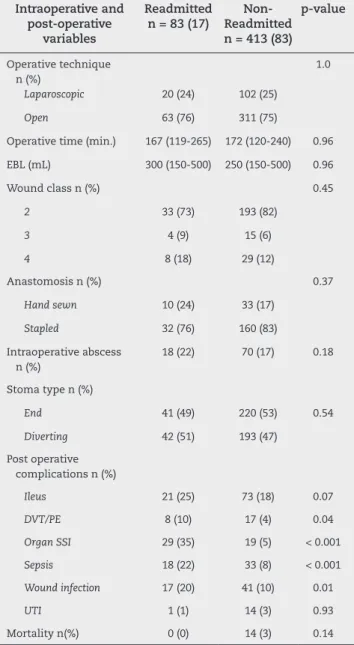
table 3 summarizes the intraoperative and postopera-tive variables. the proportion of patients diagnosed with deep venous thrombosis/pulmonary embolism (DVP/ PE), wound infection, organ space surgical site infection
Table 1 - Patient characteristics.
Pre-operative Variables
Readmitted n = 83 (17%)
Non-Readmitted n = 413 (83%)
p-value
Gender (n%)
Male 47 (57) 220 (53) 0.63
Female 36 (43) 193 (47)
Age (years) 48.3 (37-62) 48.5 (33-60) 0.56
ASA (n%)
I / II 52 (63) 244 (59) 0.62
III / IV 31 (37) 169 (41)
bMi (kg/m2) 26 (22-30) 25 (22-29) 0.2
Smoker (%)
Current 20 (24) 58 (14) 0.02
Quit/Never 63 (76) 355 (86)
Diagnosis (%)
IBD 48 (58) 248 (60) 0.89
Cancer 17 (21) 72 (17)
Diverticulitis 2 (2) 14 (4)
Other 16 (19) 79 (19)
Steroidsa n = 296 (n%) 19 (40) 105 (42) 0.75
inliximaba n = 296 (n%) 6 (12) 40 (16) 0.66
Preoperative Chemotherapyb (n%)
n = 89
2 (12) 16 (22) 0.5
Pelvic radiationb
n = 89 (n%)
3 (18) 14 (19) 1.0
Creatinine (mg/dL) 0.82 (0.7-0.9) 0.84 (0.7-1.0) 0.51
Albumin (g/dL) 3.9 (3.2-4.3) 3.9 (3.3-4.4) 0.81
WbC (billion cells/L) 8.2 (6.6-11.1) 7.6 (5.7-10.6) 0.08
HtC (%) 38.9 (35.2-41.9) 38.8 (34.2-42.4) 0.79
ASA, American Society of Anesthesiology classiication; bMi, body mass index; ibD, inlammatory bowel disease; WbC, white blood cells; HtC, hematocrit.
Table 2 - Surgical procedures.
Surgical Procedure n(%) Readmitted
n = 83 (17%)
Non-Readmitted n = 413 (83%)
p-value
Small bowel resection 27 (35) 122 (30) 0.60
total abdominal colectomy / end ileostomy 16 (19) 101 (24) 0.33
total proctocolectomy/iPAA 16 (19) 87 (21) 0.77
Low anterior resection 10 (11) 35 (8) 0.40
Segmental colectomy 7 (8) 43 (10) 0.69
total proctocolectomy/ End ileostomy 7 (8) 23 (6) 0.45
other 0 (0) 2 (1) 1
(orgSSi) and/or sepsis increased significantly in the re-admitted group. Moreover, for 21 (72%) out of 29 patients in the readmission group with an orgSSi, diagnosis was made at the time of readmission.
Reasons for readmission
Among the 75 patients who were readmitted at the Cleveland Clinic, the most common complaint or diagnosis was abdomi-nal pain in 32 (43%), dehydration in 21 (28%) patients and nau-sea/vomiting in 12 (16%). Forty-nine patients underwent Ct imaging of the abdomen and pelvis. of these, the most com-mon pathologic inding were orgSSi (26 patients [33%]) and small bowel obstruction (Sbo) (8 patients [16%]) (Fig. 1).
Fig. 1 - Common pathologic inding. CCF, Cleveland Clinic Foundation; PVT, portal vein thrombosis; SMVT, superior mesenteric vein thrombosis; SBO, small bowel obstruction, PE, pulmonary embolism; Abx, antibiotic.
Table 3 - Intraoperative and postoperative information.
Intraoperative and post-operative
variables
Readmitted n = 83 (17)
Non-Readmitted n = 413 (83)
p-value
operative technique n (%)
1.0
Laparoscopic 20 (24) 102 (25)
Open 63 (76) 311 (75)
operative time (min.) 167 (119-265) 172 (120-240) 0.96
EbL (mL) 300 (150-500) 250 (150-500) 0.96
Wound class n (%) 0.45
2 33 (73) 193 (82)
3 4 (9) 15 (6)
4 8 (18) 29 (12)
Anastomosis n (%) 0.37
Hand sewn 10 (24) 33 (17)
Stapled 32 (76) 160 (83)
intraoperative abscess n (%)
18 (22) 70 (17) 0.18
Stoma type n (%)
End 41 (49) 220 (53) 0.54
Diverting 42 (51) 193 (47)
Post operative complications n (%)
Ileus 21 (25) 73 (18) 0.07
DVT/PE 8 (10) 17 (4) 0.04
Organ SSI 29 (35) 19 (5) < 0.001
Sepsis 18 (22) 33 (8) < 0.001
Wound infection 17 (20) 41 (10) 0.01
UTI 1 (1) 14 (3) 0.93
Mortality n(%) 0 (0) 14 (3) 0.14
Univariate and multivariate analysis
in order to more accurately assess the factors associated with readmission, univariate and multivariate analyses were performed using the readmission as dependent variable and perioperative data as independent variables.
in the univariate analysis current smoking status, venous thromboembolism (DVt/PE), orgSSi, sepsis, and wound infec-tion were signiicantly associated with the occurrence of re-admission (table 4). However, in the multivariate analysis this association persisted only for orgSSi (table 5).
Table 4 - Univariate analysis.
Independent variables n (%)
Readmitted n = 83 (17%)
Non-readmitted n = 413 (83%)
Odds ratio 95% Conidence
interval
p-value
Sepsis 18 (22) 33 (8) 3.18 1.66-5.94 < 0.001
organ SSi 29 (35) 19 (5) 11.13 5.89-21.5 < 0.001
Wound infection 17 (20) 41 (10) 2.33 1.22-4.28 0.01
Smoking 20 (24) 58 (14) 1.94 1.07-3.4 0.02
DVt/PE 8 (10) 17 (4) 2.48 0.98-5.80 0.05
30-days prior surgeries
3 (4) 3 (0.7) 5.12 0.93-28.12 0.06
ileus 21 (25) 73 (18) 1.57 0.88-2.71 0.11
WbC 8.2 (6.6-11.1) 7.6 (5.7-10.6) 0.99 0.95-1.03 0.82
DVt/PE, deep venous thrombosis, pulmonary embolism; organ SSi, organ space surgical site infection; WbC, white blood cells.
Table 5 - Multivariate analysis.
Independent variables n(%)
Odds ratio 95%
Conidence interval
p-value
organ SSi 13.27 5.73-33.76 < 0.001
Smoking 1.77 0.91-3.31 0.08
Wound infection
1.68 0.78-3.49 0.17
Sepsis 1.75 0.7-4.83 0.23
DVt/PE 1.24 0.4-3.53 0.69
DVt/PE, deep venous thrombosis, pulmonary embolism; organ SSi, organ space surgical site infection.
Table 6 - Diverting vs. end stoma: causes for readmission at the Cleveland Clinic.
Readmission variables n (%)
Diverting stoma
95% Conidence
interval
p-value
Chief complaina
Abdominal pain 17 (47) 15 (39) 0.49
Dehydration 12 (33) 9 (23) 0.44
Vomiting 4 (11) 7 (18) 0.52
other 3 (8) 8 (21) 0.19
Diagnosisb
DVt 1(3) 2 (3) 0.60
ileus 2 (6) 1 (3) 0.61
orgSSi 17 (47) 10 (26) 0.06
Sbo 4 (11) 8 (21) 0.35
Wound infection 5 (13) 1 (3) 0.10
organ SSi, organ space surgical site infection; Sbo, small bowel obstruction.
aPercentages may not add exactly to 100% due to numbering
rounding.
bPercentages may not add exactly to 100% because a single patient
can have more than one complication.
Diverting stoma vs. end stoma (Table 6)
Discussion
Hospital readmission is a relatively common situation, hap-pening in our sample in 16% of the patients undergoing ma-jor colorectal procedures that required an ileostomy creation. the symptom that most commonly prompted patients to re-turn to the hospital was abdominal pain followed by dehy-dration. Finally, among all the perioperative variables studied, the occurrence of orgSSi was the single most important de-terminant for hospital admission in these patients.
the causes for readmissions in colorectal surgery have been previously evaluated.10-12 However, to our knowledge this
is the irst report to analyze the reasons for readmissions in patients with an ileostomy. An ileostomy creation is a com-mon procedure in colorectal surgery, usually done when a re-storative procedure cannot be performed safely.1-5 Although
the usual purpose of an ileostomy is to decrease comorbidi-ties, there are several potential complications associated with the stoma itself that could lead the patient to return to the hospital.6 these facts lead us to understand that ileostomy
patients are a singular group and, therefore, it would be im-portant to evaluate the factors associated with hospital read-mission among this group only.
before this study, the common belief was that dehydration, due to high stoma output and complications related to the ileostomy care, would be the most common reasons for hos-pital readmission in this group of patients. Surprisingly, the occurrence of an orgSSi was the single most predictive factor of hospital readmission in our study population. in fact, about 5 out of 21 patients who had dehydration as chief complaint were found to have an orgSSi. this factor is of paramount im-portance as it shows that the orgSSi diagnosis can be clouded by the presence of dehydration, which in turn can be wrongly associated to a high stoma output.
An orgSSi is one of the most feared complications in colorectal surgery, as it is associated with increased morbidity and mortality, and so an early diagnosis is one of the key fac-tors for its successful treatment.13 therefore, it is important to
be aware of its common presence in ileostomy patients who are readmitted after surgery.
Usually, antibiotic treatment only, or in association with Ct guided drainage is effective on these patients.14 in fact, in
our study population only 3 out of the 26 patients with an orgSSi had to be re-operated.
Another interesting inding of this study was the readmis-sion of one patient due to a complication related to stoma pouching. this patient had a bleeding due to stoma tearing caused by the stoma appliance. We believe that this small rate of stoma pouching complication is not only a consequence of a proper stoma creation, but because of dedicated care pro-vided by the Cleveland Clinic enterostomal therapy nurses, well known for taking special care of these patients.15
How-ever, the fact that about 21% (16) of our patients were readmit-ted due to dehydration, may suggests that a better guidance regarding the use of bowel stoppers as well as diet and luid intake is still needed.
in order to better evaluate the effect of the ileostomy type in the readmission, we further divided the readmitted at CCF group into diverting and end stoma. interestingly, we found
that diverting stoma patients had a trend towards more sep-sis and orgSSi when compared to those with an end stoma. this inding suggests that the presence of a stoma may not decrease the incidence of anastomotic complications, and it is in agreement with a recent multicentric study from 329 Japanese hospitals that demonstrated that a diverting loop ileostomy does not relate to an overall anastomotic leakage rate, but mitigates its consequences and decreases the need for urgent abdominal reoperation in rectal cancer patients undergoing low anterior resections.16
our study suffers from the limitations of any retrospec-tive analysis. Although we were able to collect data regarding whether or not a patient was admitted to an outside hospital, the details of this readmission could not be retrieved. More-over, one of the major limitations of our study is that the ile-ostomies were performed at the surgeon’s discretion without a deined protocol. However, with few exceptions, ileostomies were routinely constructed, by the majority of the colorectal surgeons, during the procedures involved in this study. For the same reason the evaluation of the Ct scan was also not clear. However, the fact that all reoperations happened among patients who underwent a Ct scan makes it unlikely that an orgSSi could had been missed.
Although this was not a randomized controlled trial, there are several strengths to the data presented here. to our knowledge, this is the irst report regarding the factors associ-ated with readmissions in ileostomy patients. Furthermore, all cases were managed in strict adherence to standard surgi-cal principles by high-volume surgisurgi-cal teams limiting nega-tive outcomes associated to technical factors.
Conclusion
Despite traditional belief that high stoma output and dehy-dration are the main factors causing readmission of ileosto-my patients, an occurrence of orgSSi was the single most im-portant factor for hospital readmissions. Colorectal surgeons should be alert for a possible orgSSi when facing an ileostomy patient readmitted after an abdominal colorectal procedure.
Conlicts of interest
the authors declare no conlicts of interest.
r e f e r e n c e s
1. Matthiessen P, Henriksson M, Hallbook o, Grunditz E, noren b, Arbman G. increase of serum C-reactive protein is an early indicator of subsequent symptomatic anastomotic leakage after anterior resection. Colorectal Dis. 2008;10(1):75-80. 2. Strong SA, Koltun WA, Hyman nH, buie WD, Standards
Practice task Force of the American Society of Colon and rectal Surgeons. Practice parameters for the surgical management of Crohn’s disease. Dis Colon Rectum. 2007;50(11):1735-1746.
4. brown Sr, Wadhawan H, nelson rL. Surgery for faecal incontinence in adults. Cochrane Database Syst Rev. 2010; (9):CD001757.
5. Welch JP, Donaldson GA. Perforative carcinoma of colon and rectum. Ann Surg. 1974;180(5):734-740.
6. beck-Kaltenbach n, Voigt K, rumstadt b. renal impairment caused by temporary loop ileostomy. Int J Colorectal Dis. 2011;26(5):623-626.
7. Kiran rP, Delaney CP, Senagore AJ, Steel M, Garafalo t, Fazio VW. outcomes and prediction of hospital readmission after intestinal surgery. J Am Coll Surg. 2004;198(6):877-883. 8. United States Department of Health and Human Services.
Hospital Compare. HHS.gov Web site. www.hospitalcompare. hhs.gov. Published August 5 2011. Updated 2011. Accessed August 13, 2011.
9. American College of Surgeons national Surgical Quality improvement Program. ACS NSQIP USer Guide for the 2007 Participant Use Data File. Chicago iL: ACS; 2008:34.
10. ozturk E, Kiran rP, remzi F, Fazio VW. Early readmission after ileoanal pouch surgery. Dis Colon Rectum. 2009;52(11):1848-1853.
11. Medress Z, Fleshner Pr. Can we predict unplanned hospital readmission after colectomy for ulcerative colitis and indeterminate colitis? Am Surg. 2007;73(10):998-1001. 12. Guinier D, Mantion GA, Alves A, et al. risk factors
of unplanned readmission after colorectal surgery: a prospective, multicenter study. Dis Colon Rectum. 2007;50(9):1316-1323.
13. de Campos-Lobato LF, Wells b, Wick E, et al. Predicting organ space surgical site infection with a nomogram. J Gastrointest Surg. 2009;13(11):1986-1992.
14. Kanellos D. Anastomotic leakage after colonic resection. Tech Coloproctol. 2010;14 Suppl 1:S43-4.
15. Karadag A, Mentes bb, Uner A, irkorucu o, Ayaz S, ozkan S. impact of stomatherapy on quality of life in patients with permanent colostomies or ileostomies. Int J Colorectal Dis. 2003;18(3):234-238.