Rev Saúde Pública 2004;38(3) www.fsp.usp.br/rsp
D ental pain as the reason for visiting a dentist
in a Brazilian adult population
Josimari Telino de Lacerdaa, Eliana M aria Simionatob, Karen Glazer Peresa, M arco Aurélio Peresc, Jefferson Traeberta and Wagner M arcenesd
aUniversidade do Sul de Santa Catarina (UNISUL). Tubarão, SC, Brasil. bEscola de Aperfeiçoamento
Profissional da Associação Brasileira de Odontologia. Florianópolis, SC, Brasil. cDepartamento de
Saúde Pública. Universidade Federal de Santa Catarina (UFSC). Florianópolis, SC, Brasil. dCenter for
Oral Biometrics. Queen Mary School of Medicine and Dentistry. Barts and The London. University of London. London, UK
Correspondence to:
Josimari Telino de Lacerda Rua Padre Rohr, 2089
88051-400 Florianópolis, SC, Brasil E-mail: [email protected]
Presented as an oral communication at the Seventh Brazilian Congress of Public Health, in Brasília, 2003. Received on 10/7/2003. Reviewed on 30/10/2003. Approved on 13/2/2004.
Keywords
Toothache, epidemiology. Oral healthcare services. Prevalence. DMFT index. Socioeconomic factors.
Abstract
Objective
The occurrence of orofacial pain and chronic pain are frequent subjects for study today, but few studies have been made on dental pain in Brazil. The objective of the study was to assess the prevalence of dental pain and the associated factors as the reason for visiting a dentist among adults.
Methods
A cross-sectional study was carried out among 860 workers aged 18-58 years at a cooperative located in the State of Santa Catarina, in 1999. The clinical examinations and interviews were carried out by dentists who had received prior guidance. Complaints of dental pain as the reason for the last visit to a dentist were analyzed as the dependent variable, in relation to the socioeconomic and demographic conditions, access to dental services, shift pattern and caries (via the DMFT index), as the independent variables. Non-conditional multiple logistic regression analysis was utilized.
Results
The prevalence of dental pain as the reason for the last visit to a dentist was 18.7% (CI 95%: 15.9-20.1) and the mean DMFT index (decayed, missing and filled teeth) was 20.2 (CI 95%: 19.7-20.7), with 54% represented by the ‘missing’ component. The following were independently associated with the presence of dental pain: schooling of less than or equal to eight years (OR=1.9; CI 95%: 1.1-3.1); four to fifteen teeth lost due to caries (OR=2.6; CI 95%: 1.4-4.9); 16 to 32 teeth lost due to caries (OR=2.5; CI 95%: 1.1-5.8); and not having visited the company’s dental service (OR=2.8; CI 95%: 1.6-5.1).
Conclusions
Dental pain reflects the severity of the dental caries, expressed by the ‘missing’ component of the DMFT and non-usage of the company’s dental services. These factors are determined by social conditions and represented by the schooling level.
INTRODUCTION
It is estimated that 30 million Brazilians have never visited a dentist4, even though the country has one of the biggest numbers of dentists in the world, both in absolute terms and in relation to the size of the popu-lation, as established by the World Health Organiza-tion.15 The dental attendance and assistance provided
Rev Saúde Pública 2004;38(3) www.fsp.usp.br/rsp Dor de origem dental em trabalhadores
Lacerda JT et al
the workers of the West-Central Cooperative of the State of Santa Catarina, at its unit in the municipality of Maravilha, Santa Catarina, Brazil, in 1999 (N=860). Maravilha is located in the western region of the state, and is a predominantly urban municipality with less than 30% of its population residing in the rural zone. The biggest local economic activity is in the cold-storage sector. The research sample was made up of workers aged between 18 and 58 years.
A structured questionnaire was applied to deter-mine the prevalence of dental pain as the reason for the last visit to a dentist. The questionnaire also in-vestigated demographic characteristics, socioeco-nomic attributes, working conditions (shift pattern) and information on access to and type of dental serv-ices utilized. The workers were also examined by one of the authors of the present study (EMS), in order to obtain information on the prevalence and severity of the dental caries, by means of the DMFT index (de-cayed, missing and filled teeth), utilizing the criteria established by the World Health Organization.15
The objectives, importance of the research and main characteristics of the study were explained by means of correspondence. There was prior contact with the company’s management to obtain the authorization needed for performing the research. In addition to this, the workers’ informed consent was obtained.
The examinations and interviews were held in the company’s dental consultation office, under artifi-cial illumination. During the clinical examinations, a visual inspection was made using clinical mirrors and wooden spatulas, and all the biosafety norms were rigorously complied with.
The preparatory stages of the study consisted of intra-examiner standardization, pretesting of the ques-tionnaire and a pilot study on a group of individuals of similar age to the population studied, who were living in a rural family housing project. During the data collection, duplicate examinations were per-formed on 10% of the sample, to verify the intra-examiner diagnostic concordance. This was gauged via the Kappa statistical test, tooth by tooth.
Calculations were made of the frequency distribu-tion and the chi-squared (χ2) association was tested to evaluate the relationship between the dependent variable and the independent variables. The odds ra-tios (OR) and respective confidence intervals (CI) were estimated and, finally, non-conditional multi-ple regression analysis was performed. The dichoto-mous (yes/no) dependent variable was the presence of dental pain as the reason for the last visit to a den-the history of public policies in Brazil, did not
un-dergo significant alteration after the implementation of the Single Healthcare System in 1990. Among other attributes, this established the principles of univer-sality, completeness and equality.
With the decline in dental caries among school-age children, seen in the latest epidemiological sur-veys performed in 19867 and 199612 and, especially, with the inclusion of the oral healthcare team in the Family Healthcare Program by the Ministry of Health in 2000, it has become indispensable for other groups within the population to be considered. Because of the systematic exclusion of the adult population from dental services, this population has been directed towards the emergency dental services, in most cases because of pain. Within the field of medicine, pain is responsible for one-third of consultations made in Brazil.13 Pain is defined by the International Associa-tion for the Study of Pain (IASP) as “a disagreeable sensory and emotional experience” of subjective na-ture that is associated with real or potential injuries, in which “each individual utilizes the word accord-ing to the individual’s learnaccord-ing from previous experi-ence”. Pain has historically been considered to be only a symptom, from which the characteristics will guide the diagnosis of morbidities, in the teachings of the health sector.14
Within the field of dentistry, recent studies have pointed towards the pressing need for greater attention in this respect. According to Ekanayake & Mendis1 (2002), dental pain is a significant predictor of the utilization of dental services. A study on oral health among adults with teeth in the United Kingdom indi-cated that pain was the most frequent problem over the preceding 12-month period (40%), thus interfering directly with these individuals’ daily activities.8
In Brazil, studies on orofacial pain have mostly re-lated to temporal-mandibular dysfunctions. No Bra-zilian publications regarding epidemiological data on dental pain were found in the Medline, Lilacs and BBO databases for the period from 1994 to 2002, when the terms ‘dental pain’ and ‘toothache’ were utilized.
The present study had the objectives of determining the prevalence of dental pain as the main reason for the last visit to a dentist among a group of workers in the State of Santa Catarina, Brazil, and verifying the exist-ence of an association with socioeconomic conditions, working conditions and access to dental services.
M ETH O D S
!
Rev Saúde Pública 2004;38(3) www.fsp.usp.br/rsp
Dor de origem dental em trabalhadores Lacerda JT et al
tist. The independent variables analyzed were age, sex, monthly income in numbers of minimum sala-ries at the time of performing the study, schooling in years of study, type of dental service utilized, last visit to a dentist, shift pattern, and also the preva-lence and severity of dental caries. The independent variables were inserted into the logistic model in an increasing manner, in accordance with their statisti-cal significance (p<0.20). These remained in the model if they continued to be significant (p<0.05) and/or modified the model. The stepwise forward pro-cedure was adopted in the SPSS version 10.0 statisti-cal software. The statististatisti-cal modeling adopted allowed the independent impact of each variable studied to be evaluated. The variables sex, age and shift pattern were utilized as controls, independent of the statisti-cal significance presented.
RESU LTS
Out of the company’s 860 employees, 754 workers (87.7%) were examined and interviewed. Individu-als who were off work due to disability, health prob-lems, vacations or traveling on company business (88 cases) and those who refused to answer the ques-tions during the interview (18 cases) were considered to have been lost from the survey. Of those interviewed,
458 (60.7%) were male and 296 (39.3%) were female. The workers’ ages ranged from 18 to 58 years, with 201 individuals (26.7%) between 18 and 24 years, 179 (23.7%) between 25 and 29 years, 166 (22.0%) between 30 and 34 years, and 208 (27.6%) between 35 and 58 years of age.
Throughout the data collection, the concordance was maintained at satisfactory levels, with a lowest Kappa value of 0.81.
The prevalence of dental pain as the reason for the last visit to a dentist among the workers studied was 18.7% (CI 95%: 15.9-20.1). The average DMFT in-dex was 20.2 (CI 95%: 19.7-20.7), and the M compo-nent (missing due to caries) had the greatest magni-tude, totaling 54.1%, with an average number of teeth missing of 11.0 (CI 95%: 10.34-11.66). The F com-ponent (fillings) formed 42% of the index total, and the average number of filled teeth was 8.5 (CI 95%: 8.09-8.91). The D component (decayed teeth) formed 3.9% of the DMFT index, and the average number of teeth presenting caries was 0.7.
Table 1 presents the result from the univariate analysis. The following variables were statistically associated with dental pain as the reason for the last Table 1 - Association between dental pain as the reason for the last visit to a dentist and risk factors, among a group of workers at the W est-Central Cooperative. Maravilha, Santa Catarina, 1999.
Variable (categories) Presence of pain Total Raw odds ratio (ORr) p*
Yes (%) No (%) N (%) ORr (CI 95%)
Income 0.909
≥5 MS 18 (20.5) 70 (79.5) 88 (100.0) 1.0
<5 MS 119 (21.0) 448 (79.0) 567 (100.0) 1.0 [0.6-1.8]
Schooling 0.001
>8 years 27 (13.2) 178 (86.8) 205 (100.0) 1.0
≤8 years 110 (24.4) 341 (75.6) 451 (100.0) 2.1 [1.3-3.4]
Last visit to a dentist 0.281
≤6 months 75 (19.6) 307 (80.4) 382 (100.0) 1.0
>7 months 66 (23.1) 220 (76.9) 286 (100.0) 1.2 [0.8-1.8]
DMFT in quartiles 0.019
0-14 21 (13.4) 136 (86.6) 157 (100.0) 1.0
15-20 39 (23.5) 127 (76.5) 166 (100.0) 2.0 [1.1-3.6]
21-24 29 (19.3) 121 (80.7) 150 (100.0) 1.6 [0.8-2.9]
25-32 52 (26.5) 144 (73.5) 196 (100.0) 2.3 [1.3-4.1]
M component (DMFT) 0.001
0-3 23 (11.0) 187 (89.0) 210 (100.0) 1.0
4-15 62 (25.5) 181 (74.5) 243 (100.0) 2.8 [1.7-4.7]
16-32 56 (25.9) 160 (74.1) 216 (100.0) 2.8 [1.7-4.8]
Type of service utilized 0.018
Company 115 (19.7) 469 (80.3) 584 (100.0) 1.0
O thers 26 (31.0) 58 (69.0) 84 (100.0) 1.8 [1.1-3.0]
Shift pattern 0.308
M orning 59 (19.3) 247 (80.7) 306 (100.0) 1.0
Afternoon 77 (23.4) 252 (76.6) 329 (100.0) 1.3 [0.8-1.9]
N i ght 5 (15.2) 28 (84.8) 33 (100.0) 0.7 [0.3-2.0]
Age 0.144
18-24 29 (15.9) 153 (84.1) 182 (100.0) 1.0
25-29 36 (22.8) 122 (77.2) 158 (100.0) 1.6 [0.9-2.7]
30-34 30 (19.9) 121 (80.1) 151 (100.0) 1.3 [0.7-2.3]
35 or over 40 (25.8) 115 (74.2) 155 (100.0) 1.8 [1.1-3.1]
Sex 0.630
M al e 85 (20.5) 330 (79.5) 415 (100.0) 1.0
Femal e 56 (22.0) 198 (78.0) 254 (100.0) 1.1 [0.6-1.6]
*chi-squared descriptive level with Yates correction MS: minimum salary (1999)
" Rev Saúde Pública 2004;38(3) www.fsp.usp.br/rsp Dor de origem dental em trabalhadores
Lacerda JT et al
visit to a dentist: schooling of eight years or less (p<0.001); 15 or more teeth attacked by caries (DMFT³15) (p=0.019); four or more teeth missing due to caries (p<0.001); non-utilization of the company’s dental service (p=0.018).
The shift pattern, sex and age of the employees did not present any significant association with com-plaints of dental pain at the last visit to a dentist. These were, however, kept in the model for control-ling the final modecontrol-ling.
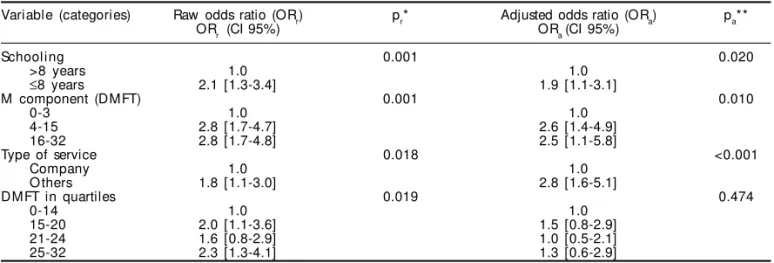
The results from the multiple analysis are presented in Table 2. Schooling of less than or equal to eight years continued to be associated with complaints of dental pain at the last visit to a dentist, after adjust-ment for the variables sex, age and shift pattern, and the other variables of the model (OR=1.9; CI 95%: 1.1-3.1). The number of teeth missing due to caries remained associated with dental pain as the reason for the last visit to a dentist, independent of the con-trol variables, the schooling, the type of dental serv-ice utilized by the individual and the severity of the caries. Individuals with 4 to 15 teeth missing due to caries had a 2.6 times greater chance of presenting dental pain as the reason for the last visit to a dentist (CI 95%: 1.4-4.9), and those with 16 to 32 teeth miss-ing had a 2.5 times greater chance of presentmiss-ing the same situation (CI 95%: 1.1-5.8). Individuals who utilized dental services other than the company’s had a 2.8 times greater chance that dental pain was the main reason for visiting a dentist (CI 95%: 1.6-5.1), independent of the other variables studied.
D ISCU SSIO N
The response rate obtained for dental pain as the reason for the last visit to a dentist was 87.7%, which
contributes to the internal validity of the study. Moreover, the losses from the study did not interfere in the results, since these presented a balanced distri-bution across the different segments of the popula-tion studied. Nonetheless, despite actively seeking the missing people during the data collection period, it must be considered possible that the results have underestimated the prevalence of pain at the last visit to a dentist, since the individuals who were more ill may have been absent from work at the time of the examination and interview. On the other hand, the reproducibility of the data was ensured by the proc-ess of training and standardization that the research went through, and also by the high concordance ob-tained through the Kappa test.
The population studied represented 10% of the adult population and one-third of the salaried popu-lation of the municipality. These percentages do not guarantee that the results regarding dental pain as the reason for the last visit to the dentist can be gen-eralized for the adult population of the municipality, nor do they for adult populations in other regions of Brazil. Furthermore, it has been considered hypotheti-cally that the results from this working population that was attended by dental services would be better than among the non-working population. No popu-lation-based information about dental pain among adults is available. It is considered that it would be difficult to extrapolate these findings to other popu-lations, and even to the remainder of this municipali-ty’s population, as pointed out above, since the work-ing population in the present study had a high de-gree of access to dental services, which is not com-monly seen in Brazil.
Pain has become a frequent topic for studies nowa-days. Among the motives for studying pain are its
Table 2 - Risk factors for dental pain as the reason for the last visit to a dentist among a group of workers at the West-Central Cooperative. Multiple regression analysis. Maravilha, Santa Catarina, 1999.
Variable (categories) Raw odds ratio (ORr) pr* Adjusted odds ratio (ORa) pa**
ORr (CI 95%) ORa (CI 95%)
Schooling 0.001 0.020
>8 years 1.0 1.0
≤8 years 2.1 [1.3-3.4] 1.9 [1.1-3.1]
M component (DMFT) 0.001 0.010
0-3 1.0 1.0
4-15 2.8 [1.7-4.7] 2.6 [1.4-4.9]
16-32 2.8 [1.7-4.8] 2.5 [1.1-5.8]
Type of service 0.018 <0.001
Company 1.0 1.0
O thers 1.8 [1.1-3.0] 2.8 [1.6-5.1]
DMFT in quartiles 0.019 0.474
0-14 1.0 1.0
15-20 2.0 [1.1-3.6] 1.5 [0.8-2.9]
21-24 1.6 [0.8-2.9] 1.0 [0.5-2.1]
25-32 2.3 [1.3-4.1] 1.3 [0.6-2.9]
*p-value via chi-squared test, with Yates correction **controlled for sex, age and shift pattern
#
Rev Saúde Pública 2004;38(3) www.fsp.usp.br/rsp
Dor de origem dental em trabalhadores Lacerda JT et al
relationship with new lifestyles, greater individual longevity and the consequent prolongation of sur-vival with affections, and environmental modifica-tions.14 Dental pain is the most frequent symptom among different types of orofacial pain that have been studied6 and is a significant determiner for seeking out attendance services.1
The prevalence of dental pain as the reason why the adults in the present study sought out dental serv-ices was similar to what was found in a survey per-formed in Sri Lanka on the demand for dental serv-ices at a university hospital (23%).2 This is also cor-roborated by the findings on the prevalence of den-tal pain from studies among industrial workers in Malaysia (18.5%)5 and Florida (12%).10 However, a study performed in Lithuania has indicated a higher prevalence rate for dental or oral pain among adults (55%).9 Methodological variations in the collection of information on the different aspects of orofacial pain, among which dental pain, and the particular way that the definition of pain is put into practice, can be put forward as possible explanations for dis-crepancies among such prevalence.10
Another characteristic that could contribute towards the discrepancies is the high degree of subjectivity in the perception of pain. Cognitive factors such as knowledge, beliefs and expectations, and also cul-tural factors, have been associated with differences in the perception of pain.11 In the present study, indi-viduals with a lower level of schooling, and probably a lower level of knowledge, presented a greater chance of consulting a dentist because of dental pain, inde-pendent of the other factors studied.
The serious cumulative effects of caries over the course of an individual’s life and their significant responsibility for dental suffering and mutilation are another point suggested by the present study. This is corroborated by the findings from a study in Finland, in which dental pain was one of the three biggest causes of tooth extraction3. In the present study, it was seen that the greater the loss of teeth had been, the greater the chances were that pain was the reason for the last visit to a dentist. Considering that tooth loss was the expression of more than half of the caries attacks, a hypothesis can be considered that the ad-vance of caries causes the pain and the individual’s consequent dental mutilation. Caries have histori-cally been dealt with as a problem among children and young people but, as well as tooth loss, they bring in the additional problem of pain. The
reper-cussions of such pain may interfere in individuals’ behavior and affect their day-to-day activities.
The data on the severity of dental caries found in this population (DMFT =20.28) corroborate the re-sults from the epidemiological survey performed in Brazil in 1986 for the population aged 35 to 39 years (DMFT =20.9).7 This indicates that the severity of caries is possibly maintained within the adult popu-lation. The absence of an oral healthcare policy di-rected towards this population, particularly in Brazil, provides a probable justification for the maintenance of high rates of dental caries. Lack of access to at-tendance and preventive measures possibly increases the complexity of the problem and may lead to two alternative extremes. On the one hand, tooth extrac-tion may be the only technically possible procedure, in view of the severity of the disease. On the other hand, tooth extraction may be indicated to relieve the pain, in view of the impossibility of access to other types of treatment. Considering that the work-ers studied had guaranteed access to dental services offered by the company, and that 87% of them made use of these, it is possible that the tooth losses found were due to the severity of the caries.
Nonetheless, the type of service provided for the individual has a significant bearing on the chance that pain will be the reason for seeking out the den-tist. The seeking out of dental services other than the company’s tripled the chance that dental pain would be the reason for seeking out a dentist. Easier access to dental services and regular periodical follow-up of oral health conditions within the company’s environ-ment may, perhaps, explain this result. Another fac-tor, albeit not measured, is the quality of the services provided, with regard to the continuity of the attend-ance and follow-up of the patient’s health, and also the preventive and conservational services in the company’s dental attendance. The offer of non-mutilative procedures in the treatment of advanced dental caries, such as endodontic treatment and the construction of dental prostheses, may contribute towards this.
$ Rev Saúde Pública 2004;38(3) www.fsp.usp.br/rsp Dor de origem dental em trabalhadores
Lacerda JT et al
REFEREN CES
1. Ekanayake L, Mendis R. Self reported use of dental services among employed adults in Sri Lanka. Int Dent J 2002;52:151-5.
2. Ekanayake L, W eerasekare C, Ekanayake N . N eeds and demands for dental care in patients attending the University Dental Hospital in Sri Lanka. Int Dental J 2001;51:67-72.
3. Hiidenkari T, Parvinen T, Helenius H. Missing teeth and loss teeth of adults aged 30 years and over in south-western Finland. Commun Dent Health 1996;13:215-22.
4. [IBGE] Fundação IBGE. Pesquisa nacional por amostra de domicílios (PNAD). Rio de Janeiro; 1998.
5. Jaafar N, Razak IA, Zain RB. The social impact of oral and facial pain in an industrial population. Ann Acad Med 1989;18:553-5.
6. Lipton JA, Ship, JA, Larach-Robinson D. Estimated prevalence and distribution of reported orofacial pain in the United States. J Am Dent Assoc 1993;124:115-21.
7. M inistério da Saúde. Secretaria Nacional de Progra-mas Especiais de Saúde. Divisão Nacional de Saúde Bucal. Levantamento epidemiológico em saúde bucal: Brasil, zona urbana, 1986. Brasília (DF); 1988.
8. Nuttall NM, Steele JG, Pine CM, White D, Pitts NB. The impact of oral health on people in the UK in 1998. Br Dent J 2001;190:121-6.
9. Petersen PE, Aleksejuniene J, Christensen LB, Eriksen HM, Kalo I. Oral health behavior and attitudes of adults in Lithuania. Acta Odontol Scand 2000;58:243-8.
10. Riley JL, Gilbert GH. Orofacial pain symptoms: an interaction between age and sex. Pain 2001;90:245-56.
11. Slade GD. Epidemiology of dental pain and dental caries among children and adolescents. Commun Dent Health 2001;18:219-27.
12. Souza SMD. CPO-D brasileiro aos 12 anos tem redução de 53,22%. Rev ABO Nac 1996;11/12:8.
13. Teixeira MJ, Shibata MK, Pimenta CAM, Correa CF. Dor no Brasil: estado atual e perspectivas. São Paulo: Limay; 1995.
14. Teixeira MJ, Figueiró JAB. Dor: epidemiologia, fisiopatologia, avaliação, síndromes dolorosas e tratamento. São Paulo: Grupo Editorial Moreira JR; 2001.