www.reumatologia.com.br
REVISTA BRASILEIRA DE
REUMATOLOGIA
Original article
Body composition by dual-energy x-ray absorptiometry in
women with ibromyalgia
Márcia Maria Marques Teles Lobo
a,*, Eduardo dos Santos Paiva
b, Aline Andretta
b,
Maria Eliana Madalozzo Schieferdecker
aa Universidade Federal do Paraná, Curitiba, PR, Brasil
b Hospital de Clínicas, Universidade Federal do Paraná, Curitiba, PR, Brasil
a r t i c l e i n f o
Article history:
Received 30 September 2013 Accepted 20 March 2014
Keywords:
Fibromyalgia Body composition Fat mass DXA
a b s t r a c t
Objectives: To assess body composition in women with ibromyalgia (FM) comparing to the reference value for healthy women.
Patients and Methods: Cross-sectional observational analytical study, with 52 women
se-lected with Fibromyalgia, according American College of Rheumatology (ACR, 1990) criteria.
The patients were selected in Hospital de Clínicas da Universidade Federal do Paraná (HC-UFPR) and divided into two groups, 28 patients with a BMI (Body Mass Index) equal or
higher (≥) than 25 kg/m2 and 24 patients with BMI less or equal (≤) 24.99 kg/m2, subjected
to physical examination for the count of tender points (TP) and completing the ibromyalgia
impact questionnaire (FIQ). The assessment of body composition was performed by the Dual-Energy X-Ray Absorptiometry (DXA). The values of the fat mass percentage (MG %) found in the two groups were compared to the average percentage of MG by age and sex, described by Heward (2004).
Results: The mean age of the study groups was 47.8 ± 8.6 years, the FIQ score was 70.5 ± 18.6
and TP 16.2 ± 2.0. The mean BMI was 26.4 ± 4.1 kg/m2, and the amount of MG was 25.2 ± 7.8
kg and 39.5 ± 6.8%, and lean mass (LM) was 37 2 ± 3.7 kg and 60.4 ± 7.3%. In the group with
BMI ≤ 25 kg/m2, the MG % was 33.8% (21.5 - 42.4) and in the group with BMI ≥ 25 kg/m2 of
the MG was 44.4% (37.6 - 56.2).
Conclusion: Both groups women with FM eutrophic as the overweight and obese group, pre-sented higher reference MG% levels comparing with the standard levels for healthy women. © 2014 Sociedade Brasileira de Reumatologia. Published by Elsevier Editora Ltda. All rights reserved.
* Corresponding author.
E-mail: [email protected] (M.M.M.T. Lobo).
Composição corporal por absorciometria radiológica de dupla energia de mulheres com ibromialgia
Palavras-chave:
Fibromialgia Composição corporal Massa gorda DXA
r e s u m o
Objetivos: Avaliar a composição corporal de mulheres com ibromialgia (FM) em relação ao valor de referência para mulheres saudáveis.
Pacientes e Métodos: Estudo transversal observacional, composto por 52 mulheres
diagnos-ticadas com ibromialgia conforme os critérios do American College of Rheumatology (ACR,
1990), selecionadas no Ambulatório de Fibromialgia do Hospital de Clínicas da Universida-de FeUniversida-deral do Paraná (HC-UFPR). As pacientes voluntárias foram divididas em dois grupos,
28 pacientes com Índice de Massa Corporal (IMC) igual ou superior (≥) a 25 kg/m2,e 24
pacientes com IMC igual ou inferior (≤) a 24,99 kg/m2 e submetidas ao exame físico para a
contagem dos tender points (TP), além de preencherem o questionário de impacto da
ibro-mialgia (FIQ). A avaliação da composição corporal foi realizada por meio da Absorciometria Radiológica de Dupla Energia (DXA). Os valores do percentual de massa gorda (% de MG), encontrados nos dois grupos, foram comparados ao percentual médio de MG por idade e sexo, descrito por Heward (2004).
Resultados: A idade média dos grupos pesquisados foi de 47,8 ± 8,6 anos, o score do FIQ foi
de 70,5 ± 18,6 e TP 16,2 ± 2,0. O IMC médio foi de 26,4 ± 4,1 kg/m2, e a quantidade de MG foi
de 25,2 ± 7,8 kg ou 39,5% ± 6,8%, e de massa magra (MM) foi de 37,2 ± 3,7 kg ou 60,4% ± 7,3%.
No grupo com IMC ≤ 25 kg/m2 o percentual de MG foi de 33,8% (21,5 – 42,4), e no grupo com
IMC ≥ 25 kg/m2 o percentual de MG foi de 44,4% (37,6 – 56,2).
Conclusão: Tanto mulheres com FM eutróicas quanto as com sobrepeso e obesas apresenta-ram percentual de MG acima dos valores de referência de mulheres saudáveis.
© 2014 Sociedade Brasileira de Reumatologia. Publicado por Elsevier Editora Ltda. Todos os direitos reservados.
Introduction
Fibromyalgia (FM) is a chronic clinical syndrome of unknown aetiology, characterized by a diffuse widespread muscle pain, fatigue and non-restorative sleep with physical and psycho-logical damage to their carriers.1 In 1990, the American Col-lege of Rheumatology (ACR) established classiication criteria for ibromyalgia, characterized by a widespread pain in at least three of the four established quadrants and that persists for a period of three months, and pain to palpation in 11 of the 18 tender points previously determined.2
FM affects approximately eight times more women than men, especially in the age group between 35 and 60 years, causing a negative impact on quality of life and on daily ac-tivities of these individuals.3,4
Studies have shown a higher prevalence of overweight and obesity in this population, when compared to general popula-tion, and it has been observed a marked worsening of pain sensitivity and, therefore, of quality of life and the ability to perform physical activities.5,6
Another possible mechanism to explain the link between obesity and FM is the psychological factor, given that the dis-ease is strongly associated with depression and eating disor-ders, which may result in changes in body weight, especially among women with low levels of physical activity.7,8
It is not possible to assert the role that obesity plays in the pathophysiology of the disease, whether it would be cause or consequence, or if, in addition to excess weight, the body composition are changed.
In this context, an accurate assessment of the nutrition-al status becomes relevant. BMI is a widely used method by health professionals for this purpose, but it is limited and does not provide information on the distribution and amount of body fat. Sometimes, individuals classiied as normal by BMI may have excess body fat.9,10
The body composition quantiies the body parts, and its determination is important for understanding the effects that diet, exercise, disease and physical growth, among other envi-ronmental factors, have on the human body.11 But it is impor-tant that, in addition to body weight and BMI, body composi-tion in patients with FM be also evaluated.
The identiication of the body measures of fat mass (FMass) and lean mass (LMass) can be accomplished by several meth-ods, including dual energy X-ray absorptiometry (DXA), consid-ered an indirect reference method for the estimation of body components and the nutritional status of individuals from various age groups. DXA offers, as advantage, a good precision, accuracy and reproducibility, being based on the measurement of three body parts (bone mineral tissue, FMass and LMass), and generating data both for total body analysis as for speciic body segments: upper limbs, lower limbs and trunk.13-16
So far, few studies have been published exploring the body composition in women with FM. It is important to understand whether there are differences in body composition of these women, compared to reference values for healthy women, to guide the nutritional planning, in view to provide greater food and nutritional safety to this group.
worsening of symptoms and quality of life of patients, the aim of this study was to evaluate the body composition in women with FM compared to the reference value for healthy women.
Patients and methods
Study design
This is an observational cross-sectional analytical study, ap-proved by the Research Ethics Committee, Hospital de Clíni-cas, Universidade Federal do Paraná (HC/UFPR), according to decision 8786.
All patients who agreed to participate signed an informed consent (IC).
The study included female patients aged 18-60 years, selected at the Clinic of Rheumatology, HC/UFPR, between March and October 2012, diagnosed with FM according to 1990 ACR criteria.2
Patients with infectious diseases, those who modiied their medication in the four weeks preceding the survey, who used corticosteroids, with diabetes, uncompensated endocrine diseases (such as hypothyroidism), severe cardiovascular dis-ease, malignancy in the last year, severe psychiatric illness (substance abuse, schizophrenia, psychosis), and pregnant and lactating women were excluded from the study.
The 52 selected patients were evaluated for impact of FM on their quality of life, number of tender points, anthropo-metrics, and body composition.
To assess the impact of FM on patients’ quality of life, we applied the ibromyalgia impact questionnaire (FIQ), which contains questions related to functional ability, professional activity, psychological distress and physical symptoms which, at the end, feature a score ranging from 0 to 100, depending on the severity of symptoms, with 100 being the maximum impact.17
The tender points (TP) were evaluated by the physician, according to 1990 ACR criteria.2
The height was measured in centimeters (cm) and con-verted to meters (m), in a wall stadiometer, to the nearest 0.1 cm. To obtain the body weight in kilograms (kg), a portable digital scale with a capacity of 150 kg was used.18
BMI was obtained by the ratio of weight in kilograms by the height squared in meters: BMI = weight (kg)/height (m)2 and was classiied as: underweight, <18.5 kg/m2; eutrophic, between 18.5 and 24.99 kg/m2; overweight, between 25 and 29.99 kg/m2; and obesity >30 kg/m2.9
Determination of body composition
The assessment of body composition was performed by dual energy X-ray absorptiometry (DXA) using a Lunar Prodigy Ad-vance DPX equipment, with the patient lying supine with legs and arms straight and lush with the unadorned body.12,19,20 The examination was conducted by a specialized technician.
The results were issued with the aid of software Encore version 12.10. Values of FMass and LMass described in grams and converted to kilogram (kg) and FMass% were obtained. The mean values of FMass% and age for the two groups stud-ied were calculated and compared to the reference values of
choice, which determine that the mean FMass% for women of age 34-55 years is 32%.21 The FMass values found in the evaluation of women with ibromyalgia were compared with reference values for healthy women. Then the percentage dif-ference between the indings for our two groups, which we deine as the percentage of adequacy, was calculated.
Statistical analysis
For the statistical analysis, the Student’s t-test with R soft-ware (R Development Core Team, 2013), and Microsoft® Ex-cel 2010 was performed. We considered a signiicance level of 95% (p ≤0.05).
Results
The mean age of the women studied was 47.8±8.6 years, and the length of disease reported was 7.2±4.9 years (Table 1).
The FIQ score was 70.5±18.6, and the number of tender points was 16.2 ± 2.0. An increased of the severity of symp-toms by FIQ, arbitrarily determined as greater than 70, was observed in 33 (63.5%) patients (Table 1).
The occupation of the patients presented the following distribution: 24 (46.1%) as housewives, 25 (48.1%) as having a formal activity, and 3 (5.8%) as off work due to FM (Table 1).
In the distribution by BMI, 24 (46.1%) patients were eutro-phic, 16 (30.8%) were overweight, and 12 patients (23.1%) were obese (Table 1).
The mean BMI of the group was 26.4±4.1 kg/m2, and, by checking the body composition, it was observed that the mean FMass was 25.2±7.8 kg or 39.5±7.3%; and the mean LMass was 37.2±3.7 kg or 60.4±7.3%, as described in Table 2.
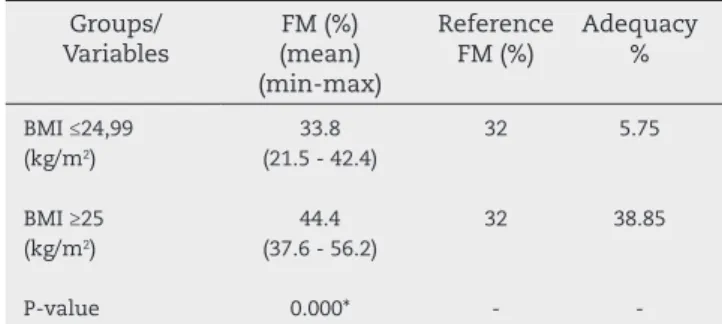
In the analysis of groups separated by BMI, when compared to the reference value of 32% used for FMass, the FMass% and the percentage of adequacy of the group with BMI ≤24.99 kg/ m2 were 33.8% (21.5 - 42.4) and 5.75%, respectively; and for the group with BMI ≥25 kg/m2, the values were 44.4% (37.6 - 56.2) and 38.85%, respectively, with statistically signiicant differ-ences between groups (Table 3).
Discussion
The larger body weight and BMI have been described as dis-turbing factors in the general population and in groups with FM. This study is relevant thanks for the paucity of data in the literature to date, and also because, in addition to identify-ing overweight and BMI, classiies the body composition usidentify-ing DXA as a method.
Among the results obtained according to BMI classiica-tion, we observed that 24 women had normal weight, and 28 were overweight or obese. Analyzing the BMI of all women, the mean value was 26.4 kg/m2 (overweight).
In general, the specialized literature reveals that in the analysis of BMI in women with FM, overweight and obesity are frequent, and that the increase in BMI has a negative cor-relation with quality of life and a positive corcor-relation with physical dysfunction and number of tender points. In the present study, these correlations were not established. Some authors suggest that the weight loss leads to improvement in the general condition and quality of life of these patients. 8,29-31
Lowe et al. (2006) report that the possible cause of obesity in the group with FM is partly due to the smaller basal energy expenditure, despite the level of physical activity and hor-monal disorders.32
In the body composition analysis in this study, the mean FMass% was 39.5%, which, when compared to the reference
value for healthy women (32%), was above average. This inding conirms that the FMass% from women with FM is consistent with the values for obese women.21 This inding demonstrates that the proile of body composition in wom-en with FM may be peculiar to the syndrome, and further studies are needed to explore the subject.
After splitting the group by BMI and comparing with the above mentioned reference value, it was observed that the FMass% of the group with BMI ≤24.99 was 5.75% higher than the recommended, while in the group with BMI ≥25 kg/m2, the FMass% was 38.85% above the recommended level. These results show that women with FM presented a FMass% higher than the recommended, and that over-weight and obese women have more quantity of adipose tissue.
Based on these results, it can be inferred that women with FM, regardless of body weight and BMI, present a FMass amount above the recommended values. This inding demonstrates that, in addition to the impairment in quality of life and functionality, and to a worsening of symptoms of the disease, in these patients there is an increased risk for the onset of chronic non-communicable diseases (CNCDs).
In the study of Arranz et al. (2012), with 103 women with FM in which the relationship between body composi-tion and quality of life was evaluated, it was observed that patients with higher fat mass showed worsening of their general health, as well as in the emotional status and pain sensation. These authors suggest that the amount of FMass may be associated with increased severity of ibromyal-gia symptoms, lower levels of quality of life, worsening of physical itness and a higher number of tender points.31
In Spain, in a study on the analysis of body composition in women with FM measured with bioelectric impedance, the authors found a mean value for total body FMass of 28.3 kg (38.6%), and concluded that obesity is a common condi-tion among women with FM, with a prevalence of 33.7%.6
More studies are needed in the analysis of body com-position in patients with FM, in order to generate further information on the prevalence of overweight and obesity in this group, and the effect of body fat on disease symptoms and its interference in quality of life.
Table 1 – Demographic and clinical variables of patients with ibromyalgia
VARIABLES FM Women
n=52
%
Age (years) 47.8±8.6*
-Length of illness (years) 7.2±4.9*
-FIQ score 70.5±18.6*
-Tender points (TP) 16.2±2.0*
-Severity of symptoms (FIQ ≥70)
33 63.5
BMI (kg/m2)
Underweight (<18.5) Normal weight (18.5 - 24.99) Overweight (25.0 - 29.99) Obesity (>30) 0 24 16 13 -46.1 30.8 23.1 Schooling
Fundamental Education 1 Fundamental Education 2 High School Graduate/Postgraduate 10 14 19 9 19.2 26.9 36.6 17.3 Occupation Housewife Formal worker Student Off work 24 25 0 3 46.1 48.1 0 5.8 Income
Up to 2 MW 2-5 MW Over 5 MW
17 19 16 32.7 36.5 30.8
FIQ: Fibromyalgia impact questionnaire; MW: Minimum wage; *Mean and standard deviation values; %: Values are represented as a percentage.
Table 2 – Anthropometrics and body composition data of women with ibromyalgia
VARIABLES n=52
MEAN (SD)
MINIMUM / MAXIMUM
Height (m) 1.57 (0.10) 1.43 / 1.69
Weight (kg) 65.5 (10.2) 45.12 / 92.6
BMI (kg/m2) 26.4 (4.1) 18.9 / 34.9
Fat mass (kg) Fat mass (%)
25.2 (7.8) 39.5 (7.3)
9.79 / 39.92 21.5 / 56.2 Lean mass (kg)
Lean mass (%)
37.2 (3.7) 60.4 (7.3)
29.08 / 51.49 43.8 / 78.5
Data are expressed as mean; and SD: Standard Deviation. Values: Minimum and maximum; m: meter; and %: percentage.
Table 3 – Percentage of FM of women with ibromyalgia with BMI ≤24.99 kg/m2 and BMI ≥25 kg/m2, with
reference values Groups/ Variables FM (%) (mean) (min-max) Reference FM (%) Adequacy % BMI ≤24,99 (kg/m2)
BMI ≥25 (kg/m2)
33.8 (21.5 - 42.4)
44.4 (37.6 - 56.2)
32
32
5.75
38.85
P-value 0.000* -
-BMI: Body mass index; FM: Fat mass; kg: kilogram; m: meter; and %: percentage
Data are expressed as mean, minimum and maximum. *Signiicant difference (p <0.005)
Though we have considered the reference values of FMass for healthy women without regard to race and geographic re-gion, our data point to the need for individualized food and nutrition planning, giving consideration to body composition.
Conclusion
The quantiication of FMass in patients with FM is relevant because, apart from being an integral part of the global nu-tritional assessment, the adipose tissue has been considered as an important component in the pathophysiology of this disease. However, the elements and mechanisms of adipose tissue need to be clariied.
In the analysis of body composition of women with FM classiied according to BMI as normal weight, overweight and obese, it was observed that the percentage of FMass is above the reference values for healthy women. These data indicate the need for using methods to assess body composition and not only the total body mass.
Conlicts of interest
The authors declare no conlicts of interest.
R E F E R E N C E S
1. Wang C, Schmidt CH, Rones, RBS, Kalish R, Yinh J, Goldenberg DL et al. A Randomized Trial of Tai Chi for Fibromyalgia. N Engl J Med. 2010;363:743-754.
2. Wolf F, Smythe HA, Yunus MB, Bennett RM, Bombardier C, Godenberg DL et al. The American College of Rheumatology 1990 criteria for the classiication of ibromyalgia. Report of the Multicenter Criteria Committee. Arthritis Rheum. 1990;33:160-72.
3. Cavalcante AB, Sauer JF, Chalot SD, Assumpção A, Laje LV, Matsutani LA et al. The prevalence of ibromyalgia: a literature review. Rev Bras Reumatol. 2006;46:40-48. 4. Senna ER, Barros ALP de, Silva EO, Costa IF, Pereira LVB,
Ciconelli RM et al. Prevalence of rheumatic diseases in Brazil: a study using the COPCORD approach. J Rheumatol. 2004;31:594-7.
5. Loevinger BL, Muller D, Alonso C, Coe CL. Metabolic syndrome
in women with chronic pain. Metab Clin Exp.2007;56:87-93.
6. Aparicio VA, Ortega FB, Heredia JM, Carbonell-Baeza A, Delgado-Fernández M. Analisis de la composición corporal em mujeres con ibromialgia. Reumatol Clin. 2011;7:7-12.
7. Ursini F, Naty S, Grembiale RD. Fibromyalgia and obesity: the
hidden link. Rheumatol Int. 2011;31:1403-8.
8. Mork PJ, Vasseljen O, Nilsen TI. Association between physical exercise, body mass index, and risk of ibromyalgia: longitudinal data from the Norwegian Nord-Trondelag Health Study. ArthritisCare Res (Hoboken). 2010;62:611-7.
9. Global Data Base on Body Mass Index. The International Classiication of adult underweight, overweight and obesity according to BMI, WHO 2004. Available at http://apps.who. int/bmi/index.jsp?introPage=intro_3.html Accessed in: 13/11/2012.
10. Mota FM, Rinaldi AEM, Pereira AF, Orsatti FL, Burini RC. Indicadores antropométricos como marcadores de risco para anormalidades metabólicas. Ciências & Saúde Coletiva. 2011;16:3901-3918.
11. González JE. Composición corporal: studio y utilidad clínica. Endocrinol Nutr. 2013;60:69-75.
12. Roche et al. Human Body Composition. In: Lohman, TG. Dual Energy X-Ray Absorptiometry. 1 ed. Illinois: Human Kinetics, 1996.
13. Plank LD, Dual-energy X-ray absorptiometry and body composition. Current Opinion in Clinical Nutrition and Metabolic Care. 2005;8:305-9.
14. Lee SY, Gallagher D. Assessment methods in human body composition. Curr. Opin. Clin. Nutr. Metab. Care. 2008;11:566-72.
15. Coin A, Giannini S, Minicuci N, Rinaldi G, Pedrazzoni M, Minisola S et al. Limb fat-free mass and fat mass reference values by dual-energy X-ray absorptiometry (DEXA) in a 20-80 year-old Italian population. Clinical Nutrition. 2012;31:506-11. 16. Lohman M, Tallroth K, Kettunen JA, Marttinen MT.
Reproducibility of dual-energy x-ray absorptiometry total and regional body composition measurements using different scanning positions and deinitions of regions. Metabolism Clinical and Experimental. 2009;1663-1668.
17. Marques, AP, Santos, AMB, Assumpção A, Matsutani LA, Lage LV, Pereira CAB. Validação da Versão Brasileira do Fibromyalgia Impact Questionnaire (FIQ). Rev Bras Reumatol. 2006;46:24-31.
18. Lohman TG, Roche AF, Martoresl R. Anthropometrics standardization reference manual. 1 ed. Champaign: Human Kinetics Books, 1988.
19. Heyward VH, Stolarczyk LM. Applied body composition assessment. in: body composition basics. 1 ed. Illinois: Human Kinetics, 1996.
20. Ramos RML, Armán AJ, Galeano NA, Hernández AM, Gómez JMG, Molinero JG Absorciometría con rayos X de doble energía. Fundamentos, metodologia y aplicaciones clínicas. Radiologia. 2012;54:410-23.
21. Heyard VH, Stolarczyk LM. Applied Body Composition Assessment. 2 ed. Champaign, Human Kinetics, 2004. 22. Sabbag LM dos S, Pastore CA, Júnior PY, Miyazaki MH, Gonçalves A, Kaziyama HHS et al. Effects of physical conditioning over patients with ibromyalgia. Rev Bras Med Esporte. 2007;13:6-10.
23. Mannerkorpi K, Nordeman L, Cider A, Jonsson G. Does moderate-to-high intensity Nordic walking improve functional capacity and pain in ibromyalgia? A prospective randomized controlled trial. Arthritis Research & Therapy. 2010;12:R189.
24. Arranz LI, Canela MA, Rafecas M. Fibromyalgia and nutrition, what do we know? Rheumatol Int. 2010;30:1417-1427. 25. Mork PJ, Vasseljen O, Nilsen TI. Association between
physical exercise, body mass index, and risk of ibromyalgia: longitudinal data from the Norwegian Nord-Trøndelag Health Study. Arthritis Care & Research (Hoboken). 2010;62:611-17. 26. Cardoso FS, Curtolo M, Natour J, Júnior IL. Avaliação da
qualidade de vida, força muscular e capacidade funcional em mulheres com ibromialgia. Rev Bras Reumatol. 2011;51:338-50.
27. Carbonel-Baeza A, Aparicio VA, Ortega FB, Cuevas AM, Alvarez IC, Ruiz JR et al. Does a 3-month multidisciplinary intervention improve pain, body composition and physical itness in women with ibromyalgia? Br J Sports Med. 2011;45:1189-95.
28. Romero-Zurita A, Carbonel-Baeza A, Aparicio VA, Ruiz JR, Tercedor P, Delgado-Fernández M. Effectiveness of a Tai-Chi Training and Detraining on Functional Capacity, Symptomatology and Psychological Outcomes in Women with Fibromyalgia. Evid Based Complement Alternat Med. 2012;2012:614196.
30. Neumann L, Lerner E, Glazer Y, Bolotin A, Shefer A, Buskila D. A cross-sectional study of the relationship between body mass index and clinical characteristics, tenderness measures, quality of life, and physical functioning in ibromyalgia
patients. Clin Rheumatol. 2008;27:1543-7.
31. Arranz L, Canela MA, Rafecas M. Relationship between body mass index, fat mass and lean mass with SF-36 quality of
life scores in a group of ibromyalgia patients. Rheumatol Int. 2012;36:3605-611.