Use of venoarterial extracorporeal membrane
oxygenation in fulminant chagasic myocarditis
as a bridge to heart transplant
INTRODUCTION
Extracorporeal membrane oxygenation (ECMO) for acute heart failure in adults can be used as a bridge to myocardial recovery, cardiac transplantation or implantation of a left ventricular assist device.(1)
here are two main types of ECMO: venovenous and venoarterial; venoarterial is the method of choice for acute heart failure in adults.(1) he
ECMO system, a modiied heart-lung machine, generally consists of a André Rodrigues Durães1, Fernando Augusto
Marinho dos Santos Figueira2, André Rabelo Lafayette2, Juliana de Castro Solano Martins1, Juliano Cavalcante de Sá1
1. Universidade do Estado da Bahia - Salvador (BA), Brazil.
2. Instituto de Medicina Integral Professor
Fernando Figueira - Recife (PE), Brazil. presented with progressive dyspnea for A 17-year-old Brazilian male
15 days, worsening in the last 24 hours, and was admitted in respiratory failure and cardiogenic shock, with multiple organ dysfunctions. Echocardiography showed a left ventricle ejection fraction of 11%, severe difuse hypokinesia, and a systolic pulmonary artery pressure of 50mmHg, resulting in the need for hemodynamic support with dobutamine (20mcg/kg/min) and noradrenaline (1.7mcg/kg/min). After 48 hours with no clinical or hemodynamic improvement, an extracorporeal membrane oxygenation was implanted. he patient presented with hemodynamic, systemic perfusion and renal and liver function improvements; however, his cardiac function did not recover after 72 hours, and he was transfer to another hospital. Air transport was conducted from Salvador to Recife in Brazil. A heart transplant was performed with rapid recovery of
Conflicts of interest: None.
Submitted on October 15, 2015 Accepted on November 12, 2015
Corresponding author:
Andre Rodrigues Duraes Hospital Ana Nery
Rua Saldanha Marinho - Caixa D’água Zip code: 40320-010 - Salvador (BA), Brazil E-mail: [email protected]
Responsible editor: Luciano César Pontes de Azevedo
Uso de membrana de oxigenação extracorpórea venoarterial em
um caso de miocardite chagásica fulminante como ponte para
transplante cardíaco
ABSTRACT
Keywords: Extracorporeal membrane oxygenation; Chagas cardiomyopathy; Heart transplantation; Case reports both liver and kidney functions, as well as good graft function. Histopathology of the explanted heart showed chronic active myocarditis and amastigotes of
Trypanosoma cruzi. he estimated global prevalence of T. cruzi infections declined from 18 million in 1991, when the irst regional control initiative began, to 5.7 million in 2010. Myocarditis is an inlammatory disease due to infectious or non-infectious conditions. Clinical manifestation is variable, ranging from subclinical presentation to refractory heart failure and cardiogenic shock. Several reports suggest that the use of extracorporeal membrane oxygenation in patients presenting with severe refractory myocarditis is a potential bridging therapy to heart transplant when there is no spontaneous recovery of ventricular function. In a 6-month follow-up outpatient consult, the patient presented well and was asymptomatic.
centrifugal pump, a heat exchanger and a membrane oxygenator. Desaturated venous blood is aspirated from the right atrium into a centrifugal pump through a long steel wire-reinforced cannula inserted into the right atrium via the femoral vein. he pump outlow is directed into a membrane oxygenator, and it is guided via an outlow cannula into the descending aorta via the femoral artery.(2) Typical ECMO complications include systemic
inlammatory response syndrome, renal failure, limb ischemia and bleeding.(2)
CASE REPORT
A 17-year-old Brazilian male presented with progressive dyspnea for 15 days, worsening in the last 24 hours, and was admitted in respiratory failure and cardiogenic shock, with multiple organ dysfunctions, to the cardiac intensive care unit at the Hospital Ana Nery, Salvador-Brazil. Echocardiography showed a left ventricle ejection fraction of 11%, severe difuse hypokinesia and a systolic pulmonary artery pressure of 50mmHg, which resulted in the need for hemodynamic support with dobutamine (20mcg/kg/min) and noradrenaline (1.7mcg/kg/min).
After 36 hours with no clinical or hemodynamic improvement, peripheral veno-arterial extracorporeal membrane oxygenation (VA-ECMO) was implanted using a centrifuge magnetic pump with a polymethylpentene oxygenation membrane (Rotalow Centrifugal Pump®
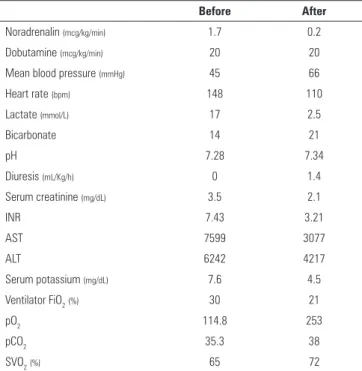
/Quadrox-i Adult/Bioline coated/MAQUET Cardiopulmonary AG, Hirrlingen, Germany). Heparin treatment (100UI/kg bolus and 20UI/Kg/h) was initiated. Blood low was initially at 4.571mL/min, with 6.000mL/ min gas low (pure oxygen Sweeper). Hemodynamic (noradrenaline dropped to 0.21mcg/kg/min), systemic perfusion (lactate of 17mmol/L dropped to 2.5mmol/L and increase diuresis volume), and renal (serum creatinine from 3.5 to 1.2mg/dL) and liver (international normalized ratio 7.4 to 3.1) function improvement were evident in 24 hours (Table 1). After 36 hours, ventilator-associated pneumonia was suspected (progressive iniltrate on chest radiograph, leukocytosis and purulent tracheobronchial secretions), and teicoplanin and meropenem were initiated. Within 72 hours of ECMO use, no cardiac function improvement was noted and a transfer to the
Instituto de Medicina Integral Professor Fernando Figueira
Table 1 - Clinical and hemodynamic parameters before and after extracorporeal membrane oxygenation implantation*
Before After
Noradrenalin (mcg/kg/min) 1.7 0.2
Dobutamine (mcg/kg/min) 20 20
Mean blood pressure (mmHg) 45 66
Heart rate (bpm) 148 110
Lactate (mmol/L) 17 2.5
Bicarbonate 14 21
pH 7.28 7.34
Diuresis (mL/Kg/h) 0 1.4
Serum creatinine (mg/dL) 3.5 2.1
INR 7.43 3.21
AST 7599 3077
ALT 6242 4217
Serum potassium (mg/dL) 7.6 4.5
Ventilator FiO2(%) 30 21
pO2 114.8 253
pCO2 35.3 38
SVO2(%) 65 72
INR - international normalized ratio; AST - aspartate aminotransferase; ALT - alanine aminotransferase; FiO2 - inspired oxygen fraction; SVO2 - mixed venous oxygen saturation. * Interval of 24 hours before and after implantation.
(IMIP) Transplant Center in Recife, Brazil was then executed.
Figure 1 - Logistics of inter-hospital transport between Salvador and Recife (Brazil). ECMO - extracorporeal membrane oxygenation; SESAB - Secretaria Estadual de Saúde da Bahia; SAMU - Serviço Móvel de Urgência; IMIP - Instituto de Medicina Integral Professor Fernando Figueira.
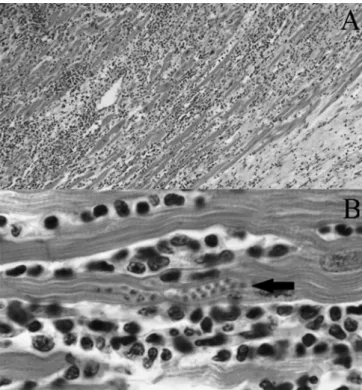
Figure 2 - Histology of an explanted heart sample. A) Photomicrograph (x400) of an hematoxylin and eosin stained sample. B) At this magnification (x1000), the organisms (amastigotes of Trypanosoma cruzi) within a myocyte (arrow) and the adjacent inflammatory response are more clearly observed.
DISCUSSION
he estimated global prevalence of T. cruzi infections declined from 18 million in 1991, when the irst regional control initiative began, to 5.7 million in 2010.(3)
Myocarditis is an inlammatory disease due to infectious or non-infectious conditions. Clinical manifestation is variable, ranging from subclinical presentations to refractory heart failure and cardiogenic shock.(4)
Mechanical circulatory support with an intra-aortic balloon or ventricular assist devices should be considered in cases refractory to medical therapy.(4) Several reports
suggest that the use of ECMO in patients presenting with severe refractory myocarditis is a potential bridging therapy to heart transplantation when there is no spontaneous recovery of ventricular function.(5,6) he VA-ECMO can be
percutaneously implanted at the bedside and can be kept for several weeks with proper care. It is the preferred device when patients present with biventricular dysfunction and often promotes rapid improvement of the hemodynamic status, oxygenation parameters and organ function.(7,8) In
support device can be progressively withdrawn, but when cardiac function impairment is maintained, the treatment of choice would be a long-term device or heart transplant.(9,10) In a 6-month follow-up outpatient consult,
the patient presented himself in good health, ratifying the cost-utility of this procedure in Brazil.(10)
CONCLUSION
In the presented case, veno-arterial extracorporeal membrane oxygenation was used on a patient with multiple organ failure secondary to a deined and refractory cardiogenic shock. he beneit of the method was unquestionable, even in the advanced stages of renal and liver failure. he patient presented with a partial recovery of the afected systems, making possible the implementation of the deinitive therapy to severe myocarditis or heart
transplant. Long- and short-distance inter-hospital transport on extracorporeal membrane oxygenation can be safely performed, but it demands a subspecialized team, highly competent in intensive care and be aware of the risks involved in transporting these patients.
ACKNOWLEDGEMENTS
We would like to thank the heart transplant team at the Instituto de Medicina Integral Professor Fernando
Figueira (IMIP) - PE, Christiane Pádua Arantes Freitas,
Anísio Silva Freire Filho, Pompilio Sampaio Britto,
Serviço de Atendimento Móvel de Urgência (SAMU) -
Salvador, Grupamento Aéreo da Polícia Militar da Bahia
(GRAER-PMBA), Central Estadual de Regulação da
Secretaria Estadual de Saúde da Bahia (CER-SESAB) and
Hospital Ana Nery.
Jovem com 17 anos de idade atendido com dispneia progressiva há 15 dias e piora nas últimas 24 horas. Foi admitido em estado de insuiciência respiratória e choque cardiogênico com disfunção de múltiplos órgãos. O ecocardiograma mostrou fração de ejeção ventricular esquerda de 11%, grave hipocinesia difusa e pressão sistólica da artéria pulmonar de 50mmHg. Houve necessidade de suporte hemodinâmico com uso de dobutamina (20mcg/kg/minuto) e noradrenalina (1,7mcg/kg/minuto). Após 48 horas, o paciente não apresentou melhora hemodinâmica nem clínica, optando-se, então, pela implantação de membrana de oxigenação extracorpórea. Ocorreu melhora do ponto de vista hemodinâmico, da perfusão sistêmica, da função renal e hepática, porém, após 72 horas, não houve recuperação da função cardíaca. Optou-se, assim, pela transferência para outro hospital. O paciente foi transferido por transporte aéreo de Salvador (BA) para Recife (PE). Foi realizado transplante cardíaco com rápida recuperação da função hepática
e renal, e boa função do enxerto. A histopatologia do coração explantado demonstrou miocardite crônica ativa e amastigotas de Trypanosoma cruzi. A prevalência global estimada de infecção por T. cruzi caiu de 18 milhões em 1991, quando a primeira iniciativa regional de controle teve início, para 5,7 milhões em 2010. A miocardite é uma doença inlamatória causada por condições infecciosas ou não infecciosas. As manifestações clínicas variam desde um quadro subclínico até insuiciência cardíaca e choque cardiogênico. Diversos relatos sugerem que o uso de membrana de oxigenação extracorpórea em pacientes com quadro grave e refratário de miocardite é uma opção como terapia ponte até transplante cardíaco, nos casos sem recuperação espontânea da função ventricular. Em uma consulta ambulatorial de acompanhamento realizada 6 meses após o transplante, o paciente encontrava-se bem e assintomático. RESUMO
Descritores: Oxigenação por membrana extracorpórea; Miocardiopatia chagásica; Transplante cardíaco; Relatos de casos
REFERENCES
1. National Institute for Health and Care Excellence - NICE.Extracorporeal membrane oxygenation (ECMO) for acute heart failure in adults. Published on March 2014. Available in https://www.nice.org.uk/guidance/ipg482/ informationforpublic
2. Werdan K, Gielen S, Ebelt H, Hochman JS. Mechanical circulatory support in cardiogenic shock. Eur Heart J. 2014;35(3):156-67. Review.
3. Bern C. Chagas’ disease. N Engl J Med. 2015;373(5):456-66.
4. Montera MW, Mesquita ET, Colafranceschi AS, Oliveira Jr AC Jr, Rabischoffsky A, Ianni BM, Rochitte CE, Mady C, Mesquita CT, Azevedo CF, Bocchi EA, Saad EB, Braga FG, Fernandes F, Ramires FJ, Bacal F, Feitosa GS, Figueira HR, Souza Neto JD, Moura LA, Campos LA, Bittencourt MI, Barbosa Mde M, Moreira Mda C, Higuchi Mde L, Schwartzmann P, Rocha RM, Pereira SB, Mangini S, Martins SM, Bordignon S, Salles VA; Sociedade Brasileira de Cardiologia. I Brazilian guidelines on myocarditis and pericarditis. Arq Bras Cardiol. 2013;100(4 Suppl 1):1-36.
6. Atluri P, Ullery BW, MacArthur JW, Goldstone AB, Fairman AS, Hiesinger W, et al. Rapid onset of fulminant myocarditis portends a favourable prognosis and the ability to bridge mechanical circulatory support to recovery. Eur J Cardiothorac Surg. 2013;43(2):379-82.
7. Chen JM, Spanier TB, Gonzalez JJ, Marelli D, Flannery MA, Tector KA, et al. Improved survival in patients with acute myocarditis using external pulsatile mechanical ventricular assistance. J Heart Lung Transplant. 1999;18(4):351-7.
8. Sayer GT, Baker JN, Parks KA. Heart rescue: the role of mechanical circulatory support in the management of severe refractory cardiogenic shock. Curr Opin Crit Care. 2012;18(5):409-16. Review.
9. Bassi E, Azevedo LC, Costa EL, Maciel AT, Vasconcelos E, Ferreira CB, et al. Uso de suporte hemodinâmico e respiratório por meio de oxigenação extracorpórea por membrana (ECMO) venoarterial em um paciente politraumatizado. Rev Bras Ter Intensiva. 2011;23(3):374-9.