Revista da
ASSOCIAÇÃO MÉDICA BRASILEIRA
w w w . r a m b . o r g . b r
Original article
Misoprostol use under routine conditions for termination
of pregnancies with intrauterine fetal death
夽
Maria Isabel do Nascimento
a,∗, Alfredo de Almeida Cunha
b,
Sandra Regina dos Santos Muri Oliveira
a, Glaucimara Gonzaga Nunes
a,
Felipe Silva Alvarez
a, Eduardo Loyola Villas Bôas
aaHospital Geral de Nova Iguac¸u, Nova Iguac¸u, RJ, Brazil
bUniversidade do Estado do Rio de Janeiro, Rio de Janeiro, RJ, Brazil
a r t i c l e
i n f o
Article history:
Received 10 August 2012 Accepted 11 February 2013 Available online 11 July 2013
Keywords:
Misoprostol Oxytocin Labor induced Delivery obstetric Fetal death Stillbirth
a b s t r a c t
Objective:To analyze the misoprostol use in pregnancies with intrauterine fetal death (IUFD), considering mode of delivery and induction-delivery interval.
Methods:Descriptive study including 171 pregnant women with IUFD, in the second or third trimester, submitted to labor induction with vaginal misoprostol and/or induc-tion/augmentation with intravenous oxytocin, from 2005 to 2008, at a teaching-hospital of the Brazilian Unified Health System (Sistema Único de Saúde - SUS).
Results:Misoprostol alone (treatment A), misoprostol plus oxytocin (treatment B), and oxytocin alone (treatment C) were administered in 9.3%, 19.9%, and 70.8% of the cases, respectively. One-third of pregnancies were less than 28 weeks, and 2.9% required a cae-sarean section. The percentage of vaginal delivery in treatments A and B combined (98.0%) was similar to treatment C (96.7%). The mean induction-delivery interval was 15.4 hours. Comparing multiple groups, the mean induction-delivery interval was significantly shorter in treatment A (20.1 hours) than in treatment B (33.3 hours), and was longer than in treatment C (9.7 hours). The majority (71%) of cases required a single administration of misoprostol, and the total dosage was lower in treatment A (mean: 98.4g) compared with
treatment B (mean: 157.0g).
Conclusion:Misoprostol effectively contributed to delivery of IUFD by vaginal route assisted under routine conditions of a public health service in Brazil, demonstrating its importance in cases resistant to usual induction methods, and its availability in Brazilian public health services is recommended.
© 2013 Elsevier Editora Ltda. All rights reserved.
Uso de misoprostol na rotina para terminar gestac¸ões com feto morto
Palavras-chave:
Misoprostol
r e s u m o
Objetivo:Descrever o uso de misoprostol em gestac¸ões com óbito fetal intraútero, con-siderando o tipo de parto e o intervalo induc¸ão-parto.
夽
Study conducted at the Obstetrics Department of Hospital Geral de Nova Iguac¸u, Nova Iguac¸u, RJ, Brazil.
∗ Corresponding author.
E-mail: [email protected] (M.I. Nascimento).
Ocitocina
Trabalho de parto induzido Parto obstétrico
Óbito fetal Feto morto
Métodos: Estudo descritivo de 171 gestantes com óbito fetal intraútero, no segundo ou ter-ceiro trimestres, submetidas à induc¸ão do parto com misoprostol vaginal ou acelerac¸ão do parto com ocitocina parenteral, de 2005 a 2008 em um hospital-escola do Sistema Único de Saúde (SUS) do Brasil.
Resultados: Misoprostol isolado (tratamento A), misoprostol complementado pela ocitocina (tratamento B) e ocitocina isolada (tratamento C) foram administrados em 9,3%, 19,9% e 70,8% dos casos, respectivamente. Um terc¸o das gestac¸ões estavam com menos de 28 semanas e 2,9% delas requereram operac¸ão cesariana. O percentual de parto vaginal nos tratamentos A e B combinados (98,0%) foi similar ao tratamento C (96,7%). A média do inter-valo induc¸ão-parto foi menor no tratamento A (20,15 horas; DP = 15,8 horas) comparado ao tratamento B (33,31 horas; DP = 29,6 horas) e a proporc¸ão de partos pela via vaginal ocorridos dentro de 48 horas foi de 100% (tratamento A), 96,7% (tratamento B) e 96,7% (tratamento C). A maioria dos casos (71%) tratados com misoprostol requereu uma única administrac¸ão da droga e a média da dosagem total foi menor no tratamento A (média 98,4g) comparado ao
tratamento B (média: 157,0g).
Conclusão: Misoprostol efetivamente contribuiu para a resoluc¸ão de gestac¸ões com óbito fetal intraútero, mostrando a importância de sua aplicac¸ão em casos resistentes aos méto-dos usuais de induc¸ão e de sua disponibilizac¸ão nos servic¸os públicos de saúde no Brasil.
© 2013 Elsevier Editora Ltda. Todos os direitos reservados.
Introduction
The effectiveness of misoprostol for labor induction has been widely demonstrated by several randomized controlled trials (RCTs),1but the absence of its registration for obstetrical and
gynecological applications remains an important problem in most countries.2Currently, Brazil and Peru are the only
Latin-American countries to make misoprostol officially licensed for reproductive health indications. In Brazil, misoprostol is approved for vaginal use, and the preparation is indicated in cases when it is necessary to induce labor in a full-term or near full-term pregnancy, to induce labor of retained dead fetus, or in the case of legal abortions.3
Despite official regulation by government, the irregular supply of misoprostol is still a barrier in Brazil, which might limit its access4and in turn lead health professionals to make
difficult choices regarding the treatments to be administered and/or opt for a suboptimal amount of misoprostol.5
Addi-tionally, the use of misoprostol in the presence of a previous uterine scar6and/or previous caesarean section increases the
risk of uterine rupture.7
As the lack of license for certain misoprostol obstetrical indications is not a problem in Brazil, experiences other than RCT may contribute to increase the understanding of the subject, especially if the focus is on medical labor induction practiced in low-resource environments. Thus, the objective of this study was to describe the use of misoprostol in pregnan-cies with intrauterine fetal death (IUFD), in the second or third trimester, regarding mode of delivery and induction-delivery interval.
Methods
This was a descriptive study carried out with pregnant women with IUFD who were submitted to medical labor induction from January of 2005 to December of 2008 at a teaching
hospital of the Brazilian Unified Health System (Sistema Único de Saúde – SUS).
Study population
According to the Brazilian Mortality Information System, 410 singleton gestations with dead fetuses registered at the aforementioned hospital were over 499 g birth weight and/or ≥ 22 weeks of gestational age, and thus were
eli-gible for this study. Initially a total of 219 women were excluded for the following reasons: postpartum admis-sion (15), emergency C-section (98), spontaneous deliveries (104), or use of Foley catheter followed by a C-section (2). The inclusion criteria for medical labor induction and/or augmentation with medications was fulfilled by 191 pregnant women. Of these, 20 were also excluded for the following reasons: (i) eight cases of medical induction in simultaneous use of Foley catheter method; (ii) ten cases of clinical induction initiated when the fetus was still alive (one anencephalic, one unexplained death, and eight cases of chorioamnionitis); (iii) two cases of loss of information about fetal vitality at the beginning of induction. The current study comprised 171 patients who received medical treatment for labor induction with vaginal misoprostol or labor augmentation with intravenous oxytocin infusion.
The medical treatment for labor induction or labor augmentation to terminate IUFD pregnancies is routinely per-formed in this hospital with misoprostol and/or oxytocin. Misoprostol is indicated for unfavorable cervix considering length, position, dilation, and station, and is exclusively administered vaginally. A favorable or mature cervix is that with 2 cm of dilation, 80%effaced, soft, and in midposition, and with a fetal occiput at −1 station, with a prognosis of
vaginal delivery;8otherwise, the cervix is classified as
alone is recommended for augmentation of spontaneously initiated labor or to supplement the induction with misopros-tol. The oxytocin infusion is administered in 500 mL of 5% glucose, intravenously, with initial dose of 2 mIU per minute, increasing until the uterus attains a level of activity similar to the physiological.
The mode of delivery (vaginal or caesarean section) and the induction-delivery interval were the two main outcomes studied. The induction-delivery interval comprises the inter-val between the beginning of induction or augmentation with use of medication and the fetus expulsion. This interval was measured in hours, and evaluated both as continuous and cat-egorical variables, based on two categories (≤48 hours and >
48 hours).
The following medical treatments were considered: miso-prostol alone (treatment A), misomiso-prostol supplemented with oxytocin (treatment B), and oxytocin alone (treatment C). Besides the mode of delivery and induction-delivery interval, the total dose of misoprostol (ing), the number of
misopros-tol administrations, and complementation with postpartum curettage were also analyzed.
The maternal/obstetric characteristics selected were maternal age (< 20 years; 20 to 34 years; 35 and over); nulli-parity (yes/no); gestational age (< 28/≥28 weeks); previous
caesarean section (yes/no); immature cervix (yes/no); and intact amniotic membranes (yes/no).
Statistical analysis was performed using the statistical package R. The continuous variables were expressed as mean and standard deviation (SD), and categorical variables were expressed as frequency and percentage.
This study follows the principles of the Declaration of Helsinki, and was approved by the research ethics committee of the teaching hospital under No. 21/2009.
Results
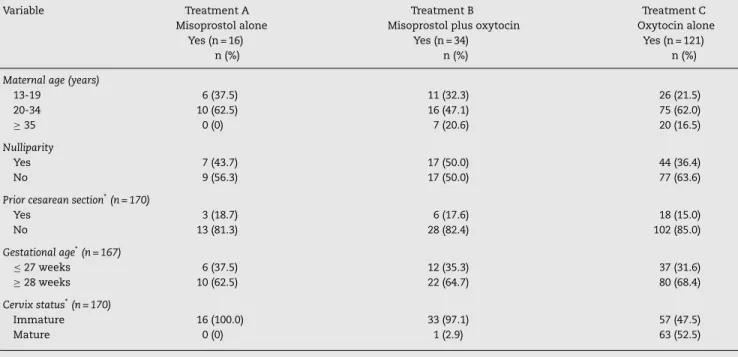
One hundred and seventy-one cases of IUFD gestations were analyzed. Misoprostol was administered in 29.2% of the cases. All administrations of misoprostol were performed by vagi-nal route, 32% of which were misoprostol alone (treatment A), and 68% of which were supplemented with intravenous oxy-tocin (treatment B). Oxyoxy-tocin alone (treatment C) was given in 70.8% of cases. The means maternal age and gestational age were 26.1 years (SD = 7.6 years; range: 14 to 46 years) and 30.7 weeks (SD = 5.4 weeks; range: 18 to 42 weeks), respectively. One-third of the pregnancies were less than 28 weeks, and the mean birth weight was 1,707.2 g (SD = 967.1 g; range: 465 to 5,760 g). All mothers in the misoprostol groups (treatment A or treatment B), and 79.1% of those in the oxytocin group (treat-ment C) had intact amniotic membranes. Unfavorable cervix was the main maternal/obstetrical characteristic found in the treatment A group (100.0%) and treatment B group (97.1%) (Table 1).
The contribution for vaginal delivery of treatments A and B combined was as high as treatment C (98.0% vs. 96.7%). C-section occurred in one out of 34 mothers of the treatment B group, and in four out of 121 mothers of the treatment C group. The relation between the type of treatment and mode of delivery revealed that misoprostol alone and misoprostol sup-plemented by oxytocin had a similar effect to that of oxytocin alone (Table 2).
The majority (71%) of cases treated with misoprostol required a single administration of the medication (range: one to four administrations). Among the cases with a single administration, 75.0% and 69.7% were from group A and group B, respectively. Repeated administrations were performed
Table 1 – Maternal and obstetrical characteristics of 171 pregnancies with intrauterine fetal death, by type of labor induction or labor augmentation
Variable Treatment A Misoprostol alone
Yes (n = 16) n (%)
Treatment B Misoprostol plus oxytocin
Yes (n = 34) n (%)
Treatment C Oxytocin alone
Yes (n = 121) n (%)
Maternal age (years)
13-19 6 (37.5) 11 (32.3) 26 (21.5) 20-34 10 (62.5) 16 (47.1) 75 (62.0)
≥35 0 (0) 7 (20.6) 20 (16.5)
Nulliparity
Yes 7 (43.7) 17 (50.0) 44 (36.4)
No 9 (56.3) 17 (50.0) 77 (63.6)
Prior cesarean section*(n = 170)
Yes 3 (18.7) 6 (17.6) 18 (15.0)
No 13 (81.3) 28 (82.4) 102 (85.0)
Gestational age*(n = 167)
≤27 weeks 6 (37.5) 12 (35.3) 37 (31.6) ≥28 weeks 10 (62.5) 22 (64.7) 80 (68.4) Cervix status*(n = 170)
Immature 16 (100.0) 33 (97.1) 57 (47.5)
Mature 0 (0) 1 (2.9) 63 (52.5)
Table 2 – Mode of delivery of 171 pregnancies with intrauterine fetal death, by type of treatment for labor induction or labor augmentation
Type of treatment Type of delivery Total (n)
Vaginal (n = 166) n (%)
Cesarean section (n = 5)
n (%)
Misoprostol in separate categories
Treatment A (misoprostol alone) 16 (100.0) 0 (0) 16 Treatment B (misoprostol plus ocytocin) 33 (97.1) 1 (2.9) 34 Treatment C (Oxyciton) 117 (96.7) 4 (3.3) 121
Misoprostol in combined categories
Treatment A and treatment B combined 49 (98.0) 1 (2.0) 50 Treatment C (Oxyciton) 117 (96.7) 4 (3.3) 121
twice (6.2% vs. 18.1%), three times (12.5% vs. 6.1%), and four times (6.2% vs. 6.1%) in group A and group B, respectively. Total value of dosage varied between 25g to 400g in the
treatment A (mean: 98.4g; SD = 92.8) and treatment B groups
(mean: 157.0g; SD = 92.7).
Forty percent of the women who received treatment with misoprostol underwent postpartum curettage. The procedure was less common in the treatment A group (31.2%) than in the treatment B group (44.1%). Overall, 62% of the patients with less than 28 weeks of gestational age underwent this surgical intervention.
The mean induction-delivery interval for the entire group was 15.37 hours (SD = 19.4 hours; range: 0.25 to 165 hours). Considering particular groups, the means were 20.15 hours (treatment A), 33.31 hours (treatment B) and 9.70 hours (treat-ment C) (Table 3).
At the end of 48 hours, 96% of the pregnancies were ter-minated, the majority of them (95.8%) by vaginal route. The proportions of cases treated with misoprostol alone, miso-prostol plus oxytocin, and oxytocin alone who delivered vaginally within 48 hours were 100%, 96.7%, and 96.7%, respec-tively.
Discussion
Unlike findings based on RCTs conducted under ideal con-ditions, the present results reflect the role of misoprostol in obstetrics as practiced under the challenging conditions rou-tinely faced in the public health services of the SUS. In these circumstances, misoprostol helped to resolve more unfavor-able clinical cases presenting cervical immaturity and intact amniotic membrane, since the oxytocin group also included pregnant women in advanced stages of cervical dilation. The
low number of induction failures and C-sections demon-strated the importance of misoprostol in the resolution of IUFD cases, in the second or third trimester, especially in low-income settings.
Comparing with other studies,9–12the present cases were
resolved with a relatively lower mean total dose of misopros-tol and a single administration. Other studies13report 400
g
to 600g of the preparation to have been effective in
achiev-ing uterine evacuation within 24 to 48 hours, and that lower doses prolonged the induction-delivery interval. Despite the prolonged induction-delivery interval observed in the present study, the lower number of administrations may have reduced the physical discomfort for a large number of these women, already distressed by the fetal death, since they had to endure only a single pelvic exam for the administration of vaginal misoprostol.
The present study included women with one (19/27), two (6/27), and three (2/27) prior C-sections (of any type), there-fore having an increased risk for uterine rupture,7although
this complication did not occur. Careful patient selection, indi-vidualization of doses administered, adequate monitoring of induction-delivery interval, and especially, the few cases with the combination of previous C-section and administration of misoprostol may have contributed to such results. Accord-ing to Ramirez et al.,143.4% of the women who had uterine
scarring and were submitted to medical labor induction for the assisted delivery of a dead fetus experienced uterine rup-ture in 19 American institutions. Although Ramirez et al.14
have emphasized that uterine rupture did not show associ-ation with any drug employed, it is possible that it increases maternal morbidity/mortality in this scenario.
Overall, the frequency of previous C-section was greater than 15% considering all women, as well as in each treat-ment group analyzedper se. Generally, with fetal death, there
Table 3 – Mean induction-delivery interval of 171 pregnancies with intrauterine fetal death, by type of treatment for labor induction or labor augmentation.
Type of treatment n (%) Mean (hours) SD Minimum value Maximum value
Treatment A (misoprostol alone) 16 (9.3) 20.15 15.8 4 60 Treatment B (misoprostol plus oxytocin) 34 (19.9) 33.31 29.6 6 165 Treatment C (oxytocin alone) 121 (70.8) 9.70 11.6 0.25 75
are reports in Brazil that a previous uterine scar reduces by 84% (OR 0.16; 95% CI: 0.04-0.71) the chance for drug-induced labor,15and increases by seven-fold (OR 7.0; 95% CI: 2.29-21.55)
the chance for a repeat C-section as the route to deliver the dead fetus.16In the present study, none of the cases requiring
a C-section was from the misoprostol alone group, as was also observed by Aquino et al.10However, one case with a previous
C-section submitted to treatment B resulted in induction fail-ure. In the treatment C cases, the C-section was conducted to guarantee the safety of the mother when the management of labor was affected by prior multiple cesarean deliveries (one case), systemic lupus erythematosus (one case), macrosomic fetus weighting 5,760 g (one case), and placental abruption associated with severe gestational hypertension (one case).
In the present study, postpartum curettage was much more frequent when compared with C-sections, but similar to other studies in proportion (40%).17It was used to check for placental
residue retention, suspected by a clinical exam and/or imag-ing. Although postpartum curettage was not the objective of this study, it is important to highlight that early gestational age appears to influence the need for the procedure,17which
was performed in over 60% of the patients with gestational age under 28 weeks.
As observed by others,18–21 in the present study the vast
majority of cases were delivered vaginally within 48 hours; however, the mean induction-delivery intervals were higher in the misoprostol groups than in the oxytocin group, as was found by Aquino et al.10It probably occurred because the
oxy-tocin group had both women in situations which favored the labor induction and women whose labor had spontaneously started, and the labor was simply augmented by employing the drug, which partially explains the mean interval found.
Also, lack of achievement of fetal expulsion within 48 hours did not extend to C-section, and four out of the seven more prolonged cases were from the treatment B group; however, misoprostol was applied according to the protocol in only one of those four cases. According to Victora et al.,22 in the
standard clinical trial model, measures are taken for ensuring ideal compliance, including intensively trained staff, strictly controlled dosages, strong supervision, and monitoring of side effects. Such measures cannot be easily replicated under rou-tine conditions. Despite the evidence, misoprostol was also initiated after oxytocin (three cases), creating a group of much worse prognosis (group B). The non-observance of the hospital protocols and the unavailability of the drug may have been rea-sons for such conduct. However, these questions are beyond the scope of the present study.
This study has limitations. Firstly, this was a retrospective descriptive study, with data collection dependent on the com-pleteness of medical forms, making it impossible to analyze characteristics such as schooling and household income. This issue did not appear to affect the study results, since all par-ticipants were selected from a single public health service, possibly reflecting the socioeconomic status of women that attend SUS units in the region. Secondly, Bishop’s score infor-mation was not available, so the option was made for using cervix description (mature or immature) instead. Although insufficient to replace the aforementioned index, this char-acteristic aided in the clinical classification of the cases at hand. Thirdly, it was not possible to classify some complaints
occasionally reported on the medical charts as side effects of misoprostol, even though there are reports9that vomiting,
nausea, fever, headache, and diarrhea are less common in the vaginal route than in the oral route. Finally, the major issue was the creation of the specific groups. Although uterus evacu-ation was the main goal in all groups, the cervix characteristics were different. Unfortunately, the oxytocin group was com-posed of women in advanced stages of cervical dilation, which made comparison among the groups difficult. The option was to show the results employing a descriptive design.
As advantages, this study was performed at a government-funded health service, which not only is a reference maternity-hospital for high-risk pregnancies, but also receives a wide variety of patients, and therefore better reflects the assistential reality of the SUS, as well as the profile of the assisted population. Taking into account the focus on dead fetus delivery, the size of the study population can be consid-ered large.
Therefore, the induction of the delivery of dead fetuses was successful, reinforcing the utilization of misoprostol in government-provided healthcare services, and its ultimate incorporation in the treatment of cases in which oxytocin has not been successful. Nonetheless, its use must be carefully evaluated, guided by evidence-based protocols, and monitored by professionals capable of managing any occurrence associ-ated with the induction. In relation to other Latin-American countries, the availability of misoprostol for vaginal admin-istration in Brazil may be considered an advance. However, additional concerns might result from situations such as: (i) distribution restricted by law to hospitals,4(ii) expensive
com-mercialization price, and (iii) product manufactured by only one local pharmaceutical company.3 Such problems related
to the supply chain of misoprostol may constitute obstacles for the renovation of the product’s license, which may in the future result in the reduction of access to the medication already guaranteed for some indications in the field of repro-ductive health in Brazil.
Conclusion
In conclusion, misoprostol effectively contributed to the success of vaginal deliveries of dead fetuses, showing the importance of its application to resolve the cases presenting difficulty with the usual induction methods, and of its avail-ability in public health services in Brazil.
Conflicts of interest
The authors declare no conflicts of interest.
r e f e r e n c e s
1. Dodd JM, Crowther CA. Misoprostol for induction of labour to terminate pregnancy in the second or third trimester for women with a fetal anomaly or after intrauterine fetal death. Cochrane Database Syst Rev. 2010;14:CD004901.
3. Fernandez MM, Coeytaux F, de León RG, Harrison DL. Assessing the global availability of misoprostol. Int J Gynaecol Obstet. 2009;105:180–6.
4. Reis AMM, Perini E. Drug shortage: determinants, consequences and management. Ciênc Saúde Coletiva [online]. 2008;13 suppl:603–10.
5. Clark S, Blum J, Blanchard K, Galvão L, Fletcher H, Winikoff B. Misoprostol use in obstetrics and gynecology in Brazil, Jamaica, and the United States. Int J Gynaecol Obstet. 2002;76:65–74.
6. Elati A, Weeks AD. The use of misoprostol in obstetrics and gynecology. BJOG. 2009;116 Suppl 1:61–9.
7. Faúndes A (Ed). Misoprostol use in obstetrics and gynecology. Federación Latinoamericana de Sociedades de Obstetrícia y Ginecología (FLASOG); 2007.
8. Cunningham FG, Leveno KJ, Bloom SL, Hauth JC, Rouse DJ, Spong CY. Labor induction (chapter 22). In: Cunningham FG, Leveno KJ, Bloom SL, Hauth JC, Rouse DJ, Spong CY, editors. Williams Obstetrics. 23rded. New York: McGraw-Hill; 2010.
9. Nyende L, Towobola OA, Mabina MH. Comparison of vaginal and oral misoprostol, for the induction of labour in women with intra-uterine fetal death. East Afr Med J. 2004;81:179–82. 10. Aquino MMA, Guedes AC, Mesquita MRS, Hernandez M,
Cecatti JG. Obstetrical management of fetal death. Rev Bras Ginecol Obstet. 1998;20:145–9.
11. Mariani Neto C, Leão EJ, Barreto EM, Kenj G, De Aquino MM, Tuffi VH. Use of misoprostol for labor induction in stillbirth. Rev Paul Med. 1987;105:325–8.
12. El-Gharib MN, Elebyary MT. Low-dose vaginal misoprostol in the management of intrauterine fetal death. J Matern Fetal Neonatal Med. 2011;24:1239–42.
13. Gómez Ponce de León R, Wing DA. Misoprostol for termination of pregnancy with intrauterine fetal demise in
the second and third trimester of pregnancy – a systematic review. Contraception. 2009;79:259–71.
14. Ramirez MM, Gilbert S, Landon MB, Rouse DJ, Spong CY, Varner MW, et al. Mode of delivery in women with antepartum fetal death and prior cesarean delivery. Am J Perinatol. 2010;27:825–30.
15. Sampaio AG, Souza ASR, Noronha Neto C. Factors associated with induced delivery in pregnant women with a dead fetus after the 20thweek of gestation. Rev Bras Saúde Matern
Infant. 2011;11:125–31.
16. Sampaio AG, Souza ASR. Cesarean section in fetal death. Rev Bras Ginecol Obstet. 2010;32:169–75.
17. Van Mensel K, Claerhout F, Debois P, Keirse MJ, Hanssens M. A randomized controlled trial of misoprostol and sulprostone to end pregnancy after fetal death. Obstet Gynecol Int.
2009;2009:496320.
18. Fawole AO, Adekunle AO, Sotiloye OS, Arowojolu AO, Otolorin EO. Experience with intravaginal misoprostol in the
management of intra-uterine fetal death. Afr J Med Med Sci. 2004;33:105–8.
19. Nakintu N. A comparative study of vaginal misoprostol and intravenous oxytocin for induction of labour in women with intra uterine fetal death in Mulago Hospital. Uganda Afr Health Sci. 2001;1:55–9.
20. Chittacharoen A, Herabutya Y, Punyavachira P. A randomized trial of oral and vaginal misoprostol to manage delivery in cases of fetal death. Obstet Gynecol. 2003;101:70–3. 21. Bugalho A, Bique C, Machungo F, Faúndes A. Induction of
labor with intravaginal misoprostol in intrauterine fetal death. Am J Obstet Gynecol. 1994;171:538–41.