Hematogenic hepatic abscess in a patient presenting fever of
unknown origin
Abscesso hepático de origem hematogênica em paciente com febre de origem indeterminada
Absceso hepático de origen hematogénico en paciente con fiebre de origen indeterminado
Mariana Facchini Granato1, Eliana Paes de C. Giorno2, Cláudio Schvartsman3, Amélia Gorete Reis4
Instituição: Serviço de Consulta de Urgência e Triagem do Instituto da Criança do Hospital das Clínicas, Departamento de Pediatria da Faculdade de Medicina da Universidade de São Paulo (USP), São Paulo, SP, Brasil
1Médica Assistente da Enfermaria de Pediatria do Hospital Auxiliar do
Cotoxó, Instituto da Criança do Hospital das Clínicas, Departamento de Pediatria da Faculdade de Medicina da USP, São Paulo, SP, Brasil
2Médica Preceptora do Serviço de Consulta de Urgência e Triagem do
Instituto da Criança do Hospital das Clínicas, Departamento de Pediatria da Faculdade de Medicina da USP, São Paulo, SP, Brasil
3Doutor em Pediatria pela Faculdade de Medicina da USP; Médico Chefe
do Serviço de Consulta de Urgência e Triagem do Instituto da Criança do Hospital das Clínicas, Departamento de Pediatria da Faculdade de Medicina da USP, São Paulo, SP, Brasil
4Doutora em Pediatria pela Faculdade de Medicina da USP; Médica
Assistente do Serviço de Consulta de Urgência e Triagem do Instituto da Criança do Hospital das Clínicas, Departamento de Pediatria da Faculdade de Medicina da USP, São Paulo, SP, Brasil
ABSTRACT
Objective: To describe the clinical presentation of an atypical liver abscess in the pediatric setting and to con-duct a review of the literature concerning ethiopathogenic differences between developed and developing countries.
Case description: A 13-year-old male patient was ad-mitted to the emergency room due to daily fever and weight loss, without abnormalities in his physical examination. After undergoing an investigation, the patient was found to have a well-defined heterogeneous nodular area in the abdominal ultrasonography exam, which was compatible with liver abscess. He was subsequently submitted to surgical drainage and started on antibiotics. The drainage material culture turned positive to methicillin-sensible Staphylococcus aureus.
Comments: The present case report shows that the pe-diatrician needs to be aware of the common causes of fever of unknown origin in order to systematically develop an investigative approach. In face of the diagnosis of a liver abscess, the possibility of Staphylococcus aureus, especially with a previous history of skin rupture, should be considered.
Key-words: liver abscess; fever of unknown origin; Staphylococcus aureus.
RESUMO
Objetivo: Descrever uma apresentação atípica de abscesso hepático em paciente pediátrico e realizar uma revisão da literatura no que diz respeito às diferenças observadas na etiopatogenia do quadro, quando considerados os países desenvolvidos e aqueles em desenvolvimento.
Descrição do caso: Paciente de 13 anos, do sexo mas-culino, foi trazido ao pronto-socorro pediátrico devido à febre diária e à perda de peso, sem alterações ao exame físico. Na investigação realizada, o ultrassom abdominal evidenciou área heterogênea nodulariforme relativamente definida, compatível com abscesso hepático. Foi realizada drenagem cirúrgica e antibioticoterapia. No material da drenagem houve crescimento de Staphylococcus aureus sen-sível à oxacilina.
Comentários: O caso demonstra a importância de o pediatra conhecer as principais causas da febre de origem indeterminada, saber desenvolver a abordagem investiga-tiva e, frente ao diagnóstico de abscesso hepático, aferir a possibilidade de o agente etiológico ser o Staphylococcus au-reus,principalmente quando houver relato de rotura da pele.
Palavras-chave: abscesso hepático; febre de causa desco-nhecida; Staphylococcus aureus.
Endereço para correspondência: Mariana Facchini Granato
Rua Aimberê, 1.300 – apartamento 84 – Perdizes CEP 05018-011 – São Paulo/SP
E-mail: [email protected]
Conflito de interesse: nada a declarer
RESUMEN
Objetivos: Describir una presentación atípica de absceso hepático en pacientes pediátricos y realizar una revisión de la literatura en lo que se refiere a las diferencias observadas en la etiopatogenia del cuadro, cuando considerados los países desarrollados y en desarrollo.
Descripción del caso: Paciente de 13 años, varón, fue traído a la emergencia pediátrica debido a la fiebre diaria y pérdida de peso, sin alteraciones al examen físico. En la investigación realizada, el ultrasonido abdominal evidenció área heterogénea nodulariforme relativamente definida, com-patible con absceso hepático. Se realizó drenaje quirúrgico y antibioticoterapia. En el material drenado hubo crecimiento de Staphylococcus aureus sensible a la oxacilina.
Comentarios: El caso demuestra la importancia del pediatra en conocer las principales causas de fiebre de ori-gen indeterminado, en saber desarrollar un acercamiento investigativo y, frente al diagnóstico de absceso hepático, estimar la posibilidad de que el agente etiológico sea el Staphylococcus aureus, principalmente cuando haya relato de rotura de la piel.
Palabras clave: absceso hepático; fiebre de causa desco-nocida; Staphylococcus aureus.
Introduction
Liver abscesses, at a rate of 2.3 to 20 cases per 100,000 inhabitants(1-3), are relatively rare in the general population. In spite of that, this pathology is relevant because of its as-sociated mortality, which ranges from 2 to 12%(3,4).
Its prevalence is higher among adults than among chil-dren, and it affects more men than women (3.3 versus 1.3 for 100,000 inhabitants)(2,5). In adults, the main risk factors are associated with liver transplants(2), malignant and benign pathologies of the biliary duct(1,5), neoplasia(2) and diabetes mellitus(2,5). Among children, other diseases may also be associated: innate immunity disorders, Crohn’s disease and intra-abdominal sepsis(6). In children, the epidemiology of liver abscesses in developing countries is different from that seen in developed countries, where it is rare and usually asso-ciated with a primary disease that results in immunodepres-sion, such as chronic granulomatous disease. About one third of the children with chronic granulomatous disease have a liver abscess some time in their life(7). A recent study in the United Kingdom reported on the occurrence of 15 cases of
pyogenic liver abscess in ten years, and in 20% of the cases the liver abscess was the irst sign of chronic granulomatous disease(6). In developing countries, the prevalence of liver abscess is signiicantly higher. A three-year study conducted in Brazil by Ferreira et al(8) found 65 cases of liver abscess in children, and at least 35% of them were associated with skin lesions. In the same study, results of stool examination were available for 36 of the 65 cases, and helminth infec-tion was found in 32, whereas only one had an Entamoeba histolytica cyst. These data suggest that helminth infection may play an important role in the etiopathogenesis of the disease, whether amebiasis seems to be a rare cause of liver abscess in the Southern and Southeastern regions of Brazil. The occurrence of helminth infection has also been identiied as a predisposing factor by other authors(9).
A history of trauma was found in 3% of the cases by Ferreira et al(8). No risk factors were detected in 46% of the population under study(8), in agreement with other studies in the literature, which reported that no cause could be deined in 50% of the cases of liver abscess(10,11). The main etiologic agents for liver abscess are different for adult and pediatric populations. Among adults, a substantial number of pyogenic abscesses have a polymicrobial origin, including aerobic and anaerobic bacteria. The main agents are Klebsiella pneumoniae (27 to 82%) and Streptococcus milleri (44%)(1,2,5), whereas the presence of Staphylococcus aureus is rare (6%)(2). However, among children, Staphylococcus aureus is the most common etiologic agent, accounting for 20 to 55% of the cases(6,8).
The clinical signs and symptoms of patients with a liver abscess include fever in about 89% of the cases, abdominal pain in 55 to 72%, and chills in 49 to 69%(1,2). Unspeciic symptoms, such as nausea, vomits, anorexia and weight loss(1,3,12), are also frequent. Physical examination often reveals liver tenderness (55%), jaundice (50%) and hepa-tomegaly (35%)(1).
This study describes the clinical presentation of a pedi-atric patient with an atypical liver abscess and reviews the literature about the differences in the etiopathogenesis of this disease in developed and developing countries.
Case report
39o to 40.5o C for 25 days, unexplained loss of 2kg, night sweats and cough. He did not report any gastrointestinal symptoms or pain. Five days before the beginning of inter-mittent fever, he had his hand cut by a kite line coated with powdered glass, which resulted in an edema that resolved spontaneously.
Initial physical examination did not reveal any abnor-malities. The patient had the results of tests requested a few days before, during an outpatient consultation: normal chest X-ray, negative PPD skin test, leukocytosis and elevated C-reactive protein in CBC (Table 1).
In the emergency department, the workup for fever of unknown origin included echocardiogram and abdominal ultrasound focused on the investigation of possible infec-tions, rheumatologic and oncologic etiologies (Table 1).
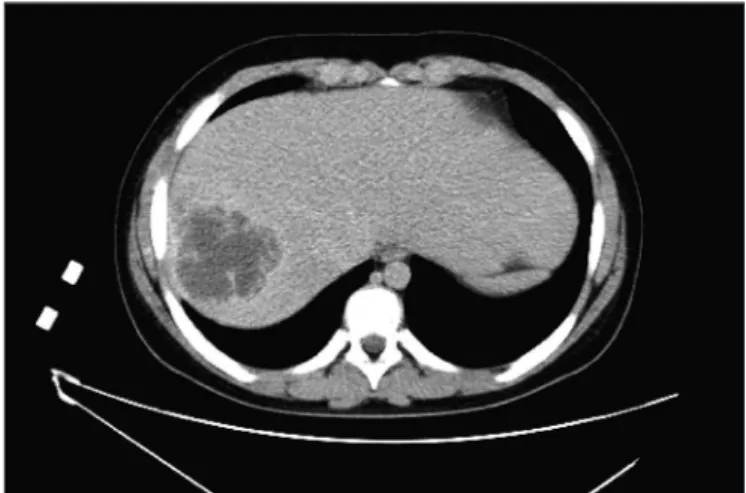
Abdominal US revealed a relatively well-deined het-erogeneous nodular mass measuring 5.5 x 7.0 cm, compat-ible with liver abscess. He was hospitalized and received IV metronidazole, oxacillin and amikacin. On the second hospitalization day, the pediatric surgery team requested an abdominal CT to plan the operation (Figure 1).
Because of the abscess size, the patient underwent open surgical drainage with placement of a Watterman drain. The culture of drained material showed growth of methicillin-sensitive Staphylococcus aureus. Treatment continued for four weeks with oxacillin, whereas all the other antibiotics were discontinued.
Discussion
The case reported here is an example of a pathology not usually found in the literature, but extremely important due to its high morbidity and mortality(3,4) and the worldwide differences in its epidemiology. According to studies in developed countries, the signs and symptoms with which our patient presented were not enough to suggest the pres-ence of a liver abscess, but studies conducted in developing
Figure 1 - Abdominal CT scan shows hypoechoic heterogeneous lesion with irregular margins and areas of increased density, measuring 9.5 x 7.3cm, in segment VII
Table 1 - Radiography and laboratory tests
20th day with fever
Outpatient service
25th day with fever
Emergency Department
15th hospitalization day Ward
Hb/Ht (g/dL – %) 10.7/33.0 10.8/34.5
Leukocytes (µL) 17,400 17,100
Platelets (K/µL) 405,000 426,000
CRP/ESR (mg/dL and mm) 161/- 153/55
LDH/uric acid (U/L – mg/dL) 159/3.6
Cytomegalovirus test Positive IgG and IgM negative IgM
Epstein Barr Virus test Positive IgG and IgM negative IgM
Toxoplasmosis test Negative IgG and IgM negative IgM
Hepatitis B test Negative IgG and IgM negative IgM
Hepatitis C test negative
HIV test negative
Ova and parasite examination negative
Complete blood count negative
Echocardiogram Normal
Hb: hemoglobin; Ht: hematocrit; CRP: C-reactive protein; ESR: erythrocyte sedimentation rate; LDH: lactate dehydrogenase; HIV: human
References
1. Huang CJ, Pitt HA, Lipsett PA, Osterman FA Jr, Lillemoe KD, Cameron JL et al. Pyogenic hepatic abscess: changing trends over 42 years. Ann Surg 1996;223:600-9.
2. Kaplan GG, Gregson DB, Laupland KB. Population-based study of the epidemiology of and the risk factors for pyogenic liver abscess. Clin Gastroenterol Hepatol 2004;2:1032-8.
3. Mohsen AH, Green ST, Read RC, McKendrick MW. Liver abscess in adults: ten years experience in a UK centre. QJM 2002;95:797-802.
4. Rahimian J, Wilson T, Oram V, Holzman RS. Pyogenic liver abscess: recent trends in etiology and mortality. Clin Infect Dis 2004;39:1654-9.
5. Chan KS, Chen CM, Cheng KC, Hou CC, Lin HJ, Yu WL. Pyogenic liver abscess: a retrospective analysis of 107 patients during a 3-year period. Jpn J Infect Dis 2005;58:366-8.
6. Mourah M, Hinds R, Verma A, Yu D, Samyn M, Mieli-Vergani G et al. Liver abscesses in children: a single center experience in the developed world. J Pediatr Gastroenterol Nutr 2006;42:201-6.
countries demonstrated that indings in the patient’s history suggested that diagnosis.
A fever of unknown origin is a common finding in pediatric clinical routine, and liver abscesses should be included in the differential diagnosis. In general, symp-toms are clearer and include abdominal pain, anorexia, nausea and vomits associated with fever(3,4,9,12). In the case described here, the patient had a few unspecific symptoms, including prolonged fever and weight loss, without any gastrointestinal changes, which contributed to the delay in diagnosis.
Our patient did not have the diseases associated with liver abscess, according to studies in developed countries(1,2,5), such as liver transplant, diabetes mellitus, cancer, biliary pathologies and chronic granulomatous disease, which also made diagnosis dificult initially.
In contrast, according to studies conducted in develop-ing countries, such as Brazil(8) , China(13) and India(14), the patient had relevant risk factors. Some studies, such as the one conducted by Ferreira et al, published in 1997, suggested that a relevant predisposing factor is a history of skin lesions, which may be found in up to 35% of the cases(8). As described above, this type of association was found in our patient, who had hurt his hand a few days before the onset of fever.
Another factors that differs in the literature of devel-oped and developing countries is the frequent association of liver abscess with helminth infection(8,9,13,15), which may justify the substantial difference in the occurrence of liver abscess in these two groups of countries. A Brazilian study of eight cases of liver abscess in children, published in 1995, reported that three of them, that is, 37.5% of the cases, had Ascaris lumbricoides infection, which may have been a predisposing factor for the development of the liver abscess(15). Another study, conducted by Ferreira et al in 1997 examined 65 children with a diagnosis of liver
abscess; results of fecal examination, available for 36 of them, revealed helminth infection in 80.6% of the cases under analysis(8). Similarly, a study conducted in India in 1998 found infection by Ascaris lumbricoides in 38.9% of the children with a diagnosis of pyogenic liver abscess(14). In helminth infection, particularly when there is pas-sage of larvae through the hepatic tissue, there might be immunomodulation characterized by eosinophilia, increased IgE production and stimulation of T2 response in association with T1 suppression, which favors the for-mation of granulomas and increases the susceptibility to bacterial infections(8,9,16,17). In addition to that, the pres-ence of parasites in the biliary duct leads to biliary stasis, which also favors secondary bacterial infections(18,19).
Staphylococcus aureus was the etiologic agent detected in the material drained from the patient. The literature in both developing and developed countries shows that this is the main etiologic agent of liver abscesses in pediatric populations(8,20).
Mechanisms previously described explain why the in-cidence of liver abscess is higher in developing countries, as hygiene and sanitation are, in general, not adequate, which promotes the occurrence of parasitoses.
7. Fehon R, Mehr S, La Hei E, Isaacs D, Wong M. Two-year-old boy with cervical and liver abscesses. J Paediatr Child Health 2008;44:670-2.
8. Ferreira MA, Pereira FE, Musso C, Dettogni RV. Pyogenic liver abscess in children: some observations in the Espírito Santo State, Brazil. Arq Gastroenterol 1997;34:49-54.
9. Mishra K, Basu S, Roychoudhury S, Kumar P. Liver abscess in children: an overview. World J Pediatr 2010;6:210-6.
10. Frey CF, Zhu Y, Susyki M, Isaji S. Liver abscess. Surg Clin North Am. 1989;69:259-71.
11. Pineiro-Carrero VM, Andres JM. Morbidity and mortality in children with pyogenic liver abscess. Am J Dis Child 1989;143:1424-7.
12. Rubin RH, Swartz MN, Malt R. Hepatic abscess: changes in clinical, bacteriologic and therapeutic aspects. Am J Med 1974;57:601-10.
13. Wang DS, Chen DS, Wang YZ, Li JS. Bacterial liver abscess in children. J Singapore Paediatr Soc 1989;31:75-8.
14. Kumar A, Srinivasan S, Sharma AK. Pyogenic liver abscess in children--South Indian experiences. J Pediatr Surg 1998;33:417-21.
15. Pereira RM, Tresoldi AT, Belangero VM, Bucaretchi F, Hessel G, da Silva JM. Liver abscess in childhood: report of 8 cases. Arq Gastroenterol 1995;32:186-90. 16. Pereira FE, Musso C, Castelo JS. Pathology of pyogenic liver abscess in
children. Pediatr Dev Pathol 1999;2:537-43.
17. Sharma MP, Kumar A. Liver abscess in children. Indian J Pediatr 2006;73:813-7.
18. Van Severen M, Lengele B, Dureuil J, Shapira M, Dive C. Hepatic ascaridiasis. Endoscopy 1987;19:140-2
19. Javid G, Wani NA, Gulzar GM, Khan BA, Shah AH, Shah OJ et al. Ascaris-induced liver abscess. World J Surg 1999;23:1191-4.