CLINICAL SCIENCE
Department of Obstetrics and Gynecology, São Paulo University Medical School, São Paulo – SP – Brasil
Email: [email protected] Received for publication on May 21, 2007 Accepted for publication on August 08, 2007
MATERNAL MORTALITY DUE TO ARTERIAL
HYPERTENSION IN SÃO PAULO CITY (1995-1999)
Carlos Eduardo Pereira Vega, Soubhi Kahhale, Marcelo Zugaib
Vega CEP, Kahhale S, Zugaib M. Maternal Mortality due to Arterial Hypertension in São Paulo City (1995-1999). Clinics. 2007;62(6):679-84.
AIM: To describe the case profile of maternal death resulting from hypertensive disorders in pregnancy and to propose measures for its reduction.
METHODS: The Committee on Maternal Mortality of São Paulo City has identified 609 cases of obstetric maternal death between 1995 and 1999 with an underreporting rate of 52.2% and a maternal mortality rate of 56.7/100,000 live births. Arterial hypertension was the main cause of maternal death, corresponding to 142 (23.3%) cases.
RESULTS: Ninety-five (66.9%) of the deaths occurred during the puerperal period and 34 (23.9%) occurred during pregnancy. The time of death was not reported in 13 (9.2%) cases. Seizures were observed in 41 cases and magnesium sulfate was used in four of them. The causes of death were ruled to be cerebrovascular accident (44.4%), acute pulmonary edema (24.6%), and coagulopathies (14.1%). Cesarean section was performed in 85 (59.9%) cases and vaginal delivery in 15 (16.0%).
CONCLUSION: Complications of arterial hypertension are responsible for the high rates of pregnancy-related maternal death in São Paulo City.Quality prenatal care and appropriate monitoring of the hypertensive pregnant patient during and after delivery are important measures for better control of this condition and are essential to reduce disorders in pregnancy.
KEYWORDS: Maternal mortality. Arterial hypertension. Risk pregnancy. Chronic arterial hypertension. Preeclampsia/eclampsia. Magnesium sulfate.
INTRODUCTION
Over the last decade, the study of maternal mortality has become of the utmost importance in the evaluation of the quality of healthcare offered to a population.1 Developed countries, which present very low maternal mortality rates (MMR), use this indicator merely for comparative purposes and self-evaluation. However, developing countries with rates higher than 50 maternal deaths/100,000 live births, as is the case for Brazil, should not only quantify, but also study maternal deaths on a case-by-case basis in an attempt to identify deficiencies in care and to establish appropriate measures to reduce these deaths.
Prenatal care is fundamental for the reduction of ma-ternal death.2 Primary care programs that were able to re-duce maternal mortality are characterized by structure and coherence, access to adequate medications and materials, detailed therapeutic guidance, and differentiated follow-up.3 The profile of diseases that lead to the death of a preg-nant woman or puerpera varies according to the degree and type of difficulty encountered by the communities, with dif-ferences from country to country or even within the same country.4,5 In most developing countries, arterial hyperten-sion is the main cause of maternal death.6
worsened this clinical condition resulting in maternal death, as well as to propose interventions to reduce the incidence of maternal death.
MATERIAL AND METHODS
The data used in the present study were requested from the Committee on Maternal Mortality of São Paulo City (CMMMSP), of which the first author is a member. A ret-rospective ecological study was conducted comprising ma-ternal deaths with a history of hypertensive disorders in pregnancy [preeclampsia/eclampsia (PE/E) and chronic hy-pertension (CH)] identified between 1995 and 1999 in São Paulo City.
The size and complexity of the city of São Paulo does not permit us to completely investigate all the deaths of women of fertile age (10 to 49 years), therefore the CMMMSP used the “mask method” for the selection of known positive or presumed cases of maternal death. This method has been used successfully since 19931. The mask method consists of reading the death certificate in order to identify any information in the text that indicates the pres-ence of pregnancy-related events, i.e., events that occurred during or within one year after pregnancy. Any death cer-tificate reporting a disease or disorder that may worsen or interfere with the physiological progression of pregnancy or puerperium, such as cerebrovascular accident, cardiovas-cular descompensation, events related to arterial hyperten-sion, general infections, and manifestations of acute anemia and its disorders in pregnancy, was also added. After ap-propriate selection of confirmed or suspected cases of ma-ternal death, a standard questionnaire recommended by the Ministry of Health7 was applied, which compiles data col-lected during home and hospital visits. When a positive case of maternal death was identified, the case was then codi-fied according to the ICD-10 which was based on the in-formation obtained and subsequently classified.
The CMMMSP defines reported maternal deaths as any case in which simple analysis of the death certificate con-firms, beyond any doubt, the presence of pregnancy-related events. Underreported maternal death was defined as an event identified during the investigation of the case with no information being present in the death certificate. At the end of the investigation process and classification of posi-tive events, the rate of underreporting was calculated by di-viding the number of underreported maternal deaths by the number of declared maternal deaths.
The investigation charts of the 142 cases of maternal deaths due to hypertensive disorders in pregnancy were analyzed by the authors in order to identify social charac-teristics, age, obstetric history, prenatal care, hospital care
(medications, obstetric management, and resulting disor-ders in pregnancy), newborn survival, and place and time of maternal death during pregnancy and puerperium.
The present study was conducted according to the ethi-cal guidelines established by the Declaration of Helsinki and according to the norms outlined by the World Medi-cal Association.
RESULTS
During the period from 1995 to 1999, a total of 1,073,917 live births and 609 confirmed cases of maternal death were reported in the city of São Paulo, which corresponds to a MMR of 56.7/100,000 live births during the period. The pres-ence of maternal death was omitted in 209 of these death certificates, resulting in an underreporting rate of 52.2%.
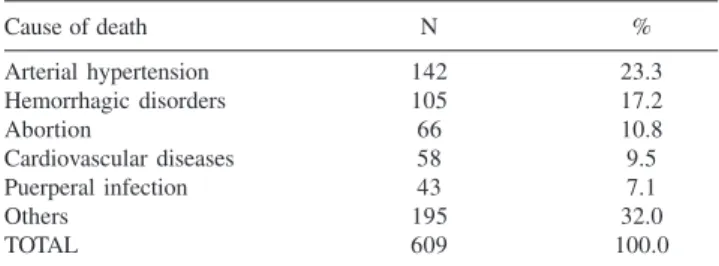
The main cause of maternal death found in the present study was arterial hypertension (Table 1) in 142 (23.3%) cases, hemorrhagic disorders in pregnancy during the 2nd-3rd trimester and puerperal period in 105 (17.2%), and abor-tions in 66 (10.8%). Among the 142 (23.3%) maternal deaths due to hypertensive disorders in pregnancy, 139 occurred up to puerperal day 42 and three occurred between puerperal day 43 and one year after delivery or abortion (extended pu-erperium), resulting in a specific MMR due to arterial hy-pertension of 13.2/100,000 live births. PE/E was the lead-ing cause of death in 99 cases and 43 were due to chronic hypertension disorders in pregnancy. Figure 1 shows the dis-tribution of 142 cases of maternal death resulting from chronic hypertension disorders in pregnancy and PE/E and the respective MMRs calculated according to age.
Seventy-four (52.1%) of the women were single, 57 (40.1%) were married, six (4.2%) were co-habiting, four (2.8%) were widows, and one case (0.7%) where the mari-tal status was unknown. On the basis of the 103 (72.5%) death certificates reporting ethnic origin/race, 65 (63.1%) women were white, 27 (26.2%) were mulatto, 10 (9.7%) were black, and one (1.0%) was of Asian origin.
Table 1 - Distribution of the 609 cases of maternal death according to the main causes of death (São Paulo City, 1995-1999)
Cause of death N %
Arterial hypertension 142 23.3
Hemorrhagic disorders 105 17.2
Abortion 66 10.8
Cardiovascular diseases 58 9.5
Puerperal infection 43 7.1
Others 195 32.0
TOTAL 609 100.0
Data regarding parity were investigated in 96 (67.6%) cases. Cases of PE/E included 33 (48.5%) primigravidae, 14 (20.6%) secundigravidae, 13 (19.1%) tertigravidae, and eight (11.8%) multigravidae. Whereas cases of chronic hypertension included five (17.9%) primigravidae, four (14.3%) secundigravidae, seven (25.0%) tertigravidae, and 12 (42.9%) multigravidae.
Data regarding prenatal care were obtained in 56 (39.4%) cases, with 37 (66.1%) of the women receiving pre-natal care, whereas 19 (33.9%) did not. The reasons for fail-ure in seeking prenatal follow-up were identified based on the data collected during home visits and included attempts to hide the pregnancy and lack of care concerning the pa-tient’s own well-being.
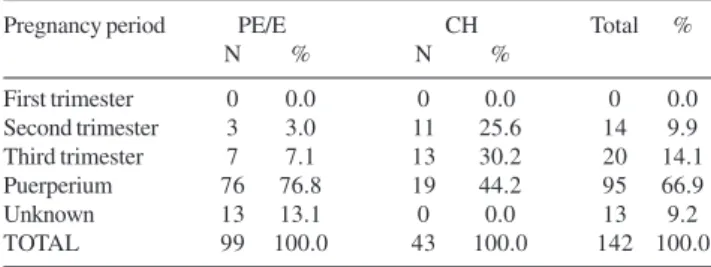
The time of death during pregnancy and puerperium is shown in Table 2.
Delivery was performed in 100 (70.4%) cases, includ-ing 85 (85.0%) cesarean sections and 15 (15.0%) vaginal deliveries. Post-mortem cesarean section was performed in six cases, with successful recovery of the neonate in two (33.3%). Time was not sufficient for any intervention in
28 (19.7%) cases and information regarding the type of pro-cedure was unavailable in 14 (9.9%) cases,
The pregnancy disorders that resulted in the death of 142 patients are shown in Table 3. The most frequent cause was cerebrovascular accident (45.1%), acute pulmonary edema (27.5%), and coagulopathies (16.2%), with the HELLP syndrome being responsible for 12 (52.2%) deaths.
In 17 (12.0%) cases, the pregnant woman or puerpera was admitted to the hospital with cardiorespiratory arrest. Eleven (64.7%) of these patients had chronic hypertension and six (35.3%) presentedwithpregnancydisordersof PE/E, of which 13 (76.5%) were gravidae and four (23.5%) were puerperae. Eleven (64.7%) patients were older than 30 years and five (83.3%) of the six post-mortem cesarean sections were per-formed in this group. Puerperae died on average 11 days after delivery, with a mean of 9 days for patients with PE/E and a mean of 20 days for chronic hypertensive patients.
The maternal death was explicitly stated in the death certificate of 82 cases among the 99 cases of PE/E, (underreporting rate of 20.7%) and of 26 patients among the 43 with chronic hypertension (underreporting rate of 65.4%). The overall underreporting rate among the 142 cases was 31.5%. The fields on the death certificate inquir-ing about the presence of pregnancy or puerperium were correctly filled out in 28 (19.7%) cases.
With respect to the place of death, 139 (97.9%) women died at the hospital and three (2.1%) died at home. Public hospitals attended to 112 (80.6%) cases and private hospi-tals attended to 22 (15.8%). Five (3.6%) patients died at hospitals outside São Paulo City. Among the 95 (73.6%) puerperae, 74 (77.9%) died at the same hospital where they gave birth either during the immediate postpartum period or days later when returning to the hospital.
Eleven (7.7%) patients were transferred to referral hos-pitals, nine (81.8%) of them after delivery and two (18.2%) during pregnancy. Most of the institutions receiving the cases were tertiary hospitals.
Figure 1 - Percent distribution and the respective maternal mortality rate (MMR) of cases of maternal death resulting from disorders in pregnancy of preeclampsia/eclampsia (PE/E) and chronic hypertension (CH) according to age of the pregnant women or puerpera at the time of death (São Paulo City, 1995-1999).
Table 3 - Distribution of the 142 cases of obstetric maternal death resulting from hypertensive disorders in pregnancy according to the determining cause of death (São Paulo City, 1995-1999)
Cause of death N %
Cerebrovascular accident 64 45.1
Acute pulmonary edema 39 27.5
Coagulopathies 23 16.2
Acute myocardial infarction 5 3.5
Others 10 7.0
Unknown 1 0.7
TOTAL 142 100.0
Source: CMMMSP.
Table 2 - Distribution of the 99 cases of maternal death due to preeclampsia/eclampsia (PE/E) and of the 43 cases resulting from disorders in pregnancy of chronic hyper-tension (CH) according to time of death during pregnancy and puerperium (São Paulo City, 1995-1999)
Pregnancy period PE/E CH Total %
N % N %
First trimester 0 0.0 0 0.0 0 0.0
Second trimester 3 3.0 11 25.6 14 9.9
Third trimester 7 7.1 13 30.2 20 14.1
Puerperium 76 76.8 19 44.2 95 66.9
Unknown 13 13.1 0 0.0 13 9.2
TOTAL 99 100.0 43 100.0 142 100.0
Eclampsia, i.e., the presence of seizures, was identified in 41 (28.9%) cases, with four (9.8%) of them using mag-nesium sulfate. However, analysis of the 142 records re-vealed the use of magnesium sulfate in 10 (7.0%) cases, including nine (90.0%) with PE/E and one (10.0%) with chronic hypertension. Other drugs used for the treatment of seizures and for the control of hypertensive peaks were benzodiazepines, phenobarbital, pindolol, hydralazine, al-pha-methyldopa, sodium nitroprussiate, propranolol, nifedipine, and diuretics.
Information regarding the health condition of the newborns was available in 96 (66.2%) cases, including 58 (61.7%) newborns who had died and 36 (38.3%) who sur-vived. Among the 85 (59.9%) women that under went a cesarean section (including the six post mortem cesarean sec-tions), neonatal death was reported in 22 (25.9%) cases and 31 (36.5%) newborns were alive. No information about the conceptus was available in the remaining 32 (37.6%) cases.
DISCUSSION
The study of trends in maternal death is of great im-portance, both for the evaluation of a community health sys-tem and for the elaboration of concrete proposals to reduce this event. Compared to most developed countries and their cities, São Paulo City has a much higher MMR8 with an underreporting rate of 52.2%, which is within the range observed in Europe and in the United States.9
Hypertensive disorders in pregnancy, delivery, and pu-erperium represented the main cause of maternal death in São Paulo City, resulting in 23.3% of deaths. In contrast, arterial hypertension occupies third place (15.9%) after thromboembolism (19.9%) and hemorrhage (18.2%) in the United States.10
Arterial hypertension can affect the pregnant woman in various manners11 which, if not controlled adequately, may pose a risk to the mother and conceptus. Unfortunately, our study is based on the analysis of medical records and of data present in the death certificate, a fact that may lead to er-rors in the correct classification of the type of arterial hy-pertension. Aggravation of the clinical manifestations through association with preeclampsia (preeclampsia super-imposed upon chronic hypertension), which leads to con-vulsions, is observed in many chronic hypertensive women. One of the criteria used for the classification of groups is based on the presence of myocardial hypertrophy, which is generally absent in cases of pure preeclampsia, a fact that does not exclude the presence of mixed manifestations. Similarly, primigravidae with chronic hypertension with-out previous follow-up may present hypertensive peaks that lead the physician to the diagnosis of pure preeclampsia.
Although the prenatal care structure of São Paulo City provides ample coverage, 33.9% of patients for whom data were available did not receive prenatal care.
The fact that most maternal deaths due to arterial hyper-tension occurred in the public sector (80.6% of the cases se-lected), the presence of pregnancy within an unstable mari-tal situation (52.1% of the patients were single) and the lack of prenatal care in 33.9% of cases, suggested that the group of women were of low socioeconomic standing. In contrast to the United States,10 the present study showed that mater-nal death due to hypertensive disorders in pregnancy mainly affected white women (63.1%), reflecting the different nu-ances of this disorder between population groups.
With respect to age (Figure 1), maternal mortality due to PE/E affected younger women (58.6% of women up to 29 years of age), whereas maternal death resulting from chronic hypertension was frequent in older multiparous pregnant women or puerperae (65.1% of women aged 30 to 49 years), in agreement with the literature.11
As shown in Table 2, most deaths occurred during the puerperal period (66.9%), which is in accordance with a worldwide trend.12 However, comparisons between deaths due to PE/E and disorders in pregnancy of chronic hyper-tension showed that 55.8% of chronic hypertensive patients died during pregnancy, in contrast to those who developed PE/E (10.1%). This finding might be explained by the fact that pregnant women with PE/E are healthier when they develop hypertension compared to chronic hypertensive pa-tients who already present variable degrees of organic and/ or functional lesions of the cardiocirculatory and renal sys-tems even before becoming pregnant.13
of gestation, and reduces the length of hospitalization.15 As shown in Table 3, the three main determining causes of maternal death due to arterial hypertension were neuro-logical disorders in pregnancy (54.1%), acute pulmonary edema (27.5%), and hemorrhagic events, especially HELLP syndrome (16.2%). Neurological disorders in pregnancy (cerebrovascular accident) have been attributed to difficul-ties in the control and reduction of arterial hypertension.16 Hydralazine, one of the best drugs for the control of hyper-tensive episodes,17 provides adequate reduction of the hy-pertensive peak, minimizing the risks of intracranial bleed-ing and hypertensive encephalopathy.
In the case of imminent eclampsia or eclampsia, mag-nesium sulfate should be adequately administered in order to minimize the morbidity and mortality associated with dis-orders in pregnancy resulting from convulsive episodes.18 In the present study, this medication was only used in 7.0% of all cases and in 10% of cases with a record of the occurrence of seizures. Magnesium sulfate is certainly the best currently available anti-convulsant drug whose efficacy has been con-firmed over a century of uninterrupted use. However, 43% of hospitals in the State of São Paulo do not possess the ba-sic emergency care kit containing this drug.19 Thus, it is es-sential that emergency care services have access to low cost drugs with proven efficacy, such as magnesium sulfate and hydralazine, whose adequate administration can reduce the disorders in pregnancy of arterial hypertension.
With respect to acute pulmonary edema, this condition has been attributed to various factors which, alone or together, trigger alterations that culminate in a dramatic and often ir-reversible state. The main causes of pulmonary edema in-clude a reduced colloid osmotic pressure caused by urinary loss of proteins, inadequate infusion of crystalloids, blood loss during delivery, and increased capillary permeability due to endothelial damage associated or not with renal and cardiac insufficiency.20 Another important factor is systolic dysfunc-tion or impaired myocardial contracdysfunc-tion resulting from trophy of the left ventricle in patients with chronic hyper-tension. The ventricular wall is thick and rigid and requires a high filling pressure, a fact that predisposes pregnant women to pulmonary edema when they retain excess sodium and water during the final phase of gestation or in the case of iatrogenic fluid overload.21
Coagulation disorders and HELLP syndrome, identified in 16.2% of the present cases, are disorders in the nancy of PE/E and may occur in severe cases or when preg-nant patients with arterial hypertension are managed con-servatively. Mortality due to these disorders in pregnancy
is attributed to a late diagnosis or to a delay in the institu-tion of appropriate therapeutic measures such as blood pres-sure reduction. The main coagulopathies resulting from in-creased blood pressure are premature detachment of the pla-centa, HELLP syndrome, and liver rupture. In the present study, HELLP syndrome was the leading cause, correspond-ing to 52.2% of all coagulation disorders, in contrast to the United States where premature detachment of the placenta occupies the first place.10,22
In conclusion, analysis of the 142 cases of maternal death due to hypertensive disorders in pregnancy showed that the care provided to hypertensive pregnant women is not adequate. There is a lack of previous preparation for women with systemic arterial hypertension who wish to be-come pregnant, adequate prenatal care coverage for women with a history of some disease or for those who develop a condition during pregnancy, and adequate guidance or pro-cedures and medications to be adopted. This fact is con-firmed by the finding that 13 pregnant women and four pu-erperae arrived at the hospital in cardiorespiratory arrest. In fact, as long as the government does not improve the socioeconomic conditions of the population and does not create units clearly and directly affiliated with tertiary care hospitals providing differentiated care for risk pregnancies, pregnant patients will arrive at the emergency room of hos-pitals in even more descompensated and difficult-to-con-trol conditions. It is of fundamental importance to stand-ardize management and protocols for risk pregnancies based on scientific evidence, and to provide specific medications with a higher resolution power. The importance of a fam-ily planning system adapted to the needs of this popula-tion of hypertensive and older women, including adequate procedures for each case, should be emphasized. Stress, which is generally present in women with an undesired pregnancy, has been indicated as one of the main causes contributing to preeclampsia and its consequences.23
Finally, as long as no worthy basic care service is pro-vided to the Brazilian population that includes well-struc-tured family planning, quality and differentiated care for pregnant women with arterial hypertension, and profession-als qualified to diagnosis and appropriately treat obstetric dis-orders in pregnancy, lives will be placed unnecessarily at risk.
ACKNOWLEDGEMENTS
RESUMO
Vega CEP, Kahhale S, Zugaib M. A mortalidade materna devido a hipertensão arterial na cidade de São Paulo (1995-1999). Clinics. 2007;62(6):679-84.
OBJETIVO: Descrever o perfil dos casos de morte materna decorrente de complicações da hipertensão arterial e propor medidas para sua redução.
MÉTODOS: De 1995 a 1999 o Comitê de Mortalidade Materna da Cidade de São Paulo identificou 609 casos de morte materna obstétrica, com uma subnotificação de 52,2% e um CMM=56,7/100.000 Nascidos Vivos. A hipertensão arterial foi a principal causa de óbito materno, correspondendo a 142 (23,3%) casos.
RESULTADOS: Ocorreram 95 (66,9%) de óbitos no puerpério e 34 (23,9%) durante a gestação. Em 13 (9,2%) casos não se teve referência ao momento do óbito. Houve relato de crises convulsivas em 41 casos com a utilização de sulfato de magnésio em quatro deles. As principais
causas determinantes do óbito foram: o acidente vascular cerebral (44,4%), o edema agudo de pulmão (24,6%) e as coagulopatias (14,1%). A cesárea foi realizada em 85 (59,9%) casos e o parto vaginal em 15 (16,0%). Em 28 (19,7%) casos não foi realizada nenhuma conduta para interromper a gravidez e em 14 (9,8%) não se obteve relato do procedimento.
CONCLUSÃO: As complicações da hipertensão arterial no ciclo gravídico-puerperal determinam altos índices de mortalidade materna na cidade de São Paulo. A realização de um pré-natal de qualidade e o atendimento apropriado da gestante hipertensa no parto e no pós-parto são medidas de fundamental importância para um melhor controle desse evento, sendo primordial para a redução dessas ocorrências.
UNITERMOS: Mortalidade materna. Hipertensão arterial. Gestação de risco. Hipertensão arterial crônica. Pré-eclâmpsia/eclâmpsia. Sulfato de magnésio.
REFERENCES
1. Vega CEP, Marcus PAF, Pazero LC, Boyaciyan K, Barbosa SA. Estudo da Mortalidade Materna no Município de São Paulo durante o ano de 1999. Rev Ginecol Obstet 2003;14:52-9.
2. Rezende CHA, Moreli D, Rezende IMAA. Mortalidade materna em cidade de médio porte, Brasil, 1997. Rev Saúde Pública 2000;34:323-8. 3. Drazancic A. Antenatal care in developing countries. What should be
done? Journal of Perinatal Medicine 2001;29:188-98.
4. Laurenti R, Mello Jorge MHP, Gotlieb SLD. Mortalidade de mulheres de 10 a 49 anos, com ênfase na mortalidade materna. Rev. Bras. Epidemiol. 2004;7:449-60.
5. Wen SW, Huang L, Liston R, Heaman M, Baskett T, Rusen ID, et al. Severe maternal morbidity in Canada, 1991-2001. CMAJ 2005;173:759-64. 6. Mahran M. Eclampsia: a leading cause of maternal mortality. J Perinat
Med 2001;29:235-40.
7. Área Técnica de Saúde da Mulher. Manual dos Comitês de Mortalidade Materna: Ministério da Saúde. Secretaria de Políticas de Saúde; 2002. 8. WHO. Maternal Mortality in 2000: Estimates developed by WHO,
UNICEF, UNFPA. In: 2004
9. Deneux-Tharaux C, Berg C, Bouvier-Colle MH, Gissler M, Harper M, Nannini A, et al. Underreporting of pregnancy-related mortality in the United States and Europe. Obstet Gynecol 2005;106:684-92. 10. Berg CJ, Chang J, Callaghan WM, Whitehead SJ. Pregnancy-related mortality
in the United States, 1991-1997. Obstet Gynecol 2003;101:289-96. 11. Kahhale S, Zugaib M. Síndromes Hipertensivas na Gravidez. São Paulo:
Editora Atheneu; 1995.
12. Lagro MG, Stekelenburg J. The Millennium project of the United Nations, focusing on adequate postpartum care to reduce maternal and neonatal mortality world-wide. Ned Tijdschr Geneeskd 2006;150:1143-7.
13. Duckitt K, Harrington D. Risk factors for pre-eclampsia at antenatal booking: systematic review of controlled studies. Bmj 2005;330:565. 14. Sibai BM. Chronic hypertension in pregnancy. Obstet Gynecol 2002;
100:369-77.
15. Giannubilo SR, Dell’uomo B, Tranquilli AL. Perinatal outcomes, blood pressure patterns and risk assessment of superimposed preeclampsia in mild chronic hypertensive pregnancy. Eur J Obstet Gynecol Reprod Biol 2005.
16. Kaplan PW. The neurologic consequences of eclampsia. Neurologist 2001;7:357-63.
17. Tuncel M, Ram VC. Hypertensive emergencies. Etiology and management. Am J Cardiovasc Drugs 2003;3:21-31.
18. Rozenberg P. Magnesium sulphate for the management of preeclampsia. Gynecol Obstet Fertil 2006;34:54-9.
19. Conselho Regional de Medicina do Estado de São Paulo. Avaliação dos Serviços de Assistência ao Parto e ao Neonato no Estado de São Paulo 1997-1998. São Paulo; 2000.
20. Benedetti TJ, Kates R, Williams V. Hemodynamic observations in severe preeclampsia complicated by pulmonary edema. Am J Obstet Gynecol 1985;152:330-4.
21. Mabie WC, Ratts TE, Ramanathan KB, Sibai BM. Circulatory congestion in obese hypertensive women: a subset of pulmonary edema in pregnancy. Obstet Gynecol 1988;72:553-8.
22. Mabie WC. Life-threatening complications of hypertension in pregnancy. In: Sibai BM, editor. Hypertensive disorders in women. Cincinnati, Ohio: W. B. Saunders Company; 2001.