C A SE R EPORT
336 J Vasc Bras. 2014 Oct.-Dec.; 13(4):336-339 http://dx.doi.org/10.1590/1677-5449.0046
Bilateral internal carotid artery agenesis: a case report
Agenesia bilateral de artéria carótida interna: relato de caso
Giuliano da Paz Oliveira1, Nara Lívia Rezende Soares2, Germano da Paz Oliveira3, Benjamim Pessoa Vale4
Abstract
Agenesis of the internal carotid artery (ICA) is deined as a congenital absence of the carotid canal and occurs in less than 0.01% of the population. his anomaly is usually diagnosed as an incidental inding or after a cerebrovascular event. We present the case of a 36-year-old woman, with bilateral agenesis of the ICA who had sufered a subarachnoid hemorrhage due to ruptured aneurysm of the basilar artery. herefore, agenesis of the ICA is a condition that, although rare, should be considered since there is a risk of coexistence with other life-threatening conditions such as aneurysms.
Keywords: internal carotid artery; carotid artery diseases; intracranial aneurysm.
Resumo
Agenesia da artéria carótida interna (ACI) é deinida como uma ausência congênita do canal carotídeo e ocorre em menos de 0,01% da população. O diagnóstico dessa anomalia ocorre geralmente como um achado incidental ou depois de um evento cerebrovascular. Apresentamos o caso de uma mulher de 36 anos, hipertensa e tabagista, com agenesia bilateral de ACI, que abriu quadro com hemorragia subaracnoide decorrente de rotura de aneurisma de artéria de basilar. A agenesia da ACI é, portanto, uma condição que, embora rara, deve ser lembrada por estar associada a outras más formações potencialmente fatais, como os aneurismas cerebrais.
Palavras-chave: artéria carótida interna; doenças das artérias carótidas; aneurisma intracraniano.
1Universidade Federal de São Paulo – UNIFESP, São Paulo, SP, Brazil. 2Centro Universitário UNINOVAFAPI, Teresina, PI, Brazil.
3University Hospital, Universidade Federal do Piauí – HUPI, Teresina, PI, Brazil. 4Hospital São Marcos – HSM, Teresina, PI, Brazil.
Financial support: None.
Conlicts of interest: No conlicts of interest declared concerning the publication of this article. Submitted: 05.26.14. Accepted: 07.07.14.
337 J Vasc Bras. 2014 Oct.-Dec.; 13(4):336-339 Giuliano da Paz Oliveira, Nara Lívia Rezende Soares et al.
INTRODUCTION
Agenesis of the internal carotid artery (ICA) is
deined as a congenital absence of the carotid canal
and is very often found in conjunction with other
arterial abnormalities in the Circle of Willis.1
Agenesis, aplasia and hypoplasia of the ICA are
rare congenital anomalies, occurring in less than 0.01% of the population.2 In the majority of cases,
absence of one or both of the internal carotid arteries does not manifest in any symptomology. This is because of collateral vessels, such as persisting embryonic vessels, the normal anastomosis routes via the Circle of Willis or anastomoses with the external carotid arteries. As a result, the anomaly is generally diagnosed as an incidental inding or after a cerebrovascular event, such as a stroke or a subarachnoid hemorrhage after rupture of an aneurysm.3
Other patients, in contrast, may exhibit signs related to cerebrovascular insuficiency or vascular complications caused by a concomitant arterial malformation. In these cases, patients can display a variety of symptoms ranging from recurrent headaches and blurred vision to hemiparesis and lowered states of consciousness.4
Although it can be detected using computed tomography angiography (angio-CT) or magnetic resonance angiography (angio-MRI), the gold standard examination for diagnosis of ICA agenesis remains conventional angiography.5
It is important to point out that ICA agenesis, when present, is generally unilateral and more commonly on the left.5 The ratios between prevalence rates of
ICA agenesis on the right-hand side, on the left-hand side, and bilaterally are 1:3:1, respectively.3
CASE DESCRIPTION
We describe the case of a 36-year-old female smoker, already known to have hypertension, for which she was not receiving regular treatment, who
presented with a sudden case of strong intensity
holocranial headaches combined with projectile vomiting and lowered state of consciousness.
An initial examination conducted on admission to a walk-in center at a tertiary hospital found that she was drowsy, arousing when called, exhibited confused speech, withdrew all four limbs in response to painful stimulus and exhibited discrete brachio-crural hemiparesis on the left and rigidity at the base of the skull. In view of the above, the patient was scored 11 on the Glasgow coma scale and classiied as grade III on the Hunt-Hess scale.
A cranial computed tomography scan was conducted, demonstrating meningeal hemorrhage on the right and bilateral agenesis of the carotid canal.
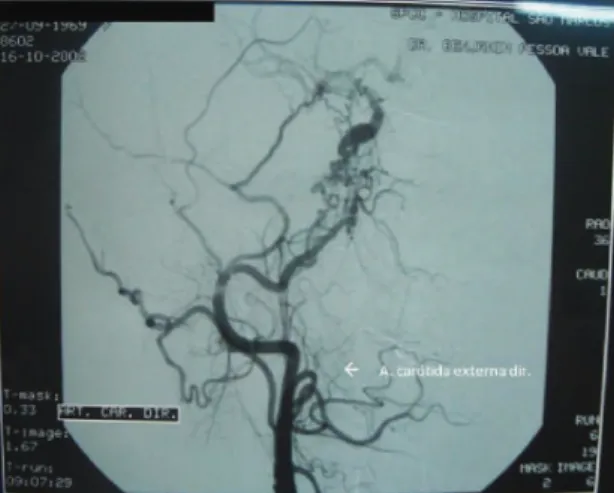
In view of this, the patient underwent angiography,
which showed an absence of opaciication of the internal carotid arteries, bilaterally from the origins,
in addition to an irregular saccular dilation at the top
of the basilar artery (Figures 1, 2 and 3). Endovascular
treatment was conducted using platinum coils and hydrocoil, achieving total occlusion of the aneurysm
(Figure 4).
The patient was admitted to the intensive care unit for postoperative recovery, where she remained for four days with no intercurrent conditions. She was discharged from hospital seven days after admission. Currently, two years after the procedure, she is in outpatients follow-up and exhibits discrete
Figure 1. Selective arteriography of the left carotid system, cervical portion, lateral view; the left internal carotid artery is not seen in contrast.
338 J Vasc Bras. 2014 Oct.-Dec.; 13(4):336-339 Bilateral internal carotid artery agenesis
hemiparesis on the left which does not limit her daily activities.
DISCUSSION
Agenesis of the ICA is a rare congenital anomaly, with a little over 100 cases reported since the irst was described by Tode, in 1787, after dissection of a cadaver.3,6 We were able to locate just 26 cases
of bilateral internal carotid artery agenesis in the literature.7
The ICA originates from the cranial portion of the dorsal aorta and the terminal segments of the primitive third aortic arch and is fully developed by around the sixth week.8 Agenesis or aplasia of the
internal carotid artery is therefore related to atresia
or involution of the third aortic arch and the distal portion of the dorsal aorta, while still in the initial
embryonic phase. In turn, the base of the skull begins to form after the ifth or sixth week of fetal life. Therefore, if the embryonic precursor of the ICA has not developed by the third to ifth week, the ICA and the carotid canal will never develop.3
No precise explanation has been found for development of internal carotid artery anomalies, but it is believed that all variants are the result of insults during embryo development. Keen e col. have suggested that mechanical injuries to developing embryos, such as excessive bending of the embryo
to one side and the effects of pressure or restriction
by amniotic bands, may be conducive to absence of the internal carotid artery.4
The natural history of patients with absent internal carotid artery is not entirely clear.9 It is known that the
majority of patients who have this anomaly remain asymptomatic because arterial supply is compensated by collateral circulation.10 It is also known that there
is a greater risk of cerebral aneurysm in the Circle of Willis among patients with internal carotid artery agenesis.9 As a result, initial clinical presentation
tends to be a cerebrovascular event such as a stroke or a subarachnoid hemorrhage after rupture of an aneurysm, as occurred in the case described here.10
It is estimated that the prevalence of intracranial aneurysms in the general population ranges from 2 to 4%. In contrast, among patients with congenital absence of the ICA, this range increases to 24 to 34%.4
Patients with bilateral internal carotid artery agenesis are at high risk of development of aneurysms, particularly in the posterior communicating and basilar arteries, as was seen in the case described here.9
The greater likelihood of intracranial aneurysm formation may be the result of abnormal hemodynamic forces, related to collateral compensation in arterial
vessels or to congenital defects of the integrity of the
internal carotid artery or other arteries.4
Conditions such as ICA agenesis which involve
a certain degree of hemodynamic impairment may comprise an additional trigger factor for development of signiicant comorbidities.10 Many different authors
stress the importance of conducting periodic imaging studies of the cerebral vessels of patients with ICA agenesis, with the objective of screening for development of intracranial aneurysms.9 Studies
have shown that early recognition of anomalies involving the carotid system can prevent potentially fatal complications.10
Figure 3. Selective arteriography of the left vertebrobasilar system, intracranial portion, anteroposterior view: aneurysm at top of basilar artery (preoperative image).
339 J Vasc Bras. 2014 Oct.-Dec.; 13(4):336-339 Giuliano da Paz Oliveira, Nara Lívia Rezende Soares et al.
Conventional angiography is more sensitive than angio-CT or angio-MRI for detection of cerebral aneurysms. Notwithstanding, angio-MRI is recommended for screening and monitoring of aneurysms in children because it is a noninvasive technique.9
Congenital ICA absence can be seen in association with other syndromes, particularly in the pediatric population. Associations that have been described previously include mastoid hypoplasia, Horner syndrome and congenital hypopituitarism.9
CONCLUSIONS
Internal carotid artery agenesis is a condition
that, although silent, can be associated with other potentially serious malformations and disorders. In general, patients with bilateral ICA agenesis are at high risk of development of intracranial aneurysms. Diagnosis of anomalies involving the carotid system should be the signal for rigorous follow-up focused on early identiication of potentially fatal changes, such as cerebral aneurysms.
REFERENCES
1. Suyama K, Mizota S, Minagawa T, Hayashi K, Miyazaki H, Nagata I. A ruptured anterior communicating artery aneurysm associated with internal carotid artery agenesis and a middle cerebral artery anomaly. J Clin Neurosci. 2009;16(4):585-6.http://dx.doi. org/10.1016/j.jocn.2008.06.001. PMid:19200736
2. Given CA 2nd, Huang-Hellinger F, Baker MD, Chepuri NB, Morris PP. Congenital absence of the internal carotid artery: case reports and review of the collateral circulation. AJNR Am J Neuroradiol. 2001;22(10):1953-9. PMid:11733331.
3. Orakdöğen M, Berkman Z, Erşahin M, Biber N, Somay H. Agenesis of the left internal carotid artery associated with anterior communicating artery aneurysm: case report. Turk Neurosurg. 2007;17(4):273-6. PMid:18050072.
4. Elazab NE, Riel-Romero RM, Gonzalez-Toledo E. Internal carotid artery agenesis and basilar artery aneurysm with third nerve palsy. Pediatr Neurol. 2010;42(6):451-4. PMid:20472202.
5. Neves WS, Kakudate MY, Cêntola CP, Garzon RG, Poça d’Água A, Sanches R. Agenesia da artéria carótida interna: relato de caso. Radiol Bras. 2008;41(1):63-6. http://dx.doi.org/10.1590/ S0100-39842008000100015.
6. Hunt WE, Hess RM. Surgical risk as related to time of intervention in the repair of intracranial aneurysms. J Neurosurg.
1968;28(1):14-20.http://dx.doi.org/10.3171/jns.1968.28.1.0014. PMid:5635959
7. Sunada I, Inoue T. Bilateral internal carotid artery agenesis. J Neurol Neurosurg Psychiatry. 1996;61(2):206-7.http://dx.doi. org/10.1136/jnnp.61.2.206. PMid:8708697
8. Naeini RM, De J, Satow T, Benndorf G. Unilateral agenesis of internal carotid artery with ophthalmic artery arising from posterior communicating artery. AJR Am J Roentgenol. 2005;184(2):571-3.http://dx.doi.org/10.2214/ajr.184.2.01840571. PMid:15671382
9. Steer AC, Rowe PW. Bilateral agenesis of the internal carotid artery: case report and approach to management. J Paediatr Child Health. 2008;44(9):511-3.http://dx.doi.org/10.1111/j.1440-1754.2008.01357.x. PMid:18928467
10. Given CA 2nd, Huang-Hellinger F, Baker MD, Chepuri NB, Morris PP. Congenital absence of the internal carotid artery: case reports and review of the collateral circulation. AJNR Am J Neuroradiol. 2001;22(10):1953-9. PMid:11733331.
Correspondence
Giuliano da Paz Oliveira Rua Doutor Diogo de Faria, 85/101 – Vila Clementino CEP 04037-000 – São Paulo (SP), Brazil Fone: +55 (11) 95234-5398 E-mail: [email protected]
Author information
GPO - MD from Universidade Federal do Piauí (UFPI). Resident physician (Neurology) at Universidade Federal de São Paulo (UNIFESP). NLRS - Medical student at Centro Universitário UNINOVAFAPI. GPO - Vascular and endovascular surgeon from the University Hospital of Universidade Federal do Piauí (UFPI). MSc in Sciences, Universidade Estadual de Campinas (UNICAMP). BPV - MD from Universidade Federal do Piauí (UFPI). Vascular and endovascular neurosurgeon, Instituto de Neurociências and Hospital São Marcos (HSM). Voluntary president of Associação Reabilitar and Coordinator of Projeto Pense Bem AVC, Teresina-PI (Sociedade Brasileira de Neurocirurgia). Member, Deliberative Council, Sociedade Brasileira de Neurocirurgia.
Author contributions
Conception and design: BPV Analysis and interpretation: GPO, NLRS Data collection: GPO, NLRS Writing the article: GPO, NLRS, GPO, BPV Critical revision of the article: GPO, GPO, BPV Final approval of the article*: GPO, NLRS, GPO, BPV Statistical analysis: N/A Overall responsibility: GPO, BPV Financial support: None.