Licenciado sob uma Licença Creative Commons DO): http://dx.doi.org. . / - . . .AO
[T]
Comparative study between manual therapy and TENS
Burst in patients with tension-type cephalalgia
[)]
Estudo comparativo entre a terapia manual e a TENS Burst
em pacientes portadores de cefaleias tensionais
[A]
Denise Vasconcelos Fernandes, Fhelício Sampaio Viana, Jefferson Paixão Cardoso*
Universidade Estadual do Sudoeste da Bahia UESB , Jequié, BA, Brazil
[R] Abstract
Introduction: Cephalgia or cephalalgia is one of the most common symptoms in the general population. Objective: To compare the efficacy of physical therapy modalities, through manual therapy and the effect of
Transcutaneous Nerve Stimulation TENS for tension-type cephalalgia. Materials and methods: The study
was compounded by subjects, but only of them completed it, due to the exclusion criteria. These were divided into control group and intervention group. The control group received treatment — manual therapy. The intervention group received TENS Burst. Patients underwent ten sessions of treatment, made at every two days on a week, lasting minutes each session. Results: The characteristics related to lifestyle,
pos-tural issues and range of motion are responsible for the main causes of tension-type cephalalgia. Discussion:
treatments showed effective results in all cases in relation to pain intensity, but the use of manual therapy
328
techniques give the patient a better quality of life compared to the use of TENS. Final considerations: The
treatment of this condition deserves analysis and studies; however, there are only a few studying physical therapy techniques, especially regarding to the use of TENS.
[P]
Keywords: Tension-type cephalalgia. Physical therapy modalities. Transcutaneous electric nerve stimulation.
[B] Resumo
Introdução: Cefaleia ou dor de cabeça é um dos sintomas mais comuns na população em geral. Objetivo: Comparar a eficácia de modalidades de fisioterapia — terapia manual e estimulação nervosa transcutânea (TENS) — para cefaleia do tipo tensional. Materiais e métodos: O estudo foi composto inicialmente por 60 indi-víduos, mas apenas 40 completaram-no em virtude dos critérios de exclusão. Estes foram divididos em grupo con-trole e grupo de intervenção. O grupo concon-trole recebeu terapia manual e o grupo de intervenção recebeu TENS. Os pacientes foram submetidos a 10 sessões de tratamento, sendo estas feitas dois dias por semana, com duração de 30 minutos cada. Resultados: As características relacionadas ao estilo de vida, problemas posturais e amplitude de movimento são responsáveis pelas principais causas de dor de cabeça de tensão. Discussão: Os tratamentos foram eficazes em todos os casos em relação à intensidade de dor, mas a utilização de técnicas de terapia manual deu aos pacientes uma melhor qualidade de vida, em comparação com a utilização de TENS. Considerações finais: O tratamento dessa condição merece análise e estudos, no entanto, há poucos estudos científicos que estu-dam técnicas de fisioterapia, especialmente com relação ao uso da TENS. [K]
Palavras-chave: Cefaleia do tipo tensional. Modalidades de fisioterapia. Estimulação elétrica nervosa transcutânea.
Introduction
Cephalalgia is the term used to designate all sorts of pains located on the head. )t is one of the most common causes of pain on adults and one of the most disabling ones in Brazil , , .
The cephalalgias may be primaries or secondar-ies, according to the aetiology . The tension-type one, which is a primary kind, inheres in the most common variant of all kinds of cephalalgia, affecting a substantial part of the general population . This kind of cephalalgia is known as tension, due to the muscular contraction .
)t is classically featured as pain on constrictive character, usually bilateral, with mild to moderate, not aggravated by daily routine physical activities and during between thirty minutes and seven days. )t may be ranked in episodic, when occurring on
less than days per year and days per month.
Alternatively, it also may be chronical, when its
fre-quency equals or overcomes these rates days a
month , for at least three months , , .
The unenviable accumulation of certain metabolic, concomitant with one’s life style and emotional state of mind brings on symptoms resulting to tension-type cephalalgias. Therefore, the praxis of manual therapy due to its effects on one’s structure also supports on the cephalalgia’s alleviation, diminishing such symp-tomatology .
Likewise, the Transcutaneous Electric Stimulation TENS has been mentioned on the literature as a pain control alternative. )t is a non-pharmacological therapy, non-invasive, accessible, easily manipulat-ing, and with a very few recommendations against usage. )ts procedures work through endogenous
opi-ates liberations , .
TENS on Burst modulation provides a group of several stimulus, felt by the patient as an only one. This sort of TENS is characterised by having high wave bringer, modulated by low frequency pulsing to (z and duration varying between
to μs. Low frequencies are recommended
in chronical conditions, bestowing on pain relief
Physiotherapeutic intervention through manual therapy and TENS Burst may offer tension-type cephalalgia relief benefits. Ergo, scientific studies on physiotherapy field of such treatment will per-mit further enlightenments and provide better as-sistance to these carrier conditions.
This study aimed to compare the physioterapeu-tical treatments through manual therapy on tension-type cephalalgias with TENS Burst effect.
Materials and methods
On Southwest State University of Bahia Physiotherapy Teaching Clinic [Clínica Escola de Fisioterapia da Universidade Estadual do Sudoeste da Bahia], located on Jequié BA , an interventionist and quantitative analytical approach study was ac-complished. The data were collected between October and December.
On the specimen group were included people with voluntary interest. Such ones went through a triage, made by a physioterapeutical evaluative application, requesting socio demographic char-acteristics, subject’s lifestyle, posture and clinical movement variable amplitude, and pain related clinical variable. Those figures were analysed based on Cephalalgia )nternational Society same criteria, being admitted subjects with chronical characteris-tics’ tension-type cephalalgia. The study exclusion principles were subjects with other sorts of cepha-lalgia, and those who not attended it for until three times in a role.
After the subjects’ identification and selection, they were allocated through simple randomly process in control group and intervention group. The control group subjects received treatment through manual therapy techniques’. As for the intervention group, the used treatment was transcutaneous electric stimula-tion on Burst modulastimula-tion – TENS Burst. The subjects were subordinated to ten sections of treatment, at each two days of the week, during about minutes each. At the end of the treatment, a new evaluation was performed, using the same admissional evalua-tive application.
The physioterapeutical treatment protocol for manual therapy was grounded on literature pur-poses, and used on the control group with: myofas-cial cervical manoeuvre and cranial applied manual
manoeuvre, global pompage, sciatic and mediano sinew’s mobilization, cervical spine stabilization strengthening through co-contraction exercises and Kabat, cervical segment articular mobilization, and stretching techniques. As for the transcutaneous elec-tric stimulation – TENS – protocol, to the interven-tion group, it was made accordingly to the literature guidelines that seek analgesia, being: TENS on Burst
modulation, microseconds pulse and (z
wrap-per frequency.
)t was realised the study’s population charac-terization on the control and intervention groups, and made the descriptive statistics using absolute and relative frequency to categorical variables and central tendency measurements amplitude, aver-age and standard-diversion to continuum variables. The association between the intragroup variations was measured using the Pearson and Wilcoxon Qui-square test. To the evaluation between groups was conditioned by the Mann-Whitney test. )t was used % of as significative statistics measurement on all tests. EpiData, version . and SPSS, version were used.
The present research was approved by the Southwest State University of Bahia Research and
Ethic Committee, accordingly to / Resolution,
opinion No. / .
Results
Forty subjects concluded the study, twenty vol-unteers excluded for presenting another sorts of cephalalgias or due to missing three consecutive intervention days. Therefore, the control and inter-vention groups were composed by twenty patients
each, being . % n = were females and . %
n = were male.
On Table presents socio demographic charac-teristics. )t was observed that the age of the subjects
drifted between and . ± . . )n
330
Table 1
-
Subjects’ sociodemographic characteristics treated with TENS and manual therapyVariables n %
Gender
Female 35 87.5
Male 5 12.5
Marital Status
Single 25 62.5
Married 14 35.0
Divorced 1 2.5
Schooling
Elementary School 4 10.0
High School 10 25.0
Tertiary Education 26 65.0
Familial Arrangements
Live by oneself 4 10.0
Live with a spouse 7 17.5
Live with spouse and children and/or
grandchildren 6 15.0
Other arrangements 23 57.5
Offspring
Yes 11 27.5
No 29 72.5
Dominance
Right 38 95.0
Left 2 5.0
Previous Treatment
No 23 57.5
Yes 17 42.5
As for lifestyle Table , it could be verified that . % of the subjects affirmed to have inadequate nourishment; . % of them denied elitism; none of them claimed to be a smoker. The usage of inad-equate mattress corresponded to . % of subjects
who also asserted to use low pillows . % and
high . % . Most of the subjects . % did not
practice any sort of physical activity.
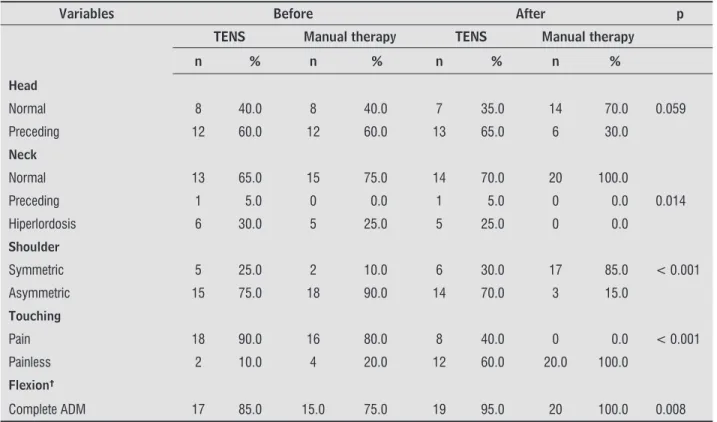
The comparison between TENS and manual therapy was observed from movement and posture variable clinical amplitude on Table . Concerning to the positioning of the head, it was noticed that
twelve subjects . % presented preceding before
TENS treatment, and . % after treatment. To the manual therapy, . % before the treatment as well had preceding, and after the therapy, there were
. % p = . decreasing. )t was perceived that
. % n = of the subjects presented neck
normal positioning before TENS treatment and
. % n = after it. To the manual therapy group,
before the treatment . % n = presented
nor-mal positioning and after therapy the nornor-mally of the
positioning increased . % p = . .
Examining the subject’ shoulder symmetry treat-ed on TENS group, . % n = were symmetric before the treatment and, after that, the number in-conspicuously increased . %. On manual therapy
group, the lesser part of the subjects . %
pre-sented symmetric shoulders, and after the therapy,
this index significantly increased to . % p < . .
The touching of the vertebral and cervical segments, and the scapular and cervical waistline musculature,
. % n = of the TENS group subject’s referred
Table 2 - Characteristics of subject’s treated with TENS and manual therapy lifestyle
Variables n %
Nourishment Habits
Adequate 30 75.0
Inadequate 10 25.0
Elitism
No 28 70.0
Yes 12 30.0
Smoking
Yes 0 0.0
No 40 100.0
Mattress
Adequate 23 57.5
Inadequate 17 42.5
Pillow
Low 11 27.5
High 6 15.0
Medium 20 50.0
Do not use 3 7.5
Physical Activity Practicing
Yes 13 32.5
to pain before the treatment and after it there was . % decreasing. On Manual Therapy group, most
of subjects . % referred to touching pain before
treatment and after that, none of them alluded painful
sensation p < . .
As for the amplitude of movement ADM on TENS group flexion before the therapy, it was verified
incom-plete amplitude on three subjects . % , and after
treatment, only one subject . % remained with incomplete ADM. On Manual Therapy group before the therapy was validated incomplete amplitude on
only five subjects . % , and after treatment, no one
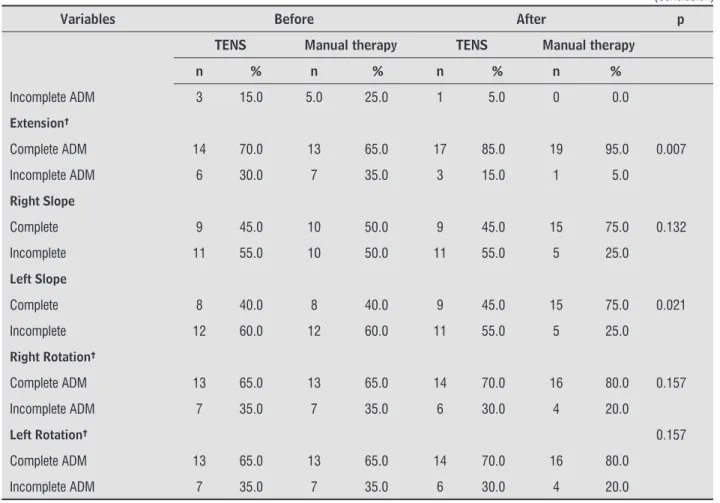
remained with the condition p = . . To ADM in
extension, on TENS group before therapy was verified incomplete amplitude on . % n = of the subjects, and after treatment, only . % n = remained with incomplete ADM. On manual therapy group before therapy was verified incomplete amplitude on . % n = subjects, and after treatment, only one subject
. % remained with incomplete ADM p = . .
For right slope on ADM, on TENS group before therapy was validated incomplete amplitude on over half of the subjects . % and there was no changes after treatment. On manual therapy group was
no-ticed incomplete amplitude on . % n = of
the subjects before treatment, and after it, there was
. % n = p = . decreasing. To left slope, on
TENS group before therapy was verified incomplete
amplitude on twelve . % of the subjects, and
after treatment there was slightly reduction of this
percentage . % . For the same ADM on manual
therapy group, before treatment, it could be observed
incomplete amplitude on twelve patients . % ,
and after treatment only . % n = remained with incomplete ADM p = .
Concerning to right rotation on ADM, on TENS group before therapy was verified incomplete am-plitude on . % n = of the subjects, and after treatment there was . % feeble decreasing. On manual therapy before treatment was noticed incom-plete amplitude on right rotation on seven subjects
. % , and after that, four . % remained with
incomplete ADM p = . . For left rotation on ADM,
on TENS group before therapy was observed incom-plete amplitude on . % n = of the subjects, and after treatment there was paltry decrease to . %. On manual therapy group before therapy was veri-fied incomplete amplitude on left rotation on . %
n = of the subjects, and after treatment . %
n = remained with incomplete ADM p = . .
Table 3 - Comparison between TENS and manual therapy accordingly posture and clinical movement variable amplitude
Variables Before After p
TENS Manual therapy TENS Manual therapy
n % n % n % n % Head
Normal 8 40.0 8 40.0 7 35.0 14 70.0 0.059
Preceding 12 60.0 12 60.0 13 65.0 6 30.0
Neck
Normal 13 65.0 15 75.0 14 70.0 20 100.0
Preceding 1 5.0 0 0.0 1 5.0 0 0.0 0.014
Hiperlordosis 6 30.0 5 25.0 5 25.0 0 0.0
Shoulder
Symmetric 5 25.0 2 10.0 6 30.0 17 85.0 < 0.001
Asymmetric 15 75.0 18 90.0 14 70.0 3 15.0
Touching
Pain 18 90.0 16 80.0 8 40.0 0 0.0 < 0.001
Painless 2 10.0 4 20.0 12 60.0 20.0 100.0
Flexion†
Complete ADM 17 85.0 15.0 75.0 19 95.0 20 100.0 0.008
332
Variables Before After p
TENS Manual therapy TENS Manual therapy
n % n % n % n %
Incomplete ADM 3 15.0 5.0 25.0 1 5.0 0 0.0
Extension†
Complete ADM 14 70.0 13 65.0 17 85.0 19 95.0 0.007
Incomplete ADM 6 30.0 7 35.0 3 15.0 1 5.0
Right Slope
Complete 9 45.0 10 50.0 9 45.0 15 75.0 0.132
Incomplete 11 55.0 10 50.0 11 55.0 5 25.0
Left Slope
Complete 8 40.0 8 40.0 9 45.0 15 75.0 0.021
Incomplete 12 60.0 12 60.0 11 55.0 5 25.0
Right Rotation†
Complete ADM 13 65.0 13 65.0 14 70.0 16 80.0 0.157
Incomplete ADM 7 35.0 7 35.0 6 30.0 4 20.0
Left Rotation† 0.157
Complete ADM 13 65.0 13 65.0 14 70.0 16 80.0
Incomplete ADM 7 35.0 7 35.0 6 30.0 4 20.0
Note: p = statistical significance value p < . ; †ADM = amplitude of movement.
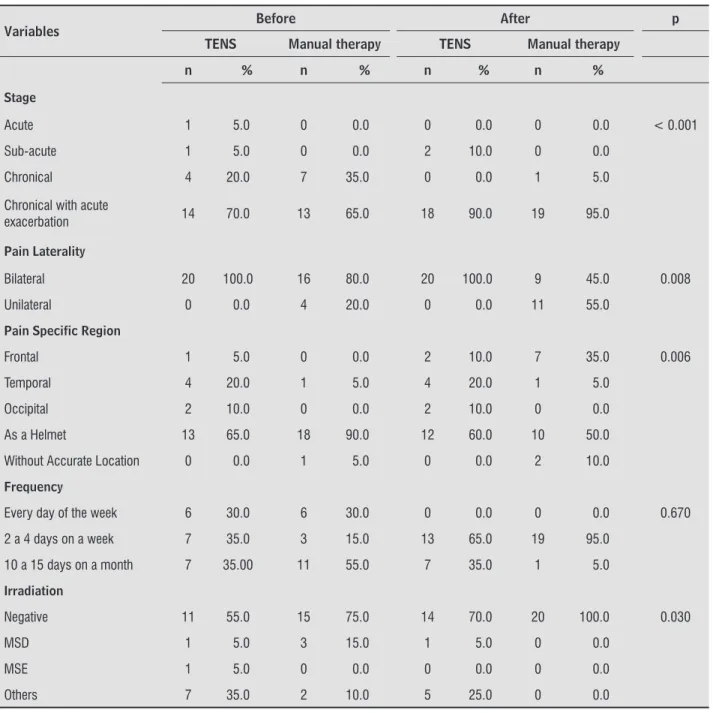
on TENS group, thirteen subjects . % presented
pain as helmet before treatment, and after it twelve
subjects . % claimed when they felt pain, it was
still as helmet. On the other hand, before treatment, on
manual therapy, most of the subjects . % related
pain as helmet, and after so, when there was such pain,
it decreased to . % p = . .
Considering how often pain occur, . % n = and . % n = related it happened from to
days on a month, every day of the week, respec-tively, on TENS group before treatment, and after
it, . % n = of the subjects presented varying
between and days on a week. No one else
re-lated feeling pain every day of the week p > . .
Before treatment on manual therapy group, . %
n = and . % n = related pain between
to days on a month and every day of the week, respectively. After treatment, most of the subjects . % mentioned pain, varying between and Table presents the comparison results
be-tween TENS and manual therapy for pain related clinical variable. )t points out that the pain stage on TENS group’ subjects before treatment prevailed on chronical and chronical with high exacerbation
category, with . % n = and . % n =
re-spectively, and, afterwards, . % n = it fit only
in the chronical with high exacerbation category. The manual therapy subjects that fit on chronical
stage before treatment were seven . % and on
chronical with high exacerbation category, thirteen
. % , after that, most of the subjects . % fit
on it p < . .
As for the TENS group pain location, before
treat-ment, all subjects . % detailed that cephalalgia
was presented bilaterally, and after therapy, such index remained. On manual therapy group . % n = reported bilateral pain before treatment, being the
in-dex decreased . % p = . thereafter. Moreover,
Table 3 - Comparison between TENS and manual therapy accordingly posture and clinical movement variable amplitude
days on a week p = . . On manual therapy
group, before treatment, . % n = and . %
n = informed of pain from to days on the month and every day of the week, respectively.
After treatment, the most of the subjects . %
stated pain, varying between and days on a
week p = . .
The complaining about pain irradiation or paraes-thesia on TENS group was not present on . % of the
subjects, and such index increased . % n = after
therapy. On manual therapy . % n = denied
pain irradiation or paraesthesia before treatment, and none of the subjects reported such complains
anymore afterwards p = . .
Table 4 - Comparison between TENS and Manual Therapy accordingly pain related clinical variables
Variables Before After p TENS Manual therapy TENS Manual therapy
n % n % n % n %
Stage
Acute 1 5.0 0 0.0 0 0.0 0 0.0 < 0.001
Sub-acute 1 5.0 0 0.0 2 10.0 0 0.0
Chronical 4 20.0 7 35.0 0 0.0 1 5.0
Chronical with acute
exacerbation 14 70.0 13 65.0 18 90.0 19 95.0
Pain Laterality
Bilateral 20 100.0 16 80.0 20 100.0 9 45.0 0.008
Unilateral 0 0.0 4 20.0 0 0.0 11 55.0
Pain Specific Region
Frontal 1 5.0 0 0.0 2 10.0 7 35.0 0.006
Temporal 4 20.0 1 5.0 4 20.0 1 5.0
Occipital 2 10.0 0 0.0 2 10.0 0 0.0
As a Helmet 13 65.0 18 90.0 12 60.0 10 50.0
Without Accurate Location 0 0.0 1 5.0 0 0.0 2 10.0
Frequency
Every day of the week 6 30.0 6 30.0 0 0.0 0 0.0 0.670
2 a 4 days on a week 7 35.0 3 15.0 13 65.0 19 95.0
10 a 15 days on a month 7 35.00 11 55.0 7 35.0 1 5.0
Irradiation
Negative 11 55.0 15 75.0 14 70.0 20 100.0 0.030
MSD 1 5.0 3 15.0 1 5.0 0 0.0
MSE 1 5.0 0 0.0 0 0.0 0 0.0
Others 7 35.0 2 10.0 5 25.0 0 0.0
334
cervical muscles major struggle, particularly from
sternocleidomastoid and trapezoid ones . Such
characteristic was found on tension-type cephalalgia subjects that partook the study.
The increasing of pericranial painful sensation detected by manual touching is the most significative deviant finding on subjects with tension-type cepha-lalgia. The painful sensation increases according to cephalalgia’s intensity and frequency, and enhances even more during crisis. The pericranial pain is easily researched through manual touching during clinical examination, and presents as a useful guide to
diag-nosis and treatment strategy .
Cephalalgia laterality is an important aspect to its diagnosis either. )t has been revealed bilateral on over . % of the cases, and the posterior regions of the head and neck are the most embroiled ones .
Varjão at al. chronicles that bilaterality is
pres-ent on . % of the cases. On this study, . % and
. % of the subjects allocated on TENS group and on Manual Therapy group, respectively, presented the same correlation as literature.
As for lifestyle, authors have stated that it cannot be noticed any relation between physical activity practicing and scenery improvement, although it is known that aerobic exercises increase endogenous endorphin’s levels, ameliorate tissue oxygenation and vascularization, easing algogenic substances
removal , .
Representative United States of America EUA and United Kingdom population specimen have demonstrated that only half of the cephalalgia’s di-agnosed people had been attended by a physician. Notwithstanding, over . % of tension-type cepha-lalgia’s carriers on Denmark had never been attended
by a cephalalgia’s physician .
Low medical appointments rate on developed countries can indicate that many cephalalgia’s car-riers are not aware of effective treatment existence. )t is unlikable there is a better situation where the
resources are proportionally limited . This could
be testified on our study, as the majority of the
sub-jects . % asserted never had done or sought any
kind of previous treatment.
Regarding the sorts of treatments, it was observed that there are several sets of techniques, specific lit-erature repots, such as electrotherapy, acupuncture, cervical traction, kinesis therapy and treatments constituted by stretching, muscular relaxation and vertebral mobilization .
Discussion
Tension-type cephalalgias are considered those which most prevalence on human beings. )ts annual
currency is between . % and . % , .
Our study demonstrated cephalalgia high inci-dence on females, corroborating with stablished lit-erature that points out women fell more recurrent pain than men, including cephalalgias. Such occur-rence might be related to oestrogen hormones and progesterone, which increases stress response,
be-sides other elements not here enlisted .
Stress can lead to muscular contracting and
functional alterations . This muscular
altera-tion and, consequently, muscular sensitivity is sig-nificantly heightened as much as on those days the subjects experience cephalalgia, as on those days it
does not . Likewise, such deed was present in
these subjects.
Concerning to schooling, it could be perceived that as higher the level, more overloaded the sub-jects were. Nevertheless, it must be considered that high-educated subjects have more appliances of un-derstanding the disease process, as well as to the importance of some adjustments on lifestyle that
might aid on facing tension-type cephalalgia .
The constant changing on activity, thereby bodily orientation, also can steer to overload and painful spots and squeezed sensations appearances. )n ad-dition, this study substantiate that the inadequate usage of mattresses and pillows, and bodily domi-nation overburden one side of the body, interfered on corporal mechanics, posture and movement, pre-disposing the subjects to several tension or trigger points major appearances.
Studies have been vouched the tension-type cephalalgias occurring to the trigger points found on sub occipitals muscles, superior trapezoid, tem-poral and sternocleidomastoid, besides influencing
shoulder musculature and paravertebral . These
assumptions assert that the referred pain caused by those muscles bestow to tension-type cephalalgia’s characteristics. This is the only brand that indicates scientific evidences on sustaining some possible
etio-logical function to muscular trigger points .
with touching, postural aspects, and amplitude of movement significative changes on the subjects treated on this group.
On the group treated with TENS on Burst modula-tion, our study verified over . % decreasing on pain complaints to muscular and vertebral touching, cor-roborating this resource efficacy. Notwithstanding, the obtained data on Manual Therapy group indicated this technique was best used on these complaints
solving, as . % of the subjects did not refer to
any pain after treatment.
A study made by Jay et al. analyses
physio-therapy treated groups’ responses, including TENS, only TENS and a group treated without physiotherapy nor TENS. The author pointed out that the cepha-lalgia intensity decreases hastily and significantly if used treatment alongside with physiotherapy. (e concludes by saying the most effective treatment is the one which interlocks physiotherapy and TENS on treating tension-type cephalalgia.
On this study we supported the two resources used separately manual therapy and TENS on Burst modulation have beneficial effects on tension-type cephalalgia carrier subjects. Nonetheless, manual therapy proved more effective results on them, as it clashes on the causes, mechanics mostly, of pain, and not only on painful sensation feeling, as happens on electric stimulation with TENS.
Final Considerations
With this work, it could be noticed that the prac-ticing of physiotherapy, particularly on this research, about TENS and manual therapy usage as alternative on tension-type cephalalgia treatment, conveys great benefits to the subjects. Although the treatments had been presented effective on concerning to the intensi-ty of the pain, the using of manual therapy techniques award the subject major life quality, comparing to TENS Burst’s.
This condition treatment deserves analysis and studying. Nevertheless, a few scientific works mind pondering on physiotherapeutic techniques, espe-cially on concerning about TENS ones’. Besides, there would be of great value studies that expose and verify the treatment effectiveness, after it is finished, on short, medium and long terms.
Long terms conducted trials are necessary to pro-vide major epro-vidences about tension-type cephalalgia The usage of physical means, as transcutaneous
electric stimulation, acupuncture or refrigerant steam local application on trigger points are also mentioned as solution to painful situation, throughout muscular
distention and trigger points inactivity .
Transcutaneous electric stimulation TENS is described as specific electrotherapeutic technique on pain control. )t works on muscular spasm reduc-tion and on muscular throe inhibireduc-tion, offering lasting benefits, besides being used as prophylaxis, divest-ing one from cephalalgias and medicine excessive
use .
On a study developed by Bezerra and Lucena ,
the usage of transcutaneous electric neural stimu-lation TENS on Burst modustimu-lation was used as co-operator on tension-type cephalalgia treatment. As studying TENS effect on tension-type cephalal-gia, the authors substantiated that all subjects were granted by TENS using, as well as on the present study. Nevertheless, on our study, as we analysed the variations that indicated amplitude of movement and postural aspects. The subjects treated with TENS, did not present significative changes on these features after treatment, mainly because in this study were not accomplished co-interventions, such as: medi-cations, therapies or behaving, postural orientation and self-stretching teaching lessons, if not the aim of this study, as our main goal was overridingly assess the therapeutic resources on pain relation efficacy.
Cephalalgias’ treatment by manual methods have recently receives major attention on literature and
clinical praxis . Mobility exercises may be applied,
seeking amplitude of movement ADM improve-ments or to segmental mobility restrictions, specific muscular stretching, and soft tissues manipulations, particularly to superior cervical extensors. As a result, it settles myofascial restrictions and trigger points that may be contributing to cephalalgia, further con-sidering neural system mobilization movements and interfacing structures.
On Morelli and Rebelatto study, the subjects
336
. Pena R, Barbosa LA, )shikawa NM. Estimulação elétri-ca transcutanea do nervo TENS na dor oncológi-ca: uma revisão de literatura. Rev Bras Cancerol.
; : - .
. Radhakrishnan R, Sluka KA. Deep tissue afferents, but not cutaneous afferents, mediate transcutaneous electrical nerve stimulation-induced antihyperalge-sia. J Pain. ; : - .
. Starkey C. Recursos terapêuticos em fisioterapia. São Paulo: Manole; .
. John OB. Estimulação elétrica nervosa transcutânea para o controle da dor. )n: Nelson RM, (ayes KW, Cur-rier DP. Eletroterapia clínica. São Paulo: Manole; . p. - .
. Kahn J. Princípios e prática de eletroterapia. . ed. São Paulo: Livraria Santos; .
. Schwartz BS, Stewart WF, Simon D, Lipton RB. Epidemiology of tension-type headache. JAMA.
; : - .
. Bigal ME, Bordini CA, Speciali JG. Tratamento da cefaleia em uma unidade de emergência da cidade de Ribeirão Preto. Arq. Neuro-Psiquiatr. ; B : - . . Bernardi MT, Bussadori SK, Fernandes KPS, Gonzalez
DAB. Correlação entre estresse e cefaléia tensional. Fisioter Mov. ; : - .
. Carvalho DS. Síndrome da cefaleia cervicogênica. Rev Neurociências. ; : - .
. Ashina M, Bendtsen L, Jensen R, Sakai F, Olesen J. Mea-surement of muscle hardness: a methodological study. Cephalalgia. ; :
-. Giona P-. Abordagem fisioterapêutica nas cefaléias tensionais através da terapia manual: Cascavel: Unio-este; .
. Fernandez-de-las-Peñas C, Cuadrado ML, Arendt-Niel-sen L, Simons DG, Pareja JA. Myofascial trigger points and sensibilization: an update pain model for tension type headache. Cephalalgia. ; : - . . Baracat PJF. Prevalência dos trigger points suturais
nas cefaléias tipo tensional. Perspectivas. [cited , May ]; . Available from: http:// www.seer.perspectivasonline.com.br/index.php/ revista_antiga/article/view/ /
physiotherapeutic treatment. The achievement of a pilot study to select characteristics that presents the specimen as much homogeneous as possible would be necessary, but it was not possible to do so in this study, as the initial purpose was to compare two treatments on general population and consolidate the external validity of it.
A clinical trial might have a lesser dimension and duration if include characters with major tendency to present major therapeutic benefits. This would vindicate the specimen choice used methods on the present study, taking into consideration the main factors, chronicled by literature, that steer people to develop tension-type cephalalgia, using an evaluation
form to admitting researching subjects .
References
. Teixeira MJ, Pimenta CAM. Avaliação do doente com dor. )n: Teixeira MJ, Figueró JAB. Dor: epidemiologia, fisiopatologia, avaliação, síndromes dolorosas e trata-mento. São Paulo: Moreira Junior; . p. - . . Vincent M, Rodrigues AJ, Oliveira GV, Souza KF, Doi LM,
Rocha MBL, et al. Prevalência e custos indiretos das ce-faleias de uma empresa brasileira. Arq Neuropsiquiatr.
; :
-. Petersen CS, Nunes MLT-. Cefaleia tensional crônica e psicopatologia. Psic. ; : - .
. Gherpelli JLD. Tratamento das cefaleias. J Pediatr. ; Supl. :S - .
. Morelli JGS, Rebelatto JR. A eficácia da terapia manual em indivíduos cefaleicos portadores e não portadores de degeneração cervical: análise de seis casos. Rev Bras Fisioter. ; : - .
. Matta APC, Moreira Filho PF. Sintomas depressi-vos e ansiedade em pacientes com cefaleia do tipo tensional crônica e episódica. Arq Neuro-Psiquiatr.
; : - .
. Matta APC, Moreira Filho PF. Cefaleia do tipo ten-sional: análise clínica de pacientes. Arq Neuro-Psiquiatr. ; : - .
. Bezerra JCM, Lucena ACT. A utilização da neuroes-timulação elétrica transcutânea TENS como coadju-vante no tratamento da cefaléia tensional. )n: Giona P. Abordagem fisioterapêutica nas cefaleias tensionais através da terapia manual: Cascavel: Unioeste; . . (ertling D, Kessler RM. Tratamento de distúrbios
musculoesqueléticos comuns: princípios e métodos de fisioterapia. . ed. São Paulo: Manole; . . Jay GW, Brunson J, Branson SJ. The effectiveness of
physical therapy in the treatment of chronic daily headaches. (eadache. ; : - .
. (ulley SB, Cummings SR., Brower WS, Grady DG, Newman TB. Delineando a pesquisa clínica: uma abordagem epidemiológica. . ed. Porto Alegre: Artmed; .
Received: / /
Recebido: / /
Approved: / /
Aprovado: / /
. Subcomitê de Classificação das Cefaléias da Sociedade )nternacional de Cefaléia. Classificação )nternacional das Cefaleias. Trad. Sociedade Brasileira de Cefaleia.
. ed. rev. ampl. São Paulo: Alaúde Editorial; . . Varjão FM, Jorge J(, Nepelenbroek K(, de
Alen-car Júnior FGP. Cefaleia, tipo tensional. Saud Pesq. ; : - .
. World (ealth Organization. Atlas of headache disor-ders and resources in the world: . Geneva: World (ealth Organization; .
. Teixeira MJ, Yeng LT, Altieri CE, Saito M. Cefaleia de origem cervical. Rev Med São Paulo . ; ed. esp. pt. : - .