Occurrence and removal of estrogens in Brazilian wastewater
treatment plants
Germana P. Pessoa
a, Neyliane C. de Souza
b, Carla B. Vidal
a, Joana A.C. Alves
a, Paulo Igor M. Firmino
a,
Ronaldo F. Nascimento
c, André B. dos Santos
a,⁎
aDepartment of Hydraulic and Environmental Engineering, Federal University of Ceará, Rua do Contorno, S/N Campus do Pici, Bl. 713, CEP: 60455-900, Fortaleza, CE, Brazil
bDepartment Sanitary and Environmental Engineering, State University of Paraíba, Rua Juvêncio Arruda, S/N, Campus Universitário, Bodocongó, CEP: 58109-790, Campina Grande, PB, Brazil cDepartment of Analytical Chemistry and Physical Chemistry, Federal University of Ceará, Rua do Contorno, S/N Campus do Pici, Bl. 940, CEP: 60451-970, Fortaleza, CE, Brazil
H I G H L I G H T S
•The occurrence of four endocrine disrupting chemicals was evaluated.
•The removal efficiency of four hormones in low-cost plants was examined.
•Estrogen occurrence showed a wide variation in influent and effluent samples.
•Estrone showed the highest occurrence in the influent and the effluent samples.
•WSP treatment was observed to be less effective for removing estrogens.
a b s t r a c t
a r t i c l e
i n f o
Article history:
Received 11 February 2014 Received in revised form 2 May 2014 Accepted 2 May 2014
Available online xxxx Editor: D. Barcelo
Keywords:
Endocrine disrupting chemical Hormone
Occurrence Removal
Wastewater treatment plant
This paper evaluated the occurrence and removal efficiency of four estrogenic hormones infive biological wastewater treatment plants (WWTPs), located in the State of Ceará, Brazil. Thefive WWTPs comprised: two sys-tems consisted of one facultative pond followed by two maturation ponds, one facultative pond, one activated sludge (AS) system followed by a chlorination step, and one upflow anaerobic sludge blanket (UASB) reactor followed by a chlorination step. Estrogen occurrence showed a wide variation among the analyzed influent and effluent samples. Estrone (E1) showed the highest occurrence in the influent (76%), whereas both 17β -estradiol (E2) and 17α-ethynylestradiol (EE2) presented a 52% occurrence, and the compound 17β-estradiol 17-acetate (E2-17A), a 32% one. The occurrence in the effluent samples was 48% for E1, 28% for E2, 12% for E2-17A, and 40% for EE2. The highest concentrations of E1 and EE2 hormones in the influent were 3050 and 3180 ng L−1, respectively, whereas E2 and E2-17A had maximum concentrations of 776 and 2300 ng L−1, respectively. The lowest efficiencies for the removal of estrogenic hormones were found in WWTP consisted of waste stabilization ponds, ranging from 54 to 79.9%. The high-rate systems (AS and UASB), which have chlorination as post-treatment, presented removal efficiencies of approximately 95%.
© 2014 Elsevier B.V. All rights reserved.
1. Introduction
Endocrine disrupting chemicals (EDCs) are a heterogeneous group of substances characterized by their potential to interfere with
endo-crine system functions in wildlife and humans (Sanfilippo et al., 2010).
The presence of these contaminants in aquatic environment and their potential effects on living organisms have become a growing concern
in recent years, which requires identification, analysis and
characteriza-tion of risks in different environmental matrices (Dolar et al., 2012).
Estrogenic hormones excreted by humans are emerging contami-nants which can reach the aquatic environment via wastewaters
release. The presence of such micropollutants in surface waters poses various questions concerning their degradation and their potential
adverse effects on the sexual and reproductive systems in wildlife,fish
and humans (Chang et al., 2011; Gabet-Giraud et al., 2010; Jobling
et al., 1998; Purdom et al., 1994).
The occurrence of estrogens in wastewaters and surface waters has
been investigated in numerous studies (Chang et al., 2011; Coleman
et al., 2010; Gabet-Giraud et al., 2010; Lundstrom et al., 2010; Radjenovic et al., 2009), in which both natural (estrone and 17β
-estradiol) and synthetic (17α-ethynylestradiol) varieties were
identi-fied as the main compounds responsible for estrogenic activities in
wastewater treatment plants (WWTPs). Many studies have also report-ed that the elimination of some EDCs in WWTP can be ineffective (Carballa et al., 2004; Dolar et al., 2012; Moon et al., 2008), as a result,
–
⁎ Corresponding author. Tel.: +55 85 33669490.
E-mail address:[email protected](A.B. dos Santos).
http://dx.doi.org/10.1016/j.scitotenv.2014.05.008
0048-9697/© 2014 Elsevier B.V. All rights reserved.
Contents lists available atScienceDirect
Science of the Total Environment
they are found in surface water, groundwater, and even drinking water (Al-Odaini et al., 2010; Rahman et al., 2009). Therefore, it is important to
develop reliable wastewater treatment technologies which can effi
cient-ly remove these emerging contaminants at trace level concentrations. Estrogen removal in WWTPs is a very complex procedure since it de-pends on numerous design aspects (sludge age, hydraulic retention time (HRT), organic loading rate (OLR), etc.), environmental conditions (sun-light, temperature, pH, toxic compounds, etc.), type of sludge and
opera-tional conditions (Clara et al., 2005). There are several studies worldwide
which have assessed the behavior of micropollutants in WWTPs. Howev-er, most of them refer to activated sludge systems, which are most
com-monly used in development countries (Andersen et al., 2003; Baronti
et al., 2000; Carballa et al., 2004; Fernandez-Fontaina et al., 2012; Joss et al., 2006; Kanda and Churchley, 2008). In contrast, there are only a few published reports on the concentrations or removal of EDCs in
Brazilian WWTPs (Brandt et al., 2013; Froehner et al., 2010; Queiroz
et al., 2012; Ternes et al., 1999b), especially those which uses waste sta-bilization ponds (WSP) technology.
In the state of Ceará, biological processes are widely used, being 62% of these wastewater treatment systems consisted of stabilization ponds (Brandão, 2000). Because of the great applicability, low capital and op-erational costs of WSP in hot-climate developing countries, such as
Brazil, it is important to evaluate the micropollutants removal efficiency
of these systems (Coleman et al., 2010) and compare them with the
tems commonly used in other countries, such as activated sludge
sys-tems and anaerobic reactors (Carballa et al., 2007; Czajka and Londry,
2006; Paterakis et al., 2012).
It is also important to determine the concentrations and fate of es-trogenic compounds in Brazilian WWTPs since there are limited studies on these compounds in wastewater systems, receiving bodies (water
and sediments) and drinking water (Jardim (Jardim et al., 2012;
Montagner and Jardim, 2011; Moreira et al., 2009, 2011; Sodré et al., 2010a, 2010b). Despite the significant increase in research on the sub-ject, the occurrence of several micropollutants in environmental matri-ces has not been established yet for many countries, mainly due to the
difficulties and costs associated with the chemical analyses (Virkutyte
et al., 2010). In fact, in Brazil, there are only a small number of studies reporting the occurrence of a few compounds.
Therefore, the main objective of this paper was to determine the
oc-currence and removal of four EDCs infive Brazilian real scale WWTPs
(specially low costs treatment technologies), i.e. three waste stabiliza-tion ponds systems, an activated sludge system followed by a chlorina-tion step and a UASB reactor also followed by a chlorinachlorina-tion step. This would provide important insights into the technology which can most effectively remove these compounds and, therefore, help to guide cur-rent environmental legislations. The paper does not focus on either re-moval mechanisms, which are well reported in literature and depend on the treatment technology, or estrogenic activity, which was out of the scope of the present investigation.
2. Materials and methods
2.1. Reagents and material
Solid-phase extraction (SPE) was carried out by using 200 mg Oasis® HLB cartridges (Waters, Milford, MA, USA) and HPLC-grade methanol purchased from Sigma-Aldrich (St. Louis, MO, USA).
HPLC-grade water was produced using a Milli-Q purification system
(Millipore, Bedford, MA, USA). Standards for estrone (E1, 99% purity),
17β-estradiol (E2, 98% purity), 17α-ethynylestradiol (EE2, 99.4%
puri-ty) and 17β-estradiol 17-acetate (E2-17A, 98.8% purity) were
pur-chased from Sigma-Aldrich (St. Louis, MO, USA). The stock EDC
standard solutions, at a concentration of 1000 ng mL−1, and the
appro-priate working standard solutions were prepared in methanol and stored in amber glass bottles at 4 °C.
2.2. Sample preparation
Thefirst step of sample preparation involved performing
wastewa-terfiltrations under vacuum through 0.45μm glass-fiberfilters to
re-move suspended particulate matter and avoid SPE cartridge clogging. The pH of each sample was then adjusted to 3.0 by addition of 50% (v/v) HCl, after which the analytes were extracted with a Speed Mate 12-port SPE vacuum manifold (Applied Separations, Allen-town, PA, USA).
The SPE cartridges were initially preconditioned with 10 mL of meth-anol, and subsequently with 10 mL of Milli-Q water. The samples,
typi-cally 500 mL, were then loaded onto the cartridges at aflow rate lower
than 2 mL min−1. The cartridges were then dried for 30 min under
vac-uum and eluted with 4 mL of methanol. Extracts collected in amber glass
flasks were dried in an oven at 45 °C. The dry residues were derivatized
by the addition of N,O-Bis(trimethylsilyl)trifluoroacetamide (BSTFA) for
30 min at 60 °C. The derivatives were cooled to room temperature and
resuspended in 500μL of methanol. The solutions were then transferred
to sealed cap vials and analyzed by gas chromatography–mass
spec-trometry (GC/MS).
2.3. GC/MS analysis
EDC determinations were performed on a Focus GC instrument interfaced to a DSQ II mass spectrometer and controlled by the software XCalibur (Thermo Electron SA, Madrid, Spain). The GC instrument was
equipped with a Supelco SLB™-5MS capillary column (silphenylene
polymer, which is virtually equivalent in polarity to 5% diphenyl/95%
methyl siloxane; 30 mm × 0.25 mm I.D. × 0.25μmfilm thickness),
and helium (N99.999% purity) was used as the carrier gas at aflow
rate of 1.2 mL min−1.
The injection port temperature was maintained at 250 °C, and the oven temperature program varied as follows: ramp up to 150 °C from
50 °C (at a rate of 40 °C min−1), ramp up to 270 °C at a rate of
40 °C min−1 (held for 1 min), ramp up to 280 °C at a rate of
10 °C min−1(held for 5 min), and ramp up to 290 °C at a rate of
10 °C min−1(held for 1 min). Sample injection was performed in
splitless mode using an injection volume of 1μL. The mass spectrometer
was operated in electron positive impact ionization mode at 70 eV, with
a full scanning range of 50–650 m/z, and ion source and transfer line
temperatures of 290 °C. This method was developed from previous
studies (Liu et al., 2004; Mol et al., 2000; Shimada et al., 2001; Tan
et al., 2007; Ternes et al., 1999b).
2.4. Quality assurance and quality control
The validation of the optimized method, as well as the determina-tion of recoveries and occurrences in the wastewater samples, was
con-ducted according to Brazilian standard DOQ-CGCRE-008 (INMETRO,
2006). Linearity (L), limits of detection (LOD) and quantification
(LOQ), recovery, and repeatability (R) were investigated. LOQ and LOD
were calculated from the calibration curve and the spiked recoveries, whereas repeatability was determined from the relative standard devi-ation (RSD) of 10 replicated samples. Analysis of each wastewater sam-ple was performed in triplicate and was accompanied by the analysis of one blank laboratory reagent. Recoveries were determined by the ex-traction, derivatization and analysis of two replicated spikes at an
esti-mated detection limit (500 ng L−1) for each target analyte.
2.5. Sample collection
Duplicate grab wastewater samples were collected between April
2010 and April 2012 fromfive full-scale WWTPs located in the State
of Ceará, a semi-arid zone in Brazil. Additional details regarding these
WWTPs are given inTable 1. For each WWTP,five influent and effluent
However, to calculate the occurrence of estrogens in influent and effl u-ent wastewater, all the 25 samples were considered. The design value of the hydraulic retention time (HRT) of each plant was not considered be-cause most of the systems are old and the real HRT is unknown but shorter due to sludge accumulation. Especially in ponds, the accurate determination of real HRT demands tracer studies, which was outside of the scope of this study. Data details of temperature and total
precip-itation are given inTable 2.
The samples were collected in glassflasks, transferred to 1 L amber
glass bottles and preserved by the addition of 10 mL L−1formaldehyde
(Cavalcante et al., 2010). Then, the samples were transported to the lab-oratory in cooling boxes and were prepared for analysis within 48 h. Formaldehyde was also used in the method validation, and no interfer-ence was observed.
3. Results and discussion
3.1. Validation of proposed method
Table 3presents validation data and determined recovery rates for
the four target analytes, with LOQ and LOD in the ranges of 37–121
and 11–60 ng L−1, respectively. Recoveries were calculated for
wastewater influent and effluent samples after correcting for
back-ground concentrations of target analytes, as determined from analyses of unspiked samples. Recoveries were above 60% for three of the four analytes under optimized SPE conditions, and standard deviations
were generally within 0.04%–0.58% of the measured recoveries on
these analytes, even in wastewater influent. The small variation in
re-covery among analytes demonstrates the reliability of the method used, and the range of repeatability was below 0.30% (RSD).
Andrási et al. (2011)found LOQ values similar to those obtained in
the present work, ranging from 1.88 to 37.5 ng L−1. Additionally, the
LOQ obtained for E1, E2 and EE2 determined by this method were
lower than those found byQuintana et al. (2004)(10–17 mg L−1),
who also used GC/MS for identification. On the other hand, the
recover-ies of the analytes with the Oasis® HLB cartridge were smaller than those presented by other authors who used the same cartridge in
their recovery assays, in which sanitary effluent added with low
estro-gens concentrations was used as matrix (Benijts et al., 2003; Laganà
et al., 2004; Salvador et al., 2007; Trenholm et al., 2006). Nevertheless, despite the low recoveries achieved in the current work, the values were acceptable since they showed a good repeatability in all samples, indicating the consistency of the method.
Vega-Morales et al. (2012)reported a recovery ranging from 88 to
98% for analytes at 500 ng L−1. However,Abegglen et al. (2009)
report-ed a recovery of 77% for EE2, a value close to the obtainreport-ed in this study
(69%) with the polymeric cartridge.Pedrouzo et al. (2009)also found
recoveries similar to those of the present study. These authors used sewage as matrix, Oasis® HLB cartridge and estrogens at a
concentra-tion of 300 ng L−1, and obtained recovery ef
ficiencies of 51% (E1), 61%
(E2), 26% (E2-17A) and 52% (EE2).
3.2. Occurrence of estrogens in influent and effluent samples
The distribution of estrogen concentrations which were measured in
raw and treated wastewater from allfive WWTP (n= 25) is shown in
Fig. 1. In addition,Table 4shows the occurrence and concentration of
es-trogens in influent and effluent samples, with these data having an
ele-vated variation. The highest estrogen occurrence in the influent was
recorded by E1 (at 76%).Johnson and Sumpter (2001)reported that
Table 1
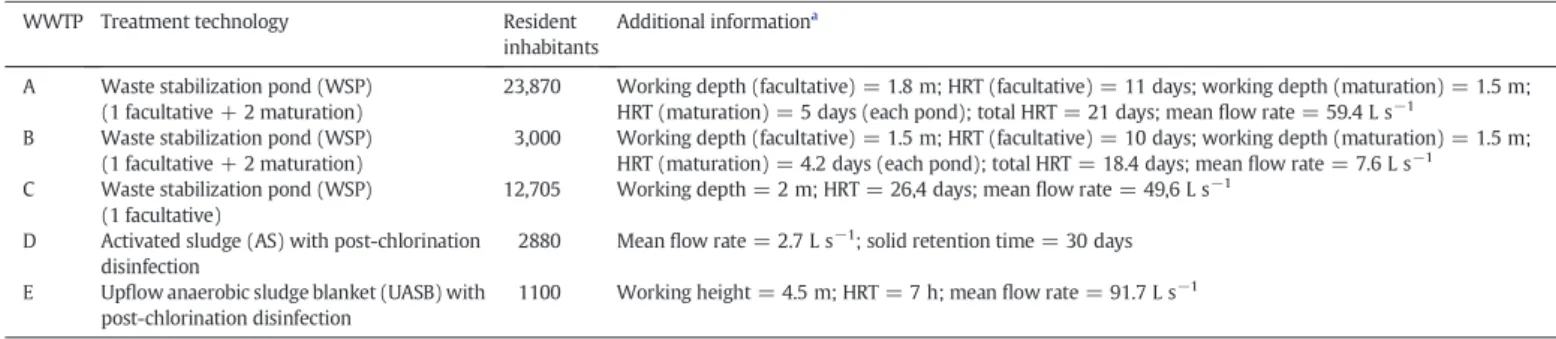
Details of the wastewater treatment plants studied.
WWTP Treatment technology Resident inhabitants
Additional informationa
A Waste stabilization pond (WSP) (1 facultative + 2 maturation)
23,870 Working depth (facultative) = 1.8 m; HRT (facultative) = 11 days; working depth (maturation) = 1.5 m; HRT (maturation) = 5 days (each pond); total HRT = 21 days; meanflow rate = 59.4 L s−1
B Waste stabilization pond (WSP) (1 facultative + 2 maturation)
3,000 Working depth (facultative) = 1.5 m; HRT (facultative) = 10 days; working depth (maturation) = 1.5 m; HRT (maturation) = 4.2 days (each pond); total HRT = 18.4 days; meanflow rate = 7.6 L s−1
C Waste stabilization pond (WSP) (1 facultative)
12,705 Working depth = 2 m; HRT = 26,4 days; meanflow rate = 49,6 L s−1
D Activated sludge (AS) with post-chlorination disinfection
2880 Meanflow rate = 2.7 L s−1; solid retention time = 30 days
E Upflow anaerobic sludge blanket (UASB) with post-chlorination disinfection
1100 Working height = 4.5 m; HRT = 7 h; meanflow rate = 91.7 L s−1
aDesign values.
Table 2
Mean temperature and total precipitation for the 5 days prior to the sampling dates at the Fortaleza sewage treatment plants.
WWTP Date Mean temperature (°C)
Total precipitation (mm)
A May 05/10 27 5.4
Dec 06/10 29.7 0 Oct 10/11 27.92 0.04 Dec13/11 28.1 0 Dec 20/11 28.14 1
B Apr 28/10 28.4 2.3
Jul 29/11 26.83 0 Mar 07/12 27.86 0.16 Mar 28/12 26.6 23.3
Apr 19/12 25 6
C May 19/10 28.6 0
Jul 14/11 26.2 8.1 Dec 13/11 28.1 0 Dec 20/11 28.14 1 Jan 24/12 27.64 4.38
D Jun 10/10 27.7 1.3
Jul 17/11 25.6 11.2
Nov 22/11 28 0
Mar 07/12 27.8 0.16 Mar 28/12 23.3 26.64
E Nov 22/11 28 0
Mar 07/12 27.8 0.16 Mar 28/12 26.6 23.3
Apr 19/12 25 6
May 19/12 27 4.6
Table 3
Validation of the proposed method. Compound L R
(RSD%) LOD (ng L−1)
LOQ (ng L−1)
Recoverya
(%) E1 0.9937 0.10 35.38 117.92 76 (±0.04) E2 0.9928 0.13 11.28 37.58 66 (±0.11) E2-17A 0.9930 0.10 18.90 62.99 42 (±0.50) EE2 0.9970 0.28 60.43 121.44 69 (±0.58)
aCalculated from samples spiked at 500 ng L−1(wastewater influent and effluent),
the origin of E1 in influent sewage is unclear; it may be a byproduct of E2 biodegradation or, alternatively, largely due to E1 sulfonide or glucu-ronide deconjugation in the sewer system, especially in treatment plants which are located a large distance away from households. These authors suggest that E1 is the most environmentally important estrogen when compared to E2 since it is more frequently detected in higher concentrations than E2.
E2 and EE2 both recorded a 52% occurrence, and E2-17A presented a 32% occurrence. The relatively low occurrence of estradiol-based
com-pounds may be the result of their fast degradation to estrone (Servos
et al., 2005).Miège et al. (2009)reported EE2 to be present in 91% of
raw wastewater at ng L−1concentration level. Thus, although EE2 was
expected to be found in more influent samples, it was only present in
half of the samples in the current work.
In this work, the influent samples showed higher estrogens
concen-trations when compared to other works (Gabet-Giraud et al., 2010;
Lishman et al., 2006), possibly caused by the low precipitation
(b27 mm) and high temperatures (25–29 ° C), resulting in low
dilu-tions of estrogens. The highest concentradilu-tions of E1 and EE2 in the infl
u-ent were 3050 and 3180 ng L−1, respectively, whereas the
concentrations of E2 and E2-17A were 776 and 2300 ng L−1,
respective-ly (Table 4). In all cases, the lowest concentrations were below the LOD.
The occurrences of each hormone in the effluent samples were 48%
for E1, 28% for E2, 12% for E2-17A, and 40% for EE2 (Table 4). In terms
of effluent concentration,Ternes et al. (1999b)found estrone (E1) to
be the highest of all measured estrogens, whereas E2 was near the
detection limit of 1 ng L−1. The relatively high concentration of E1 in
the present investigation (a mean value of 242 ng L−1) is interpreted
to have been caused by the conversion of E2 and EE2 into E1 before it
could be transformed further (Carballa et al., 2004; Czajka and Londry,
2006; Shi et al., 2004; Ternes et al., 1999a).
3.3. Removal of estrogens from the aqueous phase
The main goal of this work was to provide important insight into the technology that can most effectively remove EDCs. The paper does not
deal with mechanisms, which are very difficult to establish in real
scale systems and depend on the technology applied. However, some discussion about the known published mechanisms was made in
order to explain the occurrence and efficiency of WWTPs. Estrogen
re-moval efficiencies in each of thefive WWTPs were individually analyzed
and calculated in this study (Table 5), as described below.
3.3.1. Removal of E1
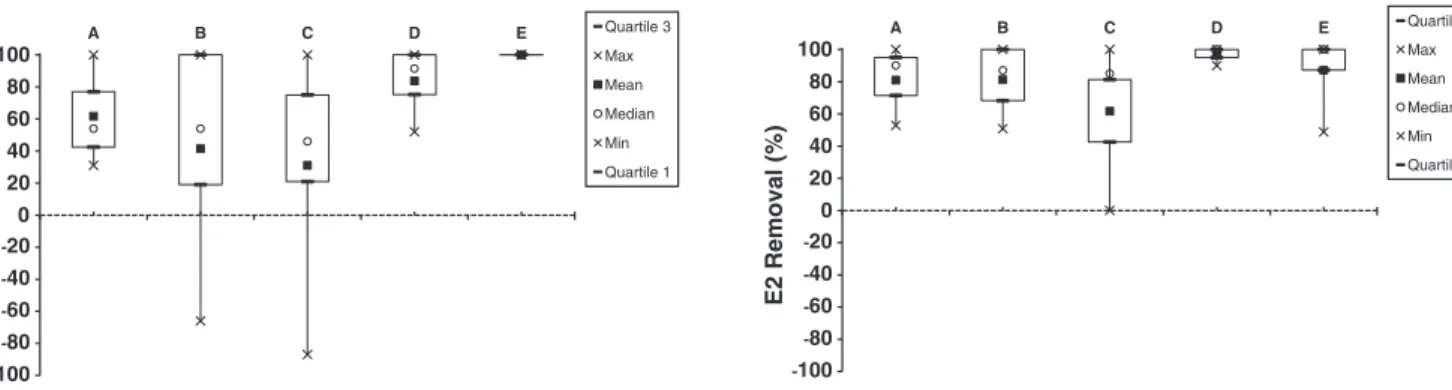
The mean E1 removal in WWTP A, which utilized one facultative and
two maturation ponds, was approximately 65% (Fig. 2). On the other
hand, WWTP B (which operates with the same technology) had an
av-erage removal efficiency of only 41.4%, suggesting that the operational
and design conditions might have directly affected the treatment
per-formance (Table 1).
WWTP C operated only one facultative pond and was less efficient
when compared to systems A and B, with a mean removal efficiency
of only 31%. This result suggests that maturation ponds might be impor-tant for estrogen removal.
WSPs are well known for their UV-disinfection capacity and have re-cently been reported to be effective photo-oxidizers of EDC. In fact,
Coleman et al. (2010)found that E1 was completely degraded by UV light. The photo-oxidative potential in ponds can be increased by both the presence of humic substances and high oxygen concentrations, with the latter contributing to the formation of reactive oxygen species (Davies-Colley et al., 1999). Thus, as the oxygen concentration in matu-ration ponds is higher than in facultative ponds, it is expected that the photo-oxidative potential will also be higher. WWTPs with a polishing step may also theoretically improve their performance by estrogen vol-atilization. However, compared to volatile organic pollutants (e.g. chlo-rinated hydrocarbons, aromatics) with a Henry's law constant (H) of
approximately 103, estrogenic hormones have a small H (approximately
10−7
–10−11), which makes these compounds less susceptible to
vola-tilization under normal pressure and temperature conditions (Hamid
and Eskicioglu, 2012).Coleman et al. (2010)found E1 removal effi cien-cies which ranged from 100 to 82% after secondary treatment in two WSPs located in Australia, which each system with two ponds.
WWTP D employed an AS treatment and a chlorination step, and
was effective in removing E1, with a mean efficiency of ~84%. The
chlo-rine dose added to disinfect the effluent was 2.5 mg L−1. The AS
treat-ment process is known to be effective in removing estrogenic hormones and other lipophilic contaminants from the wastewater
aqueous phase (Baronti et al., 2000; Leusch et al., 2006). Consequently,
E1 was only found in one effluent sample at a concentration of
261 ng L−1. Elsewhere, E1 has been detected at a maximum
concentra-tion of 350 ng L−1after AS treatment and seasonal chlorine disinfection
(Atkinson et al., 2012).
WWTP E, which uses a UASB followed by chlorination post-treatment, showed a 100% removal of E1 from wastewater. Similar
re-sults were also found bySalgado et al. (2010), who investigated the
re-moval of E1 in UASB reactors.de Mes et al. (2008)assigned adsorption
as the responsible for a 32–35% loss of E1 and E2 from the liquid phase.
In both WWTPs D and E, the complementary abiotic removal of E1 by
chlorine must also be considered (Deborde et al., 2004; Hu et al.,
2003; Lee et al., 2004).
Fig. 1.Influent and effluent estrogens concentrations.
Table 4
Occurrence of estrogens in influent and effluent samples.
Estrogen Influent concentration Occurrence (%) Mean
(ng L−1)
RSD (%)
Min (ng L−1)
Max (ng L−1)
n
E1 566 125 bLOD 3050 25 76
E2 143 139 bLOD 776 25 52 E2-17A 268 2 bLOD 2300 25 32 EE2 421 166 bLOD 3180 25 52
Estrogen Effluent concentration Occurrence (%) Mean
(ng L−1)
RSD (%)
Min (ng L−1)
Max (ng L−1)
n
E1 242 193 bLOD 2080 25 48
E2 48 177 bLOD 397 25 28
E2-17A 87 291 bLOD 1250 25 12
3.3.2. Removal of E2
The mean E2 removal efficiencies in WWTPs A, B and C were 95%,
100% and 81%, respectively (Fig. 3). This behavior was expected, given
that ponds are generally very effective at removing E2, with apparent
removals ranging from 80% to 98% (Lishman et al., 2006; Servos et al.,
2005). However, as observed previously, systems B and C only removed
low percentages of E1. One possible explanation for this would be the conversion of E2 into E1, with systems B and C being unable to degrade
E1 efficiently.
WWTP D was 100% effective in degrading estrogen E2. The most like-ly hormone removal pathways for this technique might include biological degradation, abiotic removal (chlorination) and adsorption onto solids. Sorption and biodegradation are the two major removal mechanisms
for 17β-estradiol in AS systems (Estrada-Arriaga and Mijaylova, 2010;
Fang et al., 2003; Ren et al., 2007; Shi et al., 2004; Stevens-Garmon et al., 2011; Vader et al., 2000).
Several studies have pointed out the ability of some bacteria isolated
from AS systems to convert these molecules (Ren et al., 2007; Shi et al.,
2004; Vader et al., 2000; Yoshimoto et al., 2004).Joss et al. (2004)and
Lee and Liu (2002)proposed a mechanism for aerobic or anaerobic
es-trogen degradation in WWTPs. According to them, 17β-estradiol was
initially oxidized to estrone, which was then further oxidized to
un-known metabolites, andfinally converted (mineralized) to CO2and
water.
WWTP E, which uses a UASB followed by chlorination
post-treatment, showed an 87% removal of E2.Paterakis et al. (2012)
report-ed E2 biodegradation under anaerobic conditions, although the comple-mentary abiotic E2 removal by chlorine must also be considered as a
viable mechanism (Hu et al., 2003). In the latter study, it was reported
that E2 rapidly reacted with HOCl, with almost 100% of E2 removed after a 10 min reaction.
3.3.3. Removal of E2-17A
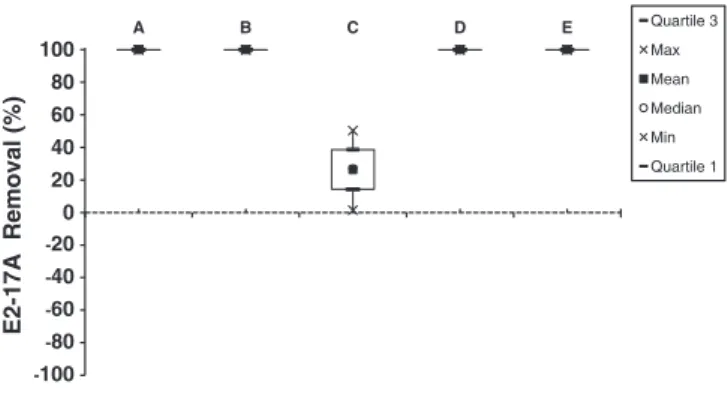
Regardless of the wastewater treatment evaluated in this
investiga-tion, the compound E2-17A was removed with 100% efficiency (Fig. 4).
Probably, the adsorption of the E2-17A molecule onto the sludge might
have played a key role, since its logKowis very high (4.95) when
com-pared to those for the E1 (3.13), E2 (4.01) and EE2 (3.67) molecules.
However,Ren et al. (2007)described the sorption of E1, E2, estriol
(E3) and EE2 onto sewage sludge as being deactivated by heat
treat-ment. Although batch experiment datafitted well to a Freundlich
iso-therm, in contrast to previous studies, they observed sorption
behavior to be independent of theKowvalues of each compound.
Nieto et al. (2008)studied the presence of E2-17A in sludge from
sew-age treatment plants and found values of 175–375μg kg−1. The only
system that removed a low proportion of E2-17A (26%,Fig. 4) was
WWTP C. The reason for this system behavior still remains unclear.
3.3.4. Removal of EE2
The removal of EE2 in WWTP A, which utilized one facultative and
two maturation ponds, was only 29.7% (Fig. 5). This result is in
agree-ment withYing et al. (2008), who noted a similar EE2 removal of 25%
and concluded that WSP do not effectively remove particular endocrine disrupters. Contrary to the above-mentioned results for WWTP A, the
system B (involving same configuration—one facultative and two
mat-uration ponds) removed 100% of EE2, which is close to the 90–95%
range reported byGomez et al. (2007). The difference in terms of EE2
removal between A and B might be attributed to the EDCs load. The
in-fluence of influent concentration on removal of EDCs for each type of
process was also tested (removal vs. influent concentration). Thus, a
tendency of higher influent concentrations values with lower removal
was observed although thep-value was greater than 0.05 (Table 6). In
this specific case, the average EE2 influent concentration was 358.8
andb121.44 ng L−1, for A and B, respectively. In addition, some design
and operational parameters might have also played a role.
WWTP C removed 58.4% of EE2 using only one facultative pond. The absence of a maturation pond in this case suggests that it is an
impor-tant factor.Williams et al. (2007)reported a 25% EE2 removal efficiency
in WSP containing only a primary facultative pond, although they do not
provideflow or population information.
Table 5
Average removal of estrogens in WWTPs.
Compound Average removal (%)a Removal for each compoundb
A B C D E
E1 62 41 31 84 100 63.6
E2 81 81 62 96 87 81.4
E2-17A 100 100 26 100 100 85.2
EE2 30 99 58 100 94 75.8
Global Removalc 68.25 79.75 44.25 95 95.25 – aRemoval was considered 100% when the concentration was
bLOD orbLOQ. b Removal considered for each compound in all treatments.
c Average for all estrogens.
-100 -80 -60 -40 -20 0 20 40 60 80 100
A B C D E
E1 Removal (%)
Quartile 3
Max
Mean
Median
Min
Quartile 1
Fig. 2.Estrone (E1) removal in 5 WWTPs.
-100 -80 -60 -40 -20 0 20 40 60 80 100
A B C D E
E2 Removal (%)
Quartile 3
Max
Mean
Median
Min
Quartile 1
AS treatment in WWTP D exhibited a 100% efficiency in removing
EE2 (Fig. 5), which is consistent with the high removal rates (N90%) in
AS plants reported byMuller et al. (2008)andJoss et al. (2004).Yi
et al. (2006)suggested that EE2 degradation may involve ammonium
monooxygenase, the key enzyme that catalyzes nitrification. They
showed that EE2 underwent mineralization in conventional bioreactors
and produced unidentified metabolites. In contrast, Kanda and
Churchley (2008)only measured a 3.2% removal efficiency of EE2 in a modern nitrifying AS, with this persistence to biodegradation also
ob-served byWeber et al. (2005).
The removal of EE2 in WTTP E, which employed a UASB reactor
followed by chlorination post-treatment, measured a mean efficiency
of 94% (Fig. 5). Although EDCs can persist through the anaerobic sludge
digestion process, with removals ranging from 10% to 48% (Ifelebuegu,
2011),Carballa et al. (2007)reported a 90% EE2 removal efficiency dur-ing the anaerobic digestion of sewage sludge. No EE2 was detected in
the UASB effluent byde Mes et al. (2008).
3.3.5. Overall removal capacity of the WWTPs
Three different sewage treatment techniques (stabilization ponds, UASB, and AS followed by chlorination post-treatment) employed in
five WWTPs in Brazil have been analyzed for their capacity to remove
hormones from wastewater. Overall removal efficiencies (Fig. 6and
Table 5) showed that AS followed by chlorination post-treatment had an average estrogen removed of 95%, and UASB followed by chlorina-tion post-treatment averaged a 95.25% removal. In contrast, the removal
efficiency observed in stabilization ponds was approximately 64%.
These data clearly indicate that AS and UASB followed by chlorination post-treatment are more effective to remove estrogens, with a low var-iability as denoted by a ~7% inter-quartile. Conversely, a larger
differ-ence of 29–31% was found between thefirst and third quartiles for
WSP techniques.
These results for AS systems are in agreement withMiège et al.
(2009), who reported mean removal rates from the dissolved aqueous
phase of around 80% for E1,αE2, andβE2. These authors created a
data-base from scientific publications, in order to quantitatively assess the
re-moval efficiency of EDCs in WWTPs. In their database, two types of ASP
were considered: those which perform carbon removal (sludge age
b10 days), and others that perform nitrogen removal (sludge age
N10 days). In the current study, the system has a sludge ageN10 days
(Table 1).
Verlicchi et al. (2012) reported global removal efficiencies of micropollutants in 244 conventional AS systems (242 full-scale plants and 2 pilot ones) in the world (located in European countries, the Americas including Brazil, Asia and Australia). Conventional AS usually operates at an HRT ranging from 2 to 24 h and at an SRT generally of
2–20 days. The estrogen removals were between 67% and 80%.
Froehner et al. (2011)reported hormone removal efficiencies of 73.1% in AS systems, 66.5% in UASB systems, and 56.5% for stabilization
ponds. These researches presented the same pattern of removal effi
-ciency (%) obtained for wastewater treatment plants in the present investigation.
InTable 6, it is possible to observe the removal for each compound in all treatments. E1 presented a 63.6% removal, whereas the other estro-gens showed a better removal, ranging from 75 to 85%.
4. Conclusions
Some patterns of occurrence and removal of estrogens in 5 wastewa-ter treatment systems in the State of Ceará, Brazil, were found. E1
showed the highest occurrence in the influent and the effluent. The
sam-pling results suggest that this estrogen is excreted in major concentra-tion by humans or others sources, and the compound was more persistent than the others since its global removal considering all treat-ments were smaller.
Systems using chlorination as post-treatment presented a better
re-moval efficiency of compounds when compared to waste stabilization
pond treatment. WSP treatment was observed to be less effective for re-moving steroid estrogens, particularly estrone. In some cases, it led to an
increased concentration of estrone in the effluent.
Continued monitoring of these estrogens is necessary in order to im-prove wastewater treatment processes and to ensure the safety of drink-ing water. Monitordrink-ing should also be expanded to include conjugates
-100 -80 -60 -40 -20 0 20 40 60 80 100
A B C D E
E2-17A Removal (%)
Quartile 3
Max
Mean
Median
Min
Quartile 1
Fig. 4.17β-Estradiol 17-acetate (E2-17A) removal in 5 WWTPs.
-100 -80 -60 -40 -20 0 20 40 60 80 100
A B C D E
EE2 Removal (%)
Quartile 3
Max
Mean
Median
Min
Quartile 1
Fig. 5.17α-Ethynylestradiol (EE2) removal in 5 WWTPs.
Table 6
Correlation analysis of influent concentration on EDCs removal.
Estrogen E1 E2 E2-17A EE2 Removal (%) Pearson correlation 0.231 −0.365 −0.320 −0.225
Sig. (2-tailed) 0.278 0.079 0.127 0.291
N 25 25 25 25
0 20 40 60 80 100
E1 E2 E2-17A EE2
Global Removal (%)
Quartile 3
Max
Mean
Median
Min
Quartile 1
and other matrices, such as sludge present in the systems analyzed. Be-sides, the effect of the air temperature and precipitation should also be assessed in WSP systems, although the operational conditions such as
flow, sludge accumulation etc. cannot be fully controlled.
Finally, more specific study seems to be necessary to understand
more about the mechanisms (biotic and abiotic) and microorganisms involved in the micropollutants removal, especially in low-cost waste-water technologies, in which experiments under controlled conditions are necessary.
Acknowledgements
The authors wish to thank the personnel of the water treatment plants in Ceará (Cagece) for their cooperation with all aspects of this study. This study was funded by the CNPQ, project nº. 577000/2008-2.
References
Abegglen C, Joss A, McArdell CS, Fink G, Schlusener MP, Ternes TA, et al.The fate of select-ed micropollutants in a single-house MBR. Water Res 2009;43:2036–46.
Al-Odaini NA, Zakaria MP, Yaziz MI, Surif S.Multi-residue analytical method for human pharmaceuticals and synthetic hormones in river water and sewage effluents by solid-phase extraction and liquid chromatography–tandem mass spectrometry. J Chromatogr A 2010;1217:6791–806.
Andersen H, Siegrist H, Halling-Sørensen B, Ternes TA.Fate of estrogens in a municipal sewage treatment plant. Environ Sci Technol 2003;37:4021–6.
Andrási N, Helenkár A, Záray G, Vasanits A, Molnár-Perl I.Derivatization and fragmenta-tion pattern analysis of natural and synthetic steroids, as their trimethylsilyl (oxime) ether derivatives by gas chromatography mass spectrometry: analysis of dissolved steroids in wastewater samples. J Chromatogr A 2011;1218:1878–90.
Atkinson SK, Marlatt VL, Kimpe LE, Lean DR, Trudeau VL, Blais JM.The occurrence of ste-roidal estrogens in south-eastern Ontario wastewater treatment plants. Sci Total En-viron 2012;430:119–25.
Baronti C, Curini R, D'Ascenzo G, Di Corcia A, Gentili A, Samperi R.Monitoring natural and synthetic estrogens at activated sludge sewage treatment plants and in a receiving river water. Environ Sci Technol 2000;34:5059–66.
Benijts T, Lambert W, De Leenheer A.Analysis of Multiple endocrine disruptors in envi-ronmental waters via wide-spectrum solid-phase extraction and dual-polarity ioni-zation LC–ion trap–MS/MS. Anal Chem 2003;76:704–11.
Brandão LP.Prospects of reusing treated wastewater stabilization ponds for irrigation in the state of Ceará. Civil Engineering. Federal University of Ceará; 2000.
Brandt EMF, de Queiroz FB, Afonso RJCF, Aquino SF, Chernicharo CAL.Behaviour of phar-maceuticals and endocrine disrupting chemicals in simplified sewage treatment sys-tems. J Environ Manage 2013;128:718–26.
Carballa M, Omil F, Lema JM, Llompart M, Garcia-Jares C, Rodriguez I, et al.Behavior of pharmaceuticals, cosmetics and hormones in a sewage treatment plant. Water Res 2004;38:2918–26.
Carballa M, Omil F, Ternes T, Lema JM.Fate of pharmaceutical and personal care products (PPCPs) during anaerobic digestion of sewage sludge. Water Res 2007;41:2139–50.
Cavalcante RM, de Andrade MVF, Marins RV, Oliveira LDM.Development of a headspace-gas chromatography (HS-GC-PID-FID) method for the determination of VOCs in envi-ronmental aqueous matrices: optimization, verification and elimination of matrix ef-fect and VOC distribution on the Fortaleza Coast, Brazil. Microchem J 2010;96: 337–43.
Chang H, Wan Y, Wu S, Fan Z, Hu J.Occurrence of androgens and progestogens in waste-water treatment plants and receiving river waste-waters: comparison to estrogens. Water Res 2011;45:732–40.
Clara M, Strenn B, Gans O, Martinez E, Kreuzinger N, Kroiss H.Removal of selected phar-maceuticals, fragrances and endocrine disrupting compounds in a membrane biore-actor and conventional wastewater treatment plants. Water Res 2005;39:4797–807.
Coleman HM, Le-Minh N, Khan SJ, Short MD, Chernicharo C, Stuetz RM.Fate and levels of steroid oestrogens and androgens in waste stabilisation ponds: quantification by liq-uid chromatography–tandem mass spectrometry. Water Sci Technol 2010;61: 677–84.
Czajka CP, Londry KL.Anaerobic biotransformation of estrogens. Sci Total Environ 2006; 367:932–41.
Davies-Colley RJ, Donnison AM, Speed DJ, Ross CM, Nagels JW.Inactivation of faecal indi-cator micro-organisms in waste stabilisation ponds: interactions of environmental factors with sunlight. Water Res 1999;33:1220–30.
de Mes T, Kujawa-Roeleveld K, Zeeman G, Lettinga G.Anaerobic biodegradation of estro-gens—hard to digest. Water Sci Technol 2008;57:1177–82.
Deborde M, Rabouan S, Gallard H, Legube B.Aqueous chlorination kinetics of some endo-crine disruptors. Environ Sci Technol 2004;38:5577–83.
Dolar D, Gros M, Rodriguez-Mozaz S, Moreno J, Comas J, Rodriguez-Roda I, et al.Removal of emerging contaminants from municipal wastewater with an integrated membrane system, MBR-RO. J Hazard Mater 2012;239–240:64–9.
Estrada-Arriaga E, Mijaylova N.A comparison of biodegradation kinetic models applied to estrogen removal with nitrifying activated sludge. Water Sci Technol 2010;62: 2183–9.
Fang H, Tong W, Branham WS, Moland CL, Dial SL, Hong H, et al.Study of 202 natural, syn-thetic, and environmental chemicals for binding to the androgen receptor. Chem Res Toxicol 2003;16:1338–58.
Fernandez-Fontaina E, Omil F, Lema JM, Carballa M.Influence of nitrifying conditions on the biodegradation and sorption of emerging micropollutants. Water Res 2012;46: 5434–44.
Froehner S, Piccioni W, Machado KS, Aisse MM.Removal capacity of caffeine, hormones, and bisphenol by aerobic and anaerobic sewage treatment. Water Air Soil Pollut 2010;216:463–71.
Froehner S, Piccioni W, Machado K, Aisse M.Removal Capacity of Caffeine, Hormones, and Bisphenol by Aerobic and Anaerobic Sewage Treatment. Water Air Soil Pollut 2011; 216:463–71.
Gabet-Giraud V, Miege C, Choubert JM, Ruel SM, Coquery M.Occurrence and removal of estrogens and beta blockers by various processes in wastewater treatment plants. Sci Total Environ 2010;408:4257–69.
Gomez E, Wang X, Dagnino S, Leclercq M, Escande A, Casellas C, Picot B, Fenet H.Fate of endocrine disrupters in waste stabilization pond systems. Water Sci Technol 2007; 55(11):157–63.
Hamid H, Eskicioglu C.Fate of estrogenic hormones in wastewater and sludge treatment: a review of properties and analytical detection techniques in sludge matrix. Water Res 2012;46:5813–33.
Hu J, Cheng S, Aizawa T, Terao Y, Kunikane S.Products of aqueous chlorination of 17β -estradiol and their estrogenic activities. Environ Sci Technol 2003;37:5665–70.
Ifelebuegu AO.The fate and behavior of selected endocrine disrupting chemicals in full scale wastewater and sludge treatment unit processes. Int J Environ Sci Technol 2011;8:245–54.
INMETRO. National Institute of Metrology, Quality and Technology.Guidance on valida-tion of methods of chemical tests [DOQ-CGCRE-008] Brazil: Brazilian Government; 2006. p. 25.
Jardim WF, Montagner CC, Pescara IC, Umbuzeiro GA, Di Dea Bergamasco AM, Eldridge ML, et al.An integrated approach to evaluate emerging contaminants in drinking water. Sep Purif Technol 2012;84:3–8.
Jobling S, Nolan M, Tyler CR, Brighty G, Sumpter JP.Widespread sexual disruption in wild fish. Environ Sci Technol 1998;32:2498–506.
Johnson AC, Sumpter JP.Removal of endocrine-disrupting chemicals in activated sludge treatment works. Environ Sci Technol 2001;35:4697–703.
Joss A, Andersen H, Ternes T, Richle PR, Siegrist H.Removal of estrogens in municipal wastewater treatment under aerobic and anaerobic conditions: consequences for plant optimization. Environ Sci Technol 2004;38:3047–55.
Joss A, Zabczynski S, Gobel A, Hoffmann B, Loffler D, McArdell CS, et al.Biological degra-dation of pharmaceuticals in municipal wastewater treatment: proposing a classifi ca-tion scheme. Water Res 2006;40:1686–96.
Kanda R, Churchley J.Removal of endocrine disrupting compounds during conventional wastewater treatment. Environ Technol 2008;29:315–23.
Laganà A, Bacaloni A, De Leva I, Faberi A, Fago G, Marino A.Analytical methodologies for determining the occurrence of endocrine disrupting chemicals in sewage treatment plants and natural waters. Anal Chim Acta 2004;501:79–88.
Lee HB, Liu D.Degradation of 17β-estradiol and its metabolites by sewage bacteria. Water Air Soil Pollut 2002;134:351–66.
Lee B-C, Kamata M, Akatsuka Y, Takeda M, Ohno K, Kamei T, et al.Effects of chlorine on the decrease of estrogenic chemicals. Water Res 2004;38:733–9.
Leusch FD, Chapman HF, van den Heuvel MR, Tan BL, Gooneratne SR, Tremblay LA.
Bioassay-derived androgenic and estrogenic activity in municipal sewage in Australia and New Zealand. Ecotoxicol Environ Saf 2006;65:403–11.
Lishman L, Smyth SA, Sarafin K, Kleywegt S, Toito J, Peart T, et al.Occurrence and reduc-tions of pharmaceuticals and personal care products and estrogens by municipal wastewater treatment plants in Ontario, Canada. Sci Total Environ 2006;367:544–58.
Liu R, Zhou JL, Wilding A.Simultaneous determination of endocrine disrupting phenolic compounds and steroids in water by solid-phase extraction-gas chromatography–
mass spectrometry. J Chromatogr A 2004;1022:179–89.
Lundstrom E, Adolfsson-Erici M, Alsberg T, Bjorlenius B, Eklund B, Laven M, et al. Charac-terization of additional sewage treatment technologies: ecotoxicological effects and levels of selected pharmaceuticals, hormones and endocrine disruptors. Ecotoxicol Environ Saf 2010;73:1612–9.
Miège C, Choubert JM, Ribeiro L, Eusèbe M, Coquery M.Fate of pharmaceuticals and per-sonal care products in wastewater treatment plants—conception of a database and first results. Environ Pollut 2009;157:1721–6.
Mol HGJ, Sunarto S, Steijger OM.Determination of endocrine disruptors in water after de-rivatization with N-methyl-N-(tert.-butyldimethyltrifluoroacetamide) using gas chromatography with mass spectrometric detection. J Chromatogr A 2000;879: 97–112.
Montagner CC, Jardim WF.Spatial and seasonal variations of pharmaceuticals and endo-crine disruptors in the Atibaia River, São Paulo State (Brazil). J Braz Chem Soc 2011; 22:1452–62.
Moon H-B, Yoon S-P, Jung R-H, Choi M.Wastewater treatment plants (WWTPs) as a source of sediment contamination by toxic organic pollutants and fecal sterols in a semi-enclosed bay in Korea. Chemosphere 2008;73:880–9.
Moreira DS, Aquino SF, Afonso RCF, Santos EPPC, Pádua VL.Occurrence of endocrine disrupting compounds in water sources of Belo Horizonte Metropolitan Area, Brazil. Environ Technol 2009;30:1041–9.
Moreira M, Aquino S, Coutrim M, Silva J, Afonso R.Determination of endocrine‐disrupting compounds in waters from Rio das Velhas, Brazil, by liquid chromatography/high res-olution mass spectrometry (ESI–LC–IT–TOF/MS). Environ Technol 2011;32:1409–17.
Nieto A, Borrull F, Pocurull E, Marcé RM.Determination of natural and synthetic estrogens and their conjugates in sewage sludge by pressurized liquid extraction and liquid chromatography–tandem mass spectrometry. J Chromatogr A 2008;1213:224–30.
Paterakis N, Chiu TY, Koh YK, Lester JN, McAdam EJ, Scrimshaw MD, et al.The effective-ness of anaerobic digestion in removing estrogens and nonylphenol ethoxylates. J Hazard Mater 2012;199–200:88–95.
Pedrouzo M, Borrull F, Pocurull E, Marcé RM.Estrogens and their conjugates: determina-tion in water samples by solid-phase extracdetermina-tion and liquid chromatography–tandem mass spectrometry. Talanta 2009;78:1327–31.
Purdom CE, Hardiman PA, Bye VVJ, Eno NC, Tyler CR, Sumpter JP.Estrogenic effects of ef-fluents from sewage treatment works. Chem Ecol 1994;8:275–85.
Queiroz FB, Brandt EM, Aquino SF, Chernicharo CA, Afonso RJ.Occurrence of pharmaceu-ticals and endocrine disruptors in raw sewage and their behavior in UASB reactors operated at different hydraulic retention times. Water Sci Technol 2012;66:2562–9.
Quintana JB, Carpinteiro J, Rodríguez I, Lorenzo RA, Carro AM, Cela R.Determination of natural and synthetic estrogens in water by gas chromatography with mass spectro-metric detection. J Chromatogr A 2004;1024:177–85.
Radjenovic J, Petrovic M, Barcelo D.Fate and distribution of pharmaceuticals in wastewa-ter and sewage sludge of the conventional activated sludge (CAS) and advanced membrane bioreactor (MBR) treatment. Water Res 2009;43:831–41.
Rahman MF, Yanful EK, Jasim SY.Occurrences of endocrine disrupting compounds and pharmaceuticals in the aquatic environment and their removal from drinking water: challenges in the context of the developing world. Desalination 2009;248: 578–85.
Ren Y-X, Nakano K, Nomura M, Chiba N, Nishimura O.Effects of bacterial activity on es-trogen removal in nitrifying activated sludge. Water Res 2007;41:3089–96.
Salgado R, Noronha JP, Oehmen A, Carvalho G, Reis MAM.Analysis of 65 pharmaceuticals and personal care products in 5 wastewater treatment plants in Portugal using a sim-plified analytical methodology. Water Sci Technol 2010;62:2862–71.
Salvador A, Moretton C, Piram A, Faure R.On-line solid-phase extraction with on-support derivatization for high-sensitivity liquid chromatography tandem mass spectrometry of estrogens in influent/effluent of wastewater treatment plants. J Chromatogr A 2007;1145:102–9.
Sanfilippo K, Pinto B, Colombini MP, Bartolucci U, Reali D.Determination of trace endo-crine disruptors in ultrapure water for laboratory use by the yeast estrogen screen (YES) and chemical analysis (GC/MS). J Chromatogr B 2010;878:1190–4.
Servos MR, Bennie DT, Burnison BK, Jurkovic A, McInnis R, Neheli T, et al.Distribution of estrogens, 17[beta]-estradiol and estrone, in Canadian municipal wastewater treat-ment plants. Sci Total Environ 2005;336:155–70.
Shi J, Fujisawa S, Nakai S, Hosomi M.Biodegradation of natural and synthetic estrogens by nitrifying activated sludge and ammonia-oxidizing bacteriumNitrosomonas europaea. Water Res 2004;38:2322–9.
Shimada K, Mitamura K, Higashi T.Gas chromatography and high-performance liquid chromatography of natural steroids. J Chromatogr A 2001;935:141–72.
Sodré F, Locatelli M, Jardim W.Occurrence of emerging contaminants in Brazilian drink-ing waters: a sewage-to-tap issue. Water Air Soil Pollut 2010a;206:57–67.
Sodré FF, Pescara IC, Montagner CC, Jardim WF.Assessing selected estrogens and xenoestrogens in Brazilian surface waters by liquid chromatography–tandem mass spectrometry. Microchem J 2010b;96:92–8.
Stevens-Garmon J, Drewes JE, Khan SJ, McDonald JA, Dickenson ERV.Sorption of emerg-ing trace organic compounds onto wastewater sludge solids. Water Res 2011;45: 3417–26.
Tan BL, Hawker DW, Muller JF, Leusch FD, Tremblay LA, Chapman HF.Comprehensive study of endocrine disrupting compounds using grab and passive sampling at select-ed wastewater treatment plants in South East Queensland, Australia. Environ Int 2007;33:654–69.
Ternes TA, Kreckel P, Mueller J.Behaviour and occurrence of estrogens in municipal sew-age treatment plants—II. Aerobic batch experiments with activated sludge. Sci Total Environ 1999a;225:91–9.
Ternes TA, Stumpf M, Mueller J, Haberer K, Wilken RD, Servos M.Behavior and occurrence of estrogens in municipal sewage treatment plants—I. Investigations in Germany, Canada and Brazil. Sci Total Environ 1999b;225:81–90.
Trenholm RA, Vanderford BJ, Holady JC, Rexing DJ, Snyder SA.Broad range analysis of en-docrine disruptors and pharmaceuticals using gas chromatography and liquid chro-matography tandem mass spectrometry. Chemosphere 2006;65:1990–8.
Vader JS, van Ginkel CG, Sperling FMGM, de Jong J, de Boer W, de Graaf JS, et al. Degrada-tion of ethinyl estradiol by nitrifying activated sludge. Chemosphere 2000;41: 1239–43.
Vega-Morales T, Sosa-Ferrera Z, Santana-Rodríguez JJ.Development and optimisation of an on-line solid phase extraction coupled to ultra-high-performance liquid chroma-tography–tandem mass spectrometry methodology for the simultaneous determina-tion of endocrine disrupting compounds in wastewater samples. J Chromatogr A 2012;1230:66–76.
Verlicchi P, Al Aukidy M, Zambello E.Occurrence of pharmaceutical compounds in urban wastewater: removal, mass load and environmental risk after a secondary treatment
—a review. Sci Total Environ 2012;429:123–55.
Virkutyte J, Varma RS, Jegatheesan VE.Treatment of micropollutants in water and waste-water. 1st ed. London, UK: IWA Publisher; 2010.
Weber S, Leuschner P, Kämpfer P, Dott W, Hollender J.Degradation of estradiol and ethi-nyl estradiol by activated sludge and by a defined mixed culture. Appl Microbiol Biotechnol 2005;67:106–12.
Williams M, Woods M, Kumar A, Ying GG, Shareef A, Mea Karkkainen.Endocrine disrupting chemicals in the Australian riverine environment: a pilot study on estro-genic compounds. Glen Osmond, Australia: Land & Water Australia; 2007 [1st].
Yi T, Harper WFJ, Holbrook R, Love N.Size and ammonium oxidation in removal of 17α -ethinyl estradiol in bioreactors. J Environ Eng 2006;132:1527–9.
Ying G-G, Kookana RS, Kumar A.Fate of estrogens and xenoestrogens in four sewage treatment plants with different technologies. Environ Toxicol Chem 2008;27:87–94.