Health technology assessment (HTA) organizations:
dimensions of the institutional and political
framework
Organizações de avaliação de tecnologias em
saúde (ATS): dimensões do arcabouço
institucional e político
Organizaciones de evaluación de tecnologías en
salud (ETS): dimensiones del marco institucional
y político
Hillegonda Maria Dutilh Novaes 1,2
Patrícia Coelho de Soárez 1,2
Abstract
Health technology assessment (HTA) is consolidated as a scientific and technological practice. The aim of this study is to identify HTA organi-zations from different settings and analyze their relevant dimensions in terms of effectiveness/impact, in order to address the challenges they face in Brazil. Narrative literature review based on data and websites of HTA organizations. There are well-established activity development processes in all organizations. These activities have specific features in their profile, in the process of technology assessment, decision and implementation of technologies that influence their potential impact on health systems. Agencies share in common the challenges of ranking the technologies to be assessed, and the implementation of their recommendations. Techni-cal and politiTechni-cal strengthening of the institutionalization of HTA in Brazil may foster scientific, technological and innovation policies, effectively im-pacting health policies.
Health Technology Assessment; Decision Making; Public Health Policy; Sustainable Development; Innovation
Correspondence
P. C. Soárez
Departamento de Medicina Preventiva, Faculdade de Medicina, Universidade de São Paulo.
Av. Dr. Arnaldo 455, 2o andar, São Paulo, SP
01246-903, Brasil. [email protected] 1 Faculdade de Medicina,
Introduction
Over the last three decades, health technology assessment (HTA) has become more visible and disseminated in Europe, North America, Austra-lia, and more lately in developing countries in ter-ms of the development of knowledge and health policies 1. HTA plays a role in the incorporation and utilization of health technology processes, by contributing to the equitable provision and access to healthcare services, more efficiency in the allocation of resources, better effectiveness and quality of services, and stronger financial sustainability of the healthcare system.
HTA has consolidated itself as a scientific and technological practice, achieving metho-dological development and having expanded its influence in the scientific milieu and among healthcare managers. However, its implementa-tion as a healthcare policy still faces difficulties. The creation of HTA organizations and agen-cies has been an institutionalization strategy to address the challenge of making it an effective healthcare policy.
The development of HTA organizations and its process of institutionalization may be obser-ved in the creation of networks and the progres-sive increase in the number of agencies that are members of the International Network of Agen-cies for Health Technology Assessment (INAHTA), currently with 55 member agencies; the Europe-an Network for Health Technology Assessment (EUnetHTA), with 51 member organizations; and the more recent Health Technology Assess-ment Network of the Americas (RedETSA), esta-blished in 2011, with 25 member institutions 2. The main reason why governments justify the creation of HTA agencies is the need to ha-ve an instance with the specific purpose of in-forming policy makers about the development, dissemination and use of health technologies. With the intention of serving as “a bridge between the world of research and the world of decision--making” 3 (p. 1464), these organizations would be situated at the border between the domains of research and policy formulation to respond to requests that require more informed, transpa-rent and legitimate decisions, and that allow for a stronger participation of society 4,5.
The expansion of agencies as organizational bodies within public services was not limited to HTA, and was an international phenomenon, present in different segments of economic ac-tivity. The creation of the agencies represented a major change in management policies of a number of countries where, typically, decisions on public policy were taken almost exclusively within the orbit of the public sector directly by
the public administration, whether ministries or equivalent bodies. The delegation to the agencies of the mandate to coordinate technical activities is seen as part of a movement towards better go-vernance, aiming at reducing the interference of political difficulties in activities that require sta-bility and continuity to be successful 6.
Many times, the results of HTA processes may be unwelcomed by some sectors or stakeholders. The reactions of some of these stakeholders to undesirable conclusions may place the agencies at risk in regards to their stability and indepen-dence 7,8. Decision-makers, public managers, and associations of medical specialties and pa-tients may be unaware of some aspects of the assessment process, including the economic analysis. The lack of understanding of the deci-sion-making process and the cost-effectiveness assessments was mentioned as one of the factors that prompted criticism of the decisions 9.
Even though most HTA agencies are scienti-fically independent, they operate in broader go-vernance structures, and are not politically inde-pendent. The institutional governance structure affects the independence of the agencies, as well as the power and control of other players, such as the judicial system and regulatory bodies.
There are no standardized models or univer-sal paths for the development and institutiona-lization of agencies, given the major differences among countries (cultures and values, healthca-re systems, political priorities, governance, etc.). Despite the differences in the settings HTA is being developed, existing and future HTA organi-zations may learn one from the other. The purpo-se of this paper is to identify HTA organizations that are representative of the different settings, how they are shaped within the institutional and political healthcare systems framework and, by assessing their effectiveness/impact, analyse them according to their relevant dimensions, thus aiding in facing the challenges arising in the domestic context.
Method
Narrative literature review
area experts. We also searched the gray literature in Google and academic Google. For our search, we used the following set of key words: “Technol-ogy Assessment Biomedical”, “Health Technol“Technol-ogy Assessment”, “HTA”, “Technology Assessment”, “HTA Agencies”, “HTA organizations”, “HTA Pro-grams”, “Evaluation”, “Decision-making”, “Health policy” and “Impact”.
We also consulted the websites of INAHTA; Health Technology Assessment International (HTAi); EUnetHTA; and those of ten HTA orga-nizations: Pharmaceutical Benefits Advisory Committee (PBAC), Australia; Swedish Council on Technology Assessment in Health Care (SBU), Sweden; Canadian Agency for Drugs and Tech-nologies in Health (CADTH), Canada; National Institute for Clinical Excellence (NICE), United Kingdom; Agency for Healthcare Research and Quality (AHRQ), United States; Institute for Qua-lity and Efficiency in Health Care (IQWiG), Ger-many; Centro Nacional de Excelencia Tecnológi-ca en Salud (CENETEC), Mexico; Haute Autorité de Santé (HAS), France; National Committee for Health Technology Incorporation (CONITEC), Brazil; and the Institute of Health Technology As-sessment (IETS), Colombia.
These organizations were selected to fur-ther the literature-review based analysis. These are pioneer HTA agencies that have influenced the models adopted in other countries, and or-ganizations more recently created, in different healthcare system models: universal system (Be-veridgian type: Sweden, United Kingdom, Aus-tralia); social security system (Bismarckian type: France, Germany); free-competition market sys-tem (United States); and hybrid syssys-tem (Mexico, Brazil, Colombia). The institutional contexts of these agencies are highly variable, presenting differences in the organization of the HTA pro-cess “chain of assessment” stages (priorization, evaluation, appreciation, dissemination, and im-plementation of results/recommendations) 10,11. Based on Hailey’s theoretical model 11 that lists the dimensions (structure, processes, results, product impact, and outcomes) that determine the effectiveness of HTA programs/agencies, we have selected for analysis the most frequently used parameters in the assessments: context, human resources/personnel, financial resour-ces, organizational structure, selection and prio-rization, formulation of HTA issues/scope of the assessment, HTA products and utilization of HTA products 12 (Figure 1 and Table 1).
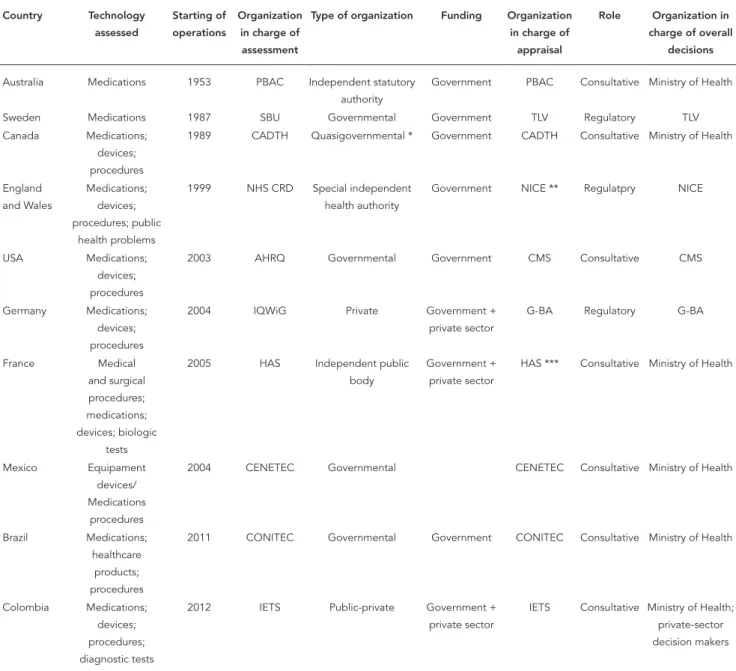
We present the profile of the 10 selected HTA organizations, summarizing the dimensions: assessed technology, starting date, organization accountable for the assessment, type of organi-zation, financing, organization accountable for
the appraisal, role and organization accountable for the overall decision, for the identification of types of agencies, and similarities or differences that are present in the domestic scenario.
Results and discussion
Development of HTA organizations within the international perspective
The narrative literature review identified HTA or-ganizations that represented different contexts, and allowed the systematization of their main institutional characteristics.
The organization considered as pioneer is the PBAC, an independent statutory body esta-blished by the Australian government in 1953, to recommend new medications for the natio-nal medication formulary of the Pharmaceutical Benefits Scheme (PBS), a governmental program that subsidizes most prescription medication in Australia. No new medication can be included in the formulary without a positve recommen-dation by PBAC. To recommend a medication, PBAC takes into account the medical conditions for which the medication was registered, for use in Austrália, its clinical efficacy, safety and cost--effectiveness versus other treatments.
Considered the first national HTA agency in Europe, the SBU was established in 1987 with the purpose of informing the central Swedish go-vernment and district councils on the value of health technologies. The agency should provide evidence-based information on health techno-logies to guide health policies and practices, and the population in general. The government gave explicit instructions for the SBU: to scientifically assess new and existing health technologies con-sidering the medical, social, economic and ethi-cal aspect, but with no regulatory mandate 13.
technologies into the healthcare system or public plans of medication dispensation 14,15.
In 1999, the NICE, the HTA organization, whose goals are mostly connected to HTA poli-cies and practices, was established in the Uni-ted Kingdom 16,17. This organization is renowned worldwide by its methodological rigor, particu-larly by its assessment guidelines that are used as models globally. NICE recommendations must be complied with. The recommended technolo-gies should be made available up to three months after the recommendation is published.
In the United States, HTA is a highly de-centralized process conducted by a number of stakeholders, including governmental agencies, insurance companies and private healthcare plans, and for-profit and not-for-profit priva-te organizations. The AHRQ was established in 2003, and is the main American government agency accountable for HTA development and funding. AHRQ assessments are typically used by the Centers for Medicare and Medicaid Services (CMS) to inform coverage policies for national and local Medicare programs. The AHRQ makes no recommendations 18.
The IQWiG is an independent institute that investigates the benefits and risks of medical in-terventions on patients. The scope of its
activi-ty is defined by law, and its mandate is from the Federal Joint Committee (Gemeinsamer Bunde-sausschuss – G-BA) or Germany’s Federal Health Ministry. The IQWiG assesses surgical and diag-nostic procedures, pharmaceutical products, and treatment guidelines, and sets the bases for new disease management programs. The IQWiG assessments are the basis for decision-making by the G-BA 19.
In 2005 the French government established the HAS, an independent public body with fi-nancial autonomy. Its mandate is to carry out specific assignments, reporting to the Govern-ment and the ParliaGovern-ment. Its activities range from the assessing medications, medical devices and procedures to publishing guidelines for ac-creditation of health organizations and medical certification. It is closely connected to health go-vernment agencies, national health insurance, research institutes, health practitioners’ unions and patient associations. It houses some specific scientific committees, such as the Commission de la Transparence (CT), responsible for evalua-ting medications.
In Latin America, the agency develop-ment process started out belatedly. In 2004, the CENETEC was established in Mexico, a spe-cialized agency within the Ministry of Health,
Figure 1
Determinants of health technology assessment (HTA) programs/agencies effectiveness.
Table 1
Dimensions of the health technology assessment (HTA) programs/agencies.
Structure Processes Results Product impact Final outcomes
•Mandate–Target-population
Process management: Screening on the horizon Acceptance of the agencyʼs products:
Impact on the health status
•Principles/Values •HRmanagement HTA products (complete): •Awareness Impact on the healthcare
system:
•Governance •Financialmanagement •Description •Attitude •Overall
•Contractrelationship •Projectmanagement •Quality •Satisfaction •Economic/Costssystem
•Colaborativerelationships •Strategy/Planning •Cost Use of HTA products: •Equitability
•Finalresources •Evaluationand/orresearch •Opportunity Symbolic •Sustainability
•Humanresources/
personnel
•Comunications •Relevance •Conceptual–changein
awareness,knowledge,
attitude in relation to technology
•Comitttee/Structures/
Functions
HTA processes: Recommendations/
Appraisals/Others:
•Instrumental–changesin
policy or practice
•Organizationalstructure •HTApriority-settingand
selection
•Researchtransference
or capacity development events/products
Impact on technology:
•Data/Informationsystems •FormulationofHTAissues •Innovationoradaptation
•Target-population •Comissioningandfollow-up •Researchanddevelopment
•Sourcesofrequests •Datacollectionandanalysis •Obsolescence/
Replacement
•Decisions/Recommendations •Reportpreparationand
revision
•Researchdisclosure/transfer •Appeals
Source: adapted from Hailey 11.
with two basic functions: (i) to generate accu-rate, pertinent and relevant information on he-alth technology to improve hehe-althcare services delivery and to subsidize health policy concepts and implementation; and (ii) to help in rationa-lizing procurement, adoption, management and dissemination of medical technologies at local, regional and national levels 20. At first, CENETEC focused on medical equipment, but expanded its scope to include medical devices, medication-sand procedures.
The IETS is a public-private not-for-profit agency established in Colombia in September 2012. It assesses health technologies, evidence-based clinical guidelines and drug-use protocols, medical devices, procedures and treatments, to support policy makers and health practitio-ners in deciding what technologies are effec-tive and most efficient, and therefore should be publicly funded.
The CONITEC replaced the Ministry of Health’s Committee for Technology Incorpora-tion (Comissão para Incorporação de Tecnolo-gias do Ministério da Saúde – CITEC), and started to operate in 2011. CONITEC is connected to the Ministry of Health’s Secretary of Science, Tech-nology and Strategic Input (SCTIE), with assis-tance from the Department of Health Technolo-gies Management and Incorporation (DGITS), created in 2012. CONITEC has the mandate to assist SCTIE in formulating policies, guidelines and goals for the incorporation, modification or exclusion of health technologies within the Bra-zilian Unified National Health System (SUS), as well as in the development and modification of medical protocols and therapeutic guidelines, in addition to suggesting updates of the National List of Essential Medication (RENAME).
documents became a continuous flow, and the term for completion of the analysis was set at 180 days, extendable to an extra 90 days 21. The term of 180 days was also established for the new tech-nology to be incorporated into the SUS, after the deliberation is published in the Brazilian Federal Register. CONITEC recommendations should be validated by the Secretary of Science, Technology and Strategic Input, and submitted to the Minis-ter of Health. AfMinis-ter deliberation by the MinisMinis-ter of Health, the process should return to CONITEC, and be presented once again to the respective technical area for the incorporation or rejection of the technology.
Nuclear dimension of HTA organizations
The most frequently used parameters proposed in Hailey’s theoretical model 11 (Figure 1 and Table 1) – context, human resources/personnel, financial resources, organizational structure, selection and priorization, formulation of HTA issues/scope of the assessment, HTA products and utilization of HTA products 12 – were used to organize the summary of the main studies identi-fied through the narrative literature review.
• Structure
The structure dimension includes the param-eters for context, human resources/personnel, financial resources and organizational structure.
a) Context
The organizations in charge of HTA processes may be on a local, regional, national and inter-national level. On the local/regional level, HTA organizations address issues from local mana-gers, healthcare services, health practitioners, insurance companies and other stakeholders. In recent years there has been an increase of HTA organizations on a hospital/local level 22. On a national level, the organization provides infor-mation to the federal government, national he-alth system, policy makers and other stakehol-ders 23. The type of assessment is influenced by how the agency is admitted into the health system. The most important agencies are posi-tioned on a national level 24.
b) Human resources/personnel
Some organizations carry out their activities with their own teams; others coordinate and follow independent studies made by external bodies, such as universities, research institutions or groups of experts. While some agencies are
pro-active in defining the studies to be conducted, setting priorities based on emerging issues and technological tracking, others are reactive and respond to demands from parties interested in specific studies 24.
c) Financial resources
Public agencies are financed exclusively by the government, or have most of their funding pro-vided by the government, but may receive some funding from the private sector. Private or for- profit HTA agencies are fully or mostly funded with private resources, and may receive a small contribution from the government 23.
d) Organizational structure
The public model is disseminated the most. In it, the organizations are either included in the public healthcare system organization chart (re-gional/national level) or are a stand-alone, in-dependent agency connected to the healthcare system. This is the model adopted in a number of countries with well-established HTA programs, such as the United Kingdom, France, Spain and Canada 24,25.
• Processes
The processes dimension includes selection and priorization, formulation of HTA issues/scope of the assessment.
a) Selection and priorization
A number of studies emphasize the lack of trans-parency in technology selection and priorization processes. Many HTA organizations do not have clear priority-setting processes that include se-lection methods and participation of stakehol-ders 26, and only a little over half of the agencies use some explicit priority-setting process. Most agencies that claim to use priority-setting proces-ses for the studies have a panel or committee to provide recommendations on the priorities 24,27.
HTA organizations that are directly con-nected to governmental bodies often perform the assessments requested by the instances ac-countable for the incorporation and compen-sation; this means they have less autonomy in defining the priorities of the research agenda 28. This is the case, for instance, of PBAC in Aus-tralia, that assesses the demands of medication manufacturers.
Most agencies try to operate with a certain degree of independence in relation to healthcare system managers, and work hard not to be direc-tly involved in the existing conflicts of interests, without denying them, by means of transparent processes and policies 29.
b) Formulation of HTA issues/scope of the assessment
The studies developed by HTA agencies adopt, in practice, narrow definitions that focus on ef-ficacy, safety and efficiency.
While some agencies develop comprehen-sive studies that include all technologies that are interesting for healthcare systems, inclu-ding those related to public health, most agen-cies limit their assessments to the study of new medications, devices, procedures or medical care programs that require major investments of capital. Worldwide, the approaches develo-ped by the agencies for drugs are better esta-blished and more systematic than for other te-chnologies. The assessments related to public health interventions, emerging technolgies and process technologies use diverse types of methodologies 30.
• Results
a) HTA products
The products of INAHTA agencies differ in both terminology and the method used for their deve-lopment. The development of some products is made under broadly accepted and well-establi-shed methods, and addresses the fundamental dimensions 31.
The complete HTA reports should present more methodological rigor, and greater comple-xity in the analysis and quantity of information. Mini-HTA reports should present methodolo-gical rigor, but their scope is more limited, and the information presented is less comprehensive than the complete HTA reports. The Rapid Asses-sments, on the other hand, are less rigorous and more reduced in scope, and respond to urgent and specific needs of managers in a short period of time 31.
The final products of HTA organizations and the recommendations drawn from the studies may be either discretionary or mandatory.
They are discretionary in nature when the considerations about their effectiveness and efficiency, at least of the technologies, and the recommendations on their incorporation in the health system are among the elements to be taken into account in the final decisions. In this case, the products are reports, medical-practice guidelines, etc. They are mandatory in nature when the political and legal conditions determi-ne compliance with the recommendations. For that to be possible, there must be an overall tical commitment and the establishment of poli-cies so that healthcare managers and service pro-viders accept the recommendations and manage the necessary resources to implement them 30.
• Productimpact
a) The use of HTA products in changing health policies or practices
The impact of products on the incorporation of health technologies depends on the political and institutional framework of the agencies. HTA or-ganizations may play a direct regulatory role, as established by law, or their recommendations may be used by the regulatory body to define the rules for the incorporation of the technologies 23. Even with their having a “consultive”, “re-commendation-making” role, HTA agencies are considered important in the economic decisions upon which the treatments are funded by public health services. Recommendations from HTA agencies may be regulatory decisions, a fact that is more and more acknowledged by the judicial system. HTA bodies are not responsible for me-dication registration, but their studies may in-fluence the purchase of medication and medical prescriptions by doctors and hospitals. The stu-dies may also influence the strategies used by the pharmaceutical industry when they launch me-dications on national pharmaceutical markets 6.
Profile of the selected HTA organizations
The narrative literature review enabled the con-struction of the profile of the selected 10 HTA or-ganizations, summarizing the important dimen-sions that define the types of agencies, and their similarities or differences that reflect the national scenario (Table 3).
läkemedels-Table 2
Priority-setting criteria for selection of technologies to be assessed.
Criteria PBAC * SBU CADTH NICE AHRQ IQWiG ** HAS *** CENETEC # CONITEC ## IETS #
Clinical impact
Economic impact
Burden of disease
Budgeatry impact
Expected level of interest
Existing evidence
Opportunityforrevision
Rate of use variation
Ethical,legalorpsychosocial
implications
Technology of controversial nature
Existing alternatives
Questionsaboutunderutilization
or overutilization
Highlikelihoodthatresultswill influencedecisionmaking
Benefits from the assessment
AHRQ:AgencyforHealthcareResearchandQuality;CADTH:CanadianAgencyforDrugsandTechnologiesinHealth;CENETEC:CentroNacionalde ExcelenciaTecnológicaenSalud;CONITEC:ComissãoNacionaldeIncorporaçãodeTecnologiasnoSUS;HAS:HauteAutoritédeSanté;IETS:Institutode EvaluaciónTecnológicaenSalud;IQWiG:InstituteforQualityandEficiencyinHealthCare;NICE:NationalInstituteforClinicalExcellence;
PBAC:PharmaceuticalBeneitsAdvisoryCommittee;SBU:SwedishCouncilonTechnologyAssessmentinHealthCare.
*PBACingeneraldoesnotdeinethemedicationstobeassessed.Itreviewsthesubmissions(presentedbythemanufacturers)ofnewmedicationorof additionaluseofmedicationsalreadylistedonthenationalmedicationformulary(PBS);
**Natureandseverityofthedisease,magnitudeofthetherapeuticbeneits,proileofsideeffects,convenienceofuse; ***Impactinorganizinghealthcare,actionplannedbytheapplicantaftertheassessment;
#NocriteriausedbyCENETECandIETSwereidentiied;
##Priority-settingprocessisbasedonthefollowingcriteria:epidemiologicalrelevance;relevanceforhealthcarepolicyandservices;advancedknowledgeon
thetheme;operationalfeasibility;andsocial/judicialdemandsrequiringactionsfromtheState.
förmånsverket – TLV, Dental & Pharmaceutical Benefits Agency, in English) that deals with medi-cation coverage and pricing only. In England and Wales, the studies include an array of technolo-gies (medications, devices, procedures, public health programs, screening programs, vaccines and services), and involve different committe-es, as presented on Table 3. Only two agencies (SBU and PBAC) limit the type of technology as-sessed (medications only); most assess different types of technologies (medications, procedures, devices, etc.)
The type of organization ranged from public- only organizations to different public-private or-ganization models to private-only oror-ganizations. Regardless of the type of organization, a point in common of all agencies is how careful they are in
country). Next, an HTA organization makes an as-sessment (technical and scientific data collection and synthesis process of the relevant aspects of the information, made by investigators) that will be used in the decision-making appraisal (poli-tical decision-making process by policy makers, taking into account the information collected in the assessment and other factors and values) 28. During the HTA study processes, interaction be-tween assessment-makers and decision-makers is expected and desirable. However, in general, the roles and responsibilities of HTA agencies and decision-makers are different 8.
The institutional limitations and the organi-zations responsible for assessment and appraisal may vary, as one can see in England and Wales, where assessment is made by academic insti-tutions and/or research institutes, like the Uni-versity of York’s Centrer for Reviews and Disse-mination (CRD) or the United Kingdom’s Health Technology Assessment Program and appraisal by NICE.
In Germany, decision-making is made by a single federal committee that makes decisions on all health technologies for outpatient clinics and hospitals. France has different appraisal committes for medications, medical procedures and devices, that are integrated in the same or-ganization in charge of the assessments (HAS). The appraisal committees with decison-making power are those of NICE, TLV and G-BA 28,29. The Latin America organizations, more recently esta-blished, are placed within the Ministry of Health structure, with no well-defined attribution.
The criteria considered for decison-making is vague in the official documents, and their ap-plication in specific studies is hard to be identi-fied 33. The higher number of explicit decision- making criteria is for medications. A number of countries (Sweden, United Kingdom, Australia, Brazil) have considered cost-effectiveness as a relevant decision-making criterium in relation to medications. The political processes related to coverage medication are quite explicit and for-malized in some countries, and HTA is clearly integrated, with laws to ensure it as a decision- making resource.
The ten selected organizations operate on a national level, according to a “national agency” model. According to the literature, this is not the only possible model; an alternative is a “network model”, where a decentralized resarch group ne-twork would be coordinated by a national mana-gement body.
Regardless of the adopted model, the degree with which an HTA organization is able to achie-ve concrete changes in healthcare systems and services depends on the policy and regulatory
characteristics of the context it operates. In other words, if the regulatory or professional bodies do not use the products from the agencies, and do not accept and implement the conclusions of HTA reports, the overall impact of HTA will likely be quite limited 34.
Final considerations
Literature review and consultation of HTA organi-zations websites have revealed their progressive institutionalization in developed and develop-ing countries. Methodological propositions that guide the studies to be conducted and that are adopted, more or less strictly by most agencies were disseminated. Methods standardization fol-lows systematization propositions disseminated by INAHTA, EUnetHTA, ISPOR, among others. Each agency, however, has their particular pro-file, technology assessment, decision-making and implementation processes in accordance with their institutional and political framework and their respective health systems.
Despite differences related to the dimensions and profile of the organizations, HTA agencies share the challenges in setting the priorities of the technologies to be assessed, and in imple-menting their recommendations for national he-alth policies.
The literature review on the relevant dimen-sions to assess agency effectiveness/impact and the profile of the selected organizations has con-tributed to a better understanding of the challen-ges faced in their countries.
The establishment of CONITEC in 2011 was a breakthrough in the process of HTA institutio-nalization in Brazil. However, one can consider it as being in the implementation stage, not yet having achieved methodological development, ample scientific legitimacy or the potential for a comprehensive policy-making role.
Upon analysis of HTA organizations that have adopted the “National Agency” model, this se-ems to be a suitable model for Brazil: a federal HTA agency that is independent, but articulated with government instances that decide about the funding of new technologies for the SUS, and that encourages the development of regional and hospital-based HTA organizations in order to promote a national, collaborative HTA network as part of health policy and for the scientific and technological development.
Table 3
Proileoftheselectedhealthtechnologyassessment(HTA)organizations.
Country Technology assessed
Starting of operations
Organization in charge of assessment
Type of organization Funding Organization in charge of
appraisal
Role Organization in charge of overall
decisions
Australia Medications 1953 PBAC Independent statutory authority
Government PBAC Consultative MinistryofHealth
Sweden Medications 1987 SBU Governmental Government TLV Regulatory TLV
Canada Medications; devices;
procedures
1989 CADTH Quasigovernmental* Government CADTH Consultative MinistryofHealth
England
andWales
Medications; devices; procedures;public
health problems
1999 NHSCRD Special independent health authority
Government NICE** Regulatpry NICE
USA Medications;
devices;
procedures
2003 AHRQ Governmental Government CMS Consultative CMS
Germany Medications; devices;
procedures
2004 IQWiG Private Government+
private sector
G-BA Regulatory G-BA
France Medical
and surgical
procedures; medications; devices;biologic
tests
2005 HAS Independent public body
Government+
private sector
HAS *** Consultative MinistryofHealth
Mexico Equipament
devices/
Medications
procedures
2004 CENETEC Governmental CENETEC Consultative MinistryofHealth
Brazil Medications;
healthcare
products;
procedures
2011 CONITEC Governmental Government CONITEC Consultative MinistryofHealth
Colombia Medications; devices; procedures;
diagnostic tests
2012 IETS Public-private Government+
private sector
IETS Consultative MinistryofHealth;
private-sector
decisionmakers
AHRQ:AgencyforHealthcareResearchandQuality;CADTH:CanadianAgencyforDrugsandTechnologiesinHealth;CENETEC:CentroNacionalde ExcelenciaTecnológicaenSalud;CMS:CentersforMedicareeMedicaidServices;CONITEC:ComissãoNacionaldeIncorporaçãodeTecnologiasnoSUS; G-BA:GemeinsamerBundesausschuss(FederalJointCommittee);HAS:HauteAutoritédeSanté;IETS:InstitutodeEvaluaciónTecnológicaenSalud; IQWiG:InstituteforQualityandEficiencyinHealthCare;NICE:NationalInstituteforClinicalEcellence;NHSCRD:NationalHealthServiceCentreforReviews andDissemination;PBAC:PharmaceuticalBeneitsAdvisoryCommittee;SBU:SwedishCouncilonTechnologyAssessmentinHealthCare;TLV:Tandvårds-och läkemedelsförmånsverket(Dental&PharmaceuticalBeneitsAgency).
*Fundedbythegovernment,butnotagovernmentalbody.Autonomousorganization;
**ScreeningprogramsareappraisedbytheNationalScreeningCommittee(NSC),andvaccinesareassessedbytheNationalCoordinatingCentreforHealth TechnologyAssessment(NCCHTA)andappraisedbytheJointCommitteeonVaccinationandImmunisation(JCVINHSCRD),andtheservicesareappraised bytheNationalSpecialistCommissioningAdvisoryGroup(NCCAG);
interested in the incorporation of technologies. Capable human resources are essential for the scientific legitimacy and the acceptance of the study results and recommendations presented in the technical reports.
The independence of the agency is essential to ensure transparency in the process to select and prioritize the technologies to be assessed. In the case of CONITEC, directly connected to a go-vernamental instance (SCTIE), most technology assessments are made upon request of the public sector. A recent international study financed by the pharmaceutical industry questioned the cla-rity of the priocla-rity-setting criteria, pointing out the difficulties in requesting new assessments and the low participation of patients in the deli-beration recommendations 35.
The need for a more democratic participa-tion of patients and representatives of society in technology selection and priority-setting criteria definition has been broadly discussed and en-couraged in the international scenario 36.
Permanent technical staff can better adapt the best practices to HTA studies, for these to
be more complete and consistent. In regards to CITEC, which existed between 2008 and 2010, among the 103 studies conducted to support decisions, the predominance was of Rapid As-sessment Reports (36/103), followed by Scien-tific Reports (26/103). Only 11.6% (12/103) of these studies were economic assessments 37. In CONITEC, between 2012 a 2015, the recommen-dation reports were also based on more simple studies about technology description and preli-minary assessment of budgetary impact. Among the technologies recommended for incorpo-ration, only 11.1% presented a full economic evaluation with incremental cost-effectiveness ratio calculation.
The reputation and credibility of an agency, the involvement of stakeholders and the quality of the products (reports, opinions, studies) pre-sented are indicarted in the literature as the most important aspects for a stronger impact of the HTA agency 24.
In terms of the regulatory role of the agency, the institutional arrangement could be the cle-ar sepcle-aration of the institutional limits, and
Figure 2
Overalldecisionmodel.
between the organizations responsible for the two tasks (assessment and appraisal), thus ensu-ring a privileged articulation with the decision- making instance to increase the influence of their recommendations and establish their effective policy activity potential.
The HTA institutionalization process in Bra-zil is continually developing, similarly to other countries. Its expansion and technical and poli-tical strengthening may contribute, significan-tly, with scientific, technological and innovation policies to effectively impacting health policies.
Contributors
H. M. D. Novaes and P. C. Soárez participated in the conception and design, data analysis and interpreta-tion, writing and critical revision of the intellectual content of the article, approval of the final version to be published and are responsible for all aspects of the work in ensuring accuracy and integrity of every part of the paper.
Acknowledgments
References
1. Banta D, Almeida RT. The development of health technology assessment in Brazil. Int J Technol As-sess Health Care 2009; 25 Suppl 1:255-9.
2. Health Technology Assessment International. Book of abstracts of the 1st meeting of the Pan-American Network of Health Technology Assess-ment. Edmontn: Health Technology Assessment International; 2011.
3. Battista RN, Hodge MJ. The evolving paradigm of health technology assessment: reflections for the millennium. CMAJ 1999; 160:1464-7.
4. Gauvin FP, Abelson J, Giacomini M, Eyles J, Lavis JN. “It all depends”: conceptualizing public in-volvement in the context of health technology as-sessment agencies. Soc Sci Med 2010; 70:1518-26. 5. Hailey D, Nordwall M. Survey on the involvement
of consumers in health technology assessment programs. Int J Technol Assess Health Care 2006; 22:497-9.
6. Thatcher M. Governance structures and health technology assessment agencies: a comparative approach. London: Department of Government, London School of Economics and Political Sci-ence; 2010.
7. Hailey D, Juzwishin D. Managing external risks to health technology assessment programs. Int J Technol Assess Health Care 2006; 22:429-35. 8. Hailey D, Babidge W, Cameron A, La D. HTA
agen-cies and decision makers: an INAHTA guidance document document. Edmonton: International Network of Agencies for Health Technology As-sessment; 2010.
9. Roughead EE, Gilbert AL, Vitry AI. The Australian funding debate on quadrivalent HPV vaccine: a case study for the national pharmaceutical policy. Health Policy 2008; 88:250-7.
10. Velasco M, Perleth M, Drummond M, Gürtner F, Jørgensen T, Jovell A, et al. Best practice in under-taking and reporting health technology assess-ments. Working group 4 report. Int J Technol As-sess Health Care 2002; 18:361-422.
11. Hailey D. Elements of effectiveness for health technology assessment programs. Edmonton: Al-berta Heritage Foundation for Medical Research; 2003. (HTA Initiative, 9).
12. Wanke M, Juzwishin D, Thornley R, Chan L. An exploratory review of evaluations of health tech-nology assessment agencies. Edmonton: Alberta Heritage Foundation for Medical Research; 2006. (HTA Initiative, 16).
13. Jonsson E. History of health technology assess-ment in Sweden. Int J Technol Assess Health Care 2009; 25 Suppl 1:42-52.
14. Menon D, Stafinski T. Health technology assess-ment in Canada: 20 years strong? Value Health 2009; 12 Suppl 2:S14-9.
15. Battista RN, Côté B, Hodge MJ, Husereau D. Health technology assessment in Canada. Int J Technol Assess Health Care 2009; 25 Suppl 1:53-60. 16. O’Donnell JC, Pham SV, Pashos CL, Miller DW,
Smith MD. Health technology assessment: lessons learned from around the world: an overview. Value Health 2009; 12 Suppl 2:S1-5.
17. Drummond M, Sorenson C. Nasty or nice? A per-spective on the use of health technology assess-ment in the United Kingdom. Value Health 2009; 12 Suppl 2:S8-13.
18. Sullivan SD, Watkins J, Sweet B, Ramsey SD. Health technology assessment in health-care decisions in the United States. Value Health 2009; 12 Suppl 2:S39-44.
19. Fricke FU, Dauben HP. Health technology assess-ment: a perspective from Germany. Value Health 2009; 12 Suppl 2:S20-7.
20. Gómez-Dantés O, Frenk J. Health technology as-sessment in Mexico. Int J Technol Assess Health Care 2009; 25 Suppl 1:270-5.
21. Ministério da Sáude. O que muda da antiga CI-TEC para a atual CONICI-TEC no processo de in-corporação de tecnologias no SUS 2011. http:// portal.saude.gov.br/portal/arquivos/pdf/conitec_ doc_070212.pdf (accessed on 27/Feb/2012). 22. Gagnon MP. Hospital-based health technology
as-sessment: developments to date. Pharmacoeco-nomics 2014; 32:819-24.
23. European Network for Health Technology As-sessment. EUnetHTA handbook on HTA capac-ity building. Barcelona: Catalan Agency for Health Technology Assessment and Research; 2008. 24. Moharra M, Kubesch N, Estrada MD, Parada A,
Cortes M, Espallargues M. Survey report on HTA organizations. Barcelona: Catalan Agency for Health Technology Assessment and Research; 2008.
25. European Network for Health Technology Assess-ment. WP8 on systems to support HTA in coun-tries with limited institutionalisation of HTA. Co-penhagen: European Network for Health Technol-ogy Assessment; 2007. (WP8 Technical Report). 26. Sorenson C, Drummond M, Kanavos P. Ensuring
value for money in health care: the role of health technology assessment in the European Union. Copenhagen: WHO Regional Office for Europe; 2008. (Observatory Studies Series, 11).
27. Noorani HZ, Husereau DR, Boudreau R, Skidmore B. Priority setting for health technology assess-ments: a systematic review of current practical ap-proaches. Int J Technol Assess Health Care 2007; 23:310-5.
28. Velasco Garrido M, Kristensen F, Nielsen C, Busse R. Health technology assessment and health pol-icy-making in Europe: current status, challenges and potential. Copenhagen: WHO Regional Office for Europe; 2008. (Observatory Studies Series, 14). 29. Sorenson C, Chalkidou K. Reflections on the evo-lution of health technology assessment in Europe. Health Econ Policy Law 2012; 7:25-45.
31. Merlin T, Tamblyn D, Ellery B; INAHTA Quality As-surance Group.A. What’s in a name? Developing definitions for common health technology assess-ment product types of the International Network of Agencies for Health Technology Assessment (INAHTA). Int J Technol Assess Health Care 2014; 30:430-7.
32. Martelli F, La Torre G, Di Ghionno E, Staniscia T, Neroni M, Cicchetti A, et al. Health technology as-sessment agencies: an international overview of organizational aspects. Int J Technol Assess Health Care 2007; 23:414-24.
33. Velasco-Garrido M, Schreyogg J, Stargardt T, Busse R. Identification of health baskets in nine EU countries. Rev Fr Aff Soc 2006; 6:63-88.
34. Lehoux P. The problem of health technology: pol-icy implications for modern health care systems. New York: Routledge; 2006.
35. Wilsdon T, Fiz E, Haderi A. A comparative analysis of the role and impact of health technology assess-ment: 2013. Washington DC: Charles River Associ-ates; 2014.
36. Menon D, Stafinski T. Role of patient and public participation in health technology assessment and coverage decisions. Expert Rev Pharmacoecon Outcomes Res 2011; 11:75-89.
37. Novaes HMD, Elias FTS. Uso da avaliação de tec-nologias em saúde em processos de análise para incorporação de tecnologias no Sistema Único de Saúde no Ministério da Saúde. Cad Saúde Pública 2013; 29 Suppl 1:S7-16.
Resumo
A avaliação de tecnologias em saúde (ATS) está con-solidada enquanto prática científica e tecnológica. O objetivo do estudo é identificar organizações de ATS de diferentes contextos e analisá-las de acordo com dimensões relevantes na avaliação de sua efetivida-de/impacto, buscando contribuir com os desafios en-frentados no contexto nacional. Revisão narrativa da literatura, realizada em bases de dados e web sites de organizações de ATS. Existem processos de desenvol-vimento das atividades bem estabelecidos em todas as organizações. Elas apresentam particularidades no seu perfil, nos processos de avaliação, decisão e im-plementação das tecnologias que influenciam o seu impacto potencial sobre os sistemas de saúde. As agên-cias compartilham os desafios de priorização das tec-nologias a serem avaliadas e implementação das suas recomendações. O fortalecimento técnico e político do processo de institucionalização da ATS no contexto nacional poderá contribuir com as políticas científi-cas, tecnológicas e de inovação, impactando de forma efetiva as políticas de saúde.
Avaliação de Tecnologias de Saúde; Tomada de Decisões; Políticas Públicas de Saúde; Desenvolvimento Sustentável; Inovação
Resumen
La evaluación de tecnologías en salud (ETS) está con-solidada en cuanto práctica científica y tecnológica. El objetivo del estudio es identificar organizaciones de ETS de diferentes contextos y analizarlas, de acuerdo a dimensiones relevantes en la evaluación de su efec-tividad/impacto, procurando contribuir a los desafíos existentes en el contexto nacional. Revisión narrativa de la literatura, realizada en bases de datos y páginas web de organizaciones de ETS. Existen procesos de de-sarrollo de las actividades bien establecidos en todas las organizaciones. Éstas presentan particularidades en su perfil, en los procesos de evaluación, decisión e implementación de las tecnologías que tienen in-fluencia por su impacto potencial sobre los sistemas de salud. Las agencias comparten los desafíos de prio-rización de las tecnologías para que sean evaluadas e implementación de sus recomendaciones. El fortale-cimiento técnico y político del proceso de institucio-nalización de la ETS en el contexto nacional podrá contribuir con políticas científicas, tecnológicas y de innovación, teniendo impacto de forma efectiva sobre las políticas de salud
Evaluación de las Tecnologías de Salud; Toma de Decisiones; Políticas Públicas de Salud; Desarrollo Sostenible; Innovación
Submitted on 24/Feb/2015