Salt stress affects mRNA editing in soybean chloroplasts
Nureyev F. Rodrigues
1, Guilherme C. da Fonseca
2, Franceli R. Kulcheski
2and Rogério Margis
1,2,31
Departamento de Genética, PPGBM, Universidade Federal do Rio Grande do Sul (UFRGS), Porto Alegre,
RS, Brazil.
2
Centro de Biotecnologia, PPGBCM, Universidade Federal do Rio Grande do Sul (UFRGS), Porto Alegre,
RS, Brazil.
3Departamento de Biofísica, Universidade Federal do Rio Grande do Sul (UFRGS), Porto Alegre, RS,
Brazil.
Abstract
Soybean, a crop known by its economic and nutritional importance, has been the subject of several studies that as-sess the impact and the effective plant responses to abiotic stresses. Salt stress is one of the main environmental stresses and negatively impacts crop growth and yield. In this work, the RNA editing process in the chloroplast of soybean plants was evaluated in response to a salt stress. Bioinformatics approach using sRNA and mRNA libraries were employed to detect specific sites showing differences in editing efficiency. RT-qPCR was used to measure
edit-ing efficiency at selected sites. We observed that transcripts ofNDHA, NDHB, RPS14 and RPS16 genes presented
differences in coverage and editing rates between control and salt-treated libraries. RT-qPCR assays demonstrated an increase in editing efficiency of selected genes. The salt stress enhanced the RNA editing process in transcripts, indicating responses to components of the electron transfer chain, photosystem and translation complexes. These increases can be a response to keep the homeostasis of chloroplast protein functions in response to salt stress.
Keywords: small RNA, chloroplast, RNA editing, PPR, salt stress.
Received: March 23, 2016; Accepted: June 20, 2016.
Introduction
Soybean (Glycine maxL.) is one of the major legume crops in the world, providing an abundant source of oil and protein-rich food for human and animal consumption (Leet al., 2012). The high demand for protein in meals drove to further expansion of oilseed production and has favored an increase of soybean production, especially in Brazil (Gue-varaet al., 2015). In Brazilian agriculture, soybean is the most important crop. Currently, Brazil is the second largest producer behind the United States. Soybeans are expected to continue being the most lucrative export product with more than half of Brazilian production destined for world markets (Guevaraet al., 2015). However, like many crops, soybean is subject to several abiotic stresses that reduce its yield.
Plants are exposed to a range of stress conditions such as oxidative stress, variant temperature, light intensity, waterlogging, drought and salinity. These abiotic stresses affect the whole plant, compromising basic molecular and physiological aspects from germination to the reproduction
phases (Mahajan and Tuteja, 2005). Salt stress is one of the main environmental stresses, and it affects economically important crop species that are very sensitive to salinity, such as bean (Phaseolus vulgaris), maize (Zea mays), rice (Oryza sativa) and soybean (Wanget al., 2003; Zhenget al., 2009). Salt-affected soils occur in more than 100 coun-tries and their worldwide extent is estimated at about 1 bil-lion ha (FAO and ITPS, 2015). Salinity stress affects mainly lipids, ions levels, malate and nitrogen metabolism, anti-oxidative enzymes and antioxidants, chloroplast struc-ture and photosynthesis (Parida and Das, 2005). Many studies have been dedicated to the impact of salinity on photosynthetic activity, carbon assimilation, pigment com-position, electron transport, and photosystem I and II effi-ciency (Sudhiret al., 2005; Parida and Das, 2005; Koyro, 2006). Clearly, there is a link between effects on photosyn-thesis and chloroplast, however, certain works have looked specifically at plastid salt stress effects (Gomez, 2003; Zhanget al., 2008; Zhenget al., 2009).
Chloroplasts are complex organelles that have their own gene expression machinery, intricate post-trans-criptional processes and a fine coordination with nuclear gene expression. Chloroplasts have received particular in-terest because they are responsible for photosynthesis. Al-DOI: http://dx.doi.org/ 10.1590/1678-4685-GMB-2016-0055
Send correspondence to Rogerio Margis. Centro de Biotecnologia, sala 213, prédio 43431, Universidade Federal do Rio Grande do Sul (UFRGS), PO Box 15005, 91501-970, Porto Alegre, RS, Brazil. E-mail: [email protected]
terations in metabolic pathways, in specific signals like redox state, or in protein structures can lead to disruption in plastid activity and, consecutively, in plant yield. RNA ed-iting, a post transcriptional process, consists in nucleotide conversions from cytosine (C) to uracil (U), or, less fre-quently, from U to C. This process, also present in mito-chondria, is performed by deamination and amination reactions (Chateigner-Boutin and Small, 2011; Hayes et al., 2015). Usually, editing events preserve amino acids that are phylogenetically conserved by restoring the codon sequence. The most frequent change is serine to leucine, but other alterations, including silent or non-conservative changes, have also been described (Inada et al., 2004; Chateigner-Boutin and Small, 2010). In both organelles, editing can create an initiation codon, and create or remove stop codons. Editing can also be found in introns (prerequi-site for splicing in some cases) and in untranslated regions (UTR) (Takenakaet al., 2008; Castandet and Araya, 2011). This powerful and intriguing process has been studied due its essential function and also because of the impact in the evolutionary process (Takenakaet al., 2013).
Plastid RNA editing depends on the editosome ma-chinery to precisely process the emerging transcripts. The editosome composition has not yet been completely identi-fied. However, some components of the editing machinery, like the pentatricopeptide repeat (PPR) proteins, were al-ready recognized. The PPR motif is a 35-amino-acid repeat that folds into a pair of antiparallel alpha helices. Arrays of tandem PPR motifs form a superhelical ribbon-like sheet (Small and Peeters, 2000; Barkan and Small 2014). In land plants, the PPR gene family contains from 400 to more than 1000 members (Barkan and Small, 2014). The PPR pro-teins are classified into two major subfamilies, P-type and PLS-type PPRs. The PLS-type PPR proteins can be further divided into three subgroups: E, E+, and DYW, that differ in the presence of an optional C-terminal region (Lurinet al., 2004). Most PLS-type PPR proteins involved in editing act as site-recognition factors, recognizing the 5’ region up-stream of the editable C residue (Yagiet al., 2013). PLS-type PPR proteins presenting cytidine deaminase motifs within the DYW domain have been described as being di-rectly responsible for RNA editing activity (Boussardonet al., 2014; Wagoneret al., 2015). Other PPR proteins, as HCF152 and PPR10, are involved in intercistronic process-ing of polycistronic precursor transcripts or in stabilizprocess-ing specific RNAs (Barkan and Small, 2014; Yapet al., 2015).
Diverse studies have been done to analyze editing regulation of plastids under various situations, such as tis-sue-specific differences, responses to molecular signals, ef-fects in immunity, and responses to abiotic stress (Kakizaki et al., 2012; García-Andrade et al., 2013; Tseng et al., 2013). The potential of the RNA editing efficiency as a marker for stress tolerance or as a target for genetic modifi-cation was evaluated in some studies. For example, incom-plete editing caused by increased temperature is correlated
with change in plastid translation in maize (Nakajima and Mulligan, 2001). Specifically, heat stress leads to loss of editing sites and intron splicing reactions inNDHB tran-scripts (Karcher and Bock 2002). Variations in the effi-ciency of plastid editing inNDHtranscripts was evaluated and not linked to differences in drought tolerance in peren-nial ryegrass (Lolium perenne) (Van Den Bekeromet al., 2013).
Most of the studies on RNA editing have used the re-verse transcription PCR (RT-PCR) method of total chloro-plast mRNAs and cloning of several chlorochloro-plast cDNA fragments into vectors to be sequenced (Rüdingeret al., 2009). Another method is to design primers to amplify tar-get genes from cDNA samples and sequence them (Wolfet al., 2004). RNA editing events could also be detected by us-ing chloroplast cDNA datasets as templates for amplifica-tion in Poisoned Primer Extension methodology, or also by High Resolution Melting (HRM) analysis (Chateigner-Boutin and Small, 2007). Many plastid small RNAs (sRNAs) showed sequence similarities to PPR-binding sites, which provides support to the idea that large amounts of sRNAs remnants resulted from PPR protein targets (Ru-we and Schmitz-Linne(Ru-weber, 2012). In this way, several chloroplast sRNAs are recovered as RNA-binding protein footprints, including PPR-editosome components, which remain in the sequencing results due to protein protection against ribonucleases.
Despite several different methodologies already de-scribed in the literature for RNA-editing recognition, in this work we evaluated the impact of salt stress on soybean C to T editing efficiency by a new method comprised byin silico screening of editing sequences of sRNA libraries obtained by high-throughput sequencing, followed by RT-qPCR as-says.
Materials and Methods
Plant material, stress treatment and RNA isolation
Soybean plants were grown over 8 days using Hoa-gland solution. After this period, six plants were transferred into a new Hoagland solution (establishing the control group), and six plants were submitted to a salt-stress treat-ment using a Hoagland solution suppletreat-mented with 200 mM NaCl. Leaves were collected after intervals of 4 and 24 hours and stored in liquid nitrogen until RNA extraction. Total RNA from leaves was isolated using TRIzol reagent (Invitrogen, CA, USA), and the RNA quality was evaluated by Nanodrop quantification and gel inspection.
sRNA/mRNA libraries, chloroplast genome, and prediction of conserved editing sites
Public sRNAs and mRNAs libraries ofG. maxleaves,
deposited in NCBI GEO
differen-tial RNA editing rate when exposed to saline stress. Com-plete chloroplast genome and coding sequences, as well as tRNAs from soybean (NC_007942) were obtained sepa-rately from the Index of Genomes from the Chloroplast Ge-nome Database (http://chloroplast.ocean.washington.edu/). To predict editing sites and evaluate their editing rates, the PREP-Cp tool (http://prep.unl.edu/) (Mower 2009) was used with a cutoff value of 0.5, in spite of the 0.8 default value, using the coding sequences of the chloroplast ge-nome mentioned above.
Analyses of edited sRNAs
The sRNAs libraries were primarily aligned against the chloroplast genome, coding sequences and tRNAs, us-ing Bowtie software (Langmeadet al., 2009) with 0 mis-match and not allowing reverse complement mis-matches. The aligned reads resulted in a new file called cp_m0. The un-aligned reads were submitted to a second round of align-ment with 0 mismatch, against nuclear and mitochondrial genomes. The unaligned reads were further aligned with two mismatches, and no reverse complement matches were allowed against the chloroplast genome and coding se-quences. This second group of aligned reads produced an-other file called cp_m2. Both cp_DNA fastq files were concatenated in a cp_m0_m2 file. The cp_m0_m2 files were aligned against chloroplast coding sequences using Geneious (Kearseet al., 2012) R8 with the Bowtie algo-rithm, using the same parameters of the previous align-ments. The Geneious Find Variation/SNPs tool was used with parameters set as follows: Minimum Coverage of 5, Maximum Variant P-Value of 10-2, to find polymorphism Inside and Outside coding sequence and P-value calcula-tion method as approximate. The coverage values of edited and non-edited reads were transposed to the implementa-tion of statistical analysis. The same pipeline was used to analyze editing rates with mRNA data.
Differential expression analysis
SAM files created in the bowtie alignment were uti-lized to generate a count table containing data from all li-braries. This table was the input file to differential expres-sion analysis performed using DeSeq2 package (Anders and Huber, 2010) implemented in R package (R Core Team, 2015). Heatmaps were generated with normalized counts of all plastid genes for data visualization.
Editing analysis by RT-qPCR
The cDNA synthesis was carried out using approxi-mately 1mg of total RNA. The d26T primer was used in each reaction. Before transcription, RNA and primers were mixed with RNase-free water to a total volume of 10mL and incubated at 70 °C for 5 min followed by ice-cooling. Then, 3mL of 5 RT-Buffer (Promega, Madison, WI, USA), 1mL of 5 mM dNTP (Ludwig, Porto Alegre, RS, Brazil) and 1mL of MMLV-RT Enzyme 200 U (Promega,
Madi-son, WI, USA) were added for a final volume of 20mL. The synthesis was performed at 42 °C for 30 min in a Veriti Thermal Cycler (Applied Biosystems, Foster City, CA, USA), and inactivation of the enzyme was completed at 85 °C for 5 min. All cDNA samples were 100-fold diluted with RNase-free water before being used as a template in RT-qPCR analysis.
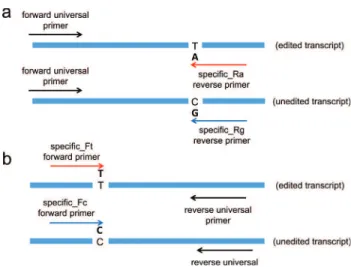
A set of primers was designed according to (Chenet al., 2008) with modifications. For each editing site, we de-signed a set of primers composed by two specific editing primers and one unique universal primer. When the spe-cific editing primers were designed as forward, the univer-sal primer was designed as reverse and vice-versa. The specific editing primers containing a unique difference in the first nucleotide recognized the edited or unedited site (Figure 1). The RT-qPCR reactions were performed in a Bio-Rad CFX384 real time PCR detection system (Bio-Rad, Hercules, CA, USA) using SYBR Green I (Invitro-gen, Carlsbad, CA, USA) to detect double-stranded cDNA synthesis. Reactions were completed in a volume of 10mL containing 5mL of diluted cDNA (1:100), 1 SYBR Green I (Invitrogen, CA, USA), 0.025 mM dNTP, 1 PCR Buffer, 3 mM MgCl2, 0.25 U Platinum Taq DNA Polymerase (Invitrogen, CA, USA) and 200 nM of each universal and C or T-specific primer set. Samples were analyzed in tech-nical quadruplicate in a 384-well plate, and a no-template control was included. The conditions were set as follows: an initial polymerase activation step for 5 min at 95 °C, 40 cycles for 15 s at 95 °C for denaturation, 10 s at 60 °C for annealing and 10 s at 72 °C for elongation. A melting curve analysis was programmed at the end of the PCR run over the range of 65 to 99 °C, and the temperature in-creased stepwise by 0.5 °C.
Threshold and baselines were manually determined using the Bio-Rad CFX manager software. To calculate the
relative expression of transcripts we used the 2-DDCtmethod (Livak and Schmittgen, 2001). Primer efficiencies were calculated by LinRegPCR software (Ruijteret al., 2009) to evaluate a possible amplification by primer efficiency bias. By doing so we obtained independent estimates of amplifi-cation efficiency for each primer in each treatment. Differ-ences in plastid transcript editing among treatments were detected using two-tailed Student’st-tests between means. Significance was set at p < 0.05. Tests were performed with R package software (R Core Team, 2015).
Results
Rates of editing in sRNAs libraries
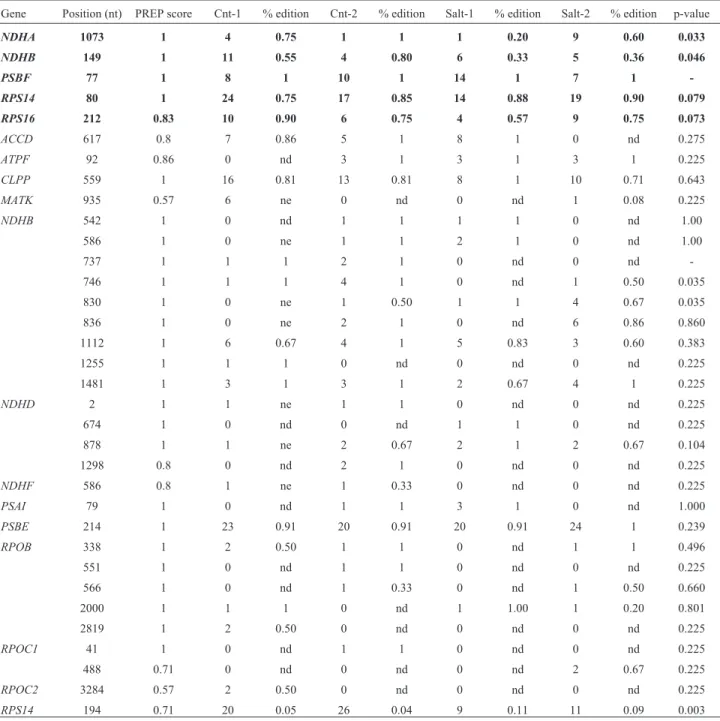
The PREP analysis carried out on soybean chloro-plasts identified 20 different genes that contained RNA ed-iting sites (Table S1). All predicted eded-iting sites were confronted with the aligned sRNA reads in order to evalu-ate the presence/absence of editing events. Edited reads were identified in a set of 16 genes from at least one of the sRNAs library (Table 1). Among 87 predicted edited sites, 34 were confirmed by sRNAs reads. Other predicted sites,
Table 1- Quantitative distribution of sRNAs reads in plastid editing sites, editing percentages and p-values (t-test).
Gene Position (nt) PREP score Cnt-1 % edition Cnt-2 % edition Salt-1 % edition Salt-2 % edition p-value
NDHA 1073 1 4 0.75 1 1 1 0.20 9 0.60 0.033
NDHB 149 1 11 0.55 4 0.80 6 0.33 5 0.36 0.046
PSBF 77 1 8 1 10 1 14 1 7 1
-RPS14 80 1 24 0.75 17 0.85 14 0.88 19 0.90 0.079
RPS16 212 0.83 10 0.90 6 0.75 4 0.57 9 0.75 0.073
ACCD 617 0.8 7 0.86 5 1 8 1 0 nd 0.275
ATPF 92 0.86 0 nd 3 1 3 1 3 1 0.225
CLPP 559 1 16 0.81 13 0.81 8 1 10 0.71 0.643
MATK 935 0.57 6 ne 0 nd 0 nd 1 0.08 0.225
NDHB 542 1 0 nd 1 1 1 1 0 nd 1.00
586 1 0 ne 1 1 2 1 0 nd 1.00
737 1 1 1 2 1 0 nd 0 nd
-746 1 1 1 4 1 0 nd 1 0.50 0.035
830 1 0 ne 1 0.50 1 1 4 0.67 0.035
836 1 0 ne 2 1 0 nd 6 0.86 0.860
1112 1 6 0.67 4 1 5 0.83 3 0.60 0.383
1255 1 1 1 0 nd 0 nd 0 nd 0.225
1481 1 3 1 3 1 2 0.67 4 1 0.225
NDHD 2 1 1 ne 1 1 0 nd 0 nd 0.225
674 1 0 nd 0 nd 1 1 0 nd 0.225
878 1 1 ne 2 0.67 2 1 2 0.67 0.104
1298 0.8 0 nd 2 1 0 nd 0 nd 0.225
NDHF 586 0.8 1 ne 1 0.33 0 nd 0 nd 0.225
PSAI 79 1 0 nd 1 1 3 1 0 nd 1.000
PSBE 214 1 23 0.91 20 0.91 20 0.91 24 1 0.239
RPOB 338 1 2 0.50 1 1 0 nd 1 1 0.496
551 1 0 nd 1 1 0 nd 0 nd 0.225
566 1 0 nd 1 0.33 0 nd 1 0.50 0.660
2000 1 1 1 0 nd 1 1.00 1 0.20 0.801
2819 1 2 0.50 0 nd 0 nd 0 nd 0.225
RPOC1 41 1 0 nd 1 1 0 nd 0 nd 0.225
488 0.71 0 nd 0 nd 0 nd 2 0.67 0.225
RPOC2 3284 0.57 2 0.50 0 nd 0 nd 0 nd 0.225
even with a higher PREP score value, that should indicate a higher confidence, could not be confirmed because they did not present enough coverage (Table S1). A group of four genes was selected considering their total coverage and for being sites with statistical differential values of edited reads between control and salt treatment: NDHA-1073 (p = 0.033),NDHB-149 (p = 0.046),RPS14-80 (p = 0.079) and RPS16-212 (p = 0.073) (Table 1). Other editing sites showed relevant p-value in leaves libraries, however, they were not selected when their total coverage was lower than four reads (Table 1).
Specific primers were designed to detect edition in the four genes and also inPSBF-77 (Table S2) that pre-sented 100% of edited reads in all anchored sRNAs. Except forRPS14-80, sRNA analysis demonstrated that in the se-lected genes, the editing percentage was higher in control libraries than in salt-treated ones (Table 1). A parallel anal-ysis of editing sites using mRNA data showed relevant val-ues in coverage and edited reads that shared similar patterns to those observed with sRNA, except forNDHA-1073 and NDHB-149 (Table S3).
Rate of editing of chloroplast transcripts by RT-qPCR
RT-qPCR was used to measure the relative amount of edited and unedited plastid transcripts at 4 and 24 hours, comparing control and salt treatment. Using LinRegPCR software, the efficiency of each amplification was calcu-lated; for each editing primer, only reactions with effi-ciency higher than 1.75 were maintained in the analysis. The mean efficiency of all primers was higher than 1.80, and was not significantly different when compared with the pairs of C/G and T/A specific primers (Table S4).
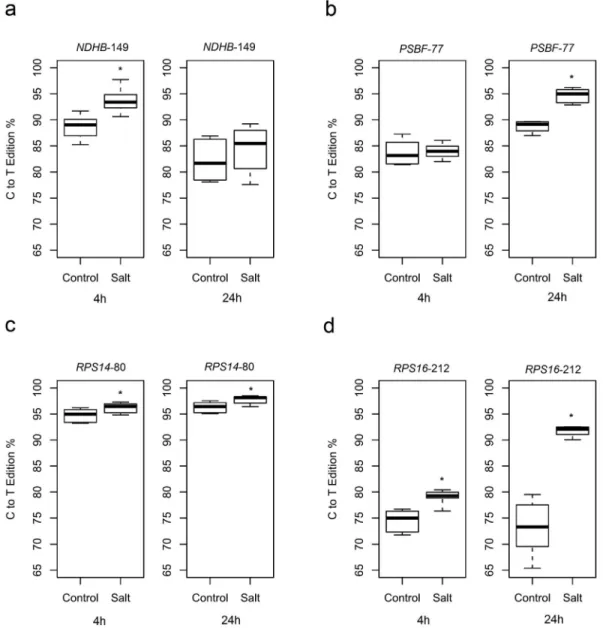
The rate of edition was affected in all four genes when leaf samples were collected 4 hours after the salt treatment. The percentage of C to T editing varied in all genes. A sta-tistically significant increase in RNA edition was observed for salt-treated samples:NDHB-149 presented an increase in editing from 88.7% to 93.7% (p = 0.004) (Figure 2a), RPS14-80 from 94.76% to 96.20% (p = 0.05) (Figure 2c) andRPS16-212 from 74.5% to 78.99% (p = 0.003) (Figure 2d).NDHA-1073 presented an absolute reduction in the av-erage of editing percentage, but due to variance, without statistical significance (from 77.79% to 70.53%, p = 0.285) (Figure S3); thePSBF-77 editing percentage was not sig-nificantly different (from 83.36% to 84%, p = 0.629) (Fig-ure 2b). When salt treatment was extended to 24 hours, an increase in editing percentage was verified in PSBF-77 from 88.75% to 94.70% (p = 0.0001) (Figure 2b),RPS14 -80 from 96.31% to 97.76% (p = 0.025) (Figure 2c) and RPS16-212 from 73.10% to 91.65% (p = 0.0002) (Figure 2d).NDHA-1073 andNDHB-149 presented no statistical differences in their editing percentages, with values from 61.51% to 60.97% (p = 0.861) (Figure S3), and from 82.18% to 84.39% (p = 0.395) (Figure 2a) respectively.
In order to evaluate if differences in editing efficiency could be correlated with transcriptional rate, a differential gene expression of chloroplast editing genes was per-formed using RNA sequence libraries. In sRNAs libraries, no differences were found between control and salt treat-ment for the analyzed chloroplast editing genes (Figure S1). The same analysis of chloroplast gene expression was performed with mRNA libraries, and no differences were found (Figure S2a). Contrarily, when all nuclear genes were compared, a differential expression was detected.
Discussion
Plant responses to salt stress have been examined due to their agronomic implications. Our results demonstrated variability in plastid transcript editing in soybeans, in re-sponse to salt treatment. The selected editing sites showed different coverage of sRNAs when control samples were compared to salt treated ones. Plastid sRNAs present as peaks of sequence reads indicated that they are found at coverage levels similar to, or even higher than matching mRNAs (Zhelyazkovaet al., 2011). The parameters that determine the rate of the initiating endonucleolytic cleav-age for chloroplast RNA decay are not known. These pa-rameters are likely to include sequence and structure of mRNAs, their extent of ribosome association, and the pres-ence of other RNA-binding proteins that mask or expose potential RNase cleavage sites (Barkan, 2011). Therefore, an increase in translation and consequent protection by the ribosome and PPR-like proteins association can lead to a reduction in the degradation of edited transcripts. This could explain the reverse correlation between total sRNA coverage decrease in editing sites and the increase in edit-ing percentage demonstrated by RT-qPCR assays, as ob-served forNDHB-149.
experi-mental approaches are necessary to confirm a possible role of transcriptional changes in the increase of editing. After 24 hours of treatment, theNDHBediting level returned to normal baseline, possibly causing a mechanism by which the photosynthesis system can be impaired, when ROS be-gin to cause effects, such as inhibition of PSII repair and of protein synthesis.
The impact of non-editing of thePSBFplastid gene has been described in anLPA66mutant for which a PPR re-sponsible for editingPSBF-77 should be encoded. Its mor-phological aspects were reduced growth, and pale green leaves under optimal growth, due to perturbed PSII func-tions (Caiet al., 2009). In our results, the editing percentage of PSBF-77 showed an increase during the salt stressed condition, probably aiming at translation and repair
en-hancement of PSII. Although after 24 hours of treatment an increase in editing percentage ofPSBFtranscripts (compo-nent of PSII) occurred, salt stress has been reported to en-hance photodamage to PSII by excess ROS suppressing transcription and translation of thePSBAgene and inhibit-ing the repair of PSII inSynechocystis(Kreslavskiet al., 2007; Murataet al., 2007).
Decreased or incomplete editing ofRPS14andRPS16 tran-scripts can affect the plastid-encoded protein synthesis. Ef-fects of incomplete editing inRPS12were reported, result-ing in the synthesis of polymorphic polypeptides in plant mitochondria (Phreaner, 1996). In heat stress, the editing status ofRPS14decreased rapidly in response to change in temperature, and it remained low after an extended period of acclimatization (Nakajima and Mulligan, 2001).RPS14 andRPS16gene expression is regulated by cytokinins (CK) and abscisic acid (ABA) (Cherepneva et al., 2003; Yamburenkoet al., 2013). Chloroplast transcription can be stimulated by CK in response to ABA, drought, and salt-induced senescence. Specific ABA and stress-respon-sive CK receptors have been described, and maybe a cross-talk among CK, ABA and stress signaling pathways exists (Tranet al., 2007). The increase in editing ofRPS14and RPS16transcripts can be linked to a CK response against salt-induced senescence.
Based on our results, salt stress enhances the editing process in transcript components of the NDH, PSII, and translation complexes. All analyzed editing sites had a per-centage of increase that can be a response to keep homeo-stasis of chloroplast functions. The maintenance of edited codons seems to be essential for protein function, and the editing process responds to this demand. Other studies that measure transcription, editing and translation of edited genes in different time intervals and salt concentrations can help to reveal the floating diversity in all edited transcripts and correlate these to other salt stress-induced responses of the editing process.
Acknowledgments
This work was sponsored by CNPq, Brazil. FRK was sponsored by a FAPERGS/CAPES-DOCFIX (1634-2551/13-9) grant.
References
Anders S and Huber W (2010) Differential expression analysis for sequence count data. Genome Biol 11:R106.
Barkan A (2011) Expression of plastid genes: Organelle-specific elaborations on a prokaryotic scaffold. Plant Physiol 155:1520-1532.
Barkan A and Small I (2014) Pentatricopeptide repeat proteins in plants. Annu Rev Plant Biol 65:415-442.
Boussardon C, Avon A, Kindgren P, Bond CS, Challenor M, Lurin C and Small I (2014) The cytidine deaminase signa-ture HxE(x)(n)CxxC of DYW1 binds zinc and is necessary for RNA editing of ndhD-1. New Phytol 203:1090-1095. Cai W, Ji D, Peng L, Guo J, Ma J, Zou M, Lu C and Zhang L
(2009) LPA66 Is required for editing psbF chloroplast tran-scripts in Arabidopsis. Plant Physiol 150:1260-1271. Castandet B and Araya A (2011) RNA editing in plant organelles.
Why make it easy? Biochemistry 76:924-931.
Chateigner-Boutin A.-L and Small I (2007) A rapid high-throughput method for the detection and quantification of
RNA editing based on high-resolution melting of amplicons. Nucleic Acids Res 35:e114
Chateigner-Boutin A-L and Small I (2010) Plant RNA editing. RNA Biol 7:213-219.
Chateigner-Boutin AL and Small I (2011) Organellar RNA edit-ing. Wiley Interdiscip Rev RNA 2:493-506.
Chen Y, Kao S, Chou H and Lin W (2008) A real-time PCR method for the quantitative analysis of RNA editing at spe-cific sites. Anal Biochem 375:46-52.
Cherepneva GN, Schmidt K-H, Kulaeva ON, Oelmüller R and Kusnetsov VV (2003) Expression of the ribosomal proteins S14, S16, L13a and L30 is regulated by cytokinin and abscisic acid. Plant Sci 165:925-932.
FAO and ITPS (2015) Global Soil Status, Processes and Trends. Status of the World’s Soil Resources (SWSR) - Main Re-port. Food and Agriculture Organization of the United Na-tions and Intergovernmental Technical Panel on Soils, Ro-me, pp 98-168.
García-Andrade J, Ramírez V, López A and Vera P (2013) Medi-ated plastid RNA editing in plant immunity. PLoS Pathog 9:e1003713.
Gomez JM (2003) Location and effects of long-term NaCl stress on superoxide dismutase and ascorbate peroxidase isoen-zymes of pea (Pisum sativumcv. Puget) chloroplasts. J Exp Bot 55:119-130.
Guevara J, Sukerman M and Velasco M (2015) OECD-FAO Ag-ricultural Outlook 2015. http://www.oecd-ilibrary.org/docserver/download/5115021e.pdf.
Hayes ML, Dang KN, Diaz MF and Mulligan RM (2015) A con-served glutamate residue in the C-terminal deaminase do-main of Pentatricopeptide Repeat Proteins is required for RNA editing activity. J Biol Chem 290:10136-10142. He Y, Fu J, Yu C, Wang X, Jiang Q, Hong J, Lu K, Xue G, Yan C,
James A,et al.(2015) Increasing cyclic electron flow is re-lated to Na+ sequestration into vacuoles for salt tolerance in soybean. J Exp Bot 66:6877-6889.
Inada M, Sasaki T, Yukawa M, Tsudzuki T and Sugiura M (2004) A systematic search for RNA editing sites in pea chloro-plasts: An editing event causes diversification from the evolutionarily conserved amino acid sequence. Plant Cell Physiol 45:1615-1622.
Kakizaki T, Yazu F, Nakayama K, Ito-Inaba Y and Inaba T (2012) Plastid signalling under multiple conditions is accompanied by a common defect in RNA editing in plastids. J Exp Bot 63:251-260.
Karcher D and Bock R (2002) Temperature sensitivity of RNA editing and intron splicing reactions in the plastid ndhB tran-script. Curr Genet 41:48-52.
Kearse M, Moir R, Wilson A, Stones-Havas S, Cheung M, Stur-rock S, Buxton S, Cooper A, Markowitz S, Duran C,et al.
(2012) Geneious Basic: An integrated and extendable desk-top software platform for the organization and analysis of sequence data. Bioinformatics 28:1647-1649.
Koyro H-W (2006) Effect of salinity on growth, photosynthesis, water relations and solute composition of the potential cash crop halophytePlantago coronopus(L.). Environ Exp Bot 56:136-146.
Langmead B, Trapnell C, Pop M and Salzberg SL (2009) Ultrafast and memory-efficient alignment of short DNA sequences to the human genome. Genome Biol 10:R25.
Le DT, Nishiyama R, Watanabe Y, Tanaka M, Seki M, Ham LH, Yamaguchi-Shinozaki K, Shinozaki K and Tran LSP (2012) Differential gene expression in soybean leaf tissues at late developmental stages under drought stress revealed by ge-nome-wide transcriptome analysis. PLoS One 7:e49522. Livak KJ and Schmittgen TD (2001) Analysis of relative gene
ex-pression data using real-time quantitative PCR and the 2^(-DDCT) method. Methods 25:402-408.
Lu KX, Yang Y, He Y and Jiang DA (2008) Induction of cyclic electron flow around photosystem 1 and state transition are correlated with salt tolerance in soybean. Photosynthetica 46:10-16.
Lurin C, Andrés C, Aubourg S, Bellaoui M, Bitton F, Bruyère C, Caboche M, Debast C, Gualberto J, Hoffmann B, et al.
(2004) Genome-wide analysis of Arabidopsis Pentatrico-peptide Repeat Proteins reveals their essential role in orga-nelle biogenesis. Plant Cell 16:2089-2103.
Mahajan S and Tuteja N (2005) Cold, salinity and drought stres-ses: An overview. Arch Biochem Biophys 444:139-158. Martín M and Sabater B (2010) Plastid ndh genes in plant
evolu-tion. Plant Physiol Biochem 48:636-645.
Mower JP (2009) The PREP suite: Predictive RNA editors for plant mitochondrial genes, chloroplast genes and user-defined alignments. Nucleic Acids Res 37:W253-W259. Murata N, Takahashi S, Nishiyama Y and Allakhverdiev SI
(2007) Photoinhibition of photosystem II under environ-mental stress. Biochim Biophys Acta - Bioenerg 1767:414-421.
Nakajima Y and Mulligan M (2001) Heat stress results in incom-plete C-to-U editing of maize chloroplast mRNAs and corre-lates with changes in chloroplast transcription rate. Curr Genet 40:209-213.
Parida AK and Das AB (2005) Salt tolerance and salinity effects on plants: A review. Ecotoxicol Environ Saf 60:324-349. Peng L, Yamamoto H and Shikanai T (2011) Structure and
bio-genesis of the chloroplast NAD(P)H dehydrogenase com-plex. Biochim Biophys Acta - Bioenerg 1807:945-953. Phreaner CGG (1996) Incomplete editing of rps12 transcripts
re-sults in the synthesis of polymorphic polypeptides in plant mitochondria. Planty Cell Online 8:107-117.
R Development Core Team (2011), R: A Language and Environ-ment for Statistical Computing. The R Foundation for Statis-tical Computing,Vienna. Available online at http://www.R-project.org/.
Rüdinger M, Funk HT, Rensing SA, Maier UG and Knoop V (2009) RNA editing: Only eleven sites are present in the Physcomitrella patens mitochondrial transcriptome and a universal nomenclature proposal. Mol Genet Genomics 281:473-481.
Ruijter JM, Ramakers C, Hoogaars WMH, Karlen Y, Bakker O, van den Hoff MJB and Moorman AFM (2009) Amplifica-tion efficiency: Linking baseline and bias in the analysis of quantitative PCR data. Nucleic Acids Res 37:e45-e45. Ruwe H and Schmitz-Linneweber C (2012) Short non-coding
RNA fragments accumulating in chloroplasts: Footprints of RNA binding proteins? Nucleic Acids Res 40:3106-3116.
Small ID and Peeters N (2000) The PPR motif - A TPR-related motif prevalent in plant organellar proteins. Trends Bio-chem Sci 25:45-47.
Sudhir P, Pogoryelov D, Kovács L, Garab G and Murthy SDS (2005) The effects of salt stress on photosynthetic electron transport and thylakoid membrane proteins in the Cyanobacterium. J Biochem Mol Biol 38:481-485. Takenaka M, Verbitskiy D, van der Merwe JA, Zehrmann A and
Brennicke A (2008) The process of RNA editing in plant mi-tochondria. Mitochondrion 8:35-46.
Takenaka M, Zehrmann A, Verbitskiy D, Härtel B and Brennicke A (2013) RNA editing in plants and its evolution. Annu Rev Genet 47:335-352.
Tiller N, Weingartner M, Thiele W, Maximova E, Schöttler MA and Bock R (2012) The plastid-specific ribosomal proteins of Arabidopsis thalianacan be divided into non-essential proteins and genuine ribosomal proteins. Plant J 69:302-316.
Tran L-SP, Urao T, Qin F, Maruyama K, Kakimoto T, Shinozaki K and Yamaguchi-Shinozaki K (2007) Functional analysis of AHK1/ATHK1 and cytokinin receptor histidine kinases in response to abscisic acid, drought, and salt stress in Arabidopsis. Proc Natl Acad Sci U S A 104:20623-20628. Tseng CC, Lee CJ, Chung YT, Sung TY and Hsieh MH (2013)
Differential regulation of Arabidopsis plastid gene expres-sion and RNA editing in non-photosynthetic tissues. Plant Mol Biol 82:375-392.
Van Den Bekerom RJM, Dix PJ, Diekmann K and Barth S (2013) Variations in efficiency of plastidial RNA editing within ndh transcripts of perennial ryegrass (Lolium perenne) are not linked to differences in drought tolerance. AoB Plants 5:plt035-plt035.
Wagoner JA, Sun T, Lin L and Hanson MR (2015) Cytidine deaminase motifs within the DYW domain of two Pentatri-copeptide Repeat-containing proteins are required for site-specific chloroplast RNA editing. J Biol Chem 290:2957-2968.
Wang W, Vinocur B and Altman A (2003) Plant responses to drought, salinity and extreme temperatures: Towards ge-netic engineering for stress tolerance. Planta 218:1-14. Wolf PG, Rowe CA and Hasebe M (2004) High levels of RNA
ed-iting in a vascular plant chloroplast genome: Analysis of transcripts from the fernAdiantum capillus-veneris. Gene 339:89-97.
Yagi Y, Tachikawa M, Noguchi H, Satoh S, Obokata J and Nakamura T (2013) Pentatricopeptide repeat proteins in-volved in plant organellar RNA editing. RNA Biol 10:1419-1425.
Yamburenko MV, Zubo YO, Vanková R, Kusnetsov VV, Ku-laeva ON and Börner T (2013) Abscisic acid represses the transcription of chloroplast genes. J Exp Bot 64:4491-4502. Yap A, Kindgren P, Colas des Francs-Small C, Kazama T, Tanz
SK, Toriyama K and Small I (2015) AEF1/MPR25 is impli-cated in RNA editing of plastid atpF and mitochondrial nad5 , and also promotes atpF splicing in Arabidopsis and rice. Plant J 81:661-669.
Zhelyazkova P, Hammani K, Rojas M, Voelker R, Vargas-Suárez M, Börner T and Barkan A (2011) Protein-mediated protec-tion as the predominant mechanism for defining processed mRNA termini in land plant chloroplasts. Nucleic Acids Res 40:3092-3105.
Zheng C, Jiang D, Liu F, Dai T, Jing Q and Cao W (2009) Effects of salt and waterlogging stresses and their combination on leaf photosynthesis, chloroplast ATP synthesis, and antioxi-dant capacity in wheat. Plant Sci 176:575-582.
Supplementary Material
The following online material is available for this article: Table S1 - Editing analyses of plastid CDS from small RNA seq.
Table S2 - Sequences and descriptions of real time primers.
Table S3 - Editing analyses of plastid CDS from mRNA seq.
Table S4 - Means of RT-qPCR primer efficiency and corre-lation.
Table S5 - Identification of chloroplast genes in heatmap. Figure S1 - Heatmap of relative expression of plastid genes. Figure S2 - Heatmap of relative expression of plastid genes and differentially expressed nuclear genes.
Figure S3 - Boxplot of percentage editing of the NDHA-1073 editing site.
Associate Editor: Nelson Saibo