EFFECT OF NOZZLE HOLE SIZE COUPLING WITH
EXHAUST GAS RE-CIRCULATION ON THE ENGINE EMISSION
PERFORMANCE BASED ON KH-ACT SPRAY MODEL
byLiang ZHANGa, Zhixia HEb*, Qian WANGa, and Genmiao GUOa aSchool of Energy and Power Engineering, Jiangsu University, Zhenjiang, China
bInstitute for Energy Research, Jiangsu University, Zhenjiang, China
Original scientific paper DOI: 10.2298/TSCI150417182Z
To research an effective measure of reducing the soot and NOxin engine at the same
time, different nozzle hole diameters coupled with exhaust gas re-circulation were adopted in this study based on KH-ACT spray breakup model, which takes the aero-dynamic-induced, cavitation-induced, and turbulence-induced breakup into ac-count. The SAGE detailed chemistry combustion and the new atomization model used in the simulation have been verified with the experiment data from YN4100QBZL engine. Different diesel nozzles were adopted in the study combined with different exhaust gas re-circulation rates ranging from 0% to 40%. The simu-lation results show that the NOxemission could be reduced effectively for both
small (0.1 mm) and large (0.15 mm) diesel nozzles when increasing exhaust gas re-circulation ratio. The soot emission increases for the small nozzle hole size as the exhaust gas re-circulation increasing. However, when it comes to the large die-sel nozzle, the emission increases slightly firstly and decreases quickly when the ex-haust gas re-circulation rate above 20%.
Key words: Diesel engine, atomization, emission, nozzle diameter, exhaust gas re-circulation
Introduction
With increasing concerns about depletion in petroleum resources and environment problems, driving the demand for high-fuel-efficient engines, compression ignition engine has attracted more and more attention for its high compression ratios and combustion-efficient [1]. But the nitrogen oxides (NOx) and particulate matter (PM) emissions of Diesel engine have led to environmental concerns and increasingly stringent pollution standards. Many advanced tech-nologies have been investigated to reduce the engine emissions [2, 3]. Especially, a lot of im-provements have been achieved in fuel injection systems and new combustion concepts such as low temperature combustion (LTC) with high rate of exhaust gas re-circulation (EGR) which is generally applied to reduce NOxproduction.
It is well known that the formation of NOxduring combustion could be suppressed by thermal, chemical, and dilution effects of EGR [4]. The EGR into the engine intake is an estab-lished technology to reduce NOxemissions which is a significant challenge for Diesel engine. According to the recent study [5], the in-cylinder strategies largely focus on reducing the
der combustion temperature. Such strategies can be classified as LTC. The combustion tempera-tures are reduced by dilution of the in-cylinder mixture, or with moderating to high levels of EGR. Quite a lot of lectures [6] show that the dilute gas by EGR could increase the fuel-specific heat capacity of the combustion mixtures, besides the oxygen concentration is also decreased, which further slows NOxformation kinetics.
Simulation [7] was performed to analyze the combustion and emission characteristics of different EGR rates. The conditional temperature at the EGR rate of 68% is between 1000 K and 1600 K, while at the EGR rate of 48% the results showed conditional temperature distribu-tion between 1000 K and 2200 K. It was also shown that the temperature is the most sensitive pa-rameter to suppress NOx. Montgomery and Reitz [8] studied the effect of EGR in a heavy-duty Diesel engine with EGR levels varying between 10% and 25%. Their investigation revealed that the use of EGR decreases the NOxemission by limiting the peak heat release rate (HRR) due to premixed combustion, thus lowering the in-cylinder temperature.
On the other hand the soot emission may increase for lack of oxygen if high level of EGR used. The decrease in combustion temperatures and oxygen concentration while increas-ing EGR rate reduces both soot production in the spray core and soot oxidation in the diffusion flame around the jet.
Soot formation rate depends strongly on temperature and on carbon to oxygen ratio in combustion systems. Some studys [9] showed that smaller size orifice could depress the soot formation because the micro orifice would decrease the droplet sizes and improve the air-fuel mixing which can depress the soot formation. According to Gao [10] the reduction in orifice di-ameter affects the fuel spray in different ways. First, the spray tip penetration will be reduced [11]. Second, the droplet sizes will be reduced so they evaporate quickly [12], and the mixing rate between air and fuel improves [13]. In addition, the flame lift-off length is relatively longer with decreased orifice diameter [14]. However, the other researchers [15] also argued that smaller orifice diameter tends to increase the exhaust soot because the jet momentum is lower and the spray penetration is excessively decreased, air in the piston cavity cannot be fully uti-lized to produce the well mixed fuel-air gas. Thus the final impact of diesel nozzle size on emis-sions is complex and the result of contradictory phenomena.
In the conventional diesel high-temperature combustion (HTC), it is quite difficult to reduce both NOxand soot at the same time [16, 17] because of different conditions required for reduction of each. The increase of EGR rate (at constant boost pressure) is accompanied by an increase of PM emissions [4]. Decreasing the nozzle hole size with high injection pressure adopted could improve the fuel and air mixture and depress the soot formation as a result. To re-duce the NOxand soot emission at the same time, the authors tried to combine the small diesel nozzle (high injection pressure) and EGR together to improve Diesel engine emission character-istics. However, it is still unclear that the effect of nozzle hole size coupled with different EGR ratio on combustion and emission characteristics though many researches about EGR or nozzle geometry and their influence on combustion have been done.
For the reasons, the aim of this study was to show possibility of NOxand soot emission reductions of a Diesel engine using different EGR ratios coupling three different size nozzle hole. In this research, EGR rates ranging from 0% to 40% were used to reduce the NOxemission, and different nozzle diameters of 0.1 mm, 0.15 mm, and 0.2 mm were adopted to research their effects on pollutants formation at low and high EGR rates.
Numerical approach
Kel-vin-Helmholtz-Aerodynamically, Cavitation and Turbulence induced Breakup Model (KH-ACT Breakup Model) and Rayleigh-Tay-lor Breakup Model (RT Breakup Model) were used to simulate the fuel atomization and breakup processes. Once the liquid spray is in-jected into the combustion chamber, a model is needed to convert the liquid into gaseous va-por. During the simulation, the time rate of charge of droplet radius due to vaporization is calculated from Frossling correlation. The
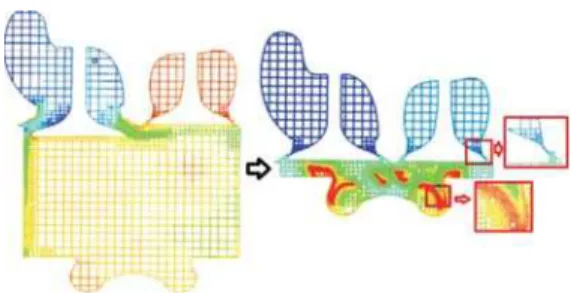
widely used O'Rourke [19] collision and coalescence model is implemented. Effects associated with spray/wall interactions, including droplet splash, film spreading due to impingement forces and motion due to film inertia were considered in the wall-film model. The liquid atomization and droplets vapor models work seamlessly with the SAGE detailed chemistry solver which is a general combustion model used to solve the detail chemical kinetics in combustion calculations. To reduce the computational time, a 76 species reduced C7H16 chemistry mechanism was adopted. In the present simulation, a perfectly orthogonal, structured grid can be automatically generated during simulation as shown in fig. 1. The sophisticated meshing technologies auto-matically add mesh elements when and where they are most needed to minimize the grid effects on the spray and combustion results.
The KH-ACT breakup model was used to calculate the droplet breakup process of high-pressure solid-cone spray injections which is first proposed by Som and Aggarwal [20], and the new diesel spray breakup model takes the aerodynamic-induced, cavitation-induced, and turbulence-induced breakup into account. The KH-ACT is short for Kelvin-Helmholtz breakup and Aerodynamic-induced, Cavitation-induced and Turbulence-induced breakup. The ratio of length (LA) and time (tA) scales for each process is calculated. As seen from eq. (1) rate of decrease in droplet radius determines the dominant breakup process:
L L t
t
L L t
t
A
A
T
T
CAV
CAV KH
KH
t t t t
= ìí
î
ü ý þ
max ( )
( ); ;
( )
( ) (1)
whereLT(t) andtT(t) are the length and time scale for the turbulence induced breakup, respec-tively,LCAVandtCAVare the length and time scale for the cavitation induced breakup, respec-tively,LKHandtKHare length and time scale for the aerodynamic induced breakup, respectively. The KH model is used to calculate the instantaneous length and time scales for every parcel. During breakup the radius of the parent droplet parcel (r) decreases continuously according to the following equation until it reaches the stable droplet radius (rKH):
LKH = -r rKH, rKH £r (2)
the breakup timetKHis given by:
tKH
KH KH
= 3276. B r1
W L (3)
whereB1is related to the initial disturbance level on the liquid jet,WKHandLKHare the maxi-mum growth rate and the corresponding wave length in the desired dispersion relation, respec-tively, given by Reitz.
When it comes to the turbulence induced breakup model, the turbulent fluctuations in the jet are responsible for the initial perturbations on the jet surface. The waves grow according to KH instabilities until they breakup from the jet surface. Following to Huh and Gosman [21] the relevant time and length scales for turbulence induced breakup can be calculated:
L t C K t
t
T( )
( ) ( ) . = æ è ç ö ø ÷ m e 1 5 (4) t e m T( )
( ) t =C æK t
è
ç ö
ø
÷ (5)
wheree(t) andK(t) are the instantaneous turbulent dissipation rate and kinetic energy, respec-tively. BesidesCmandCeare turbulence model constants ink-eequation.
In the cavitation induced breakup case, according to Bianchiet al. [22] and Amsden et al. [23], the characteristic cavitation time scale is calculated:
tCAV =min(tcollapse:tburst) (6)
Following Rayleigh Plesset theory [24], the bubble collapse time can be calculated:
tcollapse CAV rl v
=09145. R
p (7)
whereRCAVis the effective radius,pv– the fuel vapor pressure, andrl– the fuel density.
tburst = hole- CAV
¢
r R
uturb (8)
whererholeis the exit radius of the nozzle orifice, and the turbulent velocityu¢turb =[2K t( )]1 2/ /3 can be obtained from inner nozzle flow calculations. If aerodynamic-induced breakup process is dominant, the KH model is employed for primary atomization. However, if cavitation or turbu-lence processes dominate then the following breakup law is applied:
d d T,CAV A A r t C L = -t (9)
TheCT,CAVis the model constant whose value ranges from 0.1 to 1. The new primary breakup model, which includes the effects of aerodynamics, turbulence, and cavitation, is called KH-ACT breakup model. It has been validated by experiment and simulation [20].
The extended Zel'dovich mechanism as presented by Heywood [25] was used to calcu-late NO formation. Soot emission is predicted using a Hiroyasu and Kadota NSC Model [26]. The production of soot massMs(g) within a computational cell can be determined from a sin-gle-step competition between the soot mass formation rateM&sf( / )g s and the soot mass oxida-tion rate M&soaccording to Hiroyasu and Kadota [26].
d d
s
sf so
M
t M M
= & - & (10)
where the formation rate is given:
& . exp
M M A P E
T
sf form sf sf
u R
= æ
-è
çç ö
ø ÷÷
0 5 (11)
&
M M
D R MW
so s s s
total c
= 6
In eq. (11),Mfoamis the mass of the soot formation species,P– the pressure, Ru– the universal gas constant, T– the temperature, Esf– the activation energy, Asf– the Arrhenius pre-exponential factor,MWc– the molecular weight of carbon,rs– the soot density,Ds– the nominal soot particle diameter, andRtotal– the net reaction rate. The emission models have been proved to perform in combustion and emission characteristics for engine simulation.
Model validation
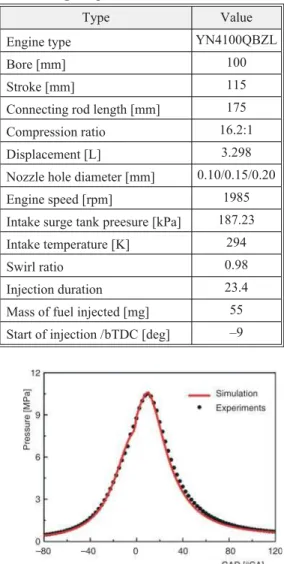
In this study the engine data used for model validation is a YN4100QBZL Diesel engine. The operation and specifications of the engine are listed in tab. 1.
Figure 2 gives a comparison between the experimental and the calculated cylinder pressure for the case no EGR used. It is clear that the simulation results match the experi-mental date fine, and most of the major char-acteristics of combustion in the experiments could be produced in this simulation.
As for EGR technology could be used to reduce NOx, and micro-orifice nozzle has a great effect on soot emission. In this study, three different diameter nozzles of 0.1 mm, 0.15 mm, and 0.2 mm coupled with EGR varying from 0% to 40% were applied. The effect of both nozzle diameters and EGR rates on the combustion and emissions are analyzed in this research. To simulate the case of EGR, assuming that intake gas with EGR has a similar composition with actual burned gas mixture of fresh air, nitrogen, carbon dioxide, and water vapor. The EGR rate can be defined:
EGR=
-CO CO amb
CO exh CO amb
2 2
2 2
100
(int) ( )
( ) ( ) % (13)
Results and discussions
Effects of EGR on combustion characteristics
The EGR involves reintroducing exhaust gases into the intake charge of the engine. Be-cause the specific heats of CO2 and H2O are slightly higher than that of the air, which
re-duces the combustion chamber temperature during the compression stroke. Besides the CO2and H2O present in the exhaust decreases the oxygen content in the intake charge. Both the thermal effect and the dilution effect of EGR have a great effect on the combustion and emission
charac-Table 1. Engine specifications
Type Value
Engine type YN4100QBZL
Bore [mm] 100
Stroke [mm] 115
Connecting rod length [mm] 175
Compression ratio 16.2:1
Displacement [L] 3.298
Nozzle hole diameter [mm] 0.10/0.15/0.20
Engine speed [rpm] 1985
Intake surge tank preesure [kPa] 187.23
Intake temperature [K] 294
Swirl ratio 0.98
Injection duration 23.4
Mass of fuel injected [mg] 55
Start of injection /bTDC [deg] –9
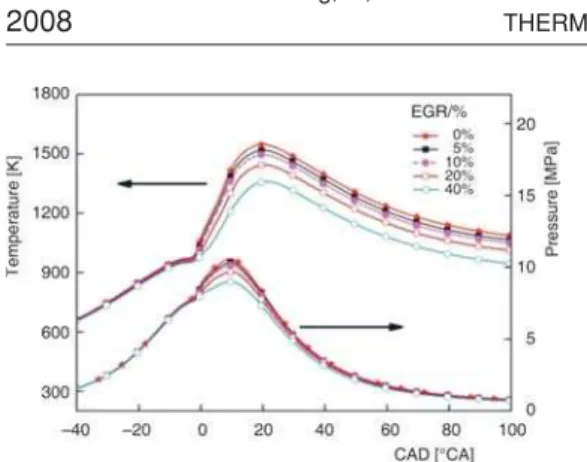
teristics in the cylinder. In this study, EGR ratios used were 0, 5%, 10%, 20%, and 40%. Figure 3 shows the cylinder pressure and temperature from simulation at different EGR levels. It can be seen that the peak in-cylinder pressure decreased dramatically as the EGR ratio increases, and so the temperature. Figure 4 gives the decreased amplitude (dp) of the max pressure (Pmax), and temperature (Tmax) under different EGR ratios comparing to the case without EGR. The parame-ter dpcan be defined:
DP P P D
P T
T T
max
max max
max
max
max max
% ( ) ( )
( ) , %
( ) (
= y - 0 = y
-0
0
0 )
( ) max
T (14)
wherePmax(y) andTmax(y) are the maximum of the pressure and temperature of the combustion in cylinder under corresponding EGR rate, respectively, andyrefers to the EGR ratio used. Be-cause more high specific heats molecules such as CO2and H2O also have negative effects on the temperature increasing, the mean pressure and temperature decreases as the EGR ratio increas-ing due to the oxygen content decreased. As shown in fig. 3, both and decreased linearly as EGR ratio increasing from 0% to 40%.
The heat release rate of the cylinder for different EGR ratios has been given in fig. 5. It is clear that the exhaust gas has little influence on the combustion characteristics at low EGR ra-tios. The diffusion combustion and premixed combustion can be distinguished easily. With more and more exhaust gas introduced into the cylinder, the heat released from both diffusion combustion and premixed combustion de-clined. But the heat release rate of premixed combustion decreases more dramatically, even the premixed combustion is hardly to distin-guish for the case of EGR ratios higher than 20%. One reason for these phenomena may be that the proportion of triatomic molecules in-creases when more exhaust gas is recycled in the combustion system. For the high specific heats of the triatomic molecules the gas have, more heat would be absorbed and the total heat released will be cut down.
Figure 3. Cylinder temperature and pressure under different EGR ratios
Figure 4. The effect of EGR on the maximum of temperature and pressure
Influence of nozzle diameter
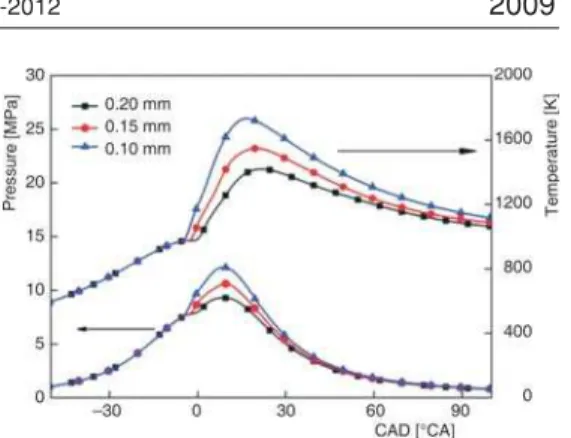
It has been known that the mixture of fuel and gas has direct effects on the combustion. As a common way to enhance the combustion effi-ciency and modify the emission characteristics, optimizing the nozzle geometry to promote fuel and air mixture has excited the interest of many scholars at home and abroad. Micro nozzle ori-fice has been adopted for small droplets pro-duced and good atomization achieved recent years. On the other hand, the oxygen in the cyl-inder could not been used fully for short spray penetration when the nozzle hole diameters de-crease. What is more, rich-fuel zone is easy to form, which will have negative effect on soot emission. Figure 6 gives the pressure and mean temperature in the cylinder for different nozzle diameters such as 0.1 mm, 0.15 mm and 0.2 mm. The peak pressure and temperature is higher as the nozzle diameter decreasing. Because the smaller droplets from small nozzle take less time to evaporate and mix with oxygen around. The chemical ignition delay reduces and more fuel burns around the top dead center.
The soot emission characteristics have been shown in fig. 7, and the micro nozzles have great advantage over the other nozzles due to its greater atomization. To further analyzing this phenomena, fig. 8 gives the mass fraction of the high temperature gas above 2200 K dur-ing the combustion. The high temperature gas fraction for 0.1 mm case is approximately twice as large as the quantity for 0.15 mm case. It was well known that soot formation rates in com-bustion systems depend on the fuel-air ratio and the temperature [27]. The soot yield strongly increases for air-fuel equivalence ratios richer thanf = 2. For less rich air-fuel ratios that is less rich, the hydrocarbon molecules are pri-marily converted to carbon monoxide instead to soot. Soot formation is further limited for
temperature range 1200 K to 2000 K. This can be explained by the fact that soot formations need radical precursors such as C3H3, which cannot be present at a low temperatures. Conversely, these precursors would be oxidized at elevated temperatures [28]. As shown in figs. 6 and 8, the temperature is higher and the soot formed can be oxidized faster when the 0.1 mm nozzle was used. As a result of above factors, its soot emission is lower for this nozzle.
Figure 6. Influence of nozzle diameter on combustion characteristics
Figure 7. Soot emission characteristics for different nozzles
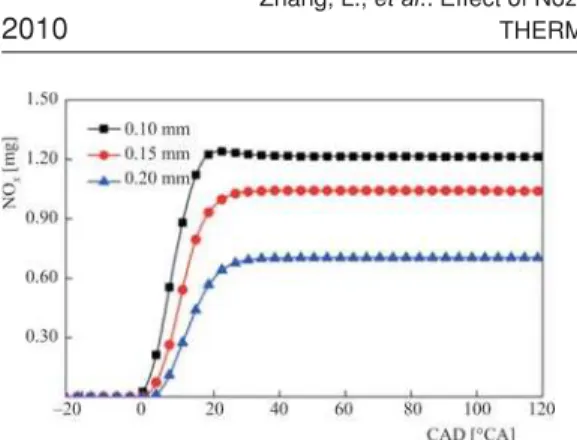
However, more NOxis produced in 0.1 mm nozzle compared with nozzles with larger diameters (fig. 9). The most important mechanism for the production of NOxis the formation of thermal NO. The presence of atomic oxygen, formed from molecular oxygen at temperatures above 2200 K, is the basic condition for formation of thermal NOx(Zeldovich reaction). As is given at fig. 8, it is easier for the 0.1 mm nozzle to produce higher temperature gas and more NOx would appear at the same time. This disadvantage could be resolved by LTC using EGR tech-nology.
Influence of nozzle diameter coupled with EGR
It was shown that smaller size nozzle (0.1 mm) could decrease the soot effectively, but the NOxemission is higher compared with the 0.2 mm nozzle. In order to decrease NOxemission, EGR combined with micro nozzle was used. Figure 10 gives the emission characteristics of 0.15 mm nozzle and 0.1 mm nozzle under different EGR rates. The NOxemission decreases as the EGR increasing for both 0.1 mm and 0.15 mm nozzles, and the NOxemission for 0.15 mm nozzle is always lower than that for 0.1 mm nozzle.
There is a great difference in soot emission between the two nozzles. For the 0.15 mm nozzle, the soot emission increases first when the EGR ratio is lower than 10%. However, when higher EGR utilized, the soot emission begins to decrease as EGR rate growing. When it comes to the 0.1 mm nozzle, the soot formed increases for the oxygen conception decreasing as more and more exhaust gas introduced into the cylinder but still lower than that of 0.15 mm nozzle. To ex-plain these interesting phenomena, it is necessary to analyze the combustion details. The fig. 11 provides the HRR for different cases.
As shown in fig. 11, the nozzle hole size and EGR have a great effect on Diesel engine com-bustion. For 0.15 mm nozzle, the HRR is lower compared with the 0.1 mm nozzle. And the maximum of HRR shows a great significant dif-ference as the EGR rate increasing. Besides, the premixed combustion almost disappears when the EGR rate is above 20%. Reference [29] shows that most soot formed in the premixed
Figure 9. The NOxemissiion for different kind of
nozzles
Figure 10. Emission characteristics of different nozzle with EGR
Figure 11. The HRRvs. EGR rate for different
combustion zone at the beginning of combustion. So the soot emission is depressed under higher EGR rate. Beside the ambient temperature is lower due to the lower HRR. This is another impor-tant factor influencing the soot emission.
Conclusions
To research an effective method of reducing the soot and NOxgeneration engine at the same time, the influence of different nozzle diameters under varied EGR rates on combustion processes and emission products of soot, and NOxwere carefully studied based on the KH-ACT spray model. The main conclusions are as follows:
· Smaller nozzle diameter is more beneficial to diesel atomization and leads to an earlier combustion, a higher maximum temperature and the in-cylinder explosion pressure.
· Soot emission reduces as nozzle diameter increasing, while NOxshowing a contrary tread. Actually, nozzles with smaller orifice diameters have a much more rapid oxidation velocity therefore less soot produced.
· The mass of NOxcan be effectively reduced with the EGR rate increasing. For the smaller diameter nozzle (0.1 mm), the formation of soot has a direct relation to the trend of the EGR rate. However, soot emission of larger diameter nozzle (0.15 mm), with the increase of EGR rate, shows a rule of increasing firstly and then decreasing.
Acknowledgment
This research was supported by the National Natural Science Foundation of China (No. 50806030, No. 51176066) and A Project Funded by the Priority Academic Program Devel-opment of Jiangsu Higher Education Institutions.
References
[1] Bolla, M.,et al., Modelling of Soot Formation in an Heavy-Duty Diesel Engine with Conditional Moment Closure,Fuel, 117(2014), Part A, pp. 309-325
[2] Majewski, W. A., Khair, M. K., Diesel Emissions and their Control, SAE International, Warrendale, Penn., USA, 2006
[3] Johnson, T. V., Diesel Emission Control in Review, Sae paper 2009-01-0121, 2009
[4] Wang, X., Su, W., Numerical Investigation on Relationship between Injection Pressure Fluctuations and Unsteady Cavitation Processes Inside High-Pressure Diesel Nozzle Holes, Fuel, 89 (2010), 9, pp. 2252-2259
[5] Zhang, W.,et al., Influence of EGR and Oxygen-Enriched Air on Diesel Engine NO-Smoke Emission and Combustion Characteristic,Applied Energy, 107(2013), Jul., pp. 304-314
[6] Labecki, L.,et al., Effects of Injection Parameters and EGR on Exhaust Soot Particle Number-Size Distri-bution for Diesel and RME Fuels in HSDI Engines,Fuel, 112(2013), Oct., pp. 224-235
[7] Lee, Y., Huh, K. Y., Analysis of Different Modes of Low Temperature Combustion by Ultra-High EGR and Modulated Kinetics in a Heavy Duty Diesel Engine [J],Applied Thermal Engineering, 70(2014), 1, pp. 776-787
Nomenclature
K(t) – turbulent kinetic energy
LA – KH-ACT model length scale
Ms(g) – soot mass, [g]
& ( / )
Msfg s – soot mass formation rate, [gs–1 ]
Rtotal – reaction rate pv – fuel vapor pressure
rhole – nozzle diameter
u' – turbulent velocity
Greek symbols
e(t) – turbulent dissipation rate
tA – KH-ACT model time scale
rl – fuel density
[8] Montgomery, D. T., Reitz, R. D., Effects of Multiple Injections and Flexible Control of Boost and EGR on Emissions and Fuel Consumption of a Heavy-Duty Diesel Engine. SAE paper 2001-01-0195; 2001 [9] Wang, X.,et al., Effects of Ultra-High Injection Pressure and Micro-Hole Nozzle on Flame Structure and
Soot Formation of Impinging Diesel Spray,Applied Energy, 88(2011), 5, pp. 1620-1628
[10] Gao, J.,et al., Flame Structure of Wall-Impinging Diesel Fuel Sprays Injected by Group-Hole Nozzles,
Combustion and Flame, 156(2009), 6, pp. 1263-1277
[11] Hiroyasu, H., Arai, M., Structures of Fuel Sprays in Diesel Engines, SAE paper 900475, 1990
[12] Kim, B. S.,et al., Effect of the Injector Nozzle Hole Diameter and Number on the Spray Characteristics and the Combustion Performancein Medium-Speed Diesel Marine Engines, SAE paper 2005-01-3853, 2005
[13] Benajes, J.,et al., The Use of Micro-Orifice Nozzles and Swirl in a Small HSDI Engine Operating at a Late Split-Injection LTC Engine,Proceedings, Institute of Mechanical Engineers, Part D,Journal of Automo-bile Engineering, 220(2006), 12, pp. 1807-1817
[14] Siebers, D., Higgins, B., Flame Lift-Off on Direct-Injection Diesel Sprays Under Quiescent Conditions, SAE paper 2001-01-0530, 2001
[15] Bergstrand, P., Denbrantt, I., Diesel Combustion with Reduced Nozzle Orifice Diameter, SAE paper 2001-01-2010, 2001
[16] Benajes, J.,et al., The Role of Nozzle Convergence in Diesel Combustion,Fuel, 87(2008), 10-11, pp. 1849-1858
[17] Lee, Y., Huh, K. Y., Analysis of Different Modes of Low Temperature Combustion by Ultra-High EGR and Modulated Kinetics in a Heavy Duty Diesel Engine,Applied Thermal Engineering, 70(2014), 1, pp. 776-787
[18] Han, Z., Reitz, R. D.,Turbulence Modeling of Internal Combustion Engines Using RNGk-eModels,
Comb. Sci.Tech.,106(1995), pp.
[19] O'Rourke,P. J., Collective Drop Effects on Vaporizing Liquid Sprays, Ph. D.thesis, Princeton University, Princeton, N. J., USA, 1981
[20] Som, S., Aggarwal, S. K., Effects of Primary Breakup Modeling on Spray and Combustion Characteristics of Compression Ignition Engines,Combustion and Flame, 157(2010), 6, pp. 1179-1193
[21] Huh, K. Y., Gosman, A. D., A Phenomenological Model of Diesel Spray Atomization,Proceedings, Inter-national Conference on Multiphase Flows, Tsukuba, Japan, 1991, pp. 515-518
[22] Bianchi, G. M.,et al., Modeling Atomization of High-Pressure Diesel Spray,J. Eng. Gas Turb. Power, 123(2000), 2, pp. 419-427
[23] Amsden, A. A.,et al., KIVA-II: A Computer Program for Chemically Reactive Flows with Sprays, Los Alamos National LaboratoryReport No. LA-11560-MS, Los Alamos, N. Mex., USA, 1989
[24] Brennen, E. C., Cavitation and Bubble Dynamics, Oxford University Press, Oxford, UK., 1995 [25] Heywood, J. B.,Internal Combustion Engine Fundamentables, McGraw Hill, New York, USA, 1988 [26] Hiroyasu, H., Kadota, T., Models for Combustion and Formation of Nitric Oxide and Soot in DI Diesel
Engiens, SAE paper 760129, 1976
[27] Warnatz, J.,et al., Combustion: Physical and Chemical Fundamentals, Modeling and Simulaton, Experi-ments, Pollutant Formation. Springer, Berlin, 2001
[28] Bockhorn, H., Soot Formation in Combustion : Mechanisms and Models, Springer, Berlin, Germany, 1994 [29] Asay, R.,et al., An Empirical, Mixing-Limited, Zero-Dimensional Model for Diesel Combustion, SAE
technical paper 2004-01-0924, 2004