The Siene and Detetion of Gravitational Waves
Barry C. Barish
CaliforniaInstitute ofTehnology LIGO 18-34
1201 E.CaliforniaBlvd.
Pasadena, CA91125,USA
Reeivedon15February,2002
AlbertEinsteinpreditedtheexisteneofgravitationalwavesasaonsequeneofthegeneraltheory
ofrelativity. Inhistheory,hangesintheshapeofonentrationsofmass(orenergy)warp
spae-time,ausedistortionsthatpropagatethroughtheUniverseatthespeedoflight. However,nodiret
detetion ofsuhwaveshas yetbeenmade. A newgeneration ofdetetors promisessensitivities
that will be apable of detetion from avariety of atastrophievents,suhas the gravitational
ollapseofstarsortheoaleseneofompatbinarysystems.
I Introdution
It has been85 years sineEinstein revolutionized our
oneptofgravitybydevelopinganewtheorywherethe
physialonsequenesofgravityarebasedonurvature
of spae-time, rather than amysterious fore between
massivebodies. Gravitationalforesdonotpullonan
objet,asin Newton'stheory. Rather,thepreseneof
massiveobjetsurvespae-timeintheviinityaround
them, and a body moving nearby has its path
deter-minedbythaturvature.
Thisnewtheoryimmediatelysolvedoneofthemost
well known puzzles of the time, involving the planet
Merury. TheorbitofMeruryaroundthesunishighly
elliptialandthepointoflosestapproah,the
perihe-lion, rotates slightly around the sun on eah
traver-sal, makingadaisypattern after manytrips. This
ef-fet isprimarily due tothe gravitationaleets of the
otherplanetsslightlyshiftingtheorbit. However,when
these eets are alulated using Newton's laws, they
aountfor only574 arseondsof the617arseonds
shiftof theperihelion. This disrepanyrepresenteda
rare instane of a failure of Newton's theory of
grav-ity to explain astronomial observations. Of ourse,
this prompted many onjetures to explain the eet,
for examplethat there undetetedplanets,that Venus
washeavierthanthoughtorthatMeruryhadasmall
moon. TheideathatperhapsNewton'stheoryof
grav-itywasn'tthewhole storyseemedanunlikely
possibil-ity. However,whenEinsteinalulatedtheatualshift
preiselyusinghis newtheoryofgravity,thisprovided
adramatidemonstrationthathehaddevelopedanew
theory thatould explainmorethantheprevious
the-Anotherdramatiandnaturalpreditionofthisnew
theoryinvolvedtheeetofgravityonthepathoflight
rays. Sine theeet ofoneobjetonanotherisa
re-sult of a urvature of spae-time in Einstein's theory,
thepassageofamasslesslightwavepastamassivebody
would produe the samekind of distortion on its
tra-jetoryasexperiened by Merurypassingnearbythe
Sun. Einsteinalulatedandpreditedaverysmall
ef-fetofonlyaoupleofarseondsforalightraypassing
nearthesun'ssurfae.Nevertheless,soonafterEinstein
madehis predition,thehallengeof seeing thiseet
wastakenupbySirArthurEddington,wholedateam
whowent totheSouthern Hemisphereto lookfor this
predited deetion of light oming stars behind the
sun. His idea was to arefully measure the light
tra-jetoriesfromthesestarsatthetimeofasolarelipse,
whih ourred in 1919,andallowedhimto viewlight
fromtheseobjetsthatgrazedthesun'ssurfaewithout
beingdrownedoutbylightfromthesun. Althoughby
modern standardsthe evidene wasnot very
onvin-ing, Eddington reported aoupleof observationsthat
showed bending that ouldnot beexplained by
New-ton'slaws and were onsistentwith thepreditions of
Einstein.Thisresultwasalaimedasadramatiproof
ofEinstein'snewtheoryofgravity.
In modern astronomy with muh more preise
in-struments, measurements of urvatures of trajetories
due to gravitational eets has beome a ottage
in-dustry. Thegeneraleetofbendingoflightraysfrom
oneobjet behind anotheris alled gravitational
lens-ingandoverthepastoupleofdeades ithasbeome
interestingappliationsisthesearhfordarkmatterin
theform of darkmassiveobjetsalled Mahos. Suh
darkobjetsarebeingsearhedforbythegravitational
lensingeetastheypassbetweentheobserverandthe
brightobjetbehind.
One last and ruial predition of Einstein's new
theory wastheexisteneof gravitationalwaves.
New-ton's theory of gravity had a basi aw in that it
in-volved instantaneous ation at a distane. In other
words,thereisnothingin thetheorythat requiresany
timeforthemessagetobearriedfromtheationtothe
observer. Instead,in Einstein'stheorytheinformation
is arriedat thespeedof light by gravitationalwaves,
just as it is foreletromagneti waves. Unfortunately,
this part of the theory, while beingperhaps the most
ruial,wasthehardest to test. Atthe time Einstein
madehispreditionstherewasnohopeofever
measur-ing suh weak eets and the oneptwastreatedfor
manyyearsasmoreofafeature ofthetheorythanan
observableexperimentaleet.
What Einstein showed was that time dependent
gravitational elds ome from the aeleration of
masses and propagate away from their soures as a
spae-timewarpageatthespeedoflight. Althoughwe
draw the analogywith eletromagneti radiation, the
basinatureofthewavesthemselvesisquitedierent.
Whileeletromagneti radiation involvesthe
propaga-tion of photonsthroughspae, gravitationalradiation
ispropagationofwavesinthefabriofspae-timeitself.
Thespeedofthewavesisthesameforeletromagneti
andgravitationalradiationin Einstein'stheory.
UsingtheMinkowskimetri,theinformationabout
spae-time urvature is ontainedin the metri asan
addedterm, h
. Intheweakeld limit,theequation
anbedesribedwithlinearequations. Ifthehoieof
gaugeis thetransverse traelessgauge theformulation
beomesafamiliarwaveequation
(r 2 1
2
2
t 2
)h
=0
Thestrainh
takestheformofaplanewave
prop-agatingatthespeedoflight().
h
=h
+
(t z=)+h
x
(t z=)
Aonsequeneoftheunderlyingquantum
mehani-aldesriptionofgravitybeingspin2isthatthewaves
havetwoomponentsrotatedby45 Æ
from eah other,
in ontrastto 90 Æ
foreletromagneti waves. It is an
interestingfatthatifgravitationalwavesareobserved
and thetwoomponentsofthewavesare deomposed
will onrm the underlying quantum spin 2struture
ofgravity.
Figure 1. The propagation of gravitational waves having
twopolarizations.
II The evidene for gravitational
waves
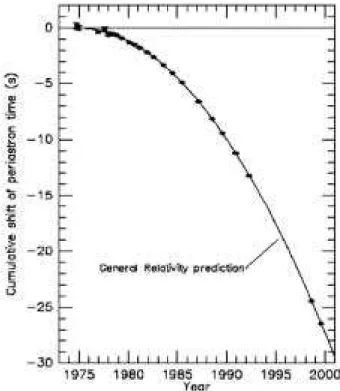
Indiret but onvining evidene for the existene of
gravitational waveswere produed from the beautiful
observationsofRussellHulseandJosephTaylor. They
studied a speial neutron star binary pulsar system
(PSR 1913+16) that they disovered in 1974. They
determined that it wasa binary system beause they
observed a variation of the frequeny with just
un-der an 8-hour period. The pulsar in this binary
sys-tem has a frequeny of about 17/se and this `lok'
allowedthem to aurately determine the
harateris-tisof the overall binary systemwith remarkable
pre-ision. The most important parameters for our
pur-pose are that the two neutron stars are separated by
about10 6
miles,havemassesm
1
=1:4solarmassesand
m
2
=1:36solarmasses,andtheelliptiityoftheorbit
is e=0:617. Hulseand Taylordemonstrated that the
motionofthepulsararounditsompanionouldnotbe
understoodunlessthedissipativereationfore
assoi-atedwithgravitationalwaveprodutionwereinluded.
Theyfoundthatthesystemradiatesawayenergy,
pre-sumablyintheformofgravitationalwaves,andthetwo
neutronstarsareslowlyspiralingintowardoneanother
resultinginaspeedingupoftheorbitalperiod. In
de-tail the inspiral is only 3mm=orbit so it will be more
than10 6
yearsbeforethepairofneutronstarsatually
oalese.
Hulse and Taylor monitored these pulsar signals
with 50-miroseond aurayovermanyyears. They
measured the orbital speedup experimentallywith an
auray of afration of a perent. Thevalue of the
speedup they reorded is in omplete agreementwith
ay-in 1993. This impressive indiret evidene for
gravi-tational wavesgivesus good reasonto believein their
existene. But, as of this date, no diret detetionof
gravitationalwaveshasbeenmade.
Figure2. Theevideneforgravitationalwaveemissionfrom
TaylorandWeinberg.
III Detetion of gravitational
waves
The eet of thepropagating gravitational waveis to
deform spae in aquadrupolarform. The
harateris-tisofthedeformationareindiatedinFig. 3.
One an estimate the frequeny of the emitted
gravitational wave. An upper limit on the
gravita-tional wave soure frequeny an be estimated from
the Shwarzshild radius 2GM= 2
of the radiated
ob-jet. We do not expet strong emission for periods
shorterthanthelighttraveltime4GM= 3
aroundits
irumferene. From this we an estimate the
maxi-mum frequeny as about 10 4
Hz for a solar mass
ob-jet. Of ourse, the frequeny an be muh lower as
illustratedbythe8hourperiodofPSR1916+13,whih
is emitting gravitationalradiation. Frequenies in the
higher frequeny range 1Hz<f <10 4
Hz are
poten-tially reahableusing detetors ontheearth's surfae,
whilethelowerfrequeniesrequireputtinginstruments
intospae. Thephysisgoalsoftheterrestrialdetetors
likedierentfrequenybandsareusedinobservational
astronomyforeletromagnetiradiation
Figure3.Theeetofgravitationalwavesforone
polariza-tionisshownatthetoponaringoffreepartiles. Theirle
alternatelyelongatesvertiallywhilesquashinghorizontally
andvieversawiththefrequenyofthegravitationalwave.
Thedetetiontehniqueofinterferometrybeingemployedin
thenewgenerationofdetetorsisindiatedinthelower
g-ure. Theinterferometermeasuresthediereneindistane
intwo perpendiular diretions, whih if sensitive enough
oulddetetthepassageofagravitationalwave.
Thestrengthofagravitationalwavesignaldepends
ruially onthequadrupole moment. Weanroughly
estimatehowlargetheeetouldbefrom
astrophys-ialsoures. Ifwedenote the quadrupole of themass
distributionofasourebyQ,adimensionalargument,
alongwiththeassumptionthatgravitationalradiation
ouplestothequadrupolemomentyields:
h G
Q
4
r
G(E
non sy mm:
k in
= 2
)
2
r
whereGisthegravitationalonstantandE
non symm:
k in
isthenon-symmetrialpartofthekinetienergy.
For the purpose of estimation, let us onsider the
ase where one solar mass is in the form of
non-symmetri kineti energy. Then, at a distane of the
Virgo luster weestimate a strainof h10 21
. This
isagoodguidetothelargestsignalsthatmightbe
ob-served. Atlargerdistanesorforsoureswithasmaller
quadrupole omponentthesignalwillbeweaker.
IV Long baseline suspended
mass interferometry
A Mihelson interferometer operating between freely
suspended masses is ideally suited to detet the
ex-induedbythegravitationalwavesaswasillustratedin
Fig. 3.
The simplest onguration, a white light (equal
arm)Mihelson interferometer isinstrutivein
visual-izingmany ofthe onepts. In suh asystemthe two
interferometer arms are idential in length and in the
lightstoragetime. Lightbroughtto thebeamsplitter
isdividedevenlybetweenthetwoarmsofthe
interfer-ometer. Thelightistransmittedthroughthesplitterto
reahonearmandreetedbythesplittertoreahthe
otherarm. Thelighttraversesthearmsandisreturned
tothesplitterbythedistantarmmirrors. Therolesof
reetionandtransmissionareinterhangedonthis
re-turnand,furthermore,duetotheFresnellawsofE&M
thereturnreetionis aompaniedbyasignreversal
of the optial eletri eld. When the optial eletri
eldsthathaveomefromthetwoarmsarereombined
atthebeamsplitter,thebeamsthatweretreatedto a
reetion(transmission)followedbyatransmission
(re-etion)emergeattheantisymmetriportofthebeam
splitterwhilethosethathavebeentreatedtosuessive
reetions(transmissions)willemergeatthesymmetri
port.
InasimpleMihelson ongurationthe detetoris
plaedattheantisymmetriportandthelightsoureat
thesymmetriport. Ifthebeamgeometryissuhasto
haveasinglephaseoverthepropagatingwavefront(an
idealizeduniphaseplanewavehasthispropertyasdoes
theGaussianwavefrontinthelowestorderspatialmode
ofalaser),then,providingthearmsareequalinlength
(or their dierene in length is a multiple of 1/2 the
lightwavelength),theentireeldattheantisymmetri
portwillbedark. Thedestrutiveinterfereneoverthe
entirebeamwavefrontisompleteandallthelightwill
onstrutivelyreombine at thesymmetri port. The
interferometer ats like a light valve sending light to
theantisymmetriorsymmetriportdependingonthe
pathlengthdierenein thearms.
Ifthesystemisbalanedsothatnolightappearsat
theantisymmetriport,thegravitationalwavepassing
thoughtheinterferometer willdisturbthebalaneand
auselighttofallonthephotodetetoratthedarkport.
Thisisthebasisofthedetetionofgravitationalwaves
inasuspendedmassinterferometer.Inordertoobtain
therequiredsensitivity,thearmsoftheinterferometer
mustbelong.
The amount of motion of the arms to produe an
intensity hange at the photodetetor depends onthe
optiallengthofthearm;thelongerthearmthegreater
isthe hange in lengthupto alengththat isequalto
1/2 the gravitationalwavewave-length. Equivalently
thelongertheinterationofthelightwiththe
gravita-wave, the larger is the optial phase shift due to the
gravitationalwaveand therebythelargeris the
inten-sityhangeatthephotodetetor. Theinitiallong
base-lineinterferometers,besideshavinglongarmsalsowill
foldtheoptialbeamsinthearmsinoptialavitiesor
delay lines to gainfurther inreasein the path length
orequivalentlyintheinterationtimeofthelightwith
the gravitationalwave. The initial LIGO
interferome-terswill storethelightabout50timeslongerthanthe
beamtransit timein anarm. (A lightstoragetimeof
about1milliseond.)
V The noise oor for
interferom-eter detetors
Figure4.ThelimitingnoisesouresfortheinitialLIGO
de-tetors. Notethattheinterferometerislimitedbydierent
soures at low frequeny(eg. seismi), middlefrequenies
bysuspensionthermalnoise,andathighfrequeniesbyshot
noise (orphotostatistis). Lurkingbeloware many other
potentialnoisesoures.
Thesuess ofthe detetor ultimatelywill depend
onhowwellweoneantoontrolthenoiseinthe
mea-surement of these small strains. Noise is broadly but
also usefully ategorizedin termsof thosephenomena
whih limitthe abilityto sense andregister thesmall
motions (sensing noiselimits) and those that perturb
the masses by ausing small motions (random fore
noise). Eventually one reahes the ultimate limiting
noise, the quantum limit, whih ombines the sensing
noisewitharandomforelimit. Thisorderlyand
experiment that onehasnotprodued less
fundamen-tal,albeit,realnoisesouresthat areaused byfaulty
designorpoorimplementation. Wehavedubbedthese
as tehnial noise soures and in real life these have
often been theimpediments toprogress. The primary
noisesouresfor theinitialdetetors areillustratedin
Fig. 4,where theestimatedlevelsofthevarious noise
souresareshownforLIGO.Theotherinterferometers
havesimilarurveswithsomediereneduetothe
dif-ferenttrade-osthathavebeenmade.
Inorder to ontrol thetehnial noisesoures,
ex-tensive use is made of two onepts. The rst is the
tehnique of modulating the signal to be deteted at
frequeniesfarabovethe1/fnoisedue tothedriftand
gaininstabilitiesexperienedinallinstruments. For
ex-ample,theoptialphasemeasurementtodeterminethe
motion of thefringe is arried out at radio frequeny
ratherthannearDC.Thereby,thelowfrequeny
ampli-tudenoiseinthelaserlightwillnotdiretlyperturbthe
measurementofthefringeposition. (Thelowfrequeny
noisestill will auseradiationpressureutuationson
themirrorsthroughtheasymmetriesinthe
interferom-eter arms.) A seond onept is to apply feedbakto
physialvariablesintheexperimenttoontrolthelarge
exursions atlowfrequeniesandtoprovidedamping.
Thevariableismeasuredthroughtheontrolsignal
re-quiredtoholditstationary. Hereagoodexampleisthe
positionoftheinterferometermirrorsatlowfrequeny.
Theinterferometerfringeismaintainedataxedphase
byholdingthemirrorsatxedpositionsatlow
frequen-ies. Feedbakforestothemirrorseetivelyholdthe
mirrors \rigidly". Inthe initial LIGO interferometers
theforesareprovidedbypermanentmagnet/oil
om-binations. Themirrormotionthatwouldhaveourred
is then read in the ontrol signalrequired to hold the
mirror.
Great are must be taken to ontrol these
tehni-al noisesoures. Inorder to testand understand the
sensitivityandlimitingnoise,extensivetestshavebeen
performed with a 40 meter LIGO prototype
interfer-ometerontheCaltehampus. Thisinterferometer
es-sentiallyhasallthepieesandtheoptialonguration
usedinLIGO,sorepresentsagoodplaetounderstand
noise and performane before the full-sale LIGO
in-terferometersareinoperation. The40mprototype
de-vieahievedadisplaementsensitivityofh10 19
m,
whihislosetothedisplaementsensitivitythatis
re-VI Astrophysial soures of
gravitational waves
There are a many known astrophysial proesses in
theUniversethat produegravitationalwaves.
Terres-trialinterferometers,likeLIGO, willsearhforsignals
fromsuhsouresinthe10Hz-10KHzfrequenyband.
Charateristi signals from astrophysial soures will
be sought over bakgroundnoise from reorded
time-frequenyseries ofthe strain. Examples of suh
har-ateristisignalsinludethefollowing:
VI.1Chirp Signals
The inspiral of ompat objets suh as a pair of
neutron stars or blak holes will give radiation that
will harateristially inrease in both amplitude and
frequenyastheymovetowardthenal oaleseneof
thesystem.
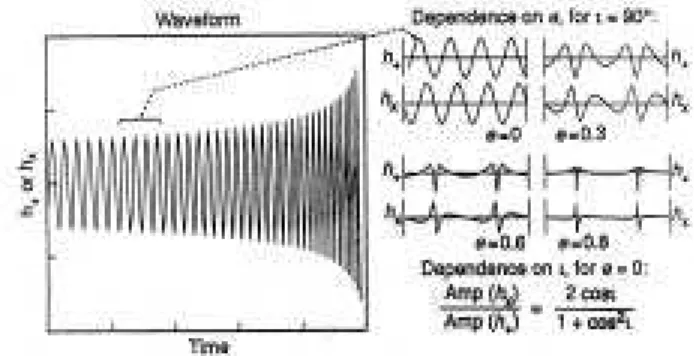
Thishirpsignalanbeharaterizedindetail,
giv-ingthedependene onthemasses,separation,
ellipti-ity of the orbits, et. A variety of searh tehniques,
inludingthediret omparison withan arrayof
tem-plateswillbeusedforthistypeofsearh. Thewaveform
fortheinspiral phaseiswellunderstood andhasbeen
alulatedin suÆientdetail forneutron star-neutron
starinspiral. ToNewtonianorder,theinspiral
gravita-tionalwaveformisgivenby
h + (t)= 2G 5 3 4
(1+os 2 (i)) r (Mf) 2 3 os(2ft)
h (t)= 4G 5 3 4 os(i) r (Mf)
2
3
sin(2ft)
wherethe+and-polarizationaxesareorientedalong
themajorand minor axes of theprojetionof the
or-bital plane on the sky, it is the angle of inlination
of the orbital plane, M=m
1 +m
2
is the total mass,
=m
1 m
2
=Misthereduedmassandthegravitational
wavefrequenyf (twiethe orbitalfrequeny)evolves
as
f(t)= 1 h 3 G i 5 8 5 256M 2 3 (t0 t) 3 8 wheret 0
istheoalesenetime. Thisformulagivesthe
harateristi'hirp'signal-aperiodisinusoidalwave
thatinreasesin bothamplitudeandfrequenyasthe
binarysysteminspirals.
TheNewtonianorderwaveformsdonotprovidethe
in-of yles that a typial inspiral will experiene while
sweeping through the broad band LIGO
interferome-ters. In order to better trak the phase evolution of
the inspiral, rst and seond order orretions to the
Newtonian quadrupole radiation, known as the
post-Newtonian formulation,must beapplied andare used
to generate templates of the evolution that are
om-pared to the data in the atual searh algorithms. If
suh aphaseevolutionis traked, it is possible to
ex-tratparametri informationaboutthe binary system
suh asthe masses,spins, distane, elliptiity and
or-bital inlination. An example of the hirp form and
the detailed struture expeted for dierent detailed
parametersisshowninFig. 5.
This inspiral phase is well mathed to the LIGO
sensitivity band for neutron star binary systems. For
heavier systems, like a systemof twoblak holes,the
nal oalesene and even the ring down phases are
in the LIGO frequeny band. On one hand, the
ex-peted waveforms for suh heavy soures in these
re-gionsarenotsostraightforwardtoparameterize,
mak-ingthesearhesforsuhsystemsalargerhallenge.
Re-searh is ongoing to better haraterize suh systems.
Ontheotherhand,thesesystemsaremorediÆultto
haraterizebeausetheyprobetheruialstrongeld
limitofgeneralrelativity, makingsuh observationsof
greatpotentialinterest.
Figure5.Anexampleisshownofthenalhirpwaveforms.
The amplitude and frequeny inrease as the system
ap-proahesoalesene. Thedetailedwaveformsanbequite
ompliatedasshownattheright,butenabledetermination
oftheparameters(eg. elliptiity)ofthesystem.
VI.3 PeriodiSignals
Radiationfromrotatingnon-axisymmetrineutron
starswillprodueperiodisignalsinthedetetors. The
emittedgravitationalwavefrequenyistwiethe
rota-tionfrequeny. Formanyknownpulsars,thefrequeny
falls within the LIGO sensitivity band. Searhes for
signalsfrom spinning neutronstars will involve
trak-Doppler shift for the motion of the Earth around the
Sun, andinludingtheeetsofspin-down ofthe
pul-sar. Targeted searhes of known pulsars and general
skysearhesareantiipated.
VI.4 Stohasti Signals
Signalsfromgravitationalwavesemittedintherst
instantsoftheearlyuniverse,asfarbakasthePlank
epohat10 43
se,anbedetetedthroughorrelation
of thebakgroundsignalsfrom twoormoredetetors.
Gravitationalwavesanprobeearlierin thehistoryof
theUniversethananyotherradiation due tothe very
weakinteration.
SomemodelsoftheearlyUniverseanresultin
de-tetable signals. Observations of this early Universe
gravitationalradiation would provide an exiting new
osmologialprobe.
VI.5 Burst Signals
Thegravitationalollapseofstars(e.g. supernovae)
will leadto emission of gravitationalradiation. Type
I supernovaeinvolvewhitedwarfstarsandarenot
ex-peted to yield substantial emission. However, Type
IIollapsesanleadtostrongradiationiftheore
ol-lapseissuÆientlynon-axisymmetri. TherateofType
IIsupernovaeisroughlyoneevery30yearsinourown
Galaxy. This is atually a lower bound on the rate
of stellaroreollapses,sinethat rateestimateis
de-termined from eletromagneti observations and some
stellaroreollapsesouldgiveonlyasmall
eletromag-netisignal. Theejetedmantledominatesthe
eletro-magneti signal,while thegravitationalwavesignalis
dominatedbythedynamisoftheollapsingoreitself.
Numerialmodelingofthedynamisoforeollapse
and boune has been used to make estimates of the
strength and harateristis. This is veryompliated
andmodeldependent,dependingonbothdetailed
hy-drodynami proesses and the initial rotation rate of
thedegeneratestellarorebeforeollapse. Estimating
theeventdetetionrateisonsequentlydiÆultandthe
ratemaybeaslargeasmanyperyearwithinitialLIGO
interferometers,orlessthanoneperyearwithadvaned
LIGO interferometers. Probablya reasonableguess is
that the initial detetors will not see far beyond our
owngalaxy,whileanadvaneddetetorshould seeout
totheVirgoluster.
Thedetetionwillrequireidentifyingburstlike
sig-nalsin oinidenefrommultiple interferometers. The
detailed nature ofthesignalisnotwellknown,exept
thatitisburstlikeandisemittedforashorttimeperiod
(milliseonds)during theatualoreollapse. Various
on-Burrows et al have alulated the gravitational wave
signal,takingintoaountthedetailedhydrodynamis
of theollapse itself, the typial measuredreoil
neu-tronstarveloitiesandtheradiationintoneutrinos.
VII Status and plans
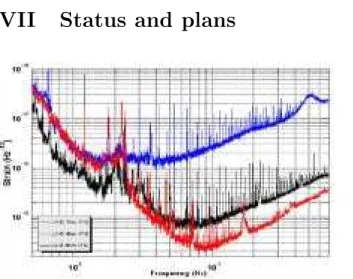
Figure6. ThesensitivityofeahofthethreeLIGO
interfer-ometersforthe rstoinideneengineering runofthethe
LIGOinterferometers.
The onstrution of LIGO was ompleted in 2000
andwearenowintheproessofommissioningthe
de-tetors. Sinewehavethreeinterferometersto
ommis-sion,weareusingoneofthem(the2kminterferometer
at Hanford) asthe pathnder and bringing the other
two interferometers into operation, using the \lessons
learned"onthatinterferometer. Wenowhavemadeall
three interferometers lok for signiant time periods
inthereombinedmodeandfortheHanford2km, we
havelokedforhoursatatimein thenaloptial
on-guration- apowerreyledMihelson interferometer
withFabry-Perotarmavities.
Reently we took our rst data-taking run of two
weekswith allthree interferometersoperatingin
oin-idene. The runwas quite suessful aswe reorded
inthat wereordedabout45 hoursofdata withall
three interferometers loked and operating for a long
strethes of time but not yet at high sensitivity (see
Fig. 6). Thiswillallowustousethisdatatoarryout
our rst end-to-end analysis of the data and prepare
fortherst sienedata run,whihweexpet to
per-formthisomingsummer. Thatrun willbeatredued
sensitivity, but will allow us to set newlimits on
sev-eral of the soures disussed above. Overthe oming
year, we will onentrate on sensitivity improvements
that should bringus loserto the expeted sensitivity
requiredtodetetastrophysialsouresofgravitational