Salar Fields: From Domain Walls
to Nanotubes and Fulerenes
DionisioBazeia
Departamento deFsia,Universidade FederaldaParaba
CaixaPostal5008,58051-970, Jo~aoPessoa,Paraba, Brazil
Reeivedon18February,2002
Inthis workwe reviewsome features oftopologial defetsineld theory modelsfor real salar
elds. Weinvestigatetopologialdefetsinmodelsinvolvingoneandtwoormorerealsalarelds.
In models involving a single eld we examinetwo dierent sublasses of models, whih support
oneor moretopologialdefets. Inmodelsinvolvingtwoormorerealsalar elds,weexplorethe
preseneof defetsthat liveinsidetopologialdefets, andjuntions and networks ofdefets. In
theaseofjuntionsofdefetsweinvestigtestruturesthatsimulatenanotubesandfulerenes. Our
investigationsmay alsobeusedto desribe nonlinearproperties ofpolymers, Langmuirlmsand
optialsolitonsinbers.
I Introdution
ResearhontopologialdefetsinFieldTheorywas
ini-iatedalmostthreedeadesago,andsomeofthemain
investigations may be found for instane in Refs.
[1-5℄. In the ase of topologial defets that appears in
models desribed by real salar elds in (1;1)
spae-time dimensions, they are usually named kinks, and
arelassialstatisolutionsoftheequationsofmotion.
Theirtopologialbehaviorisrelatedtotheasymptoti
form ofthe eld ongurations, whih has to dierin
boththepositiveandnegativespaediretions. To
en-surethat thelassialsolutionshaveniteenergy,one
requires that the asymptotibehaviorof thesolutions
is identied with minima of thepotentialthat denes
the system under onsideration, soin generalthe
po-tentialhasto inlude at leasttwodistint minima for
thesystemtosupporttopologialsolutions.
Weaninvestigaterealsalarelds in(3;1)
spae-timedimensions,andnowthetopologialsolutionsare
nameddomainwalls. Thesedomainwallsare
bidimen-sional strutures that arry surfae tension, whih is
identiedwiththeenergyofthelassialsolutionsthat
springin(1;1)spae-timedimensions. Thedomainwall
struturesaresupposedtoplayaroleinappliationsto
severaldierentontexts,rangingfrom thelowenergy
sale of ondensed matter [6-8℄ up to thehigh energy
sale required in the physis of elementary partiles,
elds andosmology[1-5℄.
Thereareat leastthreelassesof modelsthat
sup-portkinks ordomainwalls. Intherstlassonedeals
withasinglerealsalareld,andthetopologial
solu-tionsare strutureless. Examples of thisare the
sine-Gordonand 4
models. In theseond lass ofmodels
onealsodealswithasinglerealsalareld,butnowthe
systemsompriseatleasttwodistintdomainwalls. An
exampleofthisisthedoublesine-Gordonmodel,whih
hasbeeninvestigatedforinstaneinRefs.[9-11℄. Inthe
third lass ofmodelswedeal withsystems dened by
tworealsalarelds, andnowoneopenstwonew
pos-sibilities: domain walls that admit internal struture
[12-20℄. and juntions of domain walls, whih appear
inmodelsoftwoeldswhenthepotentialontains
non-olinearminima,asreentlyinvestigatedforinstanein
Refs. [21-35℄.
There are other motivations to investigate domain
wallsinmodelsofeldtheory,oneofthembeingrelated
to the fat that the low energy world volume
dynam-isofbranesin stringandMtheorymaybedesribed
by standard models in eld theory [36-38℄. Besides,
oneknowsthat eldtheorymodelsofsalareldsmay
also be used to investigate properties of quasi-linear
polymeri hains,asforinstanein theappliations of
Refs.[39-42℄,to desribesolitarywavesinferroeletri
rystals,thepresene of twistons in polyethylene, and
solitonsinLangmuirlms.
Inthepresentwork,inSe.IIwereviewsomeknown
investigations follow in Ses. III and IV, where we
searh for topologial strutures that generate kinks
andwalls,inmodelsinvolvingasinglerealsalareld,
andtwoormoreelds,respetively.
II General onsiderations
In this work we are interested in eld theory models
that desribe real salar elds and support
topolog-ial solutions of the Bogomol'nyi-Prasad-Sommereld
(BPS)type[43, 44℄. Inthe aseofasinglereal salar
eld,weonsider theLagrangedensity
L= 1
2
V() (1)
HereV()isthepotential,whihidentiesthe
partiu-larmodel underonsideration. We writethepotential
in the form V() =(1=2)W 2
, where W = W() is a
smooth funtion of theeld , and W
=dW=d. In
asupersymmetri theoryW isthesuperpotential,and
thisisthewaywenameW in thiswork.
Theequationofmotionfor=(x;t)hasthe
gen-eralform
2
t 2
2
x 2
+ dV
d
=0 (2)
andforstatisolutionsweget
d 2
dx 2
=W
W
(3)
Itwasreentlyshownin Ref.[45℄thatthisequationof
motionisequivalenttotherstorderequations
d
dx
=W
(4)
ifoneissearhingforsolutionsthatobeytheboundary
onditionslim
x! 1 (x)=
i
andlim
x! 1
(d=dx)=
0,where
i
isoneamongtheseveralvauaf
1 ;
2 ;:::g
of the system. In this ase the topologial solutions
are BPS (+) and anti-BPS (-) solutions. Their
ener-gies get minimized to the value t ij
= jW
ij
j, where
W
ij =W
i W
j
, with W
i
standing for W(
i ). The
BPSandanti-BPSsolutionsaredenedbytwovauum
statesbelongingto thesetofminimathat identifythe
severaltopologialsetorsofthemodel.
Intheaseoftworealsalareldsandthe
po-tential is written in terms of the superpotential, in a
way suh that V(;) = (1=2)W 2
+(1=2)W 2
. The
equationsofmotionforstatields are
d 2
dx 2
=W
W
+W
W
(5)
d 2
2 =W
W
+W
W
(6)
whiharesolvedbytherstorderequations
d
dx
=W
d
dx
=W
(7)
Solutions to these rst order equations are BPS (+)
and anti-BPS (-) states. They solve the equations of
motion, and have energy minimized to t ij
= jW ij
j
asinthe aseof asingleeld; here,however,W ij
=
W(
i ;
i
) W(
j ;
j
),sinenowweneedapairof
num-bers(
i ;
i
)torepresenteahoneofthevauumstates
in thesystemoftwoelds. Intheplane(;)wemay
haveminima that arenon olinear, openning the
pos-sibilityfor juntionsof defets. Intheaseof tworeal
salarelds,weanndafamilyofrstorderequations
thatareequivalenttothepairofseondorderequations
of motion, but this requires that thesuperpotentialis
harmoni,obeyingW
+W
=0[45℄.
III Modelsinvolving asingle real
salar eld
We now turn attention to kinks and domain walls. A
wellknownexampleisgivenbythe 4
model,denedby
thepotentialV()=(1=2)( 2
1) 2
. Hereweareusing
naturalunits,anddimensionlesseldsandoordinates.
Inthismodelthedomainwallanberepresentedbythe
solution
s
(x)=tanh(x). Theabovepotentialanbe
writtenwiththesuperpotentialW()= 3
=3,and
the domainwallis ofthe BPSoranti-BPStype. The
walltensionorrespondingtotheBPSwallist
s =4=3.
Weanalsondstruturelessdomainwallsinother
models,forinstaneinthe 6
model,whihisdesribed
by the potential V() = (1=2) 2
( 2
1) 2
. Here we
have W() = (1=2) 2
(1=4) 4
, and the wall
on-gurations are also of the BPS type, and are given
by
2
s
= (1=2)[1tanh(x)℄. The wall tension is now
t
s
=1=4. This potentialwasinvestigated forinstane
in Ref.[46℄.
Weanbuildanotherlassofmodelswherethe
do-main wallsengender otherfeatures. The nextlass is
yetdesribedbyasingleeld,butthesystemsmaynow
supporttwoormoredierentwalls. Aninteresting
ex-ample of this is the double sine-Gordon model, whih
isdened bythepotential
V
r ()=
1
r+1
4ros()+os(2)
(8)
whererisaparameter,realandpositive. Thispotential
isperiodi,withperiod2;forsimpliityinthe
r = 1 distinguishes two regions, the region r 2 (0;1)
where the potentialontains fourminima, and the
re-gion r 1,where the potentialontainstwominima.
Forr2(0;1)thesystemsupportstwodistintwall
on-gurations,thelargewallandthesmallwall,whih
dis-tinguishthetwodierentbarrierthemodelomprisesin
thisase. Thelimitsr!0andr!1leadusbakto
thesine-Gordonmodel. Thedoublesine-Gordonmodel
hasbeenonsideredinseveraldistintappliations,as
forinstanein Ref.[9-11℄,whereoneinvestigates
mag-netisolitons in superuid 3
He, kinkpropagation in a
model for polingin polyvinylidine uoride, and
prop-erties relatedtothetwodierentkinks thatappearin
suhpolymerihain.
To expose new features of the double sine-Gordon
modelwerewriteEq.(8)intheform[47℄
V
r ()=
2
1+r
[os()+r℄ 2
(9)
where we have omitted an unimportant r-dependent
onstant. The model an be desribed by the
super-potential
W()= 2
p
1+r
[sin()+r℄ (10)
For r in the interval r 2(0;1) the minima of the
po-tential are the singular points of the superpotential,
dW=d=0. Theyare periodi,andfor 2<<2
there are four minima, at the points
= (r),
where (r) =os 1
(r). For r 1 theminima are at
= , in the interval 2 < <2. A loser
in-spetionshowsthat for0<r<1theloalmaximaat
andtheminima (r)degenerateto the
min-ima forr =1,and remain there forr >1. Thus,
the parameter r indues a transition in the behavior
of the double sine-Gordon model. The value r =1is
theritialvalue,sineitisthepointwherethesystem
hanges behavior: for r 2 (0;1) this model supports
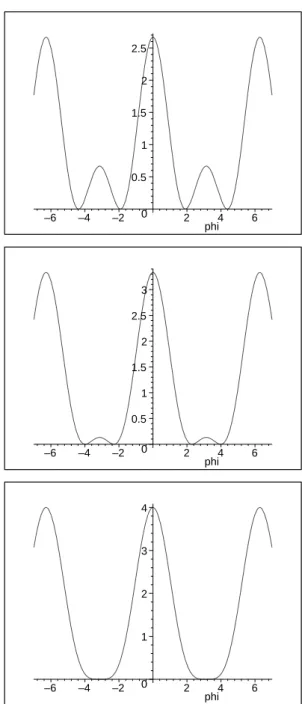
minimathatdesapearforr1. Weillustratethe
dou-ble sine-Gordon model in Fig. 1, where we depit the
potentialofEq. (9)forr=1=3;2=3andforr=1.
0
0.5
1
1.5
2
2.5
–6
–4
–2
2
4
6
phi
0
0.5
1
1.5
2
2.5
3
–6
–4
–2
2
4
6
phi
0
1
2
3
4
–6
–4
–2
2
4
6
phi
Figure 1. The double sine-Gordon potential, depitedfor
r = 1=3;2=3 and 1 from above to below respetively, to
illustratehowthebehaviorofthemodelhangeswithr.
Wegetabetterviewofthephasetransitionin the
doublesine-Gordon modelbyexaminingthe order
pa-rameter
(r),whihisgivenby(r)for0<r1,
so it goes ontinuously to for r 1. Also, the
(squared)massoftheeldanbeobtainedviathe
re-lation
V 00
r (
)=W 2
+W
W
(11)
where
istheorrespondingminimumofthepotential.
For0 <r 1we get m 2
(r) = 4 4r, and for r 1
we havem 2
(r)= 4(r 1)=(r+1). Weplot
(r) and
m 2
(r)inFig.2. Weseethatm(r)vanishesinthelimit
r ! 1. These results indiate that r drives aseond
goes from the ase of two distint phases to another
one,engenderingasinglephase.
Weonsider 0< r 1. The energies of the BPS
solutionsaregivenasfollows. Forsolutionsonneting
theminima +(r)and (r)thedefetis large
sineit joins minimaseparatedby ahigherandwider
barrier. Wehave
t l
dsG =4
p
1 r+4r
(r)
p
1+r
(12)
In the aseof theminima (r) and +(r) the
defetissmallandweget
t s
dsG =4
p
1 r 4r (r)
p
1+r
(13)
We notie that t l
dsG = t
s
dsG
+4r= p
1+r, and that
the limit r ! 1 sends t l
dsG ! 2
p
2 and t s
dsG ! 0,
asexpeted. For theBPSstatesweanwritethe
solu-tionsexpliitly. Forinstane,forsolutionsthatonnet
theminima +(r) and (r)wegetlargekink
solutions,whihareoftheform
l
(x)=2tan 1
"
r
1+r
1 r tanh
p
1 rx
#
(14)
1
r
π
r
1
Figure2. Plotsof
(r) (above)and m 2
(r) (below)for the
doublesine-Gordonpotential,whihillustratehowthe
be-haviorofthemodelhangeswithr.
Forsolutionsthatonnettheminima(r)andthe
minima (r) weget small kink solutions. They
aregivenby
s
(x)= 2tan 1
"
r
1 r
1+r tanh
p
1 rx
#
(15)
Thepotentialin Eq.(9)inthelimitr!0goesto
V
0
()=1+os(2) (16)
whih leadsus bakto thesine-Gordon model. Thus,
we ansuppose r small and use V
r
() to explore the
double sine-Gordon model as a model ontrolled by
a small parameter, in the viinity of the sine-Gordon
model. This feature may be of some use for
inves-tigations that follow the lines of Ref. [48℄, and also
in thease onerning the presene of internal modes
of solitary waves, whih seems to appear when one
slightly modies some integrable model { see for
in-staneRef.[49℄.
IV Models involving two or
more real salar elds
We now turn attention to the third lass of models,
whihisdesribedbytworealsalarelds. Inthisase
thedomainwallsmayengenderinternalstruture. This
line of investigation follows asin Refs. [14-16℄and we
illustrate suh possibility with the system dened by
thepotential
V(;) = 1
2 (
1
1) 2
+ 1
2 r
2
2
1
r
2
+
r(1+2r) 2
2
(17)
wheretheparameterr6=0isreal. Thismodelwasrst
investigatedinRef.[50℄,andanbeusedtomodifythe
internal struture ofdomain walls {seeRefs. [16, 51℄.
Thispotentialfollowsfrom thesuperpotential
W(;)= 1
3
3
r 2
(18)
andthesystemsupportstwo-eldsolutions. Anexpliit
solutionis
(x) = tanh(2rx) (19)
(x) = a(r)seh(2rx) (20)
witha 2
(r)=1=r 2. ThisisaBPS solution,andnow
theparameterrisrestritedtotheintervalr2(0;1=2).
The limit r ! 1=2 lead us to the one-eld solution
(x) = tanh(x) and (x) = 0. As we know, all the
BPSsolutionsarelinearlystable[52℄.
Thetwo-eldsolutionsobey
2
+ 2
=a 2
whihdesribesanelliptiaronnetingthetwo
min-ima(1;0)oftheorrespondingpotentialinthe(;)
plane. The one-eld solutions represent standard
do-main walls, while the two-eld solutions may be seen
as domain walls having internal struture: the
ve-tor (;) in onguration spae desribes an straight
line segmentfor the one-eld solution, and an ellipti
ar for the two-eld solution, resembling light in the
linearly and elliptially polarized ases, respetively.
The same solutions appear in ondensed matter, in
the anysotropiXY model used todesribe
ferromag-neti transition in magneti systems, and there they
arenamedIsingandBloh walls,respetively{seefor
instane Ref.[8℄,hapter 7.
We reall that domain wallsmay beseen asseeds
[4, 5℄ for the formation of non-topologial strutures.
ThispossibilityappearsinRefs.[51-54℄,wherethe
dis-retesymmetryis hangedtoan approximate
symme-try,or in Ref. [57℄, with thedisretesymmetry biased
sothatdomainsofdistintbutdegeneratevauaspring
unequally. Domainwallsthatappearinmodels
involv-ing tworeal salarelds presentfeatures that are not
seenintheaseofasingleeld. Thus,wearenow
inves-tigatingotherextensionsoftheabovemodel,denedby
thesuperpotentialofEq.(18). IntheworkinRef.[58℄
weareinvestigating thepossibility ofhangingthe
el-liptiartoamoregeneralorbit,thatmaynd
applia-tionsinondensedmatter. Inanotherwork[59℄weare
investigatingothersuperpotentials,non-polynomial,in
aneortto extendthemodelstudied in [58-60℄to the
ase of twoor moreelds. The model dened by the
superpotentialofEq.(18)presentotherinteresting
fea-tures,reentlyexploredin Ref.[63℄,whihdeserve
fur-therinvestigations.
Wenowturnourattentiontopolynomialpotentials
that engenders the Z
3
symmetry, and that supports
stable three-juntionsthat generate a regular
hexago-nal network of defets. Investigations onthe presene
of juntions [64℄ of defets in supersymmetri models
have been given in Refs. [21-23℄, and in Ref. [25℄ we
havefoundthefourth-orderpolynomialpotential
V(;) = 2 2 2 9 4 + 2 2 2 9 4 +2 2 2 2 2 ( 2 3 2 )+ 27 8 2 (22)
Thispotentialdoesnotallowforsupersymmetri
exten-sions. Theequationsofmotionforstationgurations
that followsinthisaseare
d 2 dx 2 = 2 4 2 +4 2 3 9 2 +3 2 2 (23) d 2 dx 2 = 2 4 2 +4 2 +6 9 2 (24)
The potential has three degenerate minima, at the
points v = (3=2)(1;0) and v = (3=4)( 1; p
3).
These minima form an equilateral triangle, invariant
undertheZ
3
symmetry. Thedistanebetweenthe
min-imais(3=2) p
3.
We an obtain the topologial solutions expliitly.
The easiest way to do this follows by rst examining
thesetorthat onnetsthe vaua v
2 and v
3
. This is
sobeausein thisaseweset= 3=4,searhingfor
a strainght-line segment in the (;) plane. This is
ompatible with the Eq. (23), and redues the other
Eq.(24)to theform
d 2 dx 2 = 2 4 3 27 4 (25)
Thisimpliesthattheorbitonnetingthevauav
2 and
v
3
isastraightline. Itissuhthat, alongtheorbitthe
eldfeelsthepotential 2
[ 2
(27=16)℄ 2
. Thisshows
thatthemodelreduestoamodelofasingleeld,and
thesolutionsatisestherst-orderequation
d dx = p 2 2 27 16 (26)
Thesolutionis
(x)= 3 4 p 3tanh r 27 8 x ! (27)
Theothersolutionsanbeobtainedbyrotations
obey-ingtheZ
3
symmetryofthemodel.
Thefullset ofsolutionsofthe equationsofmotion
areolletedbelow. In thesetoronneting the
min-imav 2 andv 3 theyare () (2;3) = 3 4 (28) () (2;3) = 3 4 p 3tanh r 27 8 x ! (29)
Inthesetoronnetingtheminimav
1 andv 2 theyare () (1;2) = 3 8 9 8 tanh r 27 8 x ! (30) () (1;2) = 3 8 p 3 3 8 p 3tanh r 27 8 x ! (31)
Inthesetoronnetingtheminimav
1 andv 3 theyare () (1;3) = 3 8 9 8 tanh r 27 8 x ! (32) () (1;3) = 3 8 p 3 3 8 p 3tanh r 27 8 x ! (33)
Thelabel()isusedtoidentifykinkandantikink. All
thesolutionshavethesameenergy,(9=4) p
27=8jj.
We examine how the bosoni elds behave in the
byonsidering utuationsaround thestatisolutions
(x)and (x). Weuse theequationsofmotionto see
thattheutuationsdepend onthepotential
U(x)=
V
V
V
V
(34)
Evidently,afterobtainingthederivativeswesubstitute
theeldsbytheirlassialstativalues(x)and(x).
Themodelunderonsiderationisdenedbythe
poten-tial (47). In this ase we use (28)and (29)to obtain
twodeoupledequationsfor theutuations. The
po-tentialsoftheorrespondingShrodinger-likeequations
are
U
11 (x) =
27
8
2 "
4 2seh 2
r
27
8 x
! #
(35)
U
22 (x) =
27
8
2 "
4 6seh 2
r
27
8 x
! #
(36)
The eigenvalues an be obtained expliitly: in the
diretionwegetw
0
=0andw
1
=(9=2) p
2
=2,andin
thediretionwehavew
0
=(9=2) p
2
=2. Thisshows
thatthepair(28)and(29)isstable, andbysymmetry
wegetthatallthethreetopologialsolutionsarestable
solutions.
Thelassialsolutionspresentthe niepropertyof
having energy evenly distributed in theirgradient(g)
and potential(p)portions. Intermsofenergydensity
theyare
g(x)=p(x)= 1
4
27
8
2
2
seh 4
r
27
8 x
!
(37)
To understand this feature we reall the alulation
doneexpliitlyin thesetorwith = 3=4,onstant.
Therethemodelisshowntoreduetoamodelofa
sin-gleeld,amodelthatsupportsBPSsolutions. Within
thisontext,theabovesolutionsareverymuhlikethe
non-BPSsolutionsthat appearinsupersymmetri
sys-tems [26℄. We use this property and the topologial
urrent
J
="
(38)
It obeys
J
=0,anditis alsoavetorin the(;)
plane. ForstationgurationswehaveJ t
J
= t
,
where = (;) is the harge density. This harge
densityallowswriting t
="(x), where"(x)=g(x)+
p(x) is the(total) energy density of thesolution. We
usethisresultandthenotationij,toidentifythesetor
onnetingthevaua(
i ;
i
)and(
j ;
j
),toshowthat
for any twodierent setors ij and jk, i;j;k = 1;2;3
wegetthat
(
ij +
jk )
t
(
ij +
jk )<
t
ij
ij +
t
jk
jk
(39)
This onditionshowsthat thethree-juntion is a
pro-essoffusionofdefetsthatoursexothermially,
pro-vidingstabilityofjuntionsinthepresentmodel. This
resultis moregeneralthantheonein Ref. [64℄, whih
appears within the ontext of supersymmetry.
Evi-dently,ourresultalsoworksforBPSandnon-BPS
solu-tionsthat appearsinsupersymmetrimodels,withthe
property of having energy evenly distributed in their
gradientandpotentialportions[26℄.
Wenotiethat theorbitsorrespondingtothe
sta-ble defetsolutionsform anequilateraltriangle in the
(;) plane. This is so beause the solutions are
straight-linesegmentsjoining thethree vauum states
in ongurationspae. Theyaredegeneratein energy,
andthisallowsassoiatingtoeahdefetthesame
ten-sion
t= 9
4 r
27
8
jj (40)
This makest
ij <t
jk +t
k i
;i;j;k=1;2;3,andnowthe
inequality is stritly valid in this ase, stabilizing the
three-juntionthatappearsinthismodelwhenone
en-largesthespae-timeto threespatialdimensions.
Weonsiderthepossibilityofjuntionsintheplane,
whihmaygiverisetoaplanarnetworkofdefets. We
workin(2;1)spae-timedimensions,intheplane(x;y).
Weidentify theplane (x;y) withthespaeof
ongu-rations,theplane(;). Weillustratethissituationby
onsidering,forinstane,thesolutionswehavealready
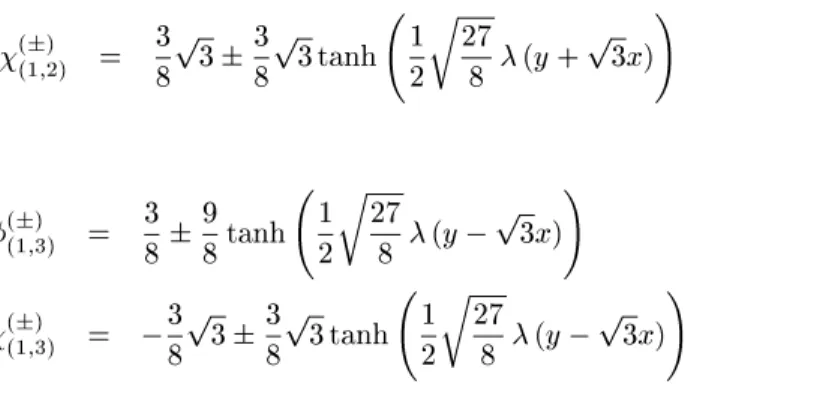
obtained. Theyare olletedin Eqs.(28)-(33) in (1,1)
dimensions. Intheplanarasetheyhangeto
()
(2;3) =
3
4
(41)
()
(2;3)
=
3
4 p
3tanh r
27
8 y
!
(42)
and
()
(1;2) =
3
8
9
8 tanh
1
2 r
27
8 (y+
p
3x) !
()
(1;2) =
3
8 p
3 3
8 p
3tanh 1
2 r
27
8 (y+
p
3x) !
(44)
and
()
(1;3) =
3
8
9
8 tanh
1
2 r
27
8 (y
p
3x) !
(45)
()
(1;3) =
3
8 p
3 3
8 p
3tanh 1
2 r
27
8 (y
p
3x) !
(46)
Theseplanardefetsaredomainwalls,andanbeused
torepresentthethree-juntioninthelimitofthinwalls.
The three-juntion that appears in this Z
3
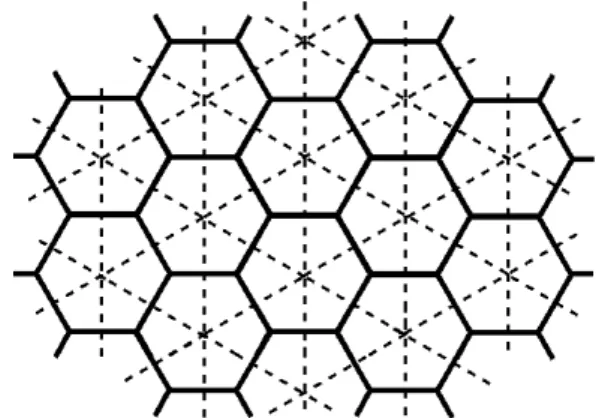
-symmetrimodelallowsbuilding anetwork ofdefets,
preisely in the form of a regular hexagonal network,
as depited in Fig. 3 in the thin wall approximation.
In this networkthe tensionassoiated to thedefetis
thetipialvalueoftheenergyinthistilingoftheplane
with aregular hexagonalnetwork, whih seems to be
the mosteÆientwayof tilingthe plane. Aswehave
shown, ourmodel behavesstandardlyin (3;1)
dimen-sions. Itsupports stable three-juntionsthat generate
astableregularhexagonalnetworkofdefets.
2
1
2
3
2
1
3
2
3
3
1
1
3
3
3
3
2
1
Figure 3. A regular hexagonalnetworkof defets, formed
bythree-juntionssurroundedbydomainsrepresentingthe
vauav
1 =1;v
2
=2,andv
3 =3.
InRef. [25℄theideaofnestinganetworkofdefets
insideadomainwallhasbeenpresented. Amodelthat
ontainsthebasimehanismsbehindthisideawas
in-troduedinRef.[31℄. Itisdesribedbythreerealsalar
elds,,and,andisdenedbythe(dimensionless)
potential,
V(;;) = 2
3
2
9
4
2
+
r 2
9
4
( 2
+ 2
)
+( 2
+ 2
) 2
( 2
3 2
) (47)
Here r ouples to thepair of elds (;). This
po-tentialispolynomial,andontainsuptothefourth
or-derpowerin theelds. Thus,itbehavesstandardlyin
(3;1)spae-timedimensions. Also, itpresentsdisrete
Z
2 Z
3
symmetry. We set (;) !(0;0), to get the
projetionV(;0;0)!V()=(2=3)( 2
9=4) 2
. The
projetedpotentialpresentsZ
2
symmetry, andanbe
written withthe superpotentialW()=(2 p
3=9) 3
(3 p
3=2), in the form V = (1=2)(dW=d) 2
. The
redued model supports the expliit ongurations
h
(z) = (3=2)tanh( p
3z). The tension of the host
wallist
h =3
p
3=(3=2)m
h
,wherem
h
representsthe
massoftheelementarymeson. Also,thewidthofthe
wallissuhthat l
h 1=
p
3.
The potentials projeted inside ( ! 0) and
out-side ( ! 3=2) the host domain wall are V
in (;)
andV
out
(;). Insidethewallwehave
V
in
(;) = ( 2
+ 2
) 2
( 2
3 2
)
9
4 (
2
+ 2
)+ 27
8
(48)
This potential engenders the Z
3
symmetry, and there
arethreeglobalminima,atthepointsv in
1
=(3=2)(1;0)
andv in
2;3
=(3=4)( 1; p
3),whihdeneanequilateral
triangle. Outsidethewallweget
V
out
(;) = ( 2
+ 2
) 2
( 2
3 2
)
+ 9
4
(r 1)( 2
+ 2
) (49)
V
out
alsoengenderstheZ
3
symmetry,butnowthe
min-imadependon r. Wean adjust rsuh that r>9=8,
whihistheonditionfortheeldsandtodevelop
nonon-zerovauumexpetationvalueoutsidethehost
domainwall,ensuringthat themodelsupports no
do-maindefetoutsidethehostdomainwall. The
restri-tion of onsidering quarti potentials forbids the
pos-sibilityof desribingtheZ
3
portionof themodel with
theomplexsuperpotentialusedin [21℄.
We investigate the masses of the elementary
and mesons. Inside the wall they degenerate to
the single value m
in = 3
p
3=2. Outside the wall,
for r > 9=8 they also degenerate to a single value,
m (r) =3 p
that m
out
(r = 4) = m
in
. Also, m
out
(r) > m
in for r
biggerthan4,and m
out
(r)<m
in
forrin theinterval
(9=8;4).
We study linear stability of the lassial solutions
=
h
(z)and(;)=(0;0). Theeldsand
van-ish lassially,andtheirutuations(
n ;
n
)deouple.
The proedure leads to two equations for the
utu-ations, that degenerate to the single Shrodinger-like
equation
d 2
n (z)
dz 2
+ 9
2 V(z)
n
(z)= w 2
n n
(z) (50)
Here V(z) = 1+rtanh 2
p
3z. This equation is
of the modied Poshl-Teller type, and an be
ex-amined analytially. The lowest eigenvalue is w 2
0 =
(3=2) p
6r+1 6. There is instability for r < 5=2,
showingthat thehostdomainwallwith(;)=(0;0)
isunstableandthereforerelaxtolowerenergy
ongu-rations,with(;)6=(0;0)forr<5=2. Insidethehost
domainwallthesigmaeld vanishes,andthemodelis
governedbythepotentialV
in
(;),whihonsequently
mayallowthepresene ofnon-trivial(;)
ongura-tions. The host domain wall entraps the system
de-sribed by V
in
(;) for the parameter r in the
inter-val (9=8;5=2). In this interval we have m
out < m
in ,
showing that it is not energetially favorable for the
elementary and mesons to liveinside thewallfor
r2(9=8;5=2). Themodelautomatiallysuppress
bak-reationsof the and mesonsinto thedefets that
mayappearinsidethehostdomainwall.
InRef.[25℄thepotentialinsidethewallwasshown
to admit a network of domain walls, in the form of
a hexagonal array of domain walls. In the thin wall
approximationthenetworkmayberepresentedbythe
solutions
1 =
3
8 +
9
8 tanh
1
2 r
27
8 (y+
p
3x) !
(51)
1 =
3
8 p
3 3
8 p
3tanh 1
2 r
27
8 (y+
p
3x) !
(52)
andby(
k ;
k
), obtainedbyrotatingthepair(
1 ;
1 )
by2(k 1)=3,fork=2;3.Weidentifythespae(;)
with(x;y),sorotationsin(;)alsorotatestheplane
(x;y) aordingly. The energy or tension of the
indi-vidual defets in the network is given by, in the thin
wall approximation, t
n
= (27=8) p
3=2 = (9=8) m
in .
Inthe nestednetwork,thewidth of eah defet obeys
l
n
p
8=27. This shows that l
h =l
n =3=2
p
2, and so
thehostdomainwallisslightlythikerthanthedefets
inthenestednetwork. Inthethinwallapproximation,
the potential V
in
(;) allows the formation of
three-juntions as reations that our exothermially, and
the nested array of thin wall ongurations is stable.
In Fig. 4 we depit the hexagonal network of defets
insidethedomainwall,inthethinwallapproximation;
thedashedlinesshowequilateraltriangles,thatbelong
to the dual lattie. Both the hexagonal network and
thedualtriagularnetworkareomposed ofequilateral
polygons,afat thatfollowsinaordanewiththeZ
3
symmetry.
Figure4.Theequilateralhexagonalnetworkofdefets,that
mayliveinsidethehostdomainwall. Thedashedlinesshow
theduallattie,formedbyequilateraltriangles.
Wenowexplore the breaking ofthe Z
2 Z
3
sym-metry of the model. The simplest ase refers to the
breakingoftheZ
3
symmetry,withoutbreakingthe
re-maining Z
2
symmetry. Weonsider theaseof
break-ingtheinternalZ
3
symmetryin thefollowingway. We
take for instane the vauum state v in
1
= (3=2)(1;0),
and hange its position to a loation farther from or
losertotheotherminimaofthesystem,inreasingor
dereasingtheangle betweentwoof thethree defets;
see Fig. 5. We an do this with the inlusion in the
potentialofanother term,proportionalto the
seond-order power on . We notie that the energy of the
defet depends on the distane between the two
min-ima thedefetonnets, andgoeswiththe ube ofit.
Thus, if the vauum state deviates signiantly from
its Z
3
-symmetri position,we annot neglet the
or-retion to theenergyof the defets. This hanges the
regularhexagonalpatternofFig.4totwoother
hexag-onalpatterns,omposedofthikerorthinnerhexagons.
Wereallthathexagonalpatternsmayappearin
hem-ialsystems[65℄,andinuidonvetion[66℄wherethey
mayalsoinvolvenon-equilateralhexagons.
000
000
000
000
111
111
111
111
000
000
000
111
111
111
00
00
00
00
11
11
11
11
000
000
000
000
111
111
111
111
000
000
000
111
111
111
000
000
000
000
111
111
111
111
(a)
(b)
Figure5. Thevauumstates(blak dots)andthejuntion
that forms the nestednetwork. (a) and (b)illustrate the
onlytwowaysofbreakingtheZ3 !Z2symmetry.
We explore the presene of loal defets in the
ells,in aloal deformationof thenetworkthat
disor-ganizeitsotherwiseregularpattern. Themehanismis
similartothatofRefs.[67,68℄. However,iftheZ
2
sym-metry that governs the host domain wall is eetive,
loal deformations may only appear in a at surfae,
requiring the pentagons and heptagons are not
regu-larpolygons. Thispossibilitymaybeseenin B
enard-Marangonionvetion;seeRef.[69℄forareportonthe
experimental observation of suh paterns. But if
to-getherwith theslightbreakingof theZ
3
symmetryof
theinternalnetwork,oneslightlybreakstheZ
2
symme-tryofthehostdomainwallloally,thiswillultimately
favor the appearene of loal deformations omposed
of pair of equilateral pentagonsand heptagons. Sine
in the network of equilateral hexagons, the presene
of equilateral pentagons and heptagons introdue
lo-al urvature, positive and negative, respetively, we
anunderstand theseloal defets asamehanismfor
roughening the planar surfae that ontains the
net-work. To break the symmetry of the nested network,
one requires a slight hange of position of one of the
three minimaof the nested system,so we anneglet
the dierenein energyandonsider thetensionasin
theregularhexagonalnetwork. Weseethatthe
rough-eningspringstogeneratehigherenergystatesfromthe
planarregularhexagonalstruture.
Wenow onentrateon breakingtheZ
2
symmetry
ofthehostdomainwall. Weandothiswiththe
inlu-sion in the potentialof aterm oddin , that slightly
removesthedegeneray ofthetwominima =3=2.
Thus,thehostdomainwallbendstryingtoinvolvethe
loalminimum,thefalsevauum. Tostabilizethe
non-topologialstrutureweinludehargedelds intothe
system. Thewayoneouplestheharged eldsis not
unique,butifwehoosetoaddfermions,weanouple
them to the eld in a way suh that theprojetion
with (;) ! (0;0) may leave the model
supersym-metri. ThisisobtainedwiththesuperpotentialW(),
with the Yukawa oupling d 2
W=d 2
= (4=3) p
3. In
thisasemasslessfermionsbind[70℄tothehostdomain
wall,andontributetostabilize[56℄thenon-topologial
defet that emerges with thebreaking of the Z
2
sym-metry.
The breaking of the Z
2
symmetry an be done
breaking or not the remaining Z
3
symmetry of the
model. We examine these twopossibilities supposing
that the host domain wall bends under the
assump-tionofspherialsymmetry,beominganon-topologial
defet with the standard spherialshape. This is the
minimalsurfaeofgenuszero,andaordingtothe
Eu-lertheorem weanonlytilethespherialsurfaewith
three-juntions as a regular polygonal network in the
three dierent ways: with4triangles, or6squares,or
yet12pentagons. Theyarethetetrahedron,ube,and
dodeahedron,respetively. Theyare threeof theve
dierent ways of tiling the sphere with regular
poly-gons, known as the Platoni solids [71℄. These three
asespreservetheZ
3
symmetryoftheoriginalnetwork,
loally,atthethree-juntionpoints. However,ifloally
oneslightlybreakstheZ
3
symmetryofthenetwork to
theZ
2
one,thethree-juntionsannowtilethe
spher-ial surfaewith 12 pentagons and 20 hexagons. We
think of breaking the Z
3
symmetry minimally, to the
Z
2
symmetry, throughthesamemehanismpresented
in Fig.5. Thus, ifthesymmetry isbrokenslightlywe
anonsiderthedefettensionsasintheregular
hexag-onalnetwork.
Thetilingwith12pentagonsand20hexagons
gen-eratesaspherialstruturethatresemblesthefullerene,
thebukyballomposedofsixtyarbonatoms[72,73℄.
Thisisthetrunatediosahedron,oneamongthirteen
dierent possibilities of tiling the sphere with regular
polygons of twoor moredistint types, known as the
Arhimedeansolids[71℄. Thetrunatediosahedronis
oneof theseven Arhimedean solidsonstruted with
triple juntions, and it is the onethat breaks the Z
3
symmetry veryslightly. We visualize the symmetries
involvedinthespherialstruturesthinkingofthe
or-respondingdual latties, whih are triangularlatties,
butinthethreerstasesthetrianglesareequilateral,
while in the fourth ase they are isoseles. We reall
that regular heptagons introdue negative urvature,
sothey annotappear when the genus zerosurfae is
minimal. However,theymayforinstanespringto
gen-eratehigherenergystatesfromthefullerene-like
stru-ture,loallyrougheningtheotherwisesmoothspherial
surfae.
Wewritetheenergyofthenon-topologialstruture
asE n
nt =E
s
nt +E
n
,whereE s
nt
standsfortheenergyof
thestandardnon-topologialdefet,andE
n
isthe
por-tionduetothenestednetwork. WeuseE s
nt =E
q +E
h ,
whih shows the ontributions of the harged elds
and of the host domain wall, respetively. We have
E
h = St
h
, and E
n
= Ndt
n
, where S is the area of
thespherialsurfae,andN anddarethenumberand
length of segments in the nested network. We
intro-duetheratioE n
nt =E
s
nt
=1+[N=(1+r)℄(t
n =t
h )(d=S),
withr = E
q =E
h
. Thenon-topologial struture nests
anetwork of defets, whih modies the senarioone
gets with the standard domain wall. The
modia-tion depends on the way one ouples harged bosons
and fermions to the ;, and elds. However, if
theZ
3
symmetry is loally brokento theZ
2
one, the
most probable defet orresponds to the fullerene or
bukyball struture. But if the Z
3
symmetry is
lo-ally eetive, there may be three equilateral
stru-tures, the most probable arising as follows. We
on-sider the simpler ase of plane polygonal strutures,
identifying thetetrahedron(i =3), ube(i=4), and
dodeahedron (i = 5). We introdue r
ij
as the
en-ergy ratio for the i and j strutures. We get r
ij =
(1+r+t
n =h
i t
h
)=(1+r+t
n =h
j t
h
), for i;j = 3;4;5.
Hereh
3 ;h
4 , andh
5
standfortheradiusoftheinirle
En-ergyfavorsthetriangularlattieasthenestednetwork.
Thisongurationisself-dual,beausethenetworkand
itsdual are theverysametriangularlattie. Thetwo
otherongurations(thataddtogivethevePlatoni
solids) are the otahedron, dual to the ube, and the
iosahedron, dual to the dodeahedron. They do not
appearintheZ
2 Z
3
modelbeausetheyrequire
four-andve-juntions,respetively.
Our work an be extended in several diretions.
For instane, we ould use the Z
2 Z
k
symmetry
(k=4;5;6), gettingto k-juntions. Thisallowstotile
the plane with squares (k = 4), ortriangles (k = 6),
andthespherialsurfaewithtriangles,asthe
otahe-dron(k=4)ortheiosahedron(k=5). Thisdiretion
seemsappropriatetomodelthereentexperimental
ob-servations of squares in spei Rayleigh-Benard and
Benard-Marangoni onvetions [74, 75℄. Also, in the
Z
2 Z
3
model, if the host domain wall bends
ylin-drially, one may get to nanotube-like ongurations
[76, 77℄. As oneknows, in ertain typesof nanotubes
oneanndpolarons[78℄,soweareusingthisideato
investigatethepreseneofhiralpolaronsinhiral
nan-otubes. Anotherline of investigations onerntheuse
ofrealsalareldstomaplaserbeamsinteratinginside
nonlinearberoptis, asfor instane in themodelwe
havealreadypresentedin Ref.[79℄,where laserbeams
that generate blaksolitons areused to give riseto a
vetorsolitonoftheblakandbrighttype.
WewouldliketothankC.A.G.Almeida,B.Baseia,
F.A.Brito,W. Freire, L.Losano,J.M.C.Malbouisson,
J.R.S. Nasimento, R.F. Ribeiro, M.M. Santos, and
C. Wotzasek for invaluable disussions, and CAPES,
CNPq,PROCADandPRONEXfornanialsupport.
Referenes
[1℄ R. Rajaraman, Solitons and Instantons
(North-Holland,Amsterdam,1982).
[2℄ C. Rebbi and Soliani, Solitons and Partiles (World
Sienti,Singapore,1984).
[3℄ S.Coleman, Aspets of Symmetry (Cambridge,
Cam-bridge/UK,1985).
[4℄ E.W. Kolb and M.S. Turner, The Early Universe
(Addison-Wesley,Redwood/CA,1990).
[5℄ A. Vilenkin and E.P.S. Shellard, Cosmi Strings
and Other Topologial Defets (Cambridge,
Cam-bridge/UK,1994).
[6℄ A.H. Eshenfelder, Magneti Bubble Tehnology
(Springer-Verlag,Berlin,1981).
[7℄ B.A. Strukov and A.P. Levanyuk, Ferroeletri
Phe-nomenainCrystals(Springer-Verlag,Berlin,1998).
[8℄ D. Walgraef, Spatio-Temporal Pattern Formation
(Springer-Verlag,NewYork,1997).
[9℄ K.MakiandP.Kumar,Phys.Rev.B14,3920(1976).
[10℄ H.Dvey-Aharon,T.J. Slukin,andP.L.Taylor,Phys.
Rev.B21,3700(1980).
[11℄ C.A.Condat,R.A.Guyer,andM.D.Miller,Phys.Rev.
B27,474(1983).
[12℄ E.Witten,Nul.Phys.B249,557(1985).
[13℄ G. Lazarides and Q. Sha, Phys. Lett. B 159, 261
(1985).
[14℄ R.MaKenzie,Nul.Phys.B303,149(1888).
[15℄ J.R.Morris,Phys.Rev.D52,1096 (1995).
[16℄ D.Bazeia,R.F.Ribeiro,andM.M.Santos,Phys.Rev.
D54,1852(1996).
[17℄ F.A. Brito and D. Bazeia, Phys. Rev. D 56, 7869
(1997).
[18℄ J.D.Edelstein,M.L.Trobo,F.A.Brito,andD.Bazeia,
Phys.Rev.D57,7561(1998).
[19℄ J.R.Morris,Int.J.Mod.Phys.A 13,1115(1998).
[20℄ D. Bazeia, H. Boshi-Filho, and F.A. Brito, J. High
EnergyPhys.04,028(1999).
[21℄ G.W. Gibbons and P.K. Townsend, Phys. Rev.Lett.
83,1727(1999).
[22℄ P.M.SaÆn,Phys.Rev.Lett.83,4249(1999).
[23℄ H. Oda, K. Naganuma, and N. Sakai, Phys. Lett. B
471,148(1999).
[24℄ S.M.Carrol,S.Hellerman,andM.Trodden,Phys.Rev.
D61,065001(2000).
[25℄ D. Bazeia and F.A.Brito, Phys. Rev.Lett. 84, 1094
(2000).
[26℄ D. Bazeia and F.A. Brito, Phys. Rev. D61, 105019
(2000).
[27℄ D.Binosi andT.terVeldhuis,Phys.Lett.B476,124
(2000).
[28℄ M. Shifman and T. ter Veldhuis, Phys. Rev. D 62,
065004(2000).
[29℄ A.AlonsoIzquierdo,M.A.GonzalezLeon,andJ.
Ma-teosGuilarte,Phys.Lett.B480,373(2000).
[30℄ R.Hofmann,Phys.Rev.D62,065012(2000).
[31℄ D.BazeiaandF.A.Brito,Phys.Rev.D62,101701(R)
(2000).
[32℄ D.BinosiandT.terVeldhuis,Phys.Rev.D63,085016
(2001).
[33℄ F.A. Brito and D. Bazeia, Phys. Rev. D64, 065022
(2001).
[34℄ M. NaganumaandM. Nitta,Prog. Theor.Phys.105,
501(2001).
[35℄ M. Naganuma, M. Nitta, and N. Sakai, BPS walls
and juntions inSUSY nonlinear sigmamodels,
hep-th/0108179.
[36℄ J.H. Shwartz, Nul. Phys. B (Pro. Suppl.) 55, 1
(1997).
[37℄ J.Maldaena, Adv.Theor.Math.Phys.2,231(1998).
[38℄ A. Giveonand D. Kutasov, Rev.Mod.Phys.71, 983
(1999).
[39℄ D.Bazeia,R.F.Ribeiro,andM.M.Santos,Phys.Rev.
[40℄ D.BazeiaandE.Ventura,Chem.Phys.Lett.303,341
(1999).
[41℄ E. Ventura, A.M.Simas, andD.Bazeia, Chem.Phys.
Lett.320,587(2000).
[42℄ D.Bazeia, V.B.P.Leite,B.H.B.Lima,andF.Moraes,
Chem.Phys.Lett.340,205(2001).
[43℄ E.B.Bogomol'nyi,Sov.J.Nul.Phys.24,449(1976).
[44℄ M.K.PrasadandC.M.Sommereld,Phys.Rev.Lett.
35,760(1975).
[45℄ D. Bazeia, J. Menezes,and M.M. Santos, Phys.Lett.
B521,418(2001).
[46℄ M.A.Lohe,Phys.Rev.D20,3120(1979).
[47℄ D. Bazeia, A.S. Inaio, and L. Losano, preprint
hep-th/0111015.
[48℄ C.A.G.Almeida,D.Bazeia,andL.Losano,J.Phys.A
34,3351(2001).
[49℄ Y.S. Kivshar, D.E. Pelinovsky, T. Cretegny, and M.
Peyrard,Phys.Rev.Lett.80,5032(1998).
[50℄ D. Bazeia, M.J. dos Santos, and R.F. Ribeiro, Phys.
Lett.A208,84(1995).
[51℄ D. Bazeia, J.R.S. Nasimento, R.F. Ribeiro, and D.
Toledo,J.Phys.A30,8157(1997).
[52℄ D. Bazeia and M.M. Santos, Phys. Lett. A 217, 28
(1996).
[53℄ T.D.Lee,Phys.Rev.D35,3637(1987).
[54℄ J.A. Frieman, G.B. Gelmini, M. Gleiser, E.W. Kolb,
Phys.Rev.Lett.60,2101(1988).
[55℄ A.L. MaPherson and B.A. Campbell, Phys.Lett. B
347,205(1995).
[56℄ J.R. Morris and D. Bazeia, Phys. Rev. D 54, 5217
(1996).
[57℄ D.Coulson,Z.Lalak,andB.Ovrut,Phys.Rev.D53,
4237 (1996).
[58℄ D. Bazeia, L. Losano, and C. Wotzasek, work in
progress.
[59℄ D. Bazeia, L. Losano, and J.M.C.Malbouisson,work
inprogress.
[60℄ I. Cho and A.Vilenkin, Phys. Rev.D 59,021701(R)
(1999).
[61℄ I. Cho and A. Vilenkin, Phys. Rev. D 59, 063510
(1999).
[62℄ D.Bazeia,Phys.Rev.D60,067705(1999).
[63℄ A.AlonsoIzquierdo,M.A.GonzalezLeon,andJ.
Ma-teosGuilarte,preprinthep-th/0201200.
[64℄ E.R.C. Abrahamand P.K. Townsend, Nul. Phys. B
351,313(1991).
[65℄ Q.OuyangandH.L.Swinney,Nature352,610(1991).
[66℄ G. Ahlers, L.I. Berge, and D.S. Cannell, Phys. Rev.
Lett.70,2339(1993).
[67℄ B.I. Halperin, in Physis of Defets. Edited by R.
Balian, M. Kleman, and J.P. Poirier (North-Holland,
Amsterdam,1980).
[68℄ D.R. Nelson, in Phase Transitions and Critial
Phe-nomena,Vol. 7.Edited by C. Domband M.S.Green
(Aademi,London,1983).
[69℄ R.Oelli,E.Guazzelli,andP.Pantaloni,J.Phys.Lett.
(Paris)44,L567(1983).
[70℄ R.JakiwandC.Rebbi,Phys.Rev.D13,3398(1976).
[71℄ P.R. Cromwell, Polyhedra (Cambridge,
Cambridge/UK,1997).
[72℄ H.W.Krotoetal.Nature318,162(1985).
[73℄ M.S. Dresselhaus, G. Dresselhaus, and P.C. Eklund,
Siene of Fullerenes and Carbon Nanotubes
(Aa-demi,NewYork,1996).
[74℄ K.S.M. Bajaj, J. Liu, B. Naberhuis, and G. Ahlers,
Phys.Rev.Lett.81,806(1998).
[75℄ W.A.Tokaruk,T.C.A.Molteno,andS.W.Morris,Ibid.
84,3590(2000).
[76℄ S.Iijima,Nature354,56(1991).
[77℄ R.Saito,G.Dresselhaus, andM.S.Dresselhaus,
Phys-ialPropertiesofCarbonNanotubes(ImperialCollege,
London,1999).
[78℄ M. Verssimo-Alves et al. Phys. Rev. Lett. 86, 3372
(2001).
[79℄ L. Losano, B. Baseia, and D. Bazeia, preprint