Development and Status of the Pierre Auger Observatory
Helio Nogima
Instituto deFsia\GlebWataghin"/DRCC
CaixaPostal6165, CEP13081-970, Campinas,SP,Brasil
Reeivedon29Marh,2002
We disussthe statusof the PierreAugerObservatory. Theonstrutionof the southernsite in
Argentinahasstartedayearandahalf ago. Theprojetisinitsrstphasewhihonsistsinthe
onstrutionand runningof theso-alled engineering array, aprototypeof the experiment. The
goals,designandonstrutionoftheobservatoryaredisussed.
I The most energetis osmi
rays
The study of the extremely high energy osmi rays
(EHECR) is diÆult due to its low ux - less than 1
partilekm 2
s 1
forenergiesgreaterthan610 18
eV.
Howevertheexisteneof partileswithenergiesabove
10 20
eVhasbeenreportedbymorethan10events
ol-leted in the last deades by experiments around the
world (Haverah Park [1℄, AGASA [2℄[3℄, Fly's Eye [4℄
- HiRes[5℄). There aretwomainproblems that arises
from thisfat: Howto explaintheoriginofsuh
pow-erfull radiation and how it propagates through
inter-stellar/intergalatimedium? Therearedierentmodel
ategories to explainthe originofthe EHECR:oneof
them supposesthatalowerenergyosmirayis
ael-erated by Fermi-like meanism [7℄ to get up to EHE
range(bottom-up). Inthosetheories,though,the
rela-tionbetweenthegyroradiusoftheaeleratedpartile
and magneti eld where the aeleration takesplae
restritstheobjetswhihouldprodue10 20
eVsale
radiation [6℄. The known andidates an be
summa-rizedasbeingativegalatinulei,neutronstars,
radio-galaxiesandgammaraybursts. Theothermodels
at-egorysupposesthat thehigh energyosmiraysome
fromthedeayofsuperheavypartiles(top-down). The
averagelife of these partilesand theamountofthem
should be onsistentwith the observedux of the
ra-diation. Whether or not EHECR origin is onneted
tosomeothersurrentosmologialproblemsisstillan
issueto beunderstood.
One of the most interesting aspets of the high
energy osmi rays is on its propagation through the
spae. Besides magneti elds, it is subjet to the
in-terationwithosmimirowavebakgroundradiation
(CMBR). A proton radiation would lose energy
inter-atingwiththeCMBRphotoproduingpions. Theless
energetiemerginghadronmayalsointerat,again
de-grading the energy and so on, until the energy gets
belowthethresholdofphotoprodution. This leadsto
the phenomenon predited by Greisen, Zatsepin and
Kuz'min, the so alled GZK uto eet [8℄ [9℄. The
GZKuto makesthe universe opaque to nuleon
ra-diationfordistaneslongerthan20Mpforenergiesof
theorderof210 20
eV.Forsuhenergiesthemagneti
eld(galatiandintergalati)shouldnotbendthe
par-tiletrajetoryenough,allowingtopointoutitssoure.
However,thepresentdatadoesnotseemtoindiateany
knownastrophysialobjetsinthisdistanelimit.
De-spitelow statistis,it looks isotropi. Thegoalof the
PAOistoinreasesubstantiallythestatistisandyield
datathatanhelptobetterunderstandtheGZKeet
andtheEHECR.
II The Pierre Auger
Observatory
Duetothesmalluxitisneessarytooverlargearea
to observe the EHECR. The olletion area must be
ompatible to the exposure time expeted for the
ex-periment. The PierreAugerObservatorywill be
on-sistedoftwosites: one atthenorthernand anotherat
thesouthernhemisphere. Eahonewillover3000km 2
whih, seondavailabledataandsupposing anisotropy
of the EHECR, will ollet 30 events above 10 20
eV
peryear. Forthedetetionof theextensiveairshower
(EAS) produed by the EHECR, two dierents
teh-niques are employed: ground basedpartile detetors
and uoresene light detetor. The rst one
on-sists of sampling dierent parts of the EAS,
measur-ingthedensityof partilesthat hitsthe ground. This
is done spreading several detetor stations in a large
area. From the reonstrution of the lateral
distribu-tionfuntion(Eq.1)thetotalnumberofpartilesofthe
showeranbeobtained,andthentheshowerenergy
es-timation. Eq. 2isforr>800mand E>110 19
eV.
(r)=kr
(+r=4000)
; (1)
=3:49 1:29se+0:165log E 10 17 eV :
(r)=kr
(+r=4000) r 800 1:03 : (2)
The diretion of the shower (that must losely
math the diretion of the EHECR) an be dened
by the front shower plane, reonstruted using the
timereordedbyeahdetetionstation-timeofight
method.
Intheuoresenetehniquethedetetionismade
by the uoresene light yielded by the atmospheri
nitrogen when the harged partiles from EAS passes
throughit. Theuoreseneisotropi emission allows
to observetheshowertransversaly to itsevolution
di-retion. Inthisway,bymeanofanimagingdetetorit
ispossibletosanthedevelopingEASandgetastati
image of the asading proess. The geometrial
re-onstrutionoftheshoweranbedoneusingthetime
informationofeahimagepixeloftheshower. Therst
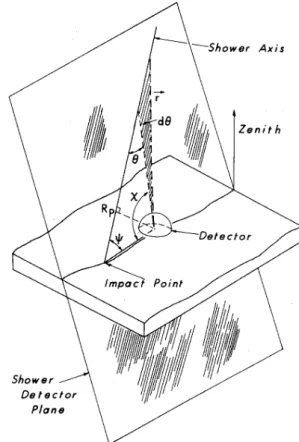
stepforthisistondtheshowerdetetorplane,dened
astheplanehavingthedetetorenterandtheaxisof
theshower(Fig. 1). Therelation betweenthe timeof
eahpixelandtheangleisgivenby:
t( i )= R p tan i 2 ; (3) where t( i
)is thetime registeredby thepixel iatthe
angle
i
. Thebest tof theparametersin Eq. 3gives
theshoweraxis. Knowingthenumberof photons
em-mitedbyeahsegmentoftheregisteredtrak,the
longi-tudinalproleoftheshoweranbereonstruted.The
depthof themaximumdevelopmentof theshoweran
then beidentied, what brings information aboutthe
hemialompositionoftheosmiraythatinduedit
[10℄. Therelationbetweenthenumberofphotonsand
hargedpartilesisgivenby:
N e = 4R 2 N pe F yield A(R ) ; (4)
where R is the distane to the orresponding shower
traksegment, Athelightolletingarea,the
dete-tor eÆieny and l the trak segment length.
Know-ingthe uoreseneyield F
yield
in airand theurrent
lighttransmitane oftheatmosphereitispossibleto
obtain the total number of (harged) partiles in the
showerN
e
,andthentheenergyoftheosmirayby:
E= E X Z N e
(x) dx ; (5)
whereE
istheritialenergyoftheeletron(81MeV)
andX
0
theradiationlengthinair(37.1gm 2
).
Figure 1. The shower detetor plane ontains the shower
axisandthedetetorenter.
Anairshowerthathitsbothdetetors,SDandFD,
an be fully reonstruted independently. These are
alled \hybrid"eventsand takeadvantageofthemost
importantarateristiofthisexperiment. Withthe
re-onstrutionbytwodierentmethodsamoredetailed
study of the EHE showers will be possible, giving a
moreaurateresult.
The Pierre Auger Observatory will be the rst
EHECR hybrid detetor and it will make possible a
betterunderstandingabouttheEHEshowersdetetion.
BesidesyielditsowndataitisexpetedthatPAOan
help to larifyinonsisteniesbetweenexisting
experi-mentsresults.
A. The surfae detetor
Thesurfaedetetor(SD)arraywillonsistof1600
stations spreadedona3000 km 2
area,separatedby a
distane of 1.5 km from eah other. This
ongura-tionwashosentosolvetheneedforgood eÆenyto
showersofE >10 19
eV and statistialsampling to
re-onstrutthelateraldistribution. Basially,theSD
sta-tionsareomposedof awatertankwheretheharged
partilesofEASprodueCerenkovlight,whihare
ol-leted by three photomultipliers (PMTs). The tanks
sealed bagshapinga3.6 mdiameter and1.2 mheight
ylinder (Fig. 2). The roles of the liner is to prevent
againstwaterontamination,isolationofexternallight
andto providediusivereetioninsidethetank. The
surfaeofthewaterylinderisthesensitiveareaofeah
surfae detetor, 10 m 2
. The signaland trigger
pro-essing eletronis are loated onthe topof the tank,
poweredbybatteriesandsolar panel. Thedata
trans-fer is done by radio ommuniation to a entral
sta-tion. Theontrolofthestationsanbedoneremotely,
turning iton oro when needed. Also, modiations
in the software will be possible downloadingthe ode
fromtheentralstation. Inthisway,eahSDstationis
a ompletelyindependent station,not needingany
lo-alinterfereneunlesssomemaintenaneduetosystem
fails ours.
Figure 2. An surfae detetor station (tank) inthe eld.
Details of themain omponentsare shown. Therewill be
1600 SDstationsinthesouthernsite.
The light olleted bythe 8' or 9' (there are both
sizes in usebynow)diameter PMTsyield eletri
sig-nalswhiharedigitizedbyash-ADCeletronis.
Run-ningatsamplingrateof40MHz,theolleteddataare
waveforms of the signal at the output of the PMTs.
This kind of information is speially useful in the
re-onstrution of the EAS beause it brings more than
thetotalolletedharge. Theanalysisoftheshapeof
the signal (risetime for instane) an help onthe
dis-riminationofmuonontentintheshower.Everyevent
reeivesatimestamp,providedbyaGPSsystem,
pos-sibiliting the reonstrution of theshower front
dire-tion. Thereareseveraltriggerslevels: level1and2are
proessedinthestation,3and4aredoneattheentral
dataaquisition.
B. The uoresene detetor
Fordetetionoftheuoresenelightthere willbe
30 Shmidt optis telesopes. These telesopes will
be distributed in four "eyes", three at the borders of
the surfae detetor distribution and one at the
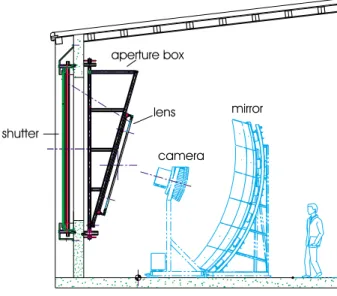
en-ter. Eah telesopeunit is omposed of light olletor
mirror,PMTamera,orretorringlens,andassoiate
to allowtheonstrution ofthe requiredsurfaearea.
The amera has a spherial surfae and is omposed
of440hexagonalPMTs,distributed in22lines and20
olumns. Eah PMT(pixel)overs1:5 Æ
,performinga
total amera eld of view of 30 Æ
in azimuth and 30 Æ
inzenith angle. Eahperipheraleyehassixtelesope,
plaedside byside performing 180 Æ
of azimuth angle,
theentralonehas12telesopesand360 Æ
. Mirror
ele-tronisareenhargedtodigitize thePMTssignalsand
proessthe rstleveltriggerand theMirror PC
om-muniateswiththeEyePCtoonstruttheeyetrigger.
Atmospheri monitoringsystemswill berunning with
theFD, providing data to orretthe amount oflight
olletedtothetransparenyoftheatmosphere.
mirror
camera
lens
shutter
aperture box
Figure3. Atelesopebaywithitsparts.
III Data aquisition and trigger
Although the observatoryuses hybrid detetion
teh-nique,thedetetorswillnotbeoperatingalways
simul-taneously. Surfaedetetorsareplannedtorun
ontin-uously24hrsaday. Theuoresenedetetor,though,
willoperatejust onlear,moonlessnights.
The long distane that separates eah SD station
makes unpratible any interonnetion by wire. The
dataofSDstationsaresenttotheentraldata
aqui-sition system (CDAS) by mean of wireless LAN
net-work to a loal onentrator. The onentrators are
Figure4. Diagram ofthewireless ommuniationbetween
detetorsandtheentraldataaquisition. SDstations
om-muniatetoloalonentrators,whihareonnetedtothe
PAOnetworkbakbone. FDeyesarealsoonnetedtothe
bakbone.
The SDssend a valid seond level trigger (T2) to
CDAS wheneverthe harge olleted and time
exten-sionofthesignalexeedaertainthreshold. TheCDAS
looksforatleastoneotherstationswithT2oiniding
in agiventime window, brodastingarequest ofdata
inpositivease. Theneverytriggeredstationsendsthe
digitizedwaveformsontainedintheirmemorybuers
toCDAS.
FortheFD,thetriggerisperformedindependently
of CDAS.The rst level triggeris done byeah pixel
(PMT) and ours when the ontinuously digitizing
FADC systemregisterlightabovethethresholdofthe
night sky utuation. A seond level trigger is
per-formedwhenatleast4pixelsaretriggeredlookinglike
astraightline. Thisiswhatisexpetedifashowerfalls
in the eld of view and all thewaveformsof pixels of
theameraarethenstored. ThedataaresenttoCDAS
byadiret onnetionto thenetworkbakbone.
IV Constrution status
After aworldwidesurvey thetwosites hosenfor the
installationofthePAOwerePampaAmarilla,Provine
ofMendoza,Argentina(southernobservatory)and
Mil-Besidestheobviouslatitudeposition,themainriteria
tohoosethesiteswere:
Goodlimateondition,withdryatmosphereand
lowlevelof polutionand light, forthe operation
oftheFD.
Flat land to allow wireless ommuniations and
someelevations at the border and enter for
in-stallationoftheFDeyes.
It has been deided that the southern site should
beonstruted rst. Theonstrutionof the
observa-toryhasstartedin 2000whentherst of1600surfae
detetor stationswas deployedin thedesertof Pampa
Amarilla. Also,theAssemblyBuildingandtherstFD
eyebuildingat LosLeonesmountainwereonstruted
by that time. The AB is the plae for the
eletron-is/mehanisshops, storage of tools and all the
on-strutionmaterialforthePAO.Itisloatedintheity
of Malargueand nextto itis thereentlynished
Of-eBuilding,plaeoftheontrolrunandollaborators
oÆes. RightaftertheentralandFDommuniations
towers were installed the rsts wireless network tests
wassuesfullydone.
Intherstphaseoftheprojetasmall partof the
SDarray,40detetors,andtwouoresenetelesopes
will be onstruted. This is the so-alled
Engineer-ingArray,aprototypethatwillhelptodeteteventual
tehnialandoneptualproblemsinthedesignofthe
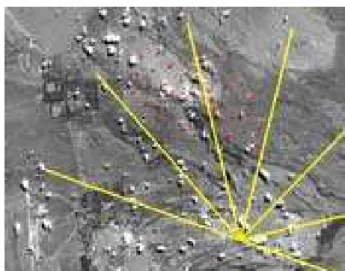
experiment. In Fig.5a satellitephoto of the EA site
area is shown. By the time this papers was written
40tankswasalreadydeployed,30ofthemfully
instru-mentedandbothFDtelesopeswereoperating.
Figure5. EngineeringArray satellitephoto,the diamonds
marksdenotethe SDtankspositions. At thevertex point
is theLos LeonesFDeye,the linesmarkthe eld ofview
ofeahtelesope.
Oneof the rsts tasks in the sitewasto map and
dene the right plaeto deploy thetanks. They were
hosenbasiallylookingforthelosestplaetothe
in the eld follow several stepsorganized in a wayto
optimizeost,manpowerandsafety:
1. Prepararationof the site. A radius of 6-10m is
ompletely leared of vegetations to redue the
sesonalrehazard.
2. Deployment of the tank with liner inside. The
tank are brought to the eld with a truk and
installedusingarane.
3. Waterlling. De-ionizedwaterisproduedinthe
waterplantintheABand broughttotheeld.
4. InstallationofthePMTs,eletronisandabling.
Thisistheproess thathavebeentriedduring the
EA phase. Improvementsin thismethodologyhaveto
bemadeinorder tooptmize thetime toonstrutthe
fullarrayonprogramedshedule.
Thewater insidethe tankhasto staylearfor the
transmissionof theproduedCerenkovlight. AsPAO
is programedtoolletdataforabout20years,thisis
alsothetimeexpetedthewatertolast.Forthisreason
the watermust bedeionizedandompletely freefrom
miroorganisms and nutrients. After many studies it
has been deided to install a water plant exlusively
to fornish water for the SD tanks. It is installed in
theAssemblyBuilding andisfullyoperational,having
produedthewaterto llalltheEA tanks. Thewater
wasdelivered to eah detetor by a trailer ontaining
12000 liter tank (one detetor apaity), pulled by a
truk-like trator on the main roads to the detetors
andbyagriultural-industrialtratorindiÆultareas.
A singlehose onnetionhasbeenusedin aneortto
preventbateriaontamination.
Time (ns)
0
200
400
600
800
1000
1200
1400
1600
Susana
Event #10868
PMT Traces
PMT Traces
Figure 6. DigitizedPMTs signals ofthe SDstation alled
\Suzana". Signalamplitude(arbitraryunits)bytime.
Due to the wireless nature of the data aquisition
andtheautonomouspowersupply(bysolarpanelsand
batteries), theassoiateeletronis ofeahSD station
is aomplexengineeringissue. BesidesthePMTs
sig-nalproessingeletronisitalsohas,powerontrol
sys-tem, radio ommuniationmodule,ommuniation
in-et. Sine the rsts tanks were deployed in the eld,
intensiveworkshavebeendonetoadjusttheeletroni
systemtotherealworkingonditions. Todaythereare
30tanks in theeld workingand sendingreal data to
theentral dataaquisition. IntheFig.6some
wave-formsfrom ashowerevent from theSD stationalled
Suzana is shown. Even if still in the way to have a
ompletebug-freesystem,thePAOSDhasproved,by
its severals already deteted events, that its design is
suessfull.
Figure7. LosLeonesFDeyebuilding.
The uoresene prototypes telesopes were
mountedon theLos Leonessite, plae of therst FD
eye,loated at thesouth ofthe array (Fig. 7). Inthe
EAphasetwoprototypetelesopeswasinstalled,their
eld of views overlook the sky above the 40 EA-SD
stations. In this way both telesopes are able detet
hybrid events and fully test the system on showers
whihimagesoverlapsbothtelesopes. Bymayof2001
therstprototypetelesopewasalreadymounted. The
optialsystem (mirror,lenses, lters), amera,analog
anddigitaleletroniswereoperating. Manytestshave
being arried out sine then and many showers have
being already deteted. One of these tests was done
shooting laser beams in the atmosphere. The laser
sourewastook to severaldierentdistanesfrom the
thetelesopes. Thelaser shotsaresattered intheair
anditisexpetedthatsomelightofsemi-vertialshots
goes through the telesopes. In this way an inverse
shower-likestruture isreated. Thisisagoodtest to
studytheperformaneof thetelesopein
reonstrut-ingtheaxisdiretion andlightsensitivity. Theresults
hasshown thatthe prototypestelesopesareas
sensi-tiveasdesignedforandalso thepreisonfordiretion
determination. Fig. 10 shows an eventdisplay of one
of the laser shots. There are also some hybridevents
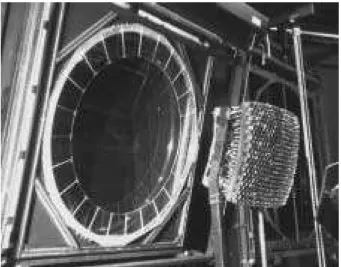
Figure8. Detailof theamera andthe apertureboxwith
theorretorring.
Figure9.Cameraview(left)anddigitizedwaveform(right)
ofpixelsofashowerevent.
Figure10. Cameraviewanddigitizedwaveformofpixelsof
alasershotevent.
V Conlusion
EA data taking and analysis is still going on, at the
same time PierreAugerObservatoryis going forward
toitspre-produtionphase. AsresultoftheEA
experi-enesomepartsofbothdetetorsarebeingrengineered
to better performane. One of them are the plasti
tankswhihgotimprovementsinitsdesigntobemore
robust. Also,theeletronisoftheSDstationsare
be-ingmodiatetoamoredenitivedesignusingASICs
instead of PLDs. For this pre-prodution phase 100
newSDstationsisin thewayto bedeployed. TheFD
expansion isalso going on and besides theinstalation
of newtelesopesto omplete theLosLeones eye, the
onstrution of theseond eyebuilding (El Coihueo)
willstartverysoon. AsSD,theFDexpansionwillhave
somemodiationsonsomedevieslike,aperturebox,
lenses,shutteret. Allthese modiationsanbe
on-sideredminorhanges,notaetingtheoneptofthe
PAOdetetors. TheEA dataanalysis isshowingthat
all the tehnial innovations brought into this projet
likeauto-suÆientSDstations(solarpower,radiolinks
et),uoresenedetetorswithShmidtoptis,is
su-essfully makingpossibleto buildanew generationof
osmirayexperiment.
Referenes
[1℄ M. A. Lawrene,R. J.O.Reid,and A.A. WatsonJ.
Phys.G17,733(1991).
[2℄ N.Chiba,K.Hashimoto,andN.Hayashidaet al,
Nu-learInstr. andMethodsA311,338(1992).
[3℄ M. Nagano, M. Teshima, Y. Matsubara, H. Y. Day,
T.Hara, N.Hayashida, M. Honda, H. Ohoka,and S.
Yoshida,J.Phys.G18,423(1992).
[4℄ R. M. Baltrusaits et al, Nulear Instr.and Methods
A240,4101985.
[5℄ D.J.Bird,S.C.Corbato,andH.Y.Daietal.,
Astro-phys.J.424,491(1994).
[6℄ A. M. Hillas Ann. Review of Astronomy and
astro-physis22,425(1984).
[7℄ E.Fermi,PhysialReview75,1169(1949).
[8℄ K.Greisen,PhysialReviewLetters 16,748(1966).
[9℄ G.T.ZatsepinandV.A.Kuz'minJETPLetters4,78
(1966).
[10℄ T.K.GaisserCosmiRayPhysis,Cambridge