Rhodoliths in Brazil: Current knowledge and potential impacts of climate change
Paulo Antunes Horta
1*, Pablo Riul
2, Gilberto M. Amado Filho
3, Carlos Frederico D. Gurgel
1,
Flávio Berchez
4, José Marcos de Castro Nunes
5, Fernando Scherner
6, Sonia Pereira
6, Tito Lotufo
7,
Letícia Peres
1, Marina Sissini
1, Eduardo de Oliveira Bastos
1, João Rosa
1, Pamela Munoz
1, Cintia
Martins
1, Lidiane Gouvêa
1, Vanessa Carvalho
1, Ellie Bergstrom
1, Nadine Schubert
8, Ricardo G.
Bahia
3, Ana Claudia Rodrigues
1, Leonardo Rörig
1, José Bonomi Barui
1, Marcia Figueiredo
31 Departamento de Botânica, Centro de Ciências Biológicas Universidade Federal de Santa Catarina (CEP:88040-970, Florianópolis, SC, Brasil)
2 Departamento de Engenharia e Meio Ambiente, Universidade Federal da Paraíba (CEP: 58297-000, Rio Tinto, PB, Brasil)
3 Instituto de Pesquisas Jardim Botânico do Rio de Janeiro (CEP: 22460-030, Rio de Janeiro, RJ, Brasil)
4 Laboratório de Algas Marinhas, Instituto de Biociências, Universidade de São Paulo (CEP: 05508-090, São Paulo, SP, Brasil)
5 Laboratório de Algas Marinhas, Instituto de Biologia, Universidade Federal da Bahia (CEP: 40210-730, Salvador, BA, Brasil)
6 Laboratório de Ficologia, Departamento de Biologia, Universidade Federal Rural de Pernambuco (CEP: 52171-900, Recife, PE, Brasil)
7 Instituto de Oceanograia, Universidade de São Paulo (CEP: 05508-090, São Paulo, SP, Brasil)
8 Programa de Pós-Graduação em Oceanograia, Departamento de Geociências, Universidade Federal de Santa Catarina(UFSC) (CEP: 88040-900, Florianópolis, SC, Brasil)
*Corresponding author: [email protected] Financial Support: CNPQ, CAPES, FAPESP.
Rhodolith beds are important marine benthic ecosystems, representing oases of high biodiversity among sedimentary seabed environments. They are found frequently and abundantly, acting as major carbonate ’factories’ and playing a key role in the biogeochemical cycling of carbonates in the South Atlantic. Rhodoliths are under threat due to global change (mainly related to ocean acidiication and global warming) and local stressors, such as ishing and coastal run-of. Here, we review diferent aspects of the biology of these organisms, highlighting the predicted efects of global change, considering the additional impact of local stressors. Ocean acidiication (OA) represents a particular threat that can reduce calciication or even promote the decalciication of these bioengineers, thus increasing the eco-physiological imbalance between calcareous and leshy algae. OA should be considered, but this together with extreme events such as heat waves and storms, as main stressors of these ecosystems at the present time, will worsen in the future, especially if possible interactions with local stressors like coastal pollution are taken into consideration. Thus, in Brazil there is a serious need for starting monitoring programs and promote innovative experimental infrastructure in order to improve our knowledge of these rich environments, optimize management eforts and enhance the needed conservation initiatives.
A
bstrAct
Descriptors: Algae, Conservation, Brazil, Global warming, Pollution, Ocean acidiication.
Bancos de rodolitos formam oásis de alta biodiversidade em ambientes marinhos de fundo arenoso. Os rodolitos são formados por espécies bioconstrutoras, que fornecem abrigo e substrato para diversas e abundantes comunidades bentônicas. No Brasil esses ambientes são frequentes, representando grandes “fábricas” de carbonato com um papel fundamental no ciclo biogeoquímico do carbono no Atlântico Sul. Estes organismos e ambientes estão ameaçados pelas mudanças climáticas (principalmente
a acidiicação dos oceanos e o aquecimento global) e pelos
estressores locais, tais como os impactos causados pela pesca e
as descargas costeiras de eluentes. Neste trabalho fazemos uma revisão da taxonomia, ilogenia e biologia desses organismos,
com destaque para os efeitos previstos das mudanças climáticas e suas relações com estressores locais. A maioria dos estudos
acerca dos efeitos das mudanças climáticas e da acidiicação
dos oceanos em algas calcárias relatam respostas negativas não
só no crescimento e na calciicação, mas também no processo
de fotossíntese, espessura da parede celular, reprodução e sobrevivência das algas. Este cenário reforça a necessidade em estabelecer uma consistente rede de trabalho para proporcionar um programa de monitoramento amplo e de longo prazo, bem como infraestrutura para avaliações experimentais de impactos locais e regionais das mudanças climáticas e dos estressores locais em bancos de rodolitos.
r
esumo
Descritores: Algas, Conservação, Brasil, Mudanças climáticas, Poluição, Acidificação dos oceanos
INTRODUCTION
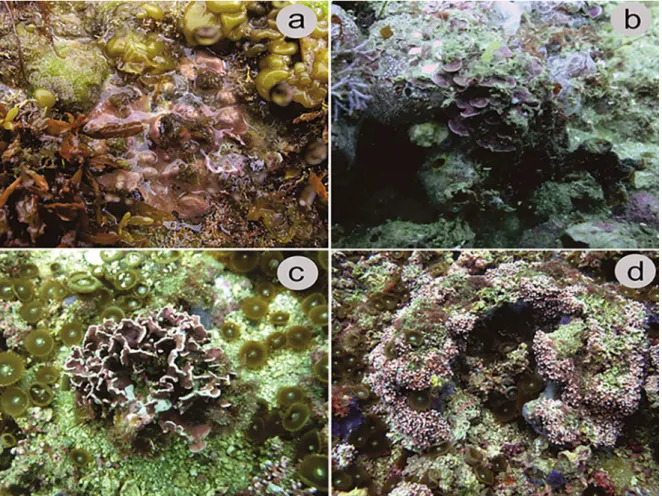
Pink or red “rocks” on the sea floor often consist of different morphotypes of a particular kind of calcareous red algae (Corallinophycidae). This particular kind of seaweed, known as coralline red algae, present calcium carbonate impregnated (i.e. calcified) cell walls. Crustose coralline red algae are completely calcified encrusting organisms (Figure 1) that either adhere tightly to hard substratum or remain unattached to the
seafloor (BROOM et al., 2008). Rhodoliths (including
maërl) can be defined as calcareous nodules composed
of more than 50% of coralline red algal material and
consisting of one to several coralline species growing together (BOSELLINI; GINSBURG, 1971). They may cover extensive areas of the seafloor forming large beds, often associated with high marine biodiversity
(STELLER et al., 2003; RIUL et al., 2009; PEÑA et al., 2014). Rhodoliths may be composed entirely of
encrusting coralline algae or may have a core of non-coralline material (e.g. a shell, piece of dead coral or a pebble), in addition to encrustations by other calcified organisms. They are distributed worldwide (FOSTER,
2001), from tropical to polar regions (ADEY; STENECK, 2001), and from the intertidal zone to depths of 268 m (LITTLER et al., 1986). Rhodolith
beds represent one of the largest carbonate depositional environments in the world (TESTA; BOSENCE, 1999), which makes them an important component in the global carbon biogeochemical cycle and hence, in the atmospheric CO2 balance (OLIVEIRA, 1996).
In Brazil, rhodolith beds extend over almost the
entire continental shelf from Maranhão (0° 50’S) to Santa Catarina state (27°17’S). They predominate within the mesophotic zone (~ 30-150 m depth) along the
continental shelf, on the tops of seamounts, and around oceanic islands (AMADO-FILHO; PEREIRA-FILHO,
2012). The mesophotic coralline ecosystems represent
extensions of shallower ecosystems (HINDERSTEIN
et al., 2010), however, information on biotic and abiotic
aspects of mesophotic habitats remains extremely scarce, due to logistic and technological restrictions, when compared to shallow habitats (BRIDGE et al.,
2011). However, recent advances in mixed-gas diving
techniques, complemented by ROV observations, and high-resolution multi-beam bathymetric mapping systems allow us to begin determining rhodolith beds’
extent, structure, and dynamics (FOSTER et al., 2013).
Rhodoliths represent heavily calciied organisms,
depositing calcium carbonate in the form of high
Mg-calcite, a mineral that attains up to ~90 % of the dry weight
of these species (WOELKERLING, 1993; OLIVEIRA, 1997) and ensures good preservation in fossil record. These features call the attention not only of phycologists, but also palaeontologists and geologists interested in the carbonate abundance of limestone deposits found since the Cretaceous
(LITTLER, 1972; BASSO, 2012). It has been estimated that the Brazilian continental shelf carbonate stock holds 2 x 10¹¹
tonnes of CaCO3 (MILLIMANN; AMARAL, 1974). Among the rhodolith beds along the Brazilian coast, the Abrolhos shelf boasts the world’s largest expansion of rhodoliths in the Atlantic, with a mean relative cover of rhodoliths around
69.1% (± 1.7%) and a mean density of 211 ± 20 nodules per square meter (AMADO-FILHO et al., 2012a). These authors
estimated a mean CaCO3 production rate of about 0.025 Gt/ year for the Abrolhos shelf, containing approximately 5% of the CaCO3 inventory of all the world’s carbonate banks. In addition to its importance in the global carbon cycle (VAN
DER HEIJDEN; KAMENOS, 2015), the reported amount
of limestone has also called the attention of multinational companies interested in the large-scale exploitation of these deposits for agronomic purposes. However, the relatively
low growth rate of mesophotic rhodoliths (about 1.0 mm per year, BLAKE; MAGGS, 2003; AMADO- FILHO et al., 2012a) confers on this resource a nearly non-renewable
characteristic, at least on human time-scales (WILSON
et al., 2004). In addition to the use of rhodolith beds as a
source of CaCO3, other potential economic uses include exploiting their associated biodiversity as a source of bioactive compounds in the pharmacology, agriculture and nutraceutical industries (AMADO-FILHO;
PEREIRA-FILHO, 2012; MARINS et al., 2012).
Despite their great importance for biodiversity resilience and the global carbon budget, in Brazil the functional ecology of these complex habitats, considering the intrinsic latitudinal and vertical variability, has received relatively little attention. In contrast, research programs and
initiatives in Europe (e.g. BIOMAERL, 1996-1999; United Nations Environment Programme, UNEP, 2007, 2015)
have contributed to the knowledge of: (1) rhodolith bed diversity, (2) rhodolith-bed associated biota, (3) functional
roles played by key elements of the biota, and (4) impacts
Figure 1. Diversity of coralline red algal forms. (a) Encrusting form in the intertidal zone; (b) prostrate foliose form; (c) erect foliose rhodolith; (d) fruticose rhodolith. Photos: M.N. Sissini.
In Brazil, only in the last decade have rhodolith beds started gaining more prominence with an increase in the number of published studies on community structure, habitat
mapping, the inluence of anthropogenic impacts, and
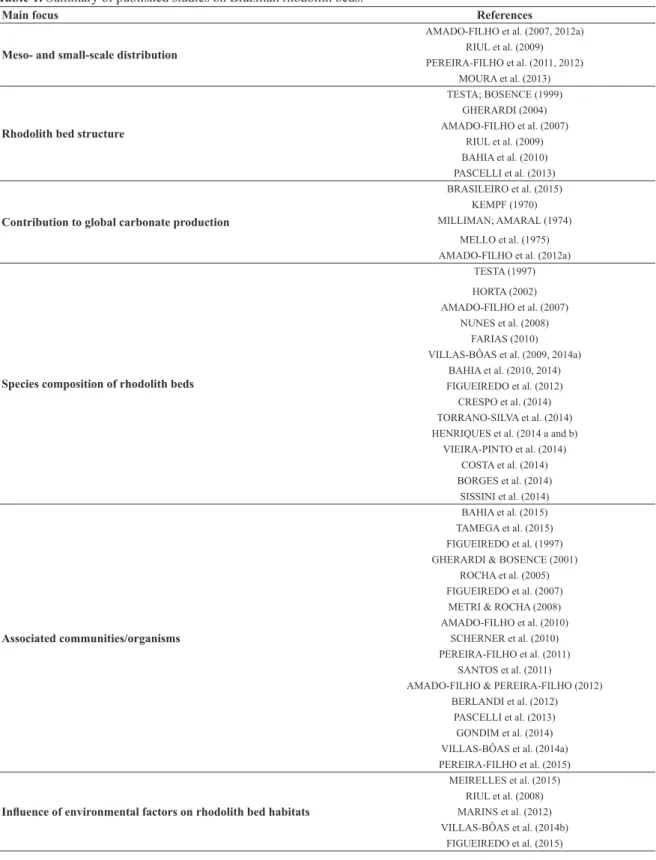
molecular systematics (see Table 1).
In the light of the great ecological and economic importance of rhodoliths, the range of threats they face currently, as well as those they will face in the future, and the lack of knowledge on the extent of their distribution and diversity in Brazil, the present bibliographical review aims to provide the basic information necessary to guide future studies, particularly those related to global climate change and its interaction with local stressors.
Ecological role
Rhodolith beds provide signiicant changes in the
physiognomy of benthic communities, compared to those in the surrounding sandy bottom environments (Figure 2;
FOSTER et al., 2013). The rhodolith-bed forming species
are considered ecosystem engineers (HALFAR; RIEGL,
2013) and their growth and accumulation over geological
time have constituted important sedimentary deposits (DIAS,
2000). They can also be considered key species because their thallus shape and skeletal stability promote structural changes in the environment, increasing habitat heterogeneity and niche availability, resulting in increased species diversity
(STELLER et al., 2003; FOSTER et al., 2013). In general,
higher species diversity is attributed to the greater availability of refuges and other resources that reduce losses derived from competitive exclusion, predation, and physical disturbance events. For these reasons rhodolith beds have been proposed as one of the most valuable habitats for studies on marine
biodiversity both in Europe (BARBERA et al., 2003) and in Brazil (HORTA et al., 2001).
Taxonomy and morphology
Rhodoliths comprise the third most diverse group
Table 1. Summary of published studies on Brazilian rhodolith beds.
Main focus References
Meso- and small-scale distribution
AMADO-FILHO et al. (2007, 2012a) RIUL et al. (2009) PEREIRA-FILHO et al. (2011, 2012)
MOURA et al. (2013)
Rhodolith bed structure
TESTA; BOSENCE (1999) GHERARDI (2004) AMADO-FILHO et al. (2007)
RIUL et al. (2009) BAHIA et al. (2010) PASCELLI et al. (2013)
Contribution to global carbonate production
BRASILEIRO et al. (2015) KEMPF (1970) MILLIMAN; AMARAL (1974)
MELLO et al. (1975) AMADO-FILHO et al. (2012a)
Species composition of rhodolith beds
TESTA (1997) HORTA (2002) AMADO-FILHO et al. (2007)
NUNES et al. (2008) FARIAS (2010) VILLAS-BÔAS et al. (2009, 2014a)
BAHIA et al. (2010, 2014) FIGUEIREDO et al. (2012) CRESPO et al. (2014) TORRANO-SILVA et al. (2014) HENRIQUES et al. (2014 a and b)
VIEIRA-PINTO et al. (2014) COSTA et al. (2014) BORGES et al. (2014)
SISSINI et al. (2014)
Associated communities/organisms
BAHIA et al. (2015) TAMEGA et al. (2015) FIGUEIREDO et al. (1997) GHERARDI & BOSENCE (2001)
ROCHA et al. (2005) FIGUEIREDO et al. (2007)
METRI & ROCHA (2008) AMADO-FILHO et al. (2010)
SCHERNER et al. (2010) PEREIRA-FILHO et al. (2011)
SANTOS et al. (2011)
AMADO-FILHO & PEREIRA-FILHO (2012) BERLANDI et al. (2012)
PASCELLI et al. (2013) GONDIM et al. (2014) VILLAS-BÔAS et al. (2014a) PEREIRA-FILHO et al. (2015)
Inluence of environmental factors on rhodolith bed habitats
MEIRELLES et al. (2015) RIUL et al. (2008) MARINS et al. (2012) VILLAS-BÔAS et al. (2014b)
morpho-species (BRODIE; ZUCCARELLO, 2007; GUIRY; GUIRY, 2015). To date, 48 species of encrusting coralline
red algae have been recognized in the Brazilian lora: 9
Sporolithaceae, 25 Corallinaceae, and 14 Hapalidiaceae
(Table 2). Of those, about 26 species are known, on the Brazilian coast, as rhodolith-forming. In relation to habitat or morphotype, there are no studies distinguishing between the occurrence of exclusively rhodolith-forming or exclusively non-rhodolith-forming species.
Because rhodolith beds consist of a diversity of living organisms, they are characterized as being both temporally and
spatially dynamic ecosystems (AMADO FILHO et al., 2010; BARRETO, 1999; DIAS, 2001; DIAS; VILLAÇA, 2012).
The surface morphology of rhodoliths presents variations regulated by depth (ADEY et al., 1982), hydrodynamic bioerosive processes and taxonomy (BOSENCE, 1983). Depth is also a regulatory factor for rhodolith density (m-2)
and size (Figure 3; BAHIA et al., 2010; PASCELLI et al., 2013). A comparison of three areas of the Brazilian tropical
continental shelf with contrasting slopes showed that in areas
with a gentle slope, rhodoliths increased in size and decreased in abundance (m-2), with a gentle increase of the ellipsoidal to
spherical shape with depth (BAHIA et al., 2010). In contrast,
rhodoliths from narrow shelves and steep slopes decreased in size but increased in abundance.
Studies have also noted that the number and size of
protuberances, hollows or cavities that characterize diferent
morphotypes of rhodoliths are fundamental features that
determine the diversity and abundance of the associated lora and fauna (e.g., AMADO-FILHO et al., 2010; BERLANDI et al., 2012). All this morphological plasticity makes the taxonomical evaluation of their diversity diicult, particularly
at the species level.
Associated fauna and flora
In some large areas of the Brazilian coast, the lack of hard substrate prevents the occurrence of most macroalgal species. In these areas rhodolith beds provide habitats for
leshy macroalgae and other groups of benthic organisms,
Figure 2. Diferent rhodolith physiognomies are sometimes observed at a single site, such as on Trindade Island. (A) Rhodolith beds without
Table 2. Species of Corallinophycidae (excluding articulate forms) reported for the Brazilian coast. (* indicates the species
that still need to be revised using modern techniques and nomenclature; ◦ indicates the species that have been added in the
last three years; # indicates rhodolith-forming species).
SPOROLITHALES Sporolithaceae
Sporolithon australasicum (Foslie) N. YAMAGUISHI-TOMITA EX M.J. WYNNE*
Sporolithon elevatum HENRIQUES & RIOSMENA-RODRIGUEZ◦# Sporolithon episporum (M.A. Howe) E.Y. DAWSON #
Sporolithon erythraeum (Rothpletz) KYLIN*
Sporolithon howei (Lemoine) N. YAMAGUISHI-TOMITA EX M.J. WYNNE*
Sporolithon molle (Heydrich) HEYDRICH◦#
Sporolithon paciicum E.Y. DAWSON*
Sporolithon ptychoides HEYDRICH◦#
Sporolithon tenue BAHIA, AMADO-FILHO, MANEVELDT and W.H. ADEY◦#
CORALLINALES Coralinaceae
Hydrolithon boergesenii (Foslie) FOSLIE
Hydrolithon farinosum (J.V. Lamouroux) D. PENROSE and Y.M. CHAMBERLAIN
Hydrolithon rupestre (Foslie) PENROSW◦#
Hydrolithon samoënse (Foslie) KEATS and Y.M. CHAMBERLAIN
Lithophyllum atlanticum VIEIRA-PINTO, OLIVEIRA and HORTA◦# Lithophyllum congestum (Foslie) FOSLIE◦
Lithophyllum corallinae (P.L. Crouan and H.M. Crouan) HEYDRICH#
Lithophyllum depressum VILLAS-BOAS, FIGUEIREDO and RIOSMENA-RODRIGUEZ#
Lithophyllum johansenii WOELKERLING and CAMPBELL#
Lithophyllum margaritae (Hariot) HEYDRICH◦# Lithophyllum stictaeforme (Areschoug) HAUCK#
Neogoniolithon accretum (Foslie and Howe) SETCH and MASON
Neogoniolithon atlanticum TÂMEGA, RIOSMENA-RODRIGUEZ, MARIATH and FIGUEIREDO◦
Neogoniolithon brassica-lorida (Harvey) SETCHELL and MASON◦
Neogoniolithon fosliei (Heydrich) SETCHELL and MASON#
Neogoniolithon mamillare (Harvey) SETCHELL and MASON*
Pneophyllum conicum (Dawson) KEATS, CHAMBERLAIN and BABA◦ Pneophyllum fragile KÜTZING*#
Porolithon improcerum (Foslie and Howe) LEMOINE◦ Porolithon onkodes (Heydrich) FOSLIE
Porolithon pachydermum (Foslie) FOSLIE◦ Spongites fruticulosa KÜTZING◦#
Spongites yendoi (Foslie) CHAMBERLAIN◦#
Titanoderma prototypum (Foslie) WOELKERLING, Y.M. CHAMBERLAIN and P.C. SILVA◦# Titanoderma pustulatum (J.V. Lamouroux) NÄGELI#
HAPALIDIALES Hapalidiaceae
Lithothamnion brasiliense FOSLIE*#
Lithothamnion crispatum HAUCK◦# Lithothamnion glaciale KJELLMAN◦#
Lithothamnion muelleri LENORMAND ex ROSANOFF◦# Lithothamnion occidentale (Foslie) FOSLIE#
Lithothamnion sejunctum FOSLIE
Lithothamnion steneckii MARIATH and FIGUEIREDO◦ Melobesia membranacea (Esper) J.V. LAMOUROUX
Melobesia rosanoii (Foslie) LEMOINE◦
Mesophyllum engelhartii (Foslie) ADEY◦# Mesophyllum erubescens (Foslie) Me. LEMOINE#
Mesophyllum macroblastum (Foslie) W.H. ADEY◦
Phymatolithon calcareum (Pallas) W.H. ADEY and D.L. MCKIBBIN*#
thus increasing local biodiversity (RIUL et al., 2009) and
primary production. Biodiversity, productivity and live biomass (standing stock) in shallow rhodolith beds are higher than in most of their equivalents found in deeper
areas or in unconsolidated lat bottom communities (RIUL et al., 2009). Remarkably, rhodolith beds provide refuge
for small animals, as abundant mesograzers in southern
Brazil (SCHERNER et al., 2010), and many larger species of ish and invertebrates that occur on adjacent reef
systems will pass over these beds, looking for food and substrate for reproduction. Despite such limitations in supporting a ‘‘complete’’ reef assemblage, rhodolith beds likely represent migration corridors for several species when they cover large inter-reef areas, such as those found
in the Abrolhos Bank (AMADO-FILHO et al., 2012a).
When compared to deep-water sand and mud-benthic communities, rhodolith beds represent submerged oases
(Figure 4). In this context, PEREIRA-FILHO et al. (2015)
hypothesized that the coalescence of rhodoliths constitutes an early successional stage in the formation of large coralline reefs on southwestern Atlantic tropical shelves.
In a study evaluating the marine biota of the Brazilian
Exclusive Economic Zone, LAVRADO (2006) reported a Shannon-Wiener diversity index of 4.0 and 5.1 for speciic areas down to 250 m depth and associated this increase in
the diversity of epibenthic communities to the presence of rhodolith beds. Information about density, dimension, shape and percentage of the live surface of rhodoliths,
associated fauna and lora, rhodolith growth rates, and calcium carbonate mineralization for speciic areas of the
Brazilian Economic Exclusive Zone.
PEREIRA-FILHO et al. (2012) and
AMADO-FILHO et al. (2012b) showed that the mesophotic zone of seamount tops and insular shelves of oceanic islands present rich benthic communities dominated by rhodoliths.
Despite their extensive area, the fauna and lora richness
associated with rhodolith beds in Brazil is very poorly
studied and research has focused on few speciic sites and
taxa (Figure 5). However, the importance of rhodolith beds in supporting a high diversity and abundance of marine species in comparison with surrounding habitats
is recognized (NELSON, 2009), and at least one endemic
species, the polychaete Sabellaria corallinea, is known to occur only in the rhodolith beds of northeastern Brazil
(SANTOS et al., 2011).
In the few studies that have evaluated the fauna
associated with rhodolith beds, 136 solitary and 32 colonial species of invertebrates, totalling 168 taxa, have been reported growing in 100 m2 of a subtropical rhodolith
bed located on Arvoredo Island, southern Brazil (METRI;
ROCHA, 2008). Among the solitary forms, Polychaeta,
Crustacea and Mollusca were the most important groups, while among the colonial forms the Porifera Pachataxa
sp. and the Ascidiacea Didemnum sp. were registered in
90% of the samples. Another study by BERLANDI et al. (2012) compared the Polychaeta composition of diferent
Figure 3. Vertical and latitudinal changes observed in the size (volume) and density of rhodoliths from diferent beds on the Brazilian coastline
Figure 4. Example of the seaweed and zoobenthic communities found in rhodolith beds on the Brazilian coast. This picture highlights the presence of gastropods, echinoderms and a turf algae assemblage on Desert Island, southern Brazil. Photo: P.A. Horta.
Figure 5. Fauna and lora associated with Brazilian rhodolith beds. Arvoredo Island, according to BOUZON & FREIRE (2007), MERTI & ROCHA
(2008), SCHERNER et al. (2010) and PASCELLI et al. (2013), Trindade and Martin Vaz Island according to PEREIRO-FILHO et al. (2011), rhodolith beds of the coast of Paraíba according to RIUL et al. (2009), SANTOS et al. (2011) and GONDIM et al. (2014), and Espírito Santo according to FIGUEIREDO et al. (2007), AMADO-FILHO et al. (2010) and BERLANDI et al. (2012). Numbers indicate the number of species
rhodolith forms (small rhodoliths with long branches and
large rhodoliths with short branches) and found that of the 26
families that had been found, 4 were exclusively associated with large rhodoliths and 9 exclusively with the small ones.
The rhodolith-bed associated fauna and lora have been studied almost exclusively in beds found above 30 m.
In relation to the rhodolith-bed associated lora, some studies have indicated a high and speciic diversity. For exam
-ple, AMADO-FILHO et al. (2010) reported that in the south -ern part of Espírito Santo state rhodolith beds provide an im-portant habitat for epibenthic communities, supporting 25% of the known macroalgal species richness along the Brazilian coast. Also, new records of seaweeds have been found
spe-ciically associated with the rhodolith beds of Espírito Santo
and the northeastern and southeastern Brazilian coasts
(FILHO et al., 2010, GUIMARÃES; AMADO-FILHO, 2008; RIUL et al., 2009).
Global and local threats
Rhodolith beds, like many other marine ecosystems,
are afected by ongoing global change due to the rise in the concentration of greenhouse gases in the atmosphere (CO2 in particular) and all its associated consequences, such
as an increase in seawater temperatures (1-4°C by 2100), decreases in seawater pH (by ~0.3-0.5 units), shifts in carbon
chemistry, sea level rise, and the increase in the strength and frequency of extreme weather events (GIBBARD et al.,
2005; IPCC, 2014).
Global change is likely to have a profound impact on the physiology of a range of marine species across many phyla. However, warmer seawater temperatures and ocean
acidiication (OA) are expected to have a stronger negative efect on crustose coralline species, such as most rhodolith species, than on other macroalgal taxa (DONEY et al., 2009). Data from multiple mesocosm studies on the efect of OA and/or temperature rise on diferent species of macroalgae suggest that the magnitude of algal growth and calciication responses to OA seems to be species-speciic (e.g. PRICE et al., 2011; JOHNSON et al., 2012; CAMPBELL et al., 2014). However, as a general rule, most calcareous algae
seem to experience a reduction in biomineralization, while
non-calcareous algae either show no efect or become more productive (DONEY et al., 2009; JOHNSON et al., 2012; KROEKER et al., 2012).
Calciied organisms can also act as bufers to OA, since
they release CO32- ions that bind with free H+ protons to form
HCO3-, thus neutralizing the acidiication process (DONEY
et al., 2009; SABINE; TANHUA, 2010; BASSO, 2012).
Model predictions estimate that in the future seawater CO2 concentration will increase by 192% and HCO3- will increase
by 14% from de-calciication processes (ROLEDA et al., 2012). These changes are expected to cause negative efects on marine calciiers, both animals and algae, due to their reduced ability to maintain and/or renew their calcareous skeleton (FABRY et al., 2008; JOKIEL et al., 2008; TYRRELL, 2008; HURD et al., 2009; RUSSELL et al., 2009; SEMESI et al., 2009; CORNWALL et al., 2012; JOHNSON et al., 2012). Despite the prediction that OA can compromise calciication, this process depends on
the particularities of the physiology and mineralogy of the
diferent taxonomic groups (RODOLFO-METALPA et al., 2009).
As regards the two main crystallographic forms of biological carbonates, aragonite is twice as soluble as pure calcite, while calcite with high Mg concentrations (8-12%) is more soluble than aragonite (MORSE et al.,
2006). Changes in the chemistry of seawater or increased temperatures can change the Mg content in the calciication
process, altering the solubility of these crystals and
eventually enhancing the sensitivity of calciiers to OA (AGEGIAN, 1985; see review BASSO, 2012). However,
it has been shown that coralline algae are able to form
dolomite (NASH et al., 2012; DIAZ-PULIDO et al., 2014), a feature that has been associated with organisms living in high-energy environments (NASH et al., 2013).
This mineral, formed within the cell wall, provides potential stability to calcareous algae, as inferred from the geological record. In fact, a recent study has shown that coralline algae exposed to OA and conditions of increasing warmth increased their dolomite concentration by 200%
(DIAZ-PULIDO et al., 2014). Dolomite-rich coralline red algae have 6-10 times lower rates of dissolution than
those precipitating predominantly Mg-calcite (NASH et al.,
2013). This property must be responsible for its abundance during periods of high CO2 concentration in our geological past and represents an important aspect that should be taken into consideration when considering experiments about OA.
For many photosynthetic marine organisms, changes in CO2 availability may either have no efect or may alter their metabolism in either positive or negative ways (see review
KOCH et al., 2013). For example, species whether without or with ineicient carbon concentration mechanisms
review KOCH et al., 2013). In the case of coralline
algae, they that are considered to be one of the groups of calcifying taxa with the highest susceptibility to OA, as they accrete high-Mg calcite, the most soluble form of CaCO3. (BOROWITZKA, 1982; MORSE et
al., 2006). The CaCO3 deposition in this algal group
occurs extracellularly within the cell wall (see review
in BOROWTZKA, 1982), representing up to 80-90% of their biomass (BILAN; USOV, 2001).
Most studies about the OA effect on coralline algae report negative responses in growth and calcification
(see Figure 6A; e.g. KUFFNER et al., 2008; SEMESI et al., 2009; NOISETTE et al., 2013; JOHNSON et al., 2014), but also in photosynthesis (e.g. ANTHONY et al., 2008; JOHNSON; CARPENTER, 2012; COMEAU et al., 2012; JOHNSON et al., 2014; KATO et al., 2014; TAIT, 2014), cell wall thickness (RAGAZZOLA et al., 2012; MCCOY; RAGAZZOLA, 2014b), reproduction (CUMANI et al., 2010), recruitment (KUFFNER et al., 2008), and survivorship (DIAZ-PULIDO et al., 2012). These strong negative OA
effects on coralline algae have been shown to alter the competitive interactions between different species
of these coralline algae (MCCOY; PFISTER, 2014a),
between coralline algae and non-calcified algae
(JOKIEL et al., 2008; KUFFNER et al., 2008; PORZIO et al., 2011; HOFMANN et al., 2012; KROEKER et al., 2013a,b), and also between coralline algae and grazer (MCCOY; PFISTER, 2014a). PORZIO et al. (2011) demonstrated a loss of 25% of coralline algae
diversity in environments that are naturally acidified by submerged vents of CO2 off the Italian coast. These changes in the phytobenthic communities in acidified environments reinforce the hypothesis that different ecophysiological susceptibilities of different taxonomic groups will result in profound changes in the physiognomy of these benthic environments in the coming decades.
Most studies related to global climate change effects on coralline algae have focused so far on their response to OA, while only a few have also included
other environmental factors (see Figure 6B), such as temperature (e.g. JOHNSON; CARPENTER, 2012; MARTIN et al., 2013; NOISETTE et al., 2013; COMEAU et al., 2014) and light conditions (GAO; ZHENG, 2010; COMEAU et al., 2014), or local
factors, such as nutrient concentration (RUSSELL et
al., 2009; STENGEL et al., 2014).
Figure 6. (A) Type of response of coralline algae (growth/
calciication) reported in ocean acidiication studies (n = 31), and (B) classiication of experimental marine climate change studies on coralline algae (n = 56 studies) according to the climate variable tested (OA- ocean acidiication, Temp.-temperature)
Besides a variety of studies investigating the OA response in coralline algae, only a few studies have
been performed on the efect of the increase in seawater temperature and possible synergistic efects of ocean warming and acidiication (see Figure 6B).
Generally, ocean warming is expected to afect
algal community structure, seeing that temperature is an important general driver of the algal life cycle and consequently, of their phenology and distribution
(RICHARDSON, 2008). All these changes can have
a decisive impact on the changes in the distribution of populations, expanding the edges of the tropical population to higher latitudes, or excluding populations of colder waters (low temperature dependent) from their current subtropical or warm temperate environments, pushing them beyond these edges.
Studies combining OA and ocean warming scenarios
have shown that there can be synergistic efects between
both factors. For example, in Porolithon onkodes, the increase in CO2 causes high mortality and necrosis only when under high temperatures (>28°C, DIAZ-PULIDO
alga Lithophyllum cabiochiae from the Mediterranean,
an additive efect of temperature was observed,
resulting in higher mortality, necrosis and dissolution of the calcareous skeleton at high temperatures (MARTIN;
GATTUSO, 2009). Thus both seawater pH and
temperature, whether alone or in combination, will most likely change the physiognomy of rhodolith beds in the near future (see Figure7).
sedimentation due to an increase in rainfall (IPCC, 2014).
Thus, larger volumes of sediments will be transported
to the continental shelf. Sedimentation can inluence the survival and growth of rhodoliths. WILSON et al. (2004) showed that rhodoliths when buried under gravel sufered less severe efects than those buried under ine sediment. They related the diferences between sedimentation efects to the movement of water around the thalli, which
also restricts gas exchange. Mud-rich sediment with high concentrations of sulphide was quite harmful to rhodoliths
and associated biota. Also, rhodolith beds can be afected
indirectly by discharges of drill cuttings from oil and gas
activities (DAVIES et al., 2007). These activities on the Brazilian shelf adjacent to the beds result in a ine sediment
cover of the algae that can cause reductions in their net
primary production up to 50-70% (RIUL et al., 2008; FIGUEIREDO et al., 2015). This reduction in primary
production severely impacts rhodolith-forming algae, and has high potential to compromise the establishment of associated diversity.
A greater amount of rainfall increases the lux of
nutrients from urban and rural environments into the
ocean, fertilizing coastal areas (VIAROLI et al., 2005; FAXNELD et al., 2010). Moreover, the growth of the
human population and the increasing use of coastal areas represent the main sources of nutrient enrichment in marine environments, especially from sewage discharges
(HALPERN et al., 2008; TEICHBERG et al., 2010; LUO et al., 2012). An increase of sewage-derived nutrients in
the coastal marine environment changes the structure of phytobenthic communities in urbanized areas (MARTINS
et al., 2012, SCHERNER et al., 2012).
An increase in the concentrations of dissolved nutrients in rhodolith beds constitutes an extremely important threat to this ecosystem (WILSON et al.,
2004). Inorganic nitrogen and phosphate are the two
most important nutrients for macroalgal growth and are consequently what promotes excessive blooms in
macroalgal biomass (VIAROLI et al., 2005; TEICHBERG et al., 2010). Macroalgal blooms can produce conspicuous
shifts in the marine benthic communities (SCHENER et
al., 2012). Thus, nitrogen and phosphorus are considered
limiting nutrients in many marine ecosystems (ZEHR;
KUDELA, 2011). Opportunistic species, such as Ulva
spp., are highly favoured in terms of growth with increasing quantities of nitrogen in the form of nitrate and
ammonium (LUO et al., 2012). RUSSELL et al. (2009) observed that ilamentous turfs are highly favoured by the
Figure 7. Schematic representation of rhodolith bed physiognomy
impacted by warmer and more acidiied waters in the future oceans, as predicted by the IPPC (2014).
Much of the efort that has addressed the impacts
of climate change on the biology of marine primary producers remains limited and has dealt with aspects
related to two initial treatment factors, acidiication and temperature (WERNBERG et al., 2012). However, these
factors have been occurring concomitantly, with other factors related to various processes associated with further changes in climate and other sources of stress. Thus, the
signiicant future increase in rainfall (FAXNELD et al., 2010) as predicted to occur in south-central South America (IPCC, 2014) should act in parallel to the irst two factors,
changing environmental conditions, especially in coastal
regions (see SCHERNER et al., 2012).
In addition to the future changes in temperature and the pH of seawater, there are other co-occurring drivers
increase in nutrients. On the other hand, perennial species, such as Sargassum stenophyllum, are negatively afected
by increases in nutrient concentration, as evidenced by a decrease in photosynthesis with increasing concentrations
of ammonium (SCHERNER et al., 2012). However, in the
same study, in Ulva lactuca, the increase in ammonium concentrations produced an increase in photosynthetic
activity. Thus, nitrogen pollution afects algae diferently,
depending on the species and eventual interaction with
other factors (MARTINS et al., 2012). GRALL and HALL-SPENCER (2003) have described the efects of
agricultural pollution, urban sewage, and industrial waste on rhodolith beds in France. The main consequences were similar to those described for other types of sedimentary habitats and environments, such as an increase in siltation and a higher abundance and biomass of opportunistic species, which replace sensitive ones. A radical change in rhodolith-associated biota together with a reduction in species diversity and area of live rhodolith cover was observed. The authors mentioned two rhodolith beds that have been killed in the Bay of Brest, both of which were
situated directly under sewage outlows.
Of all the factors that determine the structure of a rhodolith bed, the regime of waves and currents is the
most signiicant (ATABAY, 1998). Rhodolith beds require
high energy hydrodynamic regimes. The fragmentation of coralline algae deposits culminates with the formation of new individuals, storms being the main driving force for the formation of rhodolith beds. However, rhodolith beds do not develop if the water dynamic is excessively strong to the point where it causes unsustainable loss rates of thalli, or transports individuals outside suitable habitats. Likewise, weak currents and wave action cause stabilization and overgrowth by larger algal species
or burial by ine sediments, leading to rhodolith death (MARRACK, 1999; FOSTER et al., 2013). Although
poorly documented (FREIWALD, 1995), these phenomena are keys to understanding the structure of the rhodolith bed community and its dynamics. Water transparency is also a fundamental factor in the distribution of rhodolith
beds (CANALS; BALLESTEROS, 1996).
As documented by AMADO-FILHO et al. (2010), the diversity and abundance of the associated community of a shallow-water rhodolith bed is inversely related to the frequency and intensity of extreme events or cold fronts, which are more frequent and intense especially during the
winter (PASCELLI et al., 2013). These phenomena may
increase water motion and the frequency of the rolling of
rhodoliths, eroding the surface and reducing the diversity and biomass of associated soft-bodied algae. It should also be borne in mind that these phenomena reduce light availability near the bottom, theoretically reducing the potential primary production of these formations.
Interactions between global and local
stressors
Besides the anthropogenic impacts that increase nutrient concentrations in coastal regions (MARTINS et al.,
2012), global-change related scenarios that predict more
intense and frequent rainfall will also result in more river
run-of. Hence, larger volumes of land-derived pollutants
will be transported to the continental shelf, severely impacting coastal marine communities. This drainage can reduce the pH and enhance the CO2 concentration
even further, especially in anthropogenically inluenced
estuaries, aggravating the global impacts (NORIEGA et
al., 2012). Thus, drainage basins and associated estuaries
represent important regions for evaluating interactions between local and global stressors (HOWARTH et al.,
1995; CANALS; BALLESTEROS, 1996), including
variations in rainfall patterns.
There are diferent ways in which global factors, such as temperature and acidiication, can interact with local factors, such as nutrients: (1) isolated: the efect of each factor is not inluenced by the efects produced by other
factors studied independently; (2) additive: factors have a
joint efect on the study object that is equal to the sum of the efects caused by each factor when tested in isolation; (3) synergy: the factors have a joint efect on the study object that is greater than the simple sum of the efects caused by each factor when acting in isolation; and (4) antagonistic:
the factors have a negative interaction, one neutralizing the other. Most studies have focused on one factor at a time, few have addressed two factors simultaneously and rarely have three or more been tested together to assess the existence of potential multiple levels of interaction
(Figure 6). It is true that experimental designs with three or more factors are diicult to implement because the
number of necessary replicates increases exponentially and interpretation of results can become too complex. An example of a synergistic interaction has been given
by RUSSELL et al. (2009), who detected an interaction
between the efects of high pCO2 and nutrients on
as climate change factors - have to be considered in the evaluation of likely future scenarios.
Considerations for future research
Although important and abundant throughout the Brazilian coast, rhodolith beds are still poorly understood in many aspects. For example, recent molecular results
(SISSINI et al., 2014; VIEIRA-PINTO et al., 2014) have
reinforced the need for molecular information to clarify taxonomy and distribution patterns of key rhodolith bed-forming species. This is important in the context of conservation strategies, as without basic information about the distribution of the genetic diversity and population genetic connectivity of keystone, foundation and main engineering marine species along the Brazilian coast, conservation and management strategies may be compromised.
Another aspect that needs attention is the threats that global change and its possible interactions with local stressors represents for rhodolith beds. These threats can have numerous consequences for these ecosystems but, unfortunately, in Brazil studies investigating the impact of
global change and/or local stressors are still lacking (KERR et al., 2016).
This demands networking within the Brazilian scientiic
community, in order to coordinate, for example, collective
eforts to perform baseline characterization of these
formations in Brazil. This characterization on a large scale will provide us with a better understanding of the factors
that determine diferent patterns of diversity and abundance.
This pioneering survey will also allow the selection of key areas for the implementation of a program for long-term monitoring. It will provide us with vital information for the creation and improvement of models that will enhance our ability to predict the distribution of these beds and their
associated fauna and lora in the coming decades.
In order to provide evidence of the expected consequences of global change and possible interaction with local stressors for the marine environment, within
a reasonable timeline (i.e. 5-10 years), we also need to prioritize where research eforts have to be placed. The
three topics agreed upon by the authors, which should be given greatest priority are: (1) understanding how OA will interact with other anthropogenic and climatic stressors, (2) understanding whether species may adapt or become acclimatized to future OA conditions and how this will
afect species interactions and ecosystem stability, and
(3) monitoring and modelling temporal, spatial and
habitat variability in carbonate chemistry in order to more accurately predict future changes on the regional and local scale. Whilst these topics are seen as particular priorities, in answering questions regarding the expected consequences of OA, many of the topics we have listed are interlinked, providing the background and context for other research
areas. This represents a diicult task, requiring
multi-stressor experiments with complex experimental designs that will require increased collaboration and joint funding initiatives to allow the manpower, expertise and funding to successfully carry them out. This will be vital, if we are to develop the most appropriate strategies for the mitigation or remediation of or even the adaptation to future scenarios related to global climate change.
ACKNOWLEDGMENTS
Financial support was provided by the Conselho
Nacional de Desenvolvimento Cientíico e Tecnológico (CNPq 306917/2009-2 for PA Horta), INCT-RedeClima,
Rebentos, Coral Vivo Project, Fundação de Amparo à Pesquisa do Estado de São Paulo (FAPESP-BIOTA), Coordenação de Aperfeiçoamento de Pessoal de Nível Superior (CAPES/PNPD02828/09-0 and CAPES/PNADB
2338000071/2010-61 for PA Horta). Fundação de Amparo
à Pesquisa e Inovação do Estado de Santa Catarina (FAPES)
REFERENCES
ADEY, W. H.; TOWNSEND, R. A.; BOYKINS, W. T. The crustose coralline algae (Rhodophyta: Corallinaceae) of the Hawaiian Islands. Washington: Smithsonian Institution Press, 1982.
ADEY, W. H.; STENECK, R. S. Thermogeography over time creates biogeographic regions: a temperature/space/time-integrated model and an abundance-weighted test for benthic marine algae. J. Phycol., v. 37, n. 5, p. 677-698, 2001. AGEGIAN, C. R. The biochemical ecology of Porolithon
gardineri (Foslie). 1985. 178 f. (PhD dissertation). Honolulu: University of Hawaii, 1985.
AMADO-FILHO, G. M.; MANEVELDT, G.; MANSO, R. C. C.; MARINS-ROSA, B. V.; PACHECO, M. R.; GUIMARÃES, S. M. P. B. Structure of rhodolith beds from 4 to 55 meters deep along the southern coast of Espírito Santo State, Brazil. Cienc. Mar., v. 33, n. 4, p. 399-410, 2007.
AMADO-FILHO, G. M.; MANEVELDT, G.; PEREIRA FILHO, G. H.; MANSO, R. C.; BAHIA, R. G.; BARRETO, M. B. B.; GUIMARÃES, S. M. P. B. Seaweed diversity associated with a Brazilian tropical rhodolith bed. Cienc. Mar., v. 36, n. 4, p. 371-391, 2010.
AMADO-FILHO, G. M.; MOURA, R. L.; BASTOS, A. C.; SALGADO, L. T.; SUMIDA, P. Y.; GUTH, A. Z.; FRANCINI-FILHO, R. B.; PEREIRA-FILHO, G. H.; ABRANTES, D. P.; BRASILEIRO, P. S.; BAHIA, R. G.; LEAL, R. N.; KAUFMAN, L.; KLEYPAS, J. A.; FARINA, M.; THOMPSON, F. L. Rhodolith Beds Are Major CaCo3 bio-factories in the tropical South West Atlantic. PLoS ONE, v. 7, n. 4, p. e35171, 2012a.
AMADO-FILHO, G. M.; PEREIRA-FILHO, G. H.; BAHIA, R. G.; ABRANTES, D. P.; VERAS, P. C.; MATHEUS, Z. Occurence and distribution of rhodolith beds on the Fernando de Noronha Archipelago of Brazil. Aquat. Bot., v. 101, p. 41-45, 2012b.
ANTHONY, K. R. N.; KLINE, D. I.; DIAZ-PULIDO, G.; DOVE, S.; HOEGH-GULDBERG, O. Ocean acidiication causes bleaching and productivity loss in coral reef builders. Proc. Natl. Acad. Sci. U S A, v. 105, n. 45, p. 17442-17446, 2008. ATABEY, N. Facies characteristics and geographic distribution
of rhodoliths and maerls (red algae) in Southern Shelf of the sea of Marmara. Mineral Res. Expl. Bull., v. 120, p. 55-61, 1998.
BAHIA, R. G.; ABRANTES, D.; BRASILEIRO, P. S.; PEREIRA FILHO, G. H.; AMADO FILHO, G. Rhodolith bed structure along a depth gradient on the northern coast of Bahia state, Brazil. Braz. J. Oceanogr., v. 58, n. 4, p. 323-337, 2010. BAHIA, R. G.; RIOSMENA-RODRIGUEZ, R.; MANEVELDT,
G. W.; AMADO-FILHO, G. M. First report of Sporolithon ptychoides (Sporolithales, Corallinophycidae, Rhodophyta) for the Atlantic Ocean. Phycol. Res., v. 59, n. 1, p. 64-69, 2011.
BAHIA, R. G.; AMADO-FILHO, G. M.; MANEVELDT, G. W.; ADEY, W. H.; JOHNSON, G.; MARINS, B. V.; LONGO, L. L. Sporolithon tenue sp. nov. (Sporolithales, Corallinophycidae, Rhodophyta): A new rhodolith-forming species from the tropical southwestern Atlantic. Phycol. Res., v. 62, n. 1, p. 44-54, 2014a.
BAHIA, R. G.; AMADO-FILHO, G. M.; MANEVELDT, G. W. Sporolithon molle (Heydrich) Heydrich (Sporolithales, Corallinophycidae, Rhodophyta): an addition to the Atlantic lora found on a remote oceanic island. Cryptogam. Algol., v. 35, n. 1, p. 7-14, 2014b.
BARBERA, C.; BORDEHORE, C.; BORG, J. A.; GLÉMAREC, M.; GRALL, J.; HALL-SPENCER, J. M.; DE LA HUZ, C. H.; LANFRANCO, E.; LASTRA, M.; MOORE, P. G.; MORA, J.; PITA, M. E.; RAMOS-ESPLÁ, A. A.; RIZZO, M.; SÁNCHEZ-MATA, A.; SEVA, A.; SCHEMBRI, P. J.; VALLE, C. Conservation and management of northeast Atlantic and Mediterranean maerl beds. Aquat. Conserv. Mar. Freshw. Ecosyst., v. 13, p. 65-76, 2003.
BARRETO, C. C. Heterogeneidade espacial do habitat e diversidade especíica: implicações ecológicas e métodos de mensuração. Oecol. Bras., v. 84, p. 158-163, 1999.
BASSO, D. Carbonate production by calcareous red algae and global change. Biodiversitas, v. 34, n. 1, p. 13-33, 2012. BERLANDI, R. M.; FIGUEIREDO, M. A. O.; PAIVA, P. C.
Rhodolith morphology and the diversity of polychaetes of the southeastern Brazilian coast. J. Coatal Res., v. 28, p. 280-287, 2012.
BIOMAERL team. Conservation and management of Atlantic and Mediterranean Maerl beds. Aquatic. Conserv, v. 13, p. 65-76, 2001.
BILAN, M. I.; USOV, A. I. Polysaccharides of calcareous algae and their efect on the calciication process. Russ. J. Bioorganic Chem., v. 27, n. 1, p. 2-16, 2001.
BLAKE, C.; MAGGS, C. A. Comparative growth rates and internal banding periodicity of maerl species (Corallinales, Rhodophyta) from northern Europe. Phycologia, v. 42, p. 606-612, 2003.
BORGES, V. P.; BASTOS, E.; BATISTA, M. B.; BOUZON, Z.; LHULLIER, C.; SCHIMIDT, E. C.; SISSINI, M. N.; HORTA, P. A. The genus Melobesia (Corallinales, Rhodophyta) from subtropical South Atlantic, with addition of M. rosanoi (Foslie) Lemoine. Phytotaxa, v. 190, n. 1, p. 268-276, 2014.
BOROWITZKA, M. A. Mechanisms in algal calciication. Prog. Phycol. Res., v. 1, p.137-177, 1982.
BOSELLINI, A.; GINSBURG, R. N. Form and internal structure of recent algal nodules (Rhodolites) from Bermuda. J. Geol., v. 79, p. 669-682, 1971.
BOSENCE, D. W. J. The occurrence and ecology of recent rhodoliths - a review. Heidelberg: Springer Verlag, 1983. p. 225-242.
BOUZON, J. L.; FREIRE, A. S. The fauna of Brachyura and Anomura (Decapoda; Crustacea) in the Arvoredo Marine Biological Reserve Southern Brazilian Coast. Braz. J. Biol., v. 67, n. 2, p. 321-325, 2007.
BRASILEIRO, P. S.; PEREIRA-FILHO, G. H.; BAHIA, R. G.; ABRANTES, D. P.; GUIMMARÃES, S. M. P. B.; MOURA R. L.; FRANCINI-FILHO, R. B.; BASTOS, A. C.; AMADO-FILHO, G. M. Macroalgal composition and community structure of the largest rhodolith beds in the world. Mar. Biodivers., p. 1-14, 2015.
BRIDGE, T. C. L., DONE, T. J.; BEAMAN, R. J.; FRIEDMAN, A.; WILLIAMS, S. B.; PIZARRO, O.; WEBSTER, J. M. Topography, substratum and benthic macrofaunal relationships on a tropical mesophotic shelf margin, central Great Barrier Reef, Australia. Coral Reefs, v. 30, n. 1, p. 143-153, 2011. BRODIE, J.; ZUCCARELLO, G. C. Systematics of the species
rich algae: red algal classiication, phylogeny and speciation. In: HODKINSON, T. R. (Ed.). Reconstructing the Tree of Life: Taxonomy and Systematics of Species Rich Taxa. Boca Ratón: CRC/Taylor and Francis, 2007. p. 317-330.
BROOM, J. E. S.; HART, D. R.; FARR, T. J.; NELSON, W. A.; NEIL, K. F.; HARVEY, A. S.; WOELKERLING, W. J. Utility of psbA and nSSU for phylogenetic reconstruction in the Corallinales based on New Zealand taxa. Mol. Phylogenet. Evol., v. 46, n. 3, p. 958-973, 2008.
CANALS, M.; BALLESTEROS, E. Production of carbonate particles by phytobenthic communities on the Mallorca-Menorca shelf, northwestern Mediterranean Sea. Deep Sea Res., v. 44, p. 611-629, 1997.
CAMPBELL, J. E.; CRAFT, J. D.; MUEHLLEHNER, N.; LANGDON, C.; PAUL, V. J. Responses of calcifying algae (Halimeda spp.) to ocean acidiication: implications for
herbivores. Mar. Ecol. Prog. Ser., v. 514, p. 43-56, 2014. COMEAU, S.; CARPENTER, R. C.; EDMUNDS, P. J. Coral reef
calciiers bufer their response to ocean acidiication using both bicarbonate and carbonate. Proc. Biol. Sci., v. 280, n. 1753, p. 20122374, 2012.
CORNWALL, C.; HEPBURN, C.; PRITCHARD, D.; CURRIE, K.; MCGRAW, C.; HUNTER, K.; HURD, C. Carbon-use strategies in macroalgae: diferential responses to lowered pH and implications for ocean acidiication. J. Phycol., v. 48, n. 1, p. 137-144, 2012.
COSTA, I. O.; HORTA, P. A.; BERGSTROM, E. R.; NUNES, M. C. Taxonomic study of crustose coralline algae of the northeastern Brazilian coast. Phytotaxa, v. 190, n. 1, p. 130-161, 2014.
CRESPO, T. M.; BAHIA, R. G.; MANEVELDT, G. W.; AMADO-FILHO, G. M. Floristic composition of crustose coralline algae from St. Peter and St. Paul Archipelago, a summit of the Mid-Atlantic Ridge. Phytotaxa, v. 190, n. 1, p. 17-37, 2014.
CUMANI, F.; BRADASSI, F.; DI PASCOLI, A.; BRESSAN, G. Marine acidiication efects on reproduction and growth rates of Corallinaceae spores (Rhodophyta). Rapp. Comm. Int. Mer Médit., v. 39, p. 735, 2010.
DAVIES, A. J.; ROBERTS, J. M.; HALL-SPENCER, J. Preserving deep-sea natural heritage: Emerging issues in ofshore conservation and management. Conserv. Physiol., v. 138, n. 3/4, p. 299-312, 2007.
DIAS, G. T. M. Granulados bioclásticos: algas calcárias. Rev. Bras. Geof., v. 18, n. 3, p. 307-318, 2000.
DIAS, G. T. M; VILLAÇA, R. C. Coralline algae depositional environments on the Brazilian central southeastern shelf. J. Coastal Res., v. 28, n. 1, p. 270-279, 2012.
DIAZ-PULIDO, G.; ANTHONY, K.; KLINE, D.; DOVE, S.; HOEGH-GULDBERG, O. Interactions between ocean acidiication and warming on the mortality and dissolution of
coralline algae. J. Phycol., v. 48, n. 1, p. 32-39, 2012.
DIAZ-PULIDO, G.; NASH, M. C.; ANTHONY, K. R. N.; BENDER, D.; OPDYKE, B. N.; REYES-NIVIA, C.; TROITZSCH, U. Greenhouse conditions induce mineralogical changes and dolomite accumulation in coralline algae on tropical reefs. Nat. Commun., v. 5, p. 3310-3318, 2014. DICKIE, G. Enumeration of algae collected at Fernando de
Noronha by H. M. Moseley, N.A., naturalist to H.M.S. “Challenger”. J. Linn. Soc. (Bot.)., v. 14, p. 363-365, 1874. DICKIE, G. Enumeration of Algæ from Bahia, collected by H. N.
Moseley, M.A., Naturalist to H.M.S. ‘Challenger’ (Sept. 25th, 1873 J. Linn. Soc. (Bot.)., v. 14, n. 77, p. 377, 1875.
DONEY, S.; FABRY, V.; FEELY, R.; KLEYPAS, J. Ocean Acidiication: The Other CO2 Problem. Ann. Rev. Mar. Sci., v. 1, p. 169-192, 2009.
FABRY, V.; SEIBEL, B.; FEELY, R.; ORR, J. Impacts of ocean acidiication on marine fauna and ecosystem processes. J. Mar. Sci., v. 65, n. 3, p. 414-432, 2008.
FARIAS, J. N.; RIOSMENA-RODRIGUEZ, R.; BOUZON, Z.; OLIVEIRA, E. C.; HORTA, P. A. Lithothamnion superpositum (Corallinales; Rhodophyta): First description for the Western Atlantic or rediscovery of a species? Phycol. Res., v. 58, p. 210-216, 2010.
FAXNELD, S.; JÖRGENSEN, T.; TEDENGREN, M. Efects of elevated water temperature, reduced salinity and nutrient enrichment on the metabolism of the coral Turbinaria mesenterina. Coast. Shelf Sci., v. 88, n. 4, p. 482-487, 2010.
FIGUEIREDO, M. A.; NORTON, T. A.; KAIN, J. M. Settlement and survival of epiphytes on two intertidal crustose coralline algae. J. Exp. Mar. Biol. Ecol., v. 23, p. 247-260, 1997.
FIGUEIREDO, M. A.; MENEZES, K. S.; PAIVA, E. M. C.; PAIVA, P. C.; VENTURA, C. R. R. Evaluación experimental de rodolitos como sustratos vivos para la infauna em el Banco de Abrolhos, Brasil. Cienc. Mar., v. 33, n. 4, p. 427-440, 2007.
FIGUEIREDO, M. A.; COUTINHO, R.; VILLAS-BÔAS, A. B.; TÂMEGA, F. T. S.; MARIATH, R. Deep-water rhodolith productivity and growth in the southwestern Atlantic. J. Appl. Phycol., v. 24, n. 3, p. 487-493, 2012.
FIGUEIREDO, M. A.; EIDE, I.; REYNIER, M.; VILLAS-BOAS, A. B.; TÂMEGA, F. T. S.; FERREIRA, C. G.; NILSSEN, I.; COUTINHO, R.; JOHNSON, S. The efect of sediment mimicking drill cuttings on deep water rhodoliths in a low-through system: Experimental work and modeling. Mar. Pollut. Bull., v. 95, n. 1, p. 81-88, 2015.
FOSTER, M. S. Rhodoliths: between rocks and soft places. J. Phycol., v. 37, p. 659-667, 2001.
FOSTER, M. S.; AMADO-FILHO, G. M.; KAMENOS, N. A.; RIOSMENA-RODRÍGUEZ, R; STELLER, D. L. Rhodoliths and Rhodolith Beds. In: LANG, M. A.; MARINELLI, R. L.; ROBERTS, S. J.; TAYLOR, P. R. (Eds.). Research and Discoveries: The Revolution of Science through Scuba. Washington: Smithsonian Institution Scholarly Press, 2013. p. 143-155.
FREIWALD, A. Sedimentological and biological aspects in the formation of branched rhodoliths in northern Norway. Beitr. Paläeont., v. 20, p. 7-19, 1995.
GAO, K.; ZHENG, Y. Combined efects of ocean acidiication and solar UV radiation on photosynthesis, growth, pigmentation and calciication of the coralline alga Corallina sessilis (Rhodophyta). Glob. Change Biol., v. 16, p. 2388-2398, 2010.
GHERARDI, D. F. M.; BOSENCE, D. W. J. Composition and community structure of the coralline algal reefs from Atol das Rocas, South Atlantic, Brazil. Coral Reefs, v. 19, n. 3, p. 205-219, 2001.
GHERARDI, D. F. M. Community structure and carbonate production of a temperate rhodolith bank from Arvoredo Island, Southern Brazil. Braz. J. Oceanogr., v. 52, n. 3/4, p. 207-224, 2004. GIBBARD, S.; CALDEIRA, K.; BALA, G.; PHILIPS, T. J.;
WICKETT, M. Climate efects of global land cover change. Geophys. Res. Lett., v. 32, n. 23, p. L23705, 2005.
GONDIM, A. I.; DIAS, T. L. P.; DUARTE, R. C. S.; RIUL, P.; LACOUTH, P.; CHRISTOFFERSEN, M. L. Filling a knowledge gap on the biodiversity of Rhodolith-associated Echinodermata from northeastern Brazil. Trop. Conserv. Sci., v. 7, n. 1, p. 87-99, 2014.
GRALL, J.; HALL-SPENCER, J. M. Problems facing maerl conservation in Brittany. Aquat. Conserv., v. 12, p. 55-64, 2003. GUIMARÃES, S. M. B. P.; AMADO FILHO, G. M. 2008. A com
-munity of gelatinous rhodophytes in the sublittoral of southern Espírito Santo State, Brazil. Bot. Mar. 51: 378-387.
GUIRY, M. D.; GUIRY, G. M. AlgaeBase. World-wide electronic publication, National University of Ireland, Galway. Available: <http://www.algaebase.org>. 2015.
HALFAR, J.; RIEGL, B. From coral framework to rhodolith bed: sedimentary footprint of the 1982/1983 ENSO in the Galápagos. Coral Reefs, v. 32, n. 4, p. 985, 2013. HALPERN, B. S.; WALBRIDGE, S.; SELKOE, K. A.;
PERRY, M.; SELIG, E.; SPALDING, M.; STENECK, R.; WATSON, R. A Global Map of Human Impact on Marine Ecosystems. Science, v. 319, n. 5865, p. 948-952, 2008. HENRIQUES, M. C.; COUTINHO, L. M.;
RIOSMENA-RODRÍGUEZ, R.; BARROS-BARRETO, M. B.; KHADER, S.; FIGUEIREDO, M. A. O. Three deep water species of
Sporolithon (Sporolithales, Rhodophyta) from the Brazilian continental shelf, with the description of Sporolithon elevatum
sp. nov. Phytotaxa, v. 190, p. 320-330, 2014a.
HENRIQUES, M. C.; RIOSMENA-RODRÍGUEZ, R.; COUTIN-HO, L. M.; FIGUEIREDO, M. A. O. Lithophylloideae and Mastophoroideae (Corallinales, Rhodophyta) from the Bra-zilian continental shelf. Phytotaxa, v. 190, n. 1, p. 112-129, 2014b.
HINDERSTEIN, L. M.; MARR, J. C. A.; MARTINEZ, F. A.; DOWGIALLO, M. J.; PUGLISE, K. A.; PYLE, R. L.; ZAWADA, D. G.; APPELDOORN, R. Theme section on mesophotic coral ecosystems: Characterization, ecology, and management. Coral Reefs, v. 29, p. 247-251, 2010.
HOFMANN, L. C.; STRAUB, S.; BISCHOF, K. Competition between calcifying and noncalcifying temperate marine macroalgae under elevated CO2 levels. Mar. Ecol. Prog. Ser., v. 464, p. 89-105, 2012b.
HORTA, P. A. Bases para a identiicação das coralináceas não articuladas do litoral brasileiro: uma síntese do conhecimento. Biotemas, v. 15, p. 7-44, 2002.
HORTA, P. A.; AMANCIO, C. E.; COIMBRA, C.; OLIVEIRA, E. C. Considerações sobre a distribuição e origem da lora de macroalgas marinhas brasileiras. Hoehnea, v. 28, p. 243-265, 2001.
HOWARTH, R. W.; JENSEN, H. S.; MARINO, R.; POSTMA, H. Transport and processing of P in Near-shore and Oceanic Waters. In: THIESSEN, H. (Ed.). Phosphorus in the Global Environment. Chichester: John Wiley & Sons Ltd; 1995. 476 p.
HURD, C.; HEPBURN, C.; CURRIE, K.; RAVEN, J.; HUNTER, K. Testing the efects of ocean acidiication on algal metabolism considerations for experimental designs. J. Phycol., v. 45, n. 6, p. 1236-1251, 2009.
IPCC: Climate Change: Impacts, Adaptation, and Vulnerability. Part A: Global and Sectorial Aspects. Contribution of Working Group II to the Fifth Assessment Report of the Intergovernment Panel on Climate Change. In: FIELD, C. B.; BARROS, V. R.; DOKKEN, D. J.; EBI, K. L.; ESTRADA, Y. O.; GENOVA, R. C.; GIRMA, B.; KISSEL, E. S.; LEVY, A. N.; MACCRACKEN, S.; MASTRANDEA, P. R.; WHITE, L. L. (Eds.). Cambridge: Cambridge University Press; 2014. 1132 p.
JOHNSON, M. D.; CARPENTER, R. C. Ocean acidiication and warming decrease calciication in the crustose coralline alga
Hydrolithon onkodes and increase susceptibility to grazing. J. Exp. Mar. Biol. Ecol., v. 435, p. 94-101, 2012.
JOHNSON, V.; RUSSELL, B.; FABRICIUS, K.; BROWNLEE, C.; HALL-SPENCER, M. Temperate and tropical brown macroalgae thrive, despite decalciication, along natural CO2 gradients. Glob. Change Biol., v. 18, n. 9, p. 2792-2803, 2012.
JOHNSON, M. D.; MORIARTY, V. W.; CARPENTER, R. C. Acclimatization of the crustose coralline alga Porolithon onkodes to variable pCO2. PLoS ONE, v. 9, n. 2, p. e87678, 2014.
JOKIEL, P. L.; RODGERS, K. S.; KUFFNER, I. B.; ANDERSON, A. J.; COX, E. F.; MACKENZIE, F. T. Ocean acidiication and calcifying reef organisms: a mesocosm investigation. Coral Reefs, v. 27, n. 3, p. 473-483, 2008.
KATO, A.; HIKAMI, M.; KUMAGAI, N. H.; SUZUKI, A.; NOJIRI, Y.; SAKAI, K. Negative efects of ocean acidiication on two crustose coralline species using genetically homogeneous samples. Mar. Environ. Res., v. 94, p. 1-6, 2014.
KEMPF, M. Notes on the benthic bionomy of the N-NE Brazilian shelf. Mar. Biol., v. 5, p. 213-224, 1970.
KERR, R., DA CUNHA, L. C., KIKUCHI, R. K., HORTA, P. A., ITO, R. G., MÜLLER, M. N., ... & PINHEIRO, B. R. (2015). The western south Atlantic Ocean in a high-CO2 world: current measurement capabilities and perspectives. Environmental management, 1-13.
KOCH M, BOWES G, ROSS C, ZHANG XH (2013) Climate change and ocean acidiication efects on seagrasses and marine macroalgae. Global Change Biol 19:103-132 KROEKER, K. J.; MICHELI, F.; GAMBI, M. C. Ocean
acidiication causes ecosystem shifts via altered competitive interactions. Nat. Clim. Chang., v. 3, p. 156-159, 2012. KROEKER, K. J.; KORDAS, R. L.; CRIM, R.; HENDRIKS, I.;
RAMAJO, L.; SINGH, G. S.; DUARTE, C. M.; GATTUSO, J. P. Impacts of ocean acidiication on marine organisms: quantifying sensitivities and interaction with warming. Glob. Change Biol., v. 19, n. 6, p. 1884-1896, 2013. KUFFNER, I. B.; ANDERSSON, A. J.; JOKIEL, P. L.;
RODGERS, K. S.; MACKENZIE, F. T. Decreased abundance of crustose coralline algae due to ocean acidiication. Nat. Geosci., v. 1, p. 114-117, 2008.
LAVRADO, H. P. Caracterização do ambiente e da comunidade bentônica. Capítulo 1. In: LAVRADO, H. P.; IGNÁCIO, B. L. (Eds.). Biodiversidade bentônica da região central da Zona Econômica Exclusiva Brasileira. Rio de Janeiro: Série Livros do Museu Nacional, Museu Nacional, 2006. p. 19-66.
LITTLER, M. M. The crustose Corallinaceae. Oceanogr. Mar. Biol., v. 10, p. 311-347, 1972.
LITTLER, M. M.; LITTLER, D. S.; BLAIR, S. M.; NORRIS, J. N. Deep-water plant communities from an uncharted seamount of San Salvador Island, Bahamas: distribution, abundance, and primary productivity. Deep Sea Res., v. 33, n. 7, p. 881-892, 1986.
LUO, M.; LIU, F.; XU, Z. Growth and nutrient uptake capacity of two co-occurring species, Ulva prolifera and Ulva linza. Aquat. Bot., v. 100, p. 18-24, 2012.
MARINS, B. V.; AMADO-FILHO, G. M.; BARRETO, M. B. B.; LONGO, L. L. Taxonomy of the southwestern Atlantic endemic kelp: Laminaria abyssalis and Laminaria brasiliensis (Phaeophyceae, Laminariales) are not diferent
species. Phycol. Res., v. 60, p. 51-60, 2012.
MARTIN, S.; GATTUSO, J. P. Response of Mediterranean coralline algae to ocean acidiication and elevated temperature. Glob. Change Biol., v. 15, p. 2089-2100, 2009. MARTIN, S.; COHU, S.; VIGNOT, C.; ZIMMERMAN, G.;
GATTUSO, J. P. One-year experiment on the physiological response of the Mediterranean crustose coralline alga,
MARTINS, C. D. L.; ARANTES, N.; FAVERI, C.; BATISTA, M. B.; OLIVEIRA, E. C.; PAGLIOSA, P. R.; FONSECA, A. L.; NUNES, J. M. C.; CHOW, F.; PEREIRA, S. B.; HORTA, P. A. The impact of coastal urbanization on the structure of phytobenthic communities in southern Brazil. Mar. Pollut. Bull., v. 64, n. 4, p.772-778, 2012.
MARRACK, E. C. The relationship between water motion and living rhodolith beds in the southwestern Gulf of California, Mexico. Palaios, v. 14, p. 159-171, 1999.
MCCOY, S. J.; PFISTER, C. A. Historical comparisons reveal altered competitive interactions in a guild of crustose coralline algae. Ecol. Lett., v. 17, n. 4, p. 475-483, 2014a.
MCCOY, S. J.; RAGAZZOLA, F. Skeletal trade-ofs in coralline algae in response to ocean acidiication. Nat. Clim. Chang., v. 4, p. 719-723, 2014b.
MEIRELLES, P. M.; AMADO-FILHO, G. M.; PEREIRA-FILHO, G. H.; PINHEIRO, H. T.; MOURA, R. L.; JOEUX, J. C.; MAZZEI, E. F.; BASTOS, A. C.; EDWARDS, R. A.; DINSDALE, E.; PARANHOS, R.; SANTOS, E. O.; IIDA, T.; GOTOH, K.; NAKAMURA, S.; SAWABE, T.; REZENDE, C. E.; GADELHA Jr, L. M. R.; FRANCINI-FILHO, R. B.; THOMPSON, C.; THOMPSON, F. L. Baseline Assessment of Mesophotic Reefs of the Vitória-Trindade Seamount Chain Based on Water Quality, Microbial Diversity, Benthic Cover and Fish Biomass Data. PLoS ONE, v. 10, n. 6, p. e130084, 2015.
MILLIMANN, J. D.; AMARAL, C. A. B. Economic potential of Brazilian continental margin sediments. An. Congr. Bras. Geogr., v. 28, p. 335-344, 1974.
METRI, R.; ROCHA, R. M. Bancos de algas calcárias, um ecossistema rico a ser preservado. Nat. Cons., v. 6, p. 8-17, 2008.
MORSE, J. W.; ANDERSSON, A. J.; MACKENZIE, F. T. Initial responses of carbonate-rich shelf sediments to rising atmospheric pCO2 and “ocean acidiication”: Role of high Mg-calcites. Geochim. Cosmochim. Acta, v. 70, n. 23, p. 5814-5830, 2006.
MOURA, R. L.; SECCHIN, N. A.; AMADO-FILHO, G. M.; FRANCINI-FILHO, R. B.; FREITAS, M. O.; MINTE-VERA, C. V.; TEIXEIRA, J. B.; THOMPSON, F. L.; DUTRA, G. F.; SUMIDA, P. Y. G.; GUTH, A. Z.; LOPES, R. M.; BASTOS, A. C. Spatial patterns of benthic megahabitats and conservation planning in the Abrolhos Bank. Cont. Shelf Res., v. 70, p. 109-117, 2013
NASH, M. C.; TROITZSCH, U.; OPDYKE, B. N.; TRAFFORD, J. M.; RUSSELL, B. D.; KLINE, D. I. First discovery of dolomite and magnesite in living coralline algae and its geobiological implications. Biogeosciences, v. 8, n. 11, p. 3331-3340, 2012.
NASH, M. C.; OPDYKE, B. N.; TROITZSCH, U.; RUSSELL, B. D.; ADEY, W. H.; KATO, A.; DIAZ-PULIDO, G.; BRENT, C.; GARDNER, M.; PRICHARD, J.; KLINE, D. I. Dolomite-rich coralline algae in reefs resist dissolution in acidiied conditions. Nat. Clim. Chang., v. 3, p. 268-272, 2013. NELSON, W. A. Calciied macroalgae - critical to coastal
ecosystems and vulnerable to change: a review. Mar. Freshwat. Res., v. 60, n. 8, p. 787-801, 2009.
NOISETTE, F., EGILSDOTTIR, H., DAVOULT, D., & MARTIN, S. (2013). Physiological responses of three temperate coralline algae from contrasting habitats to near-future ocean acidiication. J. Exp. Mar. Biol. Ecol., 448, 179-187.
NORIEGA, R.; SCHLACHER, T. A.; SMEUNINX, B. Reductions in Ghost Crab Populations Relect Urbanization of Beaches and Dunes. J. Coast. Res., v. 28, n. 1, p. 123-131, 2012.
NUNES, J. M. C.; GUIMARÃES, S. M. P. B.; DONANGELO, A., FARIAS, J.; HORTA, P. A. Aspectos taxonômicos de três espécies de coralináceas não geniculadas do litoral do estado da Bahia, Brasil. Rodriguésia, v. 59, n. 1, p. 75-86, 2008. OLIVEIRA, E. C. Is there a relation among the global warming,
the missing carbon and the calcareous algae? An. Acad. Bras. Cienc., v. 68, p. 18-21, 1996.
OLIVEIRA, E. C. Letters. Science, v. 277, p. 1991, 1997. PASCELLI, C.; RIUL, P.; RIOSMENA-RODRIGUEZ, R.;
SCHERNER, F.; NUNES, M. HALL-SPENCER, J. M.; OLIVEIRA, E. C.; HORTA, P. A. Seasonal and depth-driven changes in rhodolith bed structure and associated macroalgae of Arvoredo island (southeastern Brazil). Aquat. Bot., v. 111, p. 62-65, 2013.
PEÑA,V.,BÁRBARA,I.,GRALL,J.,MAGGS,C.A.&HALL-SPENCER, J.M. (2014a). The diversity of seaweeds on maerl in the NE Atlantic. Marine Biodiversity, 44: 533-551. PEREIRA-FILHO, G. H.; AMADO-FILHO, G. M.;
GUIMA-RÃES, S. M. P. B.; MOURA, R. L.; SUMIDA, P. Y. G; ABRANTES, D. P.; BAHIA, R.; GÜTH, A. Z.; JORGE, R. R.; FRANCINI-FILHO, R. B. Reef Fish and Benthic assem-blages of the Trindade and Martin Vaz island group, Sou-thwestern Atlantic. Braz. J. Oceanogr., v. 59, n. 3, p. 201-212, 2011.
PEREIRA-FILHO, G. H.; AMADO-FILHO, G. M.; MOURA, R. L.; BASTOS, A. C.; GUIMARÃES, S. M. P. B.; SALGADO, L. T.; FRANCINI-FILHO, R. B.; BAHIA, R. G.; ABRANTES, D. P.; GUTH, A. Z.; BRASILEIRO, P. S. Extensive Rhodolith Beds Cover the Summits of Southwestern Atlantic Ocean Seamounts. J. Coastal. Res., v. 28, p. 261-269, 2012. PEREIRA-FILHO, G. H.; FRANCINI-FILHO, R. B.;
PIEROZZI-JR, I.; PINHEIRO, H. T.; BASTOS, A. C.; MOURA, R. L.; COEIXAS, F.; MATHEUS, Z.; BAHIA, R. G.; AMADO-FILHO, G. M. Sponges and ish facilitate succession from rhodolith beds to reefs. Bull. Mar. Sci., v. 91, n. 1, p. 45-46, 2015.
PORZIO, L.; BUIA, M. C.; HALL-SPENCER, J. M. Efects of ocean acidiication on macroalgal communities. J. Exp. Mar. Biol. Ecol., v. 400, n. 1/3, p. 278-287, 2011.
PRICE, N. N.; HAMILTON, S. L.; TOOTELL, J. S.; SMITH, J. E. Species-speciic consequences of ocean acidiication for the calcareous tropical green algae Halimeda. Mar. Ecol. Prog. Ser., v. 440, p. 67-78, 2011.
RAGAZZOLA, F.; FOSTER, L. C.; FORM, A.; ANDERSON, P. L.; HANSTEEN, T. H.; FIETZKE, J. Ocean acidiication weakens the structural integrity of coralline algae. Glob. Change Biol., v. 18, p. 2804-2812, 2012.
RICHARDSON, A. In hot water: Zooplankton and climate change. J. Mar. Sci., v. 65, p. 279-295, 2008.
RIUL, P.; TARGINO, C. H.; FARIAS, J. N.; VISSCHER, P. T.; HORTA, P. A. Decrease in Lithothamnion sp. (Rhodophyta) primary production due to the deposition of a thin sediment layer. J. Mar. Biol. Assoc. U. K., v. 88, p. 17-19, 2008.