From the Department of Pediatrics, Hospital das Clínicas, Faculty of Medicine, University of São Paulo - São Paulo/SP, Brazil. E-mail: [email protected]
Received for publication on January 19, 2004.
ORIGINAL RESEARCH
GLYCEMIA IN NEWBORNS OF HYPERTENSIVE
MOTHERS ACCORDING TO MATERNAL TREATMENT
Silvana Darcie, Cléa R. Leone, Valdenise M. L. T. Calil, Elizete P. Prescinotti, Soubhi Kahhale and Marcelo Zugaib
DARCIE S et al. Glycemia in newborns of hypertensive mothers according to maternal treatment. Rev. Hosp. Clín. Fac.Med.
S. Paulo 59(5):244-250, 2004.
PURPOSE: To evaluate the evolution of glycemic levels in newborns of hypertensive mothers according to maternal
treatment.
METHODS: Prospective randomized study, including 93 newborns of mothers treated with isradipine (n = 39), atenolol
(n = 40), or low sodium diet (control group – n=14). Glycemia was determined at birth (mother and newborn by the oxidase glucose method) and in the 1st, 3rd, 6th, 12th, and 24th hours after birth (newborn by a test strip method). The evolution of glycemia was analyzed in each group (Friedman test). The groups were compared regarding glycemia (Kruskall-Wallis test), and linear regression models were constructed for the analyses (independent variable = maternal glycemia; dependent variables = umbilical cord, 3rd, and 6th hour glycemia).
RESULTS: There were no statistically significant differences among the mean blood glucose levels of the 3 groups in
any of the assessments. There was a correlation between maternal and umbilical cord blood glucose in the isradipine (r = 0.61; P <.05) and control (r = 0.84; P <.05) groups. Regarding glycemia levels of the mothers and newborns in the third and sixthhours postpartum, this correlation was present only in the control group (maternal x third hour: r = 0.65; P <.05; maternal x sixth hour: r = 0.68; P <.05). There were no correlations in the atenolol group. Hypoglycemia was detected in 51.3% of the isradipine group, 60% of the atenolol group, and 35.7% of the control group, and it was more frequent in the first hour postpartum in all groups.
CONCLUSIONS: The results suggest a similar effect of the 3 types of treatment upon newborn glycemia. The correlation
analysis suggests that isradipine could have effects upon newborn glycemia only after birth (correlation only in umbilical cord blood), whereas atenolol could act earlier (there was no correlation at any moment). The results also point to the need for glycemic control from the first hour postpartum of newborns of hypertensive mothers whether they have or have not undergone treatment with antihypertensive drugs.
KEY WORDS: Hypertension. Pregnancy. Glycemia. Hypoglycemia.
Hypertension during gestation may be considered not only a disorder but also a maternal response to an un-derlying disease. It is usually the first signal of a placental dysfunction, and therefore it may be used as a risk pre-dictor.1,2
The elevation of blood pressure in gestation that is a consequence of a pre-existent arterial hypertension or preeclampsia is associated with severe
fetal-maternal risks. For the mother, there is the risk of eclampsia, HELLP syndrome with multiple organ failure, cerebral hemorrhage, and death. For the fetus, there is an increasing risk of
an intrauterine growth restriction, pre-mature birth, abruptio placenta, and fetal death.1-3
However, since antihypertensive treatment may reduce the need for in-terrupting gestation, fetal maturity may be obtained, with a reduction of
neonatal loss as a consequence.1,4
oth-ers alter cardiac output, othoth-ers affect pe-ripheral vascular resistance, and others
inhibit angiotensin-converting enzyme.1
Some treatment modalities seem to be favorable, although other drugs have undesirable side effects. Atenolol, a beta-blocker, is a drug used to con-trol the blood pressure levels during gestation, mainly in the patient who has an elevated cardiac output. How-ever, there are reports of abnormalities in the fetal heart rate when this drug is used. The use of beta-blockers in gestation is also associated with hypoglycemia, bradycardia, and
hypo-tension in some newborns.1,5
Among the treatment modalities, isradipine is a dihydropyridine cal-cium antagonist that acts as a calcal-cium channel blocker (classified as a drug that acts upon peripheral vascular re-sistance). Isradipene has been found to be well-tolerated, free from side effects upon the uteroplacental circulation and the fetal hemodynamics, present-ing a low tocolytic effect, reducpresent-ing blood pressure in non-proteinuric
hy-pertensive women.6,7,8,9
Considering these characteristics of isradipine, a study was developed with the aim of evaluating its effects on the evolution of glycemia levels in newborns of pregnant women who have arterial hypertension , comparing it to the use of atenolol and with situ-ations where the blood pressure con-trol was done without using antihyper-tensive medications.
Test Population and Methodology
Test population
The test population comprised 93 newborns admitted in the Nursery Annex to the Maternity, Neonatal Pediatrics Service, Children’s Institute “Prof. Pedro de Alcântara”, Faculty of Medicine, University of São Paulo (BAM), from 06/01/1994 to 03/19/1997, who fulfilled the following inclusion criteria:
1) Newborn of a mother with arte-rial hypertension defined as a diastolic blood pressure (Korotkoff phase 4) equal to or higher than 90 mmHg, meas-ured on the left arm at the heart level, after at least 10 minutes of resting, seated, or in dorsal decubitus position with adequate cuff on 2 occasions at in-tervals of a minimum of 6 hours;
2) The maternal hypertension diag-nosis was specific hypertensive dis-ease of pregnancy (SHDP) or chronic arterial hypertension (CAH) and super-imposed SHDP, treated with isradipine, atenolol, or without antihypertensive medication with only a low sodium diet (noting that the pregnant women who received drugs also were pre-scribed a low sodium diet);
3) The mother had been undergo-ing the treatment for at least 2 weeks before the delivery (a previous study with pregnant women showed a statis-tically significant reduction in the blood pressure levels in a week after
the beginning of the use of drugs.10
Also, the group that received only the diet intervention must have been on the low sodium diet for a minimum period of 2 weeks);
4) The newborn was a result of a singleton pregnancy;
5) The pregnant woman had given post-information consent.
Exclusion criteria:
1) The mother had a previous fetal loss, especially without explanation;
2) The mother had another pathol-ogy, such as cardiopathy, hepatopathy, hemopathy, diabetes, or pneumopathy; 3) The mother had been taking other medications that could interfere with the metabolism of carbohydrates in the newborn.
The study was approved by the Ethics Committee in Research of the Institution.
Methodology
This was a randomized, longitudi-nal, prospective study comparing 3
groups of patients according to the type of maternal treatment:
Group 1: 39 newborns of hyperten-sive mothers treated with isradipine (5 mg twice a day);
Group 2: 40 newborns of hyperten-sive mothers treated with atenolol (50 mg twice a day);
Control group: 14 newborns of mothers whose hypertension was con-trolled with diet only.
Study Design
All newborns included in the study were evaluated at birth through the use of the Apgar score at the first and fifth minutes postpartum, and birth weight in relationship to gestational age was evaluated according to Ramos
intrau-terine growth curve.11
Glycemia was determined at birth in the mother and in the newborn (through venous blood assessment of the umbili-cal cord) and then successively in the newborn in the 1st, 3rd, 6th, 12th, and 24th
hours postpartum. Immediately after col-lection, the blood sample was sent to the laboratory for analysis.
The glucose oxidase method was used for the maternal and newborn
glycemias at birth, and the DextrostixÒ
strip method test (analyzed by the same
GlucometerÒ machine throughout the
study) for the 1st, 3rd, 6th, 12th, and 24th
hour samples from the newborn. The newborns were preferentially breastfed, and in cases where this was not possible, were fed with a formula for term newborns after the first 6 hours postpartum.
Hypoglycemia was considered to be blood glycemia values less than 40 mg/dL.
Statistical analysis
the Friedman repeated measure test (one-way ANOVA test) in each group.
Linear regression models were con-structed for the glycemic concentra-tions, considering maternal glycemia as an independent variable; dependent variables were the glycemias of the umbilical cord and of the newborn in the third and sixth hours postpartum.
Fisher’s exact test was used for comparing the proportions.
The significance level was set as
P <05.
RESULTS
Ninety-three newborns that ful-filled the inclusion criteria were
in-cluded in the study. However, only the newborns with usable test results were included in the statistical evaluation.
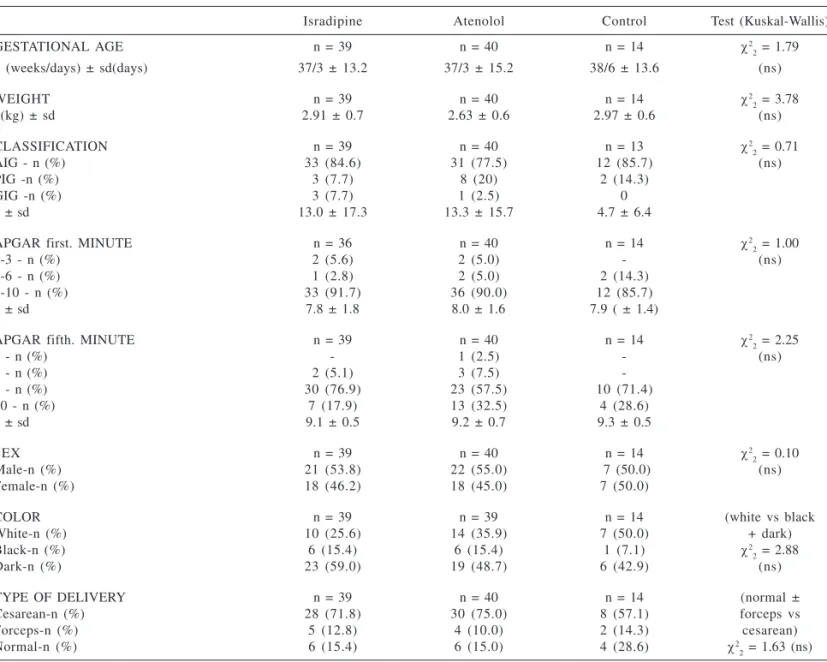
There was no difference among the groups regarding gestational age, weight, classification, Apgar, sex, color, and type of delivery. (Table 1)
Differences related to the glycemic levels of the mother and the newborn were not observed among the groups, and there were no differences among the glycemic levels regarding any of the determinations at any time point for any group as shown in Table 2.
Figure 1 shows the evolution of glycemic levels with time in each group. Figures 2 and 3 show the correla-tion between the maternal and umbili-cal cord glycemias in the isradipine
Table 1 - Characteristics of the newborn.
Isradipine Atenolol Control Test (Kuskal-Wallis)
GESTATIONAL AGE n = 39 n = 40 n = 14 χ2
2 = 1.79
µ (weeks/days) ± sd(days) 37/3 ± 13.2 37/3 ± 15.2 38/6 ± 13.6 (ns)
WEIGHT n = 39 n = 40 n = 14 χ2
2 = 3.78
µ(kg) ± sd 2.91 ± 0.7 2.63 ± 0.6 2.97 ± 0.6 (ns)
CLASSIFICATION n = 39 n = 40 n = 13 χ2
2 = 0.71
AIG - n (%) 33 (84.6) 31 (77.5) 12 (85.7) (ns)
PIG -n (%) 3 (7.7) 8 (20) 2 (14.3)
GIG -n (%) 3 (7.7) 1 (2.5) 0
µ ± sd 13.0 ± 17.3 13.3 ± 15.7 4.7 ± 6.4
APGAR first. MINUTE n = 36 n = 40 n = 14 χ2
2 = 1.00
0-3 - n (%) 2 (5.6) 2 (5.0) - (ns)
4-6 - n (%) 1 (2.8) 2 (5.0) 2 (14.3)
7-10 - n (%) 33 (91.7) 36 (90.0) 12 (85.7)
µ ± sd 7.8 ± 1.8 8.0 ± 1.6 7.9 ( ± 1.4)
APGAR fifth. MINUTE n = 39 n = 40 n = 14 χ2
2 = 2.25
7 - n (%) - 1 (2.5) - (ns)
8 - n (%) 2 (5.1) 3 (7.5)
-9 - n (%) 30 (76.9) 23 (57.5) 10 (71.4)
10 - n (%) 7 (17.9) 13 (32.5) 4 (28.6)
µ ± sd 9.1 ± 0.5 9.2 ± 0.7 9.3 ± 0.5
SEX n = 39 n = 40 n = 14 χ2
2 = 0.10
Male-n (%) 21 (53.8) 22 (55.0) 7 (50.0) (ns)
Female-n (%) 18 (46.2) 18 (45.0) 7 (50.0)
COLOR n = 39 n = 39 n = 14 (white vs black
White-n (%) 10 (25.6) 14 (35.9) 7 (50.0) + dark)
Black-n (%) 6 (15.4) 6 (15.4) 1 (7.1) χ2
2 = 2.88
Dark-n (%) 23 (59.0) 19 (48.7) 6 (42.9) (ns)
TYPE OF DELIVERY n = 39 n = 40 n = 14 (normal ±
Cesarean-n (%) 28 (71.8) 30 (75.0) 8 (57.1) forceps vs
Forceps-n (%) 5 (12.8) 4 (10.0) 2 (14.3) cesarean)
Normal-n (%) 6 (15.4) 6 (15.0) 4 (28.6) χ2
2 = 1.63 (ns)
group and in the control group respec-tively.
The glycemic values in each group according to the assessment time point are listed in Table 3.
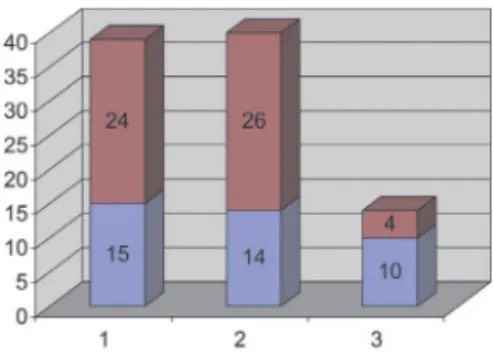
The hypoglycemic episodes that occurred during the first 24 hours post-partum are shown in Figure 4, and the distribution of these episodes per group is shown in Figure 5.
Figure 6 shows the number of newborns with hypoglycemia in each of the groups.
DISCUSSION
Table 2 - Maternal and newborn glycemic levels (mg/dL).
Isradipine Atenolol Control Test (Kruskal-Wallis)
Maternal glycemia n = 37 n = 33 n = 13 χ2
2 = 0.95
µ ± sd 104.1 ± 42.2 110.9 ± 43.2 114.0 ± 33.8 (ns)
Umbilical Cord glycemia n = 38 n = 38 n = 12 χ2
2 = 4.01
µ ± sd 80.5 ± 32.3 78.9 ± 30.7 97.4 ± 31.7 (ns)
Glycemia 1st h (newborn) n = 35 n = 36 n = 9 χ2
2 = 1.47
µ ± sd 45.0 ± 23.1 37.6 ± 13.3 53.9 ± 18.0 (ns)
Glycemia 3rd h (newborn) n = 36 n = 37 n = 11 χ2
2 = 2.95
µ ± sd 56.0 ± 24.8 53.4 ± 22.7 68.5 ± 39.6 (ns)
Glycemia 6th h (newborn) n = 34 n = 36 n = 13 χ2
2 = 1.86
µ ± sd 58.8 ± 25.2 55.9 ± 22.3 52.0 ± 15.8 (ns)
Glycemia 12th h (newborn) n = 37 n = 39 n = 12 χ2
2 = 2.19
µ ± sd 61.4 ± 24.9 55.7 ± 22.8 53.3 ± 18.1 (ns)
Glycemia 24th h (newborn) n = 36 n = 38 n = 14 χ2
2 = 1.65
µ ± sd 64.0 ± 19.7 66.6 ± 22.4 53.1 ± 14.1 (ns)
Friedman Test χ2
5 = 25.51 χ
2
5 = 48.40 χ
2 5 = 18.89 (P <.001) (P <.001) (P <.01)
Figure 1 - Evolution of glycemia during the study.
Figure 2 - Correlation between maternal and the umbilical cord glycemia in the isradipine group.
Figure 3 - Correlation between maternal and the umbilical cord glycemia in the control group.
isradipine have been published in the medical literature.12,13,14,15,16 The drug
has been shown to have a good anti-hypertensive effect in patients who have nonproteinuric hypertension dur-ing gestation without modifydur-ing
pla-cental circulation,6,7,8,9 and its
effi-ciency and good tolerance in patients who have essential hypertension has
been demonstrated.17 However,
con-cerns about the effects on the fetus have been raised, since isradipine can pass through the placenta, although the concentration has been found to be
low in the fetus.18 Despite these
con-cerns, calcium channel blockers have been described as safe drugs and free
of side effects to the fetus when used during gestation to control arterial
hy-pertension.1,19 But data is scarce
con-cerning the possible hypoglycemic ef-fect on the fetus of isradipine, a new generation calcium channel blocker.
The present study demonstrates that all treatments were safe regarding the evolution of glycemic levels, since there was no difference between the treated and the control groups for any assessment (Table 2).
As for the glycemia evolution with time in each study group, a statistically significant difference was verified among the groups at several times of
Figure 4 - Hypoglycemic episodes according to lifetime.
Table 3 - Hypoglycemia episodes in each of the groups, according to the assessment time point.
1st hour 3rd hour 6th hour 12nd hour 24th hour Total
ISRADIPINE 1 5 8 5 3 5 3 6
ATENOLOL 1 7 1 0 8 6 3 4 4
CONTROL 2 1 1 2 1 7
Total 3 4 1 9 1 4 1 1 9 8 7
Figure 5 - Hypoglycemic episodes distribu-tions per groups.
Figure 6 - Number of newborns with hypo-glycemia in each one of the groups.
<.001; atenolol: P <.001; control; P
<.01; Table 2). This finding is to be expected, beginning with the differ-ence observed between the maternal glycemia and the umbilical cord, since fetal plasma glucose levels at birth have been reported to be two thirds of
maternal levels.20
Moreover, the evolution of glycemic levels during the consecu-tive time points of this study in each group is consistent with the published data, which show a reduction of the plasma glucose concentration after birth, reaching a nadir around 1 hour postpartum followed by elevation and stabilizing of levels between 2 and 4
hours after birth,20,21 as it may be
ob-served on Table 2 and in Figure 1. The 3 groups presented similar patterns, having no significant differences among themselves at each time point of the assessments (Table 2).
In 1992, Kalhan20 referred to a
lin-ear relationship between maternal and fetal glycemia, which is also evident in the present study, since there was correlation between maternal and um-bilical cord glycemias in the isradipine and control groups (Figures 2 and 3). In the control group, there was also a correlation between glyc-emia levels in the mother and in the newborn at the third and sixth hours postpartum, suggesting that there is a tendency for maintaining the glycemia at normal levels for a longer time, in spite of the drop during the first hours postpartum. This finding differs from that of the isradipine group, where a correlation of glycemia levels was found only between the maternal and umbilical cord blood. In the atenolol
group, there was no correlation of gly-cemia levels at any time between the mother and newborn. This finding may suggest that atenolol has an earlier ef-fect upon newborn glycemia than isradipine does.
This observation, associated with the presence of correlation at all time points of assessment in the control group, suggests that isradipine may have an early effect upon newborn gly-cemia, although a bit later than that of atenolol.
The observation of more frequent hypoglycemic episodes in the first and third hours postpartum in all groups (Figure 4, Table 3), agrees with the well-known evolution of the glycemic levels of the newborn during the first hours after birth.20
There were more hypoglycemic episodes in newborns of the atenolol group than in the isradipine group, al-though this was not statistically
sig-nificant (P = .818). However, the
oc-currence of hypoglycemia was signifi-cantly higher in the atenolol group compared with the control group, which indicates its effects upon the newborn glycemia. As for the isradipine group compared with the control group, there was a trend of the occurrence of hypoglycemia, suggest-ing a mild effect upon the newborn glycemia (Figures 5 and 6).
The occurrence of hypoglycemia also in newborns of mothers whose hy-pertension was controlled with diet only is consistent with the knowledge of the effects of hypertensive disease on the fetal glycemia. These effects in-clude the reduction of uteroplacental circulation, resulting in hypoxemia that stimulates hormonal and circula-tory effects with the redistribution of the fetal blood flow and stimulation of glycolysis (Pasteur effect), resulting in an increase of triphosphate adenosine (ATP) and lactic acid, in addition to
causing hypoglycemia.2 Besides that,
specific hypertensive disease of preg-nancy and the resistance to insulin syndrome are increasing in the medi-cal literature: hyperinsulinemia, low levels of high density lipoproteins (HDL) and elevated levels of triglyc-eride.23
After the analysis of these results, some conclusions and consequent rec-ommendations could be made:
- Different antihypertensive
treat-ment schemes used in pregnant women (diet, isradipine, and atenolol) have similar effects upon mean values of glycemia in the newborn;
- The correlation analysis suggests
that isradipine may have later and milder effects upon the glycemia, since the correlation was obtained
only in umbilical cord, while atenolol may act earlier, since there was no correlation in any time point;
- The results reinforce the need for
glycemic control from the first hour postpartum in newborns of hy-pertensive mothers whether or not they are undergoing drug treatment.
RESUMO
DARCIE S e col. Glicemia no recém-nascido de mãe hipertensa de
acor-do com a terapêutica materna. Rev.
Hosp. Clín. Fac. Med. S. Paulo
59(5):244-250, 2004.
OBJETIVO: Avaliar o comporta-mento da glicemia em recém-nascidos (RN) de mães hipertensas conforme o tratamento materno.
MÉTODOS: Estudo prospectivo, randomizado, incluindo 93 RN de mães tratadas com isradipina(n=39), atenolol (n=40) ou dieta - controle (n=14). De-terminou-se a glicemia ao nascimento (mãe e RN, pela glicose oxidase) e na 1a., 3a., 6a., 12a. e 24a. horas (RN, por fita
reagente). A evolução da glicemia, em cada grupo, foi analisada (Teste de Friedman). Os grupos foram compara-dos, quanto às glicemias, em cada
mo-mento (Teste de Kruskall-Wallis) e fo-ram ajustados modelos de regressão li-near para as glicemias (variável inde-pendente = glicemia materna; variáveis
dependentes = glicemias de cordão, 3a.
e 6a. horas).
RESULTADOS: Não houve dife-rença estatisticamente significante en-tre as glicemias médias dos 3 grupos, em qualquer uma das coletas. Houve correlação entre as glicemias materna e de cordão umbilical nos grupos isradipina (r =0,61; p<0,05) e controle (r =0,84; p<0,05); entre as glicemias
materna e 3a. e 6a. horas, houve
ape-nas no grupo controle (materna X
3a.hora: r = 0,65; p<0,05; materna X
6a.hora: r =0,68; p<0,05). Não houve correlação em nenhum momento no grupo atenolol. Detectou-se hipogli-cemia em 51,3% (Isradipina), 60%
(Atenolol) e 35,7% (Controle), mais
freqüentemente na 1a. hora de vida, em
todos os grupos.
CONCLUSÕES: Os resultados su-gerem efeito semelhante dos 3 tipos de terapêutica sobre a glicemia do RN. As análises de correlação sugerem que a isradipina possa ter efeitos sobre a glicemia somente após o nascimento (correlação apenas em cordão umbili-cal), enquanto o atenolol, possa atuar mais precocemente (não se correla-cionou em nenhum momento). Tam-bém reforçam a necessidade de
contro-le glicêmico desde a 1a. hora de vida
em RN de mães hipertensas, submeti-das ou não a tratamento medica-mentoso.
UNITERMOS: Hipertensão.
Ges-tação. Glicemia. Hipoglicemia.
REFERENCES
1 . Walker JJ. Hypertensive drugs in pregnancy. Clin Perinatol 1991;18(4):845-73.
2 . Henriksen T. Hypertension in pregnancy: use of antihypertensive drugs. Acta Obst Gynecol Scand 1997;76:96-106.
3 . Szymonowicz W, Yu VH. Severe pre-eclampsia and infants of very low birth weight. Arch Dis Child 1987;62:712-6. 4 . Kahhale S, Zugaib M. The use of antihypertensive drugs. In:
Voto LS, Margulies M, Cosmi EV, editors. 4th World Congress of Perinatal Medicine. Bologna: Monduzzi Editore; 1999. p. 87-91.
5 . Rubin PC, Clark DM, Sumner DJ, Low RA, Butters L, Reynolds B, et al. Placebo-controlled trial of atenolol in treatment of pregnancy-associated hypertension. Lancet 1983;26:431-4. 6 . Hansson L. Isradipine in hypertension. Drugs 1990;40(Suppl
2):10-4.
8 . Feiks A, Grünberger W, Meisner W. Influence of isradipine on the maternal and fetal cardiovascular system in hypertensive disorders in pregnancy. Am J Hypertens 1991;4(2 Pt 2):200S-202S.
9 . Wide-Swensson DH, Ingemarsson I, Lunell N-O, Forman A, Skajaa K, Lindberg B, et al. Calcium channel blockade (isradipine) in treatment of hypertension in pregnancy: A randomized placebo-controlled study. Am J Obstet Gynecol 1995;173:872-8 .
10. Alves EA. Estudo prospectivo, comparativo da Isradipina e Atenolol no tratamento de gestantes hipertensas. São Paulo, 1998. Tese de Doutoramento. F.M.U.S.P.
11. Ramos JLA. Avaliação do crescimento intra-uterino por medidas antropométricas do recém-nascido. São Paulo, 1983. Tese de Doutoramento. F.M.U.S.P.
12. Jespersen LT, Krusell LR, Sihm I, Pedersen OL. Differential effects of isradipine and atenolol on peripheral hemodynamics and arterial compliance. Am J Med 1989;86(Suppl 4A):57-9. 13. Isradipine In Hypertension Study Group. A multicenter evaluation
of the safety and efficacy of isradipine and atenolol in the treatment of hypertension. Am J Med 1989;86 (Suppl 4A):119-23.
14. The Italian-Belgian Isradipine Study Group. “Multicenter evaluation of the safety and efficacy of isradipine in hypertension”. Am J Med 1989;86(Suppl 4A):94-7. 15. Meriç M, Gören T, Atilgan D, Eren N, Çubukçu A, Koylan N.
Metabolic, hematological, and cardiac effects of long-term isradipine treatment in mild-to-moderate essential hypertension. J Cardiovasc Pharmacol 1992;19(Suppl. 3):S58-S60.
16. O’grady J, Kritz H, Schmid P, Pirich C, Sinzinger H. Effect of isradipine on in-vivo platelet function. Thromb Res 1997;86(5):363-71.
17. Weiss RJ. A large, prospective, open-label study of isradipine in patients with essential hypertension. Clin Ther 1994;16(4):647-52.
18. Lunell N-O, Bondesson U, Grunewald C, Ingemarsson I, Nisell H, Wide-Swensson D. Transplacental passage of isradipine in the treatment of pregnancy-induced hypertension. Am J Hypertens 1993;6(3 Pt 2):110S-111S.
19. Lewis R, Sibai BM. The use of calcium-channel blockers in pregnancy. New Horiz 1996;4(1):115-22.
20. Kalhan Sc. Metabolism of glucose and methods of investigation in the fetus and newborn. In: Polin RA, Fox WW, editors. Fetal and Neonatal Physiology. Philadelphia: W. B. Saunders Company; 1992. p. 357-72.
21. Padbury JF, Ogata ES. Glucose metabolism during the transition to postnatal life. In: Polin RA, Fox WW, editors. Fetal and Neonatal Physiology. Philadelphia: W. B. Saunders Company; 1992. p. 402-5.
22. Philipps AF. Carbohydrate metabolism of the fetus. In: Polin RA, Fox WW, editors. Fetal and Neonatal Physiology. Philadelphia: W. B. Saunders Company; 1992. p.373-84.