Temporomandibular Disorder:
relationship between otologic
and orofacial symptoms
Summary
Cláudia Maria de Felício1, Tatiana Gontijo Faria2, Marco Antonio Moreira Rodrigues da Silva3, Antônio Maria Claret Marra de Aquino4, Cinthia Amorim Junqueira5
1 Speech and Hearing Therapist, Professor, Department of Ophthalmology, Otorhinolaryngology and Head and Neck Surgery,
Medical School, Ribeirão Preto, University of Sao Paulo. Ph.D. in Sciences, USP.
2 Speech and Hearing Therapist, Specialist in Oral Motricity, University of Ribeirão Preto.
3 Dental Surgeon, Professor, Department of Restorative Dental Sciences, School of Dental Sciences, Ribeirão Preto, University of Sao Paulo. Ph.D. in Oral Rehabilitation, USP. 4Otorhinolaryngologist, Professor, Course on Speech and Hearing Therapy, University of Ribeirão Preto. Ph.D. in Sciences, USP.
5 Speech and Hearing Therapist, Specialist in Audiology, Professor of Clinical Audiology, Course on Speech and
Hearing Pathology, University of Ribeirão Preto. Master in Sciences, USP.
Study conducted at the School of Dental Sciences, Ribeirão Preto, University of Sao Paulo and Course on Speech and Hearing Therapy, University of Ribeirão Preto. Address correspondence to: Cláudia Maria de Felício – Rua Sakuma Miyasaka, 30 City Ribeirão 14021-045 Ribeirão Preto SP.
Tel (55 16) 602-2523 – Fax (55 16) 621-1008
Article submited on June 16, 2004. Article accepted on October 20, 2004.
T
he otologic symptoms are frequents in temporomandibular disorder patients, and studies are needed to elucidate the involved mechanisms. Aim: The objective of the present study was to investigate the association of otology symptoms (otalgia, tinnitus, ear fullness) with otologic findings, the other temporomandibular disorder signs and symptoms, and parafunctional habits. Study Design: Clinical prospective. Mater ial and Methods: 27 temporomandibular patients from Occlusion Clinic of the Dental School of Ribeirão Preto – University of Sao Paulo, answered a questionnaire w hich included questions about signs and symptoms of temporomandibular disorder and parafunctional habits; they w ere submitted to otorhinolaryngological and audiologic examination. The data obtained were analyzed through Binomial Test, Exact Test of Fisher and Pearson Correlation, with p value < 0.05. Results: Otologic symptoms were presented in 88.88% of the patients (59.26% presented otalgia, 74.07 tinnitus and 74.07% ear fullness). There was no significance between the otologic symptoms and audiologic findings. There was significant association between otologic symptoms and jaw movements or functions (speaking, opening, closing the mouth). There was significant correlation between grade of otologic symptoms and grade of other temporomandibular disorder signs/ symptoms, and betw een the symp tom ear ful l ness and number of the parafunctional habits. Conclusion: The results provide additional su p p o r t f o r th e n o ti o n th at a r el ati o n sh i p b etw een temporomandibular disorder and otologic symptoms does exist. In temporomandibular disorder patients, the stomatognathic system alterations, such as orofacial pain and functional difficulties, were statically associated with otologic symptoms.Key w ords: temporomandibular joint, otologic symptoms, stomatognathic system.
« « « « « « « « Rev Bras Otorrinolaringol.
V.70, n.6, 786-93, nov./dec. 2004
INTRODUCTION
Otological symptoms are frequent in patients w ith temporomandibular joint disorders (TMJD)1-9, and dental
treatment contributes to their remission 10-15. How ever, the
origin and possible correlations between otological symptoms and other manifestations of the problem are not completely explained.
Costen16 suggested that lack of posterior dental
support and the consequent alteration to mandible condyle positioning could result in a set of symptoms, among which some are otological.
Since then, the origin of otological symptoms in patients w ith TMJD, such as ear fullness, tinnitus, otalgia, vertigo, external ear pruritus, and hearing loss, have been based on anatomical-functional considerations between TMJ, muscles innervated by trigeminal nerve and ear structures
11, 17-21. However, electromyography does not always confirm
this correlation 22, 23.
In addition to etiology, there is controversy considering audiological findings in patients with TMJD. Decrease of pure tone thresholds in specific frequencies was referred by some authors 21, 24, 25, but not by them all 2, 10. Some studies have
suggested that pure tone thresholds may be improved after occlusal treatment, even in patients with normal audiogram
14, 15, 26. Another possibility is the coexistence of auditory
pathologies and TMJD in some cases, without cause-effect correlation 26,27.
The risk of otological symptoms is considered greater in patients with pain upon palpation of TMJ, mastication and neck muscles, as well as pain during mouth opening 8,28.
The p urp ose of the p resent study w as, after characterizing the sample concerning frequency and severity of signs and symptoms of TMJD, to investigate the association between auditory symptoms - otalgia, tinnitus and ear fullness - and audiological findings, with other signals and symptoms related to TMJD, including functional limitations and oral parafunctional habits.
MATERIAL AND METHOD
The study included 27 consecutive patients diagnosed as having temporomandibular joint disorder in the Division of Occlusion II, Department of Restorative Occlusion, School of Dental Science, Ribeirão Preto, University of Sao Paulo (FORP-USP). There w ere 25 female patients and 2 male patients, ages ranging from 13 to 52 years (mean age of 32.8 years). They all signed the informed free consent term, as provided by the approval of the protocol by the Research Ethics Committee, University of Ribeirão Preto – SP.
The inclusion criteria w as clinical examination conducted by specialized dentist, signs and symptoms that led to the diagnosis of TMJD, such as presence of pain in mastication muscles and/ or TMJ during mandible function
and palpation of structures, limitation or deviation of mandible movements, TMJ noise, and abnormal static or dynamic occlusal relation 29.
Exclusion criteria w ere to present history of central neurological or peripheral disorders, or tumors or traumas of the head and neck, as well as to have previously conducted some kind of TMJ treatment.
Subjects underw ent exams and interview s w ith the same professionals, before any treatment approach, as follows: (1) clinical examination of stomatognathic system; (2) protocol for TMJ and parafunctional habits signs and symptoms; (3) ENT history and clinical examination, and (4) audiological tests.
We used the follow ing devices: dental clinical instruments; otoscopy brand Welch Allyn; audiometer Interacoustics AC40; immittanciometer Interacoustics AZ7R; soundproof booth; clinical history protocol and routine audiological assessment, containing questions on risk factors to hearing loss; investigation protocol of signs and symptoms of TMJ 30, modified by the inclusion of questions about
parafunctional habits and/ or pain during sw allow ing and speech.
After the diagnosis of TMJD, patients answ ered the p rotocol about si gns and symp toms to TMJD and parafunctional habits. The first part had yes/ no questions. In the second part they were asked to indicate the severity of signs and symptoms w hen w aking up, w hen masticating, speaking and at rest using an 11-point scale, supported by a graduated printed scale in which zero was considered com-plete absence of symptom or sign, and 10 w as highest severity possible (Annex A).
Next, subjects were referred to audiological anamnesis, ENT examination to define otological conditions and diagnose other p athol ogi es; audi ol ogi cal tests that i ncl uded meatoscopy, pure tone bone and air audiometry, speech recognition index (monosyllables) and acoustic immittance measures (tympanometry and acoustic reflex investigation). The used criteria to define abnormality in audiological exams w ere: Air pure tone thresholds (in frequencies of 250Hz, 500Hz, 1000Hz, 2000Hz, 3000Hz, 4000Hz and 8000Hz) and bone pure tone (in frequencies of 500Hz, 1000Hz, 2000Hz, 300Hz e 4000hz) higher than 20 dBHL; air-bone GAP greater than 10 dBHL; speech recognition index (IRF – monosyllables) lower than 92%; tympanometric cur-ve deviated as of – 100 dapa; contralateral acoustic reflexes higher than 115 dBHL (absent); the difference between air pure tone and reflex below 60 dBHL, suggestive of recruitment.
Chart 1. Protocol of Investigation of Signs and Symptoms of TMJD and Habits
Name: _____________________________________________________________________________________________________________________ Age: ______________ Date of Birth: ______/______/______ Gender: F ( ) M ( )
Onset of Problem: ___________________________________________________________________________________________________________ History of other problems: ____________________________________________________________________________________________________ Previous treatments: _________________________________________________________________________________________________________
SIGNALS AND SYMPTOMS YES NO R L BIL
1) Do you have pain in the mastication muscles? 2) Location of pain
3) Do you have fatigue in the mastication muscles? 4) Do you have TMJ noise?
5) Type:
6) Do you have headaches? 7) Do you have auditory symptoms? 7.1) Otalgia
7.2) Ear fullness 7.3) Tinnitus Type of tinnitus
8) Do you have difficulty to move the mandible (mouth)? 9) Open it
10) Close it 11) Masticate 12) Yawn 13) Swallow 14) Speak
R = right side, L = left side, Bil = Bilateral
PARAFUNCTIONAL HABITS YES NO PAST
1) Chew gum 2) Bite nails 3) Bite objects
4) Do you lock or move your teeth during sleep? 5) Do you lock or move your teeth during the day? 6) Others
Severity judgment by the patient
Instruction: You should try to remember how you perceive the signals/symptoms in the specified situation and indicate in the scale how severe it is. Zero means absence of symptoms and 10 is the worst grade. The more severe the symptom is, the higher the score; the less severe the symptom is, the lower the score.
Table to record answers
Intensity of Signals and Symptoms
Situation
1) Pain in mastication muscles (face) 0 1 2 3 4 5 6 7 8 9 10
2) TMJ pain 0 1 2 3 4 5 6 7 8 9 10
3) Neck pain 0 1 2 3 4 5 6 7 8 9 10
4) Otalgia 0 1 2 3 4 5 6 7 8 9 10
5) Tinnitus 0 1 2 3 4 5 6 7 8 9 10
6) Ear fullness 0 1 2 3 4 5 6 7 8 9 10
7) Teeth sensitivity 0 1 2 3 4 5 6 7 8 9 10
8) Joint noise 0 1 2 3 4 5 6 7 8 9 10
by sum of scores attributed to the four questioned situations and later they were classified concerning grade of severity as follows: Grade 0 (absent signal/ symptom); Grade 1 (sum ranging from 1 to 10); Grade 2 (from 11 to 20); Grade 3 (from 21 to 30) and Grade 4 (from 31 to 40). For example, to a patient that reached score 10 in muscle pain symptom in the four questioned situations (w hen w aking up, masticating, speaking and at rest), the sum was 40, and the symptom w as classified as Grade 4, and then successively for each investigated signal/ symptom.
The analysis was made using non-parametric statistics, ow ing to level of measurement of data relative to signals and symptoms, employing the softw are GMC31. Binomial
test was employed to check whether the presence of signs/ symptoms of TMJD and oral parafunctional habits w as significant in the sample. Fisher’s exact test was employed to analyze the possible associations of otological symptoms with results of otological exams, difficulty to make mandible movements, and difficulties in stomatognathic functions. Using the product-moment correlation test by Pearson, we analyzed the correlation betw een grade of otological symptoms and grade of other TMJD signs and symptoms, and the sum of oral parafunctional habits. The significance level adopted w as p<0.05.
RESULTS
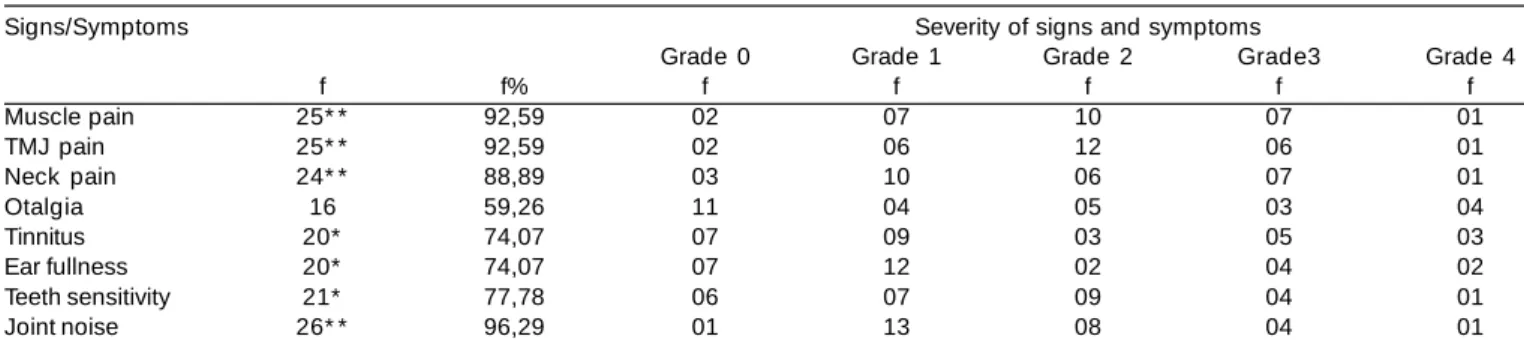
Using the Binominal test, we noticed that the studied sample was statistically significant in the presence of articu-lar noise, muscle pain, TMJD pain, neck pain, teeth sensitivity (P<0.01), tinnitus and ear fullness (p<0.05). There w as no statistically significant difference between number of subjects with and without otalgia. Considering the scores attributed by the patients to signs and symptoms, it w as possible to describe their severity in the sample. In Table 1 we can see frequency of TMJD signs and symptoms and the respective levels of significance and distribution of the sample according to severity grade.
As to difficulty to make mandible movements and stomatognathic functions, presence of difficulty to open the mouth (p <0.05), yaw n and masticate (p <0.01) w as statistically significant. There was no statistically significant difference betw een presence and absence of difficulty to close the mouth, sw allow and speak (relative frequencies can be observed in the first column of Table 4).
As to oral parafunctional habits, we noticed statistically significant differences in the sample for night bruxism, day bruxism (p<0.01) and biting objects or other habits (p<0.05), as w ell as the number of subjects w ith 3 habits or more (p<0.01). There was no statistically significant difference in the presence and absence of habits: chew ing gum, biting nails and biting the cheeks (Table 2).
In ENT examination, w e did not find otological abnormalities nor signs and symptoms that could prevent conduction of audiological tests. Upon analyzing the risk factors to hearing loss, their absence was significant compared to their presence, that is, exposure to noise (p<0.05), use of ototoxic drugs (p<0.01) and family history (p<0.01). When analyzed as a group, at least one risk factor per subject, 15 subjects out of 27 did not present any risk factor, leading to the conclusion that there was no significance (p>0.05).
According to audiometry results, on the right ear mean of air thresholds in frequencies of 250, 500 and 1000 Hz in the sample ranged from 3.33 to 16.67 dBHL, in frequencies of 1000, 2000 and 4000 Hz from 3.33 to 21.67 and in 3000, 4000, 6000 and 8000 Hz from 2.5 to 28.75 dBHL, and in only 3 subjects means w ere higher than 20dB HL. On the left ear, mean of pure tone thresholds of 250, 500 and 1000 Hz in the sample ranged from 0 to 18.33 dBHL, in frequencies of 1000, 2000 and 4000 Hz from -3.33 to 21.67, and 3000, 4000, 6000 and 8000 Hz from 0 to 40 dBHL. Only one subject presented means above 20 dBHL.
On the right ear, means of bone thresholds in frequencies of 250 and 500 Hz ranged from –10 to 15 dBHL, from 1000 to 2000 it was –7.5 to 12.5, and 3000 and 4000Hz, from –5 to 15 dBHL. On the left ear, the mean of bone
Table 1. Frequency of signs and symptoms of TMD and distribution of the sample according to grade of signs and symptoms
severity.
Signs/Symptoms Severity of signs and symptoms
Grade 0 Grade 1 Grade 2 Grade3 Grade 4
f f% f f f f f
Muscle pain 25* * 92,59 02 07 10 07 01
TMJ pain 25* * 92,59 02 06 12 06 01
Neck pain 24* * 88,89 03 10 06 07 01
Otalgia 16 59,26 11 04 05 03 04
Tinnitus 20* 74,07 07 09 03 05 03
Ear fullness 20* 74,07 07 12 02 04 02
Teeth sensitivity 21* 77,78 06 07 09 04 01
Joint noise 26* * 96,29 01 13 08 04 01
thresholds in frequencies of 250 and 500 Hz ranged from – 10 to 15dB, in 1000 and 2000 from –10 to 12.5, and in 3000 and 4000Hz, from –5 to 42.5 dBHL. None of the subjects presented speech recognition index below 92%.
At tympanometry, w e noticed curve type A in 48 ears, type Ad in 3 right ears and 2 left ears, and type C in one left ear. Therefore, type A curve was the most prevalent in the sample (p<0.01). Ipsilateral and contralateral acoustic reflexes w ere significantly present in the sample in all analyzed frequencies and in both ears, that is, in 22 out of 27 subjects.
The prevalence of normal audiological results did not require the application of statistical tests for analysis of association.
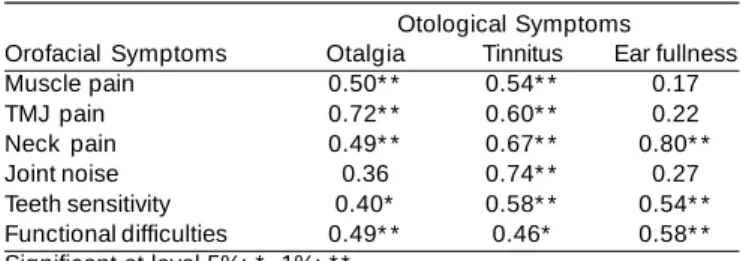
The severity of symptoms of otalgia, tinnitus and ear fullness w as considered positive in most of the signs/ symptoms of TMJD. Pearson correlation coefficient (r) and significance levels are presented in Table 3.
To better understand the correlation betw een difficulties in mandible movements and stomatognathic function and otological symptoms, w e conducted an individualized analysis by Fisher exact test. There w as significant association between presence/ absence of difficulty to open the mouth and otalgia (p<0.01), difficulty to close the mouth and otalgia (p<0.01). Difficulty to speak w as significantly associated with otalgia and ear fullness (p<0.05). In Table 4, we could observe frequencies relative to difficulty of making mandible movements and stomatognathic functions, as w ell as absolute frequencies according to presence or absence of otological symptoms.
As to oral parafunctional habits, we detected significant correlation betw een number per patient and grade of ear fullness symptom (r = 0.45, p<0.05).
DISCUSSION
The objectives of the present study were: to analyze the association between otological and audiological symptoms in patients with TMJD, or in other words, to define whether the complaints patients had reflected their otological
conditions and to investigate the association and correlation betw een otological symptoms and other TMJD signs and symptoms relative to the stomatognathic system, as well as oral parafunctional habits.
In the studied sample, as expected in cases of TMJD, there w ere more female patients than male patients
2,5,10,13,15,26-28.
Predominant signs and symptoms were: joint noise, muscle pain and pain on the TMJ area, w hich coincided with previous findings 10,11,30. Other symptoms that presented
significant frequency in our study w ere neck pain 3, 4 and
teeth sensitivity 28, 30. The high incidence of otological
symptoms in the present sample w as in agreement w ith the literature 4,5,6,8,9,27,28, in which ear fullness prevailed over
the symptom of otalgia 2,12,30. Tinnitus was as frequent as ear
fullness. Other studies indicated prevalence of otalgia 10,13,32.
It is possible that the way we asked about symptoms of ear fullness and tinnitus have contributed to patients’ understanding, and consequently, to their positive answer about these symptoms, respectively “sensation that you ear is blocked, clogged, as if w hen you go to the beach”, and “quick high noise, something that comes and goes”. As previously characterized, tinnitus in TMJD is normally of high frequency, moderate intensity and sporadic, different from most types of tinnitus associated w ith otoneurological affections 5.
We did not include in the present study the investigation of dizziness or vertigo, w hich are sometimes associated with TMJD, since differential diagnosis of vesti-bular pathology would require otoneurological exams, which were not included in the method.
The exact correlation between TMJD and otological symptoms is still unknown. This issue has been explained based on embryological, anatomical and functional correlation of the region that comprises the TMJs, the muscles innervated by the trigeminal nerve and middle ear structures 21. Among other
things, it has been suggested that muscle affections in patients with TMJD, such as lateral pterygoid muscle spasm, may lead to tympanic tensor muscle hypertony, causing alterations in the opening cycle of auditory tube and consequent reduction
Table 2. Frequency of parafunctional habits.
Habits f f%
Chewing gum 16 59.26
Biting nails 12 44.44
Bite the cheeks 14 51.85
Night Bruxism 21* * 77.78
Day Bruxism 21* * 77.78
Bite objects/others 19* 70.37
At least 3 habits 23* * 85.18
Absolute frequency: f: , relative frequency: f%, Significant at level 5%: * , 1%: * *
Table 3. Pearson’s correlation coefficient between otological
and orofacial symptoms.
Otological Symptoms
Orofacial Symptoms Otalgia Tinnitus Ear fullness
Muscle pain 0.50* * 0.54* * 0.17
TMJ pain 0.72* * 0.60* * 0.22
Neck pain 0.49* * 0.67* * 0.80* *
Joint noise 0.36 0.74* * 0.27
Teeth sensitivity 0.40* 0.58* * 0.54* *
in middle ear ventilation 17,20. Nevertheless, some authors do
not confirm this hypothesis 22,23.
Interferences in the petrotympanic fissure region, through w hich w e have tympanic corda nerve, tympanic artery and disk-malleolus ligament, which is originated from the malleolus anterior process and inserted in the TMJ capsule and disk, could also cause otological symptoms 19.
In some cases, it is considered that flat configuration of joint eminence w ould lead to mandible condyle displacement against the sphenomandibular ligament, triggering neuromuscular system dysfunction and causing abnormalities to the protective reflex during sw allow ing, which would inhibit the opening of auditory tube and reduce middle ear ventilation 18.
As to perception of functional limitations and difficulty to make mandible movements, we can point out reports of difficulties to masticate, yaw n and open the mouth, as previously detected 30.
Mastication suffers influence from the morphology of stomatognathic system, as well as other factors, such as pain and lack of posterior occlusal support, which causes changes and compensations and can become pathological 9.
Functional analyses of the mastication system of patients w i th TMJD have evi denced reducti on i n mandi bl e movements when opening the mouth 3, 10, which could result
in sensation of difficulty to perform stomatognathic functions, such as masticate and speak. Even though it w as not significant, difficulty to speak has also had considerable incidence (55.55%).
Considering ENT and audiological findings, most of the patients w ere w ithin the normal range. Therefore,
otological symptoms in the present sample did not reflect ear conditions, w hich w ere normal. Thus, despite the symptoms, no other auditory pathologies have been evidenced in cases of TMJD 1,2,8,10,27. How ever, it has also
been detected that despite being w ithin the normal range, pure tone air thresholds may improve after mouth rehabilitation 14 or use of stabilizing splint 26, especially in
cases of extra-articular TMJD 15.
Conversely, healthcare professionals should bear in mind the possible occurrence of TMJD and concomitant hearing pathologies w ithout cause-effect correlation 26, 27;
the differential diagnosis is always a requirement.
I n the present study, w e detected significant correlations betw een otological symptom severity and orofacial sign/ symptom severity. Subjects with more severe/ intense pain in the muscles and TMJ w ere more prone to otalgia 12 and tinnitus 3, w hich normally require active
treatment of TMJ 6. Neck pain was also positively correlated
with otological symptoms 28.
Otol ogi cal symp toms have been si gni fi cantl y associated w ith difficulty in mandible movement and stomatognathic functions. More specifically, otalgia w as associated with difficulty to speak, open the mouth and close the mouth. Ear fullness was associated with difficulty to speak. Similarly to otological symptoms, disorders of stomatognathic functions are frequent in patients with TMJD
9,25. Subjects w ith otological signals presented higher
likelihood of feeling pain during mouth opening 28.
Electromyography studies in humans demonstrated that periorbital muscle contraction during facial movement caused tympanic tensor muscle activity. Moreover, tympanic tensor
Table 4. Frequency of auditory symptoms according to difficulty to make mandible movements and functions.
Movements and Functions Otalgia Tinnitus Ear fullness
f% A P A P A P
Open the mouth
W/out difficulty 33.33 07 02 03 06 04 05
W/ difficulty 66.66 04 14 04 14 03 15
Close the mouth
W/out difficulty 66.66 10 08 06 11 06 12
W/ difficulty 33.33 01 08 00 09 01 08
Masticate
W/out difficulty 18.51 03 02 02 03 02 03
W/ difficulty 81.48 08 14 05 17 05 17
Yawn
W/out difficulty 22.22 04 02 02 04 03 03
W/ difficulty 77.77 07 14 05 16 04 17
Swallow
W/out difficulty 55.55 08 07 05 10 06 09
W/ difficulty 44.44 03 09 02 10 01 11
Speak
W/out difficulty 55.55 08 04 05 07 06 06
W/ difficulty 44.44 03 12 02 13 01 14
muscle activity was detected during speech and swallowing and stapedial muscle activity during the conduction of mandible and speech movements 11.
Facial innervation - motor and sensorial - involves many different cranial nerves and innervation is not shared. In subjects with TMJD, rather than harmonic functioning of face, mouth and pharynx, there is gradual modification of movements that the joints mak e w hen masticating, swallowing and speaking in the process of muscle and joint disorganization of the disease8.
We can add that parafunctional habits may predispose to rupture of the harmony of the stomatognathic system, leading to imbalance. In subjects with TMJD they are frequent
3,9,25, as detected in the present study, and they have been
considered significant in the etiology and in progression of muscle and intra-articular disorder 33. In the studied sample,
there w as significant correlation betw een number of parafunctional habits per subject and grade of ear fullness; how ever, other investigations w ill be necessary to clarify w hether parafunctional habits participate as etiological agents, simple participants or guiders of the process.
CONCLUSION
Based on the results, w e could conclude that the studied sample presented high incidence of otological symptoms, w ith prevalence of ear fullness and tinnitus in relation to otalgia, in addition to other signs and symptoms related to TMJD.
The prevalence of results within the normal range in otological and audiological exams suggested that otological symptoms do not reflect ear conditions, detected in the clinical ENT and audiological exam.
Otological symptoms w ere correlated w ith severity of one or more investigated symptoms, w hich included muscle pain, TMJ pain, neck pain, teeth sensitivity, joint noise and general, functional difficulties.
There was significant association between otological symptoms and those directly related to stomatognathic functions. Otalgia presented association w ith sensation of difficulty to speak, open the mouth and close it. Ear fullness was associated with difficulty to speak.
The presence of parafunctional habits w as also significant in the sample and there was significant correlation between number of habits per subject and ear fullness.
Thus, lack of harmony in the stomatognathic system, w hich w as manifested as orofacial pain, and difficulty in functional activities w ere significantly associated w ith otological symptoms in cases of TMJD.
REFERENCES
1. Vieira MM, Ávila CRB, Caovilla HH, Ganança MM. Repercussão otoneurológica da disfunção da articulação temporomandibular. Acta AWHO 1992; 11(2): 68-72.
2. Henderson DH, Cooper, JC, Bryan, GW, Van Sickels JE. Otologic Co m p l ai n ts i n tem p o r o m an d i b u l ar jo i n t sy n d r o m e. Ar ch . Otolaryngol Head and Neck Surg 1992; 118(11): 1208-13. 3. Ren Y, Isberg A. Tinnitus in patients with temporomandibular joint
internal derangement. J Craniomandib Pract 1995; 13(2): 75-80. 4. Barbosa CMR, Martinelli DA, Albergaria-Barbosa JB. Pacientes
portadores de zumbido e os sinais e sintomas de D.C.M. RGO 1998; 46(1): 42-9.
5. Felício CM, Oliveira, JAA, Nunes LJ, Jeronymo LFG, Ferreira-Jeronymo, RR. Alterações auditivas relacionadas ao zumbido nos distúrbios otológicos e da articulação temporomandibular. Rev Bras Otolaringol 1999; 65(2): 141-6.
6. Kuttila S, Kuttila M, Le Bell Y, Alanen P, Jouko S: Aural symptoms and signs temporomandibular disorder in association with treatment need and visits to a phisician. Laryngoscope 1999; 109: 1669-73. 7. D’Antonio WEPA, Ikino CMY, Castro SM de, Balbani APS, Jurado JRP, Bento RF. Distúrbio têmporo mandibular como causa de otalgia: um estudo clínico. Rev Bras Otorrinolaringol 2000; 66(1): 46-50. 8. Pascoal MIN, Rapoport A, Chagas JFS, Pascoal MBN, Costa CC, Magna LA. Prevalência dos sintomas otológicos na desordem tem-poromandibular: estudo de 126 casos. Rev Bras Otolaringol 2001; 67(5): 627-33.
9. Felício CM, Mazzetto MO, Dos Santos, CPA. Masticatory behavior in individuals w ith temporomandibular disorders. Minerva Stomatol 2002; 51(4): 111-20.
10. Kosk inen J, Paavolainen M, Raivio M, Roschier J. Otological manifestations in temporomandibular joint dysfunction. J Oral Rehabil 1980; 7(1): 249-54.
11. Williamson EH. The interrelationship of internal derangements of the temporomandibular joint, headache, vertigo and tinnitus: A survey of 25 patients. J Craniomandib Pract 1990; 8(4): 301-6. 12. Keersmaek ers K, Boever, JA, Van Den BERGUE L. Otalgia in
patients w ith temporomandibular joint disorders. J Prosthet Dent 1996; 75(1): 72-6.
13. Felício CM, Angeli JB, Souza LB, Nassar Filho J. Sintomas auditi-vos em desordens temporomandibulares pré e pós-tratamento com placa oclusal. Pró-Fono: Rev Ataul Ci 1999; 11(1): 38-41. 14. Dos Reis AC, Hotta TH, Ferreira-Jeronymo, RR, Felício CM,
Ribei-ro RF. Ear symptomatology and occlusal factors: a clinical report. J Prosthet Dent 2000; 83(1): 21-4.
15. Angeli JB, Felício CM, Silva, MAMR, Vera e Silva, MR Sinais e sintomas auditivos em sujeitos com distúrbio temporomandibular intra e extra-articular: estudo comparativo. Em: Marchesan IQ, Zorzi JL, editores, Tópicos em fonoaudiologia. São Paulo: Revinter; 2002. p. 3-11.
16. Costen JB. A syndrome of ear and sinus symptons dependent upon disturbed function of the temporomandibular joint. Ann Otol Rhinol Laryngo 1934; 43(1): 805-19.
17. Malkin DP. The role of tTMJ dysfunction in the etiology of middle ear disease. Int. J. Orthod 1987; 25(1): 20-1.
18. Mello JB. Inclinação e forma látero-medial da eminência articular – provável relação com distúrbios auditivos. RGO 1990; XLVII(3): 35-40. 19. Morgan DH, Goode, RL, Christiansen RL, Tiner LW. The TMJ-ear
connection. J Craniomandib Pract 1995; 13(1): 42-3.
20. Myrhaug H. The incidences of ear symptons in cases of malocclusion and temporomandibular joint disturbances. Br J Oral Surg 1965; 2: 28-32.
21. Arlen H. The otomandibular syndrome. Em: Gelb H. Clinical managment of head, neck and TMJ pain and dysfunction: a multi-disciplinary approach to diagnostic, treatment. Philadelphia: Saunders; 1985. p. 181-95.
22. Manni A, Brunori P, Lapi A, Raffaelli L, Raffaelli R: Ricerca parametric eletromiografici e k inesiografici standard in un campione di popolazione sana. Minerva Stomatol 1995; 44(9): 411-9. 23. Penkner K, Kole W, Kainz J, Shied G, Lorenzoni M. The function
24. Baldurson G, Blackmer ER Temporomandibular joint symptons in
patients w ith mid-frequency sensorineural hearing loss. Ear Hearing 1987; 8: 63-76.
25. Rodrigues ACY, Berretin G, Jorge JC, Genaro, KF. Caracterização das alterações miofuncionais orais e auditivas em indivíduos com disfunção craniomandibular. Pró-Fono: Rev Atual Ci 1998; 10(1): 51-5.
26. Angel i JB, Souza, LB, Nassar FO, JN, Fel íci o, CM. Achados
audiológicos em pacientes com desordem temporomandibular antes e após tratamento com placa oclusal. Em: Marchesan IQ, Zorzi, J. Anuário cefac de fonoaudiologia. São Paulo: Revinter; 2000. p. 3-10.
27. Jones JL, H orn KL. The effect of temp oromandi bul ar joi nt arthroscopy on ear function. J Oral Maxillofac Surg 1989; 47(1): 1022-5.
28. Lam DK, Lawrence, HP, Tenenbaum HC. Aural symptoms in tem-poromandibular disorder patients attending a craniofacial pain unit. J Orofacial Pain 2001; 15(2): 146-7.
29. Dw orkin SF, Huggins KH, LeResche L, Van Korff M, How ard J, Truelove E, Sommers E. Epidemiology of signs and symptoms in temporomandibular disorders: clinical signs in cases and controls. J Am Dent Assoc 1990; 120(3): 273-81.
30. Felício CM, Mazzetto MO, Bataglion C, Hotta TH, Rodrigues da Silva MAM. Desordem Temporomandibular: análise da freqüência e severidade dos sinais e sintomas antes e após a placa de oclusão. J Bras Ortodon Ortop Facial 2003; 8(43): 48-57.
31. Campos, GMC. Programa estatístico. mar. 2002. Disponível em <http: / w w w .forp.usp.br/ restauradora/ gmc>
32. Bruto LH, Kós, AOA, Amado, SM, Monteiro C, Lima, MAT de. Alterações otológicas nas desordens têmporo-mandibulares. Rev Bras Otolaringol 2000; 66(4): 317-24.