Ar
ti
cl
e
0103 - 5053 $6.00+0.00
*e-mail: [email protected]
#Present address:Departamento de Química, Universidade Federal de
Mato Grosso, 78060-900 Cuiabá-MT, Brasil
§Present address:Departamento de Biologia, Universidade Federal de
Santa Maria, CP 511, 98300-000 Palmeira das Missões-RS, Brasil
Diesel Degradation in Soil by Fenton Process
Ricardo D. Villa,# Alam G. Trovó§ and Raquel F. Pupo Nogueira*
Instituto de Química de Araraquara,UNESP -Universidade Estadual Paulista, CP 355, 14801-970 Araraquara-SP, Brazil
Este trabalho descreve a utilização do processo Fenton para degradação de diesel em solo e destaca aspectos comuns em situações reais de contaminação que podem afetar a eiciência da remediação. Foi observado que a maior parte dos hidrocarbonetos presentes no diesel com menos de 14 carbonos foi perdida por volatilização antes da remediação. Em solo franco, cerca de 80% do diesel foi degradado enquanto que em solo franco-argiloso a degradação foi inferior a 20%. Adições múltiplas de H2O2 proporcionaram degradação de até 80% do diesel, enquanto
que com adição única a degradação foi inferior a 14%. A adição de ferro solúvel foi essencial para obtenção de altas porcentagens de degradação. Não foi observado aumento signiicativo (t-test; P = 0.05) na degradação do diesel quando foram utilizadas dosagens de H2O2 entre 0,09 e 0,36 g g-1. Além disso, a alta dosagem de H
2O2 (0,36 g g
-1) degradou 87% da matéria orgânica
originalmente presente no solo.
This work reports the use of Fenton process for diesel degradation and addresses common aspects of real situations that can affect the soil remediation eficiency. It was observed that most of diesel hydrocarbons containing less than 14 carbon atoms were lost by volatilization prior to the treatment. About 80% degradation was achieved in a loam soil, while less than 20% was observed in a clay loam soil. The multiple additions of H2O2 resulted in 80% diesel degradation,
while only 14% of diesel was degraded after a reaction time of 80 h using a single addition. The addition of soluble iron was essential to achieve high degradation levels. No signiicant increase in diesel degradation (t-test; P = 0.05) was observed using H2O2 dosages between 0.09 and 0.36 g g
-1.
Furthermore, the highest H2O2 dosage applied (0.36 g g
-1) degraded around 87% of the organic
matter originally present in the soil.
Keywords: remediation, soil texture, fuel, hydrogen peroxide, short-chain alkanes
Introduction
Globally, about 3.5 trillion liters of crude oil are reined annually, and consumed as fuels, greases and lubricating oils.1 The extraction, handling, transportation and storage of
such a volume of material often result in spills, which can cause water and soil contamination.2,3 In Brazil, one of the
most serious reported environmental accidents involving oil derivatives occurred in Guanabara Bay in January 2000, when approximately 1.3 million liters of crude oil were spilled. The São Paulo State environmental protection
agency (CETESB) reports that 78% of soil contamination in the State is caused by fuel spills from roadside illing stations.4
Increasing soil contamination by fuels has motivated the development of various remediation techniques, among which are the in situ and ex situ chemical oxidation processes (ISCO and ESCO, respectively).5 These
processes are commonly employed for the remediation of soils and groundwater contaminated with chemicals such as organochlorines and volatile organic compounds.6 ESCO
Several oxidative processes are based on oxidations mediated by hydroxyl radicals (•OH), which have a high reduction potential (2.73 V versus Normal Hydrogen Electrode) and are able to oxidize a wide variety of organic contaminants.8
One simple way of generating •OH is through the decomposition of hydrogen peroxide catalyzed by Fe2+ in
acidic medium, known as the Fenton reaction. Many studies have highlighted the eficiency of Fenton processes for
ex situ remediation of soils contaminated with pesticides, diesel, kerosene and other organic contaminants.9-13
However, degradation processes have often been explored using simple systems, such as silica, as a model of soil, or with very low amounts of soil, generally in the range of 1.0 to 30 g. These conditions do not allow evaluation of several parameters that could inluence the effectiveness of the remediation process in the real environment, including contaminant volatilization, OM degradation, temperature variation, and soil characteristics.
The aim of the present work is to study the use of the Fenton process for the ex situ degradation of diesel in a soil slurry, and to address some of the aspects, common to real situations, that can affect degradation, such as the volatilization of diesel prior to application of the Fenton process, soil texture and OM content, the contribution of the mineral iron naturally present in soil, and dosage and mode of addition of H2O2.
Experimental
Reagents
The diesel used in the experiments was a commercial product obtained from a road fuel illing station. Pesticide-grade n-hexane solvent (Tedia) was used to prepare the diesel standard solutions and for diesel extraction from the soil. H2O2 (29%, m/v) from Synth was used in the degradation experiments, and Na2SO4 (Baker) was used as desiccant. The Fe2+ solutions were prepared by dissolving
FeSO4•7H
2O (Carlo Erba) in 0.1 mol L
-1 H
2SO4 (Synth).
Solutions of H2SO4 (Synth) and/or NaOH (Synth) were used for pH adjustment. Ammonium metavanadate (Vetec) was used for the H2O2 determination. All the glassware was cleaned with Extran MA-01 detergent (10%, v/v) from Merck.
Evaluation of diesel volatilization
For identiication of diesel compounds volatilized from soil, 10 g of diesel-contaminated soil (1.0 mg g-1)
were left in the open air for 24 h. After this time, the diesel
contained in the sample was extracted (described below) and the extracts analyzed using a gas chromatograph coupled to a mass spectrometer detector (GC-MS). The identiication of diesel compounds remaining in the soil was achieved by comparison of the fragmentation proile of the diesel components with those provided in the instrument database (Shimadzu LabSolutions software). The chromatogram obtained for this extract was compared with that obtained for diesel maintained in a closed system, hence enabling identiication of compounds that had been volatilized. Diesel compounds remaining in soil after application of the remediation process were identiied in a similar way. All mass spectra had at least 90% agreement with the fragmentation standards obtained from the equipment database. The percentage of diesel volatilized from soil was determined by mass difference, using an analytical balance with a precision of ± 0.1 mg (Mettler Toledo AB204-S).
Since the variation of diesel mass caused by volatilization can introduce errors in quantiication, the most volatile compounds were irst eliminated. To this end, a volume of 200 mL of diesel was stirred for 12 h, in the open air, in a 5 cm high beaker having an exposed surface area of 200 cm2. After this time, chromatographic analyses
conirmed the loss of the most volatile compounds, as in the previous experiments using contaminated soil. Subsequent recovery tests and all degradation experiments, were performed using samples of diesel from which the most volatile compounds had been removed.
Sampling and contamination of the soil
Degradation of diesel was studied using two types of soil. Both were collected at the same location, in the central-west region of Brazil, however at different depths. One was collected at the surface (0-4 cm), and the other at 90-100 cm. After sampling, the soil was passed through a 3.0 mm sieve and dried in the open air at 25-30 oC for 48 h.
The spiked soil was prepared by adding 200 mL of a diesel solution (50 g L-1 in n-hexane) to 2.0 kg of soil. Before the
degradation experiments, the spiked soil was vigorously homogenized for 30 min, then left standing for 24 h to completely eliminate hexane (conirmed by weight loss).
Experimental conditions for degradation
A slurry of diesel-spiked soil was prepared by directly mixing 500 mL of aqueous 12 mmol L-1 FeSO
4 solution
and 150 g of contaminated soil (5.0 mg g-1). To evaluate
5.0 or 10 mol L-1 H
2O2 was pumped into the slurry, in
separate experiments, corresponding to the addition of a total dosage of 0.045, 0.09, 0.18 and 0.36 g of H2O2 g-1 of soil,
respectively. The H2O2 was added using a peristaltic pump (Ismatec model 78017-10), programmed to deliver 1.1 mL of H2O2 solution every 20 min for 12 h. After 12 h reaction time, addition of H2O2 was interrupted for a further 12 h, to allow for the consumption of the H2O2, and then restarted. A total of 145 additions were made in each experiment employing step additions of H2O2. In the experiment using a single addition of hydrogen peroxide, a dose of 0.36 g H2O2 g-1
was added to the slurry. The dose of H2O2 was 0.045 g g-1
in the experiment where the mineral iron contribution (in the absence of soluble iron) was evaluated. All experiments were carried out at an ambient temperature of 28 oC, under
mechanical stirring (110 rpm). The pH of the slurries was adjusted to 2.5-3.0, the optimum pH for the Fenton reaction in soil,14 by the addition of 3 mol L-1 H
2SO4 solution before
starting the experiments. No further pH adjustment was made during the experiments.
Chemical analysis
Extraction of diesel from the soil was carried out by adding 7.0 mL of n-hexane/dichloromethane solution (1:1) and 1.0 g of anhydrous sodium sulfate (to assist in moisture removal and dispersal of soil particles) to 3.0 g of spiked soil in an airtight sealed glass tube (2 cm internal diameter and 15 cm long). The mixture was mechanically stirred at 240 rpm for 2 h, and then centrifuged and the extract collected. This extraction procedure was repeated two more times. The soil extracts were combined, and the diesel quantiied by gas chromatography with lame ionization detection (GC-FID), using a Shimadzu 14B chromatograph equipped with a DB-5 capillary column (0.32 mm × 30 m). The following chromatographic conditions were used: injector temperature, 280 oC; initial furnace temperature,
45 oC; inal furnace temperature, 250 oC; heating rate,
12 oC min-1; detector temperature, 330 oC; H
2 as carrier
gas at a low rate of 10 mL min-1. The diesel concentration
determination was based on the sum of the total peak area, according to EPA method 8015B. Individual compounds were identiied using a gas chromatograph (Shimadzu 17A) coupled to a mass spectrometer (QP-5000), under similar chromatographic conditions as used for diesel quantitation. For the diesel concentrations evaluated (0.2-10 g kg-1),
the extraction method recovery percentages ranged from 80 to 95%, with relative standard deviations between 2.5 and 10%. The residual H2O2 concentration was monitored using a spectrophotometric method employing ammonium metavanadate.15
The relative abundance of iron minerals was determined by X-ray luorescence in a Shimadzu EDX-800 diffractometer. The pH was determined in water.16 The soil
OM content was determined by thermogravimetric analysis (TG), using a Simultaneous Thermal Analysis Module (TA Instruments, model number SDT-2960).
Results and Discussion
Diesel volatilization from soil
Soil contaminated due to fuel spillage usually remains exposed to the air for periods of time that can vary from days to years, before application of any remediation process. This exposure favors the loss of volatile compounds, which will therefore not be targeted during the remediation. Comparing the chromatogram corresponding to the diesel that had remained in a closed system, with that for diesel extracted from the soil after exposure to the open air (Figure 1), it can be observed that the lightest fraction of the fuel was volatilized during exposure. This fraction contains n-alkanes with carbon chains possessing fewer than 14 carbon atoms, together with several other unsaturated and/or cyclic hydrocarbons whose peaks appear at retention times between 5 and 15 min, and corresponds to 8% of the original diesel mass (as determined by gravimetric analysis).
These results indicate that when diesel-contaminated soil remains exposed to the open air for at least 24 h at temperatures between 25 oC and 35 oC, temperatures
14 carbon n-alkanes. Although the volatilized fraction is small, as observed in the present work and elsewhere,3 it
is signiicant, since it can contain a greater proportion of toxic compounds than the material remaining in the soil. For example, petroleum hydrocarbons containing up to ten carbon atoms are characterized by high acute toxicity. These compounds quickly evaporate and do not persist in soil. However, petroleum hydrocarbons with more than 20 carbon atoms, most of which are waxes and asphaltenes, do not show signiicant bioavailability or toxicity.17 Hence, the
eficiency of a remediation process can be overestimated, due to volatilization, especially in ex situ treatments involving soil removal and transportation, where such losses are favored.
Inluence of soil texture on diesel degradation
The soils collected at two different depths differed considerably in terms of texture, pH and OM content (Table 1). The surface soil was slightly acidic and would be classiied as a loam soil. The soil collected at 90-100 cm depth would be classiied as a clay loam; its pH was neutral and it was practically free of OM.
Soil texture can strongly influence remediation processes such as vapor extraction, thermal desorption and soil washing.19,20 In the present study, the eficiency
of diesel degradation by the Fenton process was also found to be strongly inluenced by soil texture. About 20% degradation of diesel was observed for the clay loam soil, while approximately 80% degradation was achieved for the loam soil, under the same oxidizing conditions (Figure 2).
The large surface area of clay loam soil results in efficient contaminant adsorption, which reduces its exposure to hydroxyl radical attack. According to Watts
et al.,21 adsorbed contaminants are not easily attacked
by hydroxyl radicals, due to mass transfer limitations. Furthermore, clay soils have low permeability, and high forces of cohesion between particles hinder the dispersion of oxidizing species.
The OM generally plays an important role in the sorption of organic contaminants in soil, and consequently in the degradation process. According to Spark and Swift,22
the sorption of organic compounds is complex and may
involve both the organic and inorganic fraction of the soil. They also state that the organic matter may govern the sorption of contaminants when corresponding to more than 5% of the soil. The results of the present study suggest that the soil texture played more important role than the organic matter in the sorption of diesel. In case of the soil collected at the surface, about 70% of the organic matter originally present in the soil was degraded together with the diesel and therefore did not contribute to the sorption process. In the case of the deep soil, the low organic matter content (0.5%) probably played little inluence on the sorption process. Another aspect regarding the organic matter from the soil is that it may consumeH2O2 and HO• contributing to the
loss of the Fenton process eficiency for the degradation of the target compound. However, in the present study it was not possible to evaluate the consumption of hydrogen peroxide by OM since the studied soils presented very different texture.
Approximately 39% of Brazilian soils are latosoils,23
characterized according to the Brazilian System of Soil Classiication as deep, homogeneous, and with a texture varying from moderately to very clayey. These characteristics can hinder application of the Fenton process for remediation of deep contamination in many regions of Table 1. Characteristics of the soils used in the degradation experiments
Soil pH
(H2O)
OM Sand Silt Clay Textural*
classes %
Surface (0-4 cm) 5.7 7.5 41 47 12 loam
Depth (90-100 cm) 6.7 0.5 30 36 33 clay loam
*Classiied according to the textural triangle described by Brady and Buckman.18
Figure 2. Comparison of diesel degradation in clay loam soil and loam soil. Experimental conditions: [Fe2+] = 12 mmol L-1; H
2O2 dosage:
0.09 g g-1 (145 additions of 93.54 mg of H
Brazil. Since the percentage of diesel degradation in clay loam soil was very low (20%), all subsequent experiments were carried out using loam soil collected at the surface.
Inluence of mineral iron in diesel degradation
Iron is the fourth most abundant element in the Earth’s crust, occurring in various minerals mainly in the form of oxides.24 Several workers have suggested that these
minerals may participate in the Fenton reaction, making further addition of soluble iron unnecessary.25,26 However,
in the present work, it was observed that after 6 h reaction time, using sequential additions of H2O2 (total dosage 0.045 g of H2O2 g-1 of soil) without addition of soluble
iron, only 28% of diesel was degraded. In the presence of 12 mmol L-1 Fe2+, removal of diesel reached 48%, for
the same period of time and H2O2 dosage (Figure 3). This corresponds to an initial degradation rate of 0.23 g kg-1 h-1 in
the presence of mineral iron, compared to 0.40 g kg-1 h-1 for
soluble iron. 45% of diesel was degraded after 84 h reaction time in the presence of mineral iron alone, while the same result was achieved in less than 6 h with addition of soluble iron. The catalytic decomposition of H2O2 by mineral iron is generally slower than with soluble iron due to the lower availability of the metal ion in solution in the heterogeneous system. Furthermore, since decomposition only occurs on the mineral surface, it is dependent on variables such as surface area and mass transfer of reagents.27
In the experiments with addition of Fe2+, the initial
rate of H2O2 decomposition was 0.32 mmol min-1, while
in the presence of mineral iron alone it achieved only 0.1 mmol min-1 in the irst 90 min of reaction. The low
H2O2 consumption indicates the low catalytic activity of this mineral, and consequently the weak generation of •OH radicals and concomitant slow rate of diesel degradation.
Amongst the most abundant iron minerals in soils, hematite is least effective for H2O2 decomposition,14,27
because it is composed exclusively of Fe(III) species, which possess low catalytic activity. This could explain the poor degradation of diesel in the absence of soluble iron addition, since the soil used in the present study was rich in hematite. About 15% (m/m) of all oxides present in this soil are in the form of hematite, while the percentage of other iron oxides is lower than 0.4%.28 All subsequent
experiments were carried out with addition of soluble iron.
Effect of dosage and mode of H2O2 addition
Although a single addition of H2O2 simplifies the process, it was observed that step additions of H2O2 increased the eficiency of treatment. With a single addition to the slurry of a 0.36 g g-1 dose of hydrogen peroxide,
only 14% diesel degradation was achieved in the irst 2 h of reaction time, with no further degradation up to 84 h. In comparison, 80% degradation was obtained using step additions of hydrogen peroxide, and the same total dosage (Figure 4).
A single addition results in a high concentration of H2O2 in the reaction medium, which favors self-decomposition reactions (equation 1) and scavenging of hydroxyl Figure 3. Diesel degradation in loam soil using mineral and soluble iron.
Experimental conditions: [Fe2+] = 12 mmol L-1; H
2O2 dosage: 0.045 g g -1
(145 additions of 46.75 mg every 20 min).
Figure 4. Inluence of initial H2O2 concentration and mode of addition on the degradation of diesel in loam soil. −− Single addition of 0.36 g g-1
of soil; −− 0.045 g g-1; −− 0.09 g g-1; −− 0.18 g g-1; −− 0.36 g g-1
radicals by excess H2O2 (equation 2), hence decreasing the eficiency of the degradation processes.29
H2O2 + H2O2→ 2 H2O + O2 (1)
H2O2 + HO•
→ H2O + HO2• (2)
In the single addition experiment, the H2O2 was totally consumed in 20 min, which explains the absence of further degradation after 2 h reaction time. Furthermore, the single addition caused an abrupt temperature increase, from 28 to 72 oC in 17 min, which contributes to the decomposition
of H2O2 to H2O and O2, and probably to the loss of volatile compounds during the degradation process.30 No signiicant
increase in temperature was observed during experiments employing step additions.
The total costs and eficiencies of remediation processes using Fenton reactions are highly dependent on the amount of H2O2 used.9,25,31 The results obtained here showed that
although an increased H2O2 dosage, from 0.045 g g-1 to
0.18 g g-1 of soil, improved the initial rate of degradation
in the irst 12 h of reaction time, no signiicant difference (t-test at 95%) in the degradation percentages (between 72 and 80%) was observed after 36 h reaction time for H2O2 dosages of between 0.09 g g-1 and 0.36 g g-1.
Watts and Dilly9 reported that the use of high
concentrations of H2O2 for soil remediation resulted in a fast decrease of soluble iron concentration after thirty minutes of reaction time due to the formation of amorphous iron lakes, which were insoluble in water and hindered the degradation reactions. In agreement with those observations, in the present study it was found that the rate of H2O2 consumption decreased gradually with time, especially in experiments where greater amounts of H2O2 were added. No consumption of H2O2 was observed after 76 h in the experiment with 0.36 g g-1 H
2O2 dosage, while
in the experiments with dosages of 0.09 g g-1 and 0.18 g g-1,
consumptions of about 3.4 µg min-1 and 6.5 µg min-1 of
H2O2 were observed, respectively. Total consumption occurred after 15 min in the experiment with 0.045 g g-1
H2O2. In addition to formation of insoluble iron species, the scavenging of hydroxyl radicals by H2O2 can also decrease the eficiency of degradation in a medium containing excess hydrogen peroxide, as mentioned previously (equation 2).
After 40 h reaction time, practically no further diesel degradation occurred in any of the experiments. GC-MS analysis showed that the fraction of diesel remaining in the soil after this time contained mainly saturated aliphatic hydrocarbons with carbon chain lengths greater than 17 carbons (Figure 5b). Hydrocarbons with longer chains are more hydrophobic, and consequently tend to
remain adsorbed to soil, where they are less susceptible to degradation processes.21 Comparing the chromatograms
presented in Figure 5, it can be observed that the diesel components with less than 17 carbon atoms in the chain are totally degraded, while those with longer chain lengths are more persistent in the soil.
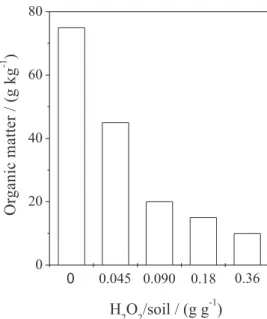
The amount of OM remaining in the soil after the Fenton treatment was also inluenced by the H2O2 dosage used. The greater the amount of H2O2 added during treatment, the larger was the amount of organic matter degraded (Figure 6). These results indicate that the process is extremely aggressive to the soil. The use of 0.36 g g-1
H2O2, for example, resulted in 87% degradation of the OM originally present in the soil. Besides contributing to soil degradation, the Fenton process also causes soil sterilization. Ferguson et al.30 observed the elimination of
a large part of the native microorganisms present in soil, Figure 5. Chromatogram of soil extracts, (A) before and (B) after 84 h of reaction time. Experimental conditions: [Fe2+] = 12 mmol L-1; H
2O2
dosage: 0.36 g g-1 (145 additions of 376 mg).
following application of the Fenton process for remediation of diesel-contaminated soil. They attributed the death of microorganisms to the strong oxidizing conditions of the medium, pH change, and increase of the soil temperature during application of hydrogen peroxide. Metal dissolution and volatilization of contaminants may also occur during the Fenton treatment, which can make the remediation processes unfeasible.32
Conclusions
Considering the data reported in this work, it can be concluded that (i) at temperatures between 25 and 35 oC, common in tropical countries, the light fraction of
diesel will probably not be the target of any remediation process, since it is volatilized from soil within a few hours following contamination; (ii) the granular structure of contaminated soil has a large inluence on the eficiency of diesel degradation by Fenton processes; the Fenton process can be highly eficient for surface soil remediation, but completely inadequate in the case of deeper soils with higher clay contents; (iii) the use of soluble iron increases the degradation rate in comparison to mineral iron such as hematite and may be necessary, even for soils rich in iron minerals such as hematite; (iv) H2O2 must be added in steps, in order to achieve greater eficiency and minimize the loss of volatile contaminants due to temperature increases; (v) the results suggest that it can be advantageous to add H2O2 in dosages of between 0.09 and 0.18 g g-1,and to interrupt H
2O2 addition after 12 h, since
highest degradation rates were obtained in the irst 12 h of reaction time, after which degradation was slow in all cases, even using step additions of H2O2. Adoption of these procedures can contribute to soil preservation, and reduce costs and treatment time, so that the Fenton process can be used as an alternative to other methods of soil remediation, such as biodegradation. (vi) It is important to highlight that in this study the degradation was evaluated in an ex-situ
system and that in an in situ remediation, other factors must be considered including the amount of macro and microporous of soil, what inluences the sorption of diesel and the dispersion of reagents in soil and consequently the degradation eficiency.
Acknowledgments
The authors thank CAPES and FAPESP (05/00172-0) for scholarships to R. D. Villa and A. G. Trovó, respectively. The authors also thank Dr. M. R. de Marchi for use of the GC-FID, and Dr. M. S. Crespi for TG analysis.
References
1. Xie, G.; Barcelona, M. J.; Environ. Sci. Technol. 2003, 37, 4751.
2. Edgara, G. J.; Barrett, N. S.; Mar. Pollut. Bull. 2000, 40, 36. 3. Namkoong, W.; Hwang, E-Y.; Park, J-S.; Choi, J-H.; Environ.
Pollut. 2002, 119, 23.
4. http://www.cetesb.sp.gov.br/Solo/areas_contaminadas/relacao_ areas.asp, accessed in March 2009.
5. http://www.frtr.gov/matrix2/section3/3_5.html, accessed in March 2009.
6. http://www.clu-in.org/download/remed/chemox.pdf, accessed in March 2009.
7. Hyman, M.; Dupont, R. R.; Groundwater and Soil Remediation: Process Design and Cost Estimating of Proven Technologies, ASCE Press: Reston, VA, 2001.
8. Pignatello, J. J.; Oliveros, E.; Mackay, A.; Crit. Rev. Environ. Sci. Technol. 2006, 36, 1.
9. Watts, R. J.; Dilly, S. E.; J. Hazard. Mater. 1996, 51, 209. 10. Kong, S.; Watts, R. J.; Choi, J.; Chemosphere 1998, 37, 1473. 11. Millioli, V. S.; Freire, D. D. C.; Cammarota, M. C.; J. Hazard.
Mater. 2003, 103, 79.
12. Cravato, G.; Di Carlo, S.; Ondruschka, B.; Tumiatti, V.; Roggero, C. M.; Chemosphere 2007, 69, 1326.
13. Jonsson, S.; Persson, Y.; Frannkki, S.; van Bavel, B.; Lundstedt, S.; Haglund, P.; Tysklind, M.; J. Hazard. Mater. 2007, 149, 86. 14. Watts, R. J.; Udell, M. D.; Rauch, P. A.; Hazard. Waste Hazard.
Mat. 1990, 7, 335.
15. Nogueira,R. F. P.; Oliveira, M. C.; Paterlini, W. C.; Talanta
2005, 66, 86.
16. EMBRAPA - Empresa Brasileira de Pesquisa Agropecuária;
Manual de Métodos de Análise de Solo, Rio de Janeiro, Brasil, 1997.
17. http://response.restoration.noaa.gov/book_shelf/678_Chapter2. pdf, accessed in March 2009.
18. Brady, N. C.; Buckman, H. O.; Natureza e Propriedades do Solo, Freitas Bastos: Rio de Janeiro, Brasil, 1983.
19. Hamby, D. M.; Sci. Total Environ. 1996, 191, 203.
20. Khan, F. I.; Husain, T.; Hejazi, R.; J. Environ. Manage. 2004,
71, 95.
21. Watts, R. J.; Kong, S.; Dippre, M.; Barnes, W.; J. Hazard. Mater.
1994, 39, 33.
22. Spark, K. M.; Swift, R. S.; Sci. Total Environ. 2002, 298,147. 23. Nicolella, A. C.; Dragone, D. S.; Bacha, C. J. C.; Rev. Econ.
Sociol. Rural 2005, 43, 81.
24. vanLoon, G. W.; Duffy, S. J.; Environmental Chemistry, Oxford University Press: New York, 2000.
25. Watts, R. J.; Bottemberg, B. C.; Hess, T. F.; Jensen, M. D.; Teel, A. L.; Environ. Sci. Technol. 1999, 33, 3432.
27. Huang, H-H.; Lu, M-C.; Chen, J-N.; Water Res. 2001, 35, 2291. 28. Villa, R. D.; Nogueira, R. F. P.; Sci. Total Environ. 2006, 371,
11.
29. Parra, S.; Sarria, V.; Malato, S.; Péringer, P.; Pulgarin, C.; Appl. Catal., B 2000, 27, 153.
30. Ferguson, S. H.; Woinarski, A. Z.; Snape, I.; Morris, C. E.; Revill, A. T.; Cold Regions Sci. Tech. 2004, 40, 47.
31. Goi, A.; Trapido, M.; Chemosphere 2002, 46, 913.
32. Villa, R. D.; Trovó, A. G.; Nogueira, R. F. P.; Chemosphere
2008, 71, 43.
Received: August 25, 2009
Web Release Date: March 11, 2010