Article
0103 - 5053 $6.00+0.00*e-mail: [email protected]
Chiral Auxiliary-Mediated Enantioenrichment of (
±
)-Ibuprofen, under Steglich
conditions, with Secondary Alcohols derived from (
R
)-Carvone
Marcela Amongero, Damian Visnovezky and Teodoro S. Kaufman*
Instituto de Química Rosario (IQUIR, CONICET-UNR) and Facultad de Ciencias Bioquímicas y Farmaceuticas, Universidad Nacional de Rosario, Suipacha 531, S2002LRK Rosario, Argentina
A síntese de uma série de álcoois secundários derivados da (R)-carvona, assim como o curso
estereoquímico da esteriicação destes derivados com (±)-ibuprofeno é apresentada. O composto comercial racêmico foi transformado nos respectivos ésteres diastereoisoméricos através do acoplamento mediado por DCC/DMAP, fornecendo o par de diastereoisômeros derivados de (S)- ou (R)-ibuprofeno em relação até 5.7:1, dependendo do tipo de auxiliar quiral empregado.
The synthesis of a series of chiral secondary alcohols derived from (R)-carvone, and the
stereochemical outcome of their reaction with (±)-ibuprofen, is reported. The racemic drug was transformed into the corresponding diastereomeric esters mediated by DCC/DMAP, affording up to 5.7:1 diastereomeric ratios of the esters derived from either (S)- or (R)-ibuprofen, depending
on the type of chiral auxiliary employed.
Keywords: ibuprofen, carvone, Steglich esteriication, chiral auxiliaries, chiral secondary
alcohols
Introduction
During the past two decades, the preparation of optically active drugs has received considerable attention both, from academics and industry. The reasons behind this interest are threefold, including the medical beneit from using a single chemical entity, the changing pharmaceutical regulations, which now require the development of optically active drugs as single stereoisomers, and also advances in strategies for the synthesis of optically pure compounds, which facilitated the task.1
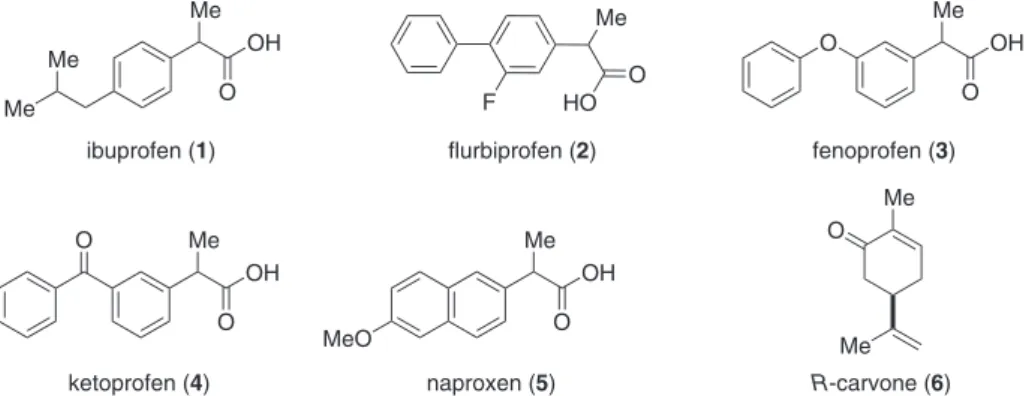
Ibuprofen (1, Figure 1) is a non-steroidal
anti-inlammatory agent of the class of the α-arylpropionic acids, which also includes flurbiprofen (2, Figure 1),
fenoprofen (3, Figure 1), ketoprofen (4, Figure 1) and
naproxen (5, Figure 1), amongst its most prominent
members. The drug is marketed mostly as the racemate despite that it has been shown that the (S)-enantiomer is
the main responsible for the therapeutic effect. The pure enantiomer is also available, being prescribed only for certain speciic conditions.2
It has been demonstrated that (R)-ibuprofen as well as
its congeners can be stereoselectively interconverted in vivo
into their active enantiomers through a thioester-mediated epimerization process which involves the Co-enzyme A (CoA).3 However, these acyl-CoA thioester derivatives
are chemically reactive and may become involved in a transacylation reactions with endogenous nucleophiles, leading to covalent binding of the drug to proteins, the clinical consequences of which relate to the toxicity of this pharmaceutically active ingredient.4 It is also suspected
that the acyl-CoA intermediate derived from (R)-ibuprofen
may be responsible for the formation of mixed glyceryl esters, which once deposited in fatty tissue could cause unknown long-term effects, transforming (R)-ibuprofen
into a pharmacological uncertainty.5
Therefore, the selective preparation of (S)-ibuprofen
has been the subject of intense research and numerous stereoselective chemical approaches have been explored for that purpose.6 In addition, resolutions of the racemate by
means of crystallization of diastereomeric salts,7 as well as
chemoenzimatic transformations including esteriicacion, trans-esterification,8 enantioselective hydrolysis of
esters,9 amides10 and nitriles11 and other enzyme-mediated
strategies,12 and a yeast-mediated selective degradation of
the unwanted enantiomer,13 have also been reported.
and Mentha spicata, being available in both of its
enantiomeric forms. It has been extensively employed as building block in organic synthesis.14 Interestingly,
however, the use of carvone derivatives as chiral auxiliaries has only few and scattered precedents.15
The chiral auxiliary-mediated dynamic kinetic resolution of α-substituted carboxylic acids has been recently recognized as an approach towards the preparation of enantioenriched α-aminoacids, as well as their
α-mercapto-, α-halo- and α-hydroxy- congeners. This is an effective alternative, provided conigurational lability can be induced at the stereogenic α-carbonyl center.16
Recently, Amoroso and coworkers17,18 reported
the preparation of different α-arylpropionic acids in their enantioenriched forms, by using lactamide-type chiral auxiliaries. The diastereomeric mixtures of the corresponding lactamic esters were obtained in good yields and reasonable diastereoselectivities depending upon the solvent and chiral auxiliary used. Therefore, here we wish to report the synthesis of chiral secondary alcohols derived from (R)-carvone (6, Figure 1) and their reaction
with racemic ibuprofen under Steglich conditions,19 as a
stereodivergent entry to enantioenriched mixtures of esters derived from either (S)- or (R)-ibuprofen, depending on the
type of chiral auxiliary employed.
Results and Discussion
Three series of secondary alcohols were prepared. In the irst one, (R)-carvone was submitted to a conjugate
addition reaction with thiophenol under thermodynamic conditions,20 furnishing thioethers (7a-c, Scheme 1) in
4, 34 and 16% yield, respectively. On the other hand, reaction with PhSH and 2-naphthalenethiol under kinetic21
conditions afforded sulides (7a and 8, Scheme 1) in 60 and
92% yield, respectively.
The stereochemistry of these products was deduced by comparison with literature data,22 analysis of the enhancement
of signals in nuclear Overhauser effect (nOe) experiments and
examination of their 1H NMR spectra, which revealed that
H-3 was considerably more deshielded in 7a (d 3.89 ppm) than in 7b (d 2.91 ppm) and 7c (d 3.29 ppm), pointing out to a pseudo-axial orientation of the heteroatomic substituent. The preferential generation of 7a and 8 under kinetic conditions is
consistent with an axial Michael addition of the thiols from the α-face of carvone, driven by stereoelectronic effects, and subsequent protonation of the resulting enolate from the opposite and less hindered β-face. Compounds 7b and 7c may
result from the base-mediated equilibration of 7a under the
reaction conditions.23
Diastereoselective reduction of ketones 7a, 7b and 8 with K-Selectride in anhydrous THF,24 from the less
encumbered β-face of their corresponding carbonyl moiety,25 provided alcohols 9a, 9b and 10 (Scheme 1) in
58, 66 and 56%, respectively.
Thioether 7b was further elaborated by oxidation with
H2O2 under (NH4)6Mo7O24 catalysis.26 This furnished 12
(Scheme 1) (47%), 11 (Scheme 1) (5%) and recovered 7b
(30%) when limiting amounts of the oxidant were employed, and a separable mixture consisting of 11 (52%) and 12 (24%),
when a ive-fold excess of H2O2 was used. Next, compounds
11 and 12 were stereoselectively reduced with K-selectride,
providing 13 and 14 (Scheme 1) in 45 and 44% yield,
respectively. Low yields were caused by elimination of the sulfur-bearing moiety. However, in an improved approach, the required sulfone-alcohol 13 was accessed in 60% yield
through the (NH4)6Mo7O24-catalyzed oxidation of alcohol 9b.
For the second series, where the aromatic substituent is directly attached to a cyclohexenic six-membered ring, (R)-carvone was subjected to the direct addition of three
different Grignard reagents. The procedure stereoselectively furnished alcohols 15a-c (Scheme 2), as result of an anti
-periplanar attack of the Grignard reagent with respect to the isopropenyl group.27 In turn, these tertiary allylic alcohols
were treated with PCC/Al2O3, producing an oxidative allylic transposition28 to the corresponding 3-phenyl-(S)-carvone
derivatives 16a-c (Scheme 2) in yields ranging from 71
to 86%.29 Me
Me
Me OH O
Me OH O O
Me O HO F
Me OH O MeO
ibuprofen (1)
ketoprofen (4)
flurbiprofen (2)
naproxen (5)
Me OH
O O
fenoprofen (3)
Me
Me O
R-carvone(6)
These ketones were stereoselectively reduced with sodium borohydride in a MeOH-THF mixture, furnishing the secondary allylic alcohols 17a-c (Scheme 2) in 83-94%
yield. Their coniguration was determined as 1S,5S based on
literature precedents30 and the results of a nOe experiment,
where signal enhancement of H-5 was observed upon irradiation of H-1.
The third group of chiral alcohols was obtained after subjecting (R)-carvone to conjugate addition reactions with
aryl and 1-naphthyl Grignard reagents in the presence of copper(I) iodide31 to which TMSCl was added in order to
ensure eficient transformations.32
These gave the corresponding silyl enol ether intermediates 18a and 18b (Scheme 3) in high yields, as
single diastereomers to which the (3S,5R)- coniguration
was assigned on the basis of literature precedents,33 an
exhaustive NMR analysis of 18b and knowledge of the role
of the isopropenyl group in determining the stereochemistry of the conjugate addition product. The stereochemical result of this reaction is consistent with the outcome of the reductions of ketones 16a-c, resulting from a nucleophilic
attack anti-periplanar to the bulky isopropenyl group.
In turn, these were desilylated by careful treatment with TBAF in Et2O in order to avoid the production of
Me
Me O
Me
Me
O S
Ar +
Me
Me
O S
Me
Me
O S
+
6 7b
7a Ar = Ph 8 Ar = 2-Naphth
7c
Me
Me
O S
O
O
Me
Me
O S
O
Me
S O
O Me HO
13
Me
Me
HO S
O
14 Me
Me
HO S
9b
+
11 12
a
d c
e f g
Me
Me
HO S
Ar
9a Ar = Ph 10 Ar = 2-Naphth
H
H H
H
CH3 H
H
S H H3C
O
H
H
H
7b b
h H
H
1 2 3 4 5 6
7
8 10
1' 2' 3'
4' 5' 6'
H H
9a 9b
Scheme 1. Reagents and conditions:a) PhSH (5 equiv.), Et3N, CHCl3, relux 3 days (7a, 4%; 7b, 34%; 7c, 16%), or PhSH (1 equiv.), Et3N (cat.), hexane, 0 ºC, 8 h (7a, 60%), or 2-NaphthSH (1 equiv.), Et3N (0.5 equiv.), hexane, 0 ºC, 8 h (8, 92%); b) K-Selectride, THF, –78 ºC, 2 h (9a, 58%; 10, 56%);
c) K-Selectride, THF, –78 ºC, overnight (66%); d) H2O2 (5 equiv.), (NH4)6Mo7O24, EtOH, 0 ºC (11, 52%; 12, 24%); e) H2O2 (5 equiv.), (NH4)6Mo7O24 (cat.), EtOH, 0 ºC, 24 h (60%); f) K-Selectride, THF, –78 ºC, overnight (45%); g) K-Selectride, THF, –78 ºC, overnight (44%); h) H2O2 (1.05 equiv.), (NH4)6Mo7O24, EtOH, 0 ºC, 3 h (11, 5%; 12, 47%).
diastereomeric mixtures at the stereocenter adjacent to the carbonyl, due to the base-catalyzed epimerization of the initial product.34 In this process, protonation of the
trapped intermediate enolate from the less hindered face
anti-periplanar to the C-5 substituent, furnished ketones 19a
and 19b (Scheme 3) in 96 and 90% yields, respectively.
Finally, ketones 19a,b were stereoselectively reduced with
K-selectride to the corresponding secondary alcohols 20a
and 20b (Scheme 3) in 80% yield.
Interestingly, the stereochemical outcome of the reduction was different from that previously observed with the sulfur-containing alcohols and could be attributed to a different preferred conformation of the starting ketones, where the bulky aryl substituents are located equatorially, lipping the isopropenyl moiety to a pseudo-axial position, thus hindering the approach of the reducing agent from the side of the isopropenyl group.
This speculation was conirmed by nOe experiments on 19a and 19b, which revealed that irradiation of the
methylene carbon of the isopropenyl moiety excerted signal enhancement of H-3 (Figure 2). On the other hand, detection of H-3 signal enhancement in 20a upon irradiation
of the C-2 methyl group and also of H-9b conirmed that they were located on the same side of the molecule. Furthermore, the axial nature of the hydroxyl group was established from the values of the coupling constants between H-1 and its neighbours in its 1H NMR spectrum
(4.5 and 5.9 Hz) and its lack of nOe signal enhancement of H-1 upon irradiation of H-9b.
The performance of the chiral auxiliaries was evaluated through their submission to esterification reactions
with (±)-ibuprofen, under the conditions described by Steglich,19 which employ the DCC-DMAP reagent system
as condensing agent.
As shown in Table 1, alcohol 9a provided up to a
28:72 mixture of diastereomeric esters in 89% combined yield, when the reaction was carried out in CHCl3 at –50 ºC (entry 1). Furthermore, when the bulkier 2-naphthyl thioether 10 was used as chiral auxiliary, a
slight improvement in the diastereomeric ratio (26:74) was observed, at the expense of a slight decrease in yield of product (entry 10). On the other hand alcohol 9b, a
diastereomer of 9a, furnished essentially equimolecular
mixtures of diastereomeric esters (entries 4-9), according to NMR and HPLC peak area integration, regardless the solvent and temperature conditions employed.
In an attempt to improve the product diastereomeric ratio, the reactions with the related sulfoxide 13 and sulfone 14 were explored. However, essentially no chiral induction
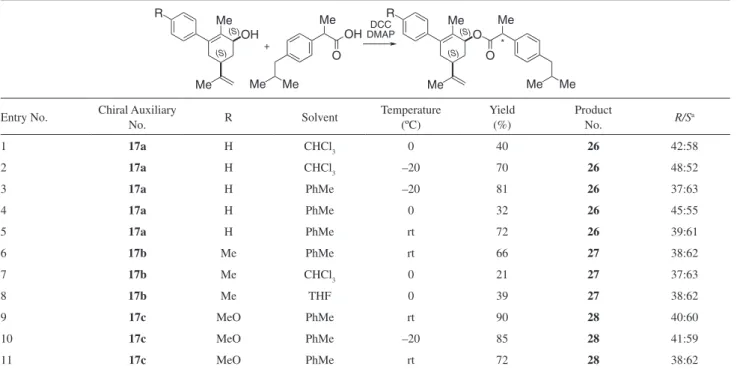
was observed among the resulting esters (entries 11-14). Chiral auxiliaries 17a-c gave diastereomeric ratios
nearing 2:1 (Table 2), always favouring the same ester which as discussed below, was demonstrated to be that derived from (S)-ibuprofen. The best results in terms of chemical
and optical yields were obtained with alcohol 17a, when
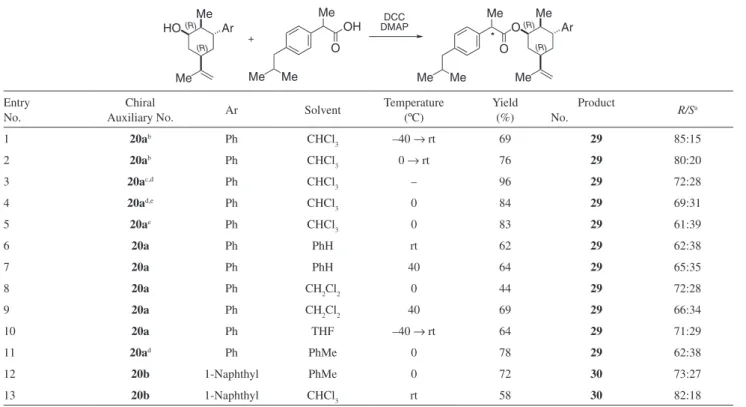
subjected to esteriication in toluene at –20 ºC (entry 3). When chiral alcohols 20a and 20b were subjected
to esterification with (±)-ibuprofen under Steglich conditions (Table 3), it was observed that the best results were obtained when chloroform was employed as solvent (entries 1, 2 and 13) and that the product was enantioenriched in the ester derived from (R)-ibuprofen.
O
H H
H Me
H
Me H H
H
H H
H Me
H3
Me H9b H9a
OH
H
H H
19a 20a
O
H H
H Me
H
Me H H
H
19b H
H
Figure 2. Signal enhancements in the nOe experiments of compounds 19a, 19b and 20a.
Me
Me
O
Me
Me
6 18a Ar = Ph
18b Ar = 1-Naphth a
Me
Me
O Ar
(R) (R) Me
Me
HO Ar
b c
19a Ar = Ph 19b Ar = 1-Naphth
20a Ar = Ph 20b Ar = 1-Naphth
TMSO Ar
Scheme 3. Reagents and conditions:a) ArMgBr, CuI, TMSCl, THF, 0 ºC (18a, 95%; 18b, 96%); b) TBAF, Et2O, rt (19a, 96%; 19b, 90%); c) K-Selectride,
Table 1. Esteriication of (±)-ibuprofen with chiral auxiliaries 9a, 9b, 10, 13 and 14
Me
Me
HO S
Ar OH
O
Me Me
Me
O S
Ar DCC
DMAP +
O Me
(O)n (O)n
(S)
*
(S) R (S) R
(S)
Me Me Me Me
Entry No.
Chiral
Auxiliary No. Ar (n) R Solvent
Temperature (ºC)
Yield (%)
Product No.
Diaster. ratioa
1 9a Ph (0) β-H CHCl3 –50 → rt 89 21 72:28
2 9a Ph (0) β-H CHCl3 –20 95 21 67:32
3 9a Ph (0) β-H CHCl3 0 85 21 ca. 50:50
4 9b Ph (0) α-H CHCl3 –50 44 22 ca. 50:50
5 9b Ph (0) α-H CHCl3 rt 38 22 ca. 50:50
6 9b Ph (0) α-H PhMe –50 65 22 ca. 50:50
7 9b Ph (0) α-H PhMe –20 72 22 ca. 50:50
8 9b Ph (0) α-H PhMe rt 52 22 ca. 50:50
9 9b Ph (0) α-H PhH rt 49 22 ca. 50:50
10 10 Naphthyl β-H CHCl3 0 → rt 69 23 74:26
11 13 Ph (2) α-H CHCl3 0 95 24 ca. 50:50
12 14 Ph (1) α-H PhMe –20 81 25 ca. 50:50
13 14 Ph (1) α-H CHCl3 –20 40 25 58:42
14 14 Ph (1) α-H CHCl3 0 62 25 ca. 50:50
aComparison with esters prepared with pure (S)-ibuprofen indicated that the major diastereomer is that derived from (R)-ibuprofen.
Table 2. Esteriication of (±)-ibuprofen with chiral auxiliaries 17a-c
OH
O
Me Me
Me O DCC
DMAP +
O Me R
Me
Me OH R
*
Me Me
(S) (S)
(S) (S)
Me Me
Entry No. Chiral Auxiliary No. R Solvent Temperature (ºC) Yield (%) Product No. R/Sa
1 17a H CHCl3 0 40 26 42:58
2 17a H CHCl3 –20 70 26 48:52
3 17a H PhMe –20 81 26 37:63
4 17a H PhMe 0 32 26 45:55
5 17a H PhMe rt 72 26 39:61
6 17b Me PhMe rt 66 27 38:62
7 17b Me CHCl3 0 21 27 37:63
8 17b Me THF 0 39 27 38:62
9 17c MeO PhMe rt 90 28 40:60
10 17c MeO PhMe –20 85 28 41:59
11 17c MeO PhMe rt 72 28 38:62
Interestingly, slightly improved diastereomeric ratios were obtained when a ive-fold excess of ibuprofen was employed, while changing the order of addition of the reagents, preincubation of a mixture of the acid and the alcohol with activated 4Å molecular sieves and the addition of triethylamine (entries 3-5) did not improve the diastereomeric ratios of ester products.
In addition, a trend was observed, indicating that the bulkier 1-naphthyl derivative 20b slightly outperformed
its congener 20a, probably by leading to a chiral auxiliary
with a conformationally more rigid cyclohexyl ring. Under the typical conditions, a ratio of products up to 82:18 was observed (entry 13). These levels of enantioenrichment are similar to those previously informed by the group of Amoroso.17
For the sake of comparison, the effect of placing a bulkier group near the secondary alcohol was examined with (–)menthol (31, Scheme 4), the esteriication of which
with (±)-ibuprofen in CHCl3 at 0ºC gave 55% of a nearly 1:1 mixture of diasteromeric esters 32 (Scheme 4).
Therefore, the more hindered alcohol 35 (Scheme 4)
was synthesized by K2Cr2O7-H2SO4 oxidation of 31 to
menthone (33, Scheme 4),35 followed by a Claisen-Schmidt
condensation of the latter with 4-bromobenzaldehyde36 to
furnish 43% of 34 (Scheme 4), which was inally reduced
with NaBH4 in 66% yield. However, Steglich esteriication of 35 with (±)-ibuprofen provided a diastereomeric mixture
of esters 36 (Scheme 4) in 97% yield and in a 65:35 (R/S)
diastereomeric ratio.
The group of Amoroso has demonstrated that ibuprofen and other α-substituted carboxylic acids undergo a dynamic kinetic resolution process when subjected to the Steglich esteriication.19 As shown in Scheme 5, when an α-substituted carboxylic acid (I) reacts with DCC and
DMAP, enantiomeric acyl-DMAP derivatives II and III
are formed as intermediates. Under these conditions, it has been proposed that the stereogenic center becomes labile and the enantiomeric acyl-DMAP derivatives are thus capable of being interconverted. When a chiral alcohol (R*OH) is added to the reaction medium, both acyl-DMAP intermediates can react to furnish diastereomeric ester products (IV and V). Two main conditions are required
for a successful dynamic kinetic resolution. One of them is that interconversion between the acyl-DMAP derivatives
II and III should proceed at a faster rate than formation
of the ester products and the other is that the acyl-DMAP intermediates should react at very different rates with the chiral auxiliary.
In order to gain further understanding on the studied esteriication, a series of esteriications were carried out
Table 3. Esteriication of (±)-ibuprofen with chiral auxiliaries 20a and 20b
Me
Me
HO Ar
Me
Me
O Ar
OH
O Me
O Me
* DCC
DMAP
+ *
(R)
(R)
(R)
(R)
Me Me Me Me
Entry No.
Chiral
Auxiliary No. Ar Solvent
Temperature (ºC)
Yield (%)
Product
No. R/Sa
1 20ab Ph CHCl
3 –40 → rt 69 29 85:15
2 20ab Ph CHCl
3 0 → rt 76 29 80:20
3 20ac,d Ph CHCl
3 – 96 29 72:28
4 20ad,e Ph CHCl
3 0 84 29 69:31
5 20ae Ph CHCl
3 0 83 29 61:39
6 20a Ph PhH rt 62 29 62:38
7 20a Ph PhH 40 64 29 65:35
8 20a Ph CH2Cl2 0 44 29 72:28
9 20a Ph CH2Cl2 40 69 29 66:34
10 20a Ph THF –40 → rt 64 29 71:29
11 20ad Ph PhMe 0 78 29 62:38
12 20b 1-Naphthyl PhMe 0 72 30 73:27
13 20b 1-Naphthyl CHCl3 rt 58 30 82:18
aDeduced by comparison with esters prepared with pure (S)-ibuprofen. bFive-fold excess of ibuprofen. cThe chiral alcohol added as the last reactant. dPre-incubated with activated 4Å molecular sieves (200 mg). eEt
with pure (S)-ibuprofen. After examination of the products,
it was observed that when the reaction was carried out with alcohol 20a the resulting major diastereomers where those
carrying the (R)-coniguration on the ibuprofen α-carbonyl stereocenter. On the contrary, when the esteriications where carried out with alcohols 17a-c, the prevailing
diastereomers were those derived from (S)-ibuprofen
(Tables 1-3).
However, composition of the mixtures was different from those arising from the racemic acid, pointing out to poor compliance of the studied transformations with the requirements for a successful dynamic kinetic resolution. Particularly, the experiments revealed that interconversion of the enantiomeric acyl-DMAP intermediates is not fast enough, compared with their reaction with the chiral auxiliary, to grant a more optically eficient transformation.
In conclusion, it was demonstrated that secondary alcohols derived from naturally-occurring (R)-carvone are
able to provide good yields of enantioenriched mixtures of
ibuprofen esters, that their performance is similar to that of other chiral alcohols and that depending on the chosen chiral auxiliary, production of (R)- or (S)- ibuprofen derived
esters may be favoured.
Experimental
Melting points were taken on an Ernst Leitz Wetzlar model 350 hot-stage microscope and are reported uncorrected. Speciic rotation data were obtained with a Jasco DIP 1000 photopolarimeter, itted with 1 dm cells. FT-IR spectra were determined employing a Shimadzu Prestige 21 spectrophotometer as solid dispersions in KBr disks, or as thin ilms held between NaCl cells. The
1H and 13C NMR spectra were acquired in CDCl 3 in a
Bruker Avance spectrometer (300.13 and 75.48 MHz for
1H and 13C, respectively), with tetramethylsilane (TMS)
as internal standard. The chemical shifts are reported in ppm downield from TMS and coupling constants (J) are
given in Hertz. DEPT 135 and DEPT 90 experiments aided the interpretation and assignment of the fully decoupled 13C NMR spectra. In special cases, 2D-NMR
(COSY, HMBC, HMQC and J-resolved spectra) and
selective nOe experiments were also employed. Pairs of signals marked with “#”, “‡” or with an asterisk, “*”, as superscripts indicate that their assignments may be exchanged.
The reactions were carried out under dry Nitrogen or Argon atmospheres, employing oven-dried glassware. Reagents were used as received. Dry hexane, benzene and toluene were prepared by distillation from Na-benzophenone ketyl. Anhydrous CH2Cl2 and CHCl3 were prepared by a 4 h relux over P2O5 followed by distillation. Anhydrous Et3N
Me Me Me O Br H Me Me Me OH Br H Me Me Me O c d Me Me Me OH Me Me Me O Br H O Me Me Me e 31
33 34 35 36
* a b Me Me Me O Me Me Me 32 * O 1 2 3 4 5 6 7 8 9 10 1 2 3 4 5 6 7 8 9 10 1' 2' 3' 4' 5' 6' 1" 2" 3" 4" 5" 6" 1' 2' 3' 4' 5' 6' (S) (S) (S) (S) (R) (R)
Scheme 4. Reagents and conditions: a) DCC (1.0 equiv.), DMAP (1.0 equiv.), ibuprofen (1.0 equiv.), CHCl3, 0 ºC (55%); b) K2Cr2O7, H2SO4, rt 50 ºC (82%); c) 4Br-C6H4-CHO, KtBuO, DMSO, 12 h, rt (43%); d) NaBH
4, THF-MeOH, 30 min, 0 ºC (66%); e) DCC (1.0 equiv.), DMAP (1.0 equiv.), ibuprofen
(1.0 equiv.), CHCl3, 0 ºC (97%).
HO X R O N+ X R O N+ X R O
Me2N Me2N
DCC, DMAP DCC, DMAP
R*OH R*OH *RO X R O *RO X R O Diastereomeric esters I II III IV V Epimerization
was obtained by distillation, after a 4 h relux over CaH2. Anhydrous solvents were stored in dry Young ampoules. In the conventional work-up procedure, the reaction was diluted with brine (5-10 mL) and the products were extracted with EtOAc (4-5 × 20 mL). The combined organic extracts were then washed once with brine (5 mL), dried over Na2SO4 and concentrated under reduced pressure. The residue was submitted to lash column chromatography with silica gel 60 H. Elution was carried out with hexane-EtOAc mixtures, under positive pressure and employing gradient of solvent polarity techniques.
All new compounds gave single spots on TLC plates run in different hexane-EtOAc and CH2Cl2-toluene solvent systems. Chromatographic spots were detected by exposure to UV light (254 nm), followed by spraying with ethanolic ninhydrin (amines) or with ethanolic p-anisaldehyde/
sulfuric acid reagent and careful heating of the plates for improving selectivity.
The diastereomeric esters of ibuprofen were best separated on a Varian ProStar liquid chromatograph itted with a 250 × 4.6 mm C-18 Luna column (Phenomenex, 5 µm particle size), using a 80:20 mixture of MeOH:50 mmol L-1
phosphate buffer, pH 5.5 as mobile phase, pumped at 1 mL min-1. Detection wavelength was 254 nm.
(2S,3R,5S)5Isopropenyl2methyl3phenyl -sulfanylcyclohexanone 7a under kinetic control conditions:Thiophenol (110 mg, 1.0 mmol) was added
to a stirred solution of (R)-carvone (150 mg, 1.0 mmol)
and Et3N (0.2 mL) in hexane (3 mL), cooled at 0 ºC. The resulting solution was stirred 8 h at 0 ºC while a white precipitate was formed. The precipitate was separated from the solution, washed twice with hexane (5 mL) and dried under vacuum, affording 7a (156 mg, 60%),
as a white solid mp 62.5-64 ºC (hexane-EtOAc. Lit.: 63-65 ºC21). [α]
D25 –100.4 [c 1.20, CHCl3. Lit.:21 –91.0
(c 10, CH2Cl2)]. IR (ilm, νmax/cm-1): 2977, 2854, 1700,
1663, 1439, 1290, 1147, 897, 749 and 692. 1H NMR: d
1.21 (d, 3H, J 6.8, H-7), 1.65 (bs, 3H, H-10), 1.84 (ddd,
1H, J 2.9, 11.4 and 13.8, H-4ax), 2.06 (ddt, 1H, J 2.1, 3.8
and 13.8, H-4eq), 2.28 (ddd, 1H, J 1.0, 12.5 and 13.7,
H-6ax), 2.52 (ddd, 1H, J 2.1, 4.3 and 13.7, H-6eq), 2.88
(ddq, 1H, J 1.1, 4.8 and 6.7, H-2), 3.02 (ddt, 1H, J 3.8,
11.4 and 12.5, H-5), 3.89 (bdt, 1H, J 3.5 and 4.8, H-3),
4.70 (bs, 1H, H-9b), 4.76 (bs, 1H, H-9a), 7.21-7.32 (m, 3H, H-3’, H-4’ and H-5’) and 7.38-7.42 (m, 2H, H-2’ and H-6’). 13C NMR: d 12.7 (C-7), 20.8 (C-10), 35.3
(C-4), 40.4 (C-5), 45.9 (C-6), 48.5 (C-2), 53.4 (C-3), 110.2 (C-9), 127.4 (C-4’), 129.1 (2C, C-3’ and C-5’),** 132.5 (2C, C-2’ and C-6’),** 134.6 (C-1’), 146.9 (C-8) and 209.7 (C-1).
5-Isopropenyl-2-methyl-3-phenylsulfanyl-cyclo-hexanones 7a-c under thermodynamic conditions: A
solution of thiophenol (5.15 mL, 50 mmol) and Et3N (1.0 mL, 14 mmol) in CHCl3 (30 mL), was treated dropwise with (R)-carvone (1.56 mL, 10 mmol) and the resulting
reaction mixture was stirred 3 days under relux. Then the reaction was diluted with brine (5 × 10 mL) and the products were extracted with EtOAc (3 × 10 mL). The combined organic extracts were dried under Na2SO4, concentrated under reduced pressure, leaving an oily residue which was lash-chromatographed (hexane-EtOAc, slow gradient from 99.5:0.5 to 95:5), furnishing three relevant fractions.
(2S,3R,5S)5Isopropenyl2methyl3phenyl -sulfanylcyclohexanone 7a: Yield = 105 mg, 4%. Melting point, speciic rotation and spectral data in agreement with the compound previously accessed under kinetic conditions.21
(2S,3S,5S)-5-Isopropenyl-2-methyl-3-phenyl-sulfanylcyclohexanone 7b: Yield = 889 mg, 34%. White solid, mp 67-69 ºC (hexane-AcOEt). [α]D25 –95.0 (c 0.96,
CHCl3). Lit.: mp 68-69 ºC.20 [α]
D25 –95 (c 4, CHCl3).
IR (KBr, νmax/cm-1): 3071, 2927, 2850, 1707, 1643, 1436,
1379, 1210, 902, 749 and 692. 1H NMR: d 1.33 (d, 3H, J 6.5,
H-7), 1.69 (s, 3H, H-10), 1.74-1.84 (m, 1H, H-4ax), 2.23-2.42 (m, 4H, H-2, H-4eq, H-5 and H-6 eq), 2.46 (dd, 1H, J 2.3 and
9.2, H-6ax), 2.91 (dt, 1H, J 3.7 and 12.1, H-3), 4.69 (s, 1H,
H-9b), 4.75 (s, 1H, H-9a), 7.16-7.39 (m, 3H, 3’, ArH-5’ and ArH-4’) and 7.40-7.54 (m, 2H, ArH-2’ and ArH-6’).
13C NMR: d 12.6 (C-7), 20.2 (C-10), 39.1 (C-4), 43.9 (C-5),
46.3 (C-6), 49.5 (C-2), 53.3 (C-3), 110.2 (C-9), 127.7 (ArC-4’), 128.9 (2C, ArC-3’ and ArC-5’), 133.1 (ArC-1’), 133.5 (2C, ArC-2’ and ArC-6’), 146.3 (C-8) and 209.5 (C-1).
(2R,3S,5S)5Isopropenyl2methyl3phenyl -sulfanylcyclohexanone 7c: Oil. Yield = 419 mg, 16%. [α]D25 +37.9 (c 1.57, CHCl
3). IR (ilm, νmax/cm-1): 2971,
2934, 1712, 1644, 1584, 1480, 1439, 1377, 1280, 1216, 1089, 1025, 749 and 692. 1H NMR: d 1.29 (d, 3H, J 6.9,
H-7), 1.65 (s, 3H, H-10), 1.95 (ddd, 1H, J 4.1, 7.5 and 14.2,
H-4ax), 2.20 (ddd, 1H, J 3.7, 7.8 and 14.2, H-4eq), 2.39-2.50
(m, 1H, H-2), 2.43 (dd, 1H, J 6.1 and 14.2, H-6ax), 2.56
(dd, 1H, J 7.3 and 14.2, H-6eq), 2.77-2.88 (m, 1H, H-5),
3.29 (dt, 1H, J 3.7 and 7.5, H-3), 4.68 (bs, 1H, H-9b), 4.82
(bs, 1H, H-9a), 7.25-7.37 (m, 3H, Ar-3’, ArH-4’ and Ar-5’) and 7.39-7.46 (m, 2H, Ar-2’ and Ar-6’). 13C NMR: d 15.1
(2S,3R,5S)-5-Isopropenyl-2-methyl-3-(naphthalen-2-ylsulfanyl)-cyclohexanone 8: 2-Naphthalenethiol (303 mg, 1.9 mmol) was added to a stirred solution of (R)-carvone
(285 mg, 1.9 mmol) and Et3N (0.7 mL, 0.95 mmol) in anhydrous hexane (10 mL), cooled at 0 ºC. The resulting solution was stirred 8 h at 0 ºC while a white precipitate was formed. The precipitate was separated from the solution, washed twice with hexane (2 × 5 mL) and dried under reduced pressure, affording 8 (540 mg, 92%), as a white solid
mp 113-116ºC (hexane-EtOAc). [α]D25 –96.7 (c 1.0, CHCl 3).
IR (KBr, νmax/cm-1): 3054, 2925, 2844, 1711, 1443, 1378,
1208, 1141, 1015, 889, 858, 825 and 744. 1H NMR: d 1.25
(d, 3H, J 7.5, H-7), 1.64 (s, 3H, H-10), 1.92 (ddd, 1H, J 3.2,
4.9 and 13.9, H-4ax), 2.10 (ddt, 1H, J 2.1, 3.6 and 13.9, H-4eq),
2.30 (ddd, 1H, J 1.2, 12.6 and 13.7, H-6ax), 2.56 (ddd, 1H, J
2.0, 4.3 and 13.6, H-6eq), 2.92 (ddq, 1H, J 1.2, 4.8 and 7.5,
H-2), 3.08 (ttd, J 4.1 and 12.0, H-5), 4.02 (dq, 1H, J 1.3 and
7.5, H-3), 4.71 (d, 1H, J 0.6, H-9b), 4.76 (d, 1H, J 0.6, H-9a),
7.45-7.50 (m, 3H, H-3’, H-6’ and H-7’), 7.70-7.80 (m, 3H, H-4’, H-5’ and H-8’) and 7.88 (bs, 1H, H-1’). 13C NMR: d
12.8 (C-7), 20.8 (C-10), 35.4 (C-4), 40.5 (C-5), 46.0 (C-6), 48.5 (C-2), 53.3 (C-3), 110.3 (C-9), 126.3 (C-6’),# 126.7
(C-7’),# 127.3 (C-4’),‡ 127.8 (C-5’),‡ 128.8 (C-8’),‡129.6
(C-3’),# 131.2 (C-1’), 131.9 (C-2’),* 132.4 (C-8a’),* 133.7
(C-4a’),* 146.9 (C-8) and 209.8 (C-1).
(1S,2S,3R,5S)-5-Isopropenyl-2-methyl-3-(naphthalen-2-ylsulfanyl)-cyclohexanol 10: A solution of 8 (140 mg,
0.45 mmol) in THF (3 mL), was cooled to –78 ºC and treated dropwise with K-Selectride (2.7 mL, 1.34 mmol). The reaction was stirred at –78 ºC during 2 h, when acetone (0.1 mL) was added to destroy the remaining reducing agent, and the solvent was removed under reduced pressure leaving an oily residue, which was chromatographed, furnishing
10 (93 mg, 66%), as a yellow solid, mp 56-59 ºC
(hexane-EtOAc). [α]D25 –88.0 (c 0.75, CHCl
3). IR (KBr, νmax/cm-1):
3462, 3052, 2927, 1643, 1624, 1587, 1500, 1448, 1375, 1193, 1133, 1052, 944, 888, 857, 814, 746 and 602. 1H NMR: d
1.29 (d, 3H, J 7.1, H-7), 1.51 (ddd, 1H, J3.0, 12.0 and 14.2,
H-6ax), 1.56 (ddd, 1H, J 3.0, 12.0 and 14.9, H-4ax), 1.68 (s,
3H, H-10), 1.98-2.11 (m, 3H, H-2, H-4eq and H-6eq), 2.81 (tt, 1H, J3.0, 12.0 and 12.0, H-5), 3.66 (dt, 1H, J 3.6 and 3.8,
H-3), 3.95 (dt, 1H, J 3.0 and 3.1, H-1), 4.71 (bt, 1H, J 0.9,
H-9), 4.72 (bt, 1H, J 0.9, H-9), 7.44-7.51 (m, 3H, H-3’, H-6’
and H-7’), 7.73-7.81 (m, 3H, H-4’, H-5’ and H-8’) and 7.88 (d, 1H, J 1.7, H-1’). 13C NMR: d 16.2 (C-7), 21.1 (C-10),
32.7 (C-5), 36.1 (C-4), 38.0 (C-6), 39.0 (C-2), 50.6 (C-3), 71.4 (C-1), 109.1 (C-8), 125.8 (C-6’),# 126.3 (C-7’),# 127.1
(C-4’),‡ 127.5 (C-5’),‡ 128.3 (C-8’),‡ 129.1 (C-3’),# 129.8
(C-1’), 132.0 (C-2’),* 133.6 (C-8a’),* 133.8 (C-4a’)* and 148.9 (C-8).
(1S,2S,3R,5S)-5-Isopropenyl-2-methyl-3-phenyl-sulfanylcyclohexanol 9a:A solution of ketone 7a (22 mg,
0.08 mmol) in THF (5 mL), was cooled to –78 ºC and treated with K-Selectride (0.24 mL, 0.12 mmol). The mixture was stirred 2 h at –78 ºC, then acetone (0.1 mL) was added to destroy the remainder of the reducing agent and the solvent was removed under reduced pressure, leaving an oily residue, which was chromatographed, yielding 9a
(13 mg, 58%), as an oil. [α]D25 –28.6 (c 1.42, CHCl 3). IR
(ilm, νmax/cm-1): 3421, 2927, 2872, 2360, 1645, 1436,
1024, 975, 949 and 889. 1H NMR: d 1.25 (ddd, 1H, J 10.7,
12.0 and 12.2, H-6ax), 1.26 (d, 3H, J 6.7, H-7), 1.49 (ddd,
1H, J 3.4, 12.2 and 13.4, H-4ax), 1.63 (bs, 1H, OH), 1.69
(s, 3H, H-10), 1.73-1.83 (m, 1H, H-2), 1.93 (dq, 1H, J 4.1
and 13.4, H-4eq), 2.05-2.13 (m, 1H, H-6eq), 2.67 (tt, 1H, J
3.1 and 12.2, H-5), 3.57 (dd, 1H, J 3.4 and 7.0, H-3), 3.63
(dt, 1H, J 4.5 and 10.7, H-1), 4.71 (s, 2H, H-9), 7.18-7.32
(m, 3H, H-3’, H-4’ and H-5’) and 7.38-7.45 (m, 2H, H-2’ and H-6’). 13C NMR: d 16.3 (C-7), 21.1 (C-10), 36.8 (C-4),
38.3 (C-5), 40.6 (C-6), 43.7 (C-2), 53.8 (C-3), 71.9 (C-1), 109.1 (C-9), 126.8 (C-4’), 129.0 (2C, C-3’ and C-5’), 131. 9 (2C, C-2’ and C-6’), 136.3 (C-1’) and 148.6 (C-8).
(1S,2S,3R,5S)-5-Isopropenyl-2-methyl-3-phenyl-sulfanylcyclohexanol 9b: K-Selectride (0.214 mL, 0.107 mmol) was added dropwise to a solution of ketone
7b (18.6 mg, 0.071 mmol) in anhydrous THF (2 mL), kept
at –78 ºC, and the reaction was further stirred 24 h at this temperature. Then, the solvent was removed under reduced pressure and the residue was subjected to chromatography, furnishing 9b (13 mg, 66%), as an oil. [α]D25 +118.7 (c 0.94,
CHCl3). IR (ilm, νmax/cm-1): 3447, 2928, 2359, 1643, 1582,
1437, 1180, 949, 889, 743 and 691. 1H NMR: d 1.33 (d, 3H,
J 6.5, H-7), 1.29-1.49 (m, 2H, H-4ax and H-6ax), 1.50-1.61
(m, 1H, H-2), 1.67 (d, 3H, J 1.1, H-10), 1.91 (ddt, 1H, J
2.5, 3.3 and 12.6, H-6eq), 2.12 (ddt, 1H, J 2.5, 3.3 and 13.0,
H-4eq), 2.43 (tt, 1H J 3.3 and 12.7, H-5), 3.19 (dt, 1H J 3.3
and 11.8, H-3), 4.01 (d, 1H, J 2.5, H-1), 4.66 (dd, 1H, J
0.9 and 1.8, H-9b), 4.68 (s, 1H, H-9a), 7.18-7.34 (m, 3H, 3’, 4’ and 5’) and 7.37-7.47 (m, 2H, ArH-2’ and ArH-6’). 13C NMR: d 16.9 (C-7), 20.7 (C-10), 38.2
(C-6), 38.3 (C-5), 39.7 (C-4), 40.9 (C-2), 48.4 (C-3), 71.8 (C-1), 109.0 (C-9), 126.7 (ArC-4’), 128.7 (2C, ArC-3’ and ArC-5’), 132.2 (2C, ArC-2’ and ArC-6’), 134.7 (ArC-1’) and 148.8 (C-8).
(2S,3R,5S)-3-Benzenesulfonyl-5-isopropenyl-2-methylcyclohexanone 11:A solution of (NH4)6Mo7O24•4H
2O
(2 mL). The reaction mixture was stirred 3 h at 0 ºC, brine was added, and the reaction products were extracted with Et2O (5 × 10 mL). The combined organic extracts were dried (Na2SO4) concentrated under reduced pressure and the residue was chromatographed, affording sulfone 11 (32
mg, 52%), as a white solid mp 73-74 ºC (hexane-EtOAc). [α]D25 –27.0 (c 0.91, CHCl
3). IR (KBr, νmax/cm-1): 2924,
1713, 1447, 1305, 1144, 1083, 898, 747 and 690. 1H NMR: d 1.36 (d, 3H, J 6.6, H-7), 1.66 (s, 3H, H-10), 1.71-1.88 (m,
1H, H-4ax), 2.04 (ddd, 1H, J 2.8, 3.9 and 11.7, H-4eq),
2.18-2.32 (m, 1H, H-5), 2.20-2.34 (m, 1H, H-6eq), 2.42-2.58 (m, 1H, H-6ax), 2.75 (dq, 1H J 6.6 and 12.8, H-2), 3.14 (ddd, 1H, J 3.9, 11.3 and 12.8, H-3), 4.68 (s, 1H, H-9b), 4.78 (s, 1H,
H-9a), 7.55-7.73 (m, 3H, ArH-3’, ArH-4’ and ArH-5’) and 7.87-7.94 (m, 2H, ArH-2’ and ArH-6’). 13C NMR: d 13.3
(C-7), 20.0 (C-10), 31.7 (C-4), 42.3 (C-5), 44.1 (C-2), 45.5 (C-6), 67.8 (C-3), 111.0 (C-9), 128.6 (2C, ArC-2 and ArC-6), 129.3 (2C, ArC-3 and ArC-5), 134.0 4), 137.9 (ArC-1), 145.5 (C-8) and 207.7 (C-1). Increasing solvent polarity afforded sulfoxide 12 (14 mg, 25%).
(2S,3R,5S)-3-Benzenesulfinyl-5-isopropenyl-2-methylcyclohexanone 12: A solution of (NH4)6Mo7O24.4H2O (27 mg, 0.0211 mmol) and 30% H2O2 (0.05 mL, 0.062 mmol) was cooled to 0 ºC and added through a cannula to ketone 7b
(49 mg, 0.19 mmol)dissolved in ethanol (2 mL). The reaction mixture was stirred 3 h at 0 ºC, brine was added, and the reaction products were extracted with Et2O (5 × 10 mL). The combined organic extracts were dried (Na2SO4) concentrated under reduced pressure and the residue was chromatographed, affording sulfone 11 (2.4 mg, 5%). Increasing solvent polarity
afforded sulfoxide 12 (23 mg, 47%), as a white solid mp
103-105 ºC (hexane-EtOAc). [α]D25 +93.3 (c 0.95, CHCl 3).
IR (KBr, νmax/cm-1): 2932, 1713, 1442, 1215, 1084, 1039,
902, 746 and 700. 1H NMR: d 1.34 (ddd, 1H, J 3.0, 3.9 and
13.0, H-4eq), 1.47 (d, 3H, J 6.5, H-7), 1.61 (s, 3H, H-10),
2.05 (ddd, 1H J 12.2, 12.5 and 13.0, H-4ax), 2.21 (tt, 1H, J
3.0 and 12.2, H-5), 2.33 (dd, 1H, J 12.2 and 12.6, H-6ax),
2.42 (dt, 1H, J 3.9 and 12.5, H-3), 2.45 (dd, 1H, J 3.0 and
12.6, H-6eq), 2.88 (dq, 1H, J 6.5 and 12.5, H-2), 4.66 (s, 1H,
H-9b), 4.71 (s, 1H, H-9a), 7.47-7.56 (m, 5H, ArH). 13C NMR: d 12.1 (C-7), 19.8 (C-10), 24.2 (C-4), 43.0 (C-5), 44.4 (C-2), 45.8 (C-6), 68.2 (C-3), 110.8 (C-9), 124.0 (2C, ArC-2’ and ArC-6’), 129.1 (2C, ArC-3’ and ArC-5’), 130.7 (ArC-4’), 140.8 (ArC-1’), 146.0 (C-8) and 209.1 (C-1).
(1S,2S,3S,5S)-3-Benzenesulfonyl-5-isopropenyl-2-methylcyclohexanol 13:A solution of alcohol 9b (137 mg,
0.521 mmol) in ethanol (10 mL) was cooled to 0 ºC and added dropwise to a solution of (NH4)6Mo7O24•4H
2O
(74 mg, 0.059 mmol) in 30% H2O2 (0.32 mL, 2.85 mmol)
cooled in an ice bath, and the resulting mixture was stirred 24 h at 0 ºC. Then, brine (10 mL) was added and the products were extracted with Et2O (5 × 10 mL). The combined extracts were washed with brine (5 mL), dried over Na2SO4 and concentrated under reduced pressure, leaving a residue which was chromatographed, furnishing alcohol 13 (92 mg,
60%) as a white solid mp 116-118 ºC (hexane-EtOAc). [α]D25 +22.3 (c 0.47, CHCl
3). IR (KBr, νmax/cm-1): 3504,
2938, 1437, 1282, 1141, 1086, 752, 719 and 690 cm-1. 1H RMN: d 1.29 (ddd, 1H, J 12.5, 12.6 and 12.6, H-4
ax),
1.36 (dt, 1H, J 2.7 and 12.0, H-6ax), 1.37 (d, 3H, J 6.8,
H-7), 1.62 (s, 3H, H-10), 1.75 (ddd, 1H, J 2.7, 3.3 and
12.6, H-4eq), 1.83-1.90 (m, 1H, H-6eq), 1.90-1.97 (m, 1H, H-2), 2.39 (tt, 1H, J 2.7 and 12.5, H-5), 3.31 (ddd, 1H, J
3.3, 11.2 and 12.6, H-3), 3.93-3.99 (m, 1H, H-1), 4.62 (s, 1H, H-9b), 4.69 (s, 1H, H-9a), 7.51-7.60 (m, 2H, ArH-3’ and ArH-5’), 7.60-7.68 (m, 1H, ArH-4’) and 7.83-7.91 (m, 2H, ArH-2’ and ArH-6’). 13C NMR: d 17.5 (C-7), 20.5
(C-10), 32.1 (C-4), 36.5 (C-5),** 36.7 (C-2),** 37.6 (C-6), 63.7 (C-3), 72.5 (C-1), 109.6 (C-9), 128.4 (2C, ArC-2’ and ArC-6’), 128.9 (2C, ArC-3’ and ArC-5’), 133.4 (ArC-4’), 138.5 (ArC-1’) and 147.8 (C-8).
(1S,2S,3S,5S)-3-Benzenesulfinyl-5-isopropenyl-2-methylcyclohexanol 14:A solution of sulfoxide 12 (71 mg,
0.257 mmol) in THF (5 mL) was cooled to –78 ºC, treated dropwise with K-Selectride (0.32 mL, 0.385 mmol) and the resulting mixture was stirred 2 days at –78 ºC. Then, the solvent was removed under reduced pressure and the remaining oil was chromatographed, furnishing alcohol 14
(32 mg, 44%) as a white solid, mp 125-127 ºC (hexane-EtOAc). [α]D25 +32.7 (c 0.55, CHCl
3). IR (KBr, νmax/cm-1):
3404, 2925, 1643, 1443, 1084, 1014, 885, 740 and 668.
1H NMR: d 1.15 (ddd, 1H, J 3.5, 3.7 and 12.6, H-4 eq), 1.43
(ddd, 1H, J 2.4, 12.6 and 13.4 H-6ax), 1.44 (d, 3H, J 6.8,
H-7), 1.58 (s, 3H, H-10), 1.60 (ddd, 1H, J 12.0, 12.6 and
12.6, H-4ax), 1.85 (ddd, 1H, J 2.2, 3.5 and 13.4, H-6eq), 2.02
(ddq, 1H, J 2.2, 6.8 and 12.0, H-2), 2.34 (tt, 1H, J 3.5 and
12.6, H-5), 2.58 (dt, 1H, J 3.7 and 12.0, H-3), 4.08 (ddd,
1H, J 2.2, 2.2 and 2.4, H-1), 4.61 (s, 1H, H-9b), 4.63 (s, 1H,
H-9a) and 7.41-7.50 (m, 5H, ArH). 13C NMR: d 16.3 (C-7),
20.3 (C-10), 24.2 (C-4), 36.0 (C-5), 36.8 (C-2), 38.0 (C-6), 63.7 (C-3), 71.6 (C-1), 109.5 (C-9), 124.2 (2C, ArC-2’ and ArC-6’), 128.8 (2C, ArC-3’ and ArC-5’), 130.2 (ArC-4’), 141.2 (ArC-1’) and 148.5 (C-8).
further heated to relux during 1 h. The Grignard reagent was cooled to –20 ºC and treated with (R)-carvone
(0.10 mL, 0.67 mmol) at room temperature. After 30 min, the solvent was removed under reduced pressure and the residue was chromatographed, yielding alcohol 15a
(114.7 mg, 75%) as an oil. [α]D25 –122.4 (c 1.19, CHCl 3).
IR (ilm, νmax/cm-1): 3448, 1646, 1448, 1029, 934, 889, 768
and 703. 1H NMR: d 1.62 (s, 3H, H-10), 1.65 (s, 3H, H-7),
1.93-2.19 (m, 4H, H-4ax, H-5, H-6ax and H-6eq), 2.20-2.31 (m, 1H, H-4eq), 4.62 (s, 1H, H-9b), 4.65 (s, 1H, H-9a), 5.79 (m, 1H, H-3), 7.22-7.28 (m, 1H, ArH-4’), 7.30-7.37 (m, 2H, ArH-2’ and ArH-6’) and 7.44-7.49 (m, 2H, ArH-3’ and ArH-5’). 13C NMR: d 17.8 (C-7), 20.6 (C-10), 31.1
(C-4), 37.8 (C-5), 45.1 (C-6), 77.2 (C-1), 108.8 (C-9), 125.8 (ArC-4’), 126.2 (2C, ArC-2’ and ArC-6’), 126.9 (C-3), 127.9 (2C, ArC-3’ and ArC-5’), 135.8 (C-2), 145.6 (ArC-1’) and 148.6 (C-8).
(1R,5R)-5-Isopropenyl-2-methyl-1-p-tolylcyclohex-2-enol 15b: A suspension of Mg turnings (212 mg, 8.71 mmol) in anhydrous THF (8 mL) was heated to 60 ºC and treated dropwise with a solution of bromotoluene (1.37 g, 8.06 mmol) in THF (2 mL) during 30 min and the resulting mixture was further reluxed during 1 h. The Grignard reagent was cooled to –20 ºC and treated with (R)-carvone (1.0 mL, 6.7 mmol) at room temperature. After
1 h, the solvent was removed under reduced pressure and the residue was chromatographed, yielding alcohol 15b
(877 mg, 54%) as an oil. [α]D25 –154.2 (c 2.50, CHCl 3).
IR (ilm, νmax/cm-1): 3420, 2918, 1645, 1508, 1447, 1375,
1022, 934, 899 and 820. 1H NMR: d 1.62 (s, 3H, H-7),
1.64 (s, 3H, H-10), 1.87-2.17 (m, 4H, H-4ax, H-5, H-6ax and H-6eq), 2.29 (ddd, 1H, J 1.6, 3.1 and 16.5, H-4eq), 2.33
(s, 3H, ArMe), 4.61 (s, 1H, H-9b), 4.64 (s, 1H, H-9a), 5.75
(ddq, 1H, J 1.3, 2.8 and 3.7, H-3), 7.12 (dd, 2H, J 1.9 and
8.3, ArH-3’ and ArH-5’) and 7.34 (dt, 2H, J 1.9 and 8.3,
ArH-2’ and ArH-6’). 13C NMR: d 17.8 (C-10), 20.4 (C-7),
20.7 (PhMe), 31.0 (C-4), 37.7 (C-5), 45.0 (C-6), 76.8 (C-1),
108.6 (C-9), 125.3 (C-3), 126.0 (2C, ArC-2’ and ArC-6’), 128.4 (2C, ArC-3’ and ArC-5’), 136.0 (ArC-4’), 136.2 (C-2), 142.6 (ArC-1’) and 148.4 (C-8).
(1R,5R)-5-Isopropenyl-2-methyl-1-(4-methoxyphenyl)-cyclohex-2-enol 15c: A suspension of Mg turnings (35 mg, 1.46 mmol) in anhydrous THF (5 mL) was heated to 60 ºC and treated dropwise with a solution of bromoanisole (262 mg, 1.4 mmol) in THF (2 mL) during 30 min, and the resulting mixture was further reluxed during 1 h. The Grignard reagent was cooled to –20 ºC and treated with (R)-carvone (0.1 mL, 0.68 mmol) at room temperature.
After 1 h, the solvent was removed under reduced pressure
and the residue was chromatographed, yielding alcohol 15c
(102 mg, 59%), as an oil. [α]D25 –153.3 (c 4.88, CHCl 3).
IR (ilm, νmax/cm-1): 3431, 2916, 1608, 1508, 1248, 1175,
1036 and 833. 1H NMR: d 1.64 (s, H-10), 1.68 (s, 3H, H-7),
1.92-2.18 (m, 3H, H-4ax, H-5 and H-6eq), 1.95 (t, 1H, J 13.0,
H-6ax), 2.19-2.31 (m, 1H, H-4eq), 3.81 (s, 3H, OMe), 4.64 (s, 1H, H-9b), 4.67 (s, 1H, H-9a), 5.78 (dd, 1H, J 1.5 and
4.8, H-3), 6.89 (d, 2H, J 8.8, ArH-3’ and ArH-5’) and 7.41
(d, 2H, J 8.8, ArH-2’ and ArH-6’). 13C NMR: d 17.8 (C-7), 20.5 (C-10), 31.1 (C-4), 37.8 (C-5), 45.2 (C-6), 54.9 (OMe), 76.7 (C-1), 108.7 (C-9), 113.1 (2C, ArC-3’ and ArC-5’), 125.5 (C-3), 127.3 (2C, ArC-2’ and ArC-6’), 136.0 (ArC-1’), 137.7 (C-2), 148.5 (C-8) and 158.3 (ArC-4’).
(5S)-5-Isopropenyl-2-methyl-3-phenylcyclohex-2-enone 16a: 18% PCC on Al2O3 (9.34 g, 7.8 mmol) was added portionwise to a solution of alcohol 15a (741 mg,
3.25 mmol) in anhydrous CH2Cl2 (30 mL), and the resulting suspension was stirred 3 days at room temperature. The solids were separated by iltration through Celite and the ilter was washed with CH2Cl2 (3 × 15 mL). The iltrates were concentrated under reduced pressure and the residue was chromatographed, furnishing ketone 16a (599 mg,
82%), as an oil. [α]D25 +152.6 (c 0.85, CHCl
3). IR (ilm, νmax/cm-1): 2923, 1668, 1442, 1108, 893, 765 and 701. 1H NMR: d 1.73 (s, 3H, H-7), 1.77 (s, 3H, H-10), 2.45
(dd, 1H, J 13.0 and 16.2, H-4ax), 2.56-2.76 (m, 3H, H-4eq,
H-6ax and H-6eq), 2.82 (ddd, 1H J 4.2, 9.2 and 17.7, H-5),
4.80 (s, 1H, H-9b), 4.83 (s, 1H, H-9a), 7.18-7.23 (m, 2H, 2’ and 6’) and 7.28-7.43 (m, 3H, 3’, ArH-4’ and ArH-5’). RMN de 13C: d 12.6 (C-7), 20.4 (C-10),
37.9 (C-4), 41.6 (C-5), 42.5 (C-6), 110.5 (C-9), 127.0 (2C, ArC-2’ and ArC-6’), 127.8 (ArC-4’), 128.3 (2C, ArC-3’ and ArC-5’), 131.4 (C-2), 141.1 (ArC-1’), 146.4 (C-8), 155.4 (C-3) and 199.7 (C=O).
(5S)-5-Isopropenyl-2-methyl-3-p-tolylcyclohex-2-enone 16b: 18% PCC on Al2O3 (5.17 g, 4.32 mmol) was added portionwise to a solution of alcohol 15b (435 mg,
1.80 mmol) in anhydrous CH2Cl2 (15 mL), and the resulting suspension was stirred 3 days at room temperature. The solids were separated by iltration through Celite and the ilter was washed with CH2Cl2 (3 × 10 mL). The iltrates were concentrated under reduced pressure and the residue was chromatoraphed, furnishing ketone 16b (373 mg,
86%), as an oil. [α]D25 +134.2 (c 0.85, CHCl
3). IR (ilm, νmax/cm-1): 2920, 1666, 1510, 1437, 1377, 1342, 1107, 893
and 816 cm-1. 1H NMR: d 1.74 (s, 3H, H-7), 1.77 (s, 3H,
H-10), 2.38 (s, 3H, ArMe), 2.44 (dd, 1H, J 12.9 and 16.1,
1H, H-9a), 7.12 (d, 2H, J 8.0, ArH-2’ and ArH-6’) and 7.21
(d, 2H, J 8.0, ArH-3’ and ArH-5’). 13C NMR: d 12.7
(C-7), 20.4 (C-10), 21.1 (ArMe), 38.0 (C-4), 41.6 (C-5), 42.5
(C-6), 110.4 (C-9), 127.1 (2C, ArC-2’ and ArC-6’), 128.9 (2C, ArC-3’ and ArC-5’), 131.2 (C-2), 137.8 (ArC-1’), 138.1 (ArC-4’), 146.6 (C-8), 155.6 (C-3) and 199.8 (C=O).
(5S)-5-Isopropenyl-2-methyl-3-(4-methoxyphenyl)-cyclohex-2-enone 16c: 18% PCC on Al2O3 (1.09 g, 0.91 mmol) was added portionwise to a solution of alcohol
15c (98 mg, 0.38 mmol) in anhydrous CH2Cl2 (15 mL),
and the resulting suspension was stirred 1 day at room temperature. The solids were separated by iltration through Celite and the ilter was washed with CH2Cl2 (3 × 10 mL). The iltrates were concentrated under reduced pressure and the residue was chromatoraphed, furnishing ketone 16c
(69 mg, 71%), as an oil. [α]D25 +190.6 (c 1.13, CHCl 3).
IR (ilm, νmax/cm-1): 2953, 1665, 1607, 1510, 1441, 1287,
1250, 1179, 1107, 1034 and 831. 1H NMR: d 1.76 (s, 3H,
H-7),** 1.78 (s, 3H, H-10),** 2.43 (dd, 1H, J 13.0 and 15.9.
H-6ax), 2.56-2.81 (m, 3H, H-4ax, H-4eq and H-6eq), 2.76-2.90 (m, 1H, H-5), 3.84 (s, 3H, OMe), 4.80 (s, 1H, H-9b), 4.83 (s, 1H, H-9a), 6.93 (d, 2H, J 8.9, ArH-3’ and ArH-5’) and
7.18 (d, 2H, J 8.9, ArH-2’ and ArH-6’). 13C NMR: d 13.0
(C-7), 20.6 (C-10), 38.1 (C-4), 41.6 (C-5), 42.6 (C-6), 55.3 (OMe), 110.5 (C-9), 113.7 (2C, ArC-3’ and ArC-5’), 128.8 (2C, ArC-2’ and ArC-6’), 131.2 (C-2), 133.3 (ArC-1’), 146.7 8), 155.3 3), 159.4 (ArC-4’) and 199.9
(C- (1S,5S)-5-Isopropenyl-2-methyl-3-phenylcyclohex-2-enol 17a: A solution of ketone 16a (575 mg, 2.54 mmol)
in THF (5 mL) was transferred to a suspension of NaBH4 (97 mg, 2.54 mmol) in a 5:3 THF-MeOH (8 mL) mixture cooled at 0 ºC. After 1 h, the solvent was removed under reduced pressure and the residue was chromatographed, affording alcohol 17a (504 mg, 88%), as an oil, [α]D25
+81.0 (c 0.57, CHCl3). IR (ilm, νmax/cm-1): 3355, 2921,
1442, 1043, 890, 765 and 700. 1H NMR: d 1.58-1.73 (m,
1H, H-6ax), 1.66 (s, 3H, H-7), 1.77 (s, 3H, H-10), 2.19-2.49 (m, 4H, H-4ax, H-4eq, H-5 and H-6eq), 4.32 (m, 1H, H-1), 4.77 (s, 1H, H-9a), 4.79 (s, 1H, H-9b), 7.12-7.18 (m, 2H, ArH-2’ and ArH-6’), 7.20-7.27 (m, 1H, ArH-4’) and 7.29-7.37 (m, 2H, ArH-3’ and ArH-5’). 13C NMR: d 15.8
(C-7), 20.6 (C-10), 37.6 (C-6), 37.7 (C-4), 39.9 (C-5), 71.9 (C-1), 109.3 (C-9), 126.4 (ArC-4’), 128.1 (2C, ArC-3’ and ArC-5’), 128.1 (2C, ArC-2’ and ArC-6’), 131.1 (C-2), 135.1 (C-3), 142.9 (ArC-1’) and 148.7 (C-8).
(1S,5S)-5-Isopropenyl-2-methyl-3-p-tolylcyclohex-2-enol 17b:A solution of ketone 16b (241 mg, 1 mmol) in
THF (5 mL) was transferred to a suspension of NaBH4
(38 mg, 1 mmol) in a 5:3 THF:MeOH (8 mL) mixture cooled at 0 ºC. After 3 h, acetone (0.5 mL) was added, the solvent was removed under reduced pressure and the residue was chromatographed, affording alcohol 17b
(230 mg, 94%), as an oil. [α]D25 +101.6 (c 2.7, CHCl 3).
IR (ilm, νmax/cm-1): 3340, 2918, 2856, 1643, 1512, 1441,
1039, 972, 888 and 816. 1H NMR: d 1.55-1.70 (m, 1H,
H-6ax), 1.66 (s, H-7), 1.77 (s, 3H, H-10), 2.16-2.46 (m, 7H, H-5, H-4ax, H-4eq and H-6eq), 2.38 (s, 3H, ArMe), 4.34 (t,
1H, J 7.7, H-1), 4.76 (s, 1H, H-9a), 4.78 (s, 1H, H-9b), 7.05
(d, 2H, J 8.0, ArH-2’ and ArH-6’) and 7.15 (d, 2H, J 8.0,
ArH-3’ and ArH-5’). 13C NMR: d 15.8 (C-7), 20.6 (C-10),
21.0 (ArMe), 37.6 (C-4),** 37.7 (C-6),** 39.9 (C-5), 71.9
(C-1), 109.2 (C-9), 128.0 (2C, ArC-2’ and ArC-6’), 128.7 (2C, ArC-3’ and ArC-5’), 130.9 (C-2), 134.9 (C-3), 136.0 (ArC-1’), 139.9 (ArC-4’) and 148.8 (C-8).
(1S,5S)-5-Isopropenyl-2-methyl-(4-methoxyphenyl)-cyclohex-2-enol 17c:A solution of ketone 16c (69 mg,
0.27 mmol) in THF (5 mL) was transferred to a suspension of NaBH4 (20.2 mg, 0.54 mmol) in a 5:3 THF:MeOH (8 mL) mixture cooled at 0ºC. After 2 h, acetone (0.5 mL) was added, the solvent was removed under reduced pressure and the residue was chromatographed, affording alcohol
17c (58 mg, 83%), as a white solid mp 94-96 ºC
(hexane-EtOAc). [α]D25 +111.4 (c 1.21, CHCl
3). IR (KBr, νmax/cm-1):
3392, 2913, 1643, 1609, 1512, 1441, 1240, 1173, 1028, 903, 829 and 584. 1H NMR: d 1.64 (dt, 1H, J 9.8 and 12.3,
H-6ax), 1.70 (s, 3H, H-7), 1.79 (s, 3H, H-10), 2.17 (dd, 1H, J 5.9 and 12.3, H-6eq), 2.26-2.53 (m, 3H, H-4ax, H-4eq
and H-5), 3.43 (s, 3H, OMe), 4.21 (m, 1H, H-1), 4.85 (s, 1H, H-9a), 4.90 (s, 1H, H-9b), 6.89 (d, 2H, J 8.8, ArH-3’
and ArH-5’) and 7.14 (d, 2H, J 8.8, ArH-2’ and ArH-6’).
13C NMR: d 16.3 7), 20.6 10), 38.4 4), 38.4
(C-6), 40.6 (C-5), 54.8 (OMe), 71.9 (C-1), 109.5 (C-9), 114.0 (2C, ArC-3’ and ArC-5’), 129.7 (2C, ArC-2’ and ArC-6’), 132.2 (C-2), 134.3 (ArC-1’), 135.7 (C-3), 149.0 (C-8) and 158.8 (ArC-4’).
( 2 S , 3 R , 5 R ) 5 I s o p r o p e n y l 2 m e t h y l 3 -phenylcyclohexanone 19a:CuI(500 mg, 2.64 mmol) was added to a stirred 1.18M THF solution of PhMgBr (8 mL, 5.28 mmol), cooled to 0 ºC. After stirring 15 min, a solution of (R)-carvone (209 mg, 1.39 mmol) and TMSCl (772 mg,
silica gel, furnishing 18a (380 mg, 96%), as a yellowish
oil. Without further puriication, a stirred solution of the silyl ether 18a (100 mg, 0.35 mmol) in Et2O (10 mL) was
cooled to 0 ºC and treated with 1M TBAF in THF (0.42 mL, 0.42 mmol). After 2 h at this temperature, the volatiles were removed under reduced pressure and the residue was chromatographed affording ketone 19a (72 mg, 95%), as
a pale yellow oil. [α]D25 –55.8 (c 1.76, CHCl
3). IR (ilm, νmax/cm-1): 2970, 2875, 1709, 1643, 1496, 1377, 1211,
1146, 1030, 900, 756 and 701. 1H NMR: d 0.86 (d, 3H,
J 6.4, H-7), 1.74 (s, 3H, H-10), 2.14 (bdd, 2H, J 4.6 and
7.4, H-4), 2.58 (dq, J 0.8 and 6.4, H-2), 2.60-2.72 (m, 1H,
H-3), 2.64 (dd, 1H, J 7.7 and 14.3, H-6ax), 2.74 (bd, 1H, J
14.3, H-6eq), 2.78-2.84 (m, 1H, H-5), 4.77 (s, 1H, H-9b), 4.94 (s, 1H, H-9a), 7.19 (dd, 2H, J 1.5 and 7.2, H-2’ and
H-6’), 7.18-7.26 (m, 1H, H-4’) and 7.32 (dd, 2H, J 1.5 and
7.2, H-3’ and H-5’). 13C NMR: d 12.4 (C-7), 22.0 (C-10),
35.9 4), 40.9 5), 44.3 6), 46.4 3), 50.1 (C-2), 112.6 (C-9), 126.4 (C-4’), 127.1 (2C, C-2’ and C-6’), 128.5 (2C, C-3’ and C-5’), 143.7 (C-8),** 146.1 (C-1’)** and 211.8 (C-1).
(2S,3R,5R)-5-Isopropenyl-2-methyl-3-naphthalen-1-yl-cyclohexanone 19b: To an ultrasonically irradiated mixture of magnesium turnings (160 mg, 6.67 mmol) and a crystal of iodine in dry Et2O (10 mL) under argon was added dropwise a solution of 1-bromonaphthalene (833 mg, 3 mmol) in anhydrous Et2O (5 mL) over a 30 min period. During the addition the temperature of the water bath increased due to sonication and maintained the reaction at rapid relux. After addition was complete, sonication was continued for another 2 h to ensure complete consumption of the 1-bromonaphthalene. Then, the reaction was cooled to 0 ºC, CuI (360 mg, 1.87 mmol) was added, and 15 min later, the mixture was treated dropwise with a solution of (R)-carvone (282 mg, 1.82 mmol)
and TMSCl (204 mg, 1.87 mmol) in THF (2 mL). After stirring 45 min, the reaction was quenched with saturated NH4Cl (10 mL) and the organic products were extracted with EtOAc (4 × 25 mL). The combined organic layers were washed once with brine (10 mL), drier over Na2SO4, concentrated under reduced pressure and the remaining oily residue was chromatographed, furnishing (5R,3S
)- 5-isopropenyl-2-methyl-3-naphthalen-1-yl-cyclohex-1-enyloxy)-trimethylsilane (18b, 380 mg, 96%), as a yellowish
oil. [α]D25 –32.9 (c 0.85, CHCl
3). IR (ilm, νmax/cm-1):
3066, 2959, 2857, 1685, 1508, 1448, 1337, 1252, 1187, 1063, 929, 842, and 779. 1H NMR: d 0.35 (s, 3H, Me
3Si),
1.61 (s, 3H, Me-7), 1.64 (s, 3H, Me-10),1.90-2.10 (m, 2H, H-4), 2.10-2.25 (m, 1H, H-6), 2.26-2.38 (m, 2H, H-5 and H-6), 4.32 (bd, 1H, J 1.2, H-3), 4.64 (d, 1H, J 1.5, H-9),
4.66, d, 1H, J 1.5, H-9), 7.36 (dd, 1H, J 1.1 and 7.1, H-2’),
7.42-7.61 (m, 3H, H-6’ and H-7’), 7.77 (d, 1H, J 8.1, H-4’),
7.89 (dd, 1H, J 3.3 and 6.2, H-3’), 7.92 (dd, 1H, J 1.4 and
8.1, H-5’) and 8.20 (d, 1H, J 8.3, H-8’). 13C NMR: d 1.0
(3C, Me3Si), 15.6 (C-7), 20.8 (C-10), 34.3 (C-4), 36.0 (C-6), 37.1 (C-5), 41.3 (C-3), 109.0 (C-9), 112.4 (C-2), 123.4 (C-8’), 125.2 (C-6’), 125.9 (2C, C-7’ and C-2’), 126.8 (C-4’), 127.9 (C-3’), 129.0 (C-5’), 132.0 (C-4a’), 134.3 (C-8a’), 139.9 (C-1’), 146.1 (C-1) and 146.9 (C-8). Without further puriication, a solution of silyl ether 18b
(140 mg, 0.40 mmol) in Et2O (20 mL) was treated with a 1M solution of TBAF in THF (0.48 mL, 0.48 mmol) and the resulting mixture was stirred 2 h at room temperature. Then, brine (10 mL) was added and the organic products were extracted with EtOAc (4 × 15 mL). The combined organic extracts were washed with brine (1 × 10 mL), drier (Na2SO4) and concentrated under reduced pressure. The residue was chromatographed, furnishing 19b
(100 mg, 90%) as a solid, mp 77-79 ºC (hexane-EtOAc). [α]D25 –19.9 (c 1.10, CHCl
3). IR (ilm, νmax/cm-1): 3058,
2966, 2863, 1703, 1641, 1510, 1448, 1376, 1213, 1141, 906, 800 and 783. 1H NMR: d 0.93 (d, 3H, J 6.5, H-7), 1.79
(s, 3H, H-10), 2.10-2.25 (m, 2H, H-4), 2.71 (dd, 1H, J 6.9
and 15.1, H-6ax), 2.78-2.84 (bs, 3H, H-2, H-5 and H-6eq), 3.74 (bt, J 3.2 and 7.8, 1H, H-3), 4.87 (s, 1H, H-9a), 5.05 (s,
1H, H-9b), 7.44-7.55 (m, 4H, H-2’, H-3’, H-6’ and H-7’), 7.75 (d, 1H, J 6.3, H-4’), 7.88 (dd, 1H, J 2.9 and 6.6, H-5’)
and 8.00 (d, 1H, J 8.8, H-8’). 13C NMR: d 13.0 (C-7), 22.3
(C-10), 36.0 (C-4), 39.6 (C-3), 41.3 (C-5), 44.7 (C-6), 50.3 (C-2), 112.9 (C-9), 122.4 (C-8’), 123.3 (C-2’), 125.6 (2C, C-6’ and C-7’), 126.2 (C-3’), 127.0 (C-4’), 129.1 (C-5’), 131.9 (C-8a’), 134.0 (C-4a’), 140.0 (C-1’), 146.7 (C-8) and 212.8 (C-1).
( 1 R 2 S , 3 R , 5 R ) 5 I s o p ro p e n y l 2 m e t h y l 3 -phenylcyclohexanol 20a: A stirred solution of ketone
19a (70 mg, 0.31 mmol) in THF (5 mL), was cooled to
–78 ºC and treated dropwise with a 0.5 mol L-1 solution
of K-Selectride (0.94 mL, 0.47 mmol). Stirring continued for 2 h, when acetone was added to destroy the unreacted reducing agent. The mixture was left to attain room temperature, brine (10 mL) was added and the reaction products were extracted with EtOAc (4 × 15 mL). The organic phases were combined, washed with brine (5 mL) and dried over Na2SO4. After removal of the solvent under reduced pressure, the residue was chromatographed, affording alcohol 20a (56 mg, 80%), as an oil. [α]D25 –36.3
(c 1.13, CHCl3). IR (ilm, νmax/cm-1): 3415, 2935, 2874,
1650, 1495, 1447, 1066, 889 and 699. 1H NMR: d 0.87
(d, 3H, J 6.9, H-7), 1.71 (bs, 1H, w1/2= 13, OH), 1.75-2.25