http://dx.doi.org/10.1590/0104-530X1677-14
Resumo: Este artigo empírico tem como principal objetivo identiicar como a inovação contribui para a conquista de vantagens competitivas numa irma produtora de suco e vinho orgânicos. Para isso, foram apresentados referenciais teóricos a respeito de inovação e vantagem competitiva. Para atingir o objetivo, metodologicamente, o estudo utilizou a abordagem exploratória qualitativa, por meio de entrevistas em profundidade realizadas com cinco gestores da irma. Os resultados permitiram analisar a introdução de inovações, especiicamente de processo e de produto, reletindo-se na conquista de vantagens competitivas. Embora o segmento de alimentos orgânicos ainda tenha pequena representatividade, as perspectivas mostram, para os próximos anos, aumento na participação no total dos alimentos consumidos no país e no mundo.
Palavras-chave: Inovação; Vantagem competitiva; Suco e vinho orgânicos.
Abstract: This empirical article aims at recognizing how innovation contributes to competitive advantage achievement in a company which processes organic juice and wine. To this end, theoretical reference regarding innovation and competitive advantage is presented. In order to methodologically achieve the objective, the study used an exploratory qualitative approach based on in-depth interviews conducted with ive managers of the company. The results allowed the innovation introduction analysis, speciically concerning the product and process, relecting on the competitive advantage achievement. Even though the organic food division is still slightly represented in the market, prospects have shown that there will be a consumption increase of such products nationally and worldwide in the next few years.
Keywords: Innovation; Competitive advantage; Organic juice and wine.
Innovation as a competitive advantage issue: a
cooperative study on an organic juice and wine
producer
A inovação como fator de vantagem competitiva: estudo de uma cooperativa produtora de suco e vinho orgânicos
Samuel Martim de Conto1,2
José Antônio Valle Antunes Júnior1,3
Guilherme Luís Roehe Vaccaro3
1 Programa de Pós-graduação em Administração – PPGA, Universidade do Vale do Rio dos Sinos – UNISINOS, Avenida Unisinos,
950, Cristo Rei, CEP 93022-000, São Leopoldo, RS, Brasil, e-mail: [email protected]; [email protected]
2 Centro Universitário Univates, Rua Avelino Tallini, 171, Bairro Universitário, CEP 95900-000, Lajeado, RS, Brasil
3 Programa de Pós-graduação em Engenharia de Produção e Sistemas – PPGEPS, Universidade do Vale do Rio dos Sinos – UNISINOS,
Avenida Unisinos, 950, Cristo Rei, CEP 93022-000, São Leopoldo, RS, Brasil, e-mail: [email protected] Received Aug. 18, 2014 - Accepted Feb. 12, 2016
Financial support: none.
1 Introduction
Competition is more and more present on the
business environment, on the irm’s environment and
on the management decision taking. Mainly in the last and in the current century, the market globalization
deeply inluenced how the companies compete among
themselves and for their own survival. The frequent need of showing something new, improved or unique to the consumption shows the competitive level that companies are having. What was great yesterday already suffers from contests today and it will possibly not be supported tomorrow.
The market dynamics are affected by many
factors - from consumers’ socioeconomic conditions
to a irm’s capacity to show an innovative product
for consumption. Thus, innovation is becoming the
companies’ main competitive factor to increase and
keep their operating area.
Brazil is one of the main food producers and,
speciically, Rio Grande do Sul also has an outstanding
The rise on people’s health concern has caused a
growth on the production and offer of differentiated products, such as functional foods (the ones that
provide beneicial effects to health besides their
basic nutritional functions) and organic foods (free
from artiicial inputs such as chemical fertilizers
and pesticides). Even though the organic product represents a higher cost to the consumer compared to a conventional product, the organic products market has shown an increase in the last years. According to what the document The Future Report Food (Printec Comunicação, 2014) mentions that by the end of 2014, the world food market must achieve a volume of approximately US$ 6 trillion – a rise of 37.2% compared to 2009, with highlights to the growth of the functional and organic foods global market. Initially linked to vegetables, the organic foods are currently being observed in many other sub segments, as an example, the juice and wine produced from organic grapes. In this way, it is understood by organic products, the ones that do not use pesticides (Darolt, 2007).
The irm focused on this study is a cooperative
from Serra gaúcha, which produces their juice and wine organically, having started their activities in
the 30’s (XX century), and it is currently the leader
in the muscatel sparkling wine production and it is ranked the fourth on the sparkling wine rank in Brazil (Fanti, 2011).
In addition, the focus of this article is to identify how the innovations contributed to the achievement on the competitive advantages in an organic juice
and wine producing irm.
In order to achieve the study’s goal, irstly it is shown
a referential on innovation, followed by competitive advantage. After, the used methodological procedures
are presented, and then the irm’s management
in-depth interviews are shown. At the end, the main considerations from the research are presented.
2 Innovation
The technological progress and the innovation have
contributed to the country’s economic development over the decades. A lot is attributed to the workers’ qualiication and the education levels as one of the
most important factors of the productivity growth and improvement in all aspects. In a way, the innovation has become, for many companies, the main surviving competitive strategy and growth strategy, besides the possibility of taking advantage of the market opportunities generating competitive advantages (Porter, 1999).
Schumpeter (1977) was the irst to mention the
importance of the innovation on business growth when opposing theories supported by classical economists. The classic economic theory foreboded that companies operated in a market without changes,
making it possible for all companies to have space in the operating environment. Facing such situation,
Schumpeter (1977) elaborated a set of new indings
mentioning that the entrepreneur role in the economy
is vital to keep a circular low of the economic
development. These ideas have had continuation and have been deepened by the neo-Schumpeterian authors, highlighting Nelson & Winter (1982) and Dosi (1982). Such authors have included factors which are considered essential for innovation: routines, abilities and learning (Tigre, 1998).
Schumpeter (1977) also mentions that in order to occur innovation in an organization ambit, there must be a combination of materials and strengths. Still in this sense, Nelson & Rosenberg (1993, p. 4) have the idea of innovation as “[...] the process by which
irms put in practice projects of the products and
manufacturing processes which are new for them”.
Also, it is the economic and inancial result of the
introduction of a new technology in an organization
environment, aiming its growth. A irm is considered
innovative when it offers goods and services which did not exist previously, using a new organizational method (unused previously) which aids in the production of a new product (nonexistent in the market by then) (Pelegrin & Antunes, 2013).
The Oslo Manual (Finep, 2004), conceived by the Organization for Economic Cooperation and Development (OCDE), aims at orientating and standardizing concepts, methodologies and construction of statistics and P&D research indicators in industrialized countries. According to this document, innovation is the introduction of a new product (good or service)
or signiicantly improved, if a new process, of a new
marketing method, of a new organizational method on business practices, on the organization of the workplace or on the external relations, or still the reorganization of part or the whole institution.
As far as the importance of innovation to irms,
Hitt et al. (2002, p. 523) postulates that “[...] innovations are crucial, because they distinguish their products and services from the competitors, creating an additional or new value to customers”. Sharing this idea, Zawislak (1995, p. 127) mentions that “[...] the knowledge developed by practice can be a source of competitive advantages” for organizations. For Paiva et al. (2004, p. 69) innovation “[...] is a process of change, such as any organizational activity that can be managed with the goal of bringing future competitive advantages to companies that do so”.
contributes to expand the economic and social inputs of the cities, regions and countries.
According to the Oslo Manual (Finep, 2004), irms innovate focusing on maximizing proit, therefore
obtaining some advantage compared to competitors. Hence, innovation can be understood
[...] as a new productive process or the change in the existing process on machines, equipment, installations, labor methods, management methods, etc., that were different and new to an organization. (Machado, 2007, p. 16).
Thus, innovation is considered a inancial and
economic result of the introduction of a technology into the organization ambit, aiming its growth.
From this perspective, the main goal of an innovative
irm is to become a leader in its segment, with the
product or service in which it operates, determining competitors to follow and to be constantly following it. In this case, when introducing a technological innovation (focused on product, materials or processes) or a business model (focused on management aspects
or market openings) the irm will also be creating
a competitive advantage, therefore contributing to
greater inancial incomes.
3 Competitive advantage
The markets have become more complex and unpredictable, demanding, from the management, mechanisms which can follow and recognize future
trends in the industry in which the irm is inserted. Knowing the competitors’’ movements have also become more frequent by the irm. It is no longer
possible to expect that a competitor implements a new market strategy without having in mind how to react. (Day & Reibstein, 1999).
This dynamic establishes a new paradigm in
which irms are constantly seeking to report and to
follow the surging of innovations in the processes, products, organization of the production and ways of commercialization. The pace of responses, in
which the irm will report to, depends on the internal
capacities, the organizational competence and the
productive qualiication (Ferraz et al., 1995).
In this way, the competitive advantage is accomplished
when a irm can create a value in a product or in a
process that goes beyond its production cost and that cannot be concomitantly implemented by the current or potential competitors (Porter, 1989; Barney, 1991). In addition, it is a competitive measure because it
indicates the position of a irm over its competitors or over the industry. Besides, it is possible for a irm to
produce and offer a high technology product which does not have a competitive advantage and other companies commercialize a low quality product, but for being the only one in the market, it enjoys the competitive advantages (Barros, 2001).
In another work, Porter (1990) questions the reason why some nations develop more than others. Delimitating the discussion in order to aid the answer,
when analyzing an industry, it is noticed that some irms
have more market power while others are followers of
the irst ones and they constantly have dificulties in following the sector’s move. In other words, the irms
can take advantage of their capacities and competences having the goal of promoting activity growth and achieving competitive advantage. This way, some countries are more developed and, consequently, more competitive than others, because they use the capacities and internal productive capacities that are able to be transformed into competitive advantages,
something which irms, from other countries, are not able to. Besides such competitive advantages, irms
can enjoy the comparative advantages that, according to Ricardo (1982), refer to the natural conditions of a
place. For instance, the climate and the soil from speciic
region can be more propitious for grape production over another region. Also, competitive advantages can be added to the comparative advantages, turning
a region or a irm highly competitive.
Lower production cost and differentiation of products and services are two important sources of competitive advantages, according to Porter (2000).
The lowest production cost is reached when the irm
produces a product, offers it and commercializes it comparatively more effectively than its competitors, adopting similar or lower prices. The differentiation of products refers to the capacity of offering buyers an exceptional and superior value as far as product quality, special features or assistance services. Both are eagerly inserted into the competitive process and are directly involved in the creation of the competitive advantages and in their support (Porter, 2000).
4 Innovation as a competitive
advantage factor
It is necessary to emphasize the causal link of innovation, making the competitive advantages
generation possible for the irm. It is common that
managers seek the survival of the organization in the initial moments and, later, the expansion of their activities through strategies that unfold in differentiation or competition for costs, either having a broad or
speciic focus. In this process, it is also natural to imagine that the challenges appear and that irms seek
Firms operate in a competitive environment, and one of the adopted ways to face the competition is the adoption of strategies which aim at strengthening the organization in the market. The way that the company will model its strategies to face the challenges and the way that will take advantage of the opportunities will result or not in the achievement of competitive advantages (Porter, 1989). However, Barney (2001) mentions that the company must take into consideration the available sources, which can be the difference on the construction and consolidation of the advantages. In this way, the competitive advantage is achieved when the organization effectively implements a strategy or an innovation capable of creating value for the market (Bharadwaj et al., 1993).
Thereby, the innovation can be the main mechanism for a company to achieve sustainable competitive advantage facing the other competitors. According to Hall (1980), the source of differentiated competitive advantages is achieved by the reduction of prices, the use of advertising means and the innovation of products. In accordance with this purpose, Coyne (1986) argues that the existing difference between
the irm’s product or service and its competitors must be a long-lasting difference under the market’s
supervision. Hence, the competitive advantage becomes sustainable when none of the other rival
irms can replicate the beneits of the adopted strategy
(Barney, 2001).
Thus, the existing relation between innovation
and competitive advantage is in the organization’s fact to use more eficient its sources, in a way to
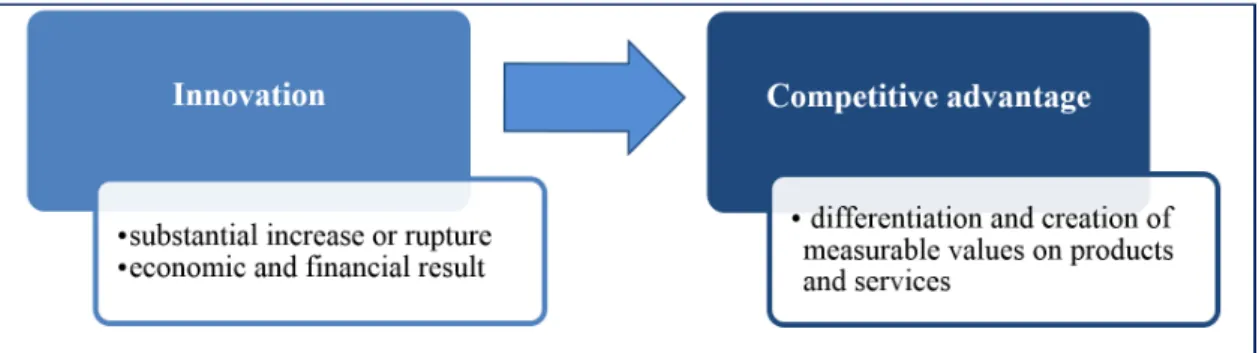
manage them to generate innovations and those to be subjected to achieve competitive advantage (Ito et al., 2012). In this way, according to Figure 1, it will only be considered an innovation if there is
(viable) economic result and (quantitative) inancial
result and this innovation will be able to determine if
the irm will obtain competitive advantage facing its
competitors. This advantage is characterized by the market perception on the differentiation and the value creation of products and services, which so far were not available to consumers. It is reinforced in this assurance the ex post facto character of innovation.
5 Methodological procedures
This article is characterized for being and exploratory quantitative study, aiming at identifying how the
innovations have contributed for a irm to achieve
competitive advantages (Figure 1). The chosen
studied irm is one of the oldest and most important
cooperatives of Rio Grande do Sul, having more than 80 years of existence and having many awards achieved by the quality of its products. It started the production of organic juice and wine in the state, with strong commercial appeal products, focused
on a market niche which has signiicantly grown in
the last years.
Aaker et al. (2011, p. 94) state that the exploratory research is used “[...] when seeking the understanding of the general nature of a problem, the possible alternative hypotheses and the relevant variables which need to be considered”. Malhotra (2001, p. 106) also states that the exploratory research aims at “exploring a problem or a situation to provide
criteria and comprehension”. In addition, he afirms
that the exploratory research is highlighted by the
lexibility and versatility in relation to the methods,
which are responsible for providing the researcher enough knowledge and understanding to proceed with the research project. Aaker et al. (2011) add that the exploratory research can be considered useful, mainly when much background for the questions to be researched is not obtained, aiding in the establishment of priorities, in a way to provide greater understanding about many of the practical problems in the course of the research work.
According to Sampieri (2006), the qualitative
interview is more lexible and open. It is a conversation
between the interviewer and the interviewee. The semi structured interviews, in turn,
[...] are based on a guide of topics or questions and the researcher has the freedom to introduce more questions to the accuracy of the concepts or to obtain more information about the desired topics (Sampieri, 2006, p. 381).
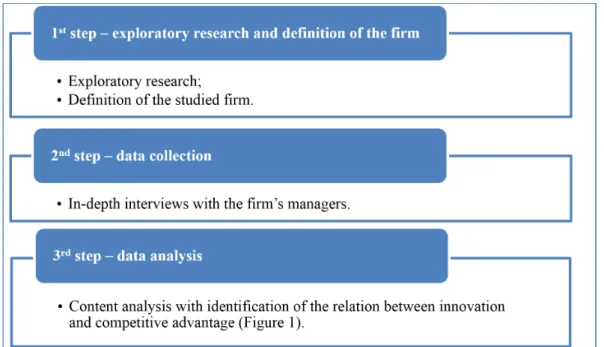
In this way, the data and information collection
was done through ive in-depth interviews, exploring
the questions focused on the achievement of the
study’s goal (Figure 2). The cooperative’s president, the administrative director, the commercial manager, the farming manager and the production manager were interviewed. The interviews were recorded and later transcribed, ipsis litteris, for their content
analysis. The ive interviews were done in different days. In order to facilitate the identiication of the interviews’ content, it was determined that the
Interviewee 1 was the president, the Interviewee 2 was the administrative director, the Interviewee 3 was the commercial manager, the Interviewee 4 was the farming manager and the production manager was the Interviewee 5. The script of the questions for the in-depth interviews was elaborated based on the theoretical reference used, considering the structural aspects and the operation market characteristics, the productive chain and the production processes, the operation market strategies and the perspectives of
the irm and the perspective of the activities.
In addition, the article is characterized as being a case study, which many historical research technics are used, added by direct observation and interviews, which are crucial for this research model. Besides, it is a quite broad research strategy, which planning logic
is used in order to incorporate speciic approaches
to the data collection and data analysis (Yin, 2001).
6 Data presentation
On January 22nd, 1931, 73 families founded Cooperativa Vinícola Garibaldi. Shortly after the 1929 crisis, a group of farmers, motivated by the ideals
of partnering and encouraged by the cooperative movement leaders, started the one that years later would be considered one of the biggest of its kind
in the Americas. Many were the dificulties over the eight decades, mainly inancial ones, but nowadays
the cooperative shows an average annual growth over the Brazilian average. It is considered the leader in the production of muscatel sparkling wine and the 4th on the sparkling wine rank in Brazil. It
employees directly around 110 people in the production and commercialization of its products, which are recognized by many awards achieved over the last years (Fanti, 2011).
The cooperative’s income was R$ 45 million in
2009, R$ 47 million in 2010, R$ 52 million in 2011, R$ 57.2 million in 2012 and R$ 69 million in 2013,
that is, the irm increased its income in 53.33% or R$ 24 million in the last ive years. If we consider that the inlation in the period (from 2009 to 2013) was
28.47%, the real growth of the income was 24.86% or an annual average of 5.64%.
6.1 Beginning of the production
The Interviewee 1 mentions that the organic production begun in 2001 through a partnership with Centro Ecológico de IPÊ, which is
[...] also a nonproit organization that works only with organic production, providing support and technical assistance to whoever is interested.
Facing this, three associates joined this organic production project converting part of the grapevine block. The cooperative had an interest in producing
a different product. The production, of those three associates, represented 2.800 bottles of organic wine
in the irst year.
Financial dificulties were mentioned by the
Interviewee 2, especially in the decade of 1990, and this made
[...] it [the cooperative] stop investing, logically, there was no money, and there was no source. Well, it survived, from a decade to now, 10, 15 years to now, especially in the current president’s term that it started to focus on products with higher added value in order to survive, in order to be in a better condition. If it had kept with the same production master and commercial focus from 15 years ago, it would probably have been with the income of roughly 25, 30 million, and this year, we are heading to about 70, because back then it focused on low added value products, especially bulk wine, which has, has been dying, the bulk wine sale has dropped a lot.
Thus, one of the solutions, found by managers, was to direct part of the production of higher added value products, in this case, the organic ones.
The initial dificulties were given specially by
the suspicion from cooperates towards the organic production, which is reported by Interviewee 1,
[...] because in their minds, it was really dificult to produce without chemical pesticides, without, right, so it was a dificult reason…But since there has been this project for a while, the irst ones that started and kept the project end up being, serving as a role model to others.
Besides,
[...] the market return was something that was just beginning, since it has been twelve years ago, there was practically none or very little room for organic products in the market. So, there was a certain resistance of the differentiated product in the market, sure, I will pay more to leave it with a conventional product. So, that was the main resistance that was found in the beginning.
It is noticed, in this aspect mentioned by the
cooperative’s president, an initial difficulty in
overcoming the cultural barriers of the wine producers. The majority of the associates had a high average age, which contributed to the suspicion in the adoption of a new production method. One of the advantages reported by the Interviewee 4 (farm manager) is about the purchase guarantee on the organic production,
[...] you will make the member produce, plant, and when the time comes say to us that we are not going to get paid, and it would be very bad for us and to the member too, imagine the product being ready and say that he or she will not get paid for it. Then, we can guarantee so, if you want to produce the organic grape, we will get the grape.
However, some organic grape producers, who are not members, drew the attention to it and are committed to hand their production to the cooperative through a verbal agreement “io de bigode” (on my word). In 2013, the volume of processed organic grape was one million kilograms.
However, there was internal resistance in the irm
in adopting this new productive method, mainly from the commercial department
[...] that it is a product that will be sold…with a higher added value, I will have more dificulties in selling it. Sometimes it is much more comfortable to sell a product when you can compete with the price, right? And then there was a certain resistance (Interviewee 1).
It was decided by the presidency that it would be a bet and that the investment at that moment was
low. Another justiication for the bet was that the producer’s remuneration would be more than on the
conventional production. This way, the cooperative would be contributing to increase the remuneration of the members and to create a differentiated product, according to the report from the Interviewee 1:
[...] and there has always been that pressure to pay more for the product, but you have limits, right? You cannot exaggerate…and then on this product you ind a way to value more, but with convincing arguments, okay, with the organic product, I can sell it more expensive, I can add value, and then consequently, I can value a bit more the feedstock.
This matter of encouraging the producers is highlighted by the farm manager (Interviewee 4) when mentioning that it is
[...] about 0.70 cents the Isabel grape, on the conventional of 15 degrees Celsius, a good grape, he gets 0.57 cents and he will get R$ 1.10 also for the organic grape. Then you will ask why such difference, in order to encourage people to produce Isabel grape, we had to pay a bit more because the production is harder and the waste rate is higher, because it is a more sensible to diseases variety, so the chance of going wrong is bigger.
Still, the grading of the grape aims at valuing those producers who offer a better quality product
[...] today they accept normally and amazing as it might seem, in the last years, with this kind of grading we have increased the value of the harvest, because in fact we ended up prizing who produced quality and who did not, end up getting less, but between those who got more and got less, the outstanding one is the grape with greater quality (Interviewee 4).
In addition, there is certiication that attests the
quality and the product as being organic. Different from the conventional juice, which does not need
[...] it is issued a certiicate for the organic grape which attests that the product is contaminant free, and we are all beneited by the end of the certiication, archiving all the requirements, having a certiicate that proves an organic product.
As the new productive activity had been developing and growing, the producers, who had not adopted this model, begun to notice that members, who had already been producing organic grapes, were having a greater income (per hectare) compared to the ones who were on conventional production (with the use of pesticides). However, the increase on the offer was greater than the demand, mentioned by the Interviewee 1:
[...] because in the begging, what happened was… there were 4000 kg of grape, it went to 10, to 18, went to 30, I think it went to 60, I think it went to 80, to 120 and so on, it was about 3, 4 years ago that we have been always having more demand than the product’s offer, so we even stimulated them to increase production, but that ended up over stimulating it and the production, which was 200, 300.000 kg, went up to 1.000.000 kg and the market did not absorbed it, so we had an oversupply problem, the market increases about 10, 15, 20% and the production increased much more than that.
In this way, the cooperative decided to focus more on the production of organic juice and allocate a lower amount of feedstock (organic grape) to the production of wine. This movement, initiated by Cooperative Garibaldi, increased the interest of the competitors, which nowadays also operate in this organic juice and wine market. One of the current challenges, faced by the cooperative, is the low number of buyers which bet on the organic product, and facing this, the production focuses on one big client.
Nowadays, I think that half of the production goes to Pão de Açucar, which is a great supermarket chain which betted on organic products, there are many other chains with a similar potential as Pão de Açúcar, but they have the product, but it is along the conventional one and the consumer ends up not seeing this differentiated product, right? Supermarket chains do not have the appealing for the differentiated product, so sometimes this matter of retailer chain still has not assumed the importance of offering the organic product to the consumer (Interviewee 1).
The cooperative inancial participation in the
production of organic products is about 5 to 6% of the total income.
This has increased well in the last years, but like this it does not have a decisive impact, but it surely helps, but it adds up a lot of value and this is interesting, right? From production to sale, because we pay twice as much for the organic grape to the
member. Depending on the kind and quality of the grape, it can get paid almost 100% more compared to the regular, okay. Our organic product sale is normally about 30%, the value is about 30% over the conventional product, which means that it helps adding value a lot, but it still is a respectably low value for the overall business, of course, it helps a lot, but it is not decisive (Interviewee 2).
Another important aspect of the organic production adoption is that producers started being more environmentally concerned, according to the
Interviewee 1’s report
[...] besides being healthier products, they end up protecting the environmental system because one thing that we also noticed in the country side was that the producer was not much worried about protecting the springs, the streams, they destructed them and did not have this conscience…Nowadays it is totally different, the producer already is, he has this conscience that he must protect the stream, he must protect the things because he is going to end up paying for it tomorrow, right?
6.2 Strategic aspects of organic production
The main competitive advantage, with the production of organic juice and wine, is that, in the beginning, it gave greater visibility (brand) to the cooperative for being offered a
[...] product with greater value, it ended up being an entrance door because there is wine, there is sparkling wine, whatever, there a lot…organic product, ops, there is not this one, so it ended up being the entrance door and eventually it attracted other products, so in the beginning it was like that (Interviewee 1).
Currently, the organic products are considered
a segment of the cooperative’s operation due to its economic importance, to its proitability and
[...] to work the sustainability matter of being a cleaner product, but it provides greater income to the cooperative’s member and this also brings more income so the cooperative can keep on existing, so we see how it is a good deal, it is paying back (Interviewee 1).
In addition, it is considered a differentiated product
by the irm, according to Interviewee 4
[...] the apple of our eye, so for Garibaldi’s image, it was a differentiated product that we put on the market and it gave us a certain advantage in credibility because it is a totally different product that we actually had inside Garibaldi.
The main dificulty faced by the cooperative was
a differentiated product, it should have a higher price compared to the other products, and with that, limiting the consumption coverage by consumption families. The future perspective is that
[...] as time passes by, with a greater dissemination, with the increase of volume, the price matter is over which also gets a bit more affordable as we can say. Because you end up selling to the market a bit more expensive, okay, but the market gets that price and doubles it and the market does not really care…and on the conventional product, it adds up 30, 40% of the brand, which is something that retailers work with, not on the organic product, it is 100% (Interviewee 1).
This vision is also from interviewee 3 when he mentions that
[...] grape juice is a bit expensive compared to the nectar juice drinks around, so I believe that it is the person with higher economic power and higher education too, right? The grape juice nowadays is not cheap if compared to R$8.00, R$9.00, R$10.00 a liter of juice becomes expensive for daily consumption compared to nectars sold from R$3.00 to R$4.00, but I think it is the culture, I think it is predominant.
In addition, according to the administrative director (Interviewee 2), the growth of organic juice has been lower than the growth of the conventional juice due to the following factors:
[...] one factor is the increase of competitors, many people got into it, the production grew a lot and maybe the market did not follow it, it was a growing market, a disputed market, an increasing market, but it was not in the same rhythm as the production rose and the entry of competitors, this is one aspect.
Another aspect highlighted by interviewee 2 refers
to the consumer proile,
I was willing to pay for such a big difference in an organic product, I was talking about 30% more, and I think the difference is too much. There has still been a lot of awareness work for this market, understanding what an organic product is in order to spark interest of consumers.
6.3 Perspectives of the activity
As far as the future of Cooperativa Garibaldi, the president states that
[...] it is well seen, that since it was the pioneer, it was the irst one that made it in the big retailer, inside the organic products market, it would be a benchmark, which is the impression that I have. Now, inside the organic products segment, I believe that the image is good and like that, it is very much
disseminated, right? As we arrived irst, we ended up being a benchmark, right?
With this, for having been the pioneer in the production of organic juice and wine, the clients know how to recognize it, when the offer is greater than the
demand, the cooperative’s products are kept and the
ones from the competitors are not offered. In other
words, considering that the irm was the pioneer in
this market, a competitive advantage was created over its competitors, which arrived later. This aspect is complemented by interviewee 2 when mentioning
[...] that the special contribution of the organic product to Garibaldi is in the irm’s image, for being part of the proile, for being part of the irm’s strategy in the concept of sustainability which is what we have been selling strongly out there, it is crucial to any presentation that we do at Garibaldi to highlight our organic product client. It is the apple of our eyes, which was something no one betted on in the beginning, every one disbelieved it, even commercially it would not work out, even in the technical area and there have been some people that bought the idea, especially the president, look at it nowadays, it got to 1 million kilos of organic grape.
In addition, in the opinion of interviewee 3
[...] in the future, for sure, it will be a very attractive market. We started in 2001 and practically it was just us who consumed it, today there is about four or ive irms with organic juice on the market. I see a great perspective in the future”. Complementing he says that “as we were practically the pioneers of the organic line, sometimes orders are requested on that…wow! We have a line of organics…ah! We were the irst ones to launch a juice; it opens doors, it still does.
The concern with the organic grape producers is constant from part of the cooperative, whether one of them decides to add any pesticide in order to improve
productivity, the relexes will be felt by all the other producers. In this case, the product’s image will be jeopardized and it will lose conidence by the inal consumers. Hence, more than the certiication of a product, the organic wine and juice’s image represents
a pesticide free production.
The concern on the constant qualiication of the
activities and productive processes is mentioned by the production manager (Interviewee 5), due to the
development of the processes’ manuals, seeking to
describe the processes of each productive activity from the cooperative.
7 Case analysis
The presented results relect the irm’s initiative
the creation of competitive advantages over the competitors. Without the addition of pesticides, organic products represented an innovation in production and in the commercialization of differentiated products with added value for the cooperative and greater
proitability for the producers. Thus, as highlighted by Bharadwaj et al. (1993), the irm achieved competitive
advantage by the fact of having implemented an innovation strategy capable of creating value to the market.
However, in the beginning of the organic grape
production, there were many dificulties and skepticism
to be overcome by the cooperative, especially with the producers in replacing the traditional process by a pesticide free model (Chart 1). In addition, the
commercial department of the irm saw these new
products with suspicion, because the innovation makes the organization get out of a comfort zone by the potential risk of the unknown. The growth of the productive activity and the commercialization
overcame the initial dificulties, causing, including in
the last years, an oversupply. With the entry of new competitors, the organic juice and wine production in the cooperative revealed a lower growth over the conventional products.
From the innovation strategy point of view, it is observed that the innovation is presented as an
incremental form in the proile, not replacing other
income sources, but with impacts on the productive process. This strategy is positive as far as the new competitors also launched products in the organic juice market, lowering the competitive advantage of the cooperative. It is also observed the use of partnerships and technological transfer as innovation facilitators.
From the market point of view, the organic products are seen as differentiated products by the
big supermarket chains and that is why they abuse
the prices for the inal consumer, causing restrictions
on the consume.
In relation to the main competitive advantages achieved by the introduction of the innovations, those are regarded by the fact that the organic products are products that encourage the order of other products
from the irm, making the entry into new markets or
new supermarket chains possible. The organic product operates along with the conventional products, and the
competitive advantage for the irm is on the variety and
the distinct focus of the set of new offered products, according to Chart 1. Also, even though the production and commercialization of organic product has little
participation in the total income of the irm, it results in greater inancial income compared to conventional
products. And this greater income is passed on to the producer, making it more attractive than the conventional production. From the point of view of
its brand, the cooperative’s image became stronger
over the consumer market, considering the concern of the sustainable production and, consequently, the health of producers and consumers.
Some challenges and perspective for the activity’s future were identiied in the interviews. The organic
product market will keep up its growth, mainly with
the people’s concern for their health. Being related
to this increase in the market, there is a need of greater promotion of organic products, showing to the consumer markets the differences and advantages of consuming pesticides free products. And in relation to the productive process, with the focus on improving
the inancial income, there is the challenge to develop
a new bottle with lower cost, replacing the glass one, which is currently used.
Chart 1. Main characteristics of the productive activity analyzed.
Beginning of the activity In 2001, through a partnership with Centro Ecológico de Ipê/RS.
Main dificulties faced in the beginning Suspicion by part of the producers;Internal and external cultural barriers; The amount is still underdeveloped.
Main dificulties faced over the activity
More recently, oversupply;
Low bet on organic products by the big supermarket chains; Price abuse by part of the supermarkets;
Consumer proile still very restricted.
Achieved competitive advantages
Being a product that encourages the order of other products from the irm;
Providing a greater inancial return to the cooperative and to the producers;
Concern with sustainability;
Image of a pioneer irm in the market of organic juice and wine.
Perspectives and challenges for the future
Developing a bottle with lower cost compared to the current glass one; Greater exposure of the organic products;
Market growth of organic products.
8 Final considerations
The focus of this study was to identify how the innovations contribute in achieving competitive
advantages in the analyzed irm. In order to achieve this goal, ive in-depth interviews with the cooperative’s
managers were done.
According to the presented results, the irm
structured and implemented a productive activity of
organic wines and juices, causing signiicant changes
in the structure and in the links of the productive chain. The main barrier in the introduction of the innovation (organic production) was the suspicion of the ones involved in the activity, mainly by the rural producers. However, as time went on and the production development, the producers, who were not inserted in this activity yet, noticed the income
and health advantages, and the irm achieved some
competitive advantage as the differentiated product offer to the market in which it operates, consumer
awareness of the organization’s social responsibility, the demonstration of being a pioneer irm on the
production and offer of those products and greater
inancial income for the irm and the producers/
members.
References
Aaker, D. A., Kumar, V., & Day, G. S. (2011). Pesquisa de marketing. São Paulo: Atlas.
Barney, J. B. (1991). Firms resources and sustained competitive advantage. Journal of Management, 17(1), 99-120. http://dx.doi.org/10.1177/014920639101700108.
Barney, J. B. (2001). Gaining and sustaining competitive
advantage. Upper Saddle River: Prentice Hall.
Barros, L. A. M. (2001). Inovação como fator de
competitividade: o segmento da indústria eletroeletrônica
(Dissertação de mestrado). Programa de Pós-graduação em Administração de Empresas, Universidade Presbiteriana Mackenzie, São Paulo.
Bharadwaj, S. G., Varadarajan, P. R., & Fahy, J. (1993). Sustainable competitive advantage in service industries: a conceptual model and research propositions. Journal of Marketing, 57(4), 83-99. http://dx.doi.org/10.2307/1252221. Coyne, K. P. (1986). Sustainable competitive advantage:
what it is, what it isn’t. Business Horizons, 29(1), 54-61. http://dx.doi.org/10.1016/0007-6813(86)90087-X.
Darolt, M. R. (2007). Alimentos orgânicos: um guia para o consumidor consciente (2nd ed.). Londrina: IAPAR. 36 p. Day, G. S., & Reibstein, D. J. (1999). A dinâmica da
estratégia competitiva. Rio de Janeiro: Campus.
Dosi, G. (1982). Technical paradigms and technological trajectories: a suggested interpretation of the determinants and directions of technical change. Research Policy, 11(3), 147-162.
Fanti, C. A. (2011). La nostra cooperativa. Flores da Cunha: Novo Ciclo.
Ferraz, J. C., Kupfer, D., & Haguenauer, L. (1995). Made in Brazil: desaios competitivos para indústria. Rio de Janeiro: Campus.
Financiadora de Estudos e Projetos – Finep. (2004). Manual de Oslo: proposta de diretrizes para coleta e interpretação de dados sobre inovação tecnológica. Brasília. Recuperado em 10 de março de 2014, de www.finep.gov.br/imprensa/sala_imprensa/oslo2.pdf Giget, M. (1997). Techonology, innovation and strategy:
recent developments. International Journal of Technology Management, 14(6-7-8), 613-634. http:// dx.doi.org/10.1504/IJTM.1997.002583.
Hall, W. K. (1980). Survival strategies in a hostile environment. Harvard Business Review, 58, 75-85. Hitt, M. A., Ireland, D. R., & Hoskisson, R. B. (2002).
Administração estratégica: competitividade e globalização. São Paulo: Pioneira Thomson Learning.
Ito, N. C., Hayashi, P., Jr., Gimenez, F. A. P., & Fensterseifer, J. E. (2012). Valor e vantagem competitiva: buscando definições, relações e repercussões. Revista de Administração Contemporânea, 16(2).
Machado, D. D. P. N. (2007). Organizações inovadoras: estudo dos fatores que formam um ambiente inovador. Revista de Administração e Inovação, 4(2), 5-28. Malhotra, N. K. (2001). Pesquisa de Marketing: uma
orientação aplicada (3. ed.). Porto Alegre: Bookman. Nelson, R., & Rosenberg, N. (1993). Technical innovation
and national systems. In R. Nelson (Org.), National
innovation systems: a comparative analysis. Oxford: Oxford University Press.
Nelson, R., & Winter, S. (1982). An evolutionary theory of economic change. Cambridge: Harvard University Press. Paiva, E. L., & Carvalho, J. M., Jr., & Fensterseifer, J.
E. (2004). Estratégia de produção e operações. Porto Alegre: Bookman.
Pelegrin, I., & Antunes, J. A. V., Jr. (2013). Inovação: uma discussão conceitual a partir da perspectiva da cadeia de valor. In A. Proença, D. P. Lacerda, J. A. V. Antunes, J. L. Tavora & M. S. Salerno (Orgs.), Gestão da inovação e competitividade no Brasil: da teoria à prática. Porto Alegre: Bookman.
Porter, M. E. (1989). Vantagem competitiva: criando e sustentando um desempenho superior. Rio de Janeiro: Elsevier.
Porter, M. E. (1990). Vantagem competitiva: criando e sustentando um desempenho superior. Rio de Janeiro: Campus.
Porter, M. E. (1999). Competição: estratégias competitivas
Sampieri, R. H. (2006). Metodologia de pesquisa (3rd ed.). São Paulo: McGraw-Hill.
Schumpeter, J. (1977). Capitalismo, socialismo e democracia. Rio de Janeiro: Zahar.
Tigre, P. B. (1998). Inovação e teorias da firma em três paradigmas. Revista de Economia Contemporânea, 3. Yin, R. (2001). Estudo de caso: planejamento e métodos
(2nd ed.). Porto Alegre: Bookman.
Zawislak, P. A. (1995). A relação entre conhecimento e desenvolvimento: essência do progresso técnico. Análise, 6(1), 125-149.
Porter, M. E. (2000). A vantagem competitiva das nações. Rio de Janeiro: Campus.
Printec Comunicação. (2014). The Future Report Food. Release sobre pesquisa: alimentos no mundo. São Paulo. Recuperado em 10 de agosto de 2014, de www. printeccomunicacao.com.br
Quandt, O. C. (2013). Inovação em clusters emergentes. Campinas: Com Ciência. Recuperado em 13 de dezembro de 2013, de http://www.comciencia.br