*e-mail: [email protected]
Synthesis and Characterization of Silsesquioxane-Based
Polymer Hybrids with Controlled Structure
Ricardo O.R. Costaa, Wander L. Vasconcelosa* and Richard M. Laineb a Department of Metallurgical and Materials Engineering,
Federal University of Minas Gerais, 30160-030 Belo Horizonte - MG, Brazil b Departments of Materials Science and Engineering,
Chemistry and the Macromolecular Science and Engineering Center, University of Michigan, 48109-2136 Ann Arbor - MI, USA
Received: September 27, 2001; Revised: July 10, 2002
We have developed a method to obtain polymer hybrids with control of inorganic content and molecular configuration. Hybrid poly(methyl methacrylate) (PMMA) was obtained via atom trans-fer radical polymerization (ATRP) initiated by octafunctional cubic silsesquioxanes using CuCl as catalyst. Two different ATRP initiators obtained by attaching specific chemical groups to the cubic silsesquioxane were employed to produce two types of hybrids with different architectures. While α-bromide ester groups generated a star-shaped polymer, the benzyl chloride groups pro-duced longer and more linear polymeric chains containing the cubic silsesquioxane. These results were explained on the basis of the low initiation efficiency of benzyl chloride groups for PMMA, leading to polymers with molecular weights (Mn) and polydispersities (PDI) higher than the
ex-pected ones.
Keywords: polymer hybrid, structural control, cubic silsesquioxane, ATRP
1. Introduction
In recent years, there have occurred major developments in the science and technology of polymeric materials with controlled architectures. In this sense, different kinds of regular branched polymers such as dendrimers, combs, lad-ders and stars have been designed1-3. The search for
syn-thetic routes that lead to well-defined polymers aims to at-tain the control of structure-property relationships, so that the materials can be tailored for specific applications. Simi-larly, extensive efforts have been made to synthesize novel organic/inorganic hybrids from octahedral silses-quioxanes4-6, whose regular shape may also facilitate
struc-tural control of nanocomposite materials.
Branched molecules are particularly interesting due to their different processing characteristics and properties when compared to the linear molecules with the same molecular weight. Crystallinity, melting point, glass transition tem-perature, intrinsic viscosity and viscoelastic behavior are affected by branching7. The facility for processing branched
polymers associated with the potential applications of or-ganic-inorganic hybrid materials have stimulated the study of synthetic routes leading to block, graft and star polymers from inorganic macroinitiators8.
Although the concept of controlled/living polymeriza-tion processes has long been known9, only recent
develop-ments of controlled radical polymerization techniques10,
particularly atom transfer radical polymerization (ATRP)11,12,
allowed the synthesis of polymer hybrids with well-defined architectures and low polydispersities. In ATRP, the reac-tion is initiated by an alkyl halide activated by a catalyst, usually a complex of copper with a ligand, so that termina-tion reactermina-tions are mostly suppressed because of a rapid equi-librium established between dormant and active propagat-ing species.
In a previous paper13, we reported the synthesis of an
8-arm star poly(methyl methacrylate) (PMMA) via ATRP initiated by α-bromide esters attached to an octafunctional
Syntheses of octakis(2-(4-chloromethylphenyl)
ethyldimethylsiloxy) octasilsesquioxane (OCPS) and
octakis(2-bromo-2-methylpropionoxypropyldimethyl-siloxy)octasilsesquioxane (OBPS) have been reported
else-where13. Methyl methacrylate (MMA) (99% Acros) and
ac-etonitrile (99.5% Aldrich) were distilled under N2 and stored in flasks sealed under N2. CuCl (98% Aldrich) was purified by stirring for 4 h with acetic acid, which dissolves CuCl2, washing the filtrate with ethanol and drying. The ligand 2,2'-bipyridine (99%) and the ATRP initiators, 4-methylbenzyl chloride (98%) and ethyl-2-bromoisobutyrate (98%), were used as received from Aldrich.
General Procedure for the Solution ATRP of MMA
In a typical reaction, 0.070 g (0.707 mmol) of CuCl and 0.329 g (2.10 mmol) of 2,2'-bipyridine were added to a 50 mL Schlenk flask, equipped with a reflux condenser and a magnetic stirrer. The reaction flask was degassed and
purged 3× with N2. Acetonitrile (15.0 mL) and MMA
(7.5 mL, 70.1 mmol) were added by syringe and the homo-geneous solution formed was equilibrated in an oil bath at 90 ± 2 °C. In another small flask, OCPS initiator (0.196 g, 0.0877 mmol) was dissolved in acetonitrile (7.5 mL) under N2. The start of the reaction was recorded when the initiator was injected into the reaction flask. Samples of the reaction solution were collected at specific time intervals. A total of ~4.0 mL of solution was collected each time by syringe and 2.5 mL was immediately poured into 20 mL of methanol to precipitate the polymer, which was washed with methanol to remove copper complex and then dried. The remaining 1.5 mL was used to determine monomer conversion by weighing the solution and the dried mass at 70 °C in a vacuum oven after mass change ceased.
Characterization
All analyses by gel permeation chromatography (GPC) were performed on a Waters 440 system, using an Acuflow Series III pump, Waters styragel columns (7.8 × 300, HT2, 3, 4) with RI detection using an Optilab DSP Interferomet-ric Refractometer (Wyatt Technology). The system was cali-brated using polystyrene standards, the eluent was CH2Cl2 and the flow was 1.0 mL/min.
3. Results and Discussion
The chemical structures of the octafunctional silses-quioxanes synthesized to be ATRP initiators are shown in
lymerize MMA under identical reaction conditions, i.e. equivalent concentrations of monomer, catalyst, ligand and initiator.
Figure 1 compares the dependence of the
number-aver-age molecular weight (Mn) and polydispersity (PDI) on
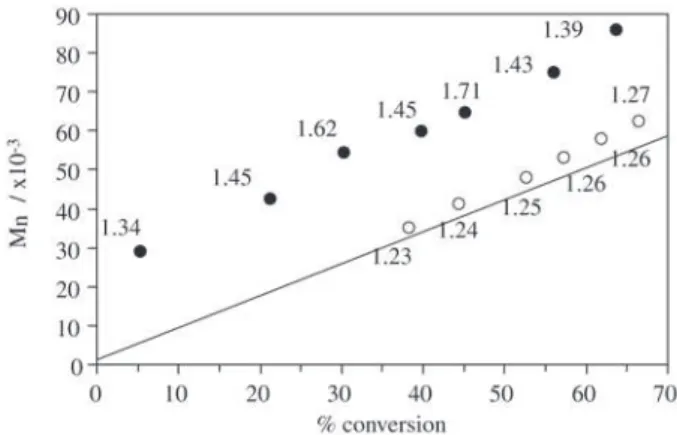
monomer conversion for PMMA hybrids obtained from both initiators, OCPS and OBPS. The drawn line represent the theoretical molecular weight, Mn(th), calculated assuming that every initiator group originates only one polymer chain at-tached to the silsesquioxane core. It can be observed that, while Mn for OBPS system is only slightly above the theo-retical line, PMMA hybrids initiated by OCPS have much higher Mn. PDI values are also significantly higher for OCPS system, suggesting that polymerization is not controlled in this case.
Figure 2 shows the dependence of the parameter ln([M]0/[M]) on reaction time, where [M]0 is the initial monomer concentration and [M] is the monomer concen-tration at a specific reaction time. In typical ATRP, the con-centration of active species remains constant throughout the reaction, which can be verified by obtaining linear semi-logarithmic plots of monomer conversion vs. time. Neither system presents such a linear dependence, meaning that the concentration of active species varies in both cases. In OCPS system, the upward concave curve indicates that additional
sites are activated throughout the reaction, contrary to OBPS system, whose downward concave curve suggests that propagating sites are deactivated as reaction proceeds.
The facts that OCPS initiator provides PMMA hybrids with Mn higher than the predicted ones and the concentra-tion of active species increases with time indicate that the benzyl chloride group does not actuate efficiently as ATRP
initiator for MMA, confirming what has already been re-ported in the literature14. As a result, part of the initiating
creasing concentration of propagating chains as reaction proceeds increases polydispersity, as observed in Fig. 1. However, the steric hindrance caused by grown polymer chains would probably impede the access of monomer to most of the remaining inactive initiating groups on the core. The apparent tendency for decreasing PDI at higher con-versions might result from the lower propagating rates of longer chains associated with the activation of non-reacted OCPS molecules and a few accessible non-reacted initiat-ing sites.
On the other hand, the higher reaction rates provided by OBPS initiator (Fig. 2) mean that virtually all OBPS mol-ecules and a significant fraction of its 8 α-bromide esters
initiating groups are active as propagating polymer chains. Moreover, their Mn close to the theoretical ones (Fig. 1) and their comparatively low PDI values suggest that a star PMMA has been formed. However, the decreasing concen-tration of active species demonstrated in Fig. 2 is indicative of the occurrence of inevitable termination reactions that lead to coupling between star molecules. Termination reac-tions promote deactivation of propagating sites and conse-quent stabilization of catalyst in its oxidized form CuX2, leading to a downward concave curve.
The confirmation that coupling takes place between stars initiated by OBPS but not by OCPS can be observed in Fig. 3, where GPC traces for both systems are compared. The pairs of curves refer to samples with similar monomer conversions. As already discussed, OCPS produces higher
Mn polymer hybrids, but more important is the high
mo-lecular weight shoulder that appears in OBPS samples and increases with conversion. This shoulder results probably from the presence of double or even higher order stars
Figure 3. GPC traces of PMMA hybrids initiated by OCPS or OBPS and obtained under similar reaction conditions with approxi-mate the same monomer conversions. [initiator] = 2.92 mM, [CuCl] = 23.4 mM, MMA:initiator group (–Cl or –Br) = 100.
Figure 2. Semi-logarithmic kinetic plot for the synthesis of PMMA hybrids initiated by OCPS (filled) or OBPS (open) under similar reaction conditions. Lines are used only to guide the eye. [initia-tor] = 2.92 mM, [CuCl] = 23.4 mM, MMA:initiator group (–Cl or –Br) = 100.
formed when coupling takes place between arms of differ-ent star molecules. The high concdiffer-entration of active sites in OBPS system, caused by the efficient initiation of α
-bro-mide ester groups, increases the probability for termination reactions to occur as compared with OCPS system. If ter-mination occurs by disproportionation, unsaturated chain ends may be formed and further linked to other propagat-ing arms, while termination by combination would lead to direct star-star coupling.
Figure 5. Semi-logarithmic kinetic plot for the synthesis of linear PMMA initiated by 4-methylbenzyl chloride (BzCl) (filled) or ethyl-2-bromoisobutyrate (BrBu) (open). Lines are used only to guide the eye. [BzCl] = 2.92 mM, [CuCl] = 23.4 mM, MMA:BzCl = 100; [BrBu] = 1.46 mM, [CuCl] = 11.7 mM, MMA:BrBu = 200.
Figure 4. Dependence of Mn on monomer conversion of linear PMMA initiated by 4-methylbenzyl chloride (BzCl) (filled) or ethyl-2-bromoisobutyrate (BrBu) (open). Lines represent the theo-retical Mn for eachh study and numbers are PDI values according to GPC. [BzCl] = 2.92 mM, [CuCl] = 23.4 mM, MMA:BzCl = 100; [BrBu] = 1.46 mM, [CuCl] = 11.7 mM, MMA:BrBu = 200.
Scheme 2. Molecular architecture of PMMA hybrids initiated by OCPS and OBPS.
arms, the number of arms could be determined. The ap-plied procedure to OBPS system has been better described elsewhere13. An average of 6.5 arms was found for
OBPS-initiated hybrid, while OCPS-OBPS-initiated hybrids had only 2 arms at high monomer conversions.
To confirm the hypothesis of initiator inefficiency, an-other experiment was carried out using the ATRP initiators 4-methylbenzyl chloride (BzCl) and ethyl-2-bromo-isobutyrate (BrBu), which are small molecules containing the same chemical groups previously attached to the cubes. The comparison between results obtained using the initia-tor cubes and those obtained using BzCl and BrBu would permit the evaluation of any possible influence or steric ef-fect caused by the presence of the cubic silsesquioxane.
Figure 4 shows the dependence of Mn on monomer
conver-sion for ATRP of MMA initiated by both BzCl and BrBu. It can be noted that the Mn of PMMA initiated by BrBu fol-lows its theoretical line very closely, whereas the Mn of PMMA initiated by BzCl is almost 10× higher than expected at low conversions, similarly to what has been found for OCPS and OBPS systems. Also, PDI values are consider-ably higher for BzCl system, confirming that late initiation takes place.
Figure 5 shows the dependence of the parameter ln([M]0/[M]) on reaction time. The results obtained for BzCl and BrBu are very similar to those obtained for OCPS and OBPS systems (Fig. 2). Even though the BzCl concentra-tion employed was twice as much as the BrBu one, the re-action was still slower, confirming that benzyl chloride group does not initiate efficiently MMA polymerization.
There-fore, ATRP initiated by silsesquioxanes is virtually not af-fected in its fundamental aspects.
combination of them in a specific proportion.
4. Conclusions
By employing different octafunctional ATRP initiators, OCPS and OBPS, PMMA hybrids with different molecular architectures were obtained. Given the low initiation effi-ciency of benzyl chloride groups for ATRP of methyl meth-acrylate, it was obtained a polymer hybrid with an average of only 2 polymer chains attached to OCPS core. However, star-shaped molecules were obtained when OBPS initiator was employed. The different molecular architectures serve as a basis for structural control of polymer hybrids. The polymerization characteristics of the silsesquioxane-based polymer hybrids are quite similar to those of their linear analogues generated from the unattached ATRP initiators. Therefore, the activity of the initiating groups remained vir-tually unaffected by their attachment to the silsesquioxane core, which is an important conclusion for further studies involving different initiators.
Acknowledgements
The authors gratefully acknowledge the financial support from CAPES, FAPEMIG and CNPq (Brazil) and the partial support from Pfizer and the Air Force Phillips Laboratories at Edwards Air Force Base for aspects of these studies.
Vlahos, C. Adv. Polym. Sci., v. 142, p. 71-127, 1999. 3. Webster, O. Science, v. 251, p. 887-893, 1991.
4. Laine, R.M.; Zhang, C.; Sellinger, A.; Viculis, L. Appl. Organometal. Chem., v. 12, p. 715-723, 1998.
5. Choi, J.; Costa, R.O.R.; Tamaki, R.; Laine, R.M. Polym. Prep., ACS Div. Polym. Chem., v. 41, n.1, p. 524-525, 2000.
6. Laine, R.M.; Choi, J.; Lee, I. Adv. Mater., in press. 7. Roovers, J. in Encyclopedia of Polymer Science and
En-gineering, 2nd ed., J.I. Kroschwitz, Ed., Wiley, New York, v. 2, p. 478, 1985.
8. Matyjaszewski, K.; Miller, P.J.; Fossum, E.; Nakagawa, Y. Appl. Organometal. Chem., v. 12, p. 667-673, 1998. 9. Szwarc, M. Nature, v. 178, p. 1168-1169, 1956. 10. Mishra, M.K.; Yagci, Y. in Handbook of Radical Vinyl
Polymerization, Marcel Dekker, New York, p. 233, 1998.
11. Wang, J.-S.; Matyjaszewski, K. J. Am. Chem. Soc., v. 117, p. 5614-5615, 1995.
12. Wang, J.-S.; Matyjaszewski, K. Macromolecules, v. 28, p. 7901-7910, 1995.
13. Costa, R.O.R.; Vasconcelos, W.L.; Tamaki, R.; Laine, R.M. Macromolecules, v. 34, p. 5398-5407, 2001. 14. Matyjaszewski, K.; Shipp, D.A.; Wang, J.-L.; Grimaud,