*e-mail: [email protected]
Predicting Microstructure Development During High
Temperature Nitriding of Martensitic Stainless Steels
Using Thermodynamic Modeling
André Paulo Tschiptschin
Metallurgical and Materials Engineering Department, University of São Paulo Av. Prof. Mello Moraes, 2463, 05508-900 São Paulo - SP, Brazil
Received: September 27, 2001; Received: July 10, 2002
Thermodynamic calculations of the Fe-Cr-N System in the region of the Gas Phase Equilibria have been compared with experimental results of maximum nitrogen absorption during nitriding of two Martensitic Stainless Steels (a 6 mm thick sheet of AISI 410S steel and green powder compacts of AISI 434L steel) under N2 atmospheres. The calculations have been performed com-bining the Fe-Cr-N System description contained in the SGTE Solid Solution Database and the gas phase for the N System contained in the SGTE Substances Database. Results show a rather good agreement for total nitrogen absorption in the steel and nitrogen solubility in austenite in the range of temperatures between 1273 K and 1473 K and in the range of pressures between 0.1 and 0.36 MPa. Calculations show that an appropriate choice of heat treatment parameters can lead to optimal nitrogen absorption in the alloy. It was observed in the calculations that an increased pressure stabilizes CrN at expenses of Cr2N - type nitrides.
Keywords: nitrogen absorption, high temperature nitriding, martensitic stainless steels
1. Introduction
Nitrogen improves mechanical properties, wear and cor-rosion resistance of martensitic stainless steels1. High
ni-trogen martensitic stainless steels can be obtained by means of high-pressure metallurgy. Nitrogen content of martensitic stainless steels can also be increased by exposition of austenite to high purity nitrogen, under relatively low pres-sures2. This can be done with bulk (case hardening) or
particulate materials (powder metallurgy)3.
The beneficial effects of nitrogen on mechanical, corro-sion and corrocorro-sion-erocorro-sion properties can only be obtained if nitrogen remains in solid solution after quenching or is precipitated as coherent and fine chromium nitride parti-cles after tempering. If coarse nitride precipitation is not hindered during high temperature nitriding, chromium and nitrogen depletion of the matrix can impair corrosion and wear resistance of these steels4.
When stainless steel is exposed to a nitrogen atmosphere at high temperature, nitrogen may be incorporated in steel through dissolution of nitrogen in the austenitic phase up to
its solubility limit, according to equation (1):
½ N2(gas)⇔ [N]γ (1)
and through precipitation of chromium nitrides, according to equations (2) and (3):
[Cr] γ + [N]γ⇔ CrN (2)
2[Cr] γ + [N]γ ⇔ Cr2N (3)
Each of these reactions has its own equilibrium con-stant, for given temperatures and nitrogen gas pressures.
K h
a
f N
p
N N
N N
N
= [ ] = ⋅[% ]
2 2
(4)
where h[N] is the Henryan activity of nitrogen in solution in austenite aN2 is the Raoultian activity of nitrogen in the gas phase, which can be represented by the nitrogen partial
chemical activity of nitrogen with its weight percent con-centration [%N]. This relationship leads to Sieverts’ law under the domain of validity of Henry’s law.
[% ]N ≈K" pN2 (5)
where K” = KN / fN.
Nitrogen will remain in solid solution depending on tem-perature of thermo-chemical treatment and nitrogen pres-sure. Nitrogen loss or nitrogen pickup may occur accord-ing to Sieverts’ law at a given set of temperature and nitro-gen partial pressure parameters.
The equilibrium of the reaction ½ N2 (gas) ⇔ [N] γ may be shifted by reactions (2) and (3) relative to CrN and Cr2N precipitation with equilibrium constants given by eqs. 6 and 7:
K
a
h
h
K
a
h
h
CrN
CrN Cr N
Cr N
Cr N Cr N
=
⋅
=
⋅
[ ] [ ]
[ ] [ ]
2
2 2
where aCrN and aCr2N are the activities of the two chromium
nitrides and h[Cr] andh[N] are the Henryan activities of chro-mium and nitrogen in solution.
Extensive thermodynamic calculations must be carried out to know the nitrogen content in solution in austenite and the amount of precipitated chromium nitrides.
Thermocalc®5 calculations may also be done leading to
a good description of the equilibrium between nitrogen gas and steel, provided that convenient databases are selected. Nitrogen contents calculated by this procedure were compared with measured ones after high temperature nitriding of low carbon stainless steels.
2. Experimental
Fe-Cr-N phase diagrams were computed using the Thermocalc® (version L) program for a system in which
equilibrium between austenite, chromium nitrides and N2 gas at the metal surface was considered. The thermodynamic description of the gaseous phase contained in the SGTE Substances 1994 Database - SUB94 – was appended to the system’s description contained in the SGTE Solid Solutions – SSOL - Database.
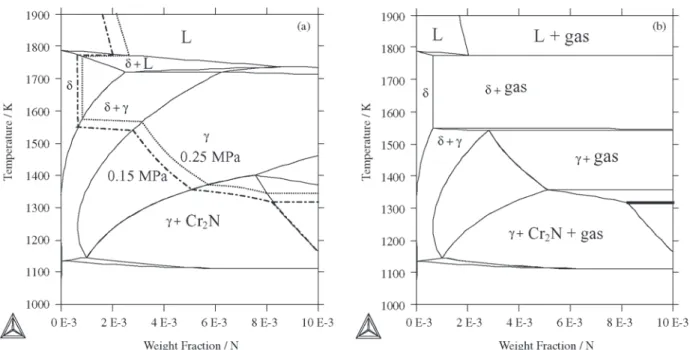
Usually the equilibrium between nitrogen gas and steel is described by overlaying N2 isobar lines6 on phase
dia-grams calculated without considering the gas phase as an equilibrium one, as shown in Fig. 1a, for Fe-13 %Cr-N al-loys. It has the advantage of representing phase diagrams for different pressures all in one.
(6)
(7)
The method used in this work considers the equilibrium between the gas phase and the steel as shown in Fig. 1b, cal-culated for a Fe-13 %Cr-N alloy at 0.15 MPa. It gives a real-istic representation of the phase fields beyond the solid state. AISI 410S and AISI 434L stainless steels were high tem-perature nitrided in a tubular furnace under high purity N2 atmosphere at pressures between 0.15 and 0.36 MPa and temperatures between 1273 K and 1473 K, during 1 to 24 h. The AISI 410S bulk specimens were thermo-chemically treated in order to obtain hardened cases 0.15 to 2 mm thick. The AISI 434L stainless steel powder was compacted and simultaneously sintered and nitrided to obtain homogene-ous and dense high nitrogen, high hardness martensitic stain-less steels. The chemical compositions of the alloys are shown in Table 1.
Thermo-chemical treatments were performed at tem-peratures between 1273 K and 1473 K and pressures be-tween 0.15 and 0.36 MPa, during 1 to 24 h.
Nitrogen absorbed during thermo-chemical treatment
Table 1. Chemical composition of the alloys (wt.%).
Steel C N Cr Mn Si Mo
410 S bulk 0.07 0.020 13.0 0.27 0.40 -434 L powder 0.02 0.018 16.2 0.20 1.20 0.8
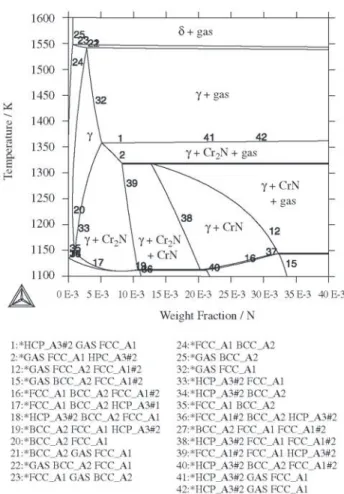
Figure 2. Isopleth of the Fe- 13% Cr – N system for 0.15 MPa N2 pressure.
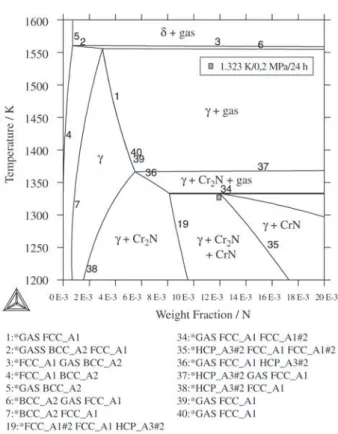
Figure 3. Isopleth of the Fe- 13% Cr – N system for 0.25 MPa N2 pressure.
was evaluated by measuring the increase in weight of the specimens and also by fusion under inert gas analysis to check the results. The nitrogen content at the surface of the case hardened AISI 410S steel was determined by GDOS.
3. Results
The Fe – 13% Cr – N system and AISI 410 S alloy
Fe-Figure 4. Isopleth of the Fe- 13% Cr – N system for 0.20 MPa N2 pressure. The small square indicates the GDOS measured surface nitrogen content of an AISI 410 S stainless steel after 24 hours of exposure to a 0.20 MPa N2 atmosphere at 1323 K.
Table 2. Nitrogen absorbed, nitrogen dissolved in austenite and phases in equilibrium with N2 gas in a Fe- 13 %Cr alloy and 0.15 MPa.
Temperature (K) % Ntotal %Nγ Phases in equilibrium with N2 gas
1,273 2.30 0.25 γ + CrN
1,373 0.49 0.49 γ
1,473 0.35 0.35 γ
Table 3. Nitrogen absorbed, nitrogen dissolved in austenite and phases in equilibrium with N2 gas in a Fe- 13 %Cr alloy and 0.25 MPa.
Temperature (K) % Ntotal % Nγ Phases in equilibrium with N2 gas
1,273 2.6 0.28 γ + CrN
1,373 0.70 0.55 γ + Cr2N
1,473 0.45 0.45 γ
13% Cr alloy absorbs larger amounts of nitrogen, the lower the temperatures, provided equilibrium is attained. Never-theless, the amount of nitrogen in solution in austenite in-creases as the temperature is decreased until the Cr2N hex-agonal nitride becomes stable. From this point on the solu-bility limit of nitrogen in austenite decreases with decreas-ing temperatures. Tables 2 and 3 show for Fe –13% Cr al-loys, the total nitrogen content, the nitrogen content dis-solved in austenite and the phases in equilibrium with N2 gas for different temperatures and 0.15 and 0.25 MPa pres-sures, respectively.
It can be seen that thermo-chemical treatments carried out at 1273 K lead to extremely high values of nitrogen absorbed by the alloy, although the nitrogen content dis-solved in austenite is low and cubic CrN nitride is present. As the temperature is increased to 1373 K the total amount of nitrogen is decreased but the content of nitrogen dissolved in austenite increases. Increasing pressure stabilizes the Cr2N phase at expenses of the cubic CrN phase.
Figure 4 shows the Fe 13% Cr – N isopleth for 0.20 MPa N2 pressure. The small square plotted in the figure indicates the GDOS measured surface nitrogen content (1.2%) of an AISI 410 S stainless steel after 24 h of exposition to a 0.20 MPa N2 atmosphere at 1323 K. The volume fraction of precipitated CrN at the surface of the alloy was estimated by quantitative metallography as being 3%, leading to a cal-culated (through mass balance) nitrogen content dissolved in austenite of 0.45%. One can see that the agreement be-tween predicted and measured values is rather good.
The Fe-16.2% Cr-N system and AISI 434L alloy
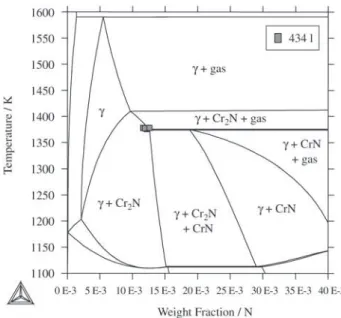
Phase diagrams for Fe-16.2 Cr – N alloys were calcu-lated and Figs. 5, 6 and 7 show the isopleths for 0.15 MPa, 0.25 MPa and 0.36 MPa N2 pressures, respectively. One can see that the solubility of nitrogen in austenite increases with increasing temperature until the gas phase becomes stable. From this point on an increase in temperature leads to a decrease in nitrogen solubility of austenite.
Figure 5. Isopleth of the Fe-16.2% Cr-N phase diagram and 0.15 MPa N2 pressure. The nitrogen contents of the samples are shown as small squares.
Figure 6. Isopleth of the Fe-16.2% Cr-N phase diagram and 0.25 MPa N2 pressure. The nitrogen contents of the samples are shown as small squares.
Figure 7. Isopleth of the Fe-16.2% Cr-N phase diagram and 0.36 MPa N2 pressure. The nitrogen contents of the samples are shown as small squares.
Takaki7 reports a total amount of 4.6 wt % N absorbed
by a Fe –22% Cr alloy during a long term nitriding treat-ment (t > 100 h ) at 1273 K, this value being very close to the equilibrium one indicated in the isothermal section of the Fe-Cr-N system in Fig. 8.
4. Conclusions
1. The calculated phase diagrams were in good agree-ment with experiagree-mental results on nitrogen absorp-tion and nitrogen solubility in austenite obtained in high temperature nitriding experiments;
2. An appropriate choice of heat treatment parameters can lead to optimal nitrogen absorption in the alloy. Extremely high nitrogen levels can be achieved by nitrogen pickup during lower temperature treatments; 3. It was observed in the calculations that increasing
pressure stabilizes CrN at expenses of Cr2N; 4. The databases SSOL and SUB94 used in Thermocalc
version L describe thoroughly well the thermodynam-ics of nitrogen absorption in Fe-Cr alloys exposed to N2 atmospheres.
Acknowledgements
The author thanks to FAPESP – Fundação de Amparo à Pesquisa do Estado de São Paulo, processes 98/15758-4, 99/07570-8, CNPQ, Conselho Nacional de Desen-volvimento Científico e Tecnológico process n. 300286/80-5 and PADCT – Programa de Apoio ao Desenvolvimento Científico e Tecnológico process 62.0133/98-8.
References
1. Berns, H. Martensitic High Nitrogen Steels, Steel Re-search, v. 63, n. 8, p. 343-348, 1994.
2. Bell, T.; Kumar, D. Thermochemical production of nitro-gen stainless steels, Metals Technology, n. 9, p. 293-301, 1978
3. Tschiptschin, A.P. Thermodynamics and Kinetics of High Temperature Nitriding of Martensitic Stainless Steels,
Journal of Materials Processing Technology, special is-sue - CD-Rom v. 117, 2001.
4. Toro A.; Alonso-Falleiros, N.; Rodrigues, D.; Ambrosio Filho, F.; Liberati, J.F.; Tschiptschin, A.P. Microstruc-ture and Corrosion Resistance of Simultaneous Nitrided and Sintered AISI 434L Powder, Key Engineering Mate-rials, v. 189-191, p. 418 –424, 2001.
5. Sundman, B. Thermocalc users’s guide, version M, Royal Institute of Technology, Stockholm, 1998.
6. Frisk, K. A Thermodynamic evaluation of the Cr-Fe-N system, Metallurgical Transactions A, v. 21A, p. 2477-2488, 1990.