*e-mail: [email protected], [email protected]
Numerical Characterization of Concrete Heterogeneity
Roque Luiz Pitangueiraa*, Raul Rosas e Silvab*
aDepartment of Structural Engineering, Federal University of Minas Gerais
Av. do Contorno, 842, 30110-060 Belo Horizonte - MG, Brazil
bDepartment of Civil Engineering, Pontifical Catholic University of Rio de Janeiro
Rua Marquês de São Vicente, 225, 22453-900 Rio de Janeiro - RJ, Brazil
Received: September 27, 2001; Revised: July 10, 2002
In this paper, a finite element model including both material heterogeneity and size effects is presented. The concrete is considered as a statistical combination of constituent phase with differ-ent properties (aggregate, mortar and interface material). The material point response is based on a combination of the random occurrence of the solid phases in the structural volume as well as on the differences of structural response due to the size effect. Such combination allows for higher or lower heterogeneity corresponding to smaller or larger structural size. Simulations of the material heterogeneity and associated size effect in a computationally efficient and simple manner show good qualitative agreement with available experimental results for the three-point bending and Brazilian split tests.
Keywords:heterogeneity, size effect, concrete, finite element method
1. Introduction
The existence of the size effect phenomenon is as old as the Solid Mechanics. The question was discussed by Galileo Galilei in the book Discorsi e Dimostrazioni Matematiche Intorno a Due Nuove Scienze1.
In concrete structures, however, the consideration of size effect has received attention in only recent years. Experi-mental evidence2-5 has shown a significant influence of size
in the structural strength and brittleness. Bazant and Pfeiffer2
studied such phenomenon in structures subject to three-point bending and direct tension. The reduction of the nominal strength with the size was observed in the tests. The ques-tion related to the brittleness was also investigated3 and the
equilibrium paths obtained in the tests revealed a more brit-tle behavior as the structural member becomes larger in size. Many theoretical models have been proposed to simu-late the size effect in concrete structures6-8. However, the
material heterogeneity, which seems to be the main factor influencing the size effect, is not taken into consideration. In some models the introduction of heterogeneity is made
by discretizing the material microstructure in finite ele-ments9-11. The use of such models is limited to small
struc-tures due to the large amount of computer time required. In this paper, a novel finite element model including both heterogeneity and size effects is presented. The concrete heterogeneity is considered by a statistical combination of the constituent materials with different properties (aggre-gate, mortar matrix and interface material). The size effect is taken into account by combining a local constitutive re-sponse, related to one of the material constituents, with a law representing the mixture and valid for structural vol-umes larger than the material inhomogeneities. The pro-posed model preserves the usual characteristics of the finite element method and allows for simulating the size effect phenomenon in a computationally efficient and simple man-ner.
2. Heterogeneity Simulation
considers the cracks as regions of damaged material in the finite element. The process of damage propagation can be followed by proper modification of the stress-strain rela-tions. This appears to be a more convenient tool for the ap-proximate modelling of the propagation of cracking pat-terns occurring in concrete structures.
Using the smeared approach, the material heterogene-ity can be accounted for in a simple manner, by assigning different stress-strain relations to each integration point.
In the usual models, the constitutive relation is the same for all integration points, in the start of the analysis. With deformation, this relation is modified to account for dam-age in tension and compression. In the present study, the initial properties of each integration point are associated to the components of concrete.
The mechanical properties of concrete are related to the low strength of the interface region between the mortar and the aggregate. Solid concrete can be represented as a three-phase material: aggregate, mortar matrix and interface ma-terial.
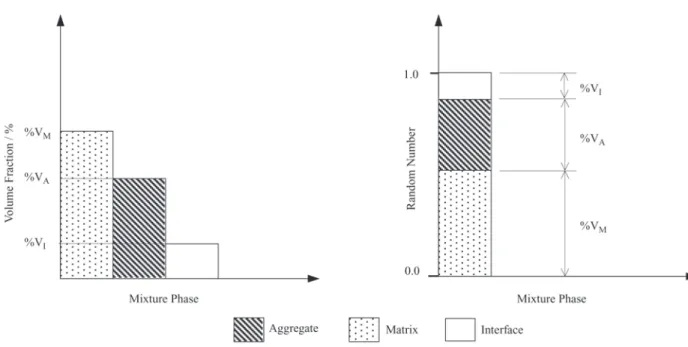
Using all integration points of the finite element mesh to define a statistical space, a random number is generated for each point. With that number and assuming an uniform probability model, one of the three phases of the heteroge-neity mixture is chosen to represent the point, based on the volume fraction of each phase (Fig. 1).
In spite of the heterogeneity model simplicity, the local constitutive law (of an integration point) cannot be consid-ered as a stress-strain relation of one of the concrete
con-stituents. That law should be a combination of the constitu-tive (local) and structural (global) response to allow for size effect to be considered.
Such a combination can be performed by defining an index of heterogeneity (IH) as the ratio between the volume of a basic cell (VCB), representing the material inhomoge-neities, and the finite element volume (VPI), representing the integration point14:
PI CB
V V
IH = (1)
Using the heterogeneity index, the integration point con-stitutive law can be obtained by combining the solid phase (aggregate, mortar or interface) properties of the heteroge-neity model with the properties of the basic cell represent-ing the mixture law. Such a combination allows for higher or lower heterogeneity corresponding to smaller or larger structural size.
For a constitutive property P the combination can be written as14
(
)
LELC
PI IH P IH P
P = ⋅ + 1− ⋅ (2)
where PPI represents the value of the constitutive prop-erty P at integration point PI, PLC represents such property locally measured (local constitutive law) and PLE represents the value of the property in the structural level.
Such a combination contemplates the size effect since a
property P measured in the structural and constitutive level has very different values. The heterogeneity randomness is also represented because the property PLC can be associated to any mixture constituent phase. Fig. 2 illustrates the idea. Constitutive behavior of each phase and its combina-tions, can be described by a simple stress-strain relation (Fig. 3).
Using a bilinear relationship to describe compression and tensile behavior, the mechanical parameters are: elastic
modulus of the ascending branch (E0), elastic modulus of the descending branch (E2), axial compression strength (fc), axial tensile strength (ft) and fracture energy per unit vol-ume (gf).
In order to obtain the equilibrium paths in the nonlinear analysis, the generalized displacement control method12 was
adopted.
3. Simulation Results of the Brazilian
Split-Cylinder Tests
The Brazilian split-cylinder test has been modeled for different structural sizes, corresponding to different hetero-geneity indexes.
To represent the local behavior of each phase (aggre-gate, matrix and interface), bilinear relationships are adopted, with the mechanical properties shown in Table 1. The properties of the matrix correspond to those of the
Figure 2. Proposed model to heterogeneity.
Table 1. Properties used in the model.
Constituent fc ft ν E0 E2 gf (MPa) (MPa) (MPa) (MPa) (MPa) Matrix 48.0 3.4 0.2 3.2e4 -3.2e3 1.81e-3 Aggregate 80.0 16 0.2 1.0e5 -1.0e4 1.28e-2 Interface 13.0 2.0 0.2 1.7e4 -1.7e3 1.18e-3 Mixture 40.0 3.8 0.2 4.4e4 -4.4e3 1.64e-3
mortar of Bazant and Pffeifer2. The aggregate phase is
rep-resented as the basalt of Monteiro13 and the interface phase
is simulated with the test results of Monteiro13. The
con-crete mixture adopted has the proportion of 30% of aggre-gate, 55% of matrix and 15% of interface. The mixture prop-erties are also shown in Table 1. On the basis of the above mentioned test results, the bilinear constitutive law param-eters of Table 1 are obtained14.
Figure 4 shows a mesh of four-node quadrilateral ele-ments used in the analysis of a cylinder of diameter d = 150 mm and thickness of 100 mm, with an initial cen-tral crack. Four integration points in each element and plane stress conditions are considered.
By taking the smallest finite element to represent the maximum degree of heterogeneity or the smallest beam (IH ≈ 1.0 or VCB ≈ VPI), the variation of the basic cell vol-ume (VCB) allows for size effect to be analised for different heterogeneity indexes (IH) or different structural sizes. The simulated equilibrium paths, obtained with the generalized displacement control method12, reference load of -30 kN,
tolerance of 10-4 and different heterogeneity indexes (IH)
are shown in Fig. 5.
Figure 4. Finite element mesh used in the Brazilian split-cylinder tests model.
Figure 5. Equilibrium paths of the Brazilian split-cylinder tests.
Figure 6. Finite element mesh used in the three-point bending tests model.
4. Simulation Results of the Three-Point
Bending Tests
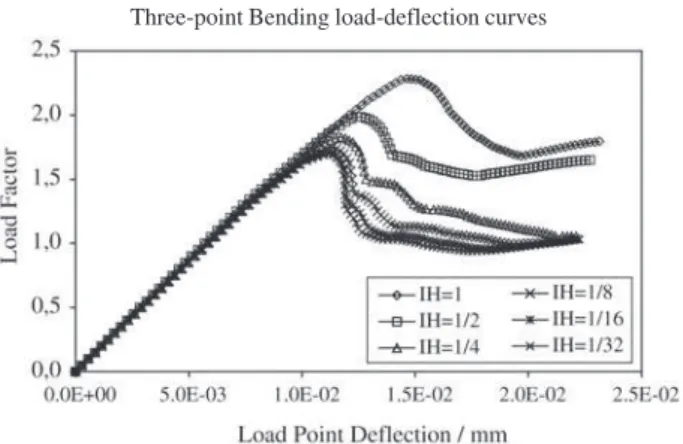
A concrete beam of dimensions 90×36×36 mm with a notch of dimensions 2.5×6.0 mm is taken as reference for the size effect analysis in three-point bending tests. A mesh of four-node quadrilateral elements used in the analysis is shown in Fig. 6. Four integration points in each element and plane stress conditions are adopted.
The mixture proportions as well as the mechanical prop-erties to the bilinear relationships for the constituents and the mixture are the same of the previous example (brazilian split-cylinder test). The equilibrium paths obtained with reference load of –1.0 kN and tolerance of 10-4are shown
in Fig. 7.
Figure 7. Load Factor versus Load Point Deflection curves.
Figure 8. Stress Contour for the Three-Point Bending.
The influence of size in the structure strength is also observed. As shown in Fig. 5 and 7, the load factor decreases as the heterogeneity index (IH) decreases, indicating smaller strength in the case of larger structures.
This numerical evidence shows a good qualitative agree-ment with experiagree-mental results of various researchers2-5. For
a quantitative analysis, more test results for the individual components of concrete are needed.
The proposed model allows for better understanding the influence of heterogeneity on the nonlinear response of crete structures. As it can be seen in Fig. 8, the stress con-tour for the three-point bending model appears to be a more realistic representation than the one that would be obtained with the homogeneous approach.
5. Final Remarks
In this paper, a finite element model including both het-erogeneity and size effects has been presented. The con-crete initial heterogeneity and the nonlinearities in the de-formation process are considered in a smeared manner,
al-lowing for simple simulation of the structural response. Simulations of the material heterogeneity in a compu-tationally efficient and simple manner show a good agree-ment between qualitative experiagree-mental and proposed model results.
This model appears to be a useful tool for the design of reinforced concrete structures when an estimate of the sen-sitivity of the brittleness and strength with respect to size is required.
Further work is necessary to develop a three-dimensional model which takes into account the spatial distribution and interaction of the constituent materials.
References
1. Galileo, G.L. “Discorsi e Dimostrazioni Matematiche Intorno à Due Nuove Scienze”, English version by Weston, T., London, 1730.
2. Bazant, Z.P.; Pfeiffer, P.A. Determination of Fracture Energy from Size Effect and Brittleness Number, ACI Materials Journal, v. 84, p. 463-480, 1987.
3. Gettu, R.; Bazant, Z.P.; Karr, M.E., Fracture Properties and Brittleness of High-Strength Concrete, ACI Materi-als Journal, v. 87, p. 608-618, 1990.
4. Perdikaris, P.C.; Romeo, A. Size Effect on Fracture En-ergy of Concrete and Stability Issues in Three-Point Bending Fracture Toughness Testing, ACI Materials Jour-nal, v. 92, p. 483-496, 1995.
5. Chang, T.P.; Shieh, M.M., Fracture Properties of Light-weight Concrete, Cement and Concrete Research, v. 26, n. 2, p. 181-188, 1996.
6. Bazant, Z.P.; Cedolin, L. Stability of Structures - Elastic, Inelastic, Fracture and Damage Theories, Oxford Uni-versity Press, New York, 1991.
7. Hillerborg, A.; Modéer, M.; Peterson, P. Analysis of Crack Formation and Crack Growth in Concrete by Means of Fracture Mechanics and Finite Elements, Cement and Concrete Research, v. 6, p. 773-782, 1976.
8. Bazant, Z.P.; Lin, F.B., Nonlocal Smeared Cracking Model for Concrete Fracture, Journal of the Engineer-ing Mechanics (ASCE), v. 114, n. 11, p. 2493-2510, 1988. 9. Burt, N.J.; Dougill, J.W., Progressive Failure in a Model Heterogeneous Medium, Journal of the Engineering Mechanics Division (ASCE), v. 103, n. EM3, p. 365-376, 1977.
10. Schlangen, E. Experimental and Numerical Analysis of Fracture Processes in Concrete, Heron, v. 38, n. 2, pp. 1-117, 1993.
11. Vonk, R.A. A Micromechanical Investigation of Sof-tening of Concrete Loaded in Compression, Heron, v. 38, n. 3, pp. 1-94, 1993.
12. Yang, Y.B.; Kuo, S.R. Theory & Analysis of Nonlinear Framed Structures, Prentice Hall, Singapore, 1994. Three-point Bending load-deflection curves
13. Monteiro, P.J.M. Microstructure of Concrete and its In-fluence on the Mechanical Properties, Ph.D. Thesis, De-partment of Civil Engineering, University of Califor-nia, Berkeley, 1985.