*e-mail: [email protected]
Stochastic Effects in Microstructure
M.E. Glicksman, K.G. Wang* and P. Crawford
Materials Science and Engineering Department, Rensselaer Polytechnic Institute, Troy, NY 12180-3590
Received: September 27, 2001; Revised: July 10, 2002
We are currently studying microstructural responses to diffusion-limited coarsening in two-phase materials. A mathematical solution to late-stage multiparticle diffusion in finite systems is formulated with account taken of particle-particle interactions and their microstructural correla-tions, or “locales”. The transition from finite system behavior to that for an infinite microstructure is established analytically. Large-scale simulations of late-stage phase coarsening dynamics show increased fluctuations with increasing volume fraction, Vv, of the mean flux entering or leaving
particles of a given size class. Fluctuations about the mean flux were found to depend on the scaled particle size, R/<R>, where R is the radius of a particle and <R> is the radius of the dispersoid averaged over the population within the microstructure. Specifically, small (shrinking) particles tend to display weak fluctuations about their mean flux, whereas particles of average, or above average size, exhibit strong fluctuations. Remarkably, even in cases of microstructures with a relatively small volume fraction (Vv ≈ 10
-4), the particle size distribution is broader than that for
the well-known Lifshitz-Slyozov limit predicted at zero volume fraction. The simulation results reported here provide some additional surprising insights into the effect of diffusion interactions and stochastic effects during evolution of a microstructure, as it approaches its thermodynamic end-state.
Keywords: microstructural evolution, coarsening processes, simulation, stochastic effect
1. Introduction
Phase coarsening is a spontaneous kinetic process in late-stage microstructural evolution that leads to the decrease in the interfacial energy of two-phase systems. The biphase system consists typically of individual dispersed domains, crystallites, or particles, distributed more-or-less at random through another contiguous matrix phase. During phase coarsening, the transport of atoms via lattice diffusion pro-ceeds through the intervening matrix phase from solute sources at particle-matrix interfaces with high mean curva-ture towards solute sinks at particle-matrix interfaces with low mean curvature. Typically, in such systems, larger par-ticles tend to grow at the expense of small parpar-ticles. Over time, as the smallest particles dissolve, the “competitive” multiparticle diffusion process among particles results in an increase in the average size of their population, and in a concomitant decrease in their number. When matrix diffu-sion is the rate-limiting atomic transport process, the aver-age particle size increases with sub-linear kinetics
(cube-root of time) and the particle number density decreases re-ciprocally with time. These kinetic “signatures”, observed in many aging microstructures, are so robust and funda-mental as to be virtually independent of the physical model. The particle size and microstructure representative of many cast and liquid-phase sintered alloys are known to depend on similar phase coarsening processes. Moreover, the physical and chemical properties of these materials, such as their strength, toughness, ductility, electrical conductiv-ity, and corrosion resistance all depend on the material’s average particle size and particle size distribution (PSD). Understanding and controlling microstructures in two-phase systems are materials science topics with broad technologi-cal implications. Indeed, predicting microstructure evolu-tion in general remains a cornerstone of modern materials science.
Predicting microstructure evolution quantitatively from first principles has an interesting 40-year history. Todes1
capillary-mediated phase coarsening was completed by Lifshitz and Slyozov2, and, then independently, by Wagner3. These
theo-ries collectively are often referred to as “LSW theory”. A major assumption in LSW theory is that particles with equal size experience the same time-rate of change of their vol-ume or mass. LSW theory predicts that (1) the average vol-ume (or cube of the radius) of the particle population in-creases linearly with time-a fact borne out by numerous careful experiments in many different systems; and (2) that the PSD predicted from LSW theory is self-affine, which implies that the particle patterns at later times appear statis-tically similar to those observed at earlier times, apart from a uniform global increase of size scale. However, the rate constant controlling the kinetics of the evolving length scales, and the PSD predicted from LSW theory, both disa-gree with the preponderant body of quantitative experiments on coarsening microstructures4,5.
LSW theory is a “limit law”, insofar as it applies strictly to microstructures with zero volume fraction of dispersoid phase. The predicted PSD and coarsening rate based on LSW theory therefore ignores all interactions occurring among particles. For any volume fraction of the dispersoid phase, other than zero, the particles would have neighbors posi-tioned at finite distances. Interactions among them clearly become possible. Recently, Glicksman, Wang and Marsh6
reviewed the interaction effects among dispersed particles, and described how such interactions influence the PSD and the kinetics of coarsening. Another source of error in the predicted PSD and coarsening rates at finite volume frac-tions is that caused by influences of the unique microstruc-tural environment encountered by each particle – i.e., its “locale”. Locale differences are ignored when adhering to the tenets of mean-field theory, whereas, in fact, it is known that particles of the same size located at different positions in a microstructure may exhibit different growth rates.
The subject of stochastics in late-stage phase coarsen-ing, although still in an early stage of development, has been discussed recently by Glicksman et al.7,8. The interactions
among particles and the fluctuations in their individual growth rates induced by their “locale” are complicated in-fluences, so it is not surprising that it is difficult to treat stochastics either analytically or experimentally. It is for this reason that to gain even limited heuristic insight into the stochastics of microstructures, large-scale simulations must play a central role. The earliest study of multiparticle phenomena in micorstructures was published in 1973 by Weins and Cahn9, who used a few particles to simulate some
basic coarsening interactions during sintering. Their study was followed by Voorhees and Glicksman10 who
systemati-cally studied the behavior of several hundred particles ran-domly placed in a periodic, three-dimensional, unit cell to simulate coarsening. Later, Beenaker11 further improved
multiparticle simulation procedures and was able to increase the total number of particles during simulation. More re-cently, other investigators8,12-15, continued to improve the
accuracy of large-scale simulation of microstructural coars-ening processes. Studying the interactions among many particles and including the statistics of their fluctuations during growth and dissolution, even in the case of very small volume fractions, can contribute important facts required in the understanding of real microstructures. In this paper, we shall focus on early progress being made on these is-sues at our laboratory.
This article is organized as follows: The theories for a finite system with nonzero volume fraction, along with that for an infinite system with zero volume fraction (LSW) are presented in section 2. In section 3, details of the modeling and numerical simulations are given. The results for the observed growth law for particles, their steady-state PSD’s, and the characteristics of the statistical fluctuations in individual particle growth rate are presented in section 4. Finally, a few conclusions are presented in the last sec-tion.
2. Theoretical Analysis
2.1 Theory for finite microstructures with nonzero volume fraction
One can simulate only finite microstructural systems, due obviously to the finite nature of computing power and memory. A theoretical approach to treat a finite system com-prises the first essential step to improve the extent and ac-curacy of numerical simulations. We proceed with an analy-sis of a system conanaly-sisting of a large but finite number of polydisperse spherical precipitate particles suspended throughout the volume of a three-dimensional, isotropic matrix phase. Although we begin this analysis with a set of microstructural definitions more aptly applied to an infinite system, eventually we restrict and apply the mathematical results to finite microstructures. The sizes of the domains comprising the population of dispersed particles are de-scribed with a distribution function, F(R, t), defined here conventionally as the number of particles per unit volume at time t, with radii in the range R to R + dR. The normaliza-tion for F (R, t) is based on the total number of particles per unit volume, N
v, that is,
, N t)dR (R, F
0
V
∫
∞
= (1)
. ) , ( 3 4
0
3F Rt dR
R VV
∫
∞
π
≡ (2)
Equation 2 may be rewritten as
, 3
4π < 3>
= N R
VV V (3)
where <R3> represents the average of the cube of the
parti-cle radii, R.
The biphase microstructure under consideration is aged sufficiently so that the supersaturation of the matrix solu-tion may be assumed to small. Thus, it follows, that nuclea-tion of new particles within the aged microstructure is pre-cluded. This condition constitutes the chief thermodynamic requirement for “late-stage” phase coarsening.
The continuity equation for smoothly growing and dis-solving dispersed particles in size space is
. 0 )] , ( ) ( [ ) , (
= ∂
∂ + ∂ ∂
t R F R v R t
t R F
(4)
Here v(R) is the time-rate of change of the radius, R, of a particle. Equation 4 precludes “non-smooth” changes in the microstructure such as nucleation, particle splitting, and agglomeration, To obtain v(R), some additional simplify-ing assumptions are needed: (1) the kinetics of coarsensimplify-ing is determined by volume diffusion through the matrix; and (2) the diffusion transport to or from each particle occurs slowly enough to be considered quasi-static. These addi-tional assumptions justify approximating the diffusion equa-tion with Laplace’s equaequa-tion to describe the concentraequa-tion fields, C(r), in the matrix. Thus, the diffusion field surround-ing a particle may be described by
, 0 ) C(
2 =
∇ r (5)
where C(r) = (c(r) – c0)/c0 defines a dimensionless diffu-sion potential, c(r) is the concentration at any point defined by the position vector, r, and c0 denotes the equilibrium solu-bility at a flat interface between the matrix and particle phases.
The boundary conditions at the spherical interface of the ith particle are specified through the Gibbs-Thomson (or
Thomson-Freundlich) local equilibrium solubility relation, namely,
, / )
(Ri lc Ri
C = (6)
where lcis a capillary length, usually of near atomic dimen-sions, defined by
. 2
T k l
B a c
Ω γ
≡ (7)
In Eq. 7, γ denotes the specific interfacial free energy between the particle and matrix, Ωa is the particle’s atomic volume, kB is Boltzmann’s constant, and T is the absolute temperature.
The solution to Laplace’s equation for n particles (some acting as sources and some as sinks) distributed as a three-dimensional polydispersion throughout the matrix may be represented as the superposition of n dimensionless con-centration fields summed over the microstructure.
. 1
c C
| |
B l )
C( ∞
=
+ −
=
∑
n
i i
i
r r
r (8)
The vector r appearing in Eq. 8 is the field point, always located in the matrix, whereas ri is a vector that locates the center of the ith particle in the microstructure.
The ith particle’s volume flux equals 4πB
i, and the far-field potential C∞, comprise together, for all n particles, a total of n + 1 unknowns that must be determined in solving Eq. 8 for the microstructure’s diffusion field. The far-field potential C∞ is found by using global mass conservation. The following conservation law may be written for a dis-crete system consisting of n spherical particles each com-peting for, but also conserving, the solute transported via diffusion through the matrix phase:
. 0 1
=
∑
= n
i i
B (9)
Substituting the expression for the diffusion potential, Eq. 8, along with the mass conservation condition, Eq. 9, one obtains after a few steps of algebra
,
1
∑
∑
≠ = ∞=〈 〉− 〈 〉
n
k
j jk
j n
k k c c
r R B R n
l R l
C (10)
systems. Equation 10, in fact, includes enough detailed en-vironmental information to describe the “locale” of every particle, and, most importantly, its subtle influence on the particle’s diffusion-limited growth or shrinkage. The envi-ronmental information built into Eq. 10 is normally excluded from mean-field descriptions of microstructure evolution, but if included, adds important microstructural physics to the diffusion solution.
The assumption of describing C(r) using a quasistatic (conservative) diffusion field requires that the mass trans-fer to or from a particle is equal to its change of mass. Thus, using Eq. 8, the time-rate of change of a particle’s radius, dR/dt, is directly connected to the volume flux, Bi, as
2 0 0 2 )
(
i i a c i i
R B c D l dt dR R
v ≡ =− Ω , (11)
where D0 , appearing on the right-hand side of Eq.(11), is the interdiffusion coefficient for solute in the matrix.
In principle, the volume fluxes, Bi, can be determined by substituting both the Gibbs-Thomson local equilibrium relation, Eq. 6, and the far-field potential, Eq. 10, into Eq. 8. However, one cannot obtain a useful analytical result for a finite system, excepting the limiting case of an infinite sys-tem with zero volume fraction. We can determine numeri-cally the volume fluxes from Eqs. 6, 8, and 10, and then substitute the values of the Bi’ s into the growth rate rela-tionship, Eq. 11. In this manner, one may solve Eq. 11 nu-merically, and find the so-called “kinetic” equation for ticle growth and shrinkage, enabling prediction of the par-ticle size distribution. The details for accomplishing this are provided in the next section.
2.2 Theory for infinite systems with zero volume fraction
If the number of particles comprising a biphase micro-structure rises without limit, so n →∞, but the matrix vol-ume is allowed to increase sufficiently to become diluted to an infinitesimal particle density, so that Vv→0, (i.e., dis-tances, rjk, between particle pairs increase indefinitely) then Eq. 10 reduces to the limiting form
. 〉 〈 =
∞ R l
C c (12)
Eq. 12 was derived originally by Todes1 under his
as-sumption of an “infinite system” with zero volume fraction of particles. For the case of such an infinite, yet infinitely diluted system, one may substitute Eq. 12 and Eq. 6 into Eq. 8 and show that the volume fluxes per steradian, Bi’ s, reduce to the linear form
. 1
〉 〈 − =
R R
B i
i (13)
If it is assumed that <R> = R*, where R* is the “critical radius” defined later in Lifshitz and Slyozov’s paper2, then
Eq. 13 reduces to the usual LSW formulation. Substituting Eq. 13 into Eq. 11, the LSW growth rate for a particle be-comes
) 1 ( 2
) (
2 0 0
〉 〈 − −
= ≡
R R
R V c D l dt dR R
v i
i a c i
i . (14)
Substituting Eq. 14 into Eq. 4, finding the self-similar solution to Eq. 4, and then applying the LSW stability argu-ment based on mass conservation for the particle popula-tion that 1 there exists some maximum particle size and 2 that the time rate of change of the maximum sized particle, relative to the growing average, must vanish, yields the (di-mensional) growth law of any particle of radius R as
. ) ( 9 4 ) 0 ( )
(t 3 R 3 D0lc0 t
R 〉 −〈 〉 = c
〈 (15)
Equation 14, which provides the basis for Equation 15, is a deterministic growth rate law, insofar as the rate of growth or shrinkage of every particle is solely a function of its radius. Indeed, in such an infinitely-diluted microstruc-ture, each particle would exist perhaps somewhat illogically-in total isolation from all its “neighbors.” LSW theory also predicts that the particle size distribution (PSD) is affine, or self-similar. If the particle sizes are expressed as radii nor-malized to the growing average, or critical, radius, then the affine form of the PSD does not change with time. Self-similarity of coarsening quasi-spherical microstructures has been demonstrated experimentally in Pb-Sn alloys by Hardy and Voorhees14.
2.3 Microstructural interactions
In order to extend LSW theory to cases of non-zero vol-ume fraction, a number of markedly different approaches were developed. Marqusee and Ross16 were the first to model
the effects of non-zero volume fraction on phase coarsen-ing kinetics by uscoarsen-ing active-medium theory to describe the quasi-static diffusion fields. The emission of solute from dissolving particles, or absorption of solute from growing ones, are modeled by using point sources or sinks of solute distributed within the matrix. Furthermore, those investiga-tors limited the spatial extent of diffusional interactions by allowing “diffusional screening” to occur active-medium approach led to the use of Poisson’s equation to replace the Laplace approximation for quasi-static diffusion,
, 4 ) C(
2 =− πσ
∇ r (16)
)). C( R (l
NV c−〈 〉 r
=
σ (17)
Re-organizing these Eqs. 16 and 17 yields the diffusion analog of the Debye-Hückel equation, namely13
, 0 ) C ) (C( )
C( 2
2 −κ − =
∇ r r ∞ (18)
Here κ ≡ (4πNv<R>)1/2 is introduced as the diffusion
analog of the reciprocal of the Debye screening length, and C∞ = lc/R*≈ lc/<R> is the far-field diffusion potential. Eq.(18) is well known from theories of ionic solutions and plasmas. In three dimensions, the general solution to the Debye-Hückel equation for diffusion around a spherical source or sink, subject to the Gibbs-Thomson boundary condition, may be expressed in the form of the well-known Yukawa potential. The spherically symmetric diffusion so-lution being sought may be written in terms of the volume fluxes as
, C |) | exp( | |
B l )
C( i
1
c ∞
=
+ − κ − −
=
∑
ii n
i
r r r
r
r (19)
where now the Bi’ sare defined as
). 1 )( 1
( * i
i
i R
R R
B = − +κ (20)
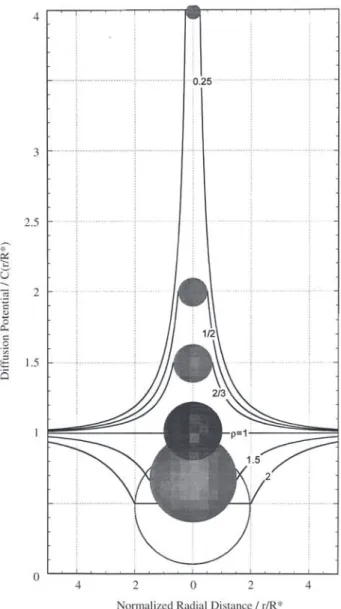
The diffusion fields obeying Eqs. 19 and 20 surround-ing spherical particles embedded in an “active” matrix phase are shown plotted in Fig. 1. For illustrative purposes, the critical particle size, R*, used in Fig. 1 to normalize all length scales, was chosen to be lc , so that the mean concentration, or diffusion potential, C∞ = 1. (In reality, dispersoids in aged microstructures usually have critical radii between circa 103
lc to 105 l
c , so that our choice of R*/lc merely introduces a convenient scale factor of unity into the diffusion poten-tial). In addition, the dispersoid volume fraction is arbitrar-ily set to be 0.05, which is sufficiently small so that R*≈<R>, but large enough to have interactions occurring among the particles. Note that the fields plotted in Fig. 1 show that the gradients are negative around all particles smaller than the average, i.e., those for which ρ ≤ 1, and that these gradients increase sharply in magnitude as the particles become smaller and more curved. Also, the gradi-ents adjacent to larger particles-those for which ρ ≥ 1 -re-main relatively small when compared to the gradients around smaller particles. The gradients surrounding “critical” par-ticles are, by definition, zero, because at the instant depicted in Fig. 1, “critical” particles-those for which ρ= l -are con-ditionally stable, and would neither be growing nor shrink-ing. The scheme of relative diffusion potentials and their gradients depicted in Fig. 1 makes clear the “competitive”
nature of multiparticle diffusion. Specifically, at every in-stant, small particles (relative to the average-size particle) are forced to shrink rapidly; larger than average-size parti-cles grow at the expense of dissolving smaller partiparti-cles, and
Figure 1. Diffusion fields, C(ζ; ρ; VV), based on Debye-Hückel theory during phase coarsening in a microstructure with a dispersoid volume fraction of VV=0.05. The dimensionless potential plotted here represents the expression for the normalized field, C(ζ; ρ; VV) = (1- ρ) exp(ρ√3 VV })exp(-ζ√3 VV)/ ζ +1, where
ζ = r/R* is the running (distance) variable. Each field is labeled by
the value of the scaled particle radius, ρ≡ R/R*, with which it is
average-size (critical) particles themselves are condition-ally stable and neither grow nor shrink. What makes the overall kinetics of competitive multiparticle aging so inter-esting is that the average-size particle in the population it-self increases with time, in accord with Eq. 15. Thus, the polydisperse population of particles is constantly in “com-petition” with average-size particles that inexorably grow as the cube-root of time. The net result of this coupled com-petitive diffusion process is a microstructural population that maintains an affine distribution for all time. That is, the PSD remains identical except for a scale factor that increases as the cube-root of time.
Glicksman, Wang and Marsh6 recently proved that the
diffusional Debye screening length LD (κ-1), which
effec-tively limits the distance over which the diffusion potential of one particle affects another, is related to the ratio of mo-ments of the PSD and to the reciprocal square-root of the volume fraction of the system,
. 3
3
V D
V R R L
〉 〈
〉 〈
= (21)
Equation 21, in fact, can be employed to gauge the in-teraction length scale in a three-dimensional microstruc-ture undergoing diffusion-limited coarsening, and compare the results with computer simulation or experiment. Moreo-ver, as indicated in Eq. 21, the volume fraction of the micro-structure, Vv , is the main factor that acts to reduce the Debye screening length. The population of dissolving and grow-ing particles collectively act to “cuts off” the diffusion field emanating from each particle beyond the Debye screening distance, LD. This interesting screening effect is shown in Fig. 2, where the diffusion potentials for a small particle (ρ≤ 1), a critical particle (ρ= l) , and a large particle (ρ ≥ 1) are plotted for several values of the volume fraction. A vol-ume fraction of zero denotes the behavior expected in the LSW model, where the screening distance becomes infi-nite, and the Yukawa potential reduces to the Laplace po-tential. At non-zero volume fractions, the gradients steepen, especially around larger particles, and the diffusion fields drop off to the mean potential (C∞= 1) much faster than for the limiting case where Vv= 0. Thus, Debye screening tends to speed up diffusive transport in a microstructure, and in-creases the kinetics of phase coarsening.
3. Modeling and Simulation of
Microstructures
3.1 Modeling
The microstructure is modeled by placing n particles of the dispersoid phase in a cubic box. The contiguous spaces between the particles represents the matrix phase in which
the dispersoid population is embedded. Particles are located by specifying the positions of their centers with three ran-dom coordinates representing the Cartesian vector, ri, and by their radii, Ri, chosen initially from a relatively narrow Gaussian distribution. These radii are non-dimensionalized by the capillary length, lc, a material property based on ther-modynamic data, and the microstructure evolution time is non-dimensionalized by a characteristic diffusion time, an-other property based on the materials transport coefficients, defined as τd≡ - lc2/(Ω
aD0c0). The dimensionless form of the
growth rate, Eq. 11, can be written as 2 i i i R B dt
dR
=
−
(22)
where Ri is known at the time t. Assuming that all the Bi’s are known, numerical integration of the growth rate, Eq. 22, can be used in a forward marching scheme to evolve the radii. The Runge-Kutta technique, was used to evaluate Ri (t + ∆t). Here, ∆t represents each subsequent time step in the marching integral. One, of course, must re-determine the volume fluxes, Biat each subsequent time step.
Introducing Eq. 8 into Eq. 6, along with the non-dimensionalized system of linear equations, one may cast these equations into matrix form as follows:
,
U B
A• = (23)
where A is the (n + 1) by (n + 1) matrix
= 0 1 . . . 1 1 1 1 / 1 . . . / 1 / 1 / 1 . . . . . . . . . . . . . . . . . . . . . . . . 1 / 1 . . . / 1 / 1 / 1 1 / 1 . . . / 1 / 1 / 1 1 / 1 . . . / 1 / 1 / 1 3 2 1 3 3 32 31 2 23 2 21 1 13 12 1 n n n n n n n R r r r r R r r r r R r r r r R A , (24)
and where rijrepresents the separation between a pair of particles i and j. B and U are (n + 1) by 1 column matrices, namely, = ∞ C B B B B n . . . 3 2 1 B , (25) and = 0 / 1 . . . / 1 / 1 / 1 3 2 1 n R R R R U . (26)
Equation 23 represents (n + 1) linear equations.
Substi-tuting Eq. 10 into Eq. 23 and eliminating the (n + l)th row
and column in matrix A, allows reduction of Eq. 23 to n linear equations, which may be written as the matrix equa-tion , ' ' ' U B
A • = (27)
where A’ is the n by n matrix
〉 〈 − 〉 〈 − 〉 〈 − 〉 〈 − 〉 〈 − 〉 〈 − 〉 〈 − 〉 〈 − 〉 〈 − =
∑
∑
∑
∑
∑
∑
∑
∑
∑
≠ ≠ ≠ ≠ ≠ ≠ ≠ ≠ ≠ . 1 1 . . . 1 1 1 1 . . . . . . . . . . . . . . . . . . 1 1 . . . 1 1 1 1 1 1 . . . 1 1 1 1 ' 1 2 2 1 1 1 2 2 2 2 1 1 21 1 2 2 12 1 1 1 n n j jn j n n j j j n n j j j n n n j jn j n n j j j n j j j n n j jn j n n j j j n j j j r R R n R r R R n r r R R n r r R R n r r R R n R r R R n r r R R n r r R R n r r R R n R A (28) = n B B B . . . 2 1 B' , (29) and 〉 〈 − 〉 〈 − 〉 〈 − = R R R R R R n 1 1 . . . 1 1 1 1 ' 2 1 U . (30)The Gauss-Seidel method was employed to solve this system of linear equations, Eq. 27, yielding at each time step values for the Bi’s. Substitution of the up-dated Bi’s back into Eq. 22 dynamically advances the microstructure by up-dating the radii of all the particles and their coordi-nates at any time step.
3.2 Simulation of microstructures
faster the statistics for the data settle to steady trends. How-ever, numerical difficulties are eventually encountered as the number of particles, n, and thus the number of linear equations, n2, increase. The larger the number of particles, the greater is the required computer memory, and the longer is the CPU time required to evolve the system. Ultimately, the increasing CPU time limits the practicality of these simulations for large microstructural assemblages.
4. Results
Simulation of microstructural coarsening was carried out for volume fractions covering the range 10-4 < V
v < 10
-1.
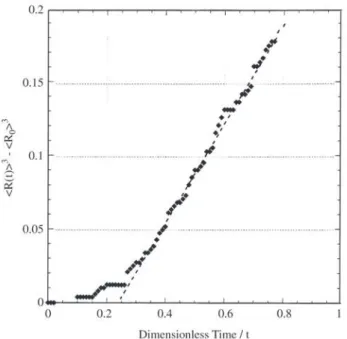
Figure 3 shows that for values of the time, t, larger than about 0.3, the cube of the average radius of the particles increases linearly with time. The “cube-root of time” kinet-ics, is a well-known prediction from LSW theory for diffu-sion-limited coarsening, and is confirmed by numerous ex-periments. Figure 4 displays the PSD developed in the simu-lated microstructure. The radii plotted here are scaled by the average radius of the particle population for a volume particles obeying some initially chosen size distribution.
These initial particles are placed randomly within a cubic box to comprise the initial microstructure. The box size may be determined from the specified volume fraction, Vv, the initial number of particles, n(0), and their starting distribu-tion.
The choice of time-step in performing the integration of Eq. 22, is crucial. Large time-steps that allow the system to evolve quickly do not permit sufficiently accurate solutions to the microstructure evolution equation, Eq. 22. Too large a time step may result in an unsatisfactory PSD. At each time step, the computational program checks the radius of every particle. If any became smaller than 0.1l<R>, they are removed from the simulation box and considered “dis-solved”. Equivalently, the column and row corresponding to a dissolved particle is struck from the matrix, Eq. 28. The initial number of particles forming the microstructure in-fluences the total run time. Specifically, data are collected from each simulation throughout the time period for which mass is conserved and the volume fraction remains con-stant to within a prescribed tolerance. It is observed, not surprisingly, that the greater the number of particles form-ing the initial microstructure, the better is the accuracy of the simulation, the longer the run may be evolved, and the
Figure 4. Particle size distribution (PSD). Plot of the probability density, G(ρ), of finding particles of radius ñ in a small range of sizes, dρ, versus normalized particle radius. Data are for a small but non-zero volume fraction (VV =10-4). At finite, non-zero values
of VV, the PSD broadens toward larger radii, drops in height, and becomes slightly more symmetrical than predicted from LSW theory. Multiparticle interactions are responsible for these changes.
Figure 3. Average of the radius of the particle population cubed, versus time. The predicted linearity of <R>3 against time develops
fraction of Vv= 10-4. The PSD predicted from LSW theory
(Vv= 0) is shown in Fig. 4 for comparison. Neither prior theoretical, experimental, nor simulation results are avail-able for Vv= 10-4. Figure 4 clearly indicates that
microstruc-tures with even a small volume fraction of particles exhibit detectable broadening of the PSD and a marked decrease its peak height, as compared with that predicted from LSW theory.
Figure 5 displays the form of the computed volume fluxes, B(ρ)for zero volume fraction and for Vv= 10-4. LSW
theory predicts that the volume flux has a linear variation with the scaled particle radius, that is, B(ρ) = 1 - ρ. How-ever, as is also indicated in Fig. 5, the simulation for Vv= 10-4
shows clearly that particles of identical size actually exhibit a small range of flux values scattered around the LSW pre-diction. The growth rate experienced by a particle of radius
ρ, even at a relatively small volume fraction, is not a purely deterministic quantity as predicted by mean-field theory.
Figures 6 through 8, show the volume fluxes B(ρ) simu-lated for Vv= 10-3, V
v= 10
-2, and 10-1, respectively. These
figures demonstrate that the B(ρ)’s steadily deviate from the linear LSW prediction. It is also evident from these
Figure 6. Volume flux per steradian, B(ρ), versus scaled particle radius, ρ. Data are simulated from the multiparticle diffusion model for a microstructure with a dispersoid volume fraction VV =10-3.
Note the broadened noise band as compared to that in Fig. 5.
Figure 5. Volume flux per steradian, B(ρ), versus scaled particle radius, ρ. Data are simulated from the multiparticle diffusion model for a microstructure with a dispersoid volume fraction VV =10-4.
The associated microstructural noise distribution for these fluxes is shown by the scatter of the simulation data relative to the noise-free linear flux function (dashed line) predicted from LSW theory. Even at this small (but non-zero) volume fraction, discernible fluc-tuations, or “locale noise”, are evident.
Figure 7. Volume flux per steradian, B(ρ), versus scaled particle radius, ρ. Data are simulated from the multiparticle diffusion model for a microstructure with a dispersoid volume fraction VV =10-2.
simulations that the fluctuation, or “noise” band for the volume fluxes increases with increasing volume fraction.
5. Conclusions
Microstructure evolution in a two-phase system was simulated by solving a large linear matrix equation that de-scribes multiparticle diffusion. Particles interacted in the simulated microstructure under conditions close to steady-state, or affine, coarsening. The far-field diffusion potential used in these simulations is derived here for a finite system [c.f. Eq. 10] in this paper. The effects of system size and microstructure locale information for each particle were included in the far-field diffusion potential. As the volume fraction becomes small, our results approach those of Todes1
and LSW2,3, exclusive of the weak interactions that persist
among particles.
Simulations of diffusion-limited coarsening carried out on sparse to moderately dense microstructures (10-4 ≤ V
v≤10
-1) display classical coarsening kinetics that
Figure 8. Volume flux per steradian, B(ρ), versus scaled particle radius, ρ. Data are simulated from the multiparticle diffusion model for a microstructure with a dispersoid volume fraction VV = 10-1.
Locale noise, except perhaps for the smallest particles exhibits strong stochastic behavior. That is, particles, particularly those close to the average size within the simulated microstructure, act unpre-dictably by occasionally growing or dissolving rapidly. Were the average size particles to act deterministically, they would hardly grow or shrink at all. The fluctuations at this volume fraction also exhibit non-linear departures from the LSW prediction (dashed line).
is the cube of the average radius increases linearly with time. However, the PSD computed for a biphase micro-structure as sparse as Vv= 10-4 remains somewhat broader
and more symmetric than that predicted by LSW. This is the first PSD derived using simulation at such a small vol-ume fraction.
Mean-field theory treats the growth rates of particles as a deterministic kinetic process that depends only on the size of a particle relative to the average size of the entire micro-structural population. In addition, mean-field theories ig-nore environmental information for individual particles. From the simulations reported here, however, we find that the fluctuation band for a particle’s volume flux widens with the increase of volume fraction. Larger particles experience stronger fluctuations, or locale noise, in their growth rates than do smaller particles. The non-linear character of the particle volume flux versus particle size increases steadily with increasing volume fraction. Finally, this work suggests that stochastic effects must always be present in real biphase microstructures and may play an important role in micro-structure evolution. Once the statistical nature of microstruc-tural fluctuations are understood, then theories of micro-structure evolution can be modified to include their effect. The authors hope that this work will stimulate quantitative experiments that focus on systems at small volume frac-tion, to help achieve firmer understanding of multiparticle interactions within evolving biphase microstructures.
Acknowledgements
The authors are pleased to acknowledge partial finan-cial support received from the National Aeronautics and Space Administration, Marshall Space Flight Center, Huntsville, AL, under Grant NAG-8-1468.
References
1. Todes, O.M. J. Phys. Chem. (Sov.), v. 20, p. 629, 1946. 2. Lifshitz, I.M.; Slyozov, V.V. “The Kinetics of
Precipita-tion from Supersaturated Solid SoluPrecipita-tion,” J. Phys. Chem. Solids, v. 19, p. 35-50, 1961.
3. Wagner, C. “Theorie der Alterrung von Niederschlagen durch Umlosen,” Z. Elektrochem., v. 65, p. 581-591, 1961. 4. Alkemper, J.; Snyder, V.A.; Akaiwa, N.; Voorhees, P.W. “Dynamics of Late-Stage Phase Separation: A Test of Theory,” Phys. Rev. Lett., v. 82, p. 2725-2728, 1999. 5 Voorhees, P.W. “Ostwald Ripening of Two-Phase
Mix-tures,” Ann. Rev. Mater. Sci., v. 22, p. 197-215, 1992. 6. Glicksman, M.E.; Wang, K.G.; Marsh, S.P. “Diffusional
Interactions among Crystallites,” J. Crystal Growth, v. 230, p. 318-327, 2001.
W.H. Hofmeister, J.R. Rogers, N.B. Singh, S.P. Marsh, P.W. Voorhees, The Minerals, Metals & Materials Soci-ety, p.229-238, 1999.
8. Glicksman, M.E.; Wang, K.G.; Crawford, P. “Simulations of Microstructural Evolution,”Computational Modeling of Materials, Minerals and Metals Processing, ed. Mark Cross, The Minerals, Metals & Materials Society, p. 703-713, 2001.
9. Weins, J.; Cahn, J.W. “The Effect of Size and Distribu-tion of Second Phase Particles and Voids on Sintering,”Sintering and Related Phenomena, ed. G.C. Kuczynski, Plenum, New York, p. 151-163, 1973. 10. Voorhees, P.W.; Glicksman, M.E. “Solution to The
Multi-Particle Diffusion Problem with Applications to Ostwald Ripening-II. Computer Simulations,” Acta Metall., v. 32, p. 2013-2030, 1984.
11. Beenakker, C.W.J. “Numerical Simulation of
Diffusion-Controlled Droplet Growth: Dynamical Correlation Ef-fects,” Phys. Rev. A, v. 33, p. 4482-44835, 1986. 12. Akaiwa, N.; Voorhees, P.W. “Late-Stage Phase
Separa-tion: Dynamics, Spatial Correlations, and Structure Functions,” Phys. Rev. E, v. 49, p. 3860-3880, 1994. 13. Fradkov, V.E.; Glicksman, M.E.; Marsh, S.P.
“Coarsen-ing Kinetics in Finite Clusters,” Phys. Rev. E, v. 53, p. 3925-3932, 1996.
14. Hardy, S.C.; Voorhees, P.W. “Ostwald Ripening in a System with a High Volume Fraction of Coarsening Phase.” Metall. Trans. A, v. 19, p. 2713, 1988.
15. Mandyam, H. et al. “Statistical Simulations of Diffusional Coarsening in Finite Clusters,” Phys. Rev. E, v. 58, p. 2119-2130, 1998.