Removal of Cd
+2From Aqueous Solutions Onto Polypyrrole Coated
Reticulated Vitreous Carbon Eletrodes
Jucelânia Tramontinaa, Giovanna Machadob, Denise S. Azambuja*a,
Clarisse M.S. Piatnickia, Dimitrios Samiosa
aUniversidade Federal do Rio Grande do Sul, Instituto de Química,
Porto Alegre - RS, Brazil
bPontifícia Universidade Católica do Rio Grande do Sul,
Porto Alegre - RS, Brazil
Received: November 29, 2000; Revised: June 5, 2001
The development of simple methods for removal of heavy metals from aqueous samples is a relevant field of research. In this connection, the electrodeposition of the Cd+2ion, one of the most toxic species for animals and human beings, was investigated in aerated pH 4.8 sulfuric-sulfate solutions. In potentiostatic conditions, the maximum rate of cadmium deposition at a neutral polypyrrole (PPy0) coated reticulated vitreous carbon (RVC) working electrode occurs at -3.0 Vvs. the saturated calomel reference electrode (SCE). Moreover, the conversion rate depends both on the applied potential and on the mass transport regime, and, for solutions containing 10 mg L-1of Cd2+, the highest removal efficiency achieved is 84% after 90 min of electrolysis. The concentration decay of the Cd+2ion in the solution was monitored by anodic stripping voltammetry (ASV) at a hanging mercury drop electrode. Besides, metallic cadmium deposited onto the polypyrrole modified RVC electrode was evidenced by Scanning Electron Microscopy (SEM) analysis using the backscattered electron image (BEI) technique and by Energy Dispersive Spectrometry (EDS).
Keywords:cadmium, RVC, polypyrrole, microscopy
1. Introduction
Environmental contamination by heavy metals is a widespread problem, with sources of pollution arising from industrial activities. These metals are of significant impor-tance as they are non-biodegradable and once released into the environment, they can only be diluted or transformed, not destroyed. It must be emphasized that the Cd+2ion is one of the most toxic species for animals and human beings. The legal limitations concerning Cd+2 ion discharge in effluents are very stringent due to the highly toxic nature of cadmium salts. The maximum cadmium concentration ad-mitted in effluents is 0.5 mg L-1in Germany, 0.3 mg L-1in the United States and 0.1 mg L-1in Switzerland. These are only slightly higher than those for mercury1.
The development of simple methods for removing heavy metals from aqueous samples is a relevant field of research. Boyanov et al.2 reported a concentration drop from 100 mg L-1to 5 mg L-1in the removal of cadmium from dilute solutions after 7 h electrolysis. Kreysa and
Reynvaan3found that the Cd+2ion concentration falls from 22 to 0.61 mg L-1by using an electrochemical reactor with a specific flow rate.
The interest in continuous electrolysis to remove metals from aqueous media by using porous electrodes combined with flowing solutions has been growing recently4,5, vari-ous geometric shapes and materials being employed to obtain high conversion rates.
Reticulated vitreous carbon is a form of glass-like carb-on combining some properties of both glass and normal industrial carbon6,7. It is a very inexpensive open pore material with a foam structure and it is available in several porosity grades, from 10 to 100 pores per inch (ppi). It can be easily machined into various geometric shapes, has a high surface area, up to 66 cm2 cm-3 for the 100 ppi standard5, and appears to be well suited as an electrode material for flow-through cells8. Recently, Dutra et al.9
developed a laboratory scale electrolytic flow-by cell using a RVC cathode which permitted the purification of aqueous solutions containing cadmium. Operating in a mass
trans-*e-mail: [email protected]
port regime, the authors reported the decrease in cadmium concentration of 2 liters volume solutions from 200 to 0.1 mg L-1with current efficiencies up to 40% in 85 min.
In this connection, polypyrrole modified electrodes, obtained by electrochemical oxidation of pyrrole onto an electrode substrate10,11, have been employed in the removal of metallic ions12-14 from aqueous solutions. Besides its chemical an thermal stability, the optical and electrochemi-cal properties of polypyrrole may be easily changed by choosing the appropriated experimental synthesis condi-tions15. Due to this versatility, much interest has been directed in developing practical applications of polypyr-role16-21. For example, in the reduction process at the RVC-PPy0electrode and at the uncoated RVC one, in the same experimental conditions, the removal of copper attains the percent efficiencies of 99.8% and 79%, respectivelly. Be-sides, polypyrrole modified electrodes have shown some improved characteristics as compared to the uncoated ones in electrochemical applications such as in all-solid state potentiometric sensors22, in anion selective electrodes23, and in stripping techniques24-25.
The aim of this study is to investigate the removal of Cd2+ion in the 10 mg L-1concentration range, from aerated aqueous solutions, through reduction at a reticulated vitre-ous carbon electrode modified with polypyrrole. The ex-perimental conditions simulate the composition of an effluent from which the Cd2+ and other ionic species have already been removed by a bulk procedure however still containing an environmentally unacceptable residual con-centration of the metallic ion. Moreover, as the electrical conductivity of polypyrrole is maintained even after it is submitted to a long reduction time26, the electroreduction of Cd2+is carried out onto the previously reduced film.
2. Materials and Methods
The electrochemical cell used in this study was a con-ventional three-electrode assembly. The working electrode was a 40 ppi RVC prism of approximately 1.0 cm x 1.0 cm x 1.5 cm fixed to a graphite rod with a conducting graphite paint from Ladd Research Industries Inc., Burlington, Ver-mont. The reference electrode was a SCE, to which all potentials are referred, and the auxiliary one was a Pt gauze. The PPy films were electrodeposited on the working elec-trode surface from an aqueous air free 0.1 mol L-1Pyrrole and 0.1 mol L-1 KCl solution and allowed to grow for 30 min at 0.90 V using a potentiostat model DEA 332 from Radiometer. The deposited PPy film was then reduced to PPy0for 30 min at -0.90 V in a deaerated KCl 0.1 mol L-1 solution and washed with distilled and deionised water before use.
A 1000 mg L-1cadmium sulfate stock solution was prepared in 5.10-3 mol L-1 H2SO4 from the Merck p.a. reagent previously dried at 110±1 °C for 6 h. The measured
pH of the Cd+2ion solution prepared from the stock solution in K2SO40.1 mol L-1was 4.8. The reduction of the Cd+2 ion was then carried out onto the RVC-PPy0electrode at the applied potentials -2.50; -3.00 and -3.50 V, in a stirred bath, for 90 min, in the presence of dissolved O2.
Before and after the Cd+2ion electroreduction proce-dure, the RVC-PPy0 electrode was analyzed by Scanning Electron Microscopy (SEM) using the backscattered elec-tron image (BEI) technique and by Energy Dispersive Spectrometry (EDS). The SEM instrument was a PHILIPS XL30 coupled to an Energy Dispersive Spectrometer (EDS) from Edax. In this technique, a semiconductor de-tector classifies X-radiation according to its energy rather than its wavelength. All spectra were collected within 100 s using the selected area mode and a 10 mm work distance. The rate of the Cd+2ion concentration decay in the sample solution was followed by ASV at a hanging mercury drop electrode27. After reduction of the Cd+2ion at the RVC-PPy0electrode, 200µL of the sample solution were trans-ferred to a cell containing 10 mL of KCl 0.1 mol L-1, the pH of which was previously adjusted to 4.8 with sulfuric acid. The solution was then deaerated with high purity grade N2for 10 and 4 min, respectively, before and after addition of the sample.
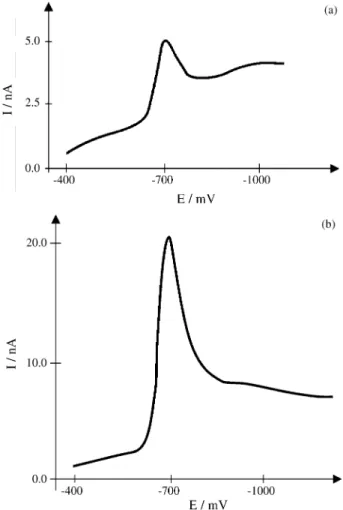
The preconcentration of cadmium in the hanging mer-cury drop electrode was undertaken at -1.00 V for 30 s, and the electrochemical measurements were carried out with a model 303A polarograph from EGG. Cadmium was then stripped from the Hg electrode by scanning its potential from -1.00 V to -0.30 V and the peak current, previously calibrated, was employed to determinate the Cd+2ion con-centration in the sample solution (see Fig. 1).
All solutions were prepared from analytical grade re-agents with bidistilled and deionized water.
3. Results and Discussion
Preliminary experiments on the Cd+2ion electroreduc-tion behavior in the pH 4.8 sulfuric-sulfate medium and in the presence of dissolved O2 were carried out by linear potential scan voltammetry. Figure 2 shows the polariza-tion curves obtained with a glassy carbon rotating disc electrode for a 10 mg L-1Cd+2ion concentration, run from Esa = 0.00 V to Esc = -1.80 V at 0.02 V s-1and at several angular velocities. It can be seen that the Cd deposition begins at -0.90 V, which is in accordance with thermody-namic data28for the experimental pH 4.8 employed in this work. The limiting current densities show a linear variation withω1/2, as it can be observed in the insert of Fig. 2. This behavior agrees with the Levich equation29, according to:
1/j = 1/jk+ 1.61ν1/6/nFD2/3Co*ω-1/2 (1)
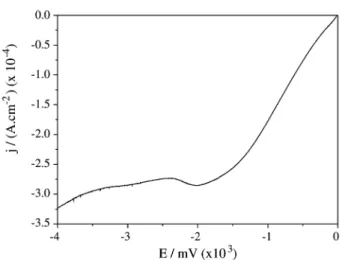
viscosity, Co*is the bulk concentration of the electroactive species, D its diffusion coefficient and n the number of electrons. It is observed that, at -1.00 V, the curve jlim-1vs. ω-1/2is a straight line, the extrapolation of which gives a positive intercept, thus meaning that the electroreduction of the cadmium ion is a mixed mass transport-kinetics controlled reaction. Similar measurements were performed with a glassy carbon rotating disc electrode coated with a neutral polypyrrole film. In this case, the limiting current plateau is extended up to around -3.00 V as shown in Fig. 3. In a previous work, Agarvalet al.5 used a reticulated vitreous carbon (RVC) electrode to remove cadmium from dilute aqueous solution in a pH range from 1.92 to 3.5. The reported results show that the metal deposition efficiency depends on the RVC porosity, on the flow rate and on the Cd2+ and supporting electrolyte concentrations. A maxi-mum efficiency of 92.2% was achieved at -2.75 V with a 25 mg L-1Cd2+ion solution containing 0.1 mol L-1 support-ing electrolyte at pH 2.6 with a 10 ppi RVC, after 9 passes. In the absence of supporting electrolyte, the applied voltage increases and the removal efficiency drops deeply (46%).
Similarly, in the same potential range, the removal efficiency by electrodeposition from a pH 4.8 sulfuric-sul-fate solution containing 10 mg L-1of Cd+2ion was deter-mined in this study with no addition of supporting electrolyte, either at RVC and at RVC-PPy0coated elec-trodes. The role of the electrode material on the removal efficiency is shown in Table 1. It is observed that for applied potentials more negative than -2.50 V, after 90 min of electrolysis, there is practically no Cd+2reduction at the Figure 1.Anodic stripping voltammograms of a deaerated 200µL sample
of Cd2+10 mg L-1solution in 10 mL of KCl 0.1 mol L-1at pH 4.8 (a) after 90 min electrolysis and b) before electrolysis onto a RVC-PPy0electrode.
Figure 2.Linear voltammetric curves for Cd2+reduction at a glassy carbon rotating disc electrode. Aerated 10 mg L-1Cd2+ion in pH 4.8 sulfuric-sulfate solution. Potential scans from Esa = 0.00 V to Esc = -1.80 V at 0.02 V s-1and rotation speed of (a) 100; (b) 1000; (c) 1500 and (d) 2500 rpm. Inset: jlim-1vs.
uncoated RVC electrode, probably due to a high rate of the hydrogen evolution reaction.
In order to investigate the role of the polymer coating on the efficiency of the electrodeposition process similar experiments were carried onto the RVC-PPy0electrode. As shown in Table 1 the removal efficiency is deeply depend-ent on the electrodeposition potdepend-ential, attaining its highest value, 84%, at -3.00 V and decreasing at more negative potentials which is again probably related to a higher H2 evolution rate at more cathodic potentials31. The influence of the hydrogen reaction on the rate of Cd deposition has been also reported by Dutraet al9.
Data relating the dependence of the reduction efficiency on the electrolysis time, evaluated at several applied poten-tials, are given in Table 2. It is evidenced that the Cd2+ion concentration decay cannot be described as obeying a first order kinetics law. At all investigated potentials, a mini-mum time, around 60 min, is required so that the reduction reaction may occur.
The improvement in the metal removal efficiency at -3.0 V for the PPy0coated electrode is probably related to an increase in the overall overpotential required for the hydrogen reduction to occur on the cadmium deposit reco-vering the polymer surface. Therefore, the same reaction on the cadmium deposit recovering the uncoated RVC electrode demands a lower overpotential32. The distribution of overpotentials so that a charge transfer reaction occurs at the polarized RVC electrode after it is recovered with cadmium may be described as:
E =ηRVC/Cd+ηCd/sol. (2)
While for the RVC-PPy0it will be:
E =ηRVC/PPy0+ηPPy0/Cd+ηCd/sol. (3)
Therefore, for a given cathodic potential, the charge needed for the hydrogen reduction to occur at the RVC-Cd electrode will be available for the Cd2+ion removal at the RVC-polypyrrole-Cd electrode, for then hydrogen reduc-tion will occur only at more negative potentials.
As it may be seen in Figs. 4 and 5, the SEM and EDS analysis allows the characterization of the morphology and of the chemical composition of the RVC electrodes, respec-tively. Figure 4 (a) shows the electrode after electroreduc-tion of the polypyrrole film at -0.90 V. The presence of metallic cadmium was observed in the electrodes after reduction of Cd2+ion onto the RVC-PPy0electrode both at -3.00 V as shown in Fig. 4 (b) and at -3.50 VSCE. In Fig. 5, Energy Dispersive Spectrometric analysis of the RVC-PPy0electrode shows the presence of deposited Cd. Figure 3.Linear voltammetric curves for Cd2+reduction at a glassy
carbon rotating disc electrode coated with PPy0. Aerated 10 mg L-1Cd2+ ion in pH 4.8 sulfuric-sulfate solution. Potential scans from Esa = 0.00 V to Esc = -4.00 V at 0.02 V s-1, at static conditions.
Table 1.Effect of the electrode material on the Cd2+ion removal efficiency at several applied potentials, after 90 min electrolysis. Aerated 10 mg L-1Cd2+ion in pH 4.8 sulfuric-sulfate solution. Working RVC and RVC/PPy0electrodes.
Applied potential (V)
Removal efficiency (%) RVC/PPy0
Removal efficiency (%) RVC
-2.50 21 10
-3.00 84 Nd
-3.50 65 Nd
Table 2.Effect of applied potential and electrolysis time on the Cd2+ion removal efficiency. Aerated 10 mg L-1Cd2+ion in pH 4.8 sulfuric-sulfate solution. Working RVC/PPy0electrode.
Applied potential (V)
Removal efficiency (%) 30 (min) 60 (min) 90 (min)
-2.50 nd 15 21
-3.00 <10 30 84
-3.50 <10 20 65
4. Conclusions
It has been shown that Cd2+ion, in a concentration level as low as 10 mg L-1, can be electrodeposited onto an RVC-PPy0electrode from a low concentration electrolyte H2SO4-K2SO4aerated solution of pH 4.8. In these experi-mental conditions, the highest efficiency value (84%) for cadmium removal is achieved when electrolysis is carried out for 90 min at -3.00 V. Moreover, it has been observed that the removal efficiency is deeply dependent on the electrodeposition potential value and that the reaction (which involves simultaneous H2 evolution) is a mixed mass transport-kinetically controlled one. The lower per-cent removal of Cd2+ion at -3.50 V is probably related to higher H2evolution rates at more cathodic potentials.
The proposed procedure presents practical interest in the development of flow systems for low concentration level removal of heavy metals from effluents. Moreover, the use of RVC-PPy0modified electrodes at this applied potential (-3.00 V), seems to be a promissory method for removing simultaneously Cd and other less noble metallic cations, even in aerated and acid solutions. Nevertheless, the effect of other reducible species in the removal effi-ciency must be investigated further.
Acknowledgments
The authors acknowledge the support from FAPERGS and CNPq.
References
1. Bisang, J.M.; Grau, J.M.J. Chem. Technol. Biotech-nol., v. 73, p. 398-404, 1998.
2. Boyanov, B.S.; Donaldson, J.D.; Grimes S.M. J. Chem. Technol. Biotechnol., v. 41, p. 317-328, 1988. 3. Kreysa, G.; Reynvaan, C. J. Appl. Electrochem., v.
12, p. 241-251, 1982.
4. Pletcher, D.; Whyte, I.; Walsh, F.C.; Millington, J.P.
J. Appl. Electrochem., v. 21, p. 659-666, 1991. 5. Agarval, I.C.; Rochon, A.M.; Gesser, H.D.; Sparling,
A.B.Water Res., v. 18, p. 227-232, 1984.
6. Cowlard, F.C.; Lewis, J.C.J. Mater. Sci., 2, p. 507-512, 1967.
7. Botelho, E.C.; Scherbakoff, N.; Rezende, M.C.Mater. Res., v. 3, p. 19-23, 2000.
8. Wang, J.; Blaedel, W.J.Anal.Chem., v. 51, p. 799-802. 1979.
9. Dutra, A.J.B.; Espínola, A.; Borges, P.P. Minerals Engin., v. 13, 10-11, p. 1139-1148.
10. Diaz, A.F.; Kanazawa, K.K.; Gardini, G.P.J. Chem. Soc. Chem. Commun., v. 14, p. 635-637, 1979. 11. Planche, M.F.; Thiéblemont, J.C.; Mazars, M.; Bidan,
G.J. Appl. Polym. Science, v. 52, p. 1867-1877, 1994. 12. Rajeshwar, K.; Basak, S.; German, S.; Wei, C. J.
Electrochem. Soc., v. 140, p. 60-62, 1993.
13. Castagno, K.R.L.; Hasse, E.E.S.; Azambuja, D.S.; Piatnicki, C.M.S. Electrochem. Soc. Proceedings, Walton, C.W.; Rudd, E.J., eds., v. 97, n. 28, p. 257-265, 1998.
14. Piatnicki, C.M.S.; Azambuja, D.S.; Hasse, E.E.S.; Castagno, K.R.L.; Guterres, S.B.Sep. Sci. and Tech-nol., 2001, submitted.
15. Street, G.B. Handbook of Conducting Polymers, Stockhein, T.A., ed., Marcel Dekker, New York, v. 1, chap. 8, p. 265-291, 1986.
16. Ohtani, A.; Abe, M.; Higuchi, H.; Shimidzu, T. J. Chem. Soc. Chem. Commun., p. 1545-1547, 1988. 17. Panero, S.; Prosperi, P.; Bonino, F.; Scrosati, B.
Elec-trochim. Acta, v. 32, p. 1007-1011, 1987.
18. Agostiano, A.; Caselli, M.; Dellamonica, M.; Laera, S.Electrochim. Acta, v. 38, p. 2581-2588, 1993. 19. Ferreira, C.A.; Aeyach, S.; Aaron, J.J.; Lacaze, P.C.
Electrochim. Acta, v. 41, p. 1801-1809, 1996. 20. Ehrenbeck, C.; Jjttner, K.Electrochim. Acta, v. 41, p.
1815-1823, 1996.
21. Lyons, M.E.G.Analyst, 119, p. 805-826, 1994. 22. Gao, Z.; Bobacka, J.; Lewenstam, A.; Ivaska, A.
Elec-trochim. Acta, v. 39, p. 755, 1994. Figure 5.EDS analysis of the RVC-PPy0electrode showing the presence
of Cd.
23. Chou, S.; Rau, J.; Chen S.Electrochim. Acta, 42, p. 2313-2317, 1997.
24. Imisides, M.D.; Wallace, G.G.J. Electroanal. Chem., v. 246, p. 181-191, 1988.
25. Wallace, G.G.; Lin, Y.P.J. Electroanal. Chem., v. 247, p. 145-156, 1988.
26. Diaz, A.F.; Castillo, J.J.; Logan, J.A.; Lee, W. J. Electroanal. Chem., v. 129, p. 115-125, 1981.
27. Bard, A.J.; Faulkner, L.R.Electrochemical Methods, J. Wiley & Sons, N.Y., p. 413, 1980.
28. Pourbaix, M. Atlas d’Équilibres Électrochimiques, Gauthier-Villars & Cie., Editeur, 1963.
29. Ibid. 27, p.291.
30. Komárek, J., Holy J.,Spectrochim. Acta,Part B, v. 54, p. 733-738, 1999.