Candida albicans
morphologies revealed by scanning electron microscopy analysis
M. Staniszewska
1, M.Bondaryk
1, E. Swoboda-Kopec
2, K. Siennicka
3, G. Sygitowicz
4,
W. Kurzatkowski
11
National Institute of Public Health, National Institute of Hygiene, Independent Laboratory of Streptomyces and Fungi Imperfecti, Warsaw, Poland.
2
Department of Microbiology, Medical University of Warsaw, Poland. 3
Warsaw University of Life Sciences, Poland. 4
Department of Biochemistry and Clinical Chemistry, Medical University of Warsaw, Poland.
Submitted: February 1, 2012; Approved: September 10, 2012.
Abstract
Scanning electron microscope (SEM) observations were used to analyze particular morphologies of
Candida albicansclinical isolate (strain 82) and mutants defective in hyphae-promoting genesEFG1
(strain HLC52) and/ orCPH1(strains HLC54 and Can16). Transcription factors Efg1 and Cph1 play role in regulating filamentation and adhesion ofC. albicans’morphologies. Comparative analysis of such mutants and clinical isolate showed that Efg1 is required for human serum-induced cell growth and morphological switching. In the study, distinct differences between ultrastructural patterns of clinical strain’s and null mutants’ morphologies were observed (sphericalvstube-like blastoconidia, or solid and fragile constricted septavsonly the latter observed in strains withEFG1deleted). In ad-dition, wild type strain displayed smooth colonies of cells in comparison to mutants which exhibited wrinkled phenotype. It was observed that blastoconidia of clinical strain exhibited either polarly or randomly located budding. Contrariwise, morphotypes of mutants showed either multiple polar bud-ding or a centrally located single bud scar (mother-daughter cell junction) distinguishing tube-like yeast/ pseudohyphal growth (the length-to-width ratios larger than 1.5). In their planktonic form of growth, blastoconidia of clinical bloodstream isolate formed constitutively true hyphae under undi-luted human serum inducing conditions. It was found that true hyphae are essential elements for de-veloping structural integrity of conglomerate, as mutants displaying defects in their flocculation and conglomerate-forming abilities in serum. While filamentation is an important virulence trait inC. albicansthe true hyphae are the morphologies which may be expected to play a role in bloodstream infections.
Key words:Candida albicans, pleomorphism, ultrastructure, virulence.
Introduction
Literature data described that individual pleomorphic forms of Candida albicans provide critical functions re-quired for the pathogenic lifestyle (Cullen and Sprague, 2000; Yanget al., 2009; Chunget al., 2010; Nesset al., 2010; Nobleet al., 2010). Although the distinguishing cri-teria between various morphotypes are still a matter of de-bate, some of them have been established based upon transmission electron microscopy (TEM) by Müller and
Melchinger (2006). Our previous studies (Staniszewska 2009; Staniszewskaet al., 2011, 2012) based upon phase-contrast microscope as well as transmission and scanning electron microscopes partially provided criteria of C. albicanswild type morphotypesi.e.: criteria of breakable septa typical for blastoconidia and pseudohyphae, features of massive septa characterizing true hyphae, privileged ar-eas of budding or branching, relations between the cultiva-tion condicultiva-tions and growth of particular pleomorphic forms, fibrous appearance at the outer surface of the cell
Send correspondence to M. Staniszewska. Independent Laboratory of Streptomyces and Fungi Imperfecti, National Institute of Public Health, National Institute of Hygiene, 24 Chocimska, 00-791 Warsaw, Poland. E-mail: [email protected].
wall of different morphotypes, cellular and hyphal organi-zation of mycelium-like aggregates. Underin vitro condi-tions, the interconversion among the cell types are induced by modifying the pH, temperature, and/ or serum concen-tration in the growth medium (Barnett 2008; Kruppa 2009; Staniszewska 2009; Nobleet al., 2010; Staniszewskaet al., 2011, 2012). Moreover, the success of C. albicans as a pathogen is related in part to polymorphism as strains blocked in morphogenesis proved to be non-virulent (Loet al., 1997; Kumamoto and Vinces, 2005; Yanget al., 2009). While hyphal forms are found in many patients suffering from candidiasis and are thought to be necessary for infec-tion and virulence (Sudberyet al., 2004) we expected that true hyphae may be important for increased capacity of blood infections. The morphotypes are currently under in-tensive investigation and may serve as model forms for the elucidation of the role ofC. albicansin virulence. To our knowledge,C. albicansis the major cause of serious fungal infections in the United States, andCandidaspecies are the fourth most commonly cultured microbes from blood (No-bleet al., 2010). Thus, in the study we included undiluted blood serum to mimic environmental cues found within dif-ferent niches of the host. The primary objectives of the study were the following: (i) to provide the morphology patterns of particular pleomorphic forms of C. albicans
clinical bloodstream isolate (strain 82) based on scanning electron microscopic (SEM) analysis, (ii) and to compare the cellular ultrastructure of clinical strain 82 and mutants with hyphae-promoting genesEFG1(strain HLC52) and/ orCPH1(HLC54 and Can16) defects under undiluted hu-man serum influence at huhu-man body temperature. Addi-tionally, the role ofEFG1andCPH1 in cell growth and morphological switching can be estimated by comparing
the mutants and clinical isolate under human serum influ-encein vitro.
Material and Methods
Candida albicansstrains and culture conditions
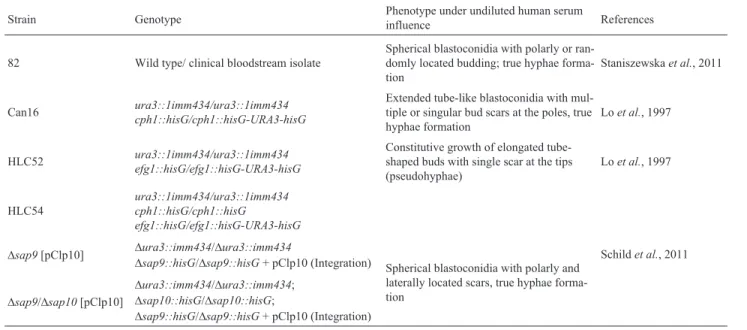
All of the strains used in the study are listed in Table 1.
The Candida albicans clinical strain (named strain 82) was isolated from blood culture of patient hospitalized in the Children’s Memorial Health Institute (Department of Oncology). Prior to the performed studies, strain 82 and mutant strains (Can16, HLC52 and HLC54) were routinely cultured on Sabouraud dextrose agar at 30 °C for 18 h (Staniszewskaet al., 2011), then a loopful (10mL) of cul-tures was reinoculated into 10 mL of YEPD medium (Ness
et al., 2010) and incubated at 30 °C for 18 h. The strains were stored on Microbank cryovial beads (Prolab Diagnos-tics, Canada) at -70 °C.
Induction of germ tubes, pseudohyphae and true hyphae in undiluted human serum. The human serum was obtained from healthy human volunteers (Department of Biochemistry of the Institute of Haematology and Transfu-sion Medicine in Warsaw). The serum was filtered using Millex filter with 0.45mm durapore membrane (Millipore, Carrigtwohill, Ireland). For the next culture of the each strain, 50mL of the blastoconidial suspension (1.5-5 x 10⁷ cfu mL-1) grown in YEPD medium was transferred to Eppendorf vial containing filtered undiluted human serum (500 mL, pH 7.1-7.4). To examine the wild type strain’s morphologies, blastoconidia were grown at 37 °C for the following time periods: 1, 2, 6, 18 and 48 h. For the each mutant’s forms, blastoconidia were incubated at 37 °C for 18 h.
Table 1-Candida albicansstrains used in the current study.
Strain Genotype Phenotype under undiluted human seruminfluence References
82 Wild type/ clinical bloodstream isolate
Spherical blastoconidia with polarly or ran-domly located budding; true hyphae forma-tion
Staniszewskaet al., 2011
Can16 ura3::1imm434/ura3::1imm434
cph1::hisG/cph1::hisG-URA3-hisG
Extended tube-like blastoconidia with mul-tiple or singular bud scars at the poles, true hyphae formation
Loet al., 1997
HLC52 ura3::1imm434/ura3::1imm434
efg1::hisG/efg1::hisG-URA3-hisG
Constitutive growth of elongated tube-shaped buds with single scar at the tips (pseudohyphae)
Loet al., 1997
HLC54
ura3::1imm434/ura3::1imm434 cph1::hisG/cph1::hisG
efg1::hisG/efg1::hisG-URA3-hisG
Dsap9[pClp10] Dura3::imm434/Dura3::imm434
Dsap9::hisG/Dsap9::hisG+ pClp10 (Integration) Spherical blastoconidia with polarly and
laterally located scars, true hyphae forma-tion
Schildet al., 2011
Dsap9/Dsap10[pClp10]
Dura3::imm434/Dura3::imm434;
Dsap10::hisG/Dsap10::hisG;
Microscopy study
To examine cell morphology, samples were prepared as described previously Oliviera et al. (2010). Briefly, morphotypes of the each strain were fixated with 2.5% glutaraldehyde in 0.1 M phosphate buffer (pH 7.2) for 18 h at a low temperature (5-6°C). Then, the samples were care-fully washed with 0.1 M phosphate buffer (pH 7.2). Post-fixation was carried out for 2 h at room temperature with 2% osmium tetroxide. Initial dehydration was accom-plished by placing specimens in the following series of eth-anol gradients: 50% and 70% (two times for 10 min), 95% (two times for 5 min) and 100% (two times for 1 min), re-spectively. Then, samples were dehydrated with acetone (two times for 30 s) until dried by the critical point method in liquid CO2. Subsequently, the specimens of the wild type strain were coated with gold in a vacuum evaporator and examined with a scanning electron microscope (SEM Quanta-200, FEI, Czech Republic). In the case of the mu-tant strains, after post-fixation morphotypes were dehy-drated two times for 10 min with graded ethanol (50% and 75%) followed by dehydration with acetone (two times for 30 s). The dried specimens were coated with osmium tetro-xide and observation was done under scanning electron mi-croscope Hitachi S-5500 (Japan). Images were assembled with Photoshop (Adobe Photoshop CS3 Extended). Cell
di-mensions were determined by using bars. Morphology index (Mi).
The morphology index (Mi) described by Merson-Davies and Odds (1989) was applied in this study to depict each of the particular pleomorphic forms of the clinical bloodstream isolate. The morphology index was deter-mined for the each cell type based on the formula: Mi =ls/d2. The length of the cell (l), maximum diameter of the cell (d) and diameter at the septal junction (s) were de-termined for 456 randomly selected cells of the clinical strain 82.
Statistical analysis of the clinical strain’s pleomor-phic forms. The morphology index (Mi) of the different pleomorphic forms was analyzed by descriptive statistics (number of cells measured, average, SD, minimum and maximum). Analysis was done using SPSS 12.0/ (//SPSS for Windows, Rel 12.0.1, 2004, Chicago: SPSS INC/).
Results
Blastoconidia
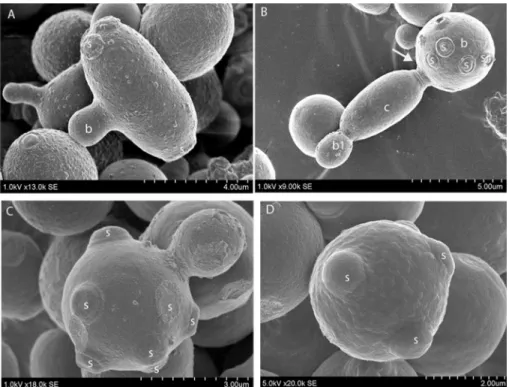
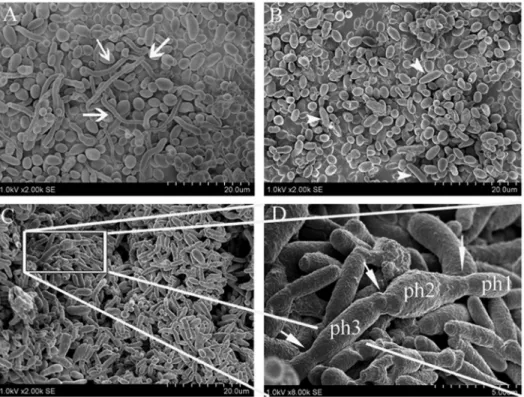
Under undiluted human serum blastoconidia of the clinical bloodstream isolate appeared as ovoid, spherical cells (Figure 1A). On the contrary, the colony morphology of the mutants’ blastoconidia looked as significantly
tended tube-like forms (Figure 1B-D). The average length-to-width ratios for the mutants’ cells (n = 138) were larger than 1.5. In this regard, the presented results sug-gested that a large number of cells testified pseudohyphae, not blastoconidia.
In the case of the mutants, the ratio of length to width was measured to reveal their defects in cell morphology and to clearly distinguish pseudohyphal cells from yeast-form cells (n > 50 for each strain). Blastoconidial cell poles were observed to be the privileged budding areas (Figure 1A, C). Generally, several polarly located scars were noted at the tips of the strains tested as in Figure 1A-C.
To examine the ultrastructural organization of scars at the surface of blastoconidia following undiluted serum in-duction, we included the sap9D/sap9D andsap9D/sap9D
sap10D/sap10Dmutants in this analysis. Sap9 and Sap10 are cell surface-associated aspartic proteases. In contrast to the above, SEM analysis revealed bud scars located ran-domly on the yeast cells surface of thesap9D/sap9D and
sap9D/sap9Dsap10D/sap10Dmutants as well as the wild type strain 82 (Figure 2B-D).
As can be observed in Figure 3D, the wild type strain showed a smooth and homogenous cell surface, whereas the mutants with morphology defects such asefg1D/efg1D (strain HLC52; Figure 3A),cph1D/cph1D (strain Can16; Figure 3B),cph1D/cph1Defg1D/efg1D(strain HLC54;
Fig-ure 3C) showed a highly heterogeneous, warty and rougher cell surface.
Germ tubes and true hyphae
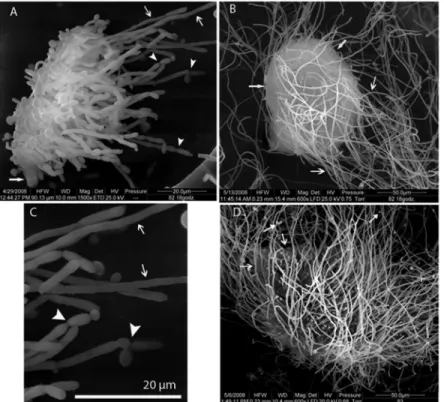
SEM analysis of the wild type strain 82 revealed that morphotypes appear as clustered cells of filamentous mor-phology embedded in a flocculent extracellular material (Figure 4B, D). Fibrillar material was observed as connect-ing neighbourconnect-ing morphologies.
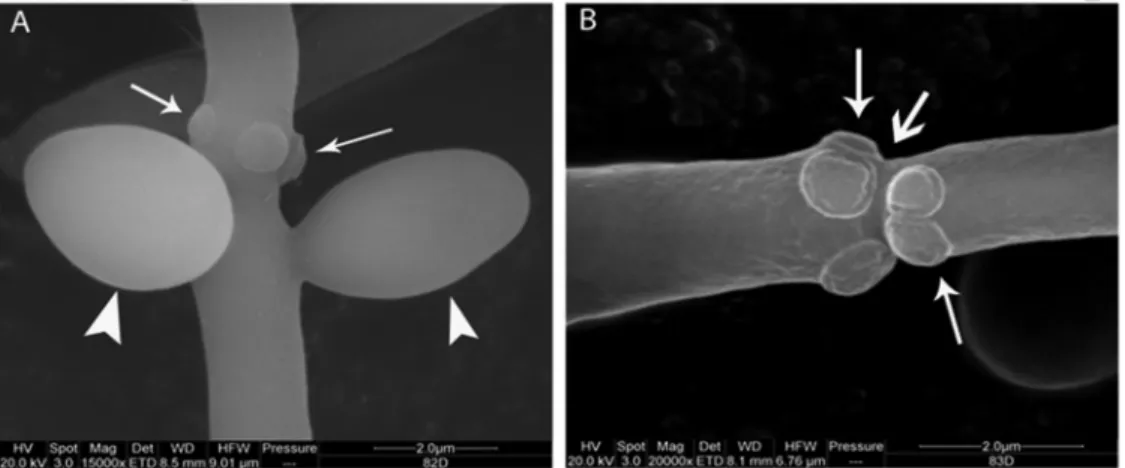
SEM showed that long true hyphal forms with rings of truncated bud scars located at one (Figure 5A) or at both sides of the solid septum were observed (Figure 5B).
True hyphal forms exhibited homogenously elon-gated shape and lack of constrictions at the solid septum. The average length-to-width ratios for the clinical strain’s true hyphal cells (n = 215) were about 6.91 (Table 2). After 48 h of incubation in undiluted human serum buds emerg-ing from the hyphal forms were noted (Figure 5A).
Altered morphogenesis of all the mutant strains was observed (Figure 6A-D). From all the mutants used in the study only thecph1D/cph1Dwas able to undergo morpho-logical transition and form true hyphae (Figure 6A). The latter strain formed hyphae (retaining solid septum) in hypha-inducing human serum, although the hyphal length observed was much shorter than that seen in the wild type cells (Figure 4B-D). The relative percentage of mycelia forms was lower in the case ofcph1D/cph1D(Figure 6A)
Figure 3- Characterization of surface phenotype ofC. albicansstrains. The strains were grown in undiluted human serum at 30 °C for 18 h. Deletion of
EFG1(strain HLC 52; A) or/ andCPH1(strain Can 16; B/ strain HLC54; C) results in roughness and warty phenotype. (D) Micrograph showing smooth phenotype of theC. albicansclinical strain 82. Scanning electron micrographs.
comparing with the wild type strain (Figure 4B, D). Con-trariwise, bothefg1D/efg1Dandcph1D/cph1Defg1D/efg1D mutants failed to form true hyphae (Figure 6B-D) upon un-diluted human serum stimulation. Thus, no true hyphae ex-tended from germ tube emerged from yeasts were noted.
Pseudohyphae
In the case of the wild type strain 82, pseudohyphae formed branched chains of elongated blastoconidial cells retaining constrictions at the septal junctions (Figure 4A, C). Fragile septal junctions are typical for pseudohyphal forms. Pseudohyphae were also wider than true hyphae forms. The average length-to-width ratios for pseudo-hyphal cells (n = 47) of wild type strain 82 were about 2.93 (Table 2). After 6 h of incubation in serum cells of the clini-cal isolate grew as a mix of pseudohyphae with a low pro-portion of true hyphal forms (Figure 4A, C). Null mutant
cph1D/cph1Dandefg1D/efg1Das well as double null mu-tantcph1D/cph1Defg1D/efg1Dformed elongated tube-like cells testified pseudohyphae (this due to elongated tube-shaped cells either singular or a few cells remaining
attached as filaments as in Figure 6) after 18 h-incubation in undiluted blood serum at 37 °C.
Discussion
Our data suggests that elongated tube-like buds of the null mutants (cph1D/cph1D,efg1D/efg1Dandefg1D/efg1D
cph1D/cph1D) should be referred to as pseudohyphae (this is due to a constrictions at the fragile septal junction be-tween tube-shaped cells remaining attached as in Figure 1D and Figure 6D, and the length-to-width ratios larger than 1.5). Because, a well-defined chains of pseudohyphal cells of mutant strains (Figure 1B-D) evidently consist of indi-viduals with different modes of growth as well as ultra-structural shape and organization compared to typical blastoconidia of the wild type strain 82 (Figure 1A). Dis-crepancies in scar locations were also observed - even though the mutants exhibited predominantly, but not exclu-sively multiple polar budding (testified by numerous scars remaining after daughter cells had dropped out from the mother cell as in Figure 1C) but at the tips of the elongated Table 2- Morphology index (Mi) values for pleomorphic cells ofCandida albicansclinical isolate grown for 18 h in undiluted human serum at 37 °C. Data estimated by measuring the cells documented by scanning electron micrographs.
Pleomorphic forms Morphology index (Mi) No. of cells examined
Range* Average Standard deviation
Minimum Maximum
Yeast 1.0 1.5 1.11 0.1614 133
Germ tube 1.6 2.4 1.93 0.2979 61
Pseudohyphae 2.5 3.4 2.93 0.3401 47
True hyphae 3.5 20.4 6.91 3.0761 215
Total 1.0 20.4 4.143 3.4045 456
*Classification of pleomorphic forms based on Mi value: blastoconidia, 1.0-1.5; germ tube, 1.6-2.4; pseudohyphae, 2.5-3.4; true hyphae > 3.4 (Merson-Davies and Odds, 1989).
tube-shaped forms there was a centrally located single bud scar (mother-daughter cell junction) which distinguishes tube-like yeast cell/ pseudohyphal growth (Figure 1D). Contrariwise, the wild type strain exhibited rings of scars at the tips of oval shaped yeasts indicating budding phenotype of blastoconidial cells (either in YEPD or undiluted human serum, Figure 1A) rather than pseudohyphal phenotype typical for mutants (Figure 1B-D) following serum induc-tion. Under these conditions, the clinical strain displayed smooth colonies (Figure 3D) in comparison to the homozy-gous mutants displayed wrinkled phenotype (Figure 3A-C and Figure 6A-D). Thus, we agree with others (Felket al., 2002; Zhaoet al., 2002) that Efg1 seems to play a major role in normal cell growth and hyphal morphogenesis in blood serum.
Incubation in human serum for 1 h (the wild type strain log phase of growth) resulted in blastoconidia unipo-lar germination combined with formation of cell aggregates (Figure 4A). Literature data (Gowet al., 2002; Argimonet al., 2007; Bauer and Wendland, 2007; Alonzo-Monge et al., 2010; Frade and Arthington-Skaggs, 2011; Giacometti
et al., 2011; Staniszewskaet al., 2011) describes that when serum is used as an inducer, cells readily aggregate (flocculate) and form clumps. In the study, SEM analysis also revealed that the wild type strain produced amorphous flocculent extracellular material, occurring in floating con-glomerate of morphologies (Figure 4A, B, D) generated in
(Biswaset al., 2000; Braun and Johnson, 2000; Felket al., 2002; Gowet al., 2002; Zhaoet al., 2002; Kumamoto and Vinces, 2005; Müller and Melchinger, 2006; Argimonet al., 2007; Bauer and Wendland, 2007; Biswaset al., 2007; Barnett 2008; Kebaaraet al., 2008; Kruppa 2009; Alonso-Mongeet al., 2010; Nesset al., 2010; Nobleet al., 2010) many examples of different media application to induce fil-amentous growth can be found, our investigation pointed out that undiluted human serum is the most effective in true hyphae and conglomerate formation (Figure 4A, B, D).
On the basis of our present microscopic analyses of the clinical strain’s cells, it can be concluded that incuba-tion in human serum at the temperature of 37 °C for 18 h re-sulted in transformation of almost 100% of all observed cells to pure true hyphal forms (Figure 4A-D). Although, a certain number of mycelia forms were consistently ob-served after 48 h of induction at 37 °C under human serum influence, the hypha to bud interconversion occurred (Fig-ure 5A; Staniszewska 2009). We expected that all morpho-logical forms can be usually seen in human blood infec-tions. Moreover, it is justified to assume that the wild type strain displayed altered morphologies related to nutrition-component changes occurred in the external environment. It may reflect the adaptation ofC. albicansto different cues found within different niches of the host. As discussed pre-viously (Lorentzet al., 2004; Yanget al., 2009; Luet al., 2011), morphogenetic transition is crucial forC. albicans
virulence. It is therefore possible that, the diversity in mor-phologies would provide them with the distinct advantage of rapid adaptation to cause candidiasis. Although blas-toconidia are efficiently disseminated by bloodstream (Gowet al., 2002), true hyphal cells induced by human se-rum are more efficient in further stages of candidiasis (tis-sue penetration - invading deep organs and macrophage evasion; Dignaniet al., 2003). Thus, the conglomerate of true hyphae due to enzymatically active apical tip (Fekete
et al., 2007) may play a crucial role in blocking the main ar-teries (tamponade of right heart and pulmonary ventricles; Salfelder et al., 1990) and colonizing the micro-environment of the host (as ureter and renal fungal ball; Dignaniet al., 2003; Nguyenet al., 2011).
In the paper we presented comparison between theC. albicansclinical isolate and strains lacking the transcrip-tion factors Cph1, Efg1 with regard to morphogenesis pro-cess induced under human serum influence. Although further analysis is required, we could infer several conclu-sions pertaining to ultrastructural morphology pattern ofC. albicanspleomorphic forms. First, blastoconidial cells of the clinical bloodstream strain exhibited either a polarly or randomly located budding under blood serum influence. Second, morphogenesis-attenuated mutants demonstrated an abnormal morphological switching under human serum influence. The deletion ofEFG1inC. albicansresulted in a constitutive growth of elongated tube-shaped buds termed pseudohyphae in serum. Thus, Efg1 is required for
se-rum-induced yeast-to-true hyphae transition. Third, our analysis along with the estimates of Müller and Melchinger (2006) and the discussion of our previously published re-sults (Staniszewskaet al., 2011) suggest that the two types of hyphae: pseudo- and true- differ in both structure (this due to fragilevssolid septum), shape (wide and short vs
narrow and long), and Mi values (average values: 2.93vs
6.91) and therefore their names cannot be used interchange-ably as filamentous forms. According to Crampin et al.
(2005), the apparent differences between morphotypes could be due to issue such as different growth. In general, polarisome components are required for hyphal growth, but not for yeast or pseudohyphal growth (Crampin et al., 2005). Fourth, if the ability to undergo the dimorphic tran-sition were the major determinant of virulence, it would in-dicate that the wild type strain shows increased virulence in body fluids. The observation that mutants are defective in yeast-to-hypha transition support the thesis that these strains are attenuated for virulence in bloodstream infec-tions. Fifth, to improve diagnosis of candidaemia and inva-sive candidiasis our data established morphological criteria for detection of fungal morphologies in human samples.
Acknowledgments
We are extremely grateful to many colleagues and all the individuals who were generous with their advice, and provided us with strains and reagents; Professor Hsiu-Jung Lo from National Health Research Institute in Zhunan (Tai-wan) with the following strains: Can16, HLC52 and HLC54; Professor Danuta Dzierzanowska-Madalinska with the strain 82; Professor Bernhard Hube with the fol-lowing strains:Dsap9andDsap9-10;Gabriela Smolenska-Sym, Ph.D with human serum. This work was supported by the NN 404 113639 grant from the Ministry of Science and Higher Education in Poland.
References
Alonso-Monge R, Román E, Arana DM, Prieto D, Urrialde V, Nombela C, Pla J (2010) The Sko1 protein represses the yeast-to-hypha transition and regulates the oxidative stress response in Candida albicans. Fungal Genet Biol 47:587-601.
Argimon S, Wishart JA, Leng R, Macaskill S, Mavor A, Alexan-dris T, Nicholls S, Knight AW, Enjabert B, Walmsley R, Odds FC, Gow, NAR, Brown AJP (2007) Developmental Regulation in the Fungal Pathogen Candida albicans. Eukaryot Cell 6:682-692.
Barnett JA (2008) A history of research on yeasts 12: medical yeasts part I,Candida albicans. Yeast 25:385-417. Bauer J, Wendland J (2007)Candida albicansSfl1 Suppresses
Flocculation and Filamentation. Eukaryot Cell 6:1736-1744.
Biswas SK, Yokoyama K, Nishimura, K, Miyaji M (2000) Effect of pH, carbon source and K+on the Na+-inhibited germ tube
Biswas SK, Van Dijck P, Datta A (2007) Environmental Sensing and Signal Transduction Pathways Regulating Morphogenic Determinants ofCandida albicans. Microbiol Mol Biol Rev 71:348-376.
Braun BR, Johnson AD (2000)TUP1,CPH1andEFG1make in-dependent contributions to filamentation in Candida albicans. Genetics 155:57-67.
Chung SC, Kim TI, Ahn CH, Shin J, Oh KB (2010)Candida albicans PHO81is required for the inhibition of hyphal de-velopment by farnesoic acid. FEBS Lett 584:4639-4645. Crampin H, Finley K, Gerami-Nejad M, Court H, Gale Ch,
Berman J, Sudbery P (2005) Candida albicanshyphae a Spiztenkörper that is distinct from the polarisome found in yeast and pseudohyphae. J Cell Sci 118:2935-2947. Cullen PJ, Sprague GF (2000) Glucose depletion causes haploid
invasive growth in yeast. PNAS 97:13619-13624.
Dignani MC, Solomkin JS, Anaissie EJ (2003) Candida. In: Anaissie, E.J.; McGinnis, M.R.; Pfaller, M.A. (eds) Clinical Mycology. Churchill Livingstone, Philadelphia, pp 195-239.
Fekete A, Ermi T, Gyetvai A, Gazdag Z, Pesti M, Varga Z, Balla J, Cserháti C, Emödy L, Gergely L, Pócsi I (2007) Develop-ment of oxidative stress tolerance resulted in reduced ability to undergo morphologic transitions and decreased patho-goenicity in a t-butylhydroperoxide-tolerant mutant of Candida albicans. FEMS Yeast Res 7:834-847.
Felk A, Kretschmar M, Albrecht A, Schaller M, Beinhauer S, Nichterlein T, Sanglard D, Korting HC, Schäfer W, Hube B (2002)Candida albicanshyphal formation and expression of the Efg1-regulated proteinases Sap4 to Sap6 are required for the invasion of parenchymal organs. Infect Immun 70:3689-3700.
Frade PF, Arthington-Skaggs BA (2011) Effect of serum and sur-face characteristics onCandida albicansbiofilm formation. Mycoses 54:e154-e162.
Giacometti R, Kronberg F, Biondi RM, Passeron S (2011) Candida albicansTpkIp and Tpk2p isoforms differentially regulate pseudohyphal development, biofilm structure, cell aggregation and adhesins expression. Yeast doi: 10.1002/yea.1839.
Gow NAR, Brown AJP, Odds FC (2002) Fungal morphogenesis and host invasion. Curr Opin Microbiol 5:366-371. Kebaara BW, Langford ML, Navarathna DHML, Dumitru R,
Nickerson KW, Atkin AL (2008)Candida albicans TUP1is involved in farnesol-mediated inhibition of filamentous-growth induction. Eukaryot Cell 7:980-987.
Kruppa M (2009) Quorum sensing and Candida albicans. Mycoses 52:1-10.
Kumamoto CA, Vinces MD (2005) Contributions of hyphae and hypha-co-regulated genes to Candida albicans virulence. Cell Microbiol 7:1546-1554.
Lo HJ, Köhler JR, DiDomenico B, Loebenberg D, Cacciapuoti A, Fink GR (1997) Nonfilamentous C. albicans mutants are avirulent. Cell 90:939-949.
Lorenz MC, Bender JA, Fink GR (2004) Transcriptional response ofCandida albicansupon internalization by macrophages. Eukaryot Cell 3:1076-1087.
Lu Y, Su C, Wang A, Liu H (2011) Hyphal development in Candida albicansrequires two temporally linked changes in
promoter chromatin for initiation and maintenance. PLoS Biol 9:e1001105.
Merson-Davies LA, Odds F (1989) A morphology index of char-acterization of cell shape inCandida albicans. J Gen Micro-biol 135:3143-3152.
Müller J, Melchinger W (2006) Ultrastructural characters defin-ing the terms ‘yeast cell’, ‘pseudomycelium’ and ‘true my-celium’ inCandida albicans. Mycoses 49:24-30.
Ness F, Prouzet-Mauleon V, Vieillemard A, Lefebvre F, Noel T, Crouzet M, Doignon F, Thoraval D (2010) The Candida albicansRgd1 is a RhoGAP protein involved in the control of filamentous growth. Fungal Genet Biol 47:1001-1011. Nguyen KA, Zmeter G, Claris O, Kassai B (2011) Epidemiology
of invasiveCandidainfection in a neonatal intensive care unit in France. Acta Paediatr doi: 10.1111/j.1651-2227.2011.02514.x
Noble SM, French S, Kohn LA, Chen V, Johnson AD (2010) Sys-tematic Screens ofCandida albicanshomozygous deletion library decouple morphogenetic switching and pathogenic-ity. Nat Genet 42:590-598.
Oliviera MT, Specian AFL, Andrade CGTJ, França EJG, Furla-neto-Maia L, Furlaneto MC (2010) Interaction ofCandida parapsilosis isolates with human hair and nail surfaces re-vealed by scanning electron microscopy analysis. Micron 41:604-608.
Pèrez A, Ramage G, Blanes R, Murgui A, Casanova M, Martínez JP (2011) Some biological features ofCandida albicans mu-tants for genes coding fungal proteins containing the CFEM domain. FEMS Yeast Res 11:273-284.
Salfelder K, de Liscano TR, Sauertaig E (1990)Atlas of Fungal Pathology. Kluwer Academic Publishing, Dordrecht, Boston, London.
Schild L, Heyken A, de Groot PWJ, Hiller E, Mock M, de Koste C, Horn U, Rupp S, Hube B (2011) Proteolytic cleavage of covalently linked cell wall proteins by Candida albicans Sap9 and Sap10. Eukaryot Cell 10:98-109.
Sudbery P, Gow N, Berman J (2004) The distinct morphogenic states ofCandida albicans.Trends Microbiol 12:317-324. Staniszewska M (2009)Search for Candida albicans virulence
factors. Warsaw, Poland, 146 p. (Ph.D. Thesis. National In-stitute of Public Health - National InIn-stitute of Hygiene. NIZP-PZH).
Staniszewska M, Bondaryk M, Kurzatkowski W (2011) Mor-photypes ofCandida albicans. Phase-contrast microscopy. Mikol Lek 18:5-10.
Staniszewska M, Bondaryk M, Siennicka K, Kurzatkowski W (2012) Ultrastructure of Candida albicans pleomorphic forms: Phase-contrast microscopy, scanning and transmis-sion electron microscopy. Pol J Microbiol 61:129-135. Steinberg G (1998) Organelle transport and molecular motors in
fungi. Fungal Genet Biol 24:161-177.
Yang YL, Wang CW, Chen CT, Wan MH, Hsiao CF, Lo HJ (2009) Non-lethal Candida albicans cph1/cph1 efg1/efg1 mutant partially protects mice from systemic infections by lethal-type cells. Mycol Res 113:388-390.
Zhao R, Lockhart SR, Daniels K, Soll DR (2002) Roles ofTUP1 in switching, phase maintenance, and phase-specific gene expression inCandida albicans. Eukaryot Cell 1:353-365.