A Kinetic Study of Drying of Teos-Derived Gels Under Nearly
Isothermal Conditions
Dario A. Donatti*, Alberto Ibañez Ruiz, Dimas R. Vollet
Departamento de Física,
IGCE/UNESP - Campus de Rio Claro
Rua Dez, 2527, 13500-230 Rio Claro - SP, Brazil;
e-mail: [email protected]
Received: December 15, 1998
The drying of wet Tetraethoxysilane-derived gels was studied by means of thermogravimetric analysis as a function of the time, from the instant when the samples were placed into a pre-heated oven, kept at 70, 83 and 100 °C. The precursor sol of the gel was obtained by sono-hydrolysis of the Tetraethoxysilane under acid condition and the final [Water]/[Tetraethoxysilane] molar ratio was adjusted to 30. The wet gels were cylindrical (2.5 cm height and 1.2 cm diameter) after 30 days of aging at 30 °C in a hermetically sealed container. The changes in volume and weight during drying are compatible with a mechanism controlled by evaporation from a flat liquid-vapour interface at the surface of the body and contraction of the gel by capillary forces, together with structural changes induced by polycondensation, which partially account for the irreversible shrinkage of the gel. The employed thermogravimetric method does not permit to unequivocally follow the small and slow final loss of weight associated to the falling rate periods.
Keywords: TEOS-derived gels, drying, kinetics
1. Introduction
The sol-gel process has become an useful tool in pre-paring finely divided powders or monoliths of glasses and glass-ceramics from hydrolysis of alcoxides1,2. This proc-ess involves hydrolysis and polycondensation reactions, gelation, aging and drying of the wet gels. The wet gel structure frequently exhibits a volume fractal feature3 sisting of a continuous solid network incorporating a con-tinuous liquid phase, which can occupy 95 to 98% of the volume4. Drying is the most critical step of the sol-gel processing if monoliths or the textural properties of the wet gels are intended to be preserved1,5-7. Supercritical drying (aerogels), freeze drying (criogels)4 and evaporation drying (xerogels)1 are usual methods for dried gels production.
The usual drying process for xerogels exhibits three distinct stages: the constant rate period (CRP), the first falling rate period and the second falling rate period6. The constant rate period, in which the greatest changes in vol-ume, weight and structure occur, is controlled by evapora-tion from the surface of the body and ends when shrinkage
ceases1,6. The rate of evaporation per unit area of the drying surface remains constant while the solid network collapses into the liquid, as a result of the compressive stress imposed by the tensile stress (capillary forces) of the liquid, and the liquid/vapor meniscus is kept at the drying surface6. The first falling rate period starts when the network becomes strong enough to resist further shrinkage and the radius of meniscus reduces enough to enter the pore, which begins to empty. This stage is controlled by flow through small pores and liquid layers over the pore surface and only small changes in weight and volume are observed1. In the second falling rate period, the liquid pathway to the surface be-comes discontinuous and a very small loss of weight fol-lows, until the equilibrium, by evaporation within the pores and diffusion of the vapor to the surface1.
It has been pointed that most alkoxide-derived gels may not exhibit a CRP which could be attributed to the mixture of water and alcohol which composes the liquid phase of the gel6. Kawaguchi et al.8 found the evaporation rate to be initially constant for large pore silica gel, meanwhile Hench and Wilson1 did not find a constant rate of loss of weight
during drying alkoxide-derived gels, even when normal-ized to the surface area.
In this work we study the kinetics of drying of Tetraethoxysilane (TEOS)-derived gels as a function of temperature by means of thermogravimetric analysis, from the instant when the sample is placed into the pre-heated oven of the thermogravimetric analyser, which kept at a constant temperature.
2. Experimental Procedure
Tetraethoxysilane (TEOS) (Wacker 97%), distilled and deionized water and HCl (Merck 37%) were used to pre-pare a two-phase TEOS-water-HCl mixture in a molar ratio 1:6.75:0.005, respectively. The mixture (~100 mL) was submitted to hydrolysis for 15 min under ultrasonic stimu-lation using a 20 kHz-600 W apparatus (Sonics & Material VC600) with a 13 mm diameter titanium transducer, driven by an electrostrictive device. Under these conditions, hy-drolysis takes place with its maximum rate at about 5 min of ultrasound stimulation9,10. Next, water was added to the solution, until the molar ratio [water]/[TEOS] = 30, and the ultrasound was continued for 5 min for complete homog-enization. High water contents are desired in order to favor the production of monoliths after drying the so derived-gel11.
Gelling of the sols and aging of the wet gels were carried out in hermetically closed cylindrical polypropylene con-tainers kept at 30 °C. Gelling occurred within 1 day and aging was extended for 30 days. The cylindrical samples of the wet gels were about 2.5 cm height and 1.2 cm diameter, after a minor syneresis. Assuming complete hy-drolysis and polycondensation reactions, and no evapora-tion of alcohol during preparaevapora-tion and aging of the gel, the composition of the liquid phase of the gel would be ap-proximately 25% weight alcohol.
The thermogravimetric analysis was carried out in a BP-3000 equipment (BP-Engenharia/Brazil) controlled by a Pentium CPU through an A/D heating rate controller board. The samples, innitially at 30 °C, were placed, each one at once, into the pre-heated oven of the thermo-gravimetric analyser at the temperatures TOVEN = 70, 83
and 100 °C, respectively. The initial time was defined as the instant in which the samples were placed into the furnace. The sample temperature was measured by a Chromel/Alumel thermocouple placed just below the sam-ple, in contact with a thin Ni-crucible which held the sample. The output data of the weight loss were obtained as a function of both the sample temperature (T) and the time (t) of heat treatment. An atmospheric air flux was driven through the tube of the oven to avoid vapor conden-sation. The same conditions of the flow rate and moisture content were maintained for all samples studied.
3. Results and Discussion
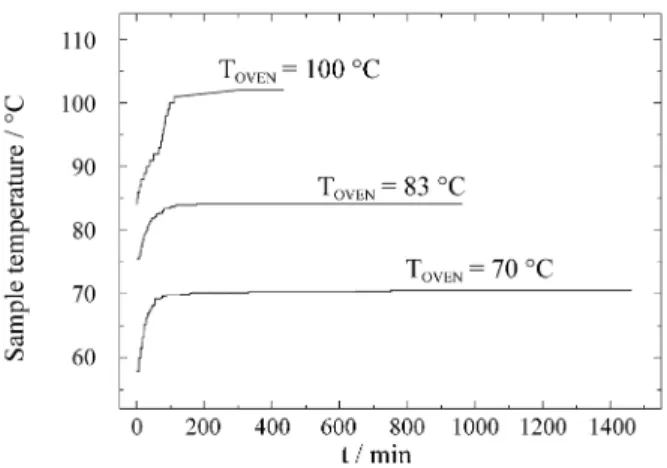
Figure 1 shows the temperature response of the samples as a function of the time (t) from the instant when the samples were placed into the oven of the thermogravimet-ric analyser, pre-heated at TOVEN = 70, 83 and 100 °C.
Figure 2 shows the weight loss of the initially wet gels through the plots of the instantaneous percentage of the sample weight (X), with respect to the initial wet gel weight, as a function of the time (t) of heat treatment. Figure 3 shows the sample temperature response under the condi-tion TOVEN as a function of the instantaneous sample weight
percentage (X).
The temperature of the sample at TOVEN=100 °C
showed a tendency to keep constant around 90 °C at the beginning of the drying process (Figs. 1 and 3), in opposi-tion to the heat treatment, because the sample temperature should be the boiling point of the alcohol-water mixture of the liquid phase at this stage.
Figure 2. Sample weight loss as a function of the time, from the instant when the samples were placed into the pre-heated oven at the indicated temperature TOVEN.
The remaining sample weight (Xeq), as inferred from
the asymptotic limit of X for high drying time in Fig. 2, diminishes with the temperature. Xeq was found to be 9.4,
8.3 and 6.2% for the samples treated at TOVEN = 70, 83 and
100 °C, respectively. The minimum theoretical value for Xeq was estimated for these samples as being 9.0%, under
the assumption that the remaining weight after drying is composed just by silica (SiO2), which would be yielded in
the gel preparation if it had undergone a 100% hydrolysis and polycondensation reaction. This value agrees reason-ably well with the experimental value of 9.4% for TOVEN
=70 °C, fairly well with 8.3% for TOVEN =83 °C, but does
not agree very well with 6.2% for TOVEN=100 °C. Which
is much too small compared to the minimum theoretical 9.0%. This observation indicates that some Si-related spe-cies, such as non-hydrolyzed TEOS or silanol groups, evaporated during sonication or during the heat treatment. In the first case, the drying process should not yet be complete when the sample weight attained the limit value Xeq for TOVEN=70 and 83 °C. This is unlikely because a
long time elapsed without weight variation until the treat-ment was interrupted. In the second case, hydrolysis and polycondensation reactions may be occurring during the heat treatment with possibility of changes in the gel struc-ture.
The drying rates, dX/dt, in min-1 units, were determined from the slopes of the curves of the Fig. 2. Following a typical procedure to characterize the drying periods12, Fig. 4 shows the drying rate curves as a function of the percent-age of the sample weight (X). The drying rate increases strongly with the temperature and decreases continuously as the sample loses weight, until practically no changes of weight can be detected. After a fairly linear drop of the drying rate with X, whose extension was dependent on the temperature, the samples exhibited little change in regime of the drying process. This can be inferred from the more accelerated diminution of the drying rates at X ~ 80% for
TOVEN = 70 °C sample, X ~ 75% for TOVEN = 83 °C, and
X ~ 65% for TOVEN = 100 °C. This deceleration in the
drying rate is more apparent at high temperatures and should be associated to variations in the composition of the alcohol and other volatile non-reacted Si-related com-pounds present in the liquid phase of the gel. The evapora-tion of volatile Si-related compounds is favoured at high temperatures since the weight loss has already attained ~35% (X ~ 65%) at TOVEN = 100 °C, which is even greater
than the alcohol content, when the deceleration in the drying rate becomes apparent.
We have estimated, from the theoretical Xeq, that these
wet gel samples are almost 98% volume liquid phase. Hence the bulk density is close to the density of the liquid phase. In this case, the volume shrinkage of the gel is equal to the volume of liquid that evaporates while the liquid/va-pour meniscus is kept flat at the external surface of the body and the solid network collapses into the liquid by capillary forces, as pointed out by Scherer5. Assuming an isotropic linear shrinkage, we have
dS S =
2 3
dV
V (1)
where S and V are instantaneous external surface area and bulk volume of the body, respectively. Integrating (1) from the initial wet gel conditions (So , Vo), we obtain
S = S0(V
V0)
2⁄
3α V2⁄3α M2⁄3α X2⁄3 (2)
where M is the instantaneous weight of the gel. Equation (2) should be observed during the CRP, while the volume shrinkage is equal to volume of liquid that evaporates. The proportionality between V and M (or X) is valid since the bulk density is practically constant, even if some Si-related species evaporate, except when the CRP has finished. According to Eq. (2), the quantity (dX/dt)/X2/3 is proportional to the drying rates, normalized by the instantaneous surface area. Figure 5 shows (dX/dt)/X2/3vs.
Figure 4. Drying rate as a function of the instantaneous weight of the sample placed into the oven at the temperature TOVEN.
X plots. The normalised drying rate in Fig. 5 is practically constant at the beginning of the drying process until about X ~ 80% for TOVEN = 70 °C, X ~ 75% for TOVEN = 83 °C
and X ~ 65% for TOVEN = 100 °C. Next, the drying rate
drops to a minor but yet constant value until the gel weight achieves approximately 40% or 30% of its initial weight. The regime changes of the drying rate, namely: at X ~ 80% for TOVEN=70 °C, X ~ 75% for TOVEN=83 °C and X ~ 65%
for TOVEN = 100 °C, which we have associated to the ending
of the alcohol content and others volatile non-reacted Si-related compounds present in the liquid phase of the gel, are more apparent in Fig. 5 than in Fig. 4. The late increase in the normalised drying rate which occurs after X ~ 30% or 40%, according to the Fig. 5, can be explained by the
normalisation function X2/3 which should begin to departure from a true measurement of the external surface area when the shrinkage of gel is ceasing, the CPR regime is finishing and the first falling rate period is starting. In addition, cracking is favoured in the first falling rate period when the pores start to empty, mainly under high temperature. The appearing of cracks increases the evaporation surface area, increasing the evaporation rate, what does not permit to unequivocally study the falling rate periods with this set experimental data. As a matter of fact, the sample treated at TOVEN = 70 °C remained apparently
monolithic, while that at TOVEN = 83 °C was found
fractured, and at TOVEN = 100 °C was found broken.
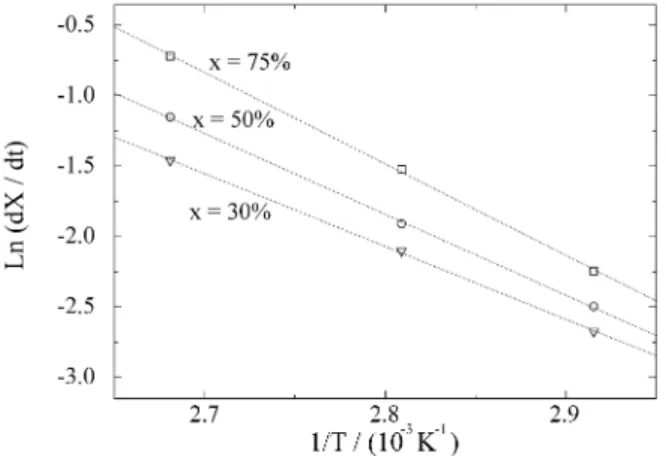
The drying rate as a function of the sample temperature, as measured at fixed values of the sample weight (X = constant), namely X = 75%, X = 50% and X = 30%, is plotted in Fig. 6 (an Arrhenius type plot). Table 1 shows the activation energy (∆E), obtained from the slope of the linear regression of the ln(dX/dt) vs. (1/T) data fitting the Arrhenius equation for each X = constant. The activation energy decreases with X and tends to the value 43 kJ/mol at X = 30%, the sample weight in which we suspect the CPR has ended. 43 kJ/mol is close to the heat of evaporation of the water. The apparent increase of the activation energy for high X values could be associated to the preferential evaporation of the volatile compounds present in the liquid phase which would shift upward the experimental dX/dt at the high temperature side of the Fig. 6.
The set of the experimental results is compatible with the model in which the greatest changes in volume and weight of the gel, with consequent changes in the structure of the gel, is controlled by evaporation from a flat liquid-vapour interface at the surface of the body and contraction of the gel by capillary forces. Polycondensation must occur during the heat treatment, and associated structural changes are induced by siloxane bond formation, which partially account for the irreversible shrinkage. The employed ther-mogravimetric method does not permit to unequivocally follow the small and slow final loss of weight associated to the falling rate periods.
4. Conclusion
The greatest changes in volume and weight of this set of high water content TEOS-derived gels are compatible with a mechanism controlled by evaporation from a flat liquid-vapour interface at the surface of the body and contraction of the gel by capillary forces. Structural changes must occur during the heat treatment induced by siloxane bond formation (polycondensation) which par-tially account for the irreversible shrinkage of the gels. The thermogravimetric method employed does not permit to unequivocally follow the small and slow final loss of weight associated to the falling rate periods.
Table 1. Apparent activation energy of the drying process as a function of the weight of the samples.
X (%weight) ∆E (kJ/mol)
75 53.9
50 47.7
30 43.0
Figure 6. Drying rates fitting an Arrhenius equation for different constant values of the weight of the samples.
Acknowledgments
This work was supported by FAPESP (Brazil).
References
1. Hench, L.L.; Wilson, M.J.R. J. Non-Cryst. Solids, v. 121, p. 234-243, 1990.
2. Ge, M.; Yang, H.; Jiang, Z.; Wang, Y.; Zhang, F. J. Non-Cryst. Solids, v. 147-148, p. 565-568, 1992. 3. Santos, D.I.; Aegerter, M.A.; Craievich, A. Cerâmica,
v. 35, p. 13-17, 1989.
4. Pajonk, G.M.; Repellin-Lacroix, M.; Abouarnadasse, S.; Chaouki, J.; Klvana, D. J. Non-Cryst. Solids, v. 121, p. 66-67, 1990.
5. Scherer, G.W. J. Non-Cryst. Solids, v. 147-148, p. 363-374, 1992.
6. Scherer, G.W. J. Non-Cryst. Solids, v. 100, p. 77-92, 1988.
7. Yasumori, A.; Kawazoe, H.; Yamane, M. J. Non-Cryst. Solids, v. 100, p. 215-219, 1988.
8. Kawaguchi, T.; Iura, J.; Taneda, N.; Hishikura, H.; Kokubu, Y. J. Non-Cryst. Solids, v. 82, p. 50, 1986. 9. Donatti, D.A.; Vollet, D.R. J. Non-Cryst. Solids, v.
208, p. 99-104, 1996.
10. Donatti, D.A.; Vollet, D.R. J. Sol-Gel Sci. Tech., v. 4, p. 99-104, 1995.
11. Dahmouche, K. PhD Thesis, Lyon University, 1993. 12. Strumillo, C.; Kudra, T. Drying: Principles,