Possibilities of using the ecological oil Arnica S 46
in agricultural engineering
Možnosti využitia ekologického oleja Arnica S 46 do
po
ľ
nohospodárskej techniky
Juraj RUSNÁK*, Milan KADNÁR, František TÓTH and Michal KROČKO
Slovak University of Agriculture in Nitra, Faculty of Engineering, Department of Machine Design, Tr. A. Hlinku 2, 949 76 Nitra, Slovak Republic, phone: +0421/37/6414100, e-mail: [email protected] * correspondence
Abstract
This paper deals with a possible use of biodegradable oil for lubrication of tribological nodes in hydraulic and transmission systems. They are mainly used in agriculture and forestry. For this reason, the research project was aimed mostly at hydraulic and gear oils, directly or indirectly designated for machinery working in these fields.
The oil was tested according to the standard ASTM G77-05(2010). The study of the tribological node included monitoring the friction factor depending on time, and
monitoring the temperature of the sliding node depending on time. In the triboelement shaft – bearing, we monitored the weight losses as well as changes in the selected characteristic of contact surface roughness. The monitored characteristic was Ra. A complete picture of geometric changes of the tested triboelement was described by the geometric deviation of cylindricity. The system also includes the study of
lubricating medium. We determined the initial and final code of oil purity. The characteristics were statistically evaluated.
Two oils were tested: PP 80 (producer: Slovnaft Bratislava) and ARNICA S 46
(producer: Agip). According to the results, both oils are appropriate for using in given conditions. No significant differences in their tribological characteristics were found.
In conclusion, the results confirmed that the suggested system for evaluating the suitability of biodegradable lubricants is applicable in given laboratory or operating conditions.
The conclusions can be used in practice for choosing the lubricant. The results can also help to create an order of appropriate oils. The conclusions can also be used by producers of lubricants as information about functional characteristics of their
products.
Keywords: ecological oil, friction factor, sliding bearing
Abstrakt
V predkladanej práci sme riešili problematiku možného použitia biologicky
dôvodu náš výskum bol zameraný na prevodové a hydraulické oleje priamo alebo nepriamo určené pre stroje pracujúce v daných oblastiach.
Testovanie oleja prebiehalo podľa normy ASTM G77-05(2010). Štúdium
tribologického uzla zahŕňalo sledovanie závislosti súčiniteľa trenia na čase skúšky a závislosti teploty klzného uzla na čase skúšky. V prípade triboelementu hriadeľ – ložisko sme sledovali hmotnostné úbytky a zmeny vybranej charakteristiky drsnosti kontaktného povrchu. Sledovaná bola charakteristika Ra. Úplný obraz geometrických zmien skúmaného triboelementu popisovala geometrická odchýlka valcovitosť.
Systém zahŕňa aj štúdium mazacieho média. Bol zisťovaný východiskový a konečný kód čistoty oleja. Jednotlivé charakteristiky boli štatisticky vyhodnocované.
Testované boli dva oleje: PP 80 od výrobcu Slovnaft Bratislava a olej ARNICA S 46 od výrobcu Agip. Z uvedených výsledkov vyplýva, že obidva oleje sú vhodné na použitie v daných podmienkach. Signifikantné rozdiely v ich tribologických vlastnostiach neboli.
Zosumarizovaním výsledkov môžeme konštatovať, že navrhnutý hodnotiaci systém pre hodnotenie vhodnosti biologicky odbúrateľných mazív pre určité laboratórne alebo prevádzkové podmienky je použiteľný.
Výsledky sa dajú využiť pre prevádzkovú prax pri výbere vhodného maziva. Dávajú predpoklad na vytvorenie radu vhodnosti ďalších olejov. Výsledky sa dajú využiť aj pre výrobcov mazív ako informácie o reálnych funkčných vlastnostiach ich výrobkov. Kľúčové slová: ekologický olej, klzné ložisko, súčiniteľ trenia
Introduction
Present time and scientific-technical development in all fields of social life put an increased demand on ecology and environmental protection. Also in agricultural engineering, in the field of slide assemblies, it comes about scientific knowledge, the possibility of substitution of synthetic lubricants by lubricants that are environmentally friendly. Concerning the availability of biodegradable oils and missing information about their possible employment instead of mineral or synthetic oils without the loss of original operating parameters, our goal was to investigate the possibilities of using the ecologic oil Arnica S 46 in slide assembly.
Materials and Methods
Arnica S 46 from the producer Agip is a biologically fast degradable hydraulic fluid on the base of synthetic esters for all types of hydraulic equipment. This fluid does not threaten the environment, it is a zinc-free system of additives, and is almost
Agip Arnica S 46 has a very good fire resistance. In this way, the possibility of ignition from potential fire sources is reduced. The oil is degradable for more than 70 % according to OECD 301 B.
The selected physical properties of Agip Arnica S 46 are listed in Table 1.
Table 1: Selected characteristics of the oil Arnica S 46
Parameter, unit Value
Kinematic viscosity at 100 °C, mm2*s-1 9.3
Kinematic viscosity at 40 °C, mm2*s-1 48.0
Viscosity index 187
Density, g*ml-1 0.921
Flash point, ºC 370
Pour point, °C -36
Preparation of research and performance of experimental tests
The selection of material pair was based on the assumption of reproducibility and possibility to compare the results with other researches. The determination of the shape of test bodies was based on the requirement for elementary simulation of assembly and loading of the friction bearing. The pair shaft – hub offers
advantageous possibilities for simulation and testing of the effect of long-lasting sliding friction. The tribological node was of a classical type, consisting of four
elements. The sliding node was lubricated by the examined fluid medium. The fourth element within the sliding node was the atmosphere as the sliding node was opened. In regard to a short running of particular tests and a small area of lubricating medium that was exposed to atmospheric effects, this element of the sliding node is
considered to be irrelevant.
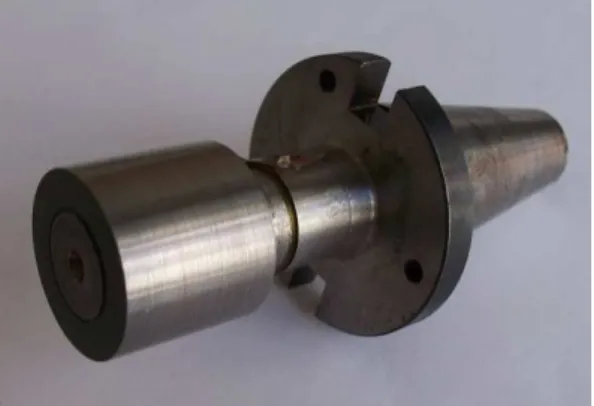
The first friction element was the shaft. The dimensions of the shaft were determined in conjunction with the dimensions of the hub. The test shaft is introduced in Fig. 1.
The material of the shaft´s test part was a structural steel of grade 14 220, cemented and tempered to HRC 58±1 according to STN.
Shafts were cut to diameter 24.960 mm, with achievement of fit H8/f7, i.e. fit with a
low clearance (Shiglez et al., 2010).
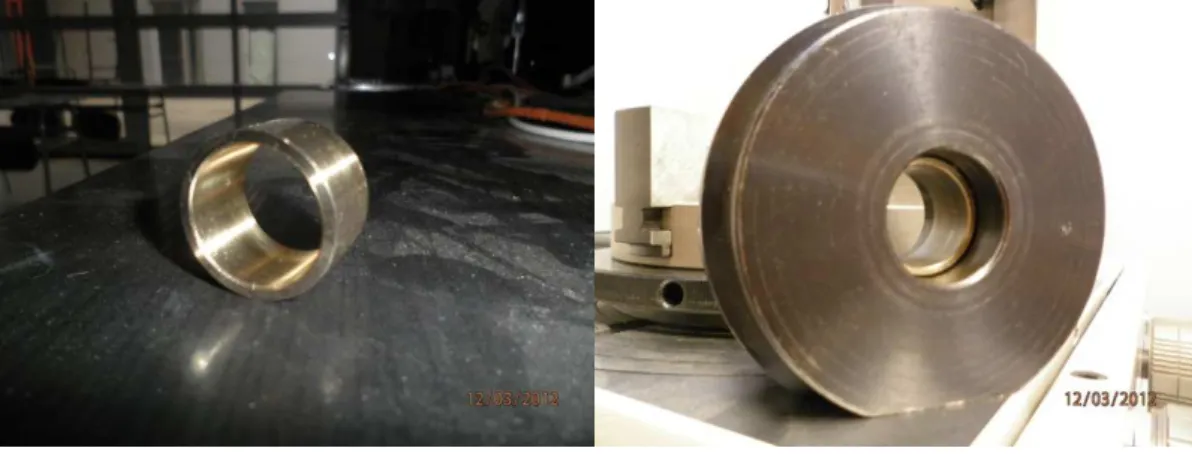
The second friction element within the test sliding node was the hub B60 M3 from the material CuSn 12, with dimensions 30r7 x 25 F7 x 20 mm. The photography of
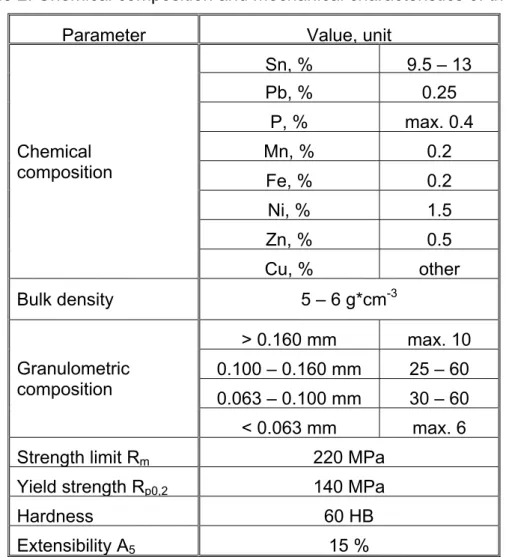
the hub before and after installation into a test head is depicted in Fig. 2. The designation CuSn12 represents tin bronze, which is the most frequently used material for manufacture of sliding bearings. The chemical composition and mechanical properties of the given material are listed in Tab. 2. In Fig. 3, there is depicted the 3D model of the sliding node.
Figure 2: Test hub
Table 2: Chemical composition and mechanical characteristics of the test hub
Parameter Value, unit
Chemical composition
Sn, % 9.5 – 13
Pb, % 0.25
P, % max. 0.4
Mn, % 0.2
Fe, % 0.2
Ni, % 1.5
Zn, % 0.5
Cu, % other
Bulk density 5 – 6 g*cm-3
Granulometric composition
> 0.160 mm max. 10
0.100 – 0.160 mm 25 – 60
0.063 – 0.100 mm 30 – 60
< 0.063 mm max. 6
Strength limit Rm 220 MPa
Yield strength Rp0,2 140 MPa
Hardness 60 HB
Extensibility A5 15 %
One of the most important elements within the sliding node is lubricating medium. In our case, it is lubricating oil. For the possibility of mutual comparison of lubricating power of these oils, it was necessary to ensure the same conditions for all of the experimental tests. The only variable within these tests was lubricating oil. In the submitted contribution, we compare two types of oils. By our research we wanted to obtain results directly usable in praxis. The oils were selected only from the oils sold and freely available in the Slovak market.
The right choice of oils was determined according to the following primary criterions: oil designated for agricultural and forestry machines and equipment;
biodegradability according to some internationally recognised standards. According to the first requirement, we chose for our experiments lubricating oils according to the following requirements:
viscosity class ISO 46, suitable power class.
Within the second requirement, criterions were determined according to internationally recognised standards:
biodegradability according to CEC L-33-A-93 (the necessary level of degradability is determined according to base oil);
total biodegradability according to OECD 301 (for level: easily biodegradable oil);
potentially obtained ecovignette, the assumption of which is a total biodegradability to at least 60 % in the OECD 301 test, for example Blauer Engel, European Eco-Label, etc.;
the class of water threat according to WGK at level 0 maximum 1. Lubricating oils selected for our research were:
1. oil PP 80 (reference);
2. ecological oil Arnica 46 S, producer Agip.
There was simulated a hydrodynamic method of lubrication. Lubricating medium was supplied from above into the test pair, with the flow into a receiving jar, situated under the sliding pair.
A detailed description of the chosen oils is introduced in the chapter Results and discussion.
Experimental tests were performed on a laboratory test device Tribotestor M´06.
The test machine is situated in the tribotechnical laboratory of the Department of Machine Design, Faculty of Engineering, Slovak University of Agriculture in Nitra. This device is used for quick determination of tribological properties of sliding pairs in general. The device enables the performance of four basic types of tests (Gáspár, 2011).
Results and Discussion
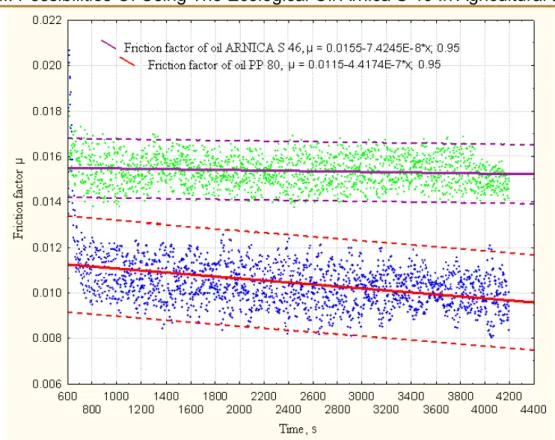
Results of changes in friction factor in dependence on time of examined oils The results are presented as graphical representations of changes. Within particular testing sets, the courses of friction factor are depicted in one coordinate system. Such a representation offers a possibility to directly notice potential anomalies during the tests.
Figure 4: Linear equalisation of friction factor function depending on time, with confidence interval 0.95
These are average values of friction factor measured and statistically evaluated in dependence on the test time. Listed values are informative data about the “central tendency” of examined variable, with the information about its confidence interval. From the average value of measured sample, we can express the information about the central tendency of the friction factor course. The confidence interval specifies in what range of values the real course of friction factor could occur (at a given level of certainty). Simple regression functions, in our case the straight line equations, describe the friction factor of the examined oils in dependence on test time, and we can point out that:
in case of PP 80, the course of friction factor is lower with a decreasing slope of line and with a higher confidence interval than in case of ARNICA S 46; ARNICA S 46 has indeed a higher but balanced friction factor course;
the confidence interval clearly indicates that the value of friction factor for PP 80 is lower and more balanced.
Results of the course of working temperature in dependence on the time of examined oils
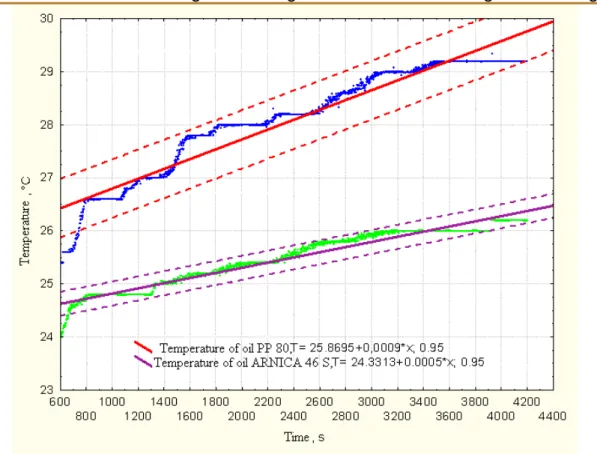
Figure 5: Linear equalisation of temperature function depending on time, with confidence interval 0.95
These are average values of working temperature of the sliding node measured and statistically evaluated in dependence on test time. Listed values are informative data about the “central tendency” of examined variable, with the information about its confidence interval. From the average value of measured sample, we can express the information about the central tendency of working temperature course of the test sliding pair. The confidence interval specifies in what range of values the real course of working temperature could occur (at a given level of certainty). Simple regression functions, in our case the straight line equations, describe the course of working temperature of the examined oils in dependence on test time, and we can point out that:
in case of PP 80, the value of working temperature is higher with a higher slope of line and with a lower confidence interval than in case of ARNICA S 46;
the confidence interval in case of ARNICA S 46 is significantly higher than in PP 80.
Results from the study of changes in contact surface roughness
We can state that:
in both examined oils, a decrease of roughness Ra was higher in the hub than in the shaft;
it was proved that if there is mutual relation between two contact surfaces, the change of surface roughness due to operating changes is remarkably higher in case of softer material (the hub in our case).
Results of evaluation of weight losses
Another tested parameter was the weight loss of examined friction elements. By means of roughness observation, we can assume the movement of material from the component’s surface. Surface roughness can also be changed in case of surface turnover. That is why it is necessary to observe the weight change of sliding elements to reveal any material loss from worn surfaces. In terms of sliding assembly, it is required that the loss of surfaces is as small as possible and the stability of assembly geometry is preserved.
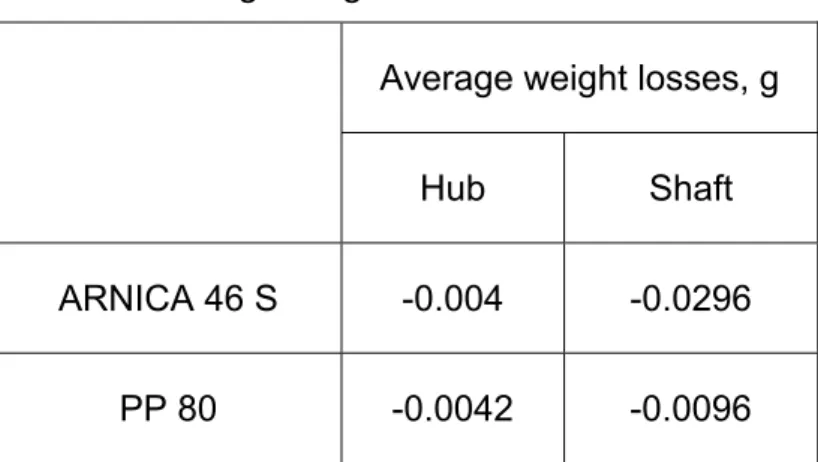
Based on the measured values of weight losses, we consequently evaluated their mean values for the pair shaft – hub for individual types of lubrication. Weight losses are shown in Tab. 3.
Based on the introduced courses of weight losses, we can point out that: for the hub, ARNICA S 46 proves lower weight losses than PP 80;
for the shaft, the results are different (ARNICA S 46 proves higher weight losses on the shaft than PP 80).
We explain this paradoxical phenomenon by a different behaviour of the examined oils in relation to the particular materials forming the sliding pair. From this point of view, it is not possible to clearly define the priority of examined oils.
Table 3: Average weight losses of hubs and shafts
Average weight losses, g
Hub Shaft
ARNICA 46 S -0.004 -0.0296
Results of purity code
We tested the oils in pure condition, just before they were used. The fact that the oils contain impurity already in pure condition was confirmed. The numeric data are shown in Tab. 4.
Table 4: ISO 4406 – 1999 purity code before testing, measured with the device CS 1000
Oil type Agip Arnica 46 S (1) Madit PP 80 (2)
ISO 4406-1999 20/19/16 18/17/14
The same procedure was performed after experiment. The numeric data are shown in Tab. 5. After experiment, oil samples were observed under the microscope with a magnification of 100 times. From the description of lengths, surfaces and angles of mechanical impurities and on the basis of comparing these results with the Catalogue of wear particles, we can point out mostly the adhesive type of wear with an
insignificant share of abrasive wear.
Based on comparing the values of purity code before and after test as well as based on microscopic observation, we can point out that:
a proportional increase of individual impurity particles in the examined oils was recorded;
adhesive wear of sliding pairs was proved during the testing; the difference between these two types of oil was insignificant.
Table 5: ISO 4406 – 1999 purity code after testing, measured with the device CS 1000
Type of oil Agip Arnica 46 S (1) MOL PP 80 (2)
ISO 4406-1999 24/23/22 23/22/21
Results of geometric changes
The deformation of sliding surfaces is expressed by the monitored geometric deviation – cylindricity, measured on the device MUC-F 300PC.
We evaluated the cylindricity of the shaft and hub of the corresponding pair in the given set before and after experiment and for the monitored lubricating medium. Statistical values of cylindricity were evaluated from each set. Based on the analysis of values, we can point out that:
a change in the cylindricity of the hub is remarkably higher in case of PP 80; evaluation of geometric deviation – cylindricity – there was a more favourable
impact of ARNICA S 46 on the stability of sliding node geometry.
Conclusion
Tribological tests were performed with the intention to determine the behaviour of examined lubricants in a real sliding node, in exactly specified operating conditions and material pair. All the performed tests were completed by the primary condition, by achieving the test duration without seizure or reaching the limit temperature of 100 °C. Limit values of tests were reached in neither of the oils. This fact shows the
suitability of the proposed evaluating procedure for specified goals. Directly or indirectly performed studies of chosen properties of the sliding node, triboelements and finally the lubricating medium brought valuable information into the final
evaluation of the given oils.
We can point out that:
a) evaluation of friction factor depending on time:
as for PP 80, friction factor is lower with a decreasing slope of line and with a higher confidence interval in comparison with ARNICA S 46; the oil ARNICA S 46 has a higher but a balanced friction factor;
the confidence interval confirms that the friction factor of PP 80 is lower and more balanced;
b) evaluation of working temperature depending on time:
the oil PP 80 has a higher working temperature with a higher slope of line and with a lower confidence interval than ARNICA S 46;
the confidence interval for ARNICA S 46 is significantly higher than for PP 80; c) evaluation of changes in contact surface roughness:
with both examined oils, the decrease of roughness Ra was higher in the hub than in the shaft;
it was proved that if there is mutual relation between two contact surfaces, a change in surface roughness due to operating changes is remarkably higher in case of softer material (the hub in our case);
d) evaluation of weight losses:
in case of the hub, ARNICA S 46 proves lower weight losses than PP 80; in case of the shaft, the results are different (ARNICA S 46 proves higher
weight losses on the shaft than PP 80);
e) achievements from purity code:
a proportional increase of individual impurity particles was recorded in the examined oils;
f) achievements from geometric changes:
a change in the cylindricity of the shaft is approximately the same with both examined oils;
a change in the cylindricity of the hub is remarkably higher in PP 80;
evaluation of geometric deviation – cylindricity – the impact of ARNICA S 46 on the stability of sliding node geometry is more favourable.
Based on individual evaluations, it is not possible to clearly define the sequence of suitability of the examined oils for the used material pair steel 14 420 and tin bronze CuSn12. Both examined oils showed comparable changes during the test. The oil PP 80 was used as a reference gear oil, verified by practice. We can say that the
ecological oil ARNICA S 46 is a full-value oil for using not only in hydraulic systems but also in transmission systems.
References
Gáspár, T., (2011) Štúdium vlastností ekologických mazív pri mazaní klzných dvojíc. Doktorandská dizertačná práca TF-3003952. Nitra: TF SPU Nitra.
Kadnár, M., Rusnák, J., (2008) Ekologické oleje aplikované do oblasti klzných
uložení – metódy, prístroje a interpretácia. Nitra: Slovenská poľnohospodárska univerzita v Nitre.
Kročko, M., (2012) Štúdium degradabiltiy tribologického systému vplyvom pôsobenia ekologických mazív. Doktorandská dizertačná práca TF-17372-272. Nitra: TF SPU.
Kučera, M., (2004) Analýza poznatkov zo skúšania tribologických vlastností vybraných materiálov. Zborník z medzinárodnej vedeckej konferencie