Management factors and cow traits influencing milk somatic cell counts and
teat hyperkeratosis during different seasons
Anna Sandrucci1, Luciana Bava1, Maddalena Zucali1, Alberto Tamburini1
1 Università degli Studi di Milano, Dipartimento di Scienze Agrarie e Ambientali, Milano, Italia.
ABSTRACT - The objective of the study was to analyze the effect of season, parity, stage of lactation and milking procedures on teat-end condition, cow cleanliness and milk somatic cell count (SCC) and identify risk factors associated with milk somatic cell counts greater than 100,000 cells/mL. A group of 15 Italian dairy farms were visited three times during different seasons: the cold (3.8 °C), the hot (23.5 °C) and the mild (12.1 °C) seasons. Hygiene of udder, flanks and legs was scored on 2,330 cows based on a 4-point scale system, from very clean (score 1) to very dirty skin (score 4). On the same cows, a total of 9,201 teats were assessed for teat-end condition and assigned to four different classes of hyperkeratosis: No lesion (N), Smooth ring (S), Rough (R) and Very rough skin (VR). The average percentage of teats classified in the worst classes of hyperkeratosis (R and VR) equaled 15.9%. Teat hyperkeratosis, cow cleanliness and milk somatic cell count were significantly affected by the season. Teat condition was significantly better in primiparous than in multiparous cows and deteriorated during lactation. Cows with the lowest values of SCC, better teat conditions and better hygiene scores were found in the farms where more than one milking practice (among forestripping, pre-dipping and post-dipping) were performed. Multivariate logistic analysis confirmed that parity and days of lactation significantly influence the risk of high somatic cell count. Among environmental and management aspects, clean udders and pre-dipping are associated with a reduced likelihood to have individual cows with milk SCC greater than 100,000 cells/mL. Teat hyperkeratosis does not seem to be a risk factor of high SCC. Milk somatic cell count can be lowered by means of simple actions such as improvement of hygiene condition of cow environment and adoption of pre-dipping.
Key Words:cow hygiene, milking practices, somatic cell count
Introduction
Bovine mastitis is the most frequent disease in dairy farms and has a significant impact on dairy farming business (Espeche et al., 2012). In Italy the cost of mastitis is estimated at 318 euros/head (Zecconi and Di Bella, 2013) and is one of the major causes of cow culling.
Teat canal is the first barrier against the invasion of mastitis pathogens into the udder and the integrity of the teat-end tissue around the teat orifice is an important resistance factor to bacterial colonization of the quarter. A mild teat-end hyperkeratosis is a normal physiological response to the forces imposed by milking. Under correct milking conditions it may reflect a healthy balance between the rate of keratin removal during milking and its regeneration within the teat canal. Improper milking management and machine factors (e.g., overmilking, high vacuum) can lead to more severe degrees of hyperkeratosis (Mein et al., 2001). Other
major factors affecting teat-end conditions include teat-end shape, seasonal and environmental conditions, milk yield, stage of lactation and parity (Mein et al., 2001; Timms and Morelli, 2008).
A severe degree of hyperkeratosis and roughness of the teat end is associated with clinical mastitis (Neijenhuis et al., 2001) and increased risk of new intramammary infections (Zecconi et al., 2003). Teat skin lesions can be colonized by a variety of bacteria, serving as a reservoir of infection (Paduch et al., 2012).
Cow cleanliness is an important indicator of cow welfare (Ellis et al., 2007) and is one of the critical factors influencing bacterial contamination of milk (Bava et al., 2011), somatic cell count (SCC) and subclinical intramammary infection rate (Schreiner and Ruegg, 2003). The contamination level of teats and udder surface depends on many factors: cubicle design, available space per cow, bedding material and management, and time spent by cows in the cubicles (Köster et al., 2006). Moreover, seasonal and environmental conditions could influence cow cleanliness; during the rainy and snowy seasons it is more difficult to keep cow bedding and alleys clean, with consequent increasing amount of dirt on legs, flanks and udders (Zucali et al., 2011).
ISSN 1806-9290
www.sbz.org.br R. Bras. Zootec., 43(9):505-511, 2014
Received January 15, 2014 and accepted July 2, 2014. Corresponding author: [email protected] http://dx.doi.org/10.1590/S1516-35982014000900008
Pre- and post-milking teat care is essential to obtain high-quality milk with low microbial contamination level and low SCC: proper teat-end disinfection before cluster attachment can reduce teat surface bacteria by 75% (Reinemann et al., 2008) and is effective in controlling mastitis caused by environmental and contagious pathogens (Ruegg and Dohoo, 1997; Huijps et al., 2010). Furthermore, pre-milking preparation is essential to obtain a continuous and rapid milk removal of cisternal and alveolar milk and to avoid prolongation of milking time with consequent risk for udder health (Sandrucci et al., 2007) and teat-end callosity development (Neijenhuis et al., 2000).
The first objective of the study was to analyze the effect of season, parity, stage of lactation and milking procedures on teat-end condition, cow cleanliness and milk somatic cell count. The second objective was to identify risk factors associated with a milk somatic cell count greater than 100,000 cells/mL, with particular emphasis on factors related to teat condition and cow hygiene.
Material and Methods
The study involved a group of 15 intensive Italian dairy farms located in Northern Italy. Each farm was visited three times in a year, during the cold (December, January and February), the hot (June and July) and the mild seasons (April and October) at evening milking. Information pertaining to housing systems, milking equipment, and milking routine were collected through personal interviews with farmers. Environmental temperature data were obtained from the database of the Regional Weather Bureau (ARPA, 2009).
Immediately after milking-claw detachment, teat-end condition was assessed following the guideline of Teat Club International (Mein et al., 2001). In particular, four different levels of hyperkeratosis were identified: No ring (N), the typical status of teat immediately after the start of lactation; Smooth ring (S), a raised ring with no roughness or only mild roughness and no keratin fronds; Rough (R), a raised roughened ring with isolated fronds of old keratin extending 1-3 mm from the teat canal orifice; and Very Rough (VR), a raised ring with rough fronds of old keratin extending >4 mm from the orifice. The percentage of cows with at least one teat classified as R or VR was calculated.
At each farm visit hygiene scores of all lactating cows were assessed through direct observation in milking parlour. Udder, flanks and legs of each cow were scored based upon a 4-point scale system, where score 1 indicated very clean skin while score 4 indicated skin completely covered with dirt (Schreiner and Ruegg, 2003).
Individual milk production as 4%-fat corrected milk (FCM, kg/d), milk fat (%), milk protein (%), SCC (cells/mL), days in milk (DIM) and parity of each cow were obtained from the database of the official milk tests of the Italian Breeders Association. Individual SCC were converted into Linear Scores (LSSCC) through the following equation: LSSCC = log2 (SCC/100,000) + 3 (Wiggans and
Shook, 1987).
Data collected during the cold, hot and mild seasons were analysed using proc FREQ, proc NPAR1WAY and proc GLM (SAS 9.1).
The model used for testing the effect of season, parity, and milking routine was:
Yijklmn = µ + Si + Pj + Mk + Fl(Mk) + Lm + eijklmn,
in which Yijklmn = dependent variables; µ = overall mean; Si =
effect of season (i = cold, mild, hot); Pj = effect of parity
(j = primiparous, multiparous); Mk = effect of milking
routine (k = one practice, more than one practice; among forestripping, pre-dipping and post-dipping); Fl(Mk) = effect
of farm (1-15) nested in milking routine; Lm = effect of stage
of lactation (m = ≤100 DIM, 100-200 DIM, >200 DIM); and eijklm= residual error.
A multivariate logistic analysis was performed (LOGISTIC procedure; SAS, version 9.1) to identify the variables associated with SCC and to assess the odds ratios for a cow to have milk SCC greater than 100,000 cells/mL. Logistic regression analysis examined all the possible interactions among variables. Variables or combinations of variables (interaction terms) were excluded through a stepwise backward method based on a 10% significance level. The end results of the analysis were final models including those variables (risk factors) that were significantly associated with SCC milk content. The final models were described in terms of odds ratios, 95% confidence intervals.
Results
A total of 2,330 cows in 15 farms were scored during evening milking to assess teat-end conditions (on 9,201 teats) and hygiene scores. Dairy cows were kept indoors all year round in loose-housing systems; in 12 farms cows were housed in cubicles, with straw (six farms), sawdust (five farms) or sand (one farm) as bedding material, while in the remaining three farms cows were on straw yards. All the cows were milked in milking parlors, parallel or herringbone type, with a number of milking units included between 5 and 20. Eleven farms had automatic cluster removals.
130; most of the animals were Italian Holstein cows. In all the farms cows calved all year round. The percentage of primiparous cows was different among farms with a minimum value of 16.7% and a maximum of 73.9% (Table 1). Average daily milk production, expressed as fat-corrected milk, was 31.0±9.7 kg/d; milk fat was on average 3.85±0.81%; milk protein was 3.45±0.44%; and LSSCC was 2.90±1.70 (Table 1).
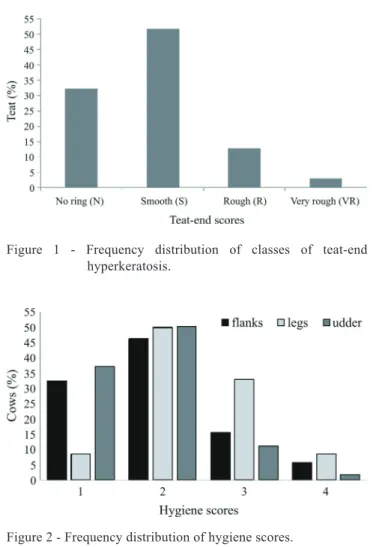
Regarding teat-end condition (Figure 1), only 12.9% of the teats were classified as rough (R) and 2.98% as very rough (VR). About one-third of the teats (32.3%) were assigned to the N class (no ring).
Average hygiene scores for flanks, legs and udders were 1.95±0.84, 2.42±0.77 and 1.77±0.71, respectively. Legs were the areas of the cow body most frequently scored as 3 and 4 (Figure 2).
Differences in outside temperatures were observed among the three periods of farm visits: mean values were 3.8 °C (with a minimum of −6.4 °C) in the cold season; 12.1 °C during the mild season, and 23.5 °C (with a maximum of 28 °C) in the hot season.
Milk production was influenced by season: the lowest production occurred during the mild season. Average DIM the three seasons were similar: 168±116 d in the cold, 181±124 d in the mild and 196±121 d in the hot seasons. Teat-end condition was significantly affected by season, with the worst result obtained during mild season (Table 2). Season significantly influenced cow cleanliness; in particular leg and flank hygiene scores were higher during the cold season. Also LSSCC was different (P<0.01) between the hot and mild seasons, with a higher value during the former.
The parity of cows enrolled in the study was on average 2.25±1.33. The percentage of cows with at least
one teat scored as R and VR was lower among primiparous cows than multiparous ones and the effect was significant (Table 3).
The stage of lactation had a significant impact (P<0.001) on teat-end condition; at the beginning of lactation (<100 DIM) the percentage of cows with at least one teat classified
Figure 1 - Frequency distribution of classes of teat-end hyperkeratosis.
Figure 2 - Frequency distribution of hygiene scores.
Table 1 - Characteristics of the herds in terms of percentages of primiparous cows, individual somatic cell count (SCC), teat-end conditions and hygiene scores
Farm Primiparous cows (% total) SCC>100,000 Teat-end conditions1 Udder hygiene score2 Leg hygiene score2 Flank hygiene score2
1 40.2 53.3 17.7 17.0 44.1 23.6
2 43.7 33.1 39.1 10.6 30.5 22.5
3 48.0 44.0 27.2 5.60 56.8 20.8
4 47.1 47.1 38.2 14.7 88.2 73.5
5 16.7 83.3 13.3 36.7 100 86.7
6 33.5 45.3 17.1 14.0 47.3 32.0
7 44.7 36.8 7.89 2.63 10.5 0
8 73.9 46.9 16.3 4.08 51.0 14.3
9 24.5 66.7 28.4 1.96 15.7 8.33
10 34.9 43.6 17.1 20.2 59.1 43.7
11 22.4 52.6 47.4 15.4 73.1 30.8
12 25.5 46.0 54.7 14.6 36.1 10.6
13 36.6 26.1 21.7 4.35 13.0 6.52
14 41.1 50.5 16.3 7.61 28.3 22.8
15 30.9 54.4 48.2 15.4 31.3 15.9
as R and VR was lower (19.9%) compared with mid and late lactation (27.2% between 100 and 200 DIM and 28.0% above 200 DIM).
Farms involved in the study performed different milking routines combining a variable number of milking practices: in particular eight farms executed pre-dipping, forestripping and post-dipping, three farms carried out forestripping and post-dipping, three farms adopted only post-dipping and one farm only pre-dipping. The lowest percentage of cows with at least one teat scored as R and VR, the best hygiene scores and the lowest milk LSSCC were found in the farms where more than one milking practice was performed (Table 4).
Multivariate logistic analysis was performed to identify the risk factors associated with SCC content in milk (Table 5). Among the variables analyzed, stage of lactation was an important risk factor: cows in late lactation (>200 days in milk) had higher risk to have SCC≥100,000 cells/mL than cows in early and mid lactation. Parity was associated with the risk of high SCC: multiparous cows have almost twice the risk of having SCC higher than 100,000 cells/mL than primiparous cows. Moreover, cows characterized by udder hygiene scores 3 or 4 had 1.5 times greater risk to have high SCC than cows with clean udders. Teat score was included in the model for LOGISTIC analysis but it did not overtake the threshold of significance of 10%.
Table 2 - Effect of season on teat-end condition, hygiene scores (means, non-parametric analysis), milk yield and Linear Score (Least squares means, GLM)
Season
SEM P-value
Cold Mild Hot
N observations 554 900 876
Teat-end condition (% cows)1 20.8±40.6 39.2±48.8 22.0±41.4 <0.001
Flank hygiene score (%)2 24.6±43.1 21.5±41.1 18.9±39.2 0.09
Leg hygiene score (%)2 54.6±49.8 34.5±47.6 40.7±49.2 <0.001
Udder hygiene score (%)2 10.4±30.5 15.1±35.9 11.9±32.4 <0.05
Fat-corrected milk (kg/d) 31.7a 28.6c 29.6b 0.393 <0.001
LSSCC 2.87ab 2.79b 3.03a 0.079 0.010
1 % of cow with at least one teat classified as rough or very rough. 2 % of 3+4 scores.
SEM - standard error of the mean; LSSCC - Linear Score.
Means in rows followed by different letters are significantly different (P<0.01).
Table 3 - Effect of parity on teat-end condition, hygiene score (means, non-parametric analysis), milk yield, and Linear Score (Least squares means, GLM)
Parity
SEM P-value
=1 >1
N observations 804 1,468
Teat-end condition (%)1 17.1±37.7 34.4±47.5 <0.001
Flank hygiene score (%)2 24.4±43.0 19.4±39.5 <0.05
Leg hygiene score (%)2 47.3±50.0 38.1±48.6 <0.001
Udder hygiene score (%)2 10.2±30.3 13.7±34.4 <0.05
Fat-corrected milk (kg/d) 28.7 30.6 0.329 <0.001
LSSCC 2.61 3.05 0.067 <0.001
1 % of cow with at least one teat classified as rough or very rough. 2 % of 3+4 scores.
SEM - standard error of the mean; LSSCC - Linear Score.
Table 4 - Effect of pre- and post-milking operations on teat-end condition, hygiene score (means, non-parametric analysis), milk yield, and Linear Score (Least squares means, GLM)
Pre- and post-milking operations
SEM P-value
one more than one
N observations 337 1,985
Teat-end condition (%)1 43.9±49.7 25.7±43.7 <0.001
Flank hygiene score (%)2 31.5±46.5 19.0±39.2 <0.001
Leg hygiene score (%)2 52.8±50.0 39.7±49.0 <0.001
Udder hygiene score (%)2 17.2±37.8 12.0±32.6 <0.01
Fat-corrected milk (kg/d) 24.5 32.0 0.576 <0.001
LSSCC 3.33 2.74 0.116 <0.001
1 % of cow with at least one teat classified as rough or very rough. 2 % of 3+4 scores.
Discussion
The results of teat-end condition scoring showed that the sum of worst classes of hyperkeratosis, R and VR, was 15.9%, similar to the result reported by Zucali et al. (2008) and lower than the target level of 20% recommended by Teat Club International (Mein et al., 2001). Neijenhuis (2004) observed 17% of R teats. The same author (Neijenhuis, 2004) reported also that teats without any callous ring had a higher risk of clinical mastitis compared with teats with a thin ring, because of the lack of the defense barrier provided by keratin. On the other hand, thicker hyperkeratosis increased the incidence of clinical mastitis.
Regarding cleanliness, average udder hygiene score was lower than leg and flank ones according to the results of Schreiner and Ruegg (2003).
Season influenced teat-end conditions and the worst result was during mild season. In Northern Italy, spring and fall are generally characterized by high environmental humidity, which could favor the presence of mud on the teats. As reported by Mein et al. (2001), when mud dries it draws moisture from the skin, which becomes less elastic and can get easily cracked. Other authors (Timms and Morelli, 2008) found significantly poorer teat condition during cold periods.
Significant seasonal effects were also obtained for cow cleanliness: flanks and legs were dirtier during the cold season than in the other ones. This result could be caused by the difficulty to keep cow bedding and alleys dry and clean during the rainy and snowy seasons, with the consequent increase in manure on legs and flanks (Zucali et al., 2011). No differences were found during different periods for udder hygiene score.
The higher LSSCC during mild season is in contrast with the results of some authors who recorded higher bulk milk SCC during summer, as a consequence of an increase in the proportion of chronic or new high individual cow SCC (Green et al., 2006; Olde Riekerink et al., 2007).
The effect of parity on teat-end condition could be associated with the differences in production level between primiparous and multiparous cows and, as a consequence,
with different milking durations (Shearn and Hillerton, 1996; Neijenhuis et al., 2000; Neijenhuis et al., 2001). Neijenhuis (2004) underlines that parity is one of the cow factors, with lactation stage and udder anatomy, that influences teat-end hyperkeratosis. Milk somatic cell count, expressed as LSSCC, was lower in first-parity cows than in multiparous ones, as found by many authors (Leavens et al., 1997; Schepers et al., 1997; Souza et al., 2005).
Teat-end condition deteriorated during lactation; this is partially in contrast with the observations of other authors (Neijenhuis et al., 2001; Gleeson et al., 2007) who reported an increase in teat-end callosity until 4-5 months of lactation and a decrease thereafter.
In this study the lowest milk LSSCC were associated with more than one milking practice. Pre- and post-dipping reduce milk SCC decreasing the risk of intramammary infections (Jayarao et al., 2004); forestripping removes the milk fraction characterized by the highest SCC (Sarikaya and Bruckmaier, 2006).
In our study the combination of various milking practices showed a positive effect on teat-end condition. Some authors (Gleeson et al., 2004; Neijenhuis, 2004) observed an increase in teat hyperkeratosis with the use of post milking disinfection, probably as a consequence of chemical irritation induced by some disinfectants.
Farms that carried out more than one milking practice had cows with better hygiene scores not only at udder level but also in terms of flank and leg cleanliness. This result suggests a special attention by the farmers both to milking routine and to the cleanliness of the cow environment (bedding materials, alleys).
The multivariate logistic regression confirms the results of previous studies that showed an increased risk of high SCC with stage of lactation (Laevens et al., 1997; Breen et al., 2009). Moreover, parity was associated with the risk of high SCC, as obtained by other authors (Laevens et al., 1997; Breen et al., 2009). Cow cleanliness, in particular udder hygiene score, was an important risk factor of high milk SCC, supporting the results of Schreiner and Ruegg (2003).
Among pre- and post-milking practices, pre-dipping was associated with lower risk of high SCC according to
Table 5 - Results of stepwise logistic regression for risk factors of somatic cell count ≥100,000 cells/mL
Effect Adjusted odds ratio1 95% Confidence interval P-value
Udder hygiene score, 3+4 vs 1+2 1.519 1.114-2.071 0.008
Pre-dipping, no vs yes 1.606 1.307-1.974 <0.0001
Days in milk, >200 d vs ≤100 d 1.980 1.556-2.52 <0.0001
Days in milk, >200 d vs 100-200 d 1.096 0.852-1.41 0.019
Parity, multiparous vs primiparous 1.917 1.563-2.352 <0.0001
1 Odds of SCC≥100,000 cells/mL.
the results of Jayarao et al. (2004). No association was obtained between teat-end hyperkeratosis and SCC as reported by Shearn and Hillerton (1996).
Conclusions
Teat-end and hygiene scoring are easy and quick methods, which can give clear and noticeable information about teat condition and cow cleanliness of the herd. They are also useful indicators of the quality of management and the welfare of the herd.
Teat-end score, hygiene scores and milk somatic cell count show important variations among seasons and are influenced by parity, stage of lactation and milking practices.
Multivariate logistic analysis confirmed that cow traits, such as parity and days of lactation, significantly influence the risk of high somatic cell count in milk. Among environmental and management aspects, clean udders and pre-dipping are associated with reduced risk to have milk somatic cell count greater than 100,000 cells/mL. Teat-end score does not seem to be a risk factor of high somatic cell count.
Milk somatic cell count can be lowered by means of simple actions such as improvement of hygiene condition of cow environment and adoption of pre-dipping.
Acknowledgments
The research was supported by Plan for Research and Development, Region of Lombardy, Italy. Project no. 1242. The authors would like to thank Dr. L. Zanini (Associazione Regionale Allevatori della Lombardia) and Dr. P. Roveda (Dipartimento di Scienze Agrarie e Ambientali, Università degli Studi di Milano, Italy) for their valuable technical support. The authors also thank Santangiolina Latte Fattorie Lombarde Società Agricola Cooperativa and the farmers involved in the study for their collaboration and for providing data.
References
ARPA - Agenzia Regionale per la Protezione dell’Ambiente in Lombardia. 2009.Available at: <http://ita.arpalombardia.it/meteo/ meteo.asp>. Accessed on: Jan 20, 2012.
Bava, L.; Sandrucci, A.; Tamburini, A.; Brasca, M.; Vanoni, L. and Zucali, M. 2011. Milk hygiene at the farm: effects of management and environmental factors. Scienza e Tecnica Lattiero-casearia 62:75-84.
Breen, J. E.; Bradley, A. J. and Green, M. J. 2009. Quarter and cow risk factors associated with a somatic cell count greater than 199,000 cells per milliliter in United Kingdom dairy cows. Journal of Dairy Science 92:3106-3115.
Ellis, K. A.; Innocent, G. T.; Mihm, M.; Cripps, P.; McLean, W. G.; Howard, C. V. and Grove-White, D. 2007. Dairy cow cleanliness and milk quality on organic and conventional farms in the UK. Journal of Dairy Research 74:302-310.
Espeche, M.; Pellegrino, M.; Frola, I.; Larriestra, A.; Bogni, C. and Nader-Macias, M. E. 2012. Lactic acid bacteria from raw milk as potentially beneficial strains to prevent bovine mastitis. Anaerobe 18:103-109.
Gleeson, D. E.; Meaney, W. J.; O’Callaghan, E. J. and Rath, M. V. 2004. Effect of hyperkeratosis on somatic cell counts of dairy cows. International Journal of Applied Research in Veterinary Medicine 2:115-122.
Gleeson, D. E.; O’Brien, B.; Boyle, L. and Earley, B. 2007. Effect of milking frequency and nutritional level on aspects of the health and welfare of dairy cows. Animal 1:125-132.
Green, M. J.; Bradley, A. J.; Newton, H. and Browne, W. J. 2006. Seasonal variation of bulk milk somatic cell counts in UK dairy herds, investigations of the summer rise. Preventive Veterinary Medicine 74:293-308.
Huijps, K.; Hogeveen, H.; Lam, T. J. G. M. and Oude Lansink, A. G. J. M.2010. Costs and efficacy of management measures to improve udder health on Dutch dairy farms. Journal of Dairy Science 93:115-124.
Jayarao, B. M.; Pillai, S. R.; Sawant, A. A.; Wolfgang and D. R. and Hegde, N. V. 2004. Guidelines for monitoring bulk tank milk somatic cell and bacterial counts. Journal of Dairy Science 87:3561-3573.
Köster, G.; Tenhagen, B. A. and Heuwieser, W. 2006. Factors associated with high milk test day somatic cell counts in large dairy herds in Brandenburg. I. Housing conditions. Journal of Veterinary Medicine Series A 53:134-139.
Leavens, H.; Deluyker, H.; Schukken, Y. H.; Meulemeester, L.; Vandermeersch, R.; Muêlenaere, E. and Kruif, A. 1997. Influence of parity and stage of lactation on the somatic cell count in bacteriologically negative dairy cows. Journal of Dairy Science 80:3219-3226.
Mein, G. A.; Neijenhuis, F.; Morgan, W. F.; Reinemann, D. J.;
Hillerton, J. E.; Baines, J. R.; Ohnstad, I.; Rasmussen, M. D.; Timms, L.; Brit, J. S.; Farnsworth, R.; Cook, N. and Hemlin, T. 2001. Evaluation of bovine teat condition in commercial dairy herds. 1. Non-infectious factors. p.347-351. In: Proceedings of the AABP-NMC International Symposium on Mastitis and Milk Quality. Vancouver, BC, Canada.
Neijenhuis, F.; Barkema, H. W.; Hogeveen, H. and Noordhuizen, J. P. T. M. 2000. Classification and longitudinal examination of callused teat ends in dairy cows. Journal of Dairy Science 83:2795-2804. Neijenhuis, F.; Barkema, H. W.; Hogeveen, H. and Noorhuizen, J. P. T.
M. 2001. Relationship between teat-end callosity and occurrence of clinical mastitis. Journal of Dairy Science 84:2664-2672. Neijenhuis, F. 2004. Teat condition in dairy cows. Thesis (PhD).
Utrecht University, Utrecht.
Olde Riekerink, R. G. M.; Barkema, H. W. and Stryhn, H. 2007. The effect of season on somatic cell count and the incidence of clinical mastitis. Journal of Dairy Science 90:1704-1715.
Paduch, J. H.; Mohr, E. and Krömker, V. 2012. The association between teat end hyperkeratosis and teat canal microbial load in lactating dairy cattle. Veterinary Microbiology 158:353-359. Reinemann, D. J.; Bade, R. D. and Thompson, P. D. 2008. Method for
assessing teat and udder hygiene. Paper No. 083796. In: ASABE
Annual International Meeting.Providence, Rhode Island.
Sandrucci, A.; Tamburini, A.; Bava, L. and Zucali, M.2007.Factors affecting milk flow traits in dairy cows, results of a field study. Journal of Dairy Science 90:1159-1167.
Sarikaya, H. and Bruckmaier, R. M. 2006. Importance of the sampled milk fraction for the prediction of total quarter somatic cell count. Journal of Dairy Science 89:4246-4250.
Schepers, A. J.; Lam, T. J. G. M.; Schukken, Y. H.; Wilmink, J. B. M. and Hanekamp, W. J. A. 1997. Estimation of variance components for somatic cell counts to determine thresholds for uninfected quarters. Journal of Dairy Science 80:1833-1840.
Schreiner, D. A. and Ruegg, P. L. 2003: Relationship between udder and leg hygiene scores and subclinical mastitis. Journal of Dairy Science 86:3460-3465.
Shearn, M. F. H. and Hillerton, J. E. 1996. Hyperkeratosis of teat duct orifice in the dairy cow. Journal of Dairy Research 63:525-532. Souza, G. N.; Brito, J. R. F.; Brito, M. A. V. P.; Moreira, E. C. and Da
Silva, M. V. G. B. 2005. Factors affecting somatic cell counts SCC in brasilian dairy cows. p.237-240. In: Proceedings of the 12th International Congress on Animal Hygiene, Warszaw, Poland.
Timms, L. L. and Morelli, J. 2008. Teat end and skin conditioning evaluation of two experimental heptanoic acid teat dips during winter. Animal Industry Report: AS 654, ASL R2315. Available at: <http://lib.dr.iastate.edu/ans_air/vol654/iss1/64>. Accessed on: May 15, 2014.
Wiggans, G. R. and Shook, G. E. 1987. A lactation measure of somatic cell count. Journal of Dairy Science 70:2666-2672.
Zecconi, A.; Piccinini, R.; Casirani, G.; Binda, E. and Migliorati, L. 2003. Effects of automatic milking system on teat tissues, intramammary infections and somatic cell counts. Italian Journal of Animal Science 2:275-282.
Zecconi, A. and Di Bella, L. 2013. La mastite costa più di 300 euro a capo. Informatore agrario 69.Suppl. al n. 29: Stalle da latte: 23-26. Zucali, M.; Reinemann, D.J.; Bade, R. D. and Tamburini, A. 2008. Effects
of liner compression on teat-end hyperkeratosis. Paper No. 083798. In: ASABE Annual International Meeting. Providence, Rhode Island.