Development and Evaluation of Growth Strategies
for a Lisbon Based Startup
MANUEL MÜLLER-OST
Student-ID: 2441A Project carried out on the International Masters in Management Double Degree Program, under the supervision of:
Luís Manuel da Silva Rodrigues
Lisbon, May 12, 2017
Manuel Müller-Ost
Gabriele-Münter-Str. 10, 51375 Leverkusen, Germany Phone: +49 177 274 0571
Abstract
Wine With a View is a Portuguese startup company, which sells wine by the glass at tourist attractions in the metropolitan area of Lisbon. Due to the local popularity and estimated potential of other locations, the management is striving to grow the business. For this purpose, an individual framework of growth strategies was developed. A scoring model, based on carefully selected criteria to determine the fit of strategies with company resources, concluded in the recommendation of a product line extension and an organic, domestic expansion strategy, while franchising was determined not to be a feasible option in the near future.
Key words
startup, growth strategies, organic growth, franchising
Table of Figures
Figure 1: Profit and Loss Statement 2016 ...5
Figure 2: Growth Ambitions of Wine With a View ...8
Figure 3: Ansoff-Matrix ...8
Figure 4: Innovation Ambition Matrix ...9
Figure 5: Internal and External Growth Strategies ... 10
Figure 6: SWOT-Analysis of Wine With a View ... 12
Figure 7: Wine With a View's Key Resources ... 12
Figure 8: Growth Readiness of Wine With a View... 13
Figure 9: Growth Options for Wine With a View ... 15
Figure 10: Example Growth Strategy of the Core Category... 15
Figure 11: Exemplary Evaluation of a Core Strategy for Growth Goal 1 ... 17
Figure 12: High Potential Growth Strategies for Wine With a View ... 17
Table of Contents
1. Introduction ...4
2. Methodology ...4
3. About Wine With a View...5
3.1 Company Overview ...5
3.2 Industry Analysis ...6
3.3 Growth Ambitions ...7
4. Literature Review ...8
4.1 Growth Strategies ...8
4.2 Evaluation of Growth Readiness ... 11
4.2.1 SWOT-Analysis ... 11
4.2.2 Organizational Resource Platform ... 12
4.2.3 Readiness for Growth Index Analysis ... 13
4.2.4 Further Considerations ... 13
5. Development of Growth Strategies for Wine With a View ... 14
5.1 Framework Development ... 14
5.2 Growth Strategy Evaluation ... 16
5.3 Interpretation of the Scoring Model... 17
6. Strategy Development ... 18
6.1 Product Line Extension ... 18
6.2 Geographic Expansion in Portugal ... 20
6.2.1 Evaluation of Potential Locations ... 20
6.2.2 Illustration of a High-Potential Location ... 21
6.3 Expansion in Europe via Franchising ... 22
6.3.1 Suitability of Franchising for Wine With a View ... 22
6.3.2 Selection of a Franchising Structure ... 24
1. Introduction
The Portuguese startup company Wine With a View sells wine by the glass to visitors of tourist attractions in Lisbon through mobile point-of-sales. With its unique business concept, the company was able to grow within the last years and is now striving to expand its operations locally, domestically and internationally, which is reflected in three distinct growth goals as outlined by the founder and CEO. However, the company did not yet identify the most suitable growth strategies to realize its ambitions. Therefore, the goal of this work project report is to recommend growth strategies, which allow the company to achieve its growth goals with its individual set of resources, capabilities and aspirations. For this purpose, after providing the reader with an overview of the company and its industry, this report will review different classifications of growth strategies as well as suitable tools to measure the growth readiness of a company. Based on this, an individual growth strategy framework for Wine With a View will be developed. After that, a scoring model will evaluate these strategies and identify the most promising ones, with regard to the company’s resources and ambitions. In the last step, this report will develop these strategies in more detail, providing Wine With a View with concrete, pursuable steps towards the achievement of its growth ambitions.
2. Methodology
The following analysis of internal company resources was aided by primary research in the form of interviews with the CEO and employees as well as the analysis of internal data. Secondary research was conducted by reviewing the relevant literature on growth strategies as a basis for the development of an individual framework and strategy scoring model for Wine With a View. Furthermore, for the evaluation and development of high potential growth strategies, databases such as Euromonitor International, the International Monetary Fund or the Portuguese National Institute of Statistics were consulted.
3. About Wine With a View
3.1 Company OverviewWine With a View is a Portuguese startup company, which was founded in Lisbon in 2014. The company sells wine by the glass at touristic sights and monuments in the metropolitan area of Lisbon, Portugal, through mobile wine bars. Wine With a View was founded by Bárbara Vidal de Moraes with the vision of creating a unique experience for tourists in Portugal, leveraging on the popularity of Portuguese wines among visitors as well as the convenient positioning of its wine bars at frequently visited tourist attractions (Vidal de Moraes, 2017a).
The product portfolio of Wine With a View consists of the product lines (1) wines, (2) glasses, and (3) snacks. The wine category includes Red Wine, White Wine, Vinho Verde, Rosé, Sparkling Wines, Port Wine, Madeira Wine and Moscatel with a total number of around 30 products. Visitors receive the purchased wine in a hard-plastic glass with the company’s logo on it. They can take it home as a souvenir or get a discounted refill at any of the existing wine bars in the city. The company sells glasses for wine and Champagne. In addition to that, visitors can choose from a selection of snacks like crackers or fruits. Appendices 1-3 illustrate the company’s point-of-sale as well as the product portfolio (Wine With a View, 2017b).
The mobile wine bars, which are three-wheeled converted motorcycles of the manufacturer Famel, are the main of-sales of Wine With a View. Starting off in 2014 with one point-of-sales in 2014, the company currently operates three mobile wine bars in Lisbon at the locations (1) St. George Castle, (2) Belem Tower and (3) Padrão dos Descobrimentos. Figure 1 illustrates the profit and loss statement of the company for 2016.
In 2016, the company generated 258.662€ in revenues with an EBITDA margin of 15%. The presented financial data reflects the strong seasonality of the business, with the strongest month October exposing revenues 4,27 times higher than the weakest month January. In addition to that, the three point-of-sales exhibit a different level of profitability (Wine With a View, 2017b). In March 2017, the company launched an online shop due to its visitors’ requests to re-purchase the locally bought products, generating a revenue of 380€ in the first three weeks after launch by selling products of the wine and glasses category (Wine With a View, 2017b). Furthermore, the company recently decided to offer a franchising opportunity and frequently receives related inquiries through its website. However, neither a concrete franchising concept nor a detailed evaluation of franchising against other growth strategies has been developed yet (Vidal de Moraes, 2017a). One goal of this report is, therefore, the evaluation of the franchising opportunity compared to other potential growth strategies.
Wine With a View purchases its products mainly from large, specialized beverage distributors like Bacalhôa or Garrafeira Nacional. However, some products like Madeira wines are directly purchased from the producing company.
The founder Bárbara Vidal de Moraes acts as the CEO of the company, assisted by a part-time operations manager responsible for purchasing and procurement. The sales force of the company consists of seven employees who operate the mobile wine bars. In addition to that, two business students were temporarily employed for the setup and launch of the company’s online shop (Wine With a View, 2017a).
3.2 Industry Analysis
Using the mobile wine bars as its main point-of-sales, Wine With a View can be classified as a company within the consumer foodservice, more precisely the street stall/ kiosk industry. In 2015, this industry in Portugal consisted of 4.165 sale outlets, generating 125,3 million Euros in revenues. 97% of these revenues were generated by independent players, while 3% were
achieved by chained outlets. While the latter mainly distribute coffee and bakery products, independent players cover a wide range of food products. In terms of beverages, the product offer mostly consists of beer, tea, juice, soda or water. The industry is expected to grow by around 2% annually until 2020 due to the growing number of young tourists and the increasing demand for convenient and informal food or drink options. Wine products, which are distributed only occasionally in the centers of large cities, are expected to gain in sales value (Euromonitor International, 2017c). Appendix 4 illustrates the analysis of Porter’s Five Forces, which reveals that Wine With a View does not face any direct competition due to the uniqueness of its business concept and customer value proposition. Buyers see a high level of differentiation from distributors of substitute products like coffee, beer, ice cream, soft drinks or water. As a premium brand with a distinctive product portfolio, Wine With a View does not participate in the mainly price focused competition in the street stall market and targets a different group of customers than full-service restaurants, cafés or bars.
3.3 Growth Ambitions
Due to the popularity of the business concept, Wine With a View could already expand its business locally to a total number of three point-of sales. However, as revealed by the financial data presented in chapter 3.1, the company recognizes the need to consolidate the local business in the nearest future as a basis for further growth. As a mid-term goal, the company is striving to expand its business to other destinations in Portugal due to the estimated attractiveness of locations with similar conditions as existent in the home market. Furthermore, in the long run, Wine With a View sees potential to expand to another European country, which is based on, among other factors, the frequently received inquiries to open franchised Wine With a View point-of-sales abroad. Despite having defined these three broad growth ambitions, the company lacks a clear vision of available and suitable growth strategies to pursue. In addition to that, the suitability of the franchising opportunity, which is currently offered by the company, has not
yet been evaluated in comparison to other growth options. Figure 2 summarizes the presented growth ambitions as a basis for the further analyses conducted within this report.
Time Horizon Growth Goal
Short-Term Consolidate + Grow Lisbon
Mid-Term Expand in Portugal
Long-Term Expand to Europe
Figure 2: Growth Ambitions of Wine With a View (own elaboration)
4. Literature Review
To provide a deeper understanding of available growth options as a basis for the development and evaluation of concrete strategies, the first part of this chapter aims to identify and present frameworks of growth strategies suggested by related literature. Since growth options need to be carefully evaluated regarding the fit with a company’s unique resources, external factors and goals of the entrepreneur (Bhide, 1996), the second part of this chapter presents and applies several tools to identify the company’s resources and readiness for growth.
4.1 Growth Strategies
One of the most well-known frameworks for growth strategies and the basis for several other approaches is the Ansoff-Matrix, developed by H. Igor Ansoff in 1957. Due to the combination of existing/ new products with existing/ new markets, Ansoff identifies four general growth strategies, which are illustrated in Figure 3.
Existing Product New Product Existing Market Market Penetration Product Development
New Market Market Development Diversification Figure 3: Ansoff-Matrix (own elaboration of Ansoff, 1957)
The path of market penetration consists of all means to increase the sale of existing products to existing customers, such as opening a new retail outlet or introducing promotion campaigns. Pursuing market development means that a company is looking to increase sales of existing products in a new market, which could take the form of targeting a new demographic or geographic market or also introducing new distribution channels. Product development describes the practice of marketing a new product to an existing market. Adding product lines
to the existing portfolio or extending the company’s brand are possible means to follow this strategy. Finally, diversification aims to grow a company by starting a new venture or acquiring a business in an area beyond the current products and markets of a company (Ansoff, 1957).
Kotler made an extension to the Ansoff-Matrix by stating that the modification of a product can already have a positive impact on the market share of a company. Therefore, his framework, illustrated in Appendix 5, introduces the modified product category. Furthermore, it makes a distinction between new or existing geographic markets, stating that the same type of customer can be targeted in another geographic area, effectively offering growth potentials for the company (Kotler, 2014).
To make Ansoff’s approach more suitable for today’s companies and their dynamic environment, Nagji and Tuff (2012) developed the Innovation Ambition Matrix. Its primary goal is to overcome Ansoff’s binary choice between existing or new products and markets. Therefore, this framework, illustrated in Figure 4, introduces the key dimensions where to play, which resembles the choice of market in the
Ansoff-Matrix, and how to win, which refers to the company’s product portfolio. The main difference to Ansoff’s model is that any value on each axis can be chosen and pursued by a company, which creates a variety of growth options. The framework introduces three distinct levels of distance to the company’s current reality, depending on the degree of change to
markets and products. By selling existing products to existing markets and customers, a company stays within the core level of distance. Making incremental changes to the products offered or selling these to slightly altered markets, a company finds itself in an adjacent distance relative to its starting point. The transformational level of distance is reached when the Figure 4: Innovation Ambition Matrix
company develops new products to target new markets or even acquires a new business beyond its former focus (Nagji & Tuff, 2012).
Another relevant approach to classify growth strategies is the distinction between internal and external growth strategies, which is, inter alia, described by Barringer and Ireland (2014). On the one hand, internal strategies are herein characterized as actions, which can be taken by the firm itself. On the other hand, external growth strategies are characterized as the establishment of relationships with external parties, while other product-related strategies include improving an existing product, market penetration, product line extension and geographic expansion. Figure 5 illustrates the framework, which, in contrast to the universal model of Ansoff, suggests concrete efforts for growth.
Internal Strategies External Strategies
• New product development • Other product-related strategies • International expansion
• Mergers & acquisitions • Licensing
• Strategic alliances and joint ventures • Franchising
Figure 5: Internal and External Growth Strategies (Barringer & Ireland, 2014)
In their study on effective growth paths for SMEs, Wakee, Van der Veen and Eurlings (2015) identified ten distinct growth paths. They make an addition to the already presented strategies by stating that increasing efficiency is an approach frequently pursued by small and medium-sized companies (SMEs) although it has only a limited impact on growth and can rather be interpreted as a strategy for market consolidation.
Apart from the assessment of relevant literature on growth strategies, a review of the currently applied approaches of strategy consultancies has been conducted. Analyzing the approaches of The Boston Consulting Group (BCG), strategy&, which is the strategic consulting department at PwC, as well as McKinsey & Company, it was found that all approaches make use of the distinct levels of growth as suggested by the previously described Innovation Ambition Matrix. The framework of strategy& adds an additional level of growth, namely geographic expansion (PwC, 2017). BCG makes the most concrete suggestions in terms
of growth strategies by providing six distinct strategies: (1) corporate product portfolio, (2) go-to-market transformation, (3) geographic expansion, (4) innovation, (5) mergers and acquisitions and (6) business model innovation. In addition to that, BCG suggests organizational growth enablers, which are described as a necessary organizational basis for growth rather than a distinct growth strategy (The Boston Consulting Group, 2017).
4.2 Evaluation of Growth Readiness
Every business has its individual story, resources, personalities and vision (Shah, et al., 2013). An extensive review of related literature suggests, that there is no “one-fits-all” approach and that the selection of a growth strategy is ultimately dependent on the individual situation and ambition of a company. However, the universal advice is to deeply analyze each strategy’s implications for each type of a company’s resources. For this purpose, this chapter provides several tools to analyze the company’s resource basis and growth readiness.
4.2.1 SWOT-Analysis
A SWOT-Analysis, which was developed by Albert Humphrey in 1964 at Stanford University as a corporate planning tool, is an instrument to analyze the internal strengths and weaknesses as well as the external opportunities and threats of a company (Witcher & Chau, 2010). As a basis for the further analysis of potential growth strategies for Wine With a View, a SWOT-Analysis has been conducted through interviews with the founder, employees and on the basis of confidential data. On the one hand, the results, which are shown in Figure 6, exhibit some great strengths and potentials to grow the business, such as the quality of products and services, the company’s social media activity and the potential of benefiting from increasing tourism numbers. On the other hand, the company exhibits a lack of management expertise, poor internal communication practices and faces the threat of market entry through established companies with a larger resource base.
Strength Opportunities
• First mover advantage for Lisbon locations • Passion and commitment of founder
management
• Quality of products and certified service • Reputation and customer satisfaction • Unique customer experience • Social media presence and fan base • Readily available online shop • Mobility of point-of-sales
• Visitors’ requests to rebuy products online • Increasing tourism in Portugal
• Increasing interest in wine tastings and food matching
• Franchising inquiries from different countries
• Popularity of Portuguese wine among visitors
• Visitor requests for more substantial food • Relatively low price of Portuguese wine • Large social media fanbase
Weaknesses Threats
• Lack of management education + expertise • Poor internal communication practices • Dependency on distributors
• Low level of operational control
• Seasonality of business due to dependency on weather conditions
• High shipping costs for online purchases • High initial costs for setting up a new wine
bar
• Competition through pop-up stores for substitute products at tourist attractions • Tough price competition with other online
distributors
• Risk of market entry by large, well-established company with significantly larger resource base (e.g. distributor)
• Seasonality of the business poses a limitation for expansion
Figure 6: SWOT Analysis of Wine With a View (Wine With a View, 2017b) 4.2.2 Organizational Resource Platform
The organizational resource platform is a tool to identify the resources of a company as the basis for the development of a sustainable competitive advantage according to the Resource Based View by Grant (1991). For this report, the evaluation of key resources, consisting of competences, specialized assets or relationships shall serve as a basis for the further evaluation of growth strategies. Each type of resource was therefore analyzed in terms of strategic importance of the resource as well as relative strength, which poses an estimation of the company’s performance in each category. Figure 7 shows the outcome of this approach, which identifies that the location of its mobile wine bars is the most valuable resource for the business concept of the company. The full analysis of key resources can be reviewed in Appendix 7.
Key Resource Strategic Importance Estimated Strength
1. Point-of-Sales Location 2. Product + Service Quality 3. Point-of-Sales Uniqueness 4. Sales License Possession
10 9 8 8 10 9 10 8 Figure 7: Wine With a View's Key Resources (own elaboration)
4.2.3 Readiness for Growth Index Analysis
The Fit for Growth Index Profiler was developed by strategy& and is a tool to measure the organizational growth readiness of a company. With a 25-question survey directed to the top management, the tool evaluates the clarity of a company’s strategy, how well resources are aligned and to which extent the organization supports growth. (PwC, 2016). For the purpose of this work project, the survey was answered by the founder of Wine With a View. The tool identified Wine With a View as a distracted company, which means that the strategy of the company is not clearly defined, capabilities and resources are not optimally prioritized and functional objectives are not consciously aligned to the strategy. However, some differentiating capabilities are considered moderately robust. Figure 8 shows an overview of the results, which emphasize that Wine With a View currently does not possess a clearly defined approach how to grow and realize its defined ambitions. For more information on the distinct archetypes of companies in terms of growth readiness, please review Appendix 8.
Category Score
Clarity of Business Strategy
Alignment of Resources with Strategy Supported and Focused Organization
3,2/5 3,2/5 2,4/5
Figure 8: Growth Readiness of Wine With a View (own elaboration of PwC, 2016) 4.2.4 Further Considerations
For the further evaluation of growth strategies, the previously conducted analyses of key resources and growth readiness will be considered as relevant criteria. In addition to that, to allow a detailed analysis of a strategy’s fit to each type of company resources, the classification according to the Resource Based View will be adopted. It divides company resources in (1) financial, (2) human, (3) organizational, (4) physical and (5) technological resources (Steinmann & Schreyögg, 2005). The outcome of the SWOT analysis, as well as confidential company data will be considered to evaluate each of these resources, regarding that strategic,
financing and internationalization capabilities should have the strongest influence on the choice of a growth strategy (Wakkee, et al., 2015).
5. Development of Growth Strategies for Wine With a View
Based on the review of growth strategy frameworks in chapter 4.1, the first part of this chapter will develop an individual framework of growth options for Wine With a View. In the second part, a scoring model will be developed to evaluate these strategies considering the company’s resources and growth readiness, as presented in chapter 4.2.
5.1 Framework Development
The goal of this chapter is the development of a holistic framework of growth options for Wine With a View. Therefore, to overcome the limitations of the Ansoff-Matrix (Figure 3) and to provide a wide range of growth options independent from defined growth goals, four levels of growth were introduced, based on the presented Innovation Ambition Matrix (Figure 4) and the framework of PwC (Appendix 6). These growth levels were determined to be (1) core, (2) adjacent, (3) geographic expansion and (4) transformational with the following definitions: (1) The core business is defined as the currently conducted business in the metropolitan area of Lisbon, selling the previously described products to visitors of the mobile wine bars. Therefore, the developed strategies aim to grow or consolidate the company’s core activities. (2) Adjacent includes all strategies which are closely related to the core, but include adjustments to the product portfolio, target segment or distribution channel. (3) The level of geographic expansion considers all strategies which aim to multiply the existing business model of Wine With a View either domestically or internationally, while (4) the transformational level consists of strategies which embrace totally new capabilities and business models of the firm.
To develop a deeper understanding of growth options, each strategy was assigned concrete potential steps, an indication on the internal or external nature of the strategy as suggested by Barringer and Irvine (2014), as well as foreseeable implications. In addition to that, as proposed
by The Boston Consulting Group (2017), the framework implements success factors for each strategy. All other presented frameworks were considered as complements, relating the suggested strategies to the defined levels of growth. Figure 9 illustrates an overview of the strategies that were developed within several workshops with the founder, operations manager, sales force, as well as two working students.
Category Developed Strategies
Core
• New Point of Sales • Efficiency Improvement • Increased Capacity Utilization • Price Promotions
• Product Line Extension
• Point-of-Sales Modification • Product Bundling
• Increased Promotion • Loyalty Schemes
Adjacent
• New Target Segments • New Product Line
• New Distribution Channels
• New Price Segments • Brand Extension
Geographic Expansion
• Franchising • Licensing
• Geographic Expansion Domestic • Geographic Expansion International
Transformational
• Business Model Innovation • Merger
• Acquisition
• Joint Venture • Strategic Alliance • Technology
Figure 9: Growth Options for Wine With a View (own elaboration)
For a better comprehension of the developed framework, Figure 10 illustrates this approach at the example of the new point of sales strategy. By opening a new wine bar at high potential locations in Lisbon, this strategy implies growing the current business model of the company and can, therefore, be classified as a core strategy. It is an internal strategy, which will contribute to the company’s local growth and requires financial resources and additional sales personnel to execute, while its success is dependent on the location and the possession of a sales license. The complete list of likewise elaborated strategies can be reviewed in Appendix 9.
Growth
Category Strategy Potential Steps
Internal / External Implications / Comment Growth Enablers Core New Point of Sales
Open additional wine bars at high potential locations. Examples: Miradouro da
Senhora du Monte, Miradouro de S. Pedro do
Alcantara
Internal
Will increase sales, local market share and
brand awareness. Requires initial setup
costs and sales personnel. Additional sales license required.
Selection of location, quality of products and service, sales license Figure 10: Example Growth Strategy of the Core Category (own elaboration)
5.2 Growth Strategy Evaluation
Based on the extensive list of growth paths and the developed in-depth understanding for each strategy and its implications, the next step of this analysis is the evaluation of each of the presented strategies considering the fit with the key resources, capabilities and growth ambitions of Wine With a View. The tool used for this evaluation is a modified version of the GE-McKinsey-Matrix, which was developed by McKinsey to support investment decisions by assessing an industry’s attractiveness, as well as the competitive strength of a business unit within that industry (McKinsey & Company, 2008). For assessing the developed growth strategies, the dimensions of the framework were modified as follows: (1) Attractiveness was introduced to measure, to which extent a strategy fits the identity and ambitions of the company. Therefore, the criteria for the attractiveness are growth goal effectiveness, brand fit and founder fit. (2) Feasibility of a strategy reflects, to which extent a strategy is executable, given the company’s individual set of resources. Therefore, as introduced in chapter 4.2, the fit with organizational key resources and growth readiness was considered. In addition to that, the fit with financial, human, physical, as well as technological/ know-how resources was determined. Since the company defined three broad growth ambitions, as illustrated in chapter 3.3, each strategy’s attractiveness and feasibility was evaluated in terms of attractiveness and feasibility for each growth goal on scale from 1 to 5. Figure 11 illustrates this approach at the previously used example of a new point of sales strategy. Since it highly contributes to the local growth of the company, is coherent with the brand identity and corresponds to the founder’s preferences, this strategy scored the maximum value in terms of attractiveness. However, the strategy is not equally feasible. On the one hand, this is due to the implied financial investments for the setup of a new wine bar. On the other hand, and more severely, the availability of one of Wine With a View’s key resources cannot be ensured, since the municipality of Lisbon currently does not issue public sales licenses to companies (Vidal de Moraes, 2017a).
Figure 11: Exemplary Evaluation of a Core Strategy for Growth Goal 1 (own elaboration) By conducting this approach for each strategy and growth goal, the most promising strategies were determined and illustrated in Figure 12. Chapter 5.3 will discuss the outcome in more detail. To review the evaluation of developed growth strategies, please see Appendices 10-13.
Growth Goal Growth Strategies Attractiveness Feasibility
1. Consolidate & Grow Lisbon Product Line Extension 4 5 2. Expand in Portugal Geographic Expansion Domestic 5 4
3. Expand to Europe Franchising 4 3
Figure 12: High Potential Growth Strategies for Wine With a View (own elaboration) 5.3 Interpretation of the Scoring Model
The previous chapter identified the strategies, which are most suitable to achieve the distinct growth ambitions of the company. Despite the considerable number of developed strategies, only few show a sufficient level of both attractiveness and feasibility. Product line extension was determined to be the most attractive strategy for consolidating the local business in Lisbon, since it is consistent with the brand of the company and requires only a low level of investment. In addition, it allows to fully leverage on the existing key resources of the company, as identified in chapter 4.1.2. Several other strategies, as for example price promotions, exhibit a high level of feasibility, but cannot be considered further due to the lack of fit with the premium brand of the company or the personal preferences of the founder. For the goal of expanding in Portugal, geographic expansion in an organic way was evaluated to be the most promising strategy. The reason for this is that other cities in Portugal might offer similarly attractive locations, which was identified as the most important resource of Wine With a View. However, this strategy also implies a high level of initial financial expenses for the setup of a new wine bar and an adequate operational infrastructure. For the long-term goal of expanding to another
requirements of an international expansion, especially in terms of financial, human and intellectual resources, are too demanding to realize with Wine With a View’s own resources. However, in both attractiveness and feasibility, franchising does not reach the maximum score. Therefore, in the following chapter, the suitability of franchising and thus the attainability of the defined growth goal will be further evaluated.
6. Strategy Development
6.1 Product Line ExtensionA product line extension strategy is defined as adding additional products to an already existing product line with the goal of competing more broadly in an industry (Lamb, et al., 2011). It was determined to be a very attractive and feasible strategy for Wine With a View to grow and consolidate the core business in Lisbon, because it is easily implementable, requires only a low level of financial resources and is aligned with the existing key resources of the company.
A product line extension could be a powerful strategy to tackle the different levels of profitability among the current point-of-sales, which were revealed by the financials (chapter 3.1) and other confidential data (Wine With a View, 2017b). A lower profitability is herein observable for the locations Belem Tower and Padrão dos Descobrimentos, located at the Tagus river. Despite similar visitor numbers and popularity among visitors (TripAdvisor, 2017d), these locations exhibit a lower average order value compared to the location at St. George Castle, Wine With a View’s main location.
A promising strategy to increase the average stay of customers, the average order value and overall profitability of these locations could be the extension of the snack offer, which is currently very limited compared to the variety of wines.
Two highly feasible ways to implement this strategy were identified. Firstly, with regard to the physical limitations of preparing food at the point-of-sales, Wine With a View could purchase ready-made products directly from a supplier. Suitable products would be for example
breads, olives, typical Portuguese chorizo sausage or azeitão cheese, which could make up a snack menu as a matching complement to the offered wines. This approach can be realized easily, since these products only require little additional equipment at the point of sales, while no food preparation know-how is needed. However, it can be assumed, that this approach will only have a limited impact on the previously described circumstances.
Secondly, Wine With a View could partner with a local restaurant and make a co-marketing agreement, which can be defined as a joint marketing effort to promote different products in an allied marketing campaign (Kurtz, 2010). This could take the form that Wine With a View sells food, prepared and provided by a local restaurant in exchange for promotional efforts conducted by Wine With a View or an agreed percentage of generated revenues. This would allow Wine With a View to offer its visitors more substantial food without being responsible for its preparation. However, the handling and sale of these dishes needs to be manageable at the point-of-sales. For example, the typical Portuguese soup Caldo Verde could be a suitable dish, since it only requires few additional equipment at the point-of-sales. In addition to that, it would enrich Wine With a View’s portfolio of typical local products and could contribute to an increased average order value.
The impact of these strategies can be easily tested by establishing the described ways of product line extension at one of the locations at the river, which offer attractive conditions for this endeavor due to a high level of accessibility. In addition to that, these locations offer the potential of slightly modifying the point-of-sales by positioning chairs and bistro tables around the wine bar. Such a step would require additional financial resources, but could, in synergy with the described product line extensions, contribute to increase the average residence time of visitors at the point-of-sales and potentially the average order value at these locations. As a result, the described steps potentially compensate the different levels of profitability and contribute to the consolidation of Wine With a View’s local business.
6.2 Geographic Expansion in Portugal
Chapter 5.2 illustrated that the most suitable way to expand the business in Portugal is growing in an organic way, which is defined as growing based on a company’s own competences and resources, without acquisitions or direct third party involvement (Schwenker & Bötzel, 2007). Since the location of its wine bars was identified as the most valuable resource of Wine With a View, this chapter will analyze potential locations and provide a concrete recommendation. 6.2.1 Evaluation of Potential Locations
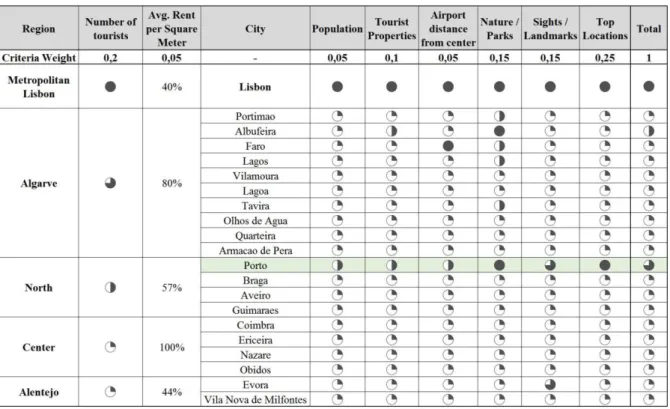
For the purpose of identifying high potential locations for Wine With a View, an extensive list of regions and cities in Portugal was created based on tourism numbers, as well as the popularity among visitors. Despite not being a scientific source of data, review platforms such as TripAdvisor were partly considered for this step and the further analysis due to the importance of tourists’ preferences for the business concept of Wine With a View and the increased influence of such platforms on travelers’ decision making (Chipkin, 2014). To evaluate each city of the developed list, several criteria were applied to ensure a maximum suitability for Wine With a View. On a regional level the criteria (1) number of tourists, (2) average rent level, (3) top visiting countries and (4) length of the main touristic season were applied, while the two latter ones were considered qualitatively. In addition to that, each city was evaluated with the criteria (1) population, (2) number of tourist properties, (3) airport distance, (4) number of nature/park attractions, (4) number of sight/ landmarks attractions and (5) number of identified top locations. Top locations were determined by examining all nature/park and sights/landmarks attractions regarding their potential as a point-of-sales for Wine With a View. To find a location with similar conditions as in the home market, each city’s relative strength was evaluated by considering Lisbon as a benchmark. The outcome of this result, illustrated in Figure 13, reveals that Porto is the most attractive location for a geographic expansion.
Figure 13: Summarized Location Analysis for Organic Growth in Portugal (own elaboration) This can be explained with the comparably larger number of high potential locations for wine bars within the city, the short distance to an international airport, as well as a low rent level for office space compared to Lisbon or Algarve (imovirtual, 2017). The total number of tourists within the north region of Portugal is lower compared to Algarve (UNWTO, 2016), but can be interpreted to be highly concentrated in the city of Porto due to the enormous number of tourist accommodations within the city (Booking.com, 2017). Additionally, the distribution of nationalities of visitors in the North is very similar to Lisbon (UNWTO, 2016), which gives rise to the assumption that visitor preferences and consumption behaviors are similar. For more information on the conducted location analysis, please review Appendix 14.
6.2.2 Illustration of a High-Potential Location
One of the identified high potential locations to erect a point-of-sales in Porto, which shall be presented in more detail, is the viewpoint of Serra do Pilar. Located near the monastery of the same name, this elevated spot allows a view on the main tourist attractions of Porto, such as the bridge of Dom Luis, the Zona Ribeirinha, as well as the numerous port wine manufactories at
on the Porto opposing riverside and is conveniently accessible by walking, car, public transport or the aerial cable car of Porto (TripAdvisor, 2017c). Similar to the St. George Castle in Lisbon, this spot offers a first mover advantage for Wine With a View, since there is no threat through substitute products in this exact location or immediate surrounding. It can be concluded, that expanding to Porto is not only a feasible, but also a highly attractive growth option for Wine With a View to realize its mid-term growth goal. Appendix 15 further illustrates this location, its advantages for Wine With a View and the competitive situation in the area.
6.3 Expansion in Europe via Franchising
Chapter 5.2 illustrated that, according to the developed scoring model, franchising is neither a highly attractive nor feasible growth strategy for Wine With a View. However, the model identifies it as the highest rated strategy for European expansion. In addition, Wine With a View recently decided to offer a franchising opportunity on its website. Therefore, the first part of this chapter aims to further analyze the general suitability of franchising for the company, while the second part will be dedicated to the identification of the most attainable approach.
6.3.1 Suitability of Franchising for Wine With a View
Not every business is suitable for franchising (Belbin, et al., 2013). Therefore, this chapter will identify, to which extent franchising is an applicable strategy for Wine With a View.
Nieman (1998) identified eight criteria, which need to be fulfilled or considered by a business which considers franchising: (1) standardization in products/ services, (2) reproducibility, (3) legal constraints, (4) personal commitment, (5) straightforward operation methods, (6) profitability, (7) distinctive and noticeable brand and (8) regular supplies. These criteria are detailed in Appendix 16 with a remark on the business concept of Wine With a View. As described in the previous chapters, Wine With a View’s business concept is highly dependent on the proximity to frequently visited locations, the quality of service and products as well as the uniqueness of its point-of-sales, which in combination generate a unique customer
experience. With regard to the mentioned criteria, Wine With a View’s business concept exhibits a high level of reproducibility, since product and services are mostly standardized, while operational processes are of low complexity. In addition to that, the product supply can be adapted to new locations and should leverage on the availability of local products. Therefore, it can be stated that, given similar conditions as in the home market, the business concept can be duplicated at another location, as it is also demonstrated in chapter 6.2.
However, apart from these rather operational criteria, there are additional aspects of franchising, which need to be taken into consideration. Legal constraints should be among the first criteria to be evaluated, as regulations differ significantly from country to country and might pose a fundamental obstacle for franchising ambitions (Abell, 2012). As the financial data reveals in chapter 3.1, Wine With a View does not maintain a stable level of profitability. Furthermore, establishing a franchise system not only incurs financial expenses for the initial setup as well as for the training and ongoing support of the franchisee, but also requires a high level of personal commitment and human resources to coordinate and monitor the franchised units (Asbill & Goldman, 2001). Considering the thorough analyses conducted, it can be concluded that Wine With a View lacks these necessary resources. Finally, the criterion distinctive and noticeable brand can be interpreted as a severe limitation to the suitability of franchising for Wine With a View. This aspect plays a minor role in the organic expansion, as described in chapter 6.2, since the growth is initiated with own resources of the company. In contrast to that, this criterion is crucial for the setup of a franchise business, since the adoption of a proven business model and reputable brand makes up the motivation of a franchisee to buy the franchise license and pay royalties to the franchisor. A strong brand is also required to increase the success chances of the franchised units in a foreign market (Nieman & Barber, 1998). Since the conducted analyses did not reveal a high level of brand recognition, this aspect represents a substantial deficiency for the franchising endeavor. It can be concluded, that with
its current set of resources, it is not possible for Wine With a View to franchise its business, which was identified as the vehicle for the expansion to another European country.
However, if the company, aided by the developed strategies, can achieve a strong growth in the local and domestic market and build a reputable brand in the next years, it might accumulate the necessary resources and thereby create the basis for establishing a franchise business. 6.3.2 Selection of a Franchising Structure
The scoring model and the previous chapter illustrated that franchising is currently a non-feasible, but in general an attractive strategy for Wine With a View. Since the company might be able to acquire the necessary resources over the next years, this chapter sets out to provide a general recommendation to consider for the setup of a franchise business.
Since Wine With a View is striving to duplicate its entire business system (Vidal de Moraes, 2017b), the suitable franchising approach can be defined as business format franchising, in which the franchisor offers a proven business concept to a franchisee in exchange for royalties, as well as initial and ongoing fees. By definition, this approach is distinct from product and tradename franchising, in which a franchisor provides a franchisee the right to sell a certain product or service (Oswald, 2010). There are three types of business format franchising with distinct implications concerning the (1) contractual relationships between franchisor and franchisee, (2) resources requirements, the (3) level of required training and the (4) level of control by the franchisor. A detailed illustration of these different franchising systems is given in Appendix 17. Based on the presented company resources it was determined that the master franchising strategy is the most suitable for Wine With a View’s endeavor. In such a system, a franchisor closes a contract with a master franchisee, who is then responsible for the development of the business in a defined area. Therefore, the master franchisee contracts sub-franchisees and is responsible for providing training and support. Because of this increased level of responsibility and required control, the master franchisee typically demands a higher
share of the generated revenues than a single-unit franchisee (Asbill & Goldman, 2001). The main arguments for the master franchising system are the following: (1) Wine With a View does not have the means or aspirations to establish and oversee foreign franchise units by itself, (2) master franchising implies significantly lower initial and ongoing capital investments compared to the other systems, (3) the system allows a full exploitation of the local resources and market knowledge of the franchisee and (4) master franchising drastically reduces the risk of expansion compared to other franchising systems, as well as an organic growth strategy.
7. Conclusion and Recommendations
The findings of this report emphasize, that the thorough analysis and consideration of a company’s resources, capabilities and aspirations are of major importance for identifying a suitable growth strategy. Despite the large number of growth options, that were developed for Wine With a View within this report, only few high potential strategies were identified with respect to the defined growth goals.
The initial company analysis revealed the need to consolidate the local business as a basis for further growth ambitions. The developed strategy framework and scoring model determined, that a product line extension is a suitable strategy for this ambition, since it can be easily implemented with the current resources of the business and can contribute to balance the profitability among Wine With a View’s point-of-sales. For the intended expansion to other locations in Portugal in the mid-term, the report identified that the organic expansion to the city of Porto is the most promising strategy, as the city offers Wine With a View similar conditions as its home market with the potential of developing and leveraging on its key resources. Furthermore, the analyses revealed, that Wine With a View currently does not possess the necessary resources to expand to another European country. However, a master franchising concept could become a suitable strategy for this endeavor under the condition of a strong and continuous growth in the local and domestic market over the course of the next years.
References
Abell, M., 2012. Which EU Jurisdictions Most Heavily Regulate
Franchising?. Who's Who Legal, November, pp. 13-14.
Ansoff, H. I., 1957. Strategies for Diversification. Harvard Business Review, September-October, pp. 113-124.
Asbill, R. M. & Goldman, S. M., 2001. Fundamentals of International Franchising. Chicago: American Bar Association.
Barringer, B. R. & Ireland, R. D., 2014. Entrepreneurship - Successfully Launching New Ventures. Essex: Pearson Education Limited.
Base de Dados Portugal Contemporâneo, 2017. Population
Census. Available at:
http://www.pordata.pt/en/Municipalities/Resident+population+in +places+with+10+thousand+inhabitants+and+over++according+ to+the+Census-26 [Accessed 05 May 2017].
Belbin, M. et al., 2013. Good Small Business Guide 2013 - How to start and grow your own business. Seventh Edition ed. London: Bloomsbury.
Bhide, A., 1996. The Questions Every Entrepreneur Must
Answer. Harvard Business Review, November-December, pp. 120-130.
Booking.com, 2017. Properties in Portugal. Available at: https://www.booking.com/searchresults.en-gb.html?label=gen173nr-1DCAEoggJCAlhYSDNi BW5vcmVmaLYBiAEBmAEuwgEKd2luZG93cyAxMMgBDN gBA-gBAZICAXmoAgM&lang=en-gb&sid=687de4cb1ef0c3516721ed73d6d63c8f&sxp_will_search _domestic_prediction_probability=0.038533860492873 [Accessed 05 May 2017].
Carrol, L. J., 1941. Through the Looking-Glass. New York: The
Heritage Press.
Chipkin, H., 2014. A growing influence when choosing
all-inclusives, tours. Travel Weekly, 11 August, pp. C6, C22.
Euromonitor International, 2017c. Street Stalls/Kiosks in Portugal. s.l.:Passport Euromonitor International.
Grant, R. M., 1991. The Resource-Based Theory of Competitive
Advantage: Implications for Strategy Formulation. California Management Review, 33(03), pp. 114-135.
imovirtual, 2017. Mercado Imobiliário em Portugal. Available at: https://www.imovirtual.com/estatisticas/mercado-imobiliario/ [Accessed 05 May 2017].
Kim, W. C. & Mauborgne, R., 2005. Blue Ocean Strategy - How To Create Uncontested Marketspace and Make the Competition Irrelevant. Boston: Harvard Business School Press.
Kotler, P. A. G., 2014. Principles of Marketing. Essex: Pearson
Education Limited.
Kurtz, D. L., 2010. Contempary Marketing. 14th Edition ed.
Mason: South-Western.
Lamb, C. W., Hair, Jr., J. F. & McDaniel, C., 2011. MKTG.
Student Edition ed. Mason: South-Western.
McKinsey & Company, 2008. Enduring Ideas: The GE–
McKinsey nine-box matrix. McKinsey Quarterly, September.
McKinsey & Company, 2009. Enduring Ideas: The three
horizons of growth. McKinsey Quarterly, December.
Nagji, B. & Tuff, G., 2012. Managing Your Innovation Portfolio. Harvard Business Review, May.
Nieman, G. & Barber, J., 1998. How to Franchise Your Own Business. Cape Town: Juta Academic.
Oswald, L. J., 2010. The Law of Marketing. Mason:
South-Western Cengage Learning.
PlanetWare Inc., 2017. 16 Top-Rated Tourist Attractions in Portugal. Available at: http://www.planetware.com/tourist-attractions/portugal-p.htm [Accessed 05 May 2017].
PwC, 2016. Fit for Growth Index Profiler. Available at: https://ffgindexprofiler.strategyand.pwc.com/ [Accessed 05 May 2017].
PwC, 2017. Our solutions - Growth strategy. Available at: http://www.strategyand.pwc.com/cds/growth [Accessed 05 May 2017].
Schwenker, B. & Bötzel, S., 2007. Making Growth Work - How companies can Expand and Become More Efficient. Heidelberg: Springer.
Shah, S. F. H., Nazir, T. & Zaman, K., 2013. A literature review
on growth models and strategies: The missing link in entrepreneurial growth. Management Science Letters, 3(08), pp. 2189-2200.
Steinmann, H. & Schreyögg, G., 2005. Management. Grundlagen der Unternehmensführung. Konzepte - Funktionen - Fallstudien. Wiesbaden: Gabler.
The Boston Consulting Group, 2017. Growth Options: Where to Play, How to Wine. Available at: https://www.bcg.com/expertise/capabilities/growth/growth-options-where-play-how-win.aspx [Accessed 05 May 2017].
touropia, 2017. 10 Best Places to Visit in Portugal.
Available at: http://www.touropia.com/best-places-to-visit-in-portugal/ [Accessed 05 May 2017].
TripAdvisor, 2017a. Castelo de S. Jorge. Available at: https://www.tripadvisor.com/Attraction_Review-g189158-d195107-Reviews-Castelo_de_S_Jorge-
Lisbon_Lisbon_District_Central_Portugal.html [Accessed 05 May 2017].
TripAdvisor, 2017b. Popular Desinations in Portugal.
Available at: https://www.tripadvisor.com/Tourism-g189100-Portugal-Vacations.html
[Accessed 05 May 2017].
TripAdvisor, 2017c. Serra do Pilar Viewpoint. Available at: https://www.tripadvisor.com/Attraction_Review- g580268-d3176927-Reviews-Serra_do_Pilar_Viewpoint-Vila_Nova_de_Gaia_Porto_District_Northern_Portugal.html [Accessed 05 May 2017].
TripAdvisor, 2017d. Things to Do in Portugal. Available at: https://www.tripadvisor.com/Attractions-g189100-Activities-Portugal.html
[Accessed 05 May 2017].
UNWTO, 2016. Tourism Highlights 2016 Edition. Madrid:
Vidal de Moraes, B., 2017a. Kick-Off Interview (8 April 2017).
Vidal de Moraes, B., 2017b. Strategy Development Interview (22
April 2017).
Wakkee, I., Van der Veen, M. & Eurlings, W., 2015. Effective
Growth Paths for SMEs. The Journal of Entrepreneurship, 24(02), pp. 169-185.
Wine With a View, 2017a. The History of Wine With a View.
Available at: https://winewithaview.pt/pages/history [Accessed 05 May 2017].
Wine With a View, 2017b. Wine With a View Data Package - Employee Interviews, Financial Data, Marketing Data, Operations Data
Witcher, B. J. & Chau, V. S., 2010. Strategic Management - Principles and Practice. Hampshire: Cengage Learning.