University of Lisbon
Institute of Social Sciences
The accommodation of Islam in Portugal and the
Republic of Ireland: A comparative case study
Luís António Pais Bernardo
MA in Comparative Politics
2009
University of Lisbon
Institute of Social Sciences
The accommodation of Islam in Portugal and the
Republic of Ireland: A comparative case study
Luís António Pais Bernardo
MA Thesis supervised by Dr. Maarten P. Vink
MA in Comparative Politics
2009
Resumo: Esta dissertação propõe um estudo comparativo do processo de acomodação do Islão em Portugal e na República da Irlanda. A hipótese central é a de que o processo de acomodação do Islão, em ambos os países, tem, como principal factor explicativo, o modelo institucionalizado de relações entre o Estado e a Igreja.
Este estudo procura, nesse sentido, analisar o processo de acomodação de um número crescente de indivíduos e grupos auto-identificados como muçulmanos, por parte dos Estados de dois países que não têm sido, geralmente, objecto de avaliação científica nesta área: Portugal e a República da Irlanda. Na realidade, a maioria dos estudos acerca da acomodação da diversidade religiosa cinge-se à análise de casos em que a presença islâmica é muito significativa – a Alemanha, a França, a Holanda e o Reino Unido, por exemplo. Reconhecendo o interesse de cada um destes casos, em particular, e da sua comparação, revela-se, cada vez mais, a necessidade de pluralizar os terrenos de investigação, alargando-os a casos específicos, como Portugal e a República da Irlanda.
O segundo foco específico deste estudo é a comparação entre o modelo institucionalizado de relações entre o Estado e a Igreja em ambos os países. Existe, para isso, uma clara justificação teórica. Em ambos os casos, a relação entre o Estado e a religião é, historicamente, equivalente à relação entre o Estado e a Igreja Católica. Assim, o processo de pluralização religiosa, em decurso na Europa Ocidental desde 1945, constitui um desafio à capacidade de adaptação e flexibilidade das instituições que definem, regulam e sistematizam as relações entre o Estado e a Igreja. A gestão da diversidade religiosa ocorre num contexto institucional que não havia sido, originalmente, estruturado para responder aos desafios específicos de uma realidade social plural. Portanto, a necessidade de mudanças adaptativas causou um processo de desenvolvimento institucional. Depois de identificarmos esse processo, analisamos os arranjos institucionais relevantes de forma estrutural e dinâmica. Ou seja, examinamos as suas propriedades estruturais, à imagem daquilo que já havia sido feito na literatura (Ferrari 2002, 2003, 2005) e, além disso, analisamos a sua diferenciação histórica (a que subjazem mecanismos de mudança adaptativa). Recorremos a um corpo teórico cada vez mais importante na Ciência Política contemporânea – o institucionalismo histórico.
Como um dos três novos institucionalismos identificados por March e Olsen (1984), o institucionalismo histórico constitui uma reaproximação à temática dos legados institucionais. Assim, além de aumentar o rigor da discussão em torno do desenvolvimento temporal das instituições políticas, os mecanismos subjacentes a esse desenvolvimento têm sido uma das áreas prioritárias dos estudos institucionalistas históricos. Ao longo deste estudo, estabelecemos uma ligação entre mecanismos de mudança institucional e modelos de relações
entre o Estado e a Igreja, que se revelou empiricamente sustentável. De facto, os arranjos institucionais sob análise diferem, em termos estruturais e dinâmicos, entre Portugal e a Irlanda.
Efectuamos uma comparação estruturada em torno de duas características metodológicas. Em primeiro lugar, o emparelhamento dos casos é feito de acordo com a lógica dos “casos mais semelhantes” (Przeworski e Teune 1970). Portugal e a República da Irlanda partilham de semelhanças estruturais que nos permitem isolar um factor explicativo do fenómeno em análise. Em segundo lugar, procedemos a uma comparação focalizada, ou seja, com recurso a técnicas de investigação qualitativa e à descrição densa dos casos em análise. Adquirimos, portanto, um conhecimento muito detalhado de ambos os casos, de modo a incrementar a nossa alavancagem empírica (Collier 2004) e, consequentemente, a diminuir o risco de enviesamento inerente a estudos qualitativos em que o número de casos é inferior ao número de variáveis. Tendo em conta a discussão prévia relativa aos mecanismos de mudança institucional, a análise processual é um dos objectivos centrais deste estudo.
A comparação entre os casos é efectuada em duas áreas: uma delas de âmbito sociológico, outra de âmbito político. No que concerne à primeira, examinamos a similitude do perfil migratório de Portugal e da Irlanda, após a II Guerra Mundial, em face da intensificação dos fluxos migratórios e dos processos de descolonização. De facto, ao longo dos últimos 40 anos, ambos os países enfrentaram uma mutação profunda: deixaram de ser países de origem migrante e passaram a ser contextos de acolhimento. A emergência da Nova Presença Islâmica, em ambos os países, deu-se nesse contexto (Gerholm e Lithman 1988; Nielsen 1992; Tiesler 2001). Além disso, analisamos a secularização como teoria e fenómeno social, na medida em que o reposicionamento da religião, enquanto sistema de crenças socialmente construído, é de importância central para o nosso estudo. Os modelos institucionalizados de relações entre o Estado e a Igreja sofreram mutações profundas, não apenas devido ao desafio colocado pelo incremento da diversidade religiosa, mas, igualmente, devido à redefinição e reposicionamento da religião nas sociedades contemporâneas. Portugal e a República da Irlanda são duas das sociedades europeias em que esta mudança estrutural se tem processado mais lentamente (Cabral et al 2001). No que diz respeito aos sistemas políticos, comparamos a centralização de ambos os regimes, além dos sistemas de partidos e dos modelos de distribuição do poder.
Depois de estabelecidas as condições básicas de comparabilidade, analisamos comparativamente os modelos de relações entre o Estado e a Igreja (variável independente) e o estabelecimento institucional do Islão em ambos os casos (variável dependente). No que diz
respeito à análise dos modelos de relações entre o Estado e a Igreja, classificamos o modelo de Portugal como “concordatário” e o modelo da República da Irlanda como “separatista suave”. Ao longo do estudo, exploramos os limites tipológicos da classificação tradicional: especialmente no que diz respeito à Irlanda, concluimos que se trata de uma grelha classificativa necessitada de revisão profunda.
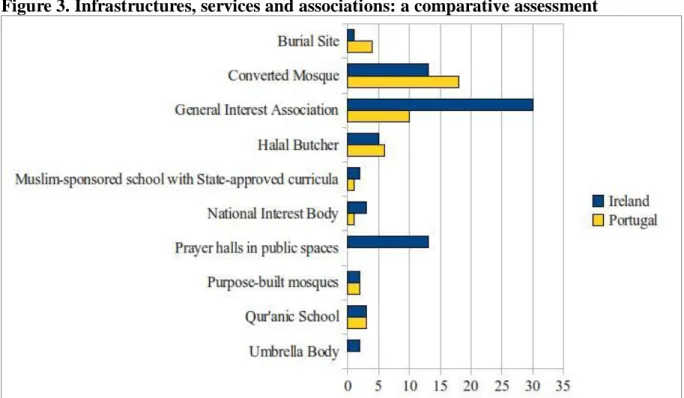
Em seguida, descrevemos a evolução institucional das múltiplas comunidades islâmicas em ambos os países. Dividimos o conjunto de instâncias institucionais em três categorias: “infraestruturas organizacionais”, “serviços generalistas” e “corpos associativos”. Tendo em atenção as questões identificadas pela literatura como mais relevantes na acomodação do Islão na Europa, como a construção de mesquitas, o estabelecimento de escolas e a emergência de associações com escopo nacional (Cesari 2005; Maussen 2007, 2009), examinamos o estabelecimento do Islão nos dois países. Determinamos a existência de uma diversidade institucional crescente na Irlanda: existe um número cada vez maior de estruturas institucionais de escopo nacional e uma pluralidade de representantes “muçulmanos” no espaço público, por oposição a Portugal, onde a Comunidade Islâmica de Lisboa é, num contexto de “invisibilidade” (Tiesler 2001) e inexistência de alterações institucionais importantes, a única entidade islâmica verdadeiramente nacional. Assim, ao longo do processo de acomodação do Islão, os efeitos do modelo institucionalizado de relações entre o Estado e a Igreja são observáveis no estabelecimento de instituições islâmicas – infraestruturas, serviços e associações – e de stakeholders muçulmanos no processo político de Portugal e da República da Irlanda. O modelo “separatista suave” da Irlanda demonstrou ser mais favorável à acomodação da diversidade religiosa – a qual engloba a acomodação do Islão, que o modelo “concordatário” de Portugal, cujo reforço dos privilégios da Igreja Católica acabou por torná-lo menos adaptável às mudanças contextuais profundas ocorridas no país. Problematizamos as tipologias existentes e propomos uma explicação processual da mudança institucional ocorrida em Portugal e na República da Irlanda.
Em conclusão, este estudo essencialmente qualitativo compara dois casos específicos e estabelece um nexo de causalidade entre o modelo institucionalizado de relações entre o Estado e a Igreja e a acomodação do Islão.
Resumo: Esta dissertação é um estudo comparativo da acomodação do Islão em Portugal e na República da Irlanda. O desenho da pesquisa estruturou-se em torno de duas características metodológicas: a comparação focalizada e o emparelhamento de casos mais semelhantes. Assim, efectua-se uma comparação sistemática das características relevantes de ambos os casos, de modo a isolar o factor explicativo da acomodação do Islão em Portugal e na República da Irlanda.
Aplicando uma perspectiva institucionalista histórica à adaptação, por parte de ambos os Estados, ao desafio colocado pela emergência da diversidade religiosa como fenómeno social relevante, o estudo examina os modelos institucionalizados de relações entre o Estado e a Igreja, e respectivo desenvolvimento histórico. De acordo com a perspectiva teórica deste estudo, formulamos a hipótese de que o modelo institucionalizado de relações entre o Estado e a Igreja é o principal factor explicativo da acomodação do Islão. A análise/classificação dos mecanismos de mudança institucional subjacentes a esse processo de mudança é particularmente relevante, na medida em que Portugal e a República da Irlanda partilham de semelhanças estruturais (a nível socio-religioso – países de maioria católica - e político – regimes políticos centralizados) que tornam a comparação particularmente interessante, do ponto de vista teórico. Com recurso a técnicas de investigação qualitativas, este estudo compara o estabelecimento das comunidades islâmicas nos dois países, a partir do final da década de 1950, e a trajectória do seu desenvolvimento institucional, gradualmente diferenciado. De facto, o desenvolvimento institucional do Islão na República da Irlanda foi facilitado pelo modelo “separatista suave” de relações entre o Estado e a Igreja, que favoreceu e facilitou a acomodação da diversidade religiosa e, por inerência, do Islão. Em Portugal, o modelo concordatário reforçou a predominância da Igreja Católica e dificultou a adaptação institucional à emergência da diversidade religiosa. Como consequência, observa-se uma maior dinâmica nas instituições criadas por muçulmanos na Irlanda, em comparação com Portugal.
Palavras-chave: Integração Política; Instituições Políticas; Islão na Europa; Religião; Relações Estado-Igreja
Abstract: This thesis is a comparative study of the accommodation of Islam in Portugal and the Republic of Ireland. Its research design was structured around two methodological features: a focused comparison and the pairing of most similar cases. Thereby, we make a systematic comparison of both cases' relevant features, so as to isolate the explanatory factor
of the accommodation of Islam.
By employing a historical institutionalist perspective to both States' adaptation to the challenge of accommodation as a relevant social phenomenon, this study examines institutionalized models of Church-State relations and their respective historical development. According to this theoretical perspective, the model of Church-State relations is the explanatory factor of the accommodation of Islam. The analysis and classification of mechanisms of institutional change underlying change in these models is particularly relevant, insofar as Portugal and the Republic of Ireland share structural similarities at a socio-religious level – Catholicism is majoritarian – and politically – centralized political systems – which increases the comparison's theoretical interest. Using qualitative research techniques, this study compares the establishment of Islamic communities in both countries from the end of the 1950s and their institutional development, which became gradually different. In effect, the institutional development of Islam in the Republic of Ireland was eased by the “soft separatist” model of Church-State relations, which favored and facilitated the accommodation of religious diversity and, inherently, of Islam. In Portugal, the concordatarian model reinforced the Catholic Church's predominance and made institutional adaptation to the emergence of religious diversity more difficult. As a consequence, institutions put in place by Muslims in Ireland are more dynamic than their equivalents in Portugal.
Keywords: Political Integration; Political Institutions; Islam in Europe; Religion; Church-State Relations
Agradecimentos
Agradecer a todas as pessoas cujo apoio foi essencial à elaboração desta dissertação revela-se, tal como todo o processo, difícil. Todavia, faço-o, por gratidão – e porque uma dissertação académica nunca está completa sem agradecimentos.
Geralmente, guardam-se os agradecimentos mais sentidos para o fim. Prefiro fazê-lo ao contrário.
Portanto, agradeço, em primeiro e segundo lugar, à minha mãe. A motivação constante e o apoio infatigável foram fundamentais para que esta dissertação visse a luz do dia.
Em terceiro lugar, à Mafalda, pela capacidade de encaixe dos meus momentos mais sombrios. A paciência dela foi um bálsamo.
Fourthly, I have to thank Maarten for guiding my meandering thoughts towards reality and for making very complex ideas, concepts and arguments sound simple. My interest in political science gradually increased because of him.
Por último, agradeço a todos os colegas e amigos do ICS. Especialmente à Adriana, ao Álvaro, ao Bernardo e ao Riccardo. Acima de tudo, pelas conversas, pelas gargalhadas e pelos bons momentos que partilhámos, ao longo de dois anos.
Table of Contents
Chapter I - Introduction... 11
Islam in Europe: a burgeoning field of research...13
Chapter organization ...14
Chapter II - Theoretical Framework ...14
Historical Institutionalism ...15
Mechanisms of change: Layering and Conversion ...16
Layering...16
Conversion ...17
Church-State Relations in Western Europe: A Typology...18
Three models of Church-State relations in Western Europe ...19
The institutional argument on Church-State relations ...22
Chapter III - Research design and methodological choices ...24
Focused comparison...24
Comparative method ...24
Data collection...25
Chapter IV - Portugal and Ireland in Context ...26
Migration and Decolonization ...26
Migration dynamics...26
Decolonization ...27
Politics in Portugal and Ireland...29
The federal-unitary discussion...29
Governments and parliaments...30
Parties and the party system ...30
Secularization and Church-State relations in Portugal and Ireland ...31
Secularization ...32
Church-State Relations in Portugal and the Republic of Ireland...34
The New Islamic Presence in Portugal and Ireland...39
Chapter V - The accommodation of Islam in Portugal and Ireland ...41
Organizational Infrastructures ...42
Mosques ...43
Prayer halls ...46
Qur’anic schools ...48
General Services...48
Halal Shops and Butchers ...49
Burial Sites...49
Faith-sponsored schools with State-approved curricula...51
Associative Bodies ...56
National Interest Bodies ...57
General Interest Associations...68
Chapter VI - Conclusions ...71
Table of Figures
Figure 1. Net Migration Rate (per 1,000 population)...28 Figure 2. Muslim Residents in the Republic of Ireland and Portugal ...40 Figure 3. Infrastructures, services and associations: a comparative assessment ...42
Chapter I - Introduction
The starting question of this study is the following: why has the accommodation of Islam in Portugal and Ireland been increasingly different over the past three decades? It is a question which makes several assumptions: first, the accommodation of Islam in Portugal and Ireland has indeed become different over time and has caused significant changes in how Muslims in both countries have organized their institutional structures and life; second, the accommodation of Islam in Western Europe is a cross-nationally comparable process; third, Portugal and Ireland are comparable cases with a key difference which is detailed below. The first assumption is, in fact, the driving “puzzle” of this study. The accommodation of Islam in Portugal and Ireland has been cross-nationally different. From a similar starting point, that of completely inexistent institutions, infrastructural facilities or contact between Muslims and other religious denominations or State officials, today Islam as a religious denomination comprises a denser institutional network in Ireland than in Portugal. We do not discuss issues of subjective integration: our explained variable (insofar as such vocabulary fits within our research design) is institutional density and differentiation; the trajectory of accommodation in Ireland has shown that the institutional arrangement for the management of religion in Ireland is more flexible and more beneficial to a smooth entry of religious denominations into its socio-political dynamics. In Portugal, the same institutional arrangement is more rigid. As members of a religious denomination, Muslims entered polities where relations between the State and religion were defined and driven by models of Church-State relation, which this study argues to be the most important factor in the accommodation of Islam in Portugal and Ireland. It is also argued that the model of Church-State relations in Ireland was more adaptable to contextual change than its Portuguese counterpart, thus making accommodation smoother and establishment easier for Muslims in Ireland. That is the key difference between cases, in our view, and it explains why the accommodation of Islam in Portugal and Ireland has been increasingly divergent in recent years. Institutional legacies related to the changing role of the Roman Catholic Church – and the changing patterns of its socio-political dominance in Portugal and Ireland –, as well as the are associated to that divergence. But there is of course more to the issue than entirely structural arguments over institutional arrangements. Islam in Ireland is also more politically segmented than in Portugal, a feature which has intensified in recent years. It is striking in our view that a plurality of self-proclaimed representatives of the many Muslim communities in Ireland has efficiently grasped an increasing openness in the opportunity structure for media exposure in Ireland.
The second assumption is the less problematic one. Islam, insofar as it is a religious belief system which, to some extent, structures the identity of specific groups, has been accommodated in Western Europe with varying degrees of effectiveness. There are, of course, severe exceptions to this assertion, but all Western European polities posit freedom of religion as one of their pillars, as liberal democracies and signatories of the International Covenant of Civil and Political Rights. So we can assert that, where Muslims of any orientation, ethnicity, nationality or class background assert their will to become engaged in socio-political affairs or to have their religious needs attended to within specific boundaries, States do accommodate Islam. How and whether States are institutionally equipped for that purpose is another question easily answerable. All Western European States have had to deal with religion as a socially significant social, cultural and political phenomenon; as such, institutional patterns have emerged over time, whether conceived by State-builders or by the establishment of governance patterns. Mono-confessional, multi-confessional or non-confessional, each Western European State has dealt with religion and groups which asserted their identity as predominantly religious.
The third assumption is less obvious. The literature on the accommodation of Islam in Western Europe has rarely turned to Portugal or Ireland as case studies or in a comparative perspective. Utilizing many approaches and perspectives, scholars usually pick Germany, Britain, France, or the Netherlands (or a selection among the four) as research sites (e.g. Soper and Fetzer 2004; Klausen 2005; Laurence 2006). These countries offer important variation in key factors and they have been the focal point of the arrival of Islam in post-war Western Europe. The number of Muslims is higher in those cases than in all other Western European countries, as is variation related to Islamic orientation, class background, ethnicity or nationality. But, as we will argue, Portugal and Ireland belong to a group of countries which should be looked at. The features relevant to this study are similar in both countries, making a comparison between them both compelling and challenging. The predominance of Catholicism, the dominance of the Catholic Church, patterns of migration and secularization, as well as specific features of the Portuguese and Irish political systems: in all these aspects Portugal and Ireland share key similarities. It is one of the purposes of this study: to argue for the benefits of extending the comparison between Portugal and Ireland to non-economic domains and issues. There are, of course, relevant differences in specific political structures and subsystems, but our comparative design holds its coherence. We will argue for this comparison on two grounds. First, social and political change in Portugal and Ireland, in what relates specifically to the arrival and accommodation of Islam, the role of religion in society
and the relationship between the State and religion, is similar enough to allow for systematic comparison. Second, the key difference between Portugal and Ireland, in what relates specifically to the accommodation of Islam, has been the pattern of relations between the main religious denomination - Catholicism, and its chief institution – the Roman Catholic Church, in Portugal and Ireland: models of Church-State relations have an impact on patterns of accommodation of religious denominations in a variety of countries. The hypothesis is that the accommodation of Islam in Portugal and Ireland has been cross-nationally different because the Irish and Portuguese models of Church-State relations are also different.
Our assumptions will be tested, as will our main hypothesis. Our research design will focus on processes and how our theoretical basis links to empirical reality. We employ a focused comparison approach which will compare background conditions (society and politics in Ireland and Portugal), Church-State relations in both countries and then the accommodation of Islam insofar as, according to our theoretical standpoint, the institutional trajectory of key Muslim representative bodies is its effect.
Islam in Europe: a burgeoning field of research
This study aims to fill a gap in existing research. Literature on Islam in Europe (Western and Eastern) has proliferated for 20 years, since Gerholm and Lithman coined the term “New Islamic Presence in Europe” (1988). The “New Islamic Presence in Europe” (NIP) refers to the arrival of a large number of diverse Muslim communities into Europe, in the postwar period, related to decolonization and migration processes, and the ensuing establishment of relations between those groups and Western European societes and polities. Although the presence of Islam in Europe is hardly new (especially in countries such as Portugal), the term NIP refers to the specific characteristics of the newly established communities in Europe, in what relates to class, national, ethnic, linguistic, cultural and gender backgrounds and patterns (Tiesler 2001). As a socio-political phenomenon, the NIP is now widely researched from a plurality of perspectives. But, as Nielsen has stated, further research is needed on countries such as Portugal and Ireland (1992). These are countries where the presence of Islam is relatively small and where models of Church-State relations do not fit easily within existing typologies. A comparative study on Islam in Portugal and Ireland will be academically relevant and contribute to the pool of knowledge in the field.
The growth of Islam in Europe, associated with subjective perceptions of threat arising from the events of New York, London or Madrid, makes informed and rigorous research on Islam in Western Europe very important. Arguments on the coming of “Eurabia” or the “Clash of
Civilizations” should be put to empirical examination by looking at the dialectic relationship between Islam and Western European States (Cesari 2007). This study will contribute to the effort of accumulating more rigorous knowledge on this topic.
Chapter organization
The thesis is organized as follows. The second chapter will detail our research design and our methodological approach. The third chapter will discuss how and where this study stands within the theoretical literature on historical institutionalism, institutional mechanisms and, most importantly, typologies of Church-State relations in Western Europe. The fourth chapter will discuss background conditions in Portugal and Ireland. We will discuss relevant features of each society and political system. Additionally, we will discuss the issue of secularization and the institutional legacy of Church-State relations. The fifth chapter will discuss Islam in Portugal and Ireland. The literature recognizes several key aspects of the accommodation of Islam in Europe, especially in the issues concerning the establishment of religious infrastructures (mosques and prayer halls) and services (schools, halal butchers, burial sites) (Maussen 2007; Cesari 2004; Fetzer and Soper 2005). Additionally, this study discusses associative bodies, a domain which is also explored in the literature (Maussen 2007; Klausen 2005). A provisional typology will be offered and several cases will be presented in order to describe and examine the establishment of an associative infrastructure constructed by Muslims. The sixth chapter will present our conclusions.
Chapter II - Theoretical Framework
What is the reasoning behind a historical institutional study of the accommodation of Islam? Historical institutionalism assumes that legacies are important and that the field of politics is not devoid of history; moreover, it is assumed that the link between cause and effect should be subjected to in depth examination. Studying the accommodation of Islam through a historical institutionalist perspective is relevant because it acknowledges the importance of long-term processes in defining how religious denominations become established in Western European polities, instead of arguing for cultural discrepancies or attrition.
The chapter that follows is divided in three sections. The first section discusses historical institutionalism, one of the new institutionalist schools in political science, following the foundational work of March and Olsen (1984). We focus on the work of Paul Pierson (2000, 2004). The second section discusses layering and conversion as the two mechanisms of
institutional change which, we argue, explain the trajectories of models of Church-State relations in Ireland and Portugal. Recent developments in institutional development theory are discussed (Thelen 2003; Thelen and Streeck 2005). The third section examines the most widely accepted typology of models of Church-State relations in Western Europe (Madeley 2003; Ferrari 2002, 2005) and attempts to characterize Portugal and Ireland within that typology.
Historical Institutionalism
Within the wider body of literature on political science, we can label our research effort as an historical institutionalist study (Hall and Taylor 1996). As a number of studies in economics and politics have shown, institutions are important in defining and explaining empirical phenomena (e.g. North 1990 or Thelen 2004). Hall has defined institutions as “the formal rules, compliance procedures, and customary practices that structure the relationships between individuals in the polity and the economy” (1992: 96). In other words, institutions modulate the actions of actors, whether by constraining, enabling or enhancing their actions. This study regards one institutional arrangement – the model of Church-State relations – as the main explanatory factor of the accommodation of Islam in Portugal and Ireland, and thus has a strong historical focus. The study relies mainly on the concept of institutional legacy. As social constructs, political institutions develop over time. Present institutional arrangements are always conditioned and, to a certain extent, determined by previous institutional arrangements. This does not translate precisely into the truism that “history matters”. Institutional legacies determine present arrangements, but only to a certain extent. In order to increasing descriptive and explanatory power, several institutionalist scholars have worked towards identifying explanations for the linkages between previous institutional systems, their development over time and their present state.
Paul Pierson is one of the best-known scholars in the advancement of historical institutionalism and provides a general explanatory framework for the field of politics. Building upon the work of institutional economists, especially Douglass North, Pierson argues that institutions develop over time in relation to two mechanisms: increasing returns and positive feedback (2000, 2004).
The idea of increasing returns is deceptively simple: contrarily to the economic sphere, where returns theoretically diminish with every expenditure, the specific dynamics of the political world makes it likely that "each additional expenditure of resources generates a higher return than the one before it" (Pierson 2004: 35). Over time, institutions become more valuable to
actors: procedures become less costly, norms of appropriateness become embedded and actors amass knowledge over the inner workings of institutions.
Pierson goes on to argue that "the political world is unusually prone to positive feedback, and the capacities for reversing course are often weak" (2004: 44). This is the logical conclusion of the previous argument. If resource expenditure becomes more fruitful over time for stakeholders, that means that, as the functioning of institutions elongates itself over time, the institutional logic reinforces itself and triggers positive feedback. Institutions, whatever their character or function, will become more coherent and stable over time.
The existence of institutional legacies inevitably influences how an institution develops over time. Later developments are contingent on, but not determined by, the possibilities generated by previous events and their timing/sequencing (id: ibid). This is the strongest argument in defense of specific attention accorded to process analysis in historical institutionalist studies such as the present one: institutional legacies impact present arrangements depending on their sequence (id: ibid).
In conclusion, this study is in line with Pierson's historical institutionalism, because institutions are crucial for an understanding of the accommodation of Islam. Institutions are influenced by legacies, whether intended or non-intended, which, for the purpose of this study, are previous institutional arrangements and events. The following section establishes mechanisms that link legacies to present arrangements over time. We will focus solely on two which are relevant for this study: layering and conversion (for a very detailed conceptual analysis, see Thelen and Streeck 2005: 1-39).
Mechanisms of change: Layering and Conversion
Works by Kathleen Thelen (1992, 1999, 2003), James Mahoney (2001, 2003, 2004) and Paul Pierson (2000, 2003, 2004) suggest that, while the origin of institutions is still a matter of rich debate, institutional change is a contingent process that operates according to specific mechanisms. Thelen identifies two such mechanisms: layering and conversion (2003). We will follow this line of reasoning, since both mechanisms operate in our cases.
Layering
Thelen states that “processes of institutional evolution through layering are pervasive” (2003: 228). The most recent layer stands on the immediately preceding one, implying a notion of linear change. As such, “layering” is a mechanism that rings immediately true to most historical institutionalists. Thelen uses written constitutions to exemplify this mode of
institutional change: “(....) many constitutions, for example, have evolved over time through a layering process that adapts inherited institutions and practices to emerging new circumstances” (2003: 225). Thelen and Pierson both agree that Schickler offers perhaps the best definition, as of yet, of this mechanism: “layering is the partial renegotiation of some elements of a given set of institutions while leaving others in place” (2001:58 cited in Thelen 2003: 226). Pierson adds that “in some cases, existing institutional arrangements may remain intact, but other institutions are added on – perhaps modifying the functioning of preexisting ones” (Pierson 2004). If the costs of changing institutions' components – rules or patterns of behavior – are too high, political agents may try to put new institutional arrangements in place and on top of the former. It may so happen, however, that layering is unintended – institutional frameworks may be layered in order to cope with contextual change. The work of Thelen and Streeck furthers the precision of this assertion by noting that layering “can put in motion path-altering dynamics through a mechanism of what we might think of as differential
growth” (2005: 22). In other words, “active sponsorship of amendments, additions, or
revisions to an existing set of institutions” (2005: 24) may be one of the causes or triggers of further institutional change. While also a mechanism, once we add a voluntary element, layering may be regarded as the product of “new dynamics [being] set in motion by political actors working on the margins by introducing amendments that can initially be sold as 'refinements' of or correctives to existing institutions” (2005: 23).
Conversion
However, change by modification may not be the only option at hand. When “institutions designed with one set of goals in mind are redirected to other ends”, their frameworks do not by default fundamentally change. As Pierson states, “specific institutions potentially may serve many purposes. As a result, what may look like institutional continuity in a formal sense may disguise considerable change in institutional functioning” (2004: 138).
Conversion pertains to the allocation of institutional resources. In that sense, it differs from layering, which pertains to the framework of institutions themselves; interestingly, as Thelen and Streeck argue, this mechanism may be perceived as contradicting the key institutionalist insight which emphasizes the importance of institutions in shaping actors' behavior. Why? Because conversion implies that actors are able to shape institutions' goals, functions and/or purposes (2005: 26). But why do institutions convert? Paul Pierson provides another insight: conversion rests on the assumption that “[institutional] environments are often populated with groups who are less than satisfied with existing arrangements and thus eager to exploit
opportunities to turn institutions to new purposes” (2004: 138). This needs further elaboration. A very narrow interpretation of this assertion would seem to reduce conversion to an effect of ongoing cost-benefit analyses by groups. But Thelen and Streeck offer four reasons for institutional conversion.
The first of these pertains to the fact that those who plan and deploy institutions are not omniscient or perfect: institutions are sometimes flawed and unable to appropriately respond to contextual change. Unintended consequences are a given in institutional design. As the authors argue, "noting that unintended consequences of institutional design may offer opportunities for political contestation that theoretical arguments that assume an identity between design and effect cannot account for." (2005:26).
The second reason offered for conversion pertains to the issue of consensus-achieving in institution design. Democratic institutions are, by definition, products of compromise. Since compromise is a form of bargaining where each stakeholder must part with some of its claims, institutions are bound to be ambivalent, meaning that rules are specified in such a way that strikingly different interpretations by different actors. The failing link between rule, interpretation and implementation is certainly a relevant factor in explaining why sometimes institutions need not undergo especially deep change in order to change deeply. Policy-making may vary greatly not according to the specificities of the political process and its rules, but to the perception of its acceptability by actors.
Thirdly, institutional conversion is also contingent on the strategies employed by a large variety of actors, because “even those not involved in the design of an institution will do everything in their power to interpret its rules in their own interest (or circumvent or subvert rules that clash with their interests)” (2005:41).
Finally, and related to the first adduced cause for institutional change by conversion, “changes in the nature of the challenges actors face or in the balance of power allow for institutions created to serve certain interests to be redirected to very different and even dyametrically opposed goals and ends” (2005: 42).
Church-State Relations in Western Europe: A Typology
The hypothesis of this study is that the model of Church-State relations in Portugal and Ireland is the main explanatory factor in the accommodation of Islam in both countries. Church-State relations, as a component of the wider political system, are a product of historical processes (in many cases, these are patterns which precede the existence of modern States as they exist today and have deeply influenced the distribution of power within those
States), which we signify, in this study, as institutional legacies. The historical development of Church-State relations in Portugal and Ireland is further examined below. The institutional development of the model of Church-State relations in Ireland has occurred by layering; on the other hand, the model of Church-State relations in Portugal has changed by conversion. In both instances, each mechanism is appropriate for explaining change, given the specific features of each model. The structural and diachronic features of each case explain the accommodation of Islam.
Three models of Church-State relations in Western Europe
The literature has developed a detailed typology of models of Church-State relations in Western Europe. This typology makes the assumption that all Western European States are formally-legally recognized as secular along two dimensions, as defined by Ferrari (2005): individual religious freedom and distinction between the political (State) and the religious (Church) spheres. These are constitutionally protected in every Western European polity, including Portugal and Ireland.
But analogous patterns throughout Europe do not exist. Although secularity in a legal sense is well-established and protected, the distinction between the political and religious spheres needs regulation and institutional structures to ensure it. These institutional structures differentiate between themselves for contextual reasons: one of the most important among those are legacies which amount to the effects of previous arrangements on the present situation; the other very important factor in differentiation is the confessional structure of Europe. In other words, the geography of religion in Western Europe is highly identified with the patterns of Church-State relations enforced in European polities (Madeley 2003: 22-45). This allows us to identify differences across confessional zones.
Ferrari (2002, 2005) identifies three Western European models of Church-State relations, which are most probably observable in corresponding confessional zones.
The separatist model of Church-State relations is not easily typified along the lines suggested by Madeley (2003), unless we conceive of a secularist legacy which preceded the 20th century, a doubtable assertion. Following Ferrari (2002), one could define separatist models in negative terms: those are models in place where other models do not exist. However, this amounts to concept stretching: “separatism” would be rendered moot by its lack of empirical translation. As Ferrari states, this negative definition would typify Ireland and France as separatist, which makes no empirical sense (2002: 7). Laïcité has never been enforced in Ireland nor is the French 1905 Law on Separation of State and Church in any way comparable
to the 1937 Irish Constitution, which forbids the State to endow any religious denomination. The debate on the nature of laïcité has framed much of the debate on separatism. Its French version, which one may define as “hard” or “militant” separatism, is hardly verifiable anywhere else in Europe, not the least in Ireland, which is definable as separatist as long as one conceives separatism as large-spectrum concept. Separatism simply states that no State instance is to elect one denomination as a preferential partner for any issues. Institutional legacies and legal interpretations are key. Where the legacy of Church-State relations has been one of conflict, political cleavages around the role of religion have remained salient and there have movements towards the jacobin end of the ultramontanism-anticlericalism spectrum, the tendency is towards the establishment of a strictly “negative” separatist model: no religious denomination is to be accorded special status as such and religion has no place in public life. France's laïcité is the common example here: it is a “hard” or “militant” version of separatism which simply does not recognize the role of religion as an identity marker or as a part of citizens' lifes. On the other hand, where the role of the Catholic Church in the political history of a country is associated with its role as a service provider and with the role of Catholicism as an identity marker, the tendency is towards the establishment of a soft “positive” separatism: the extension of rights accorded to a specific religious denomination is automatically triggered. As such, separatism is an umbrella-concept in which Ireland is perhaps the most evident instance of what this study has named as a “soft” version, where religion is perceived as a publicly legitimate belief system and that, if the State is not to endow any specific denomination, it should additionally strive to correct inadequacies in the management of religious diversity. Separatism thus becomes a problematic concept. It encompasses both “hard” and “soft” versions of a common core. The former is most evident in France; the latter is most evident in Ireland, which is an interesting case for its uniqueness. In the Lutheran North, encompassing Denmark, Finland, Sweden, Norway and Britain, the institutional arrangement for the management of religion is the “State Church” model. In this context, the Head of State will always profess the “national” confession and head the Church; the ecclesiastic hierarchy is nominated and funded by the State. The national Church enjoys widespread preferential treatment as a service provider (in education, health-care and provision of religious needs in public facilities). In conclusion, a “State Church” model entails the deepest level of cooperation between the Church and the State: according to Ferrari's pyramidal model, the Anglican Church in Britain or the Church of Sweden “enjoy the maximum degree of State cooperation” (2002: 11). As Davie makes clear, this relational model fits well into the dictum “belonging without believing” (2007), meaning that Danish,
Norwegian or Swedish citizens, being some of the most “secularized” individuals in the world, still assess their identity through identification with the State Church: to be Danish is to belong to the National Church, with its State-nominated and funded hierarchy. The existence of an Anglican Church of Ireland is a throwback to the British rule. This model easily fits empirical reality, although there has been some discussion on its effectiveness in growingly plural social contexts where religious diversity is slowly becoming the norm (Soper and Fetzer 2004; Gustafsson 2003). The monarchs in Northern European countries still head national Churches which are thoroughly embedded in the State.
The concordatarian model is in essence a compromise between the national Church model and the separatist model. It is more widely associated with Mediterranean Europe, namely Portugal, Spain and Italy. Concordats are agreements signed between the Vatican and governments, regarding religious matters and the position of Catholic Churches in several societal spheres. It is an internationally recognized treaty which accords preferential status for partnership to Catholic Churches – a form of selective cooperation which points to a State Church model without formally enforcing it and with notable exceptions: there is independence between ecclesiastic hierarchies and the State; the State recognizes the contribution of the Catholic Church and its societal predominance, but accords importance to its “neutrality”, going so far as to, in the Portuguese case, assert its non-confessionality. A concordatarian model thus operates with recourse to a Concordat (which regulates the State's relationship with the Church) and ad hoc agreements with other denominations (Ferrari 2002: 7). Concordatarian models are not analogous in every country where they remain in place: as much as any other institutional arrangement, they depend on a variety of national (for instance, the grip of the Catholic Church on the morals of public opinion or the onset of a revolution) and international factors (such as the II Vatican Council). Following Madeley, in countries where Catholic monoconfessionality has developed along Catholic Church dominance, it is common to observe a model of preferential partnership between the State and the Vatican which places the Catholic Church in a preferential position (2003). In conclusion, concordatarian models are not the same as national Church models. Important exceptions make them typologically different, but, as Ferrari states, the practical level of selective cooperation between the Catholic Church and the State, in countries where a concordatarian model is in place, makes that differentation less clear than one would suppose. It would follow, from asserting that “belonging” to the national church is generalized in Denmark and that the Danish national church is embedded in the State (for all practical purposes), it would be more affluent and politically influent than the Catholic Church in Portugal. But this
comparison would be disputable, as the Catholic Church, in Portugal, benefits from an institutional legacy of preferential partnership which has been slowly converted into a less-evident, but still effective, selective cooperation framework. The concordatarian model thus accords substantial benefits to a denomination (in our case, the Catholic Church) without institutionalizing it as the national church.
The institutional argument on Church-State relations
This study argues that the accommodation of Islam is a process which depends on the model of Church-State relations and its institutional legacy. A soft separatist arrangement makes the accommodation of diversity easier because it precludes the establishment of specific selective cooperation partnerships and, because of the role played by religion in a polity (a key feature of soft separatism), the State has better conditions for accommodating religious minorities, which subsequently have more opportunities for participation. Apart from Ireland, there are no examples of countries where soft separatist models are in place. A concordatarian arrangement establishes a specific selective cooperation partnership, enhancing a preexisting Catholic Church dominance. This makes accommodation of religious diversity by the State more difficult and establishes the privilege of a specific denomination over all the others. Concordatarian models are established in, among other countries, Spain and Italy, where issues of accommodation are also related to the existence of a selective cooperation partnership. In the scope of this study, institutional arrangements for the management of religious diversity must examined as products of a monoconfessional legacy.
In Portugal, there are two important features of this arrangement to which this study accords attention. First, religious denominations operate as private actors and service providers: their relationship with the State is clearly defined and separated, even accounting for the Concordat – public education, for instance, is constitutionally established as non-confessional. As such, public services are never managed by religious denominations on behalf of the State. Second and related to the first feature, resource transfers from the State to religious denominations are limited, meaning that the Catholic Church, because of its historical establishment and enfranchisement, enjoys the support of a centuries-old structure, while other denominations face severe difficulties in operating within the private sphere. The Catholic Church has not been, on the whole, opposed to the accommodation of Islam and the representation of Muslims in official instances. But the fact remains that, in a monoconfessional country, religion as belief system has been largely substituted by Catholicism; the Catholic Church has established itself over a long period, becoming the most significant actor in civil society, a
status it continues to enjoy. As the State developed, its rules of engagement with religion also changed, gradually establishing the incompetence of religious denominations as public service providers. As such, newly-established religious denominations faced a hard task, even in a context of growing pluralism, where the institutional arrangement for the management of religion was converted to an institutional arrangement for the management of religious diversity. We argue that opportunities for the accommodation (and participation) for Muslim representatives were decreased by their relative lack of resources in a field where the State does not provide for the correction of historically acquired privilege – at the outset, newcomers are necessarily disadvantaged, having to enter the political field, recognizing the rules made by other actors and facing a long process of establishment of institutional self-reinforcement.
In the Republic of Ireland, the separatist model ensured that extension of rights was less problematic than in Portugal. The upholding of separatism does not mean that the Catholic Church has not benefited from a high social standing, a deep embeddedness in the governance of key services, such as education and health-care and political influence over the Irish electorate (as made evident by the many referenda on the amendment of the Constitution held over 20th century). Quite on the contrary: most of the national schools remain under Catholic governance, meaning that Irish bishops, which, because of specific governance rules for the education system (which we will detail below), remain powerful civil society actors, even after the multiplicity of scandals which have deeply affected the Church's social standing in Ireland; many hospitals remain denominationally governed; the Church continues to be very important in defining Irish politics. But, since the model of Church-State relations is a soft separatist one, other religious denominations may benefit from this standing: the State must extend whatever benefits it accords to the Catholic Church, provided they, as collective bodies, have the means to pursue whatever goal they have in mind. This is why there are two Muslim national schools in Ireland and a secondary school is in talks; this is also why the dynamics of accommodation and establishment of Islam in Ireland have accelerated in recent years, just before the Celtic Tiger. Soft separatism ensures that all religious denominations are formally entitled to the same benefits on the same grounds. It is obvious that historical legacies preclude equality, insofar as the Catholic Church benefits from the investment and management of resources accumulated over centuries, as well, most importantly, moral sway over a majority of the Irish population; other denominations, such as the Church of Ireland, the Methodist Church or Islam, have been keen on supporting the Catholic Church, since they recognize its function in keeping religion a salient issue in the public sphere. The soft
separatist model enforced in Ireland from 1937, as opposed from the concordatarian model enforced in Portugal from 1940, has been beneficial to religious denominations because it has both prevented complete Catholic Church dominance and ensured religion remained an important issue in Ireland.
Chapter III - Research design and methodological choices
This comparative study is characterized by two important methodological features. It is a focused comparison and employs a most similar design. A focused comparison is a perspective which, regardless of following a most similar or a most different logic, adheres to three rules: it is systematic, focused and intensive. As such, we will systematically focus on relevant features of cases, which will be thickly described and intensively examined. Following Przeworski and Teune (1970), this study pairs two similar cases which vary in one key feature. As such, we systematically compare background conditions, which are, for the purpose of this study, relevant societal and political features of Portugal and Ireland. We then compare our explanatory factor: models of Church-State relations in both countries. Following this, we analyze the accommodation of Islam in both countries, which directly influences the modes of institutional establishment of Islam (our main descriptive focus).
Focused comparison
Yin states that “a case study is an empirical enquiry that investigates a contemporary phenomenon within its real-life context, especially when the boundaries between phenomenon and context are not clearly evident” (1994:13). Ragin adds that cases are “complex configurations of events and structures” (2004: 125), constituted before, during and after research. This study was built in accordance with that iterative logic and the precepts of structured, focused comparison, as suggested by Bennett and George (2006). This method is especially suited to the purpose of this study. We increase our leverage by making a dense descriptive account of cases, while keeping a comparative focus. Below, in the chapter dedicated to the comparative design, we will specify and compare relevant background conditions, in order to argue for the causal link between models of Church-State relations and the accommodation of Islam. In doing that, cases are constituted as suggested by Ragin (2004).
Comparative method
and George 2006; Collier and Collier 1991; Gerring 2007) in defining the scope conditions for the selection of comparable cases according to our starting question. After concluding that the accommodation of Islam in Portugal and Ireland were comparable phenomena, we proceeded to structure our comparison around models of Church-State relations and the establishment of Islam in both countries. Finally, we have focused specifically on the background conditions which, according to our theoretical standpoint, are relevant to the phenomenon under study: first, societal change related to post-war migration and decolonization; second, the political context in both countries; third, the phenomenon of secularization and the legacy of Church-State relations in Portugal and Ireland, which is the central argument of this study.
Following that, we should be able not only to determine whether our hypothesis holds but also to determine what are the mechanisms linking the explanatory factor (model of Church-State relations) to explained phenomenon (accommodation of Islam).
This study aims to causally explain the accommodation of Islam and to link the cause (models of Church-State relations) to the effect (accommodation-establishment of Islam). We will infer from an in depth examination of models of Church-State relations in Ireland and Portugal, as the cause of different trajectories of accommodation and establishment of Islam. Additionally, we will interpret the link between cause and effect and determine what were the mechanisms underlying institutional change.
Data collection
This study is essentially qualitative in nature. We have collected standardized statistical data and official documents in order to aid us in establishing background conditions for the purpose of comparing Portugal and Ireland. We have then proceeded, as far as possible, to collect data produced by representatives of Muslim communities in Portugal and Ireland; where no data was available from these primary sources, we have collected newspaper data for the period 1950-2009 with recourse to available physical archives (the National Libraries in Portugal and Ireland; the Dublin and Lisbon City Council Archives; the Lisbon Newspaper Repository and the Irish Newspaper Archive) and online databases (LexisNexis, Destakes, TCM Archives). Fieldwork was conducted in Portugal and Ireland (June 2009).
This process has not been formal nor have we tried to establish symmetry in data collection as a precondition: we have proceeded in an iterative fashion and tried to decrease bias by increasing intensive/thick knowledge of cases. As such, we have gathered a significant number of secondary sources. They served as leverage for the expectable bias a qualitative
researcher encounters in his or her work.
For material constraints, we have had no access to first-person data. It is disputable whether this has exerted a distorting effect in our findings: our perspective drew us further from first-person accounts than would seemingly be reasonable, but it is also disputable whether structured interviews of Muslim representatives would contribute to an increase in this study's explanatory power.
In the next chapter, Portugal and Ireland are compared on relevant socio-political features.
Chapter IV - Portugal and Ireland in Context
This chapter examines the background conditions of the accommodation of Islam in Portugal and Ireland.
In 2010, 10 732 000 individuals reside in Portugal, with a steady growth rate over the last 30 years. The population of the Republic of Ireland will amount to 4 589 000 (UN World Population Prospect 2008). These are comparable figures in widely differing Western European cases. Importantly, the demographic profile of Portugal and Ireland is geographically comparable: a third of the population in both countries reside in Lisbon or Dublin, the capital cities, and the rural/urban divide is increasingly prominent. Both Portugal and Ireland are liberal democratic polities and European Union members (Portugal since 1986; Ireland since 1973). Until 1974, Portugal was governed by an authoritarian regime; the Republic of Ireland was established as a democracy in 1937, after achieving autonomy from the British Empire in 1922. As open economies and Western European democracies, both countries have been a part of major developments in international politics and economics. In what concerns key features and recent development of society and politics, for the purpose of testing the hypothesis that the model of Church-State relations is the most important explanatory factor of the accommodation of Islam, these are comparable countries.
Migration and Decolonization
The arrival of Islam in Portugal and Ireland, in the second half of the 20th century, is the consequence of two global phenomena: migration and decolonization. The Portuguese and Irish societies have been deeply changed by both: religious diversity has grown and Islam is now the largest non-Christian minority in both countries.
Migration dynamics
countries which went through phases of mass change in the late 20th century, becoming so-called “immigration” countries (Pires 2003, Peixoto 2007, Baganha 1994, Ferriter 2005). Recently, these perceptions have been brought into question by scholars who argue that migration “regimes” have not really changed from negative migration rates to positive ones (Peixoto 2007, Lentin 2007): although net migration rates have become positive, this development means that migration fluxes are increasingly complex, encompassing permanent, seasonal and circular migration, as well as a growing number of asylum-seekers and refugees. Migration fluxes in Portugal and Ireland are as much the product of the specific worldscape of the post-war period as any in Western Europe (Hollifield 1992, Freeman 1995). Patterns of migration in Portugal and Ireland follow a similar path. The complexification of international migration dynamics is usually perceived as a function of post-World War II reconfigurations at various levels (Baganha 2006, Hollifield 1992). Two of those processes are of concern to this study: decolonization and internal economic restructuration. Each phenomena has contributed to the “growth in cultural, religious and diversity in Europe” (Vertovec and Wessendorf 2006) and, by extension, to the new presence / resurgence of Islam in Western Europe.
Decolonization
By 1974, Portugal and Ireland were both post-colonial countries. The former had been an imperial power from 1415 (Mattoso 1993) and was a year away from seeing African liberation movements reaching their definite goal, unilateral independence. The latter, on the other hand, had been a post-colonial country for quite some time: it was named Éire since 1937 and had established itself as the Irish Free State in 1922 (Ferriter 2005). Each of our chosen cases is therefore a post-colonial context: one was an imperial power and recent history is very much a product of that historical condition; the other was a colonial territory, then a dominion and finally an independent State, a process which created its own legacies and still impacts Irish society and politics. The world also went through a period of turmoil, especially since 1945. In a strictly material sense, decolonization is the process whereby imperial rule cease to exert control of power and administration in formerly colonial territories (Ferro 1996, Judt 2005). As such, the political economy of Western Europe, which was strictly intertwined with its articulation with worldwide pools of resources was thrown into disarray by the undoing of its support structure. Moreover, World War II brought about a severe contraction in the workforce available for the rebuilding of a severely damaged infrastructural grid. Post-war immigration is best perceived as interest-driven on the part of
first-wave immigration countries and framed within economic policy (Freeman 1995), notwithstanding its share of “unwanted” migrants (Joppke 1998). However, migration fluxes in the first postwar years were not entirely determined by policy efforts in order to attract workers. Complex and unexpected interactions were also rife, because linkages between former imperial powers and colonized territories remained.
In 1974, as we argued above, the breakdown of colonial governance meant that decolonization became a determinant of migration towards Portugal. Before the event, Portugal had negative net migration rates. The Carnation Revolution went on at roughly the same time of the First Oil Crisis in 1973, thus straining. It has been argued that the existence of an authoritarian regime, concomitantly with the first major post-war economic shock, contributed to the unattractiveness of Portugal for migrants (Tiesler 2005); on the other hand, Ireland, notwithstanding its adhesion to the European Economic Community, was not much more attractive for migrants, apart from the lack of historical ties to newly independent colonies (Messina 2007). In fact, Figure 1 shows plainly that net migration rates in both countries fluctuate almost symmetrically. Migration dynamics in Portugal and Ireland have been affected, throughout the last 30 years, by a time lag when compared to the wider Western European context.
Figure 1. Net Migration Rate (per 1,000 population)
Politics in Portugal and Ireland
In this section, we discuss the political systems in Portugal and Ireland. As liberal democracies which recognize and protect religious freedom, they are, in a general sense, comparable cases. Additionally, both countries are similar along other lines.
The federal-unitary discussion
Portugal and Ireland are unitary and centralized polities (Lijphart 1999, Budge et al 2000:34). The Portuguese and Irish political systems are characterized by a high degree of centralized decision-making, further illustrated by the highly centralized tax system – the share of central government revenues in Portugal is 92% of the total tax revenue in an average fiscal year, whereas in Ireland the same indicator ascends to 97% (at least until the Local Government Act of 2001) (Budge et al 2000: 34). In effect, Portugal and Ireland are two of the most centralized States in Western Europe. In conclusion, political resources tend to remain at central governments’ disposal, making it the most important agent with which minorities strive to make contact with, even though local government agents are crucial stakeholders: public policy is produced through central channels and local government tends to remain at a lower level. The local incumbent remains significant inasmuch as she determines, for example, whether mosques are established. The Lisbon mosque, for instance, is built on municipality-donated land, according to a ruling from the Lisbon City Council (Lisbon City Council 1976). Since state structures are highly centralized in both countries, one could expect that, regarding the accommodation and establishment of Islam, Muslim communities in Portugal and Ireland would develop nationwide structures, which in turn would be able to channel demands and command attention from state officials. This is the case in France, where government is highly centralized and a French Muslim Council tries to engage in dialogue with the State as a representative of Muslim interests in France. Such efforts have been conducted in Ireland, where there are a number of associations which bear some semblance to nationwide structures – the two foremost institutions, the Islamic Foundation of Ireland and the Islamic Cultural Centre of Ireland - are indeed formally and informally national in their aims and scope. The recent emergence of the Irish Council of Imams points towards that direction – an umbrella-group which intends to federate different interests within Muslim communities in Ireland. In Portugal, on the other hand, the only nationwide association names itself after the capital and conducts its affairs mainly in Lisbon.
Portugal (since 1982) and Ireland (since 1948) have kept a high degree of stability since the inception of democratic centralized institutions of government.