Effects of different doses of
β-alanine supplementation in the
performance and body composition of elite rowers
Dissertação apresentada com vista à obtenção do 2º ciclo em Treino de Alto Rendimento Desportivo – de acordo com o Decreto-Lei nº 74/2006 de 24 de Março.
Dissertation presented aimed at obtaining 2nd cycle in High Performance Sports Training – according to Decree-law nº 74/2006 of 24 of March.
Nuno Miguel Jesus Pinto
Supervising: Professor Doutor José Augusto Rodrigues dos Santos
Oporto, September of 2013
2
Pinto, N (2013). Effects of different doses of
β-alanine
supplementation in the performance and body composition of elite
rowers.
Key words: Rowing, Ergogenic supplementation, Beta-alanine,
exercise
performance,
Rowing-ergometer,
Aerobic
power,
Anaerobic power, Anaerobic capacity.
Palavras-chave: Remo, Suplementação ergogénica, Beta-alanina,
Performance desportiva, Remo-ergómetro, Potência aeróbia,
Potência anaeróbia, Capacidade anaeróbia.
4
ACKNOWLEDGMENTS
The preparation of this work was only possible due to collaboration and encouragement of a group of people to wich I am immensely grateful.
To Prof. Doutor José Augusto Santos, the extraordinary patience, for supporting me and the constant availability. It was a true teacher and transmitter of
knowledge, being an example that will last forever.
To Prof. Doutor Eduardo Oliveira, the friendship and support provided in the study.
To Prof. Pedro Guimarães, the constant availability and for allow the participation of the athletes on this study.
To Prof. Paula Gomes, the help in the translation of this study.
To Real Clube Fluvial Portuense, for allow of the nautical post to achievement of all the assessments made in the course of this study.
To the athletes, André Pereira, André Silva, António Lopes, Diogo Alves, Diogo Araújo, Eduardo Oliveira, Francisco Abrunhosa, Ivan Monteiro, João Gabriel, Jorge Almeida, José Monteiro, Luís Araújo, Miguel Menezes, Nuno Coelho, Octávio Barbosa, Paulo Fernandes, Pedro Machado, Pedro Barbosa, Ruben Leodoro and Rui Oliveira for the availability and commitment to participate in the study.
To my classmates, André Pereira, Fábio Ferreira, João Lameirão, Luís
Gonçalves, Roberto Moreira, Tiago Castro and Yoshitaka Yasuda, especialy to, Mariana Marques, Renato Mendes, and Rita Freitas big friends, that during this cycle were always very close demonstrating support and encouragement at all time.
5 To the family of the Triathlon of the Associação Académica de São Mamede, the enormous support, friendship and joy conveyed in every moment spent in this cycle. They made me a new and better person. Almost IRONMAN.
To my friends, Carlos Afonso, Filipe Rodrigues and Rui Moura, for all the moments we share in all of these years of study.
To my friends, José Barros and Vitor Peneda for all the years of confidence and friendship. Big hug.
To my big friend, João Moita for all these years of constant patience companionship, friendship and operability.
To Patricia, for the help and support in the most important moments. To my parents.
To my sister.
To my unforgettable Grandfather.
6
TABLE OF CONTENTS
ACKNOWLEDGMENTS 4 RESUMO 9 ABSTRACT 11 ABREVIATIONS 13 INTRODUCTION 14MATERIAL AND METHODS 18
EXPERIMENTAL PROTOCOL 20
RESULTS 21
Comparison inter-moments between the three Groups 21
Comparison intra-groups between the three moments of evaluation 22
DISCUSSION 23
CONCLUSION 27
8
Effects of different doses of
β-alanine supplementation in the
performance and body composition of elite rowers.
9
RESUMO
Introdução: A suplementação de beta-alanina visa aumentar as reservas intramusculares de carnosina e assim potenciar os mecanismos de tamponamento da acidose muscular melhorando o rendimento desportivo. Objectivo: Verificar os efeitos da suplementação de duas doses diferentes de beta-alanina – 1,6 g/dia e 6,4 g/dia no rendimento desportivo e composição corporal de remadores de elite portugueses.
Métodos: Vinte remadores de elite, divididos em três grupos (Grupo A - 6.4 g/dia; Grupo B – 1.6g/dia e Grupo C – Placebo) foram avaliados em três momentos (M1 - início, M2 - após 5 semanas de suplementação e M3 - 5 semanas após suplementação) em relação a alguns indicadores de performance e antropometria. Foi utilizado como critério de seriação o indicador de performance (tempo) no teste de 2000-m, ou seja, o atleta que realizou o menor tempo possível entrou no GA, o atleta com o segundo melhor tempo entrou no GB, o atleta com o terceiro melhor tempo entrou no GC, o atleta com o quarto melhor tempo entrou no GA e assim sucessivamente para os restantes atletas. Foi avaliada a performance expressa pelo tempo gasto e potência desenvolvida aos 100, 500 e 2000-m em remo-ergómetro, bem como o peso, IMC e percentagem de gordura. Para avaliar a percentagem de gordura foram utilizadas as equações para predição da densidade corporal e percentagem de massa gorda para indivíduos do sexo masculino do protocolo de Jackson & Pollock.
Resultados: Foram determinados os seguintes resultados entre o M1 e o M2 para os 100-m, 500-m e 2000-m respectivamente: Grupo A, 16.7±0.7 s – 16.9±0.9 s (p=0.04), 91.9±7.1 s - 93.6±6.3 s (p=0.08), 405.2±17.9 s – 402.8±19.6 s (p=0.13); Grupo B, 16.3±0.9 s – 16.4±0.8 s (p=0.63), 88.7±4.8 s – 89.3±4.4 s (p=0.43), 401.9±11.3 s – 409.8±23.8 s (p=0.49); Grupo C, 18.4±2.9 s – 17.6±1.4 s (p=0.29), 94.3±4.9 s – 94.1±4.8 s (p=0.49), 420.2±12.9 s – 418.9±11.7 s (p=0.47). A análise da variação intra-grupos evidencia que apenas existe uma alteração significativa na performance aos 100-m para o GA
10 (p=0.04) piorando a performance. No foram encontradas diferenças significativas entre os grupos nos dois momentos de avaliação.
Conclusão: O presente estudo permitiu verificar que a suplementação de beta-alanina não melhora os indicadores de tempo e potência em vários testes de performance em remo-ergómetro nem altera o peso, IMC e percentagem de massa gorda. Outros estudos são necessários alterando as quantidades de beta-alanina a ingerir, os períodos de suplementação e aumentar o número na amostra.
Palavras-chave: Remo, Suplementação ergogénica, Beta-alanina, Performance desportiva, Remo-ergómetro, Potência Aeróbia, Potência anaeróbia, Capacidade anaeróbia
11
ABSTRACT
Introduction: The supplementation with beta-alanine increases the intramuscular carnosine content improving buffer mechanisms and exercise performance.
Objective: Verify the effects of two different doses of Beta-alanine supplementation, 1.6 g/day and 6.4 g/day, on the exercise performance and body composition of Portuguese elite rowers.
Methods: Twenty elite rowers, divided in three groups (Group A – 6.4 g/day; Group B – 1.6 g/day and Group C – Placebo) were evaluated in three moments (M1 – beginning, M2 – before 5 weeks of supplementation and M3 – 5 weeks after the supplementation) for some performance indicators and anthropometry. Was used as a criterion for ranking, the time for the performance indicator of 2000-m. The athlete who held the shortest possible time (best time) entered to GA, the second shortest time put the athlete in the GB, the with the third shortest time entered in the GC, the athlete with the fourth shortest time entered in GA and so on for the others athletes. Was evaluated the performance expressed by the spending time and power in the 100-m, 500-m and 2000-m in rowing ergometer as well as weight, BMI and body fat percentage. To assess the percentage of fat, were used equations for predicting body density and mass percentage for males of protocol Jackson & Pollock.
Results: We stated the following results in M1 and M2 for the 100-m, 500-m and 2000-m respectively: Group A, 16.7±0.7 s – 16.9±0.9 s (p=0.04), 91.9±7.1 s - 93.6±6.3 s (p=0.08), 405.2±17.9 s – 402.8±19.6 s (p=0.13); Group B, 16.3±0.9 s – 16.4±0.8 s (p=0.63), 88.7±4.8 s – 89.3±4.4 s (p=0.43), 401.9±11.3 s – 409.8±23.8 s (p=0.49); Group C, 18.4±2.9 s – 17.6±1.4 s (p=0.29), 94.3±4.9 s – 94.1±4.8 s (p=0.49), 420.2±12.9 s – 418.9±11.7 s (p=0.47). The analysis of the intragroup variations showed that only for 100m performance GA showed significant alterations (p=0.04) worsening their performance. No significant differences between groups were verified in the two moments of evaluation. Conclusion: The present study has shown that supplementation with beta-alanine does not improve the indicators of time and power on various
12 performance tests on rowing-ergometer or induces significant changes in body weight, BMI and percentage of fat mass. Further studies are needed altering the amounts of beta-alanine to ingest the periods of supplementation and increase the number of sample.
Key words: Rowing, Ergogenic supplementation, Beta-alanine, exercise performance, rowing-ergometer, Aerobic power, Anaerobic power, Anaerobic capacity
13
ABREVIATIONS
% - Percentage; BA – Beta-alanine; BMI – Body mass index; cm – Centimetre;
CN2 – L-carnosine-hydrolyzing enzyme FBM – Fat body mass percentage; m – Meters;
M – Moment;
HRmax – Maximal heart rate; Kg – Kilograms;
Km – Constante de Michaelis s – Seconds;
SD – Standard deviation;
VO2max – Maximal volume of oxygen consumption; W – Watts.
14
INTRODUCTION
Sports’ training is embodied by judicious articulation of the following parameters - stimulus-load, recovery and nutrition. The diet and nutrition of the sportsman can play a critical role not only in the capacity of training and competition but also as a co-factor in the recovery process (Position of the American Dietetic Association, 2000).
Sport’s performance can be affected when the athlete does not meet the nutritional requirements (Maughan, King, & Lea, 2004) necessary to adapt to the training loads.
In current life situations and light training it seems that a balanced diet, i.e. a diet that provides the amount of energy and nutrients required by the demands of these types of activity may be sufficient to prevent nutritional deficiencies and / or energy.
However, in situations of intense of daily athletic training, a normal diet may not be sufficient to balance energy expenditure and nutritional demands induced by very intense and prolonged sportive activities (Wiliiams, 1989).
In elite sport, the recurrence to nutritional supplementation is nowadays a normal fact and is well accepted by athletes, coaches and family.
Several objectives have been sought by the effect of supplementation: (i) energy intake in high intensity exercises with carbohydrate (Rodrigues dos Santos, 1995), (ii) construction and reconstruction during the growth and recovery of any event of injury of body tissues and promotes the synthesis of haemoglobin and myoglobin, oxidative enzymes and mithochondria of protein (Branco, 2009; White et al., 2008; Ivy et al., 2002), (iii) prevent anemia, changes in metabolism and impaired vision of vitamin and minerals (Borges, 2009), (iv) reduction of protein degradation, reduction of oxidative stress, increased muscle mass and aerobic metabolism through potentiation of beta-hydroxy-beta-metilbutirate (Alvares & Meireles, 2008; Eley et al., 2007; Mukerji & Tisdale, 2007), (v) prevent infections and diseases by increasing the immune system of Glutamin (Nieman, 2001; Rogero et al., 2008), (vi) fluid retention for exercicses performed at high temperatures of glycerol (Easton et al., 2007; Kreider et al.,
15 2004; Coutts et al., 2002) (vii) improving the regeneration of phosphagens by creatine (Mahan & Escott-Stump, 2007; Chwalbinska-Moneta, 2003), (viii) increasing fat oxidation by caffeine ingestion (Mahan et al. , 2007; Schneiker et al, 2006), (ix) improving acid buffering by sodium bicarbonate (Edget et al. 2006, Stephens et al. ¸ McNaughton et al in 2002. 1999).
Among the substances with ergogenic potential it was recently highlighted the action of beta-alanine.
Beta-alanine has been used in sport aimed at (i) improving maximal strengh (Kendrick et al., 2008; Hoffman et al., 2008), (ii) increasing the metabolic (Zoeller et al., 2007) and ventilatory (Stout et al., 2007) anaerobic threshold (iii) VO2max improvement (Smith et al., 2009; Hill et al., 2007), (iv) increasing performance in high intensity and short duration exercise (Derave et al. 2,007; Suzuki et al. 2002), (v) attenuation of neuromuscular fatigue (Stout et al. 2,007) (vi) work peak power (Van Thienen et al. , 2009), (vii) running performance over 400-m (Derave et al. 2007), (viii) reduction of oxidative stress (Nagasawa et al. 2001), (ix) increasing intramuscular carnosine (Baguet et al., 2010, Baguet et al., 2009).
Carnosine is synthesized in skeletal muscle and in cells from the essential amino acid ʟ-histidine and non essential amino acid β-alanine. Endogenous synthesis of carnosine is primarily dependent on the uptake of β-alanine and ʟ-histidine by the muscle cells from blood. Also, plasma concentration of ʟ-histidine is greater than β-alanine and affinity of carnosin synthetase for ʟ-histidine (Km ~ 16.8 uM) (Horinishi et al., 1978) is greater than the affinity for β-alanine (Km ~ 1-2.3 mM) (NG & Marshall, 1978). Consequently, the rate-limiting of endogenous synthesis in humans is the availability of BA within the muscle. There are no published studies that use higher doses than 6.4 grams of β-alanine. No entanto, existem estudos que referem os efeitos secundários da ingestão de BA. However there are no studies reporting the side effects of ingesting β-alanine. Appearance of redness in the skin, characterized by a reaction of irritation that can pass through the scalp, ears, trunk, spine and extremities as well as the parastesia in the hands and feet (Harris et al., 2006).
16 Was found a maximum value, for wich most of the subjects involved in the literature showed no symptoms of paraesthesia. All capsules are developed of 800 mg.
Recently, Baguet et al., (2009) have characterized the time course of muscle carnosine washout after BA supplementation. These authors hypothesized that muscle carnosine would be stable in skeletal muscle and therefore display a slow washout profile in this tissue. The rationale for this relies on the virtual absence of expression of the enzyme tissue carnosinase (CN2, wich can hydrolyze carnosina in several tissues). In fact, data from this study (Baguet et al., 2009) showed that at 3 week of post supplementation, muscle carnosina has decreased only 30%. Although after 9 week the average muscle carnosina had returned to baseline values, the subjects who displayed a more marked increase in muscle carnosina (i.e., high responders) still presented an elevated carnosina concentration after 9 week, whereas the low responders presented baseline values at the ninth washout week. The authors estimated that the low responders would reach baseline carnosina concentration at the 6th week and the high responders at the 15th week (Artioli et al. 2010; Baguet et al. 2009) The use of beta alanine supplement in sports is widespread and the results are conflicting which may be related to the inadequacy of the doses selected. Typically, the effects of supplementation have been studied from stabilized amounts of daily doses.
According to Baguet et al. (2010), there was a positive correlation after supplementation with BA between increased intramuscular carnosin in rowing ergometer of tests to 100-m, 500-m, 2000-m and 6000-m in rowing ergometer. Magnetic resonance spectroscopy was submitted to show the content of carnosina in gastrocnemius and soleus. Been applied to study a sample of 18 rowers (17 male and 1 female) elite national Belgian team for 7 weeks with supplementation of 5 g/day of BA. This was a double blind, placebo-control. Only the study by Baguet et al. (2010) evaluated the performance in rowers. Used as reference Baguet et al. (2010) in order to try and ascertain whether other significantly alter BA times of ingestion, or not significantly alter
17 performance in elite rowers. We decided to undertake this work, to achieve data that provide us with important information to science being an opening for future studies. It is important to emphasize the fact that this work conducted with a sample of humans, not being professional rowing, pledged and fulfilled with established protocols (internal protocol of the club for training and supplementation protocol).
Thus, this study aimed to verify the effect of two different doses of beta-alanine supplementation - 1.6 g / day and 6.4 g / day in sport’s performance and body composition in elite Portuguese rowers.
18
MATERIAL AND METHODS
Twenty elite Portuguese rowers participated in the study. All the rowers belong to the Real Clube Fluvial Portuense – Porto, and usually compete at national and international level.
The study was carried out in accordance with the Declaration of Helsinki, adopted by the World Medical Association, respecting ethical principles for medical research involving human subjects and was approved by the Ethics Committee of the Faculty of Sport, University of Porto, Portugal. The subjects were informed of the procedures and possible risks associated with their participation before voluntarily giving written consent.
The participants were evaluated for body composition (assessment of the skinfold with adipometer) and performance tests at distances of 100, 500 and 2000 meters in rowing-ergometer (Concept2 Model D PM4 indoor rower).
The selection criterion for the experimental groups was supported in the individual performance (in seconds) obtained in the 2000-m rowing-ergometer test. After the 2000-m test a ranking of the results (from best to worst time) was achieved. The chosen criterion was as follows: First ranked with the less time integrated Group A (supplemented with 6.4 g of BA), second ranked with the second best or the second less time integrated the group B (supplemented with 1.6 g of BA) and third ranked with the third less time integrated the group C (received the placebo formulae). The others rowers integrated successively the groups from their ranking position, the fourth less time integrated the GA, the fifth less time integrated GB and this was the way till the twentieth.
This was a randomized, double-blind, placebo-controlled. Was said the entire sample that were going to be supplemented with only 1.6 g of BA and 6 caps of placebo. Then, Group A, was daily supplemented with 6.4 g of BA (8 capsules of 800 mg), Group B was daily supplemented with 1.6 g of BA (2 capsules of 800 more 6 capsules of placebo) and group C received daily 8 capsules of placebo. The study lasted 72 days – 36 supplemented days and 36 days for washing out period. The supplements and placebos were provided by
19 DietSport. Beta-alanine (acid killer) and placebos (maltodextrin) trade mark belongs to Scitec Nutrition, Orlando Florida.
It was used equations of Jackson & Pollocks to the assessment of the Fat Body Mass percentage and body density. This study used adipometer to evaluate the 7 skinfolds: abdominal, triceps, suprailiac, axilla, chest, subscapular and thigh. Their main physical and training background characteristics were as follows (Mean ± SD) values assessed in pre-test: age 23.2±6.1 years; Height 180±6.1 cm; BMI 22.9±1.5; Weight 74.2±6.7 Kg; FBM 5.9±2.2 %; Time 100m (Sup100m) 17.2±1.9 seconds; Power 100m (Sup100w) 594.8±115.1 watts; Time 500m (Sup500m) 91.8±5.9 s; Power 500m (Sup500w) 459.3±76.6 watts; Time 2000m (Sup2000m) 409.48±15.9 s; Power 2000m (Sup2000w) 328.4±40.5 watts.
20
EXPERIMENTAL PROTOCOL
All the participants performed an all-out 2000-m rowing test in the rowing ergometer (Concept2 Model D PM4 indoor rower) to achieve initial ranking times. The test was preceded by a standard warm-up: 10 min of low intensity rowing paced for 20 strokes per minute eliciting an intensity corresponding to 60% of the maximum heart rate specific for each rower. The warm-up period ended with two sets of 10 maximum intensity strokes interspersed with 2 min of rest.
None of the participants received verbal and visual encouragement during the pretest. For each participant total time, cadence, partial and final power over 2000-m test was measured.
In the next day, performance data (time and power) in the 100-m and 500-m tests were obtained. Warming-up procedures were the same as for the 2000-m test.
Performance testing (over 2000 meters) was realized in 3 different moments: (M1) in the beginning of the study, (M2) after 36 days of supplementation and (M3) 36 days after the end of supplementation (washout period). In the last 36 days of the study subjects were instructed to avoid any kind of supplementation. Body composition assessment was made in the three moments of evaluation prior to the warm-up period anteceding the 2000-m rowing ergometer-test.
Statistical analysis
All calculations were performed using SPSS (version 20.0 for Windows). Standard statistical methods were used for the calculation of means and
standard deviations (SD). Normal Gaussian distribution of the data was verified by the Shapiro-Wilks test. ANOVA with repeated measurements and
nonparametric test and Independent samples T test and Paired samples T test was used and comparisons were made with Friedman test. The significance level was previously set at p<0.05.
21
RESULTS
Comparison inter-moments between the three Groups
In the three moments of evaluation, all the selected variables were similar among groups, showing homogeneity of the sample in all moments.
After distributed sample and evaluated the indicators could verify the homogenity (1st moment all results p>0.05), wich allowed the groups to continue the study.
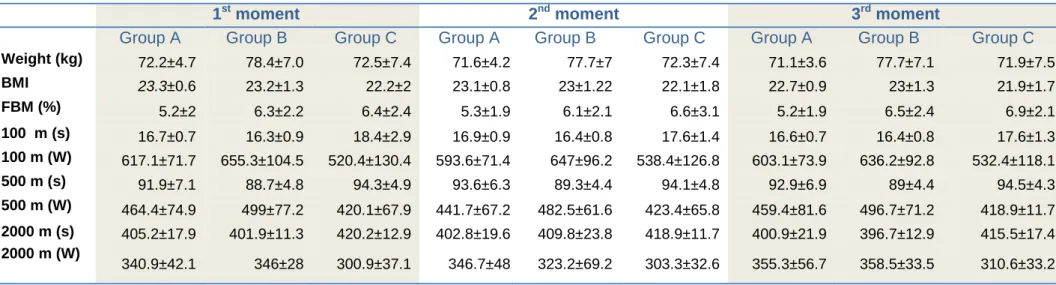
In the second moment after the supplementation period, there were no statistically significant differences between the groups showing homogeneity between the groups. After the second assessment a five week washout period was set. The results continue to show the similarity in performance indicators and anthropometric.
Table 1. Groups’ variation in the first, in the second and in the third moment of evaluation
1st moment 2nd moment 3rd moment
Group A Group B Group C Group A Group B Group C Group A Group B Group C
Weight (kg) 72.2±4.7 78.4±7.0 72.5±7.4 71.6±4.2 77.7±7 72.3±7.4 71.1±3.6 77.7±7.1 71.9±7.5 BMI 23.3±0.6 23.2±1.3 22.2±2 23.1±0.8 23±1.22 22.1±1.8 22.7±0.9 23±1.3 21.9±1.7 FBM (%) 5.2±2 6.3±2.2 6.4±2.4 5.3±1.9 6.1±2.1 6.6±3.1 5.2±1.9 6.5±2.4 6.9±2.1 100 m (s) 16.7±0.7 16.3±0.9 18.4±2.9 16.9±0.9 16.4±0.8 17.6±1.4 16.6±0.7 16.4±0.8 17.6±1.3 100 m (W) 617.1±71.7 655.3±104.5 520.4±130.4 593.6±71.4 647±96.2 538.4±126.8 603.1±73.9 636.2±92.8 532.4±118.1 500 m (s) 91.9±7.1 88.7±4.8 94.3±4.9 93.6±6.3 89.3±4.4 94.1±4.8 92.9±6.9 89±4.4 94.5±4.3 500 m (W) 464.4±74.9 499±77.2 420.1±67.9 441.7±67.2 482.5±61.6 423.4±65.8 459.4±81.6 496.7±71.2 418.9±11.7 2000 m (s) 405.2±17.9 401.9±11.3 420.2±12.9 402.8±19.6 409.8±23.8 418.9±11.7 400.9±21.9 396.7±12.9 415.5±17.4 2000 m (W) 340.9±42.1 346±28 300.9±37.1 346.7±48 323.2±69.2 303.3±32.6 355.3±56.7 358.5±33.5 310.6±33.2
22 Comparison intra-groups between the three moments of evaluation
This assessment methodology was used between moments, not to mix the indicators evaluated with and without supplementation. The groups were not assessesd among the three moments. For each group it were analysed two moments of each time.
Table 2. Groups’ variation between the first and the second, between the second and the third and between the first and third moment of evaluation
a) The results show a statistically significant difference exists between the first and the second assessment for the time (s) 100-m (p=0.04). b) The results show a statistically significant difference exists between the anthropometric indicator for BMI (p=0.02).
Group A Group B Group C
1st mom. 2nd mom. 3rd mom. 1st mom. 2nd mom. 3rd mom. 1st mom. 2nd mom. 3rd mom. Weight (kg) 72.2±4.7 71.6±4.2 71.1±3.6 78.4±7 77.7±7 77.7±7.1 72.5±7.4 72.3±7.4 71.9±7.5 BMI 23.3±0.6 b) 23.1±0.8 22.7±0.9 b) 23.2±1.3 23±1.22 23±1.3 22.2±2 22.1±1.8 21.9±1.7 FBM (%) 5.2±2 5.3±1.9 5.2±1.9 6.3±2.2 6.1±2.1 6.5±2.4 6.4±2.4 6.6±3.1 6.9±2.1 100 m (s) 16.7±0.7 a) 16.9±0.9 a) 16.6±0.7 16.3±0.9 16.4±0.8 16.4±0.8 18.4±2.9 17.6±1.4 17.6±1.3 100 m (W) 617.1±71.7 593.6±71.4 603.1±73.9 655.3±104.5 647±96.2 636.2±92.8 520.4±130.4 538.4±126.8 532.4±118.1 500 m (s) 91.9±7.1 93.6±6.3 92.9±6.9 88.7±4.8 89.3±4.4 89±4.4 94.3±4.9 94.1±4.8 94.5±4.3 500 m (W) 464.4±74.9 441.7±67.2 459.4±81.6 499±77.2 482.5±61.6 496.7±71.2 420.1±67.9 423.4±65.8 418.9±11.7 2000 m (s) 405.2±17.9 402.8±19.6 400.9±21.9 401.9±11.3 409.8±23.8 396.7±12.9 420.2±12.9 418.9±11.7 415.5±17.4 2000 m (W) 340.9±42.1 346.7±48 355.3±56.7 346±28 323.2±69.2 358.5±33.5 300.9±37.1 303.3±32.6 310.6±33.2
23
DISCUSSION
This study intended to verify the effects of supplementation of two different dosages of beta-alanine (BA) – 1.6 g/day and 6.4 g/day in rowing performance and body composition of Portuguese elite rowers.
The importance of beta-alanine (BA) as an ergogenic mean derives from its direct contribution alongside with L-histidine to the formation of carnosine, an important neutralizer of the acidosis induced by high intensity physical exercise lasting between 1 to 4 minutes (Harris & Stellingwerff, 2013).
BA has been referred to as a supplement that favors aerobic power (Stout et al. 2007; Zoeller et al. 2007). Stout et al. (2007) verified a 2.5% improvement in the aerobic power in exhaustive cycling exercise.
Several studies support the hypothesis that intramuscular carnosine increases with the adaptation to long lasting high intensity training periods (Parkhouse et al. 1985; Tallon MJ et al. 2005) while other data refutes this statement (Mannion et al. 1994; Kim et al. 2005; Kendrick et al. 2008 e Kendrick et al. 2009).
Suzuki et al. (2004), were able to show that sedentary individuals subjected to a high intensity training protocol for 8 weeks increased their intramuscular content of carnosine in a significant way. On the contrary, other researchers cannot verify intramuscular carnosine increasing after 10 weeks (Kim et al. 2005; Kendrick et al. 2008) and after 16 weeks (Mannion et al. 1994) of high intensity training. Previously some researchers showed that 800-m runners, bodybuilders and rowers possessed major quantities of intramuscular carnosine when compared with endurance athletes and untrained individuals (Parkhouse et al. 1985; Tallon MJ et al. 2005).
The investigation data casts some doubts on the effect of training on the increase of carnosine muscle content. The results obtained after BA supplementation are conflicting.
24 Although intramuscular carnosine content is increased with BA supplementation the results are equivocal in relation to the positive effects on physical performance.
Harris et al. (2006) was able to prove that different BA supplementation doses (3.2 g/day for the first week and an increase for 6.4 g/day in the next 3 weeks) resulted in an effective increase of intramuscular carnosine on individuals with no training program.
The present study not having analyzed the intramuscular variation of carnosine, intends to establish links between the BA supplementation and the performance and body composition.
In the present study we didn´t find evidences of the ergogenic action of BA in rowing performance evaluated by timings and power developed on the 100, 500 and 2000 m tests. We expected that BA supplementation would improve the performance on the shorter distances, especially the 100 m that correspond to the starting distance. Being the starting phase in rowing, a moment of high level of effort that triggers the dramatic increase of acidosis, one could expect that the supplementation with BA would decrease acidosis with positive effects in the performance. Our data do not support this hypothesis. On the contrary, the only significant difference was verified in group A (supplemented with 6.4 g, and between the first and the second moment of evaluation) and in the sense of reducing performance (p=0.04) (Table 2 a) ).
One can speculate that the supplemented group with the major quantity of BA saw their acid-neutralizing system worsen by feedback mechanisms. That is, the massive ingestion of BA blocked the endogenous and natural mechanisms induced by physical exercise for acidosis buffering.
In the third moment of evaluation the verification of the absence of statistically significant differences between the groups demonstrates the inexistence of chronic adaptations, be ergogenic or anti-ergogenic effects, induced by the supplementation of BA.
25 The existent literature shows that there is a conflict of results about the effects of BA supplementation in high intensity performance.
Derave et al. (2007) corroborated our results once they have not found improvements in 400-m running performance after a 5 week supplementation period with 4.8 g/ day of BA.
On the contrary, cyclists supplemented with BA for 10 weeks have shown a significant increase (58.8% and 80.1%, on the 4th and 10th week respectively) on muscular carnosine and performance in exercise eliciting high muscular power (Hill et al., 2007). However, Smith et al. (2009) did not verify significant improvements in the performance of exercise to exhaustion at 110% of VO2max after BA supplementation.
Baguet et al. (2010) verified that there is a positive correlation between the intramuscular content of carnosine and the performance at 100, 500, 2000 and 6000-m in rowing-ergometer testing after 7 weeks of BA supplementation (5 g/day).
This study contradicts directly our results which did not verify any significant alteration in rowing performance in any of the testing distances that were chosen.
After a certain period of supplementation with BA the eventual positive effects on performance would subsist in time. It was verified (Baguet et al., 2009; Stellinqwerff et al., 2011) that though the muscular levels of carnosine come back to their initial levels 8 to 9 weeks after the term of the supplementation, the retarded effects on controlling the intramuscular acidosis are kept. Our data point on the opposite direction. That is, even if we accept the hypothesis that a certain buffering capacity of the intramuscular acidosis induced by exercise is maintained after a supplementation period with BA, that eventual physiological capacity did not have any effect on the performance.
This study aimed also to verify the effect of BA supplementation in the BMI and the percentage of fat mass. The BMI and fat mass control is essential in rowing mainly in the competitive classes that have the body weight as reference.
26 Our results point out to a great stability of the studied indicators (Weight and BMI) mostly in the two initial moments of this study. None of those indicators has changed significantly (p>0.05) between the 1st and the 2nd moment. There is still a tendency for the BMI reduction eventually determined by the control of the body weight of the individuals that compete in the lightweight class. As the percentage of fat mass kept a great stability one can accept the hypothesis that the slight reduction of BMI in the group A between the first and the third moment (p=0.02) may be related with an also slight reduction of fat free mass or even water (Table 2 b) ).
This idea agrees with Kern & Robinson (2011), which verified that the wrestling athletes that were supplemented with 4 g/day of BA for 8 weeks lose weight when in comparison with the placebo group. The authors assume that this loss may not be due to supplementation but to food and/or hydric restriction so that the fighters can compete in lower weight classes.
However, divergent experimental situations may promote different answers. So, while Kern & Robinson (2011) verified a significant body weight increasing in soccer players submitted to a 8 week BA supplementation period (4 g/day of BA), students with no routine of strength training supplemented during 10 weeks with 6.4 g/day did not show any alteration either in weight or in body composition (Kendrick et al. 2008).
27
CONCLUSION
The results obtained, show that the supplementation with beta-alanine does not improve the indicators of time and power of performance tests on rowing ergometer, or changes in body weight, BMI and percentage of fat mass. Further studies are needed altering the amounts of beta-alanine to ingest and periods of supplementation.
28
BIBLIOGRAPHY
Alvares, T & Meirelles, C. (2008). Efeitos da suplementação de
b-hidroxi-b-metilbutirato sobre a força e a hipertrofia.
http://www.scielo.br/scielo.php?script=sci_arttext&pid=S1415-52732008000100006&lng=enandothers&nrm=iso&tlng=enandothers.
Artioli, G; Gualano, B; Smith, A; Stout, J; Lancha, Jr. (2010). Role of β-Alanine supplementation on muscle carnosine and exercise performance. Med Sci Sports Exerc. 42(6):1162-73.
Baguet, A; Reyngoudt, H & Pottier, A. (2009). Carnosine loading and washout in human skeletal muscles. J Appl Physiol, 106(3):837-842.
Baguet, A; Bourgois, J; Vanhee, L; Achten, E & Derave, W. (2010). Important role of muscle carnosine in rowing performance. J Appl Physiol, 109:1096-1101. Borges, N. (2009). Aspectos de segurança na suplementaçao de alimentos. Da necessidade de suplementaçao aos riscos potenciais. Segurança e qualidade alimentar, 6, 14-15.
Branco, R. J. (2009). Os efeitos da ingestão de bicarbonato de sódio no treino intervalado extensivo. (Estudo cientifico, descritivo e interpretativo, no âmbito da disciplina de seminário - Atletismo, opção curricular de desporto ''rendimento''), Universidade do Porto, Faculdade de Desporto.
Chwalbinska-Moneta, J. (2003). Effect of creatine supplementation on aerobic performance and anaerobic capacity in elite rowers in the course of endurance training. Int J Sport Nutr Exerc Metab, 13(2):173-183.
Coutts, A., Reaburn, P., Mummery, K., & Holmes, M. (2002). The effect of glycerolo hyperhydratation on olympic distance triathlon performance in high ambient temperatures. Int J Sport Nutr Exerc Metab, 12(1), 105-119.
Derave, W; Ozdemir, MS; Harris, RC; Pottier, A; Reyngoud, H; Koppo, K & Achten, E. (2007). beta-Alanine supplementation augments muscle carnosine
29 content and attenuates fatigue during repeated isokinetic contraction bouts in trained sprinters. J Appl Physiol, 103(5):1736-1743.
Edge, J; Bishop, D & Goodman, C. (2006). Effects of chronic NaHCO3 ingestion during interval training on changes to muscle buffer capacity, metabolism, and short-term endurance performance. J Appl Physiol, 101:918-925.
Easton, C., Turner, S., & Pitsiladis, Y. (2007). Creatine and glycerol
hyperhydratation in trained subjects before exercise in the heat. Int J Sport Nutr Exerc Metab, 17(1), 70-91.
Eley, HL; Russell, ST; Baxter, JH; Mukerji, P & Tisdale, MJ. (2007). Signaling pathways initiated by beta-hydroxy-beta-methylbutyrate to attenuate the depression of protein synthesis in skeletal muscle in responseto cachectic stimuli. Am J Physiol Endocrinol Metab, 293(4):923-931.
Harris, RC; Tallon, MJ; Dunnett, M; Boobis, LH; Coakley, J; Kim, HJ & Wise, JA. (2006). The absorption of orally suplied beta-alanine and its effect on muscle carnosine synthesis in human vastus laterallis. Amino Acids, 30(3):279-289.
Harris, RC & Stellingwerff, T. (2013). Effect of b-alanine Supplementation on High-Intensity Exercise Performance Limits of Human Endurance. Nestlé Nutr Inst Workshop Ser, 76:61-71.
Hill, CA; Harris, RC; Kim, HJ; Harris, BD; Sale, C; Boobis, LH & Wise, JA. (2007a). Influence of B-alanine supplementation on skeletal muscle carnosine concentraccions and high intensity cycling capacity. Amino Acids, 32:225-233. Hill, CA; Harris, RC; Kim, HJ; Harris, BD; Sale, C; Boobis, LH & Wise, JA. (2007b). Influence of beta-alanine supplementation on skeletal muscle carnosine concentration and high intensity cycling capacity. Amino Acids, 32(2):225-233.
Hoffman, J; Ratamess, N & Ross, R. (2008). B-alanine and the hormonal response to exercise. int J Sports Med, 29(12):952-958.
30 Horinishi, H; Grillo, M; Margolis, FL et al. (1978). Purification and characterization of carnosine synthetase from mouse olfactory bulbs. J Neurochem. J Neurochem. 31(4):909-19.
Ivy, J., Goforth, H., Damon, B., McCauley, T., Parsons, E., & Price, T. (2002). Early postexercise muscle glycogen recovery is enhanced with carbohydrate-protein supplement. J Appl Physiol, 93(4), 1337-1344.
Jackson, A. S., & Pollock, M. L. (1978). Generalized equations for predicting body density of men. British Journal of Nutrition, 40, 497-504.
Kendrick, IP; Kim, HJ; Harris, RC; Kim, CK; Dang, VH; Lam, TQ & Wise, JA. (2009). The effect of 4 weeks b-alanine supplementation and isokinetic training on carnosine concentrations in type I and II human skeletal muscle fibres. J Appl Physiol, 106:131-138.
Kendrick, IP; Harris, RC; Kim, HJ; Kim, CK; Dang, VH; Lam, TQ & Wise, JA. (2008). The effects of 10 weeks of resistance training combined with beta-alanine supplementation on whole body strenght, force production, muscular endurance and body composition. Amino Acids, 34(4):547-554.
Kern, B & Robinson, T. (2011). Effects of b-alanine supplementation on performance and body composition in collegiate wrestlers and football players. Journal of Strength and Conditioning Research, 25(7):1804-1815.
Kim, JH; Kim, Cj & Changkeun, K. (2005). Effect on muscle fibre type morphology and carnosine content after 12 days training of Korean speed skaters. Med Sci Sports Exerc, 37(5):192.
Kreider, R., Almada, A., Antonio, J., Broeder, C., Earnest, C., Greenwood, M., & al., e. (2004). ISSN Exercise and Sport Nutrition Review: Reseach and
recommendations. Journal of the International Society of Sports Nutrition, 1, 1-44.
Mahan, LK & Escott-Stump, K. (2007). Alimentos, Nutrição & Dietoterapia. São Paulo.
31 Mannion, AF; Jakeman, PM & Willan, PL. (1994). Effects of isokinetic training of the knee extensors on high-intensity exercise performance and skeletal muscle buffering. Eur J Appl Physiol Occup Physiol, 68(4):356-361.
Maughan, RJ; King, D & Lea, T. (2004). Dietatery supplements. J Sports Sci, Jan. 22(1):95-113.
McNaughton, L; Backx, K; Palmer, G & Strange, N. (1999). Effects of chronic bicarbonate ingestion on the performance of high-intensity work. Eur J Appl Physiol Occup Physiol, 80(4):333-336.
Nagasawa, T; Yonekura, T; Nishizawa, N & Kitts, D. (2001). In vitro and in vivo inhibition of muscle lipid and protein oxidation by carnosine. Mol. Cell. Biochem, 225:29-34.
Ng RH, Marshall FD. (1978). Regional and subcellular distribution of homocarnosine-carnosine synthetase in the central nervous system of rats. J Neurochem. 30(1):I87-90.
Nieman, D. (2001). Exercise, immunology and nutrition. World Rev Nutr Diet, 90, 89-101.
Parkhouse, WS; McKenzie, DC; Hochachka, PW & Ovalle, WK. (1985). Buffering capacity of deproteinized human vastus lateralis muscle. J Appl Physiol., 58(1):14-17.
Position of the American Dietetic Association, Dietitians of Canada, and the American College of Sports Medicine. (2000). Nutrition and athletic performance. J Am Diet Assoc, Dec. 100(12):1543-1556.
Rodrigues dos Santos, J. A. (1995). Dietética do Desportista.
Rogero, M., Borelli, P., Vinolo, M., Fock, R., de Oliveira Pires, I., & Tirapegui, J. (2008). Dietary glutamine supplementation affects macrophage function, hematopoiesis and nutritional status in early weaned mice. Clin Nutr.
32 Schneiker, KT; Bishop, D; Dawson, B & Hackett, LP. (2006). Effects of caffeine on prolonged intermittent-sprint ability in team-sport athletes. Med Sci Sports Exerc, 38(3):578-585.
Smith, AE; Walter, AG; Jennifer LK; Kristina, LM; Jordan, RL; Christopher M & Stout, JR. (2009). Effects of β-alanine supplementation and high-intensity interval training on endurance performance and body composition in men; a double-blind trial. Journal of the International Society of Sports Nutrition, 1 – 9. Stellingwerf, T; Helen, E; Andrea, B; Tania, K; Roland, D; Jacques, C & Boesch, C. (2011). Effect of two b-alanine dosing protocols on muscle carnosine synthesis and washout. Amino Acids.
Stephens, TJ; McKenna, MJ; Canny, BJ; Snow, RJ & McConell, GK. (2002). Effect of sodium bicarbonate on muscle metabolism during intense endurance cycling. Med Sci Sports Exerc, 34(4):614-621.
Stout, JR; Cramer, JT; Zoeller, RF; Torok, D; Costa, P & O'Kroy, J. (2007). Effects of Beta-Alanine Supplementation on the onset of neuromuscular fatigue and ventilatory threshold in women. Amino Acids, 32(3):381-386.
Suzuki, Y; Ito, O; Mukai, N; Takahashi, H & Takamatsu, K. (2002). High level of skeletal muscle carnosine contributes to the latter half of exercise performance during 30-s maximal cycle ergometer sprinting. The Japanese journal of physiology, 52(2):199-205.
Suzuki, Y; Ito, O; Takahashi, H & Takamatsu, K. (2004). The effect of sprint training on skeletal muscle carnosine in humans. Int J Sport Health Sci, 2:105-110.
Tallon, MJ; Harris, RC; Boobis, LH; Fallowfield, JL & JA, Wise. (2005). The carnosine content of vastus lateralis is elevated in resistance-trained bodybuilders. J Strenght Cond Res., 19(4):725-729.
Thienen, RV; Proeyen, KV; Eynde, BV; Puype, J; Lefere, T & Hespel, P. (2009). b-Alanine Improves Sprint Performance in Endurance Cycling. Medicine & Science in Sports & Exercise, 2009:898-903.
33 White, J., Wilson, J., Austin, K., Greer, B., St John, N., & LB., P. (2008). Effect of carbohydrate-protein supplement timing on acute exercise-induced muscle damage. J Int Soc Sports Nutr, 5(5).
Williams, MH. (1989). Beyond Training: how athletes enhance performance legally and illegally. Illinois: Leisure Press.
Zoeller, RF; Stout, JR; O'Kroy, JA; Torok, DJ & Mielke, M. (2007). Effects of 28 days of beta- alanine and creatine monohydrate supplementation on aerobic power, ventilatory and lactate threshold, and time to exhaustion. Amino Acids, 33(3):505-510.