The Influence of Executive
Compensation on Innovation
Master Thesis
International Master of Science in Business Administration
Major in Strategy & Entrepreneurship
Dissertation submitted in partial fulfilment of requirements for the degree of
International Master of Science in Business Administration
at the Universidade Católica Portuguesa in in September 2015
Author: Thiemo Werner
Supervisors: Professor Geraldo Cerqueiro (UCP)
II
The Influence of
Executive Compensation
on Innovation
by
Thiemo Werner
152113089
AbstractThis dissertation examines the relationship between CEO compensation components and the innovation capabilities of publicly traded companies in the United States of America. Based on an extensive literature review, I hypothesize that payment components with convex payoffs as well as those with long-term payoffs have a positive influence on innovation. Further, I expect cash based compensations to have no or a negative influence on innovation. Lastly, I develop a hypothesis regarding instruments that protect executives in case of failure and their positive influence on innovation. Using a sample of S&P 1500 constituents over 14 years, I find that an increase of the proportion of stock options in CEO compensation has a positive influence on innovation input and output as well as on innovation effectiveness. I obtain similar results for the proportion of long term incentives in the total compensation. For salary and bonus, I find that a higher proportion has a negative influence on innovation input and output. After a sample split, I show that all findings related to compensation components only hold for firms in less innovative industries. In a subsequent small sample analysis, I characterize elements of golden parachute agreements and classify them in accordance to the protection they offer to CEOs. Subsequently, I find evidence that more innovative firms use more and further developed agreements. I conclude that such protections for failure can influence the motivation of executives to innovate.
III
Content
1. Introduction ... 1
2. Related Literature and Hypothesis Development ... 3
2.1 Innovation in the Context of Executive Compensation ... 3
2.2 Elements of Executive Compensation and Management Incentives ... 5
2.2.1 Cash Compensation ... 5
2.2.2 Equity Compensation ... 6
2.3 Tolerance for Failure and Innovation ... 11
3. Large Sample Analysis ... 13
3.1 Data, Variables and Descriptive Statistics ... 13
3.1.1 Measuring Innovation ... 13
3.1.2 Data and Sample ... 14
3.1.3 Control Variables ... 17
3.1.4 Descriptive Statistics ... 18
3.2 Regression Model Results ... 20
3.2.1 R&D Expenditures ... 21
3.2.2 Number of Patents and Patent Citations ... 23
3.2.3 Innovativeness by Industry and Innovation Effectiveness ... 26
3.3 Concluding Remarks and Endogeneity Issue ... 29
4. Small Sample Analysis ... 30
4.1 Data Collection, Description and Quantitative Analysis ... 30
4.1.1 Sample Selection ... 30
4.1.2 Sample Description and Quantitative Analysis ... 31
4.2 Terms of Severance Agreements ... 32
4.2.1 Transparency and Termination Trigger ... 33
4.2.2 Compensation and Benefits ... 34
4.2.3 Assessment of Protectiveness of Agreements ... 35
4.3 Relationship between Severance Agreements and Innovation ... 36
4.4 Conclusion and Robustness of Findings ... 39
5. Conclusion ... 41
IV
List of Tables
Table I: Descriptive Statistics of Large Sample ... 19
Table II: CEO Compensation and R&D Intensity ... 22
Table III: CEO Compensation and Patenting Activity... 24
Table IV: CEO Compensation and Innovation Effectiveness ... 28
Table V: Prevalence of Golden Parachute Agreements and Innovation ... 32
Table VI: Quality of Severance Agreements and Innovation ... 38
List of Figures
Figure I: The Relationship between Severance Agreements and Innovation…………...401
1. Introduction
Some of the most relevant contributions to management literature emphasise the importance of innovation in the global economy. Economical and managerial research has been influenced over decades by Joseph Schumpeter and his conclusion that “(…) creative
destruction [innovation] is the essential fact about capitalism” (Schumpeter, 1942, p. 83). In
his widely used and taught management concepts, Peter Drucker incorporated the importance of innovation as “(…) the means by which the entrepreneur either creates new
wealth-producing resources or endows existing resources with enhanced potential for creating wealth.” (Drucker, 1998, p. 2). In addition, as one of the most influential business theorists of
the last 50 years (Whelan, 2011), Clayton Christensen defined disruptive innovation as the key to future success in business (Christensen, 1997).
Although these contributions to management literature were made several years ago, innovation has not lost its relevance in modern business reality. According to latest global CEO surveys, executives rank innovation as a top-4 priority, indicating it to be among the challenges that “(…) remain vitally important for driving business growth and ensuring a sustainable future” (Mitchell et al, 2014, p. 23)
A significant literature concentrates on multiple economic factors and their impact on innovation. However, relatively few studies have explored the importance of individual incentives to innovate in corporations. This thesis aims to examine this relationship. In an extensive literature review, I explain why incentives matter and develop hypotheses regarding CEO incentives and their effects on the innovation capabilities of the firms the CEOs manage. In a subsequent econometrical analysis, I test the relationship between different pay components for CEOs and innovation using a large sample of US firms. My findings generally support my hypotheses. I find that compensations with convex or long-term payoff structures incentivise CEOs to promote innovation in firms.
2
These findings hold for innovation input, measured using research and development expenses, as well as for innovation output, measure using patent applications. In a subsample, the findings also hold for innovation quality as well as for innovation effectiveness. Given the limited scope of this thesis, I do not perform advanced tests for the robustness of my findings but I give guidance and suggestions for future research.
In a subsequent qualitative small sample analysis, I find evidence that contracts, which protect the CEO in case of failure, are positively related to the innovativeness of firms. Based on the existing literature on this topic, I conclude that protected CEOs are more likely to engage in potentially risky exploratory projects then unprotected CEOs. Given the limited sample size, these findings are not generalizable but can give motivation for future research.
This thesis contributes to the existing literature on executive compensation as well as to the research on innovation. To my knowledge, I am the first to examine how different components of executive compensation contribute to innovation while controlling for the total compensation. Furthermore, I present a novel in-depth research on the effects of compensation in low- versus high innovation industries that results in the somewhat puzzling conclusion that compensation is only important in less innovative industries. Even though I deliver potential explanations for those findings, future research might concentrate on delivering further explanations for them. Finally, my qualitative analyses on golden parachute agreements might motivate more research in this controversial field.
The remainder of this thesis is structured as follows: Chapter 2 discusses relevant literature on executive compensation and potential effects on innovation. Based on this examination, four hypotheses are presented. Chapter 3 presents and discusses the data as well as the results of my large sample empirical analysis. Chapter 4 examines multiple elements of golden parachute agreements and their protection capabilities. Chapter 5 concludes.
3
2. Related Literature and Hypothesis Development
To offer a basis for the discussion of the impact of executives’ incentives on innovation in firms, I first critically review the relevant literature. I start by defining innovation and discussing it in the context of different interests within modern organisations. Secondly, I introduce the literature on the effects of specific compensation components on managerial behaviour and the associated empirical results. Finally, I discuss perspectives on contracts that protect executives from failure and their relationship with innovation. Within the examination of related literature, I develop and present four hypotheses that are tested in the subsequent analyses.
2.1 Innovation in the Context of Executive Compensation
From an economical point of view, innovation has been defined as the production of new knowledge, as a result of research or incidental observations (Arrow, 1969). In a more holistic definition, Schumpeter (1942) explains the process of innovation as the constant recombination of knowledge and by this, the disruption of existing solutions. The final definition of innovation is still a current research topic (Baregheh et al., 2009) but for simplicity, this discussion will use a combined definition by Mowery and Rosenberg (1979). They define innovation as a process of exploration including the application of new approaches in order to create wealth. The creation of social and private benefits through innovation is broadly accepted (Mansfield et al., 1977), and, because of a positive impact on company value, innovation is viewed to be in the interest of shareholders (Denis, 1999).
With regards to innovation in the context of an organisation, March (1991) describes the importance of the trade-off decision made by individuals between exploration of new options and the exploitation of well-known solutions. He argues that the level of innovation in a cooperation is to a large extend determined by such individual decisions. Furthermore, in his
4
model, exploitation leads to payoffs that are positive, proximate, and predictable. Exploration, on the other hand, has uncertain, distant and often negative returns. This view is shared by Holmstrom (1989). He explains that corporate innovations are idiosyncratically risky but offer a potential for extraordinary returns. Using a basic agent theory model, Holmstrom (1989) derives that innovation activities in firms can be encouraged by choosing specific provisions for incentive contracts.1 Combining the findings of March (1991) and Holmstrom (1989), innovation can be expected to be carried out by individuals in the organisation, who need to be encouraged to pursue uncertain new approaches that create wealth (exploration), rather than use exploitation to secure a certain payoff.
The chief executive officer (CEO) of an organisation is the main decision maker and resource manager (Capstone, 2003). With regards to innovation, literature often assumes that the CEO is essential in guiding the organisation to an optimal level of innovation in line with his ultimate task, the maximization of shareholder wealth (e.g. Manso, 2011; Francis et al., 2011).
Early relevant literature discussing risky decision behaviour of managerial agents is Berle and Means (1932). They state that risk aversion can potentially make manager-controlled firms less likely to engage in risky processes. The authors argue that managers, in standard compensation contracts, bear the cost (dismissal) of unsuccessful risk-related ventures, but only minimal shares of the profits. The understanding of such agency problems with regards to firm control has changed dramatically through the evolvement of research focussing on the use of executive compensation. Starting with Jensen and Meckling (1976), this research stream suggests that specific compensation contracts are designed to alleviate conflicts of interests and motivate managers to act to the benefits of shareholders. This claim has been tested for a variety of implications including innovation. Holmstrom (1989) suggests, besides
1 As discussed in more detail bellow, Holmstrom (1989) finds that incentive contracts must offer a long-term
5
others, that the design of executive compensation is, through the reduction of agency conflicts, a significant determinant of the innovation produced by a firm.
This line of thought will be further developed in the following sections. For this, it is beneficial to distinguish between different kinds of compensation components and further types of compensation arrangements. From the distinction of specific attributes of compensation components, I will develop hypotheses regarding the individual impact on innovation.
2.2 Elements of Executive Compensation and Management Incentives
The structure of executive pay is constantly evolving and often determined in response to current economic and political trends. Even though the magnitude of the overall compensation as well as the usage of specific compensation elements follows trends in time, the individual incentivisation characteristics remain constant (Murphy, 2012).
2.2.1 Cash Compensation
The base salary is a fixed salary that CEOs are awarded regardless of their individual performance. As this payment does not motivate the CEO to increase the effort for his work, it is the least desirable compensation form from a shareholder perspective. Accordingly, only parts of the CEO compensation are typically based on base salary (Murphy, 2012).
CEO bonuses are payoffs that depend on short-term performance, often based on accounting measures. This creates indirect ties between CEO wealth and shareholder wealth.2 At the same time, through an inherent suboptimal design, such contracts may motivate the CEO to manage earnings and to focus only on short-term results instead of long-term value creation. In addition to this, the non-linearity in the pay-performance relationship of bonus contracts may also affect the risk-taking behaviour of CEOs. Especially when CEOs face
6
higher bonus cuts for lower performance compared to the bonus increase of high performance, risky business decisions might be avoided (Murphy and Jensen, 2011).
The base salary and bonus plans are therefore unlikely to motivate CEOs to engage in risky, experimental innovation. Moreover, whilst economists provide plenty of evidence for a positive reward-effort relationship in agent models and experiments, psychologists arrive at dissimilar conclusions (Ederer and Manso, 2011). Numerous studies show that pay-for-performance improves effort in simple, routine tasks but that it has no or even the opposite effect in tasks that require creativity and the development of new approaches (e.g. Amabile, 1996). This discussion leads to the following hypothesis:
Hypothesis 1: The amount of cash based compensation, such as salary and bonus, as proportion of the total compensation of CEOs will have no significant or a negative impact on the innovation capabilities of firms.
2.2.2 Equity Compensation
Compensating CEOs with equity has the goal to align their incentives closer to the interest of shareholders (Hall and Liebman, 1998). In addition to their cash compensation, executives therefore receive stock awards and stock options of the firm employing them. Starting with Jensen and Murphy (1990), there have been discussions about different equity compensations and their individual power to maximize firm value. The authors argue that the pay-performance sensitivity is much weaker as predicted by agency theory. To underline their claim, they present an empirical analysis concluding that for each $1,000 change in shareholder wealth, CEO wealth changes by only $3.25. Even though subsequent literature argue that this pay-for-performance sensitivity is understated (e.g. Hall and Liebman, 1998), the optimality of executive contracts still remains questioned (Murphy, 2012).
7
Besides this interest-alignment dilemma, firms might face a more specific risk-related agency problem caused by equity compensation. Shareholders typically hold well-diversified stock portfolios. The incremental, idiosyncratic risk that is added through risky projects in one firm does therefore not affect their overall risk. Risk-averse CEOs on the other hand, are less diversified, i.e. the firm that employs them is the major source of risk in their portfolio. Accordingly, they might forgo positive net-present-value projects if these increase firm risk. Such behaviour, in turn, might destroy shareholder wealth (Fama and Jensen, 1983).
With a focus on precarious business decision, Smith and Stulz (1985) argue that the wrong contracting might cause the executive to be hesitant in engaging with value maximizing activities. Using a state-preference model of firm value, they derive that executives choose suboptimal levels of hedging if they are not rewarded to bear additional risk. The authors show further that compensation elements such as common stock or equity options can turn managers into risk-seekers and, through this, maximize shareholder wealth. Lambert (1986) supports this view and stresses the point that a lower observability of the executive effort, i.e. higher asymmetry of information, might increase such agency problems. Modelling the agent’s decision-making process for risky projects, he shows that the problem
can be overcome by imposing risk on the executive. The model illustrates how a compensation that is highly contingent upon cash flow can lead to a disagreement between shareholders and executives and might even motivate agents to overinvest in high-risk projects. The right level and structure of equity compensation seems therefore to be essential to effectively motivate the CEO.
To examine potential limitations of common stock as part of compensation agreements, some financial economists explore the convexity and the slope of the relationship between firm risk and executive wealth. This relationship is named vega. Guay (1999) started this line of thought with an examination of the sensitivity of CEO wealth to the volatility of equity stock. Using a sample of 278 CEOs, Black-Scholes option valuation and multivariate
8
regression models, he shows that stock options are the major driver for convexity in CEO pay. Guay (1999) concludes that this convexity can influence CEO behaviour. Moreover, he tests the impact of a number of firm characteristics on the sensitivity of CEO wealth to equity risk. Concluding the findings of this model, he argues that firms with high growth opportunities add more convexity to CEO compensation in order to overcome risk-related agency problems. This renews the hypothesis formulated by Smith and Watts (1992) that firms with greater investment opportunities tie CEO wealth more closely to performance.
While this research focuses on explaining the composition of executive pay through growth opportunities and other firm characteristics, another stream of research focuses on the effect the structure of executive pay has on managerial decisions. Using a sample including the largest US firms, Coles et al. (2006) examine how the sensitivity of CEO wealth to equity volatility changes risky firm policies in a controlled econometrical model. Their findings suggest that vega has a positive influence on investment in R&D, a negative influence on investment in property, land and equipment and leads to a higher leverage. The authors conclude that the level of vega influences precarious managerial decisions. Focussing on financial policy, Chava and Purnanandam (2010) come to the similar result that risk-seeking incentives from stock and option holdings motivate CEOs and CFOs to choose value creating, riskier finance structures. Finally, in a model that uses an exogenous shock, the change in takeover protection legislation, Low (2009) shows that if CEOs are exposed to a high vega, they are less likely to choose a value destroying reduction of firm risk following the legislation change.
While the presented works convey a homogeneous picture on the positive impact of a higher vega on risk-taking behaviour, other studies show different results. Hayes et al. (2012) examined the impact of an exogenously caused reduction of convexity in compensation on risky investments and financial policies. Using a sample of 6,983 firm-year observations they do not find that the adoption of FAS 123R and a subsequent reduction of stock option usage
9
led to less risky firm policies. Consistent with those findings, Kini and Williams (2012) do not find a systematic relationship between risky managerial decisions and risk-taking incentives provided by vega. As the first authors to control for intra-organisational CEO promotion tournaments which, according to their research, add convexity to the payoffs of executives, they do not find additional risk-taking incentives provided by stock options.3 These findings are difficult to reconcile with the majority of past research, but can nevertheless provide an understanding of the sensitivity of the discussed findings.
As elements of innovation, such as R&D expenses, typically lead to a higher volatility in firm value, it is intuitive that vega might also have an impact on measures of innovation (Coles et al., 2006). Following this rational, Francis et al. (2011) examine empirically whether compensation determines innovation output in the form of patents and innovation quality, measured by patent citations. In a sample of 6,946 firm-years they show that the total portfolio of long-term incentives in the form of options is positively related to these measures. In a smaller sample of 300 US firms, Lerner and Wulf (2007) show that this relationship also holds for the use of vested stock and stock options as compensation of R&D executives and the innovation output of firms. Arguing that the main innovators in a firm are non-executive employees that contribute through their everyday work to the innovation capabilities of firms, Chang et al. (2015) find that firms produce more innovation when employees receive more stock options and those options have a longer expiration period. Motivated by this line of research, I formulate my second hypothesis:
Hypothesis 2: An increase of stock options as proportion of total pay will result in a higher level of innovation in a corporation, regardless of the total compensation amount.
3 The authors define a promotion tournament as the competition for the role of CEO between senior executives.
They measure the incentives for this tournament with the pay gap between the CEO and the next layer of senior managers.
10
As discussed above, starting with Guay (1999), a large share of the formal literature on executive compensation focusses on compensation instruments that have convex payoffs. Even though research has identified stock options as the primary source of convexity, it is generally agreed that direct stock compensation, e.g. restricted stock, can also add convexity (Core and Guay, 1999). This is in line with a series of research that identifies long term incentives regardless of their payoff structure as determinants for innovation. Manso (2011) shows in an agent model that parts of the ideal incentive scheme to motivate innovation is a long-term compensation plan. In a later laboratory setting, Ederer and Manso (2013) confirm those findings. In a business simulation setup, participants with long-term incentives are more likely to explore new options and discover new business strategies. The authors argue that this is inconsistent with the widely-held belief that pay-for-performance cannot motivate creativity.
In the context of managerial compensation, these findings motivate to examine the impact of compensation elements that offer only limited vega but a long-term payoff. Restricted stock has such characteristics and even though there is a recent rise in restricted stock as a part of the executive compensation (Murphy, 2012), the literature about motivational effects of it is limited. Similarly, long-term incentive plans offer long-term payoffs and have yet not been the focus of executive compensation research.
This is the motivation behind the research conducted by Chi and Johnson (2008), who examine the relationship between restricted stock and corporate acquisitions. Using a sample of 1,013 firms, they find that longer vesting periods of stock, but not of stock options, are positively related to higher acquisitions announcements, higher post-merger profitability and negatively related to the paid premium. The authors argue that these effects create shareholder wealth and explain their findings through the longer vesting period of restricted stock incentives (4.38 years), compared to stock options (2.14 years). The rationale behind this is that for long-term decisions where executive have private information, such as corporate
11
acquisitions, long-term incentives with payoffs after the outcomes of the decision become observable, are favourable.
Although these findings differ from the general belief that restricted stock and long-term incentive plans are a suboptimal incentive for CEOs (e.g. Lambert and Larcker, 2011), a comparable effect could be expected for innovation decisions. For these, similarly to acquisitions, executives might have private information and the impact of the innovation investment can only be observed and judged in the long-term future. This assumption motivates my third hypothesis:
Hypothesis 3: The proportion of restricted stock and long-term incentive plans in the total CEO compensation will have a positive impact on the innovation capabilities of firms.
2.3 Tolerance for Failure and Innovation
In addition to the long-term payoff characteristics, which are incremental to innovation, a stream of literature has also examined the effects of acceptance or even encouragement of early failure. Holmstrom (1989) is the first to show in an agent model that if executives are penalized for mistakes, they are unlikely to engage in activities that have a high probability of failure. Manso (2011) progresses these findings and uses a Bayesian decision model to show that it is crucial for innovation to employ a contract which exhibits tolerance for failures. He shows that if the agent receives a protection in case of early failure, he is more likely to start exploring new options rather than exploiting existing ones. Based on those findings, Ederer and Manso (2013) find in an experimental setting that tolerance for early failure is motivating exploration.4 Tian and Wang (2011) provide empirical evidence that the relationship between failure tolerance and innovation is positive. For a sample of 1,860 firms, they construct a
4 This is in addition to the findings regarding long-term incentives by Manso (2011) and Ederer and Manso
12
venture capitalist failure tolerance measure and show that higher tolerance for failure has a positive impact on innovation, measured in patents. Eder and Manso (2011) argue that in the context of corporate governance, such tolerance for failure is resembled in golden parachutes.
A golden parachute clause provides an executive with financial benefits, should the firm decide to retire him prior to the end of his employment contract (Capstone, 2003). Ederer and Manso (2011) argue that such a provision motivates the executive to engage in riskier exploration (innovation) as his downside risk, i.e. the risk from early termination, is limited.
To verify this claim, O’Connor and Rafferty (2012) examine the impact of corporate governance, including provisions such as golden parachutes, and innovation, measured as R&D activity. In a series of least squares models, the authors do not find a consistent, significant relationship between R&D activities and any provisional factor of corporate governance. In contrast to this, Francis et al. (2011) find that golden parachute provisions are positively correlated with the number of patents held by a firm. They conclude that, after controlling for a series of other control variables, golden parachutes have a positive impact on the innovation capabilities of firms. These theoretical, experimental and empirical works inspire my fourth hypothesis:
Hypothesis 4: High-innovation firms have, in comparison with low-innovation firms, more and further developed arrangements that protect the CEO in case of an early retirement.
The first three hypotheses are tested in an econometric large sample analysis using a set of US firms and patent data as a measure of innovation. The fourth hypothesis is subsequently examined using a small sample of annual reports.
13
3. Large Sample Analysis
Next, I test my developed hypotheses using a panel dataset and ordinary least squares (OLS) regression models. I begin by explaining my data sample, its sources and descriptive statistics. Subsequently, I use a series of OLS regression models to test the validity of my Hypotheses 1 to 3. Finally, I conclude my findings, evaluate the potential limitations of my analysis and make suggestions for future research.
3.1 Data, Variables and Descriptive Statistics
3.1.1 Measuring Innovation
A critical aspect of my analysis is the measurement of innovation. The literature suggests a variety of ways to measure innovation. Obvious measures are a firm’s expenses for research and development (R&D) as research is seen as a crucial requirement for innovation. However, this measure is potentially limited as it is purely based on the assumption that higher R&D expenditures lead to higher innovation. This assumption does not account for differences in the quality of research conducted (i.e. innovation per R&D dollar spent). A company might have relatively high R&D expenditures but will not necessarily produce more innovation than its peers (Kochhar and David, 1996). Still, R&D expenditures can serve as a proxy for the intention to pursue innovation. In a competitive market, the allocation of funds into R&D is the most direct instrument to increase innovation (Kor, 2006). Accordingly, I measure the pursued innovation or innovation input with R&D scaled by book assets.
The measurement of innovation output is somewhat more complex. After a firm created an innovation it is naturally interested in seeking a legal protection to guarantee the exclusive exploitation of this innovation. Patents offer such an exclusive right in exchange for a detailed disclosure of the invention for a limited time period (Fagerberg et al., 2006). Assuming that the majority of innovation is sought to be protected, the application for patents could serve as
14
a measure of innovation created (Balkin et al., 2000). Even though patent applications are widely used as a measure of innovation, they have some limitations. Patents differ drastically regarding their economic or technological significance. A patent application alone can therefore only imperfectly capture innovation. In addition, only technological inventions are patentable. This may exclude marketable products that are not based on new technologies such as services or financial products (Fagerberg et al., 2006). Accordingly, some authors argue that trademarks, as a protection for marketing assets, may be a more complete measurement of innovation outcome, especially in service and low-tech industries (Flikkema et al., 2014). Trademarks, on the other hand, might also include pure marketing innovations such as a brand launches, based on an existing technology that is not innovative.
Taking these arguments into account, I use the count of firm patent applications as a proxy for innovation outcome. I reduce my sample as described below and excluded financial firms (high service level) to overcome some of the limitations of this measure. To mitigate the differences in economic and technological importance of an innovation, I included forward patent citations as a proxy for innovation quality and importance in my analysis. After a patent has been granted, it receives citations from subsequent patents that are based on its technology. Trajtenberg (1990) suggests that this is a strong measure of the social value of an innovation. Furthermore, Sandner (2011) found that the number of citations received by a patent are an important elements of the market valuation of it.
3.1.2 Data and Sample
My analysis includes constituents of the S&P 1500 between 1992 and 2005. This specific sample period was selected as the start date (1992) is the earliest year for which I could obtain compensation data and the end date (2005) is the last year for which patent data is available at the NBER patent database.
15
I use several databases to construct my sample. I begin by selecting the constituents of the S&P 1500 between 1992 and 2005 from the WRDS Compustat Database.5 Firm financials as well as stock returns are also based on the data available at Compustat. This includes data on R&D expenditures. I decided not to replace missing values by zero to give room for the possibility that not reporting R&D expenditures does not necessarily imply zero expenditures.6 Similarly, missing values are kept for all other financials, which leads to a variation in the effective sample size depending on the analysis. To obtain a more consistent panel, I delete firms that were part of the index for less than three years and keep only those firm-years during which the company was part of the index. Through the dynamic sample collection, any index in- and exclusion effects should be mitigated. Consistent with previous literature, I delete financial (6) and utility (9) firms based on the one-digit Standard Industry Classification (SIC) code, which leads to the exclusion of 493 firms. I obtain a sample of index constituents with sufficient accounting data that includes 1,856 firms with 16,082 firm-years
To create a measure of innovation output, I use the NBER patent database as Hall et al. (2001) suggest. This database contains 3.2 million patent applications that have been granted between 1976 and 2006.7 Next, I construct a patent application count per firm year for the entire sample which I use as a first measure of innovation output (variable Patents). To obtain a measure for the innovation relevance, I sum the total forward citations a patent received per firm year (Orig. Citations). Through the finite length of the sample, these raw citations might suffer from a truncation problem as patents granted earlier are likely to receive more citations
5 The S&P 1500 was formally launched in May 1995. Compustat does however provide a collection of
constituents for earlier years. To reassure the sample quality, I compared it against a manual collection of the S&P 400 growth, the S&P 500 and S&P 600 growth constituents which only differed by 17 firms (0.63%).
6 In addition, I ran my model with zero replacements for missing R&D expenditures and obtained consistent
results (untabulated), the model had however a much lower R2.
7 On average, there is a 2-year lag between patent application and patent grant. Hall et al. (2001) therefore
suggest that the patents applied for in 2004 and 2005 are not fully covered in the NBER database (as not granted). One way to overcome this issue is by ending the sample period in 2003. I ran a separated version of my model excluding the years 2004 and 2005 and found similar results for all hypotheses.
16
than later patents. Hall et al. (2001) therefore recommend adjusting the citation count. The authors provide a weighting index that is based on an econometrical estimation of the shape of the citation-lag distribution in a quasi-structural model. To adjust the citations, I multiply them with the weighting index and create my second measure of innovation output (Citations).
Compensation data is based on the Compustat ExecuComp database, which covers top executive pay since 1992. After dropping executives that are not CEOs, I follow Hayes et al. (2012) to calculate the yearly proportions of dollar compensation. I begin with the dollar value of cash compensation as the sum of salary and bonus8. Next, I add the Black-Scholes (1973) value of current options, long-term incentives plan and restricted stock to obtain total compensation. I then set all these single compensation elements in relation to the yearly total compensation and obtain P(Salary), P(Bonus), P(Cash), P(LtIns) and P(ResStock). In my regression models, I also use other CEO characteristics such as the age (CEO Age) and tenure (Tenure), based on ExecuComp data.
Moving forward, I match all samples using the unique gvkey firm identifier. Patent and citation counts for firms that are part of the Compustat and ExecuComp sample but not of the patent database are set to zero. I follow Hirshleifer et al. (2012) and Chang et al. (2015) and exclud firms in four-digit SIC code industries that do not have a single patent in the observation period, which reduces the sample by 168 firms. In cases of a CEO change during the financial year, I only keep the later CEO. Furthermore, I follow the reasoning of Guay (1999) and exclude CEOs that own more than one-third of their corporation’s common stock, excluding options. This is because it can be questioned whether such CEOs receive compensation schemes that are designed to mitigate agency problems. This leads to the exclusion of nine CEOs and three firms.
8 Hayes et al. also include the estimated future pay-outs under non-equity incentives. This compensation
17
My final sample consists of 1,512 firms with 12,562 firm year observations, which are typically covered for 12 years (median) and managed by 2,746 individual CEOs. These firms applied for 323,589 patents that received 5,580,262 corrected citations. This sample may be subject to a survivorship bias as it only consists of index constituents. However, as I also kept those firms that are part of the index only for a limited time, this bias is limited. Patent and citation counts as the main innovation output measures are not subject to any survivorship bias as both will be collected at the time of application, regardless of the future development of the firm.
3.1.3 Control Variables
There is plenty of literature on the relationship between firm characteristics and innovation. To separate the effects of compensation components, I control for a number of other important innovation determinants.
As one of the earliest researchers in this field, Schumpeter (1942) hypothesises that both, company size and market concentration play a major role in the innovation capabilities of firms. Building on those hypotheses, Kamien and Schwartz (1975) find strong evidence for the size effect and explain it with economies of scale and scope. To control for this effect, I include the natural logarithm of total assets (Ln(Assets)) in my model.9 With regards to competition, Aghion et al. (2005) studied the relationship between industry concentration and innovation in a growth model. In this setup, they find evidence that the relationship is not linear but rather resembles an inverted U-shape which means that innovation initially increases through competition but decreases in highly competitive market environments. Accordingly, I include the Herfindahl index (Herfindahl), calculated using the three-digit SIC code, and its square (Herfindahl2) in the regression. In addition, Hall and Ziedonis (2001) find
9 Following Hall and Ziedonis (2001), I also tested for the natural logarithm of sales as a proxy for firm size
18
that capital-intense firms generate more innovation. I therefore control for capital intensity with the total assets scaled by sales (CapInt).
Following Hirshleifer et al. (2012) and Chang et al. (2015), I furthermore control for profitability, growth opportunities, stock performance and capital structure. I calculate return on assets (ROA) by dividing EBITDA through total assets, as an indicator for profitability. The one-year sales growth (Sales growth) is included to understand the effects of growth opportunities on innovation. To control for influences of stock performance on innovation, I include the annualized buy-and-hold monthly total stock returns (Stock return) and the average stock return volatility over the past 36 months (Volatility) in my model. Lastly, I use the cash-to-total assets ratio (Cash) and short-term plus long-term debt over total assets (Leverage) to control for differences in firm financing. I winsorize all control variables at the 1% level at both tails of the distribution.
3.1.4 Descriptive Statistics
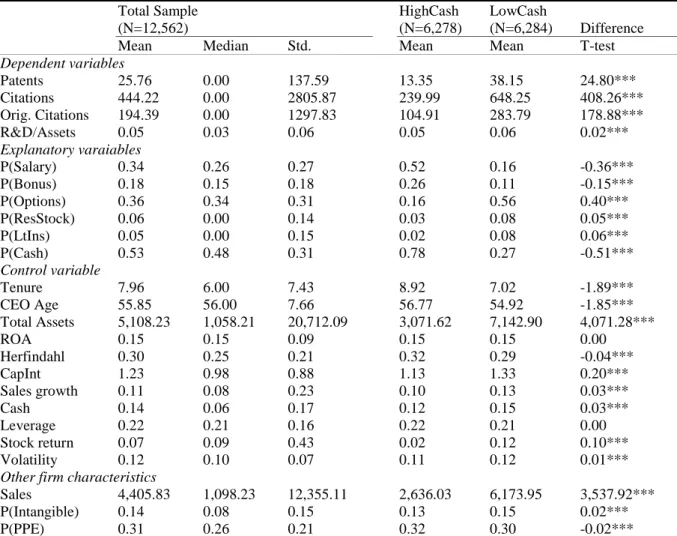
Columns 1-3 of Table I provide descriptive statistics of all variables used for the whole sample. Depending on the below or above median proportion of cash compensation (P(Cash)) each year, I split my sample in two subsamples. I report the mean and mean differences for both subsamples as well as the levels of significance in columns 4-6 respectively.
On average, a firm in my sample applied for roughly 26 patents and received 444 citations based on the weighting correction suggested by Hall et al. (2001). Well-known technology firms such as Microsoft, Hewlett-Packard and Intel applied for the highest number of patents with IBM making the maximum number of 4,344 patent applications in the year 1999.
19
The distribution of patent application is, however, highly skewed with about 51% (35%) of firms not applying for any patent in a given year (in the entire sample period). Accordingly, the median of patent application is zero. The average patent receives 17 citations. The citations per year are again highly skewed which leads to a comparably high standard deviation.10
A typical CEO in my sample receives about 26% of total compensation in the form of salary. In combination with the bonus, these cash compensations makes up for almost half of
10 Other literature using the NBER patent database arrived at similar statistics for patent and citation count. This
can be a first indication for the validity of my sample.
Table I: Descriptive Statistics of Large Sample
The table summarizes key descriptive statistics of the sample used in my analysis. The sample comprises of the constituents of the S&P 1500 between 1992 and 2005 (excluding financial and utility firms). It was split according to whether the proportion of cash compensation the CEO receives in a given year is higher (HighCash) or lower (LowCash) than the median of all CEOs in that year. I conduct a T-test for the differences in the means of firms that pay HighCash and LowCash to their CEO where *, **, and *** indicates significance at the 10%, 5%, and 1% level, respectively.
Total Sample (N=12,562) HighCash (N=6,278) LowCash (N=6,284) Difference
Mean Median Std. Mean Mean T-test
Dependent variables Patents 25.76 0.00 137.59 13.35 38.15 24.80*** Citations 444.22 0.00 2805.87 239.99 648.25 408.26*** Orig. Citations 194.39 0.00 1297.83 104.91 283.79 178.88*** R&D/Assets 0.05 0.03 0.06 0.05 0.06 0.02*** Explanatory varaiables P(Salary) 0.34 0.26 0.27 0.52 0.16 -0.36*** P(Bonus) 0.18 0.15 0.18 0.26 0.11 -0.15*** P(Options) 0.36 0.34 0.31 0.16 0.56 0.40*** P(ResStock) 0.06 0.00 0.14 0.03 0.08 0.05*** P(LtIns) 0.05 0.00 0.15 0.02 0.08 0.06*** P(Cash) 0.53 0.48 0.31 0.78 0.27 -0.51*** Control variable Tenure 7.96 6.00 7.43 8.92 7.02 -1.89*** CEO Age 55.85 56.00 7.66 56.77 54.92 -1.85*** Total Assets 5,108.23 1,058.21 20,712.09 3,071.62 7,142.90 4,071.28*** ROA 0.15 0.15 0.09 0.15 0.15 0.00 Herfindahl 0.30 0.25 0.21 0.32 0.29 -0.04*** CapInt 1.23 0.98 0.88 1.13 1.33 0.20*** Sales growth 0.11 0.08 0.23 0.10 0.13 0.03*** Cash 0.14 0.06 0.17 0.12 0.15 0.03*** Leverage 0.22 0.21 0.16 0.22 0.21 0.00 Stock return 0.07 0.09 0.43 0.02 0.12 0.10*** Volatility 0.12 0.10 0.07 0.11 0.12 0.01***
Other firm characteristics
Sales 4,405.83 1,098.23 12,355.11 2,636.03 6,173.95 3,537.92***
P(Intangible) 0.14 0.08 0.15 0.13 0.15 0.02***
20
the total pay. Only a minority of CEOs receive zero Stock Options (26%, not tabulated), while the typical CEO receives 34% of pay from Stock Options.
From the descriptive statistics it is observable that restricted stock and long-term incentive plans do not appear to contribute significantly to the dollar pay of CEOs. Only 22% (17%) of firms award restricted stock (long-term incentives).
Firms in the high P(Cash) subsample relative to their peers in the low P(Cash) apply for significantly less patents, receive less citations and have lower adjusted R&D spending. Furthermore, firms that pay CEOs less cash compensations appear to have a lower property plant and equipment to total assets ratio (P(PPE)), a higher intangible assets to total assets ratio (P(Intangible)) and a higher stock price volatility. Even though no conclusion can be drawn without an inductive statistical analysis, these tendencies are in-line with existing literature such as Coles et al. (2006) and Core and Guay (1999).
3.2 Regression Model Results
Next, I use multivariate regression models to analyse the impact of a change in specific payment proportion on innovation while controlling for a series of independent variables. The regression models hereby generally follow:
𝐼𝑛𝑛𝑜𝑣𝑎𝑡𝑖𝑜𝑛𝑖,𝑡+1
= 𝛼 + 𝛽𝑃𝑟𝑜𝑝𝑜𝑟𝑡𝑖𝑜𝑛(𝐶𝑜𝑚𝑝𝑒𝑛𝑠𝑎𝑡𝑖𝑜𝑛 𝐶𝑜𝑚𝑝𝑜𝑛𝑒𝑛𝑡)𝑖,𝑡
+ 𝛾(𝑐𝑜𝑛𝑡𝑟𝑜𝑙 𝑣𝑎𝑟𝑖𝑎𝑏𝑙𝑒𝑠 )𝑖,𝑡+ 𝛿𝐼𝑛𝑑𝑢𝑠𝑡𝑟𝑦𝑖 + 𝜃𝑌𝑒𝑎𝑟𝑡+ 𝜖𝑖,𝑡
Where 𝐼𝑛𝑛𝑜𝑣𝑎𝑡𝑖𝑜𝑛𝑖,𝑡+1 are the three innovation measures, R&D/Assets, Patent count and Citation count of a firm 𝑖 at a lead year 𝑡 + 1. To control for unobserved heterogeneity, I follow Hirshleifer et al. (2012) and include year and industry fixed effect in all my models. Industry is hereby defined at the two-digit SIC level.
21
3.2.1 R&D Expenditures
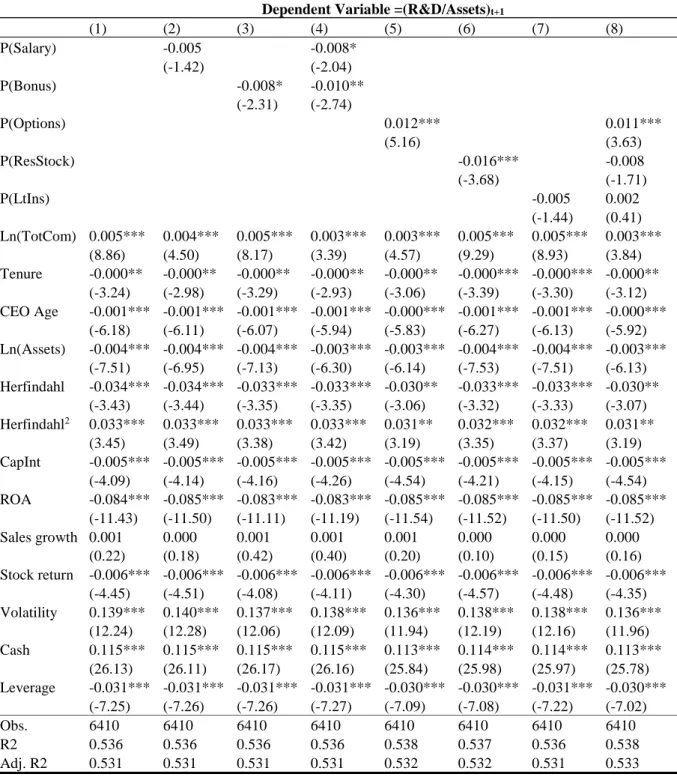
I hypothesize that cash based salary components will have none or have a negative impact on innovation while I expect option-based payment, restricted stock and long-time incentives to have a positive impact on innovation. I use a one-year lead for R&D/Assets to allow for a change in firm policy, caused by incentivization of the CEO, to reach an observable level. Column 1-4 of Table II present the outcomes of different OLS models using (1) firm and CEO characteristics, (2) the proportion of salary, (3) bonus, (4) all cash compensations, (5) options, (6) restricted stock, (7) long-term incentive plans and (8) all equity, respectively.
In line with my Hypothesis 1, the coefficients of models (3) and (4) suggest that salary and bonus have a negative impact on my measure for innovation input. The coefficients for options in (5) and (8) however suggest that an increase in the proportion of pay in options results in an increase in R&D/Assets. The coefficient for the proportion of restricted stock is only significant if no other equity compensation elements are included in the equation (6). It is therefore likely that the proportion of restricted stock, as well as the proportion of long-term incentives a CEO receives do not have a significant impact on the R&D expenditures of the firm he manages. This is inconsistent with my third hypothesis.
Given the setup of this regression, the consistently significant coefficients can be interpreted as in a unit change to unit change model. The results therefore suggest that a one percent increase in the proportion of options (0.01 of 1 unit) in combination with a one percent decrease in the proportion of bonus (-0.01 of 1 unit) would lead to an increase of 0.00021 in R&D/Assets in the following year.11 Multiplied with the mean (median) total assets of $5,108.23m ($1,058.21m), this indicates an increase in R&D expenditures of $1.07m ($0.22m). Furthermore, the findings suggest that an increase of total compensation would have a small but significant positive impact my measure of innovation input.
22
Table II: CEO Compensation and R&D Intensity
The table summarizes the regression results for eight regression models using different elements of the proportion of CEO pay in addition to a series of explanatory variables. The dependent variable is R&D expenditures scaled by total assets, winsorized at the 1st and 99th percentile. The sample includes the constituents of the S&P 1500
between 1992 and 2005 (excluding financial and utility firms). As a number of firms do not report R&D expenditures, the number of observations is much lower than in the original sample. Fixed effects for year and industry are included in all regressions. The intercept has not been tabulated. T-statistics are shown in parentheses. *, **, and *** indicate significance at the 10%, 5%, and 1% level, respectively.
Dependent Variable =(R&D/Assets)t+1
(1) (2) (3) (4) (5) (6) (7) (8) P(Salary) -0.005 -0.008* (-1.42) (-2.04) P(Bonus) -0.008* -0.010** (-2.31) (-2.74) P(Options) 0.012*** 0.011*** (5.16) (3.63) P(ResStock) -0.016*** -0.008 (-3.68) (-1.71) P(LtIns) -0.005 0.002 (-1.44) (0.41) Ln(TotCom) 0.005*** 0.004*** 0.005*** 0.003*** 0.003*** 0.005*** 0.005*** 0.003*** (8.86) (4.50) (8.17) (3.39) (4.57) (9.29) (8.93) (3.84) Tenure -0.000** -0.000** -0.000** -0.000** -0.000** -0.000*** -0.000*** -0.000** (-3.24) (-2.98) (-3.29) (-2.93) (-3.06) (-3.39) (-3.30) (-3.12) CEO Age -0.001*** -0.001*** -0.001*** -0.001*** -0.000*** -0.001*** -0.001*** -0.000*** (-6.18) (-6.11) (-6.07) (-5.94) (-5.83) (-6.27) (-6.13) (-5.92) Ln(Assets) -0.004*** -0.004*** -0.004*** -0.003*** -0.003*** -0.004*** -0.004*** -0.003*** (-7.51) (-6.95) (-7.13) (-6.30) (-6.14) (-7.53) (-7.51) (-6.13) Herfindahl -0.034*** -0.034*** -0.033*** -0.033*** -0.030** -0.033*** -0.033*** -0.030** (-3.43) (-3.44) (-3.35) (-3.35) (-3.06) (-3.32) (-3.33) (-3.07) Herfindahl2 0.033*** 0.033*** 0.033*** 0.033*** 0.031** 0.032*** 0.032*** 0.031** (3.45) (3.49) (3.38) (3.42) (3.19) (3.35) (3.37) (3.19) CapInt -0.005*** -0.005*** -0.005*** -0.005*** -0.005*** -0.005*** -0.005*** -0.005*** (-4.09) (-4.14) (-4.16) (-4.26) (-4.54) (-4.21) (-4.15) (-4.54) ROA -0.084*** -0.085*** -0.083*** -0.083*** -0.085*** -0.085*** -0.085*** -0.085*** (-11.43) (-11.50) (-11.11) (-11.19) (-11.54) (-11.52) (-11.50) (-11.52) Sales growth 0.001 0.000 0.001 0.001 0.001 0.000 0.000 0.000 (0.22) (0.18) (0.42) (0.40) (0.20) (0.10) (0.15) (0.16) Stock return -0.006*** -0.006*** -0.006*** -0.006*** -0.006*** -0.006*** -0.006*** -0.006*** (-4.45) (-4.51) (-4.08) (-4.11) (-4.30) (-4.57) (-4.48) (-4.35) Volatility 0.139*** 0.140*** 0.137*** 0.138*** 0.136*** 0.138*** 0.138*** 0.136*** (12.24) (12.28) (12.06) (12.09) (11.94) (12.19) (12.16) (11.96) Cash 0.115*** 0.115*** 0.115*** 0.115*** 0.113*** 0.114*** 0.114*** 0.113*** (26.13) (26.11) (26.17) (26.16) (25.84) (25.98) (25.97) (25.78) Leverage -0.031*** -0.031*** -0.031*** -0.031*** -0.030*** -0.030*** -0.031*** -0.030*** (-7.25) (-7.26) (-7.26) (-7.27) (-7.09) (-7.08) (-7.22) (-7.02) Obs. 6410 6410 6410 6410 6410 6410 6410 6410 R2 0.536 0.536 0.536 0.536 0.538 0.537 0.536 0.538 Adj. R2 0.531 0.531 0.531 0.531 0.532 0.532 0.531 0.533
23
With regards to the control variables, the findings of all models suggest that a higher industry concentration has a small negative impact on innovation input. Inconsistent with prior literature, the coefficient of the Herfindahl2 measure indicates that the relationship between industry concentration and innovation follows a U-shape, suggesting that less-concentrated industries as well as highly less-concentrated industries are more innovative. Also, I find that Stock Volatility and higher Cash Ratios have a positive influence on innovation.
3.2.2 Number of Patents and Patent Citations
Using my base model, I now examine the relationship between CEO payment components and the innovation output of a firm in a given year, proxied by the number of patents applied for. Subsequently, I use citations received by a patent as a measure of innovation quality. To overcome the skewness in the innovation measures, I use the natural logarithm of Patents (Ln(1+Patent)) and of Citations (Ln(1+Citations)) respectively. As the research on a delay between innovation effort and innovation output finds no evidence for the existence of such a lag (Hall et al., 1984), I use the one year lead for patents and citations.12
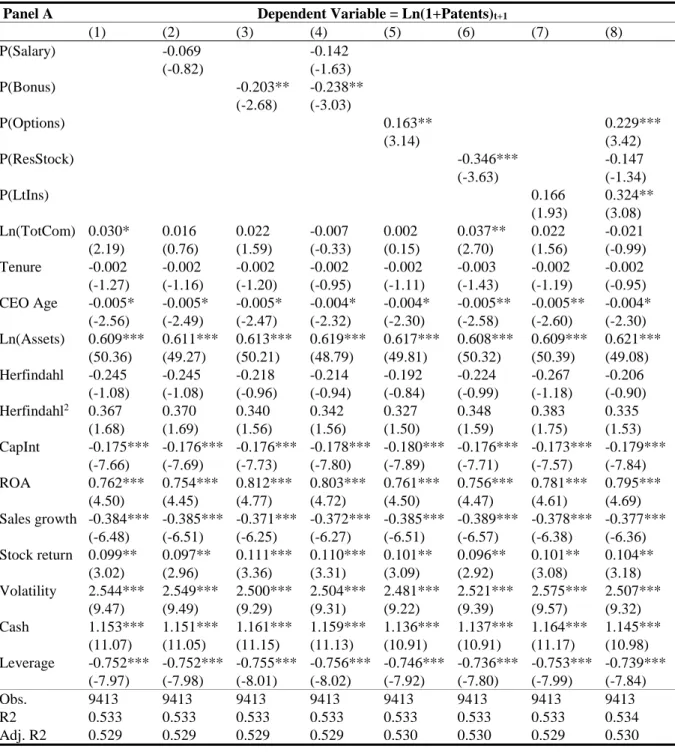
Similar to my findings for innovation input, the coefficients in model (3) and (4) of Panel A in Table III suggest that a higher proportion of salary or bonus of the total pay a CEO receives in a given year, have a negative effect on the number of patents applied for in the next year. As shown in model (2), (3) and (4) of Panel B, the proportion of cash incentives does not seem to have a significant impact on my measure for innovation quality. The proportion of options does however have a significant impact (0.229) on innovation quantity as well as a weakly significant impact on innovation quality (0.222) in a model controlling for all equity incentives (8), tabulated in Panel B.Those findings are consistent with my first and second hypothesis.
12 The one year lead has been used to allow for organizational changes in innovation effort to reach an
observable level. Similar results have been obtained using a two and three year lead for Ln(1+Patents) and Ln(1+Citations), only the significance of the findings tabulated in model (4) of Table IV Panel A decreased.
24
Table III: CEO Compensation and Patenting Activity
The tables summarize the regression results for 16 regression models using different elements of the proportion of CEO pay in addition to a series of explanatory variables. The dependent variables are one year leads of the natural logarithm of one plus patent count (Panel A) and one plus the corrected sum of patent citations using weightings suggested in the literature (Panel B). The sample includes the constituents of the S&P 1500 between 1992 and 2005 (excluding financial and utility firms). Fixed effects for year and industry are included in all regressions. The intercept has not been tabulated. T-statistics are shown in parentheses. *, **, and *** indicate significance at the 10%, 5%, and 1% level, respectively.
Panel A Dependent Variable = Ln(1+Patents)t+1
(1) (2) (3) (4) (5) (6) (7) (8) P(Salary) -0.069 -0.142 (-0.82) (-1.63) P(Bonus) -0.203** -0.238** (-2.68) (-3.03) P(Options) 0.163** 0.229*** (3.14) (3.42) P(ResStock) -0.346*** -0.147 (-3.63) (-1.34) P(LtIns) 0.166 0.324** (1.93) (3.08) Ln(TotCom) 0.030* 0.016 0.022 -0.007 0.002 0.037** 0.022 -0.021 (2.19) (0.76) (1.59) (-0.33) (0.15) (2.70) (1.56) (-0.99) Tenure -0.002 -0.002 -0.002 -0.002 -0.002 -0.003 -0.002 -0.002 (-1.27) (-1.16) (-1.20) (-0.95) (-1.11) (-1.43) (-1.19) (-0.95) CEO Age -0.005* -0.005* -0.005* -0.004* -0.004* -0.005** -0.005** -0.004* (-2.56) (-2.49) (-2.47) (-2.32) (-2.30) (-2.58) (-2.60) (-2.30) Ln(Assets) 0.609*** 0.611*** 0.613*** 0.619*** 0.617*** 0.608*** 0.609*** 0.621*** (50.36) (49.27) (50.21) (48.79) (49.81) (50.32) (50.39) (49.08) Herfindahl -0.245 -0.245 -0.218 -0.214 -0.192 -0.224 -0.267 -0.206 (-1.08) (-1.08) (-0.96) (-0.94) (-0.84) (-0.99) (-1.18) (-0.90) Herfindahl2 0.367 0.370 0.340 0.342 0.327 0.348 0.383 0.335 (1.68) (1.69) (1.56) (1.56) (1.50) (1.59) (1.75) (1.53) CapInt -0.175*** -0.176*** -0.176*** -0.178*** -0.180*** -0.176*** -0.173*** -0.179*** (-7.66) (-7.69) (-7.73) (-7.80) (-7.89) (-7.71) (-7.57) (-7.84) ROA 0.762*** 0.754*** 0.812*** 0.803*** 0.761*** 0.756*** 0.781*** 0.795*** (4.50) (4.45) (4.77) (4.72) (4.50) (4.47) (4.61) (4.69) Sales growth -0.384*** -0.385*** -0.371*** -0.372*** -0.385*** -0.389*** -0.378*** -0.377*** (-6.48) (-6.51) (-6.25) (-6.27) (-6.51) (-6.57) (-6.38) (-6.36) Stock return 0.099** 0.097** 0.111*** 0.110*** 0.101** 0.096** 0.101** 0.104** (3.02) (2.96) (3.36) (3.31) (3.09) (2.92) (3.08) (3.18) Volatility 2.544*** 2.549*** 2.500*** 2.504*** 2.481*** 2.521*** 2.575*** 2.507*** (9.47) (9.49) (9.29) (9.31) (9.22) (9.39) (9.57) (9.32) Cash 1.153*** 1.151*** 1.161*** 1.159*** 1.136*** 1.137*** 1.164*** 1.145*** (11.07) (11.05) (11.15) (11.13) (10.91) (10.91) (11.17) (10.98) Leverage -0.752*** -0.752*** -0.755*** -0.756*** -0.746*** -0.736*** -0.753*** -0.739*** (-7.97) (-7.98) (-8.01) (-8.02) (-7.92) (-7.80) (-7.99) (-7.84) Obs. 9413 9413 9413 9413 9413 9413 9413 9413 R2 0.533 0.533 0.533 0.533 0.533 0.533 0.533 0.534 Adj. R2 0.529 0.529 0.529 0.529 0.530 0.530 0.529 0.530
25
The proportion of long-term incentive plans has a significant, positive influence on innovation quantity but the coefficient turns insignificant for innovation quality. In addition, the proportion of restricted stock does not have any significant impact, which is why my Hypothesis 3 only partly holds.13
13 An untabulated regression on Ln(1+Citations) without fixed effects reported significant positive coefficients
for P(Options) and P(LtIns) and significant negative coefficients for P(Salary) and P(Bonus). The fixed effect findings suggest that industry differences and time effects explain a majority of the variation in patent citations
Panel B Dependent Variable = Ln(1+Citations)t+1
(1) (2) (3) (4) (5) (6) (7) (8) P(Salary) -0.151 -0.204 (-1.07) (-1.39) P(Bonus) -0.122 -0.174 (-0.96) (-1.31) P(Options) 0.169 0.222* (1.94) (1.97) P(ResStock) -0.372* -0.181 (-2.31) (-0.98) P(LtIns) 0.152 0.300 (1.05) (1.69) Ln(TotCom) 0.040 0.011 0.035 -0.007 0.012 0.048* 0.033 -0.007 (1.76) (0.29) (1.52) (-0.17) (0.44) (2.08) (1.39) (-0.21) Tenure -0.004 -0.004 -0.004 -0.004 -0.004 -0.005 -0.004 -0.004 (-1.41) (-1.26) (-1.38) (-1.17) (-1.31) (-1.51) (-1.36) (-1.23) CEO Age -0.008* -0.007* -0.007* -0.007* -0.007* -0.008* -0.008* -0.007* (-2.37) (-2.29) (-2.34) (-2.21) (-2.21) (-2.39) (-2.40) (-2.22) Ln(Assets) 0.817*** 0.822*** 0.820*** 0.828*** 0.826*** 0.816*** 0.817*** 0.829*** (40.18) (39.39) (39.87) (38.77) (39.60) (40.14) (40.19) (38.90) Herfindahl -0.649 -0.650 -0.633 -0.627 -0.594 -0.627 -0.670 -0.607 (-1.70) (-1.70) (-1.65) (-1.64) (-1.55) (-1.64) (-1.75) (-1.58) Herfindahl2 0.814* 0.821* 0.798* 0.800* 0.773* 0.793* 0.829* 0.780* (2.21) (2.23) (2.17) (2.17) (2.10) (2.16) (2.25) (2.12) CapInt -0.296*** -0.298*** -0.297*** -0.300*** -0.302*** -0.297*** -0.294*** -0.300*** (-7.71) (-7.75) (-7.73) (-7.79) (-7.84) (-7.74) (-7.65) (-7.80) ROA 1.405*** 1.387*** 1.435*** 1.423*** 1.404*** 1.399*** 1.423*** 1.435*** (4.94) (4.86) (5.01) (4.97) (4.93) (4.92) (4.99) (5.03) Sales growth -0.597*** -0.601*** -0.589*** -0.591*** -0.599*** -0.603*** -0.592*** -0.592*** (-6.00) (-6.03) (-5.90) (-5.92) (-6.01) (-6.05) (-5.94) (-5.93) Stock return 0.244*** 0.241*** 0.252*** 0.250*** 0.247*** 0.241*** 0.246*** 0.249*** (4.43) (4.35) (4.52) (4.48) (4.47) (4.36) (4.46) (4.50) Volatility 4.311*** 4.324*** 4.284*** 4.291*** 4.245*** 4.286*** 4.340*** 4.270*** (9.54) (9.56) (9.46) (9.48) (9.37) (9.48) (9.58) (9.42) Cash 1.598*** 1.593*** 1.603*** 1.599*** 1.581*** 1.580*** 1.608*** 1.588*** (9.12) (9.09) (9.14) (9.12) (9.01) (9.01) (9.16) (9.04) Leverage -1.184*** -1.185*** -1.186*** -1.187*** -1.178*** -1.167*** -1.185*** -1.170*** (-7.46) (-7.47) (-7.47) (-7.48) (-7.42) (-7.35) (-7.47) (-7.36) Obs. 9413 9413 9413 9413 9413 9413 9413 9413 R2 0.516 0.516 0.516 0.516 0.516 0.517 0.516 0.517 Adj. R2 0.512 0.512 0.512 0.513 0.513 0.513 0.512 0.513
26
As the dependent variable is a natural logarithm, my findings suggest that a reduction of one percent of bonus in favour of option payment (with constant total compensation) would lead to an increase of 0.5% in the number of patents.14 Even though the economic importance of an increase in patent is difficult to quantify (Hall, 1999), Chen and Chang (2010) report an increase of $6.116m in firm value per unit increase in patent citations in the pharmaceutical industry. In my sample, an increase of five percent in option compensation would lead to an increase of 1.11% in citations.15 For the mean number of citations (444.22), this increase would result in a $30.157m rise in firm value.16
Again, the coefficients of other dependent variables are consistent with suggestions in the literature. The change in sign for Ln(Assets) and in significance for Herfindahl is in line with the indefinite results in previous literature.
3.2.3 Innovativeness by Industry and Innovation Effectiveness
As discussed above, there is a high disparity in the innovation output on a firm level. Naturally, this disparity is partly explained by the innovativeness of the industry the firm belongs to. Not all industries face the same availability of opportunities for innovation. To test the effects of compensation composition separately in more versus less innovative industries, I split my sample. I use the two-digit SIC code for the industry definition and dynamically split these industries depending on whether they receive more or less than median citations in a given year. The obtained subsample for low innovation industries includes, besides others, Oil and Gas Extraction, Food Producing and Primary Metal industries with an average of 7 patent applications per year. The subsample for high innovation industries includes, besides others, the Chemicals, Computer Equipment and Electronics industries with an average of 43 patent applications per year.
14 A 0.01 unit decrease (increase) in P(Bonus) (P(Options)) leads to -0.238(-0.01)+0.229(0.01)=0.467% change
in patents (one unit change in the independent leads to a 100*β percent change in the dependent variable).
15 A five percent increase (0.05 units) leads to 0.222(0.05)*100=1.11 percent increase in citations
27
In the last chapter, I found that the proportion of cash-based compensation elements have no, or a negative impact on innovation, options have a positive impact on innovation quantity and quality while long-term incentives have a positive impact on innovation quantity. Using the two generated subsamples, I now also aim to test for the effects of different compensation components on the effectiveness of innovation generation. Therefore, I follow the rational of Hirshleifer et al. (2012) and control for R&D intensity.
Regressions (1)-(4) in Panel A and B of Table IV show the impact of cash and equity based compensation components for each generated subsample on innovation quantity and quality. The findings suggest that the identified patterns, i.e. my Hypotheses 1 to 3, only hold for low innovation industries. In those industries, the negative impact of cash compensation as well as the positive impact of options and long-term incentives is significant on both, the number of patents as well as the citations received. In addition, model (7) and (8) show that the proportion of options (salary) has a positive (negative) impact for a given level of R&D expenditures. Combined with my findings from 3.2.1, this suggests that option based compensation in favour of salary based compensation components increases R&D spending as well as the effectiveness with which these expenditures are used.
While one might have expected that compensation components play a major role in high innovation industries, my results show no significant impact of any component on neither innovation output quantity nor quality. These puzzling findings may, however, be partly explained by factors that influence innovation capabilities in high innovation industries but not in low innovation industries. For example, Chang et al. (2015) show that non-executive employee stock options are more frequently used in high innovation industries and contribute significantly to innovation capabilities. Similarly, Francis et al. (2011) find that golden parachutes are more common in innovative industries and contribute significantly to the number and citations of patents. Those omitted factors may have an influence on the innovation output in my model and the obtained coefficients could therefore be biased.
28
Table IV: CEO Compensation and Innovation Effectiveness
The tables summarize the regression results for 16 regression models using different elements of the proportion of CEO pay and a series of explanatory variables as well as R&D intensity (5)-(8). The dependent variables are one year leads of the natural logarithm of one plus patent count (Panel A) and one plus the corrected sum of patent citations using weightings suggested in the literature (Panel B). The sample includes the constituents of the S&P 1500 between 1992 and 2005 (excluding financial and utility firms). The sample is split in High Innovation and Low Innovation industries. Fixed effects for year and industry are included in all regressions. For brevity, the intercept as well as control variables have not been tabulated. T-statistics are shown in parentheses. *, **, and *** indicate significance at the 10%, 5%, and 1% level, respectively.
Panel A Dependent Variable = Ln(1+Patents)t+1
High Innovation Low Innovation High Innovation Low Innovation
(1) (2) (3) (4) (5) (6) (7) (8) P(Salary) -0.064 -0.228* -0.169 -0.342* (-0.49) (-2.25) (-1.23) (-2.10) P(Bonus) -0.179 -0.268** -0.038 -0.140 (-1.44) (-3.06) (-0.29) (-0.94) P(Options) 0.151 0.289*** 0.119 0.307* (1.49) (3.73) (1.14) (2.44) P(ResStock) -0.235 -0.081 -0.206 -0.333 (-1.35) (-0.68) (-1.11) (-1.67) P(LtIns) 0.163 0.466*** 0.061 0.233 (0.97) (4.04) (0.35) (1.23) R&D/Assets 6.075*** 6.027*** 19.145*** 19.021*** (15.71) (15.58) (11.84) (11.80)
Contr. Var. --- included ---
Observations 4806 4806 4607 4607 4242 4242 2142 2142
R2 0.536 0.537 0.378 0.381 0.564 0.564 0.524 0.527
Adj. R2 0.533 0.533 0.369 0.371 0.561 0.561 0.509 0.511
Panel B Dependent Variable = Ln(1+Citations)t+1
High Innovation Low Innovation High Innovation Low Innovation
(1) (2) (3) (4) (5) (6) (7) (8) P(Salary) -0.039 -0.395* -0.183 -0.671* (-0.18) (-2.18) (-0.83) (-2.39) P(Bonus) -0.101 -0.333* 0.033 -0.178 (-0.50) (-2.13) (0.16) (-0.69) P(Options) 0.114 0.392** 0.099 0.497* (0.69) (2.84) (0.59) (2.29) P(ResStock) -0.421 -0.030 -0.338 -0.362 (-1.49) (-0.14) (-1.13) (-1.05) P(LtIns) -0.078 0.699*** -0.137 0.451 (-0.28) (3.39) (-0.49) (1.37) R&D/Assets 8.142*** 8.065*** 31.763*** 31.500*** (13.04) (12.90) (11.39) (11.31)
Contr. Var. --- included ---
Observations 4806 4806 4607 4607 4242 4242 2142 2142
R2 0.548 0.548 0.353 0.355 0.578 0.578 0.508 0.509