Effect of copaiba oil in hepatic damage induced by acetaminophen in rats
1Renan Kleber Costa TeixeiraI, Vitor Nagai YamakiII, Edson Yuzur YasojimaIII, Marcus Vinicius Henriques BritoIV
IGraduate student, School of Medicine, State University of Para (UEPA), Brazil. Technical procedures, interpretation of data, statistical analysis,
manuscript writing.
IIGraduate student, School of Medicine, UEPA, Belem-PA, Brazil.Technical procedures, interpretation of data, histological analysis, manuscript
writing.
IIIPhD, Associate Professor, Medical School, UFPA, Belem-PA, Brazil. Conception and design of the study, interpretation of data, critical revision. IVPhD, Associate Professor, Medical School, UEPA, Belem-PA, Brazil.Critical revision.
ABSTRACT
PURPOSE: To investigate the effects of copaiba oil on the hepatic damage induced by paracetamol.
METHODSThirty six rats were distributed into six study groups (N=6): control group, that didn’t receive the acetaminophen;
Acetaminophen Group, that only received the acetaminophen; Prophylactic Copaiba Group 1, that received copaiba oil two hours before the acetaminophen; Prophylactic Copaiba Group 7, that received copaiba oil seven days, once by day, before the acetaminophen; Therapy Copaiba Group, that received the copaiba oil two hours afther the acetaminophen; and N-Acetyl-Cysteine Group, , that received the N-Acetyl-Cysteine two hours afther the acetaminophen. Euthanasia was performed after 24 hours. The serum levels of AST, ALT, alkaline phosphatase, GT, total bilirubin, direct bilirubin and indirect bilirubin and histological analisis were analized.
RESULTS:The prophylactic copaiba group 7, therapy copaiba group and N-Acetyl-Cysteine Group showed amounts of AST and ALT
similar to the control group; and the prophylactic copaiba group 1 showed similar levels to the acetaminophen group. There was no
significant difference between the groups regarding the amount of alkaline phosphatase and GT (p>0.05). The therapy copaiba group showed the highest levels of bilirubin and was statistically different from the other groups (p<0.01) and this increased the costs of direct
bilirubin. Regarding histopathology, the oil of copaiba administered prophylactic or therapeutic form for 7 days could decrease the
amount of necrosis and inflammatory infiltrate.
CONCLUSION: Copaiba oil administered prophylactically for seven days, and therapeutic could reduce liver damage caused by
paracetamol similarly N-Acetyl-Cysteine, however, when treated with copaiba therapeutically showed increases in bilirubin, costs increasing fraction indirect.
Introduction
The liver is the most important organ in the abdominal of the human body, responsible for several functions in the body, such as controlling the metabolism of lipids, carbohydrates and proteins, as well as the production and excretion of bile1. Moreover, the function of convert toxic substances into non-toxic products, it`s the a essential role for the survival and prevent diseases2.
However, when liver cannot metabolize all toxic agents, this accumulate in the organ and, eventually, causes a toxic hepatitis3. This clinical issue is very relevant in clinical practice, especially in relation to acetominophen4.
Acetominophen is an analgesic and antipyretic widely used in the world, and the accidental or voluntary ingestion of high doses has a great possibility to develop a toxic hepatitis5, especially when associated with alcohol6. The misuse of acetaminophen is the leading cause of acute hepatitis in the United States7.
The mechanism of hepatotoxicity caused by
acetaminophen is unknown, however, it is known that there is a massive production of oxygen free radicals and a direct cytotoxic effect involved in the pathogenesis of this lesion, with a consequent necrosis or apoptosis of the hepatocytes8,9. This process causes a overload in the liver function, and then symptoms of cholestasis
because of the inflammatory functions10.
The various medicinal plants are assigned with
hepatoprotective and anti-inflammatory effects. Studies shows an
effect of the plants in reduce liver damage caused by acetaminophen and some others with similar results comparing with N-Acetyl- Cysteine, the gold standard for the treatment of this kind of liver failure11-15. This practice has been encouraged by the World Health Orgaznization16.
Copaiba oil stands out among the Amazonia`s medicinal
plants due to be attributed to this an important anti-inflamatory
effect17,18 and a function that promotes protection in the liver tissue19. Therefore, this study aims to investigate the effects of Copaiba Oil (Copaifera officinalis) in liver damage acetaminophen’s induced.
Methods
Approved by the Ethics Committee in the Use of Animals
of the State University of Para (UEPA), protocol 08/07. This
study used the copaiba oil species Copaifferaofficinalis, supplied by Brazilian Agricultural Research Corporation (EMBRAPA),
previously submitted to a physicochemical analyze to define its
composition.
Thirty six male Wistar rats (Rattus norvegicus) were
used, weighing between 210 - 250 grams, provided from the
Animal Colony of the Experimental Surgery Laboratory of UEPA, kept in a controlled environment, with food and water ad libitum. The animals were randomized distributed into six study groups, with six animals each:
-Control Group (CG): The animals were used as normal standard for biochemical and histological analysis;
-Acetaminophen Group (AG): The animals received a single dose of acetaminophen;
-Prophylactic Copaiba Group 1 (PCG1): The animals received copaiba oil, once, two hours before to receive the acetaminophen dose;
-Prophylactic Copaiba Group 7 (PCG7): The
animals received copaiba, once, seven days before to receive acetaminophen;
-Therapy Copaiba Group (TCG): The animals received copaiba two hours after to receive acetaminophen;
-N-Acetyl-Cysteine Group (NG): The animals received N-Acetyl-Cysteine, two hours after to receive acetaminophen.
Copaiba oil was administered by gavage at a dose
of 0.63 mL/kg in group PCG7 and 3.8 mL/kg in groups PCG1
and TCG. The oil was provided by the EMBRAPA, as crude oil. The acetaminophen and N-acetyl-cysteine were obtained with a
concentration of 400mg/mL and 300mg/mL, respectively. The
acetaminophen and N-acetyl-cysteine were administered by
gavage at a dose of 2 g/kg and 1.2 g/kg, respectively11,12.
After 24 hours from the acetaminophen administration,
the animals were anesthetized using ketamine (70 mg / kg) and xylazine (10 mg / kg) intraperitoneally. After that was performed to collect 5 ml by vena cava inferior to measurement of aspartate
aminotransferase (AST), alanine aminotrasferase (ALT), alkaline phosphatase, gamma glutamyltraspeptidase ( GT), total bilirubin (TB) and its fractions, Direct (DB) and indirect (IB).
Followed by collecting the median lobe of the liver, this
was fixed in formalin 10% and used for histopathological analysis
by hematoxylin and eosin staining. The presence of necrosis,
inflammatory infiltrate and vascular congestion were analyzed by a semi-quantitative scale: 0 - absent, 1 - mild, 2 - moderate, 3 -
severe14,15.
ANOVA test was used to compare the biochemical results and the Kruskal-Wallis test to compare the histopathological
results. Was adopted a significance level of 5% to reject the null
Results
The mean serum levels of AST and ALT in each group
are shown in Table 1. On these significant differences between the CG and the groups AG and PCG1, (p<0.01) also was no significant
difference between the AG and the groups PCG7, GCT and NG.
TABLE 1 - Mean and standard deviation of serum AST
and ALT according to the groups.
Group AST ALT
CG 131.66 ±17.71 74.16 ±15.18
AG* 373.00 ±103.91 311.00 ±137.77
PCG1* 303.00 ±214.85 226.83 ±159.90
PCG7# 225.00 ±95.29 164.33 ±62.05
TCG# 198.33 ±91.99 168.16 ±41.84
NG# 175.33 ±97.08 104.50 ±73.90
Source: Protocol search *p<0.01 relative to CG (ANOVA) #p<0.01 relative to AG (ANOVA)
Regarding the measurement of alkaline phosphatase
and GT (Table 2), no significant difference between groups was
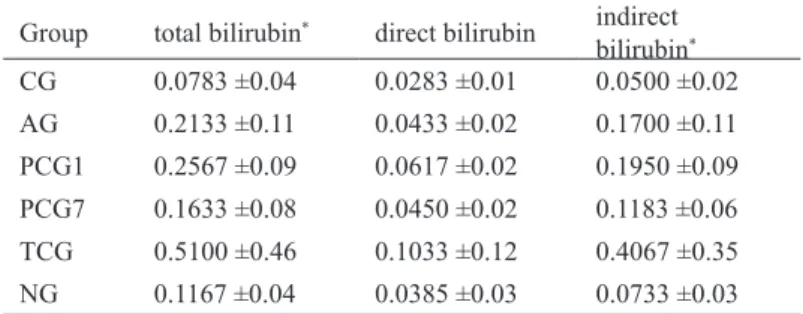
showed. Regarding total bilirubin and fractions (Table 3) there
was a statistical difference (p <0.01) between TCG and all other
groups in the dosage of total bilirubin and indirect, but there was no statistical difference between the groups regarding the estimation of direct bilirubin.
TABLE 2 - Mean and standard deviation of serum
alkaline phosphatase and GT according to the groups.
Group alkaline phosphatase GT
CG 150.33 ±88.14 6.83 ±1.83
AG 195.16 ±58.43 7.16 ±1.60
PCG1 145.66 ±30.91 7.83 ±2.40
PCG7 181.50 ±29.04 6.00 ±1.26
TCG 112.50 ±65.49 5.66 ±1.03
NG 145.00 ±52.82 7.50 ±1.87
Source: Protocol search p>0.05 (ANOVA)
TABLE 3 - Mean and standard deviation of serum total
bilirubin and fractions according to the groups.
Group total bilirubin* direct bilirubin indirect
bilirubin*
CG 0.0783 ±0.04 0.0283 ±0.01 0.0500 ±0.02
AG 0.2133 ±0.11 0.0433 ±0.02 0.1700 ±0.11
PCG1 0.2567 ±0.09 0.0617 ±0.02 0.1950 ±0.09
PCG7 0.1633 ±0.08 0.0450 ±0.02 0.1183 ±0.06
TCG 0.5100 ±0.46 0.1033 ±0.12 0.4067 ±0.35
NG 0.1167 ±0.04 0.0385 ±0.03 0.0733 ±0.03
Source: Protocol search
*p<0.01 TCG relative to outhers groups (ANOVA)
Histopathological analysis (Table 4) showed no areas
of necrosis, inflammatory infiltrate and vascular congestion in
the control group. In AG, all animals showed grade 3 areas of
necrosis, inflammatory infiltrate and vascular congestion, and the
group PCG1 showed similar results but an animal of this group
had grade 2 necrosis and inflammatory infiltrate.
In groups PCG7, TCG and NG all had grade 3 vascular
congestion, however in relation to necrosis and inflammatory infiltrate, the PCG7 4 animals showed grade 2 and grade 1 two
animals, the TCG, one animal showed grade 3, two grade 2 animals and three grade 1; Gnac the three animals had grade 2 and grade 1 three animals.
TABLE 4 - Mean histological grades of necrosis,
inflammatory infiltrate and vascular congestion according to the
groups.
Group Necrosis inflammatory
infiltrate vascular congestion
CG 0.00 0.00 0.00
AG* 3.00 3.00 3.00
PCG1* 2.83 2.83 3.00
PCG7# 1.66 1.66 3.00
TCG# 1.66 1.66 3.00
NG# 1.50 1.50 3.00
Source: Protocol search
*p<0.05 relative to CG (necrosis and inflammatory infiltrate) (Kruskal Wallis) #p<0.05 rerlative to AG (necrosis and inflammatory infiltrate) (Kruskal Wallis)
Discussion
and prophylactic therapy showed similar results to those animals treated with N-Acetyl-Cysteine, showing a hepatoprotective potential of this oil.
One mechanism of liver injury caused by acetaminophenin
is the production of free radicals leading to apoptosis and necrosis3,7,12. The oil of copaiba demonstrably can attenuate the
production of free radicals due to its anti-inflammatory, and the
effect of copaiba oil in liver transaminases had already been
identified by Noguchi et al.20, suggesting a hepatoprotective real potential of this oil.
The use of the copaiba oil’s dose of 3.8 ml/Kg, used in
PCG1 and TCG, was based on the total amount of oil administered in PCG7 and toxicity studies on copaiba oil. So, we tried to match the dose offered in all groups that received copaiba.
The use of standard dosage copaiba (0.63 mL/Kg) does not significantly alter liver function, displaying only a fraction
increases from direct bilirubin, but without showing signs of cholestasis19,20. However the use of higher doses (6 mL/Kg), changes the amount of AST, alkaline phosphatase and GT, showing signs of cholestasis without providing other signs of histopathological changes21,22. Showing a direct cause and effect of this oil.
Most studies that use medicinal plants show effects similar to those found in this study11-15, however all perform prophylactic treatment of toxic hepatitis, similar to PCG1 and PCG7. However, studies should focus on the analysis of the
therapeutic effect of the oils, whereas hardly identifies the patients
who abuse acetaminophenin before they show hepatitis.
Regarding alkaline phosphatase and GT, it is known that toxic hepatitis caused by paracetamol not generally leads to hepatic congestion3,12,15, even treatment with N-Acetyl-Cysteine, however, due to the groups treated with copaiba balsam expected a certain degree of congestion, especially on PCG1 and TCG, because the high dose administered could lead to biliary stasis, as found in a study of Botelho et al.21. Probably, this difference was not found due to the shorter exposure time and amount of oil administered.
The amount of total bilirubin was higher in TCG compared to the other groups, however all other groups showed an increase in average bilirubin compared to control, this increase probably occurred on the hepatic load due to the death of several hepatocytes, however the TCG, beyond that under load, the amount of oil delivered to the liver overload has deteriorated, similar to study of Botelho et al.21.
In TCG hardly copaiba damaged liver function, whereas
the levels of AST and ALT were normal, and the major increase
in bilirubin was indirect because its fraction, showing that the
injury occurred probably due to liver overload and not due to
cholestasis22.
The histopathologic results confirmed the toxic effects of paracetamol at the dose used, and confirm that copaiba administered
two hours before the paracetamol showed no protective effect. Also, it is evident that the oil copaiba groups PCG7 and TCG have protective effects similar to NG, as both failed to reduce vascular
congestion, even reducing the area of necrosis and inflammatory infiltrate.
Copaiba oil administered seven days before and therapeutically liver damage from paracetamol showed hepatoprotective effects, however, was only analyzed the effects
within 24 hours after injury, thus, further studies should be
conducted to understand whether longer periods in the oil copaiba can cause harm liver, as well as studies to identify the active
principle and / or how this oil works to reduce liver damage18.
Conclusion
Copaiba oil administered prophylactically for seven days and prophylactic could reduce liver damage caused by paracetamol similarly N-Acetyl-Cysteine, however, when treated with copaiba therapeutically showed increases in bilirubin, costs increasing fraction indirect.
References
1. Alberti LR, Veloso DFM, Vasconcellos LS, Petroianu A. Is there a relationship between lipids metabolism and splenic surgeries? Acta
Cir Bras. 2012;27(11):751-6.
2. Jerby L, Shlomi T, Ruppin E. Computational reconstruction of
tissue-specific metabolic models: application to human liver metabolism. Mol Syst Biol. 2010:401(6):1-9.
3. Prescott LF, Wright N. The effects of hepatic and renal damage on paracetamol metabolism and excretion following overdosage: a
pharmacokinetic study. Br J Pharmacol. 1973;49(4):602-13.
4. Fong BM, Siu TS, Tam S. Persistently increased acetaminophen concentrations in a patient with acute liver failure. Clin Chem.
2011;57(1):9-11.
5. Bernardes SS, Turini CA, Matsuo T. Perfil das tentativas de suicídio
por sobredose intencional de medicamentos atendidas por um Centro de Controle de Intoxicações do Paraná, Brasil. Cad Saúde
Publica. 2010; 26(7):1366-72.
6. Martins Junior EV. Situações que favorecem ou reduzem a hepatotoxicidade pelo acetaminofen (uso de álcool, faixa etária e
uso de outras medicações. Gastroenterol Endosc Dig.
2011;30(1):6-9.
7. Lee WM. Acetaminophen and the U.S. acute liver failure study group:
lowering the risks of hepatic failure. Hepatology. 2004;40(1):6-9.
1992;38(3):153-8.
9. Enescu A, Mitrut P, Buteicã E, Stãnoiu B, Enescu A. Drug-induced hepatitis – morphological and ultrastructural aspects. Rom J
Morphol Embryol. 2007;48(4):449-54.
10. Pugh AJ, Barve AJ, Falkner K, Patel M, McClain CJ. Drug-induced hepatotoxicity or drug-Drug-induced liver injury. Clin Liver Dis. 2009;13(2):277-94.
11. Olaleye MT, Akinmoladun AC, Ogunboye AA, Akindahunsi AA. Antioxidant activity and hepatoprotective property of leaf extracts of Boerhaavia diffusa Linn against acetaminophen-induced liver
damage in rats. Food Chem Toxicol. 2010;48(8-9):2200-5.
12. Shammi NJ, Choudhry ZK, Khan MI, Hossain MM. Protective effect of ethanolic extract of leaf and seed of Tamarindus indica on paracetamol induced hepatotoxicity in rats. J Dhaka Med Coll.
2012;21(1):12-5.
13. Hemamalini1K, Preethi1 B, Bhargav A, Vasireddy U. Hepatoprotective activity of Kigelia africana and Anogeissus accuminata against paracetamol induced hepatotoxicity in rats. Int J
Pharm Biomed Res. 2012;3(3):152-6.
14. Parmar SR, Vasharmbnar PH, Kalla K. Hepatoprotective activity of some plants extractagainst paracetamol induced hepatotoxicity in
rats. J Herbal Med Toxicol. 2010;4(2)101-6.
15. Kangralkar VA, Patil SD, Bandivadekar RM, Nandagaon VS, Burli
SC. Hepatoprotective activity of feronia elephantum fruit extract against paracetamol induced hepatic damage in Wistar rats. Int J
Pharmaceutical Appl. 2010;1(1):46-9.
16. Akerele O. Summary of WHO guidelines for assessment of herbal medicines. HerbalGram. 1993;28:13-9.
17. Brito NMB, Simoes MJ, Pessoa AF, Melo MCF. Efeitos do óleo de copaiba na cicatrização de feridas cultaneas abertas em ratos. Rev Para Med. 1998;12(1):28-32.
18. Yasojima EY, Teixeira RKC, Houat AP, Costa FLS, Silveira EL,
Brito MVH, Lopes Filho GJ. Effect of copaiba oil on correction
of abdominal wall defect treated with the use of polypropylene/ polyglecaprone mesh. Acta Cir Bras. 2013;28(2):131-5.
19. Brito MVH, Oliveira RVB, Silveira EL, Reis JMC, Noguchi A,
Epaminondas WA, Moraes MR. Aspectos microscópicos do fígado de ratos após administração do óleo de copaíba. Acta Cir Bras. 2000;15(2):29-33.
20. Noguchi A, Reis JMC, Dias CS, Epaminondas WA, Azevedo PSR, Brito MVH. Níveis séricos de aminotransferases, bilirrubinas e
gama-glutamil transpeptidase após a administração de óleo de
copaíba em ratos. Acta Cir Bras. 2002;17(2):130-4.
21. Botelho NM, Carvalho RKV, Matos LTMB, Lobato RC, Correa SC.
Efeito subagudo de altas doses do óleo de copaíba nos níveis de enzimas hepáticas em soro de ratos. Rev Para Med.
2010;24(3/4):51-6.
22. Botelho NM, Carvalho RKV, Matos LTMB, Correa SC, Lobato RC, Brito RB. Estudo morfológico do efeito subagudo de altas doses do
óleo de copaíba em ratos. Rev Para Med. 2011;25(1):9-14
Correspondence:
Renan Kleber Costa Teixeira
Rua dos Mundurucus, 2256 66035-360 Belém-PA Brasil Tel.: (55 91)8145-1108
Received: March 14, 2013 Review: May 16, 2013 Accepted: June 13, 2013 Conflict of interest: none
Financial source: none
1Research performed at Experimental Surgery Laboratory, School of