Hyaluronic acid and synovial fluid in preventing adhesion formation after
tenorrhaphy: An
in vivo
study on rabbit Achilles tendon
Ácido hialurônico e líquido sinovial na prevenção da formação de aderências após tenorrafia: Um estudo in vivo sobre o tendão de Aquiles de coelho
Başak Kurt1* Isa Ozaydin1 Mahmut Sozmen2 Ali Bilge3 Mete Cihan1
Emre Hamamci4 Ugur Aydin1
ISSNe 1678-4596
INTRODUCTION
Tendon injuries are one of the most common orthopaedic problems. They are usually accompanied by trauma to bones and the surrounding soft tissues (SLATTER, 1985; AYGÜN, 2013). Blood vessels,
tenocytes, and collagen fibres that regenerate after a
trauma in addition to suture procedures and immobility facilitate adhesion formation at the site (KHANNA et al., 2009; ORYAN et al., 2011; ÖZGENEL et al., 2001).
The most significant factor of interest to clinicians
in tendon healing is tendon adhesion to surrounding tissues, which causes a decrease in the gliding function of the tendon (LUI, 2007; ÖZGENEL et al., 2001; SLATTER, 1985).
No matter which technique is selected, the objectives are the same in all tendon surgeries. These are maintaining physical integrity of the original structure, returning tendon strength to the pre-injury condition, and restore the range of motion to pre-injury standards by minimising adhesion to the surrounding tissues (LIU et al., 2008; ÖZGENEL et al., 2001; SLATTER, 1985).
1Department of Surgery, Faculty of Veterinary Medicine, Kafkas University, TR36100, Kars, Turkey. E-mail: [email protected]. *Corresponding author.
2 Department of Pathology, Faculty of Veterinary Medicine, Ondokuz Mayıs University, Samsun, Turkey. 3 Department of Orthopaedics and Traumatology, Faculty of Medicine, Kafkas University, Kars, Turkey.
4 Department of Mechanical Engineering, Faculty of Engineering and Architecture, Kafkas University, Kars, Turkey.
ABSTRACT: Peritendinous adhesions are a significant problem in tendon surgery. One of the most preferred methods for preventing adhesion
formation is anti-adhesive applications.This study aimed to investigate the efficacy of natural synovial fluid as an alternative viscoelastic agent for preventing adhesion in the healing period compared to hyaluronic acid. Thirty adult New Zealand rabbits were used in the study to form three experimental models. In all groups, a rupture was induced in the Achilles tendons. Following tenorrhaphy, hyaluronic acid was applied in one group and synovial fluid in the other group for anti-adhesive purposes. In the control group, no viscoelastic application was made. Bandage was applied to the operated extremities for three weeks post-operatively. At the end of five weeks, euthanasia was performed on the animals using pentobarbital sodium. Surgical sites in all groups were macroscopically examined for healing status as well as the presence and extent of adhesions. Biomechanical tests and histopathological examinations were then performed on the tendons in all groups. Findings established once again the positive contribution of hyaluronic acid to preventing adhesion formation as well as to healing and tensile strength in tendon surgery. Although, we found that it is possible to use synovial fluid, which is a natural source of hyaluronic acid, as a viscoelastic material, it is not superior to commercial hyaluronic acid preparation.
Key words: Achilles tendon, adhesion, synovial fluid, hyaluronic acid, rabbit.
RESUMO: Asderências peritendinares são um problema significativo na cirurgia tendínea. Um dos métodos mais empregados para evitar a
formação de adesão são as aplicações anti-adesivas. Este estudo tem como objetivo investigar a eficácia do líquido sinovial natural como um agente viscoelástico alternativo para prevenir a adesão no período de cicatrização comparado ao ácido hialurônico. Trinta coelhos adultos da Nova Zelândia foram utilizados no estudo para formar três modelos experimentais. Em todos os grupos, uma ruptura foi induzida nos tendões de Aquiles. Após tenorrafia, o ácido hialurônico foi aplicado em um grupo e o líquido sinovial no outro grupo para fins anti-adesivos. No grupo controle, não foi feita qualquer aplicação viscoelástica. A bandagem foi aplicada às extremidades operadas por três semanas pós-operatório. No final de cinco semanas, a eutanásia foi realizada nos animais utilizando pentobarbital sódico. Os locais cirúrgicos em todos os grupos foram examinados macroscopicamente quanto ao estado de cura, bem como a presença e extensão das aderências. Testes biomecânicos e exames histopatológicos foram realizados nos tendões em todos os grupos. Os achados estabeleceram mais uma vez a contribuição positiva do ácido hialurônico para prevenir a formação de aderências, bem como para a cicatrização e resistência à tração na cirurgia do tendão. Embora se tenha constatado que é possível utilizar fluido sinovial, que é uma fonte natural de ácido hialurónico, como material viscoelástico, não é superior à preparação de ácido hialurónico comercial.
Palavras-chave: tendão de Aquiles, aderência, fluido sinovial, acido hialurônico, técnica de sutura Kessler modificada, coelho.
Various physical barriers and biological membranes have been developed to reduce or prevent adhesions. Some of these methods include polyethylene, silicone, or chondroitin sulphate membrane (LIU et al., 2008) application and placement of an arterial sheath graft on the tendon (ÖZAYDIN et al., 1995).
Studies established the need to apply viscoelastic agents that do not affect the healing process negatively and at the same time can also protect the gliding function of the tendon for successful tendon treatment. Hyaluronic acid has been used in joint, bone, eye and ear surgery for its
anti-inflammatory and anti-adhesive properties for a
long time (ORYAN et al., 2011). It is also one of the most commonly used viscoelastic agents for limiting post-operative tendon adhesion (LIU et al., 2008;
ÖZGENEL et al., 2001). Synovial fluid contains a
high amount of hyaluronic acid (3-4mg/mL) (HUI et al., 2012). It has been used as a viscosupplementation
and anti-inflammatory agent in joint diseases
(LIPOWITZ, 1985; ÖZAYDIN & KOÇ, 1993).
The main idea of this study was to find out whether or not synovial fluid is effective in preventing
tendon adhesion due to its high hyaluronic acid content and viscoelastic properties. For this purpose,
we planned to investigate the efficacy of synovial fluid compared to commercial hyaluronic acid in a
rabbit Achilles tendon model for reducing adhesion, which is one of the most common complications occurring after tendon operations in human medicine and veterinary practice.
MATERIALS AND METHODS
Animal material and experimental groups
The animal material for the study consisted of 30 adult female (non-pregnant) white New Zealand rabbits weighing 3.5–4.0 kg. The study was conducted in three groups, each of which consisted of 10 rabbits: Hyaluronic Acid (HA), Synovial Fluid (SF), and Control (C) groups.
Study plan
In all groups, the operations were performed on right hindlimb and under dissociative anaesthesia (5mg/kg, Xylazine HCl, Rompun®, BAYER-50mg/kg, Ketamine HCl, Ketasol®, RICHTER PHARMA AG). A complete incision of the Achilles tendon was performed
and repaired with the Modified Kessler technique
using 4/0 polypropylene (Prolene®, ETHICON) suture material. An anti-adhesive gel (0.5ml) containing hyaluronic acid (10mg/ml, Hyalgan®, FIDIA) was applied to the suture line in the HA group and synovial
fluid (1.5ml) in the SF group. The amount of synovial fluid (1.5ml) used in the present study was adjusted
to the commercial anti-adhesive gel which contains
10mg/ml hyaluronic acid as synovial fluid contains
approximately 3mg/ml hyaluronic acid. In group C, no anti-adhesive was used after tenorrhaphy. The site was closed using the routine technique.
In the present study synovial fluid collected
from bovine was used as it was not possible to collect
required amount of synovial fluid from joints of rabbits. Synovial fluid specimens collected from
the tarsal joints of healthy cattle were centrifuged to separate blood cells at 3000–3500 rpm for 10 minutes before application to the rabbit tendons to prevent inter-species antigen reaction.
Postoperative care and clinical observation
In all experimental groups, Cephazolin sodium (30mg/kg, IM, Cefamezin®, ZENTIVA)
and Ibuprofen (10mg/kg, IV, Intrafen®, GEN) was
administered postoperatively. The operated extremity
was placed in a fiberglass orthopaedic cast tape
(OrthoTape®, BEKSEL) and the bandages were kept clean and dry for three weeks. Animals were allowed to move freely in their individual cages. During this period, gait and function of the extremities of the animals was observed and clinically evaluated.
Ultrasonography
At the end of five weeks, ultrasonographic
examination of the tendons was performed. A Pie Medical brand (Model: 100 Falco Vet) ultrasonography device and 8MHz linear probe was used. Transverse and longitudinal sections of the Achilles tendon were scanned, and the images were examined for the presence of tendon echogenicity and peritendinous adhesions.
Euthanasia and evaluation of the results
Following ultrasonographic examinations, euthanasia was performed on the animals through intravenous (IV) administration of high-dose pentobarbital sodium (100mg/kg). In all experimental groups, the surgical sites were macroscopically examined for adhesion grading based on the length, density and, range of motion (Grade 1: No adhesion, Grade 2: Adhesion easily dissectible from the surrounding tissues, Grade 3: Adhesion not easily dissectible from the surrounding tissues, Grade 4: Adhesion involving 35–60% of the affected site, Grade 5: Adhesion involving more than 60% of the affected site) (LIU et al., 2008).
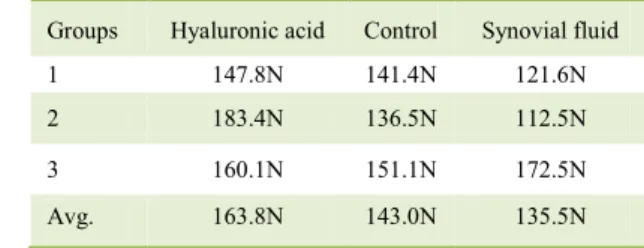
group (n=4) and the histopathological (H) examination (n=6) group. Tendons were totally excised and were subjected to tensile testing in group B. A Besmak brand Mechanical Tensile Testing Device was used for the procedure. In the tests performed at room temperature, tendons were placed between two jaws, immobile at the upper part and mobile at the lower part, and were strained at a rate of 10mm/min (till tendon rupture). Each test was repeated 3 times. The statistical average of the maximum load obtained from these three tests was used for evaluation (Table 1). The differences in tendon healing between the groups were determined based on the rupture point of tendons.
In group H, tendon tissue specimens were
fixed in a 10% formaldehyde solution. The tendon
tissues were then soaked in 10% formic acid solution for three days for easy excision and rinsed under running tap water for 12 hours. Rinsed tendon tissue specimens were dehydrated in a tissue processing device (Leica, TP1020) with alcohol and xylene series and embedded
longitudinally in paraffin. After being cut at a thickness
of 5 microns using a microtome (Leica, RM2125RT), tendons were stained with Haematoxylin Eosin (HE) and Masson’s Trichrome histochemical staining methods. Stained tendon specimens were examined under a light microscope with a camera (Nikon, Eclipse E600, Nikon Inc., Melville, NY). The sections stained with Masson’s Trichrome and HE histochemical staining methods were evaluated for grade and severity of adhesion and quality of tendon healing by modifying the criteria reported by TANG et al. (1996) (Figure 1).
RESULTS
Clinical observation findings
From the first day after the operation,
animals in all groups could stand on their bandaged extremities, and walk even though they avoided the affected extremity. Animals in the HA and
SF experimental groups were found to be more attentive to their surroundings and more active. At the end of three weeks, bandages were removed and animals were allowed to walk freely for adaptation. Slight limping was observed for three days in all groups. Following 24 days of healing period after the operation, all rabbits could walk without any
difficulty; they could even perform activities such
as jumping, running, etc. in their cages. However, asymmetry has been observed between the healthy and operated limbs in two animals from each group.
Ultrasonographic examination findings
In all experimental group, the tendons had increased in thickness and echogenicity, and heterogenous echotexture (C>SF>HA). In addition, due to irregular echogenicity along the tendon,
interruption of the fibrillar echotexture, and the
presence of hypoechoic intratendinous foci in two of these rabbits in the HA group, one in the SF group, and one in the C group, the tendons were considered suspect of rupture.
Macroscopic examination findings
The macroscopic examination revealed peritendinous adhesions with a focus on the suture line in all groups. In the HA experimental group, the tendon surfaces were smooth, and there were grade 2
adhesions in the form of fibrillary bands surrounding
the suture line that could be easily dissected. In the SF experimental group, the tendon surfaces were partially smooth, and there were grade 3 adhesions between the suture line and peritendinous tissues in the form of thick bands that could not be easily dissected. In the control group, the tendons were thickened, the surfaces appeared rough, and there were grade 4 adhesions along the tendon extending to the periosteum in the tendinous and peritendinous line, with a focus on the suture line (Figure 2). A comparison of the tendons in terms of healing status revealed that two animals in each group developed tendon rupture, and the remaining ones healed without any problems.
Biomechanical test findings
In the HA group, the tendons ceased elongating and ruptured when they reached the maximum load. After rupturing, elongation continued incrementally for the rest of load application. In the SF and C group, no sudden change was observed in the load after reaching the maximum load. The average unit elongation values in all groups varied from 19 to 20mm. The data obtained during the tensile test were recorded by the computer and are reported in table 1. Table 1 - Maximum load and average values obtained from
the tensile tests on tendons.
Groups Hyaluronic acid Control Synovial fluid
1 147.8N 141.4N 121.6N
2 183.4N 136.5N 112.5N
3 160.1N 151.1N 172.5N
Microscopic findings
According to the semi-quantitative analysis results, tendon adhesion in the HA group was more limited compared to the SF and C groups. Furthermore, the grade of tendon healing in the HA group was higher than the SF and C groups (Figures 3A, 3C). The grade of tendon healing was lower and the grade of tendon adhesion was higher in the SF group than in the HA group but better than group C
(Figures 3A, 3B).
In all experimental groups, there were
significant adhesions characterized by loose fibrous filaments between the tendon and the surrounding
epitenon and paratenon tissues, which thickened due to highly vascular and oedematous granulation tissue.
Fibroblasts in this region were not yet organized and matured (Figure 3A). In the tendon tissue, the collagen
was not yet mature but intratendinous collagen fibrils
were partially organized and began to appear more regular (Figures 3A, 3B, 3C). In rare cases, the
fibroblast nuclei between the collagen fibres at these
sites began thinning and were located parallel to the
collagen fibres (Figure 3C).
DISCUSSION AND CONCLUSION
Cell proliferation as part of the healing physiology after tendon injuries, suture applications, and immobility facilitate adhesion formation. Although, alternative tenorrhaphy techniques have Figure 1 - Average values of the semi-quantitative analysis results of tendon adhesion and tendon healing in the control and experimental
groups.
been developed, adhesions that form during the healing process and loss of function induced by this
condition are still a significant problem in tendon surgery. This study investigated the efficacy of synovial fluid compared to a commercial hyaluronic
acid preparation in preventing tendinous and peritendinous adhesions.
Some studies attempted to prevent adhesion using natural or synthetic barriers or viscoelastic materials (HUI et al., 2012; LIU et al., 2008; TAN et al., 2010). However, our literature review did not reveal any studies that used synovial
fluid as an agent for preventing tendon adhesion. For
this purpose, we applied a gel containing hyaluronic
acid in one group, and synovial fluid in the other group
after tenorrhaphy and then evaluated the tendons for adhesion formation.
When the general mobility of the animals
was examined, clinical findings revealed that anti
adhesive agent applied HA and SF groups performed better than that of the control group. This mobility increase, as ORYAN et al. (2011) indicated, is associated with pain control and the anti-degenerative properties of hyaluronic acid. Earlier tendon healing
and the efficacy of the gliding function explain the
increased activity of the animals in their cages. In human medicine, it is possible to weaken adhesions during the healing process through controlled minimal movements. However, because controlled voluntary movement is not possible in animals, this application may cause re-formation of tendon rupture and poor healing. SEVERO et al. (2012) argued that it is important to attempt to activate the
site by week 3, when tendon healing takes place that mobility in the early period will not completely prevent adhesions but will help to re-gain normal function by ensuring tendon gliding. Conversely, some researchers suggested that three weeks is not adequate for tendon healing, and the extremity should
remain in bandages for up to five weeks. In our study,
we limited the duration of bandage application on the extremities to three weeks in order to eliminate the preliminary factors that impact adhesion formation in the postoperative period. At the end of three days after the bandages were removed, all the rabbits
could walk without limping. Clinical findings showed
that tendons re-gain their normal function after tenorrhaphy. However, tendon rupture developed in two animals in each experimental group. Results revealed the importance of extending the period of bandaging and providing minimal movements in tendon surgery. This condition demonstrated the dilemma of veterinarians when it comes to ensuring healing versus preventing adhesion formation in
tendon surgery in the field of veterinary medicine. Ultrasonographic diagnosis of inflammatory
activity in tendons with paratenon can be made based on pathological images (MARTINOLI et al., 2002; PAAVOLA et al., 1998). In a study with horses, MARR
et al. (1993) reported that the presence of fibrous
adhesions can be diagnosed with ultrasonographic examination of peritendinous tissues, but warned that this evaluation may be subjective. In our study, in cases with suspected tendon rupture where ultrasonographic
examination revealed severe adhesion, findings were confirmed with the macroscopic tendon examination
after euthanasia. Although, the ruptured tendons of all animals had irregular echogenicity, intratendinous
hypoechoic foci and interruption of the fibrillar
echotexture, in one case from SF and in other case from C group could not be diagnosed ultrasonographically even though animals had ruptured tendons. Macroscopic tendon examination showed that there were partial ruptures in those tendons. Similarly, KAYSER et al. (2005) reported that ultrasonography is not
sufficiently reliable for all pathologies of the tendons,
especially partial ruptures of the Achilles tendon. In macroscopic tendon examination, limited adhesion in the SF group compared to the C group demonstrates the anti-adhesive effect of the synovial
fluid. However, results in the SF group fell short of those
achieved in the HA group. Hyaluronic acid is known to remain at the injected site for approximately 34 days. Commercial HA preparation in gel formation creates a barrier between the tendon and the surrounding tissues
and maintains its efficacy because it stays intact at the
site for a long period of time. However, there is no
information regarding how long synovial fluid stays in the region where it is applied. These findings obtained from our study support findings from the previous
studies where hyaluronic acid is used as an anti-adhesive agent (HAGBERG&GERDIN, 1992; LIU et al., 2008; MORO-OKA et al., 2000; ORYAN et al., 2011).
In our study, when the tensile strengths of the tendons were compared among all groups, HA was superior to the other groups. When load values obtained from the tests were reviewed, strength differences were considered acceptable by previous studies as well (AYGÜN et al., 2010). The fact that elongation continued incrementally for the rest of the load application after rupture, particularly in the experimental group where HA was applied, was attributed to the
flexible structure of the paratendinous tissue. AYGÜN
et al. (2010) also reported that elongation continued during tensile tests even after rupture occurred due to the heterogenous structure of the tendons. According to the histopathological examination, tendon adhesion was more limited in the SF group than in the C group. The fact that known effects of commercial HA preparations also occurred in the
group where synovial fluid was applied suggests that it holds promise as an alternative. These findings, which
are parallel to those reported by studies on anti-adhesive use in tendon surgery (HAGBERG&GERDIN, 1992; HUI et al, 2012; LIU et al., 2008; ORYAN et al., 2011), have once again established that application of viscoelastic materials, which are designed to maintain the gliding motion of the tendon for successful
tendon healing during the operation is beneficial.
In conclusion, we demonstrated in this study that in addition to the use of HA as a commercial preparation to reduce or prevent adhesion formation, one of the most common complications occurring after tendon operations both in human and veterinary medicine, natural synovial
fluid, which is a significant source of HA naturally
found in the body, can also be used as a viscoelastic material. However, in order to better understand
the role of synovial fluid in tendon healing, more
extensive studies should be conducted. We believe
that synovial fluid will be a good alternative to
other agents as an affordable and effective treatment option in tendon surgery.
ACKNOWLEDGEMENTS
This study was supported by the Kafkas University Office of the Scientific Projects Coordinator. (Project No: KAÜ- BAP-2015-TS-65).
BIOETHICS AND BIOSSECURITY COMITTEE APPROVAL
The study was conducted after approval was obtained from the Kafkas University Animal Experiments Local Ethics Committee (Approval No: KAÜ-HADYEK/2015-049). All applicable national guidelines for the care and use of animals were followed. All procedures performed in studies involving animals were in accordance with the ethical standards of Animal Experiments Local Ethics Committee.
DECLARATION OF CONFLICTS OF INTEREST
The authors declare no conflict of interest. The
founding sponsors had no role in the design of the study; in the collection, analyses, or interpretation of data; in the writing of the manuscript, and in the decision to publish the results.
REFERENCES
AYGÜN, H. et al. Tendon healing and repair: A review of current approaches. Kafkas Universitesi Veteriner Fakultesi
Dergisi, v.19 (Suppl-A), p.243-248, 2013. Available from:
<http://vetdergikafkas.org/uploads/pdf/pdf_KVFD_1492. pdf>. Accessed: May 14, 2018. doi: 10.9775/kvfd.2012.8408.
AYGÜN, H. et al. A new surgical technique for the repair of the Achilles tendon rupture: repair of the Achill tendon rupture by implant without immobilization and compared with traditional suture techniques in rabbits.
Kafkas Universitesi Veteriner Fakultesi Dergisi, v.16, n.5, p.777-782, 2010. Available from: <http://vetdergikafkas.org/uploads/pdf/pdf_ KVFD_789.pdf>. Accessed: May 15, 2018. doi: 10.9775/kvfd.2010.1546.
HUI, A.Y. et al. A systems biology approach to synovial joint lubrication in health, injury, and disease. Wiley Interdisciplinary
Reviews: System Biology and Medicine, v.4, n.1,
p.15-37, 2012. Available from: <https://www.ncbi.nlm.nih.gov/ pubmed/21826801>. Accessed: May 15, 2018. doi: 10.1002/wsbm.157.
KAYSER, R. et al. Partial rupture of the proximal Achilles tendon: A differential diagnostic problem in ultrasound imaging. British
Journal of Sports Medicine, v.39, p.838-842, 2005. Available
from: <https://www.ncbi.nlm.nih.gov/pmc/articles/PMC1725056/>. Accessed: May 15, 2018. doi: 10.1136/bjsm.2005.018416.
KHANNA, A. et al. Prevention of adhesions in surgery of the flexor tendons of the hand: What is the evidence? British Medical Bulletin, v.90, p.85-109, 2009. Available from: <https://www.ncbi.nlm.nih.gov/ pubmed/19395470>. Accessed: May 15, 2018. doi: 10.1093/bmb/ldp013.
LIU, Y. et al. Prevention of peritendinous adhesions using a hyaluronan-derived hydrogel film following partial-thickness flexor tendon injury. Journal of Orthopaedic Research, v.26, n.4, p.562-569, 2008. Available from: <https://www.ncbi.nlm.nih. gov/pmc/articles/ PMC2963073/>. Accessed: May 15, 2018. doi: 10.1002/jor.20499.
LIPOWITZ, A.J. Synovial fluid. In: Newton, C.D.; Nunamaker, D.M. Textbook of Small Animal Orthopaedics. 1st edn. Philadelphia: J.B. Lippincott Company, 1985. Chap 86.
LUI, T. H. Arthroscopy and endoscopy of the foot and ankle: Indications for new techniques. Arthroscopy: The Journal of Arthroscopic
& Related Surgery, v.23, n.8, p.889-902, 2007. Available from:
<https://www.arthroscopyjournal.org/article/S0749-8063(07)00265-4/ abstract>. Accessed: May 15, 2018. doi: 10.1016/j.arthro.2007.03.003.
MARR, C.M. et al. Ultrasonographic and histopathological findings in equine superficial digital flexor tendon injury. Equine
Veterinary Journal, v.25, n.1, p.23-29, 1993. Available from:
<https://www.ncbi.nlm.nih.gov/pubmed/8422880>. Accessed: May 15, 2018. doi: 10.1111/j.2042-3306.1993.tb02896.x.
MARTINOLI, C. et al. Ultrasound of tendons and nerves.
European Radiology, v.12, p.44-55, 2002. Available from:
<https://link.springer.com/article/10.1007/s00330-001-1161-9>. Accessed: May 15, 2018. doi: 10.1007/s00330-001-1161-9.
MORO-OKA, T. et al. Mixture of hyaluronic acid and phospholipid prevents adhesion formation on the injured flexor tendon in rabbits.
Journal of Orthopaedic Research, v.18, p.835-840, 2000.
Available from: <https://onlinelibrary.wiley.com/doi/pdf/10.1002/ jor.1100180523>. Accessed: May 15, 2018. doi: 10.1002/jor.1100180523.
ORYAN, A. et al. Effects of sodium-hyaluronate and glucosamine-chondroitin sulfate on remodeling stage of tenotomized superficial digital flexor tendon in rabbits: A clinical, histopathological, ultrastructural and biomechanical study. Connective Tissue
Research, v.52, n.4, p.329-339, 2011. Available from: <https://
www.ncbi.nlm.nih.gov/pubmed/21117902>. Accessed: May 15, 2018. doi: 10.3109/03008207.2010.531332.
ÖZAYDIN, İ.; KOÇ, B. Clinical studies on synovial fluid transplantation at the treatment of arthritis in cattle. Journal of the
Turkish Veterinary Medical Association, v.64, n.3, p.52-60, 1993.
ÖZAYDIN, İ. et al. Experimental tenorraphy with homologous arter graft and positive contrast fasciography in sheep. Turkish Journal
of Veterinary Surgery, v.1, n.1, p.10-14, 1995.
ÖZGENEL, G.Y. et al. Effects of human amniotic fluid on peritendinous adhesion formation and tendon healing after flexor tendon surgery in rabbits. The Journal of Hand Surgery, v.26, n.2, p.332-339, 2001. Available from: <https://www.sciencedirect.com/science/article/ pii/S0363502301225271>. Accessed: May 15, 2018. doi: 10.1053/ jhsu.2001.22524.
PAAVOLA, M. et al. Ultrasonography in the differential diagnosis of Achilles tendon injuries and related disorders. Acta Radiologica, v.39, p.612-619, 1998. Available from: <https://www.ncbi.nlm.nih.gov/pubmed/9817030>. Accessed: May 15, 2018. doi: 10.3109/02841859809175485.
SEVERO, A.L. et al. Biomechanics and histological analysis in rabbit flexor tendons repaired using three suture techniques with early active mobilization. Revista Brasileira de Ortopedia, v.47, n.1, p.92-101, 2012. Available from: <https://www.ncbi.nlm.nih.gov/pubmed/27027087>. Accessed: May 15, 2018. doi: 10.1016/S2255-4971(15)30351-7.
SLATTER, D. H. Muscle and tendon disorders. In: Slatter, D. H.
Textbook of Small Animal Surgery, 1st edn. Philadelphia: WB
Saunders, 1985. Chap. 158, p 2264-2272.
TAN, V. et al. Effects of nonsteroidal anti-inflamatory drugs on flexor tendon adhesion. The Journal of Hand Surgery, v.35, n.6, p. 941-947, 2010. Available from: <https://www.ncbi.nlm.nih.gov/ pubmed/20513575>. Accessed: May 15, 2018. doi: 10.1016/j. jhsa.2010.02.033.