Anticompetitive Impact of Pseudo-Generics
Vasco Rodrigues
Ricardo Gonçalves
Hélder Vasconcelos
Centro de Estudos de Economia e Gestão
Faculdade de Economia e Gestão
Universidade Católica Portuguesa
Rua Diogo Botelho, 1327; 4169-005 Porto
March 15, 2011
Abstract
A puzzling feature of pharmaceuticals markets is that sellers of branded drugs will, sometimes, sell generic versions of their own branded products, either directly or through license agreements. This paper proposes a new theoretical rationale for the fact that the introduction of these pseudo-generics may have anti-competitive e¤ects. In a model that combines horizontal and vertical product di¤erentiation, we show that the producer of the branded product will not sell the pseudo-generic unless faced with competition and that, if she does so, in some circumstances, all prices raise to the bene…t of all competitors and the detriment of consumers.
Keywords: Pseudo-Generics; Product Di¤erentiation; Pharmaceutical Pricing
JEL Codes: D43; L13; L44
1
Introduction
In recent decades, generics became an important competitive force in phar-maceutical markets, gaining considerable market share from branded products. Generics, according to the US Food and Drug Administration, "(...) are copies of brand-name drugs and are the same as those brand name drugs in dosage form, safety, strength, route of administration, quality, performance character-istics and intended use".1 Generics may enter the market if a patent-holder waives its rights or, more often, when the patents that protect a branded prod-uct expire. As imitators, generic producers do not incur signi…cant research and development costs and are able to charge very competitive prices.
Financial support by Fundação da Ciência e Tecnologia under grant PTDC/EGE-ECO/100296/2008 is acknowleged.
1http://www.fda.gov/Drugs/ResourcesForYou/Consumers/BuyingUsingMedicineSafely
It has been observed that, sometimes, the producers of a branded pharma-ceutical will sell a generic version of their own branded product, either directly or through license agreements. 2 These versions are often known in the
litera-ture as pseudo-generics.The rationale for selling pseudo-generics is not obvious: given its much lower price, selling a pseudo-generic seems to risk cannibalizing the sales of the, more pro…table, branded product. Some type of strategic im-pact on other generic competitors seems necessary to justify their use, which sugests the possibility of anticompetitive e¤ects.
The theoretical literature on the competitive implications of pseudo-generics is rather limited. Ferrándiz [3] presents a model in which …rms A and B sell sub-stitutable branded drugs under two alternative scenarios: in one of the scenarios, a third …rm sells a generic version of A’s drug; in the other scenario, the third …rm doesn’t exist but A itself sells a pseudo-generic. Unsurprisingly, this author concludes that consumers would be better o¤ in the …rst scenario but A prefers the second one. Kamien and Zang [5] assume that, when patents for the branded pharmaceutical expire, there is free generic entry. They build scenarios with and without a pseudo-generic to study the conditions under which it would be sold and conclude that selling the pseudo-generic is a dominant strategy. But these authors assume that the type of interaction between the brand-name producer and its competitors depends on whether the former is selling a pseudo-generic: if she is not, all …rms choose quantities simultaneously (Cournot) but if she is, then she has a …rst-mover advantage towards the competitors in choosing the quantities of both the branded drug and the pseudo-generic (Stackelberg). We …nd this crucial assumption unconvincing and feel it casts doubt on the generality of their conclusions. More recently, Kong and Seldon [6] have tried to rationalize pseudo-generics as an instrument to deter entry, in a model a la Dixit [2], but their results seem ‡awed [7].
This paper proposes a new theoretical rationale for the fact that the in-troduction of pseudo-generics may have anticompetitive e¤ects. In our model, …rms are price-setters in a market where both vertical and horizontal di¤erenti-ation are present: branded pharmaceuticals are vertically di¤erentiated towards generics (they are perceived as being strictly better), but generics are horizon-tally di¤erentiated among themselves. In this setting, we show that the presence of pseudo-generics may result in higher prices for every variety of the product, to consumers detriment.
That branded pharmaceuticals, which have been in the market for a con-siderable period under patent, may be perceived by consumers as being better than newcomer non-branded generics, in spite of health authorities claims to the contrary, we regard as obvious. But a crucial assumption of our model, that requires justi…cation, is that generics may be perceived as horizontally di¤eren-tiated. Even if they are "therapeutically equivalent" to the branded product, and thus also among themselves, generics may di¤er along many easily
observ-2The frequency with which this happens varies considerably from country to country,
pos-sibiliy as a result of legal and institutional di¤erences: Hollis [4] claims that they represent roughly one quarter of total generic sales in Canada and Australia, and also have strong positions in New Zeland, Germany, UK and Sweden.
able dimensions: ingredients other than the active substances may, and do, di¤er and characteristics such as ‡avour, shape, and color are usually di¤erent. Be-sides, packages and labels may vary signi…cantly. Further, although they do not carry a product brand (the product will be described as "acetylsalicylic acid", not as "Aspirin", for example), they generally identify the producer (it will be acetylsalicylic acid by XYZpharma, for example): there is no a priori reason to assume that consumers, or whoever chooses the product for them, are less sen-sitive to the identity of the producer in this type of product than in any other. Thus, we regard the assumption of horizontal di¤erentiation among generics as a reasonable one.
The rest of the paper is organized as follows. The next section introduces our model. For benchmark purposes, in section 3 we apply it in a monopoly situation. In the fourth section, we analyze oligopolistic competition under two alternative scenarios: with and without the pseudo-generic. Section 5, builds on previous results to determine the competitive impact of the pseudo-generic. We then discuss our results and conclude.
2
The model
In our model, there are two …rms: an incumbent (I) and an entrant (E), indexed by j = I; E. These …rms compete by simultaneously setting the prices of the products they sell. The incumbent sells a certain pharmaceutical product under a speci…c brand. She can also, if she chooses to, sell a generic, non-branded, variety of the product. The entrant, on the other hand, can only sell a generic variety. Let b (brand) refer to the branded variety of the product, g (generic) to the non-branded variety produced by the entrant, and pg (pseudo-generic) to the non-branded variety produced by the incumbent. Capitalized forms B, P G, and G refer to quantities or demand functions of these product varieties.
Branded and generic varieties of the product are fundamentally identical but consumers perceive them as being vertically di¤erentiated. Moreover, and as ex-plained above, consumers perceive generic varieties produced by di¤erent …rms as horizontally di¤erentiated. This being the case, this model assumes that con-sumers vary in their preferences over the di¤erentiated generic pharmaceutical product. The market is then composed of a uniform mass of consumers dis-tributed over a unidimensional space of product characteristics, de…ned by the interval [0; 1]. The disutility of consuming a generic product variety other than one’s ideal variety is assumed to be linear in the distance along this Hotelling interval, with slope t > 0.
Let ci denote consumer i’s type, where ci measures the distance between
consumer i’s location and the left endpoint of the unit interval. To re‡ect the existence of vertical di¤erentiation between the branded good and the generic al-ternatives, we assume that a consumer’s reservation price regarding the branded variety ( ) is higher than her reservation price corresponding to a generic prod-uct ( ). More formally, > > 0. In addition, and a consequence of horizontal di¤erentiation, if the consumer decides to buy a generic variety, her surplus
de-pends negatively on the distance between her location and the location of the seller in the generics product space she is buying from, where we denote by fj
…rm j’s location.
Consumers purchase either one unit or none. Each consumer opts for the product that provides her the most surplus, as long as this surplus is positive. Denoting by (pb; pg; ppg) the vector of prices, consumer ci’s individual surplus
is given by: CSi= 8 < : pb if she buys b pk t jfj cij ; k = g; pg if she buys g or pg 0 otherwise : (1)
Two additional remarks are in order at this point. First, as they are not fundamental for the purpose of this article, which is to illustrate a mechanism through which pseudo-generics can have anti-competitive e¤ects, we normalize production costs to zero. Second, since, without loss of generality, we normal-ized the total number of consumers to be equal to 1, quantities may also be interpreted as market shares.
The following two sections compare …rms’pro…ts and consumers’surplus in alternative situations.
3
The monopolist’s benchmark case
Consider …rst the case in which the incumbent is a monopolist, possibly because she is protected by patents. This being the case, she may either sell only the branded variety of the product or both the branded and the (pseudo-)generic varieties. However, in this perfect information setting, as the reservation price for generic varieties is lower than the reservation price for the branded variety (i.e., > ) and their respective production costs are identical (and equal to zero), it never pays to sell a generic variety along with the branded product. The incumbent then sets a price p1
b = for the branded variety. As a
conse-quence, every consumer buys this branded product, getting zero surplus, and the incumbent’s pro…t equals 1
I = .
4
Oligopolistic competition
Consider now the case of oligopolistic competition, say because the patents that protected the incumbent have expired and, as a result, she starts facing competition by an entrant.
In what follows, we assume that the entrant’s (generic) variety of the product is located at the left endpoint of the generics’product space (fE= 0) - the unit
interval - and that, if it is available, the pseudo-generic is located at point fI
along the (0; 1] segment. There are two di¤erent scenarios of interest, depending on whether the incumbent is present in the market with only one variety (the branded good) or with two varieties (the branded good and the pseudo-generic), which we discuss in turn.
4.1
The incumbent does not sell a pseudo-generic
Assume the incumbent sells only the branded variety and the entrant sells the generic variety. When this is the case, Figure 1 illustrates the determination of the demand for each product variety, for given location and prices. This Figure implicitly assumes that the generic variety is su¢ ciently cheaper than the branded product so as to have positive demand. Speci…cally, it assumes pb pg> . The location of the “marginal consumer”cb:g, who is indi¤erent
between varieties b and g, follows from solving pg t cb:g= pb:
cb:g=
(pb pg) ( )
t : (2)
With the total number of consumers equal to 1, the demand functions for each variety of the product are simply:
B (pb; pg) = 1 cb:g= 1 (pb pg) ( ) t ; (3a) G (pb; pg) = cb:g= (pb pg) ( ) t : (3b)
With no production costs, pro…t functions are B(pb; pg) = B (pb; pg) pb
and E(pb; pg) = G (pb; pg) pg. Maximizing these with respect to pb and pg,
one obtains the best-response functions:
pb = t + ( ) + pg 2 (4a) pg = pb ( ) 2 (4b)
Solving the system of best-response functions, we …nd the equilibrium prices: p2b = 2 3t + 1 3( ) (5a) p2g = 1 3t 1 3( ) (5b)
From these, through the demand functions, equilibrium quantities follow: B2 = 1 3 2t + ( ) t (6a) G2 = 1 3 t ( ) t (6b)
Equilibrium pro…ts are then:
2 I = 1 9 [2t + ( )]2 t (7a) 2 E = 1 9 [t ( )]2 t (7b)
Figure 1: Determination of demand functions, when the incumbent sells a branded variety of the product and the entrant sells a generic variety, assuming the entrant is located at the left end of the market
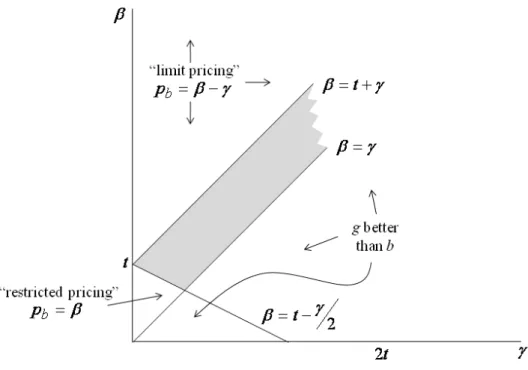
Figure 2: Restrictions on parameter values, when the incumbent sells the branded variety and the entrant sells a generic variety: results in section 4.1 hold for parameter values in the shaded area
Restrictions on parameter values For these results to hold, some restric-tions must be imposed on parameter values. Basically, these assure that the branded variety is perceived as better than the generic, but not so much better that no one would buy the latter, and that the product is su¢ ciently valuable for everyone to be willing to buy it (market is fully covered under competition). Under these conditions, both varieties will be simultaneously sold at a pro…t. Figure 2 illustrates the necessary restrictions on and , as a function of t.
In equilibrium, the indi¤erent consumer must be located in the [0; 1] segment, i.e., 0 < cb:g < 1, as assumed. Simple algebra shows that the right-hand side
condition cb:g < 1 always holds since t > 0 and > . As for cb:g > 0,it must
be that
< t + : (8)
If exceeds the threshold value t + , then incumbent can raise its price above p2b without inducing the entrant to sell the generic. Speci…cally, the incumbent can set a limit price of pb= and sell to the entire market, with a pro…t of
b= .
results to be valid: even if located in the [0; 1] segment, the indi¤erent consumer could get negative surplus from both varieties. In order for this not to happen, let pb. In equilibrium, this is equivalent to
t
2 (9)
If this condition doesn’t hold, then the incumbent will be restricted to pb=
and the entrant will respond with pg= 2. This in turn implies that pro…ts will
be I = (1 =2t) and E= 2=4t:
Summing up, the results in this section apply if conditions 8 and 9 hold.3
Hence, the relevant region of parameter values is the one illustrated with the shaded area in Figure 2.
4.2
The incumbent sells a pseudo-generic
Consider now the case in which the incumbent, faced with generic competition by an entrant, sells also a non-branded version of her own product, which we call a pseudo-generic.
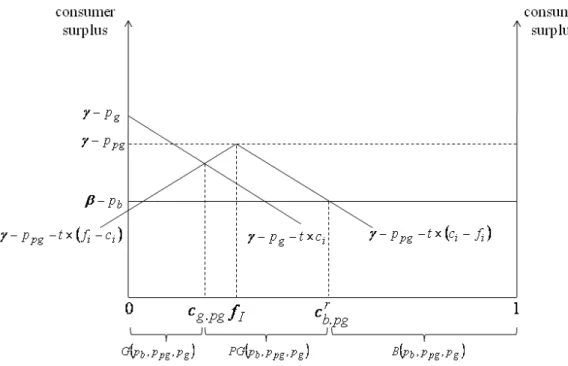
Assume the pseudo-generic is located su¢ ciently close to the entrant’s generic product for some consumer to be indi¤erent between them: otherwise, there would be no strategic interaction between the two products and, therefore, no reason for the incumbent to sell the pseudo-generic. Denote by cg:pg the
loca-tion of this consumer and by fI the location of the pseudo generic variety in
the generics product space. Assuming the pseudo-generic does not cannibalize the incumbent’s whole market, there will also be some consumer cr
b:pg that is
indi¤erent between the pseudo-generic and the branded variety of the product. Here, the superscript r indicates that this consumer is located to the right of fI.
We will later use the notation clb:pg for the consumer that is indi¤erent between these varieties to the left of fI. The determination of the demand functions for
the three varieties of the product is illustrated in Figure 3.
Solving pg t cg:pg = ppg t (fI cg:pg), the location of the
consumer indi¤erent between the two generic varieties of the product is cg:pg=
fI
2 +
ppg pg
2t : (10)
Similarly, solving ppg t crb:pg fI = pb, the location of the
consumer indi¤erent between the two varieties sold by the incumbent is: crb:pg = fI
t +
pb ppg
t : (11)
The demand functions are
Figure 3: Determination of demand functions, when the incumbent sells both a branded and a generic variety of the product and the entrant sells a generic version, assuming the entrant is located at the left end of the market and the incumbent at fI
B (pb; ppg; pg) = 1 crb:pg= 1 fI+ ( ) (pb ppg) t (12a) P G (pb; ppg; pg) = crb:pg cg:pg = fI 2 t + pb ppg t ppg pg 2t (12b) G (pb; ppg; pg) = cg:pg= fI 2 + ppg pg 2t (12c)
Pro…t functions are then:
I(pb; ppg; pg) = B (pb; ppg; pg) pb+ P G (pb; ppg; pg) ppg
and
E(pb; ppg; pg) = G (pb; ppg; pg) pg:
Maximizing these pro…t functions, one obtains the best-response functions:
pb = 1 2( ) + (1 fI) t 2 + ppg (13a) ppg = tfI 6 1 3( ) + 2 3pb+ 1 6pg (13b) pg = tfI 2 + 1 2ppg (13c)
Solving the system composed of the previous three equations, one obtains the equilibrium price for each of the three varieties present in the market:
p3b = (11 5fI) t 6 + 1 2( ) (14a) p3pg = (4 fI) t 3 (14b) p3g = (2 + fI) t 3 (14c)
Resulting in the following quantities:
B3 = 1 fI 2 + 2t (15a) P G3 = 1 + 2fI 6 2t (15b) G3 = 1 3+ fI 6 (15c)
3 I = t (41 fI(34 11fI)) 36 + (1 fI) 2 ( ) + ( )2 4t (16a) 3 E = 1 18t (2 + fI) 2 (16b)
Restrictions on parameter values Again, for these results to be valid, some restrictions must be imposed on the parameters, which we discuss in what follows.
First, as in the previous subsection, we require that some but not all con-sumers prefer the entrant’s generic to the incumbent’s branded variety. More formally, we require that that 0 cb:g 1. The …rst inequality is equivalent to
+ t 7
3 fI (17)
The second inequality implies that + t 1
3 fI (18)
Second, to guarantee that some but not all consumers prefer the pseudo-generic to the entrant’s variety, we require that: (i) cr
b:pg > cb:g; and (ii)
ppg tfI < pg. In equilibrium, both conditions are equivalent to require
that
fI >
2
5 (19)
If this holds, any > will satisfy 18.
Third, we also require that some but not all consumers prefer the branded variety of the product to the pseudo-generic, i.e., fI < crb:pg < 1. The second
inequality is trivially satis…ed for any t > 0, > and 0 < fI < 1. The …rst
inequality, on the other hand, is equivalent to require that:
< + t (1 fI) (20)
Fourth, our solution assumes also that the consumer who is indi¤erent be-tween the two generic varieties does not prefer the branded variety. Otherwise, the incumbent would not sell the pseudo-generic. Thus, we require also that cb:g clb:pg, which implies that:
+ t 5
6 fI (21)
It should be noted that condition 21 is more restrictive than either 17 and 20. Finally, we assume that the branded variety, and, therefore, every other variety, provides non-negative surplus, i.e., pb. This is equivalent to:
t11 5fI
Figure 4: Restrictions on parameter values when the incumbent sells both branded and pseudo-generic varieties of the product and the entrant sells a generic: results in section 4.2. hold for parameter values in the dark shaded area, assuming fI = 0:5; results in section 4.1. hold for both the dark and the
light shaded areas
Summing up, the active restrictions are, thus, 19, 21, and 22. Figure 4 summarizes the restrictions that apply to the demand parameters and , for fI = 0:5 and a speci…c value of t.
5
Price and pro…t impact of the pseudo-generic
We now turn to the main results in the paper, where we determine the compet-itive impact due to the pseudo-generic introduction in an oligopolistic setting. Proposition 1 For parameter values satisfying conditions 19, 21, and 22, the introduction of a pseudo-generic raises the price of both the branded and the true-generic varieties of the product.
Proof. p3
b > p2b, fI > 1 t and p3g> p2g, fI <75+15 t . With >
The overall impact of the pseudo-generic on consumers does not depend on these two prices alone, though, as some of them will replace the pseudo-generic for the other varieties of the product. But that will be of no avail.
Proposition 2 For parameter values satisfying conditions 19, 21, and 22, the pseudo-generic is more expensive than either the branded product or the true generic would be in its absence.
Proof. p3pg> p2b , fI < 2 t and p3pg> p2g, fI < 3 t . These are less
restrictive than condition 21, above, and so always true for the relevant range of parameter values.
As every price rises with the introduction of the pseudo-generic, we …nally claim that
Corollary 3 For the range of parameter values de…ned by conditions 19, 21, and 22, the introduction of a pseudo-generic reduces consumers’ surplus.
Thus, for certain parameter values, if the incumbent sells a pseudo-generic, consumers will be hurt. But we have yet to prove that the incumbent will want to sell the pseudo-generic. The following proposition establishes the conditions in which that will happen.
Proposition 4 For parameter values satisfying conditions 19, 21, and 22, sell-ing the pseudo-generic increases the incumbent’s pro…t if the pseudo-generic is perceived as a su¢ ciently good substitute for the true-generic (fI is su¢ ciently
low) and, if that does not happen, also if either consumers are sensitive to hor-izontal di¤ erentiation (t is not low) or the perceived quality di¤ erential between branded and generic products is signi…cant ( is not low).
Proof. Let = 3
I 2I. First, note that @@fI < 0, for any 0 fI 1,
and @2 @f2
I
> 0: for the relevant range of parameter values, the pro…tability of selling the pseudo-generic is decreasing in fI. As condition 19 requires that
fI > 25, note also that fI = 25 > 0. Thus, if fI is su¢ ciently close to 25,
selling the pseudo-generic is pro…table, for any values of the other parameters in the relevant range. If = 0 had no solutions for fI 2 [0; 1], this would
be true for any relevant value of fI. The solutions to this equation are fI = 1 11t 17t + 9 + p 2p142t + 13 2+ 7t2 and f I = 11t1 17t + 9 p 2p142t + 13 2+ 7t2 .
The …rst solution always exceeds 1 and thus places no additional restrictions on parameter values. The second, however, may lie in the [0; 1] interval. Although we do not have an analytical solution, visual inspection of this function shows this only happens if t and simultaneously take low values; in that case, su¢ ciently high values of fI imply that selling the pseudo-generic is not
prof-itable. Again, visual inspection shows that the critical value of fI, above which
selling the pseudo-generic is not pro…table, is always larger than 0:7.
The following numerical example ilustrates these results. Assume t = 0:5, = 1 and =76. Using the formulas above, it is immediate to …nd that, if the incumbent does not sell the pseudo-generic, equilibrium is characterized by
price quantity pro…t branded product 0:388 0:777 0:302 generic 0:111 0:222 0:025
Assume, alternatively, that the incumbent sells a pseudo-generic located at fI = 0:5. Equilibrium values will then be:
price quantity pro…t branded product 0:792 0:417 0:330 pseudo-generic 0:583 0:167 0:097 generic 0:417 0:417 0:174
Thus, every price rises, increasing both …rms’pro…ts at consumers’expenses. The intuition for these results can be understood by thinking of the impact that a price reduction by the incumbent will have on her market share. If she is not selling the pseudo-generic, the incumbent’s branded product competes directly against the entrant’s generic, as illustrated in Figure 1: in this situation, a unitary price reduction by the incumbent steals 1
t market share from the
entrant (@G(pb;pg)
@pb , along 3b). But if incumbent sells the pseudo-generic, this
product interposes between the branded product and the "true"-generic, as seen in Figure 3: a reduction of the price of the branded product would steal consumers from its own pseudo-generic (i.e., it would move cr
b:pg to the left) but
would have no impact on the entrant’s market share (cg:pg would remain the
same and @G(pb;pg)
@pb = 0, along 12c). To steal market share from the entrant,
the incumbent would now need to resort to the pseudo-generic price. But a unitary reduction of the price of the pseudo-generic steals just half as much market share from the entrant (@G(pb;ppg;pg)
@ppg =
1
2t, along 12c) as a reduction of
the price of the branded product would if the pseudo-generic was not available. This is because the two generics are horizontally di¤erentiated and consumers trade o¤ the reduced price against the higher "transportation costs". Thus, the incentive to reduce prices is weaker if the pseudo-generic is being sold.
This is aggravated by two other factors. First, reducing the price of the pseudo-generic will not only capture consumers that would otherwise buy the true-generic but also others that would buy the incumbent’s, more pro…table, branded product (reducing the price of the pseudo-generic moves crb:pg to the right).4 Besides, in this model, as usual, prices are strategic complements:
anticipating higher prices by the pseudo-generic selling incumbent, the entrant herself sets higher prices, further decreasing the incumbent’s incentive to reduce prices. Thus, the presence of the pseudo-generic softens competition between the two …rms.
4Put it another way, in case the incumbent is a multiproduct …rm, decreasing the price of
the the pseudo-generic has a canibalization e¤ect since part of the demand captured with the price decrease refers to consumers previously buying the other variety sold by the incumbent - the branded product.
6
Discussion and further research
This paper illustrates a new theoretical rationale for the fact that the intro-duction of pseudo-generics can lead to higher prices of all (branded and non-branded) varieties in the market and reduce consumer surplus. The key feature of the proposed model is the coexistence of both vertical and horizontal di¤eren-tiation which we think is a good description of the way pharmaceutical products market work in reality.
There are other contexts where this coexistence of two types of di¤erentiation is at work and in which our model may prove insightful. A good example is the case in which branded products are sold in retail stores along with private labeled products (sometimes produced by the same …rm which sells as well the main brand available in the market). The empirical literature shows that entry by store brands is often accompanied by price increases (Ward et al. [8], Bronfrer and Chintagunta [1]).
In concluding, it should be pointed out that an important limitation to the previous analysis is the fact that the location of the generic varieties in the product space are assumed to be exogenously given. Clearly, the assumption of exogenous “locations”restricts the applicability of the proposed model, since real life industries product positioning and repositioning is another important dimension through which …rms strategically interact. So, it seems important to extend the analysis in order to consider cases in which locations are endoge-nously determined. This will be done in future research. Hopefully, the above model can be seen as a stepping stone in the direction of a more complete analysis.
References
[1] Bonfrer, A. and Chintagunta, P. Store brands: who buys them and what happens to retail prices when they are introduced? Review of Industrial Organization 2004; 24: 195-218.
[2] Dixit, A. A model of duopoly suggesting a theory of entry barriers. Bell Journal of Economics 1979; 10: 20-32.
[3] Ferrándiz, J. The impact of generic goods in the pharmaceutical industry. Health Economics 1999; 8: 599-612.
[4] Hollis, A. The importance of being …rst: evidence from Canadian generic pharmaceuticals. Health Economics 2002; 11: 723-34.
[5] Kamien, M. and Zang, I. Virtual patent extension by cannibalization. South-ern Economic Journal 1999; 66: 117-131.
[6] Kong, Y. and Seldon, J. Pseudo-generic products and barriers to entry in pharmaceutical markets. Review of Industrial Organization 2004; 25: 71-86.
[7] Rodrigues, V. Pseudo-generic products and barriers to entry in pharmaceuti-cal markets: comment. Review of Industrial Organization 2006; 28: 183-187. [8] Ward, M., Shimshack, J., Perlo¤, J. and Harris, J. E¤ ects of the private-label invasion in food industries. American Journal of Agricultural Economics 2002; 84: 961-73.