LOSSES IN THE PEANUT MECHANICAL DIGGING AS A FUNCTION OF THE DIGGER SHAKER ROTATION
Rafael Scabello Bertonha1, Rouverson Pereira da Silva2, Carlos Eduardo Angeli Furlani3, Fabio Alexandre Cavichioli4
1
Universidade Estadual Paulista "Júlio de Mesquita Filho" – E-mails: [email protected], [email protected], [email protected], [email protected]
ABSTRACT
The aim of this work was to evaluate the losses in peanut digging as a function of different rotations of the digger shaker inverter. The visible, invisible and total losses were higher with the increasing of the digger shaker rotation.
Keywords: Arachis hypogaea, agricultural machines, peanut losses
PERDAS NO ARRANQUIO MECANIZADO DE AMENDOIM EM FUNÇÃO DA ROTAÇÃO DA ESTEIRA DO ARRANCADOR-INVERTEDOR
RESUMO
Objetivou-se neste trabalho avaliar as perdas no arranquio de amendoim em função de diferentes rotações da esteira do arrancador-invertedor. As perdas visíveis, invisíveis e totais foram maiores conforme o aumento da rotação da esteira do arrancador-invertedor.
Palavras-chave: Arachis hypogaea, máquinas agrícolas, perdas de amendoim
INTRODUCTION
The mechanized digging peanut has high loss, mainly due to the weakening of the stalk at the advanced stage of maturity or when the soil is very dry and compacted (ROBERSON, 2009). INCE & GUZEL (2003) have shown that gynophores breaking resistance (GBR) is an important factor to describe the digging losses and combine
harvesting of peanuts being dependent of the flowering period, i.e., the permanence time in the soil and the water content of the soil.
LAMB et al. (2004) estimated average losses in the digging about 8-40% (on later harvest), while ROWLAND et al. (2006) found losses of up to 50%. BEHERA et al. (2008) compared the performance of manual and mechanized digging of peanut, and found 23% of total losses in the mechanical digging
conducted with soil water content of 8%. JORGE et al. (2008), studying the operation of mechanized digging, verified that the speed of digging did not affect the occurrence of visible, invisible and totals losses; however, according to the authors, it was possibly influenced by the high coefficient of variation. They further argued that the high values of losses found might have occurred as a consequence of density and water content of the soil.
The design optimization of peanut digging may result in greater operational efficiency, but still, it is crucial to determining losses at harvest to maintain this efficiency (PADMANATHAN et al., 2006, BUTTS et al., 2009).
Therefore, the aim of this study was to evaluate the losses in peanut mechanized due to the shaking conveyer rotation of digger.
MATERIALS AND METHODS
The experiment was conducted in the FEPE – “Fazenda de Ensino Pesquisa e Extensão” at UNESP – São Paulo State University, in Jaboticabal, São Paulo State, Brazil. The geographical area of the experiment is located by the coordinates of latitude 21º15’ South and longitude 48º18’ West, with an average elevation of 570 meters and slope about 4%. The climate is classified
according to Köeppen as humid tropical climate (Aw) with rainy summer and dry winter. The soil is classified as Eutropherric Red Latosol (ANDRIOLI & CENTURION, 1999) and presents 510 g kg-1 of clay, 290 g kg-1 of silt and 100 g kg-1 of sand.
One used seeds of peanut (“IAC Runner 886” cultivar) with spacing of 0.90 m between rows, with 16 seeds m-1. Before seeding, one performed the conventional tillage to get a good seeding. After sowing, one performed seven applications of herbicides and fungicides, and the digging was done 132 days after seeding (DAS), using a digger 2x1 (two lines x one windrow), pulled by a tractor with 80.9 kW of power at 38.3 Hz on the engine.
The design was randomized block with four treatments and five replications. The treatments were established by four rotations of the digger shaker, defined from the manufacturer's recommendations, to work with the tractor rotation of 5.8 Hz at PTO, considering also the rotation suitable for use PTO (9.0 Hz). It was also used two intermediate PTO speeds (6.9 and 7.8 Hz) resulting in rotation of the shaking conveyer of 1.7, 1.8, 2.1 and 2.4 Hz, measured by a digital tachometer of contact. At the time of measurement, it was found on the panel of the
tractor engine rotations of 20.0, 23.3, 26.7 and 30.8 Hz.
To evaluate the maturation, it was used the Hull scrape method (WILLIAMS & DREXLER, 1981), which consists of scraping of the pods exocarp, exposing the color of the mesocarp, considering as ripe the pods that were part of black, brown and orange class. For this evaluation 100 pods in each plot were collected at random.
The water content of the pods (WCP), calculated on a wet basis, was obtained collecting 50 pods per plot, collecting after the passage of the digger. The samples for determination of water content of the soil (WCS), at the time of the digging, were collected using an auger of “Dutch type” in the layers of 0.0-0.10 and 0.10-0.20 m, being accommodated in aluminum containers and taken to the laboratory, where it was maintaining about 24 hours at 105º C. The water content of the soil was calculated on dry basis.
The losses in the digging were classified as visible (VLD), invisible (ILD) and total (TLD). The total losses correspond to the sum of the visible and invisible losses. To collect the losses, the peanut windrow formed after of the passage of the digger was carefully removed by putting up a metallic frame at this site approximately 2 m2 (1.11 x
1.80 m) across the windrow, collecting manually visible losses (pods and grains found on the surface) and invisible losses localized at a depth of 0.15 m. The definition of the width of the frame corresponds to the working width of the digger. After collecting the pods were put in paper bags, identified, and then sent to the laboratory where they were washed to remove the soil attached to the exocarp.
The pod mass determination was done on a digital scale with a precision of 0.01 g. Then the pods were put in an electric dryer, at 105 ± 3º C for 24 hours. After the drying, the mass of the dry pods was determined, obtaining the values of the losses which were corrected to 8% of water content. The values of loss were calculated in percentage relative to the gross productivity, referring to the total amount of peanut produced in a determined area, considering therefore the potential crop yield. To determine the gross productivity, it was carried out to the manual digging of all peanut plants contained within the frame (2 m2), collecting and weighing all the pods as well those that were over and under the soil to a depth of 0.15 m. The gross productivity was also corrected to 8% of water content.
For the statistical analysis, it was determined the descriptive analysis (VIEIRA et al., 2002) to permit a visualization of the
general behavior of the data, determining measures of central tendency (arithmetic mean and median), dispersion (standard deviation and coefficient of variation), skewness and kurtosis. It was conducted to the Anderson-Darling test to verify the normality of the data, and when necessary, it was performed to the standardization by the transformation, using the Minitab 16® program.
RESULTS AND DISCUSSION
The average yield 1,745.4 kg ha-1, was below the average of the last five seasons of the country (2007/08 to 2011/12) which was approximately 2,996 kg ha-1 (CONAB, 2012a, 2012b).
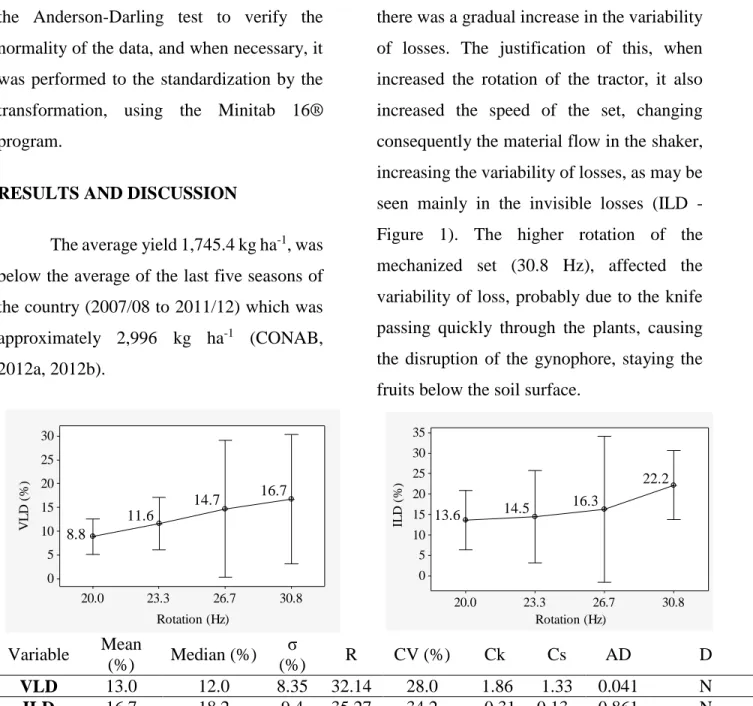
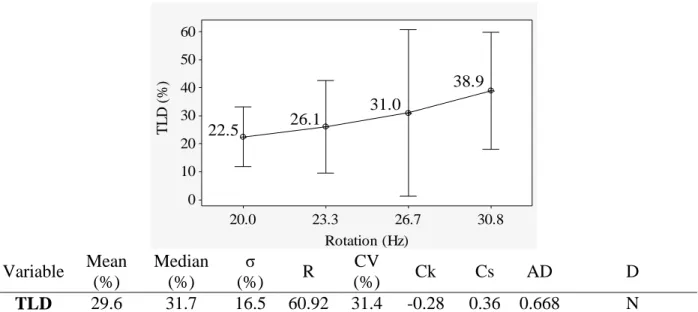
With respect to losses in the digging it was not observed effect of rotations, however, it may be noted that the variables VLD and ILD (Figure 1) and TLD (Figure 2), when increased the rotation of the digger, there was a gradual increase in the variability of losses. The justification of this, when increased the rotation of the tractor, it also increased the speed of the set, changing consequently the material flow in the shaker, increasing the variability of losses, as may be seen mainly in the invisible losses (ILD - Figure 1). The higher rotation of the mechanized set (30.8 Hz), affected the variability of loss, probably due to the knife passing quickly through the plants, causing the disruption of the gynophore, staying the fruits below the soil surface.
Variable Mean (%) Median (%) σ (%) R CV (%) Ck Cs AD D VLD 13.0 12.0 8.35 32.14 28.0 1.86 1.33 0.041 N ILD 16.7 18.2 9.4 35.27 34.2 -0.31 0.13 0.861 N
σ: standard deviation; R: range; CV: coefficient of variation; Ck: coefficient of kurtosis; Cs: coefficient of skewness; AD: Anderson-Darling test; D: Distribution (A: asymmetric or N: normal)
Figure 1. Graphics of means for visible (VLD) and invisible (ILD) losses in the mechanical digging
and their respective statistical values. 30.8 26.7 23.3 20.0 30 25 20 15 10 5 0 Rotation (Hz) V L D ( % ) 16.7 14.7 11.6 8.8 30.8 26.7 23.3 20.0 35 30 25 20 15 10 5 0 Rotation (Hz) IL D ( % ) 22.2 16.3 14.5 13.6
Variable Mean (%) Median (%) σ (%) R CV (%) Ck Cs AD D TLD 29.6 31.7 16.5 60.92 31.4 -0.28 0.36 0.668 N
σ: standard deviation; R: range; CV: coefficient of variation; Ck: coefficient of kurtosis; Cs: coefficient of skewness; AD: Anderson-Darling test; D: Distribution (A: asymmetric or N: normal)
Figure 2. Graphic of means for total losses (TLD) in the mechanical digging and their respective
statistical values.
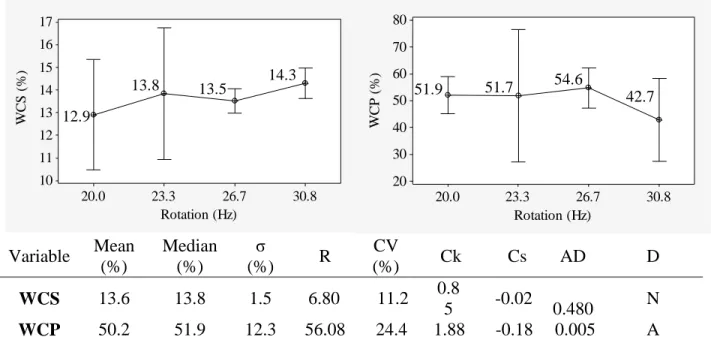
One can be observed (Figure 1) that for values of mean and median both are close to each other. The VLD variable showed kurtosis and skewness coefficients away from zero, however, applied the transformation, confirming then the normality of the data, i.e., indicators factors of normality. Another variable that also required transformation had been WCP, but this did not show as normal, presenting asymmetry, even after transforming the data. The other variables showed coefficient of kurtosis and skewness close to zero, consequently their distributions were normal. It may be noted that only the variable WCS (Figure 3) shows low range. The coefficient of variation of the variables presented medium to very high, however, for
this type of evaluation as peanut losses, this coefficient is normal to present very high due to the instability of the natural environment (soil and plant). Analyzing the average of WCS (Figure 3), note that it is by SANTOS et al. (2010) which was of 18 to 20%, considering as recommended, should be noted the importance of the ideal time for digging, because this being outside the recommended, the soil can interfere, directly, between the knives of the digger and the peanut pods. It was verified that the WCP (Figure 3), showed far of recommended by SEGATO & PENARIOL (2007) (35-45%), except at higher rotation that showed the water content of the pods within the recommended. 30.8 26.7 23.3 20.0 60 50 40 30 20 10 0 Rotation (Hz) T L D ( % ) 38.9 31.0 26.1 22.5
Variable Mean (%) Median (%) σ (%) R CV (%) Ck Cs AD D WCS 13.6 13.8 1.5 6.80 11.2 0.8 5 -0.02 0.480 N WCP 50.2 51.9 12.3 56.08 24.4 1.88 -0.18 0.005 A
σ: standard deviation; R: range; CV: coefficient of variation; Ck: coefficient of kurtosis; Cs: coefficient of skewness; AD: Anderson-Darling test; D: Distribution (A: asymmetric or N: normal)
Figure 3. Graphics of means for water content of soil (TLD) and water content of pods in the
mechanical digging and their respective statistical values.
Making a calculation of economy between the highest and lowest rotation, it may be obtained 16.4% more production, working with lowest rotation. Calculating in bags (25 kg), the farmer may earn 11.45 bags ha-1 over in the peanut yield. It is likely that
with the lowest speed, it can save in the fuel consumption.
CONCLUSIONS
The visible, invisible and total losses were higher with the increasing of the digger shaker rotation. The total losses presented high values due to the soil and pod conditions.
REFERENCES
ANDRIOLI, I.; CENTURION, J. F. Levantamento detalhado dos solos da Faculdade de Ciências Agrárias e Veterinárias de Jaboticabal. In: Congresso Brasileiro de Ciência do Solo, 27, 1999, Brasília. Proceedings... Brasília: Sociedade Brasileira de Ciência do Solo, CD-ROM. p.1-4, 1999.
BEHERA, B. K.; BEHERA, D.; MOHAPATRA, A. K.; SWAIN, S.; GOEL, A. K. Performance evaluation of a bullock drawn groundnut digger.
Environment and Ecology, Kalyani,
v.26, n.3a, p.1226-1229, 2008.
BUTTS, C. L; SORENSEN, R. B.; NUTI, R. C.; LAMB, M. C.; FAIRCLOTH, W. H. 30.8 26.7 23.3 20.0 17 16 15 14 13 12 11 10 Rotation (Hz) W C S ( % ) 14.3 13.5 13.8 12.9 30.8 26.7 23.3 20.0 80 70 60 50 40 30 20 Rotation (Hz) W C P ( % ) 42.7 54.6 51.7 51.9
Performance of equipment for in-field shelling of peanut for biodiesel production. Transactions of the ASABE, St. Joseph, v.52, p.1461-1469, 2009. CONAB - National Supply Company.
Historical series on the seasons 2007/08
to 2011/12. Available at:
<http://www.conab.gov.br/conteudos.php ?a=1252&t=2>. Access in: Aug. 11, 2013 CONAB - National Supply Company. 9th
Survey (June/2012) Crop 2011/12
Grain. Available
at:<http://www.conab.gov.br/OlalaCMS/u ploads/arquivos/12_06_12_16_15_32_bol etim_portugues_junho_2012.pdf>. Access in: Aug. 11, 2013.
INCE, A.; GUZEL E. Effects of gynophore breaking resistance on losses in mechanized peanut harvesting. In: International Conference on Crop Harvesting and Processing, 2003, Louisville, Kentucky. Proceedings… St. Joseph: ASABE. p. 1103, 2003.
JORGE, A. C.; MAHL, D.; ALMEIDA, T. F.; SERON, C. C.; MORAES, M. B. Losses in mechanized digging of peanut in function of speed and spacing of openers. In: Peanut Crop Meeting, 5, 2008. Jaboticabal. Proceedings… Jaboticabal: FUNEP, CD-ROM, p.1-4, 2008.
LAMB, M. C.; MASTERS, M. H; ROWLAND, D.; SORENSEN, R. B.; ZHU, H., BLANKENSHIP, P. D.; BUTTS, C. L. Impact of sprinkler irrigation amount and rotation on peanut yield. Peanut Science, Tifton, v.31, p.108-113, 2004.
PADMANATHAN, P. K.; KATHIRVEL, K.; MANIAN, R.; DURAISAMY, V. M. Design, development and evaluation of tractor operated groundnut combine harvester. Journal of Applied Sciences
Research, Amã, v.12, n.2, p.1338-1341,
2006.
ROBERSON, G. T. Planting, harvesting and curing peanuts. In: JORDAN, D. L.; BRANDENBURG, R. L.; BROWN, A. B.; BULLEN, S. G.; ROBERSON, G. T. ; SHEW, B.; SPEARS, J.F. 2010. Peanut
information. North Carolina Coop. Ext.
Ser. Series AG-331. p.131-148, 2009. ROWLAND, D. L.; SORENSEN, R. B.;
BUTTS, C. L.; FAIRCLOTH, W. H. Determination of maturity and degree day indices and their success in predicting peanut maturity. Peanut Science, Tifton, v.33, n.2, p.125-136, 2006.
SANTOS, E. P.; SILVA, R. P.; FURLANI, C. E. A.; BERTONHA, R. S.; MEDEIROS, R. S. 2010. Losses in mechanical harvesting of peanuts. In: Latin-American
and Caribbean Congress of Agricultural Engineering, 9, 2010. Vitória.
Proceedings…, Jaboticabal: SBEA.
CD-ROM, p.1-4, 2010.
SEGATO, S. V.; PENARIOL, A. L. A cultura do amendoim em áreas de reforma de canavial. In: SEGATO, S. V.; FERNANDES, C.; PINTO, A. S.
Expansão e Renovação de Canavial.
Piracicaba: Editora CP 2, p.85-116, 2007. VIEIRA, S. R.; MILLETE, J.; TOPP, G. C.;
REYNOLDS, W. D. Handbook for geoestatistical analysis of variability in soil and climate data. In: ALVAREZ V. V. H.; SCHAEFER, C. E. G. R.; BARROS, N. F.; MELLO, J. W. V.; COSTA, L. M. (Ed.) Tópicos em ciência do solo. Viçosa: Sociedade Brasileira de Ciência do Solo, v.2, p.1-45, 2002.
WILLIAMS, E. J.; DREXLER, J. S. A non-destructive method for determining peanut pod maturity. Peanut Science, Tifton, v.8, n.2, p.134-141, 1981.
Recebido em: 13/2/2014 Aceito para publicação em: 18/08/2014