Renata Souto Silva Neurology Department, Centro Hospitalar de Entre Douro e Vouga Rua Dr. Cândido de Pinho
PT–4520-211 Santa Maria da Feira (Portugal) Case Report
Acute Ischemic Stroke in a Child
Successfully Treated with
Thrombolytic Therapy and
Mechanical Thrombectomy
Renata Souto Silvaa Rita Rodriguesa Diana Reis Monteirob
Susana Tavaresb José Pedro Pereirac João Xavierc Cláudia Melod
Luís Ruanoa, e
aNeurology Department, Centro Hospitalar de Entre Douro e Vouga,
Santa Maria da Feira, Portugal; bPediatrics Department, Centro Hospitalar de Entre Douro e Vouga, Santa Maria da Feira, Portugal; cNeuroradiology Department, Centro Hospitalar do Porto, Porto, Portugal; dNeuropediatric Unit, Pediatrics Department, Centro Hospitalar São João, Porto, Portugal; eDepartamento de Ciências da Saúde Pública e Forenses e Educação Médica, Faculdade de Medicina da Universidade do Porto, Porto, Portugal
Keywords
Acute ischemic stroke · Childhood · Thrombolysis · Mechanical thrombectomy Abstract
Acute ischemic stroke in the pediatric population is rare but carries lasting and often lifelong morbidity. Thrombolysis and mechanical thrombectomy are mainstays of care in adults, yet there is very little evidence for these treatments in children. We present the case of a 4-year-old boy with complex congenital heart disease, admitted 30 min after sudden onset of an aphasia and right hemiplegia, scoring 14 on the Pediatric National Institutes of Health Stroke Scale (PedNIHSS). Non-contrast brain computed tomography (CT) showed no evidence of acute ischemia. CT angiogram demonstrated a thrombus in the M1 segment of the left middle cerebral artery. Intravenous recombinant tissue plasminogen activator (rTPA) was infused 3.5 h after onset of symptoms. An improvement was observed in the hour after rTPA, with a PedNIHSS score of 7. Digital subtraction angiography was performed approximately 9 h from
the onset of symptoms, showing a complete left M1 occlusion. The patient underwent suc-cessful mechanical thrombectomy and was discharged with a PedNIHSS score of 2. This case emphasizes the importance of early recognition to direct children towards rapid diagnosis and
hyperacute treatment. © 2019 The Author(s)
Published by S. Karger AG, Basel
Introduction
Acute ischemic stroke (AIS) in the pediatric population is a rare event with an estimated incidence of 1.6 per 100,000 per year [1]. Although most children who experience stroke do not die of the acute disorder, the consequences of the brain injury persist during their life-span [2].
Challenges in treating children and young people with stroke include delays in recogni-tion, the logistic challenges of timely investigation and imaging, a wide differential diagnosis, diverse stroke etiologies, and the lack of trial-based evidence for hyperacute treatments [3]. For the first time, the recent guidelines by the Royal College of Paediatrics and Child Health set out recommendations for thrombolysis and mechanical thrombectomy in childhood stroke [3].
There are increasing case reports of treating AIS in children with thrombolysis and/or mechanical thrombectomy. We report a case of a 4-year-old boy with AIS due to left middle cerebral artery (MCA) occlusion who was successfully treated with thrombolysis followed by mechanical thrombectomy.
Case Report
A 4-year-old male child was admitted to the emergency department 30 min after sudden onset of tremor of the right leg and right hemiparesis. There was no evidence of fecal or uri-nary incontinence or tongue biting. There was no report of fever or other symptoms in the previous days.
Expressive aphasia, right hemiplegia, and hemi-hypoesthesia with face involvement were documented on examination, scoring 14 on the Pediatric National Institutes of Health Stroke Scale (PedNIHSS) [4].
Pertinent past medical history included multiple surgeries (the last one was 1 year be-fore) for hypoplastic left heart syndrome, congenital heart disease (CHD), and mild develop-mental delay. Medications included lysine acetylsalicylate 100 mg daily and propranolol 5 mg and captopril 10 mg 3 times a day each.
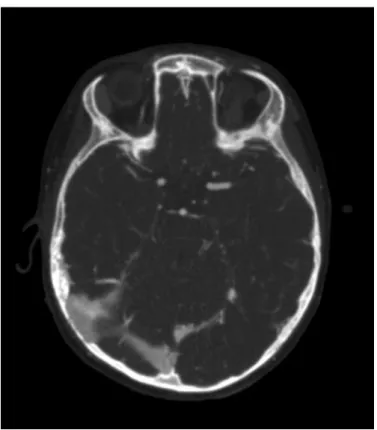
Electroencephalogram findings were normal. Non-contrast brain computed tomography (CT) showed no evidence of acute ischemia (Fig. 1). CT angiogram demonstrated a thrombus in the M1 segment of the left MCA (Fig. 2).
The patient met all standard inclusion criteria for intravenous recombinant tissue plas-minogen activator (rTPA) therapy, including blood pressure parameters, laboratory studies, and lack of intracranial hemorrhage on head imaging. Intravenous rTPA was infused 3.5 h af-ter onset of symptoms using a dose of 0.9 mg/kg, with 10% of the total dose given as a bolus and the remaining 90% infused over 1 h. The rTPA perfusion was completed with no compli-cations. An improvement of his right hemiparesis and aphasia was observed in the hour after
The patient was transferred to a tertiary hospital. Digital subtraction angiography was performed approximately 9 h from the onset of symptoms, showing a complete left M1 occlu-sion. The patient underwent successful thrombectomy with stent retriever (TREVO 4 mm × 20 mm) and mechanical aspiration. Control angiogram showed complete recanalization of the left M1 (TICI 2b).
Echocardiogram showed no evidence of intracardiac thrombus. Electrocardiogram mon-itoring was normal. Follow-up magnetic resonance imaging showed an established ischemic lesion involving the left posterior lenticulocapsular region. An extended blood panel was un-remarkable for thrombophilia or autoimmune diseases.
At the time of discharge, 8 days after the vascular event, he completely recovered from the aphasia and had mild right hemiparesis, but he was already capable of independent gait, with a PedNIHSS score of 2. Long-term hypocoagulation with warfarin was initiated.
Discussion
The limited available literature on thrombolysis and thrombectomy in pediatric stroke is composed of small case series, and consequently the existing recommendations are based on expert consensus and evidence from adult patients [3]. We described the management of pe-diatric AIS in a 4-year-old boy with a left MCA occlusion who underwent thrombolysis fol-lowed by mechanical thrombectomy. We did not report any complication attributable to the diagnostic or therapeutic approach.
First neuroimaging was at 1 h, thrombolysis at 3.5 h, and thrombectomy at 9 h after symp-tom onset. The first neuroimaging (non-contrast brain CT) was not diagnostic of AIS. Only the CT angiogram allowed confirming our suspicion. Even after an initial improvement in symp-toms after rTPA, we decided to perform thrombectomy, with good results.
The presenting features in this case (hemiparesis and speech disturbance) are similar to those seen in adults with stroke in whom such clinical features are considered a neurological emergency prompting urgent neuroimaging. The hypothesis that the focal neurological signs could be related to epileptic seizures and subsequent Todd’s paresis was partially responsible for the diagnostic and treatment delay.
It is estimated that 19–44% of children with AIS present with seizures [5]. There must be a low threshold for performing neuroimaging in children presenting with new-onset seizure in combination with focal neurologic deficits. The time required to transfer the patient from the first hospital to the neurovascular center also contributed to endovascular treatment delay.
The causes of stroke in children differ markedly from adults where atherosclerosis pre-dominates. Cardiac disorders are one of the most common etiologies, with congenital causes predominating over acquired [6]. Children with complex CHD who require cardiac surgery are at the highest risk of stroke, and this risk remains elevated beyond the immediate postopera-tive period [7]. Our case adds to the increasing weight of evidence that research to optimize long-term stroke prevention in children with complex CHD is needed.
Currently, management decisions must be individualized and taken within an experi-enced team including pediatric neurologists and interventional neuroradiologists. Data re-garding pediatric cases that undergo medical treatment with IV thrombolysis and endovascu-lar therapy must be shared to document complications and outcomes.
This case report illustrates the importance of raising the awareness of child stroke and reinforces that adult-approved interventions like thrombolysis and thrombectomy can have a big impact in patient outcomes.
Statement of Ethics
The authors have no ethical conflicts to declare. Disclosure Statement
The publication of this paper was supported by a grant from Boehringer Ingelheim. The authors declare that there is no other potential conflict of interest regarding the publication of this paper.
References
1 Mallick AA, Ganesan V, Kirkham FJ, Fallon P, Hedderly T, McShane T, et al. Childhood arterial ischaemic stroke incidence, presenting features, and risk factors: a prospective population-based study. Lancet Neurol. 2014 Jan;13(1):35–43.
2 Rivkin MJ, deVeber G, Ichord RN, Kirton A, Chan AK, Hovinga CA, et al. Thrombolysis in pediatric stroke study. Stroke. 2015 Mar;46(3):880–5.
3 Royal College of Paediatrics and Child Health. Stroke Association. Stroke in childhood: clinical guideline for diagnosis, management and rehabilitation. May 2017. Available from:
https://www.rcpch.ac.uk/resources/stroke-childhood-clinical-guideline-diagnosis-management-rehabilitation
4 Ichord RN, Bastian R, Abraham L, Askalan R, Benedict S, Bernard TJ, et al. Interrater reliability of the Pediatric National Institutes of Health Stroke Scale (PedNIHSS) in a multicenter study. Stroke. 2011 Mar;42(3):613–7.
5 Abend NS, Beslow LA, Smith SE, Kessler SK, Vossough A, Mason S, et al. Seizures as a presenting symptom of acute arterial ischemic stroke in childhood. J Pediatr. 2011 Sep;159(3):479–83.
6 deVeber GA, Kirton A, Booth FA, Yager JY, Wirrell EC, Wood E, et al. Epidemiology and Outcomes of Arterial Ischemic Stroke in Children: The Canadian Pediatric Ischemic Stroke Registry. Pediatr Neurol. 2017 Apr;69:58–70.
7 Fox CK, Sidney S, Fullerton HJ. Community-based case-control study of childhood stroke risk associated with congenital heart disease. Stroke. 2015 Feb;46(2):336–40.